



Share This Article


Byond Business Model Canvas: Building an Integrated SME Growth Ecosystem
BMC Article No: BMC #005
Updated in 2026: This article has been refreshed with Byond’s current group structure, updated products and positioning, deeper analysis of every Business Model Canvas block, an expanded Value Proposition Canvas, a more relevant comparison with Hasbul Brothers and RichWorks, revised competitive advantages and risks, new strategic recommendations, and a more refined article structure.
Introduction
Byond is more than a conventional business-training company. It operates as a broader entrepreneur-development ecosystem built around training, mentoring, business consulting, corporate services, technology products, and selected commercial ventures.
The Byond Business Model Canvas matters because the group does not depend on one programme or one customer interaction. Entrepreneurs may first encounter Byond through educational content, classes, seminars, or mentoring before adopting additional solutions related to employee management, corporate administration, marketing, automation, and business growth.
Byond describes its mission as helping entrepreneurs achieve “Automate and Grow” through classes, programmes, and intensive mentoring. Its public website also presents a group network that includes Byond Success, Byond Corporate Management, Byond Trading, Byond Healthcare, and Byond Tech Global. (Byond Group of Companies)
That broader structure makes Byond strategically interesting. Unlike a standalone trainer, the company can potentially support entrepreneurs from initial education through implementation, automation, and continuing operational assistance.
What Is Byond’s Business Model?
Byond operates an integrated SME-development model combining business education, mentoring, consulting, technology, professional support, and entrepreneur communities.
At its core, the Byond Business Model shows a company that attracts customers through knowledge and then attempts to deepen the relationship through implementation-oriented products and services.
Training helps entrepreneurs identify business weaknesses. Mentoring supports accountability and decision-making, while software and professional services can help customers apply those lessons within their daily operations.
The model can be understood through a customer-development journey:
| Customer Stage | Details | Why It Matters |
|---|---|---|
| Business exploration | Aspiring entrepreneurs learn business fundamentals, assess opportunities, and develop initial direction | Creates an accessible entry point into the wider Byond ecosystem |
| Early business development | Founders seek help with sales, pricing, financial management, and basic operating discipline | Supports demand for training, mentoring, and practical business guidance |
| Operational growth | Businesses begin formalising processes, records, employee responsibilities, and reporting | Creates opportunities for corporate services, consulting, and digital tools |
| Team expansion | Growing companies require recruitment, payroll, attendance, performance, and workforce development systems | Increases the relevance of MySyarikat and related employee-management solutions |
| Business scaling | More mature SMEs need automation, stronger leadership, financial control, and reduced founder dependency | Supports higher-value mentoring, advisory, and recurring services |
This design allows Byond to increase customer lifetime value rather than depending entirely on one-time seminar income.
However, the model becomes effective only when each service solves a genuine customer problem. A broad portfolio without strong integration may create complexity rather than additional value.
What Is Business Model Canvas?
Business Model Canvas, or BMC, is a practical framework used to explain how a company creates value, delivers that value, and captures revenue.
Rather than examining products in isolation, BMC maps the full operating logic of a business across nine interconnected blocks.
For Byond, the framework is especially useful because business performance depends on more than training quality. Customer acquisition, mentor capability, programme design, software adoption, service delivery, community engagement, cross-selling, and portfolio governance all influence the model.
| BMC Block | Main Question |
|---|---|
| Customer Segments | Who does the business serve? |
| Value Propositions | What value does the business offer? |
| Channels | How does the business reach customers? |
| Customer Relationships | How does the business build loyalty? |
| Revenue Streams | How does the business make money? |
| Key Resources | What assets does the business need? |
| Key Activities | What must the business do well? |
| Key Partnerships | Who helps the business operate? |
| Cost Structure | What are the major costs? |
The Byond Business Model Canvas provides a useful lens because it shows how education, mentoring, technology, professional services, and entrepreneur communities can operate as one commercial system.
Quick Overview of Byond
Byond positions itself as a Malaysian training and consulting organisation focused on small-business development.
Its public mission centres on helping entrepreneurs automate and grow through structured classes, programmes, and year-long mentoring. The organisation also promotes the idea of helping business owners become less trapped in daily operations and more capable of building scalable companies. (Byond Group of Companies)
Over time, Byond expanded into a wider group structure. Its current website lists companies and products covering training, corporate management, trading, healthcare, technology, HR systems, digital tools, and business automation. (Byond Group of Companies)
Technology has become an increasingly important component. Byond Tech Global supports products such as MySyarikat, while the wider corporate website also highlights ByondGO and Beast.my. (Byond Group of Companies)
This expansion indicates that Byond is attempting to move beyond a founder-led training model. Software and recurring professional services could create more stable customer relationships and less reliance on repeated seminar sales.
Scale alone does not guarantee success. The long-term value of the group depends on customer adoption, subsidiary performance, service consistency, and disciplined capital allocation.
Why Byond Is Strategically Interesting
Byond is strategically interesting because it combines business education with downstream implementation support.
Many entrepreneurs do not struggle only because they lack information. Common problems include inconsistent execution, weak financial visibility, manual administration, poor delegation, unsuitable employees, and excessive dependence on the founder.
A traditional training company may explain how to address those issues. Byond attempts to provide some of the tools and services needed to apply the solution.
The model operates across three value layers:
| Value Layer | Details | Why It Matters |
|---|---|---|
| Knowledge | Training, classes, content, and mentoring help entrepreneurs understand problems and potential solutions | Creates awareness, trust, and an initial customer relationship |
| Implementation | Consulting, templates, structured programmes, and professional support help customers take action | Converts general business knowledge into practical change |
| Infrastructure | Software and continuing services support recurring administrative and management processes | Embeds Byond more deeply into the customer’s daily operations |
This structure creates greater cross-selling potential than a training-only model. One entrepreneur can potentially purchase education, mentoring, technology, corporate services, and workforce-development support.
Nevertheless, diversification creates additional management requirements. Training, software, healthcare, consulting, and professional services involve different capabilities, regulations, economics, and risk profiles.
The strategic question is therefore not whether Byond owns multiple businesses. It is whether those businesses collectively create a more useful and defensible customer ecosystem.
Latest Developments: What Is Changing Around Byond?
In 2026, the Byond Business Model Canvas is shaped by several visible developments.
First, the group continues to position “Automate and Grow” as its central customer promise. Training and mentoring remain important, but digital products increasingly support the operational side of that proposition. (Byond Group of Companies)
Second, Byond’s public corporate network has expanded beyond education. The current group website lists operations in corporate management, trading, healthcare, and technology, alongside products such as MySyarikat, ByondGO, and Beast.my. (Byond Group of Companies)
Third, competition in Malaysian entrepreneur development remains significant. Hasbul Brothers promotes long-term and sustainable business growth through seminars and consulting, while RichWorks focuses on entrepreneur development, close mentoring, events, and structured training programmes. (Hasbul Brothers)
Fourth, SME customer needs are becoming more complex. Entrepreneurs increasingly require support involving automation, artificial intelligence, e-Invoicing, cybersecurity, workforce productivity, financial resilience, digital marketing, and better management information.
Together, these changes create opportunities for Byond but also raise customer expectations. Programmes must remain current, software must produce genuine operational benefits, and the group must show that its integrated model delivers measurable outcomes.
Byond Business Model Canvas Summary
Before examining each block in detail, the following summary provides a quick view of how Byond’s business model works.
It shows how training and mentoring can attract entrepreneurs, while technology, corporate services, and business support extend the relationship into implementation and recurring usage.
| BMC Block | Byond Application |
|---|---|
| Customer Segments | Aspiring entrepreneurs, microbusinesses, growing SMEs, established business owners, employers, HR teams, and regional entrepreneurs |
| Value Propositions | Integrated business education, implementation guidance, automation, technology, professional support, and entrepreneur-community access |
| Channels | Social media, educational content, classes, seminars, websites, consultations, communities, software platforms, and partner referrals |
| Customer Relationships | Training engagement, mentoring, group programmes, community participation, professional account support, and software onboarding |
| Revenue Streams | Seminar fees, programme fees, mentoring, consulting, SaaS subscriptions, corporate services, training contracts, and investment returns |
| Key Resources | Corporate brand, leadership credibility, trainers, mentors, consultants, software, intellectual property, customer data, and business networks |
| Key Activities | Programme development, training, mentoring, consulting, software development, professional services, marketing, and portfolio management |
| Key Partnerships | Technology vendors, financial institutions, professional advisers, government agencies, business associations, and regional partners |
| Cost Structure | Employees, trainers, customer acquisition, events, technology, software infrastructure, support, compliance, and subsidiary overheads |
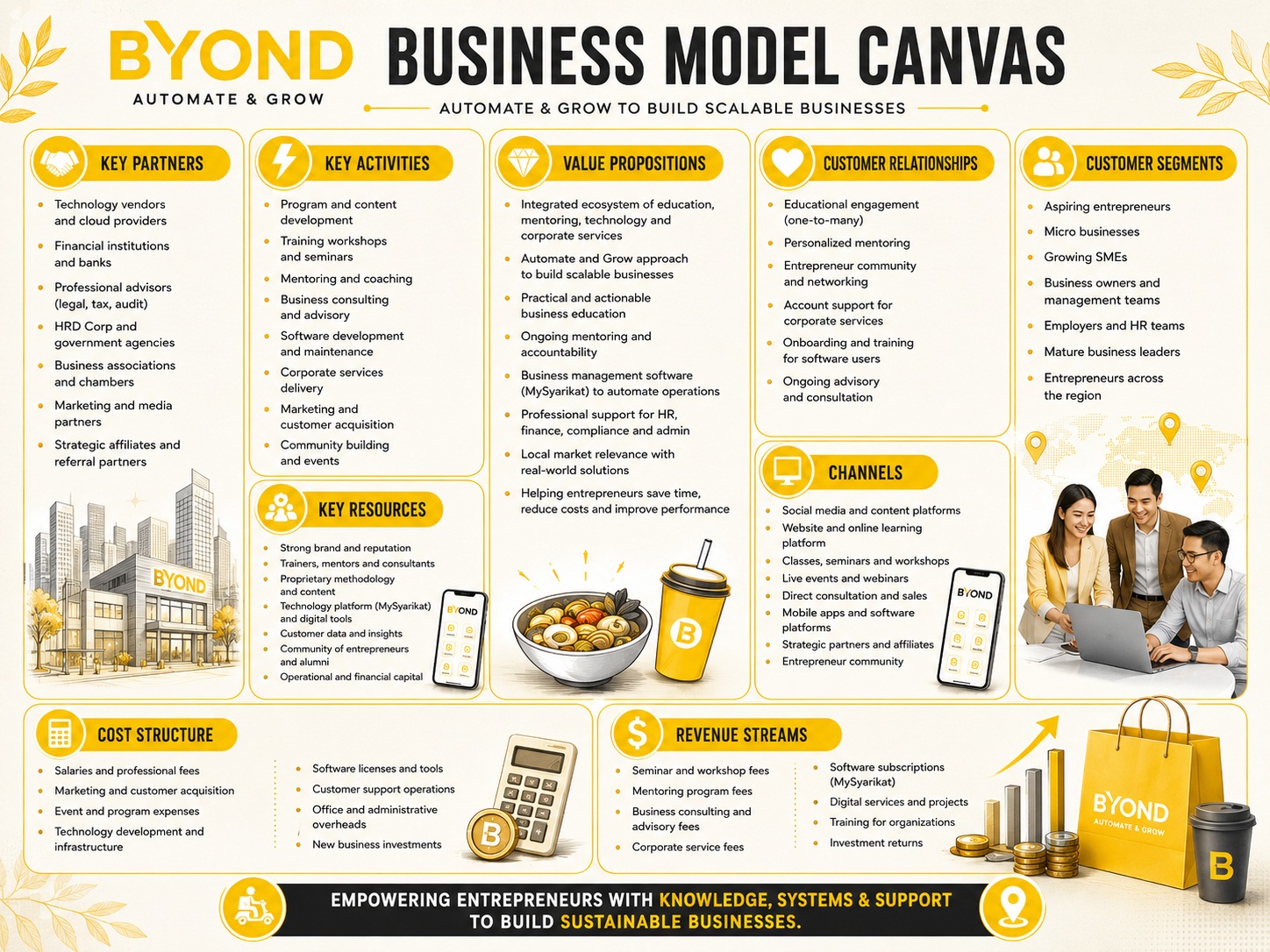
Byond BMC Diagram
The diagram below should give a visual summary of how the main blocks of Byond’s model connect in one view.
It should present training and mentoring as customer-entry mechanisms, supported by software, professional services, communities, and the wider group ecosystem.
BMC Analysis of Byond
The BMC analysis of Byond examines how nine business-model blocks work together to support an integrated SME-development ecosystem.
Each component represents a separate part of the company, but performance depends on how well customer demand, programme design, mentor quality, technology, professional services, partnerships, and cost control remain aligned.
This analysis is particularly important because Byond operates across multiple customer stages. An introductory seminar may generate awareness, but long-term commercial value depends on whether customers progress into mentoring, software, corporate services, or other relevant solutions.
Cross-selling alone is not enough. Additional products must address genuine customer requirements and improve business performance.
The following sections examine every block of the Byond Business Model Canvas in greater detail. Together, they show how the company creates value through education, delivers that value through human and digital channels, and captures revenue through programmes, subscriptions, consulting, and related services.
1. Customer Segments
Customer segments explain who Byond serves and why those customers matter.
Byond addresses a broad entrepreneur and SME market, but its customers are not all at the same stage. Their needs vary according to business age, revenue, team size, management maturity, and digital capability.
Aspiring entrepreneurs may require foundational knowledge and opportunity assessment. Microbusiness owners usually need support with sales, cash flow, pricing, and basic operating systems.
Growing SMEs face more complex problems. Larger teams create requirements involving delegation, payroll, employee performance, leadership, compliance, and management reporting.
Byond Customer Segments
| Segment | Details | Why It Matters |
|---|---|---|
| Aspiring entrepreneurs | Individuals considering entrepreneurship or preparing to launch a business | Creates demand for introductory content, foundational programmes, and entrepreneur communities |
| Microbusiness owners | Small operators managing sales, customers, finances, and daily work personally | Represents a large market for practical training, mentoring, and basic management solutions |
| Growing SMEs | Companies adding employees, formalising operations, and seeking stronger financial and management systems | Supports higher-value consulting, technology, corporate services, and long-term mentoring |
| Established business leaders | More mature owners seeking scaling, leadership development, investment readiness, and regional expansion | Creates demand for premium advisory and strategic programmes |
| Employers and HR teams | Organisations requiring recruitment, attendance, payroll, employee administration, and workforce development | Expands Byond into business-to-business software and corporate training |
| Regional entrepreneurs | Business owners in Malaysia and neighbouring markets seeking accessible, locally relevant guidance | Provides opportunities for online delivery, software expansion, and regional partnerships |
The model benefits from a broad customer ladder. People can enter through lower-commitment education and progress into more advanced solutions.
However, Byond must avoid treating every entrepreneur as one homogeneous segment. A startup founder and an established SME require different content, pricing, technology, and service intensity.
2. Value Propositions
The value proposition explains why customers would choose Byond instead of separate trainers, accountants, software providers, consultants, or marketing agencies.
Byond’s principal proposition is integration. Entrepreneurs can potentially access education, mentoring, automation tools, corporate support, and other business services within one connected ecosystem.
Convenience provides part of the value. SME owners often lack the time and expertise needed to identify multiple providers and coordinate their work.
Implementation creates a second layer of value. Training can explain what should change, while mentoring, professional support, and software can help customers apply that knowledge.
Byond Value Propositions
| Value Proposition | Details | Why It Matters |
|---|---|---|
| Integrated SME ecosystem | Training, mentoring, technology, corporate management, and selected business services are offered within a wider group structure | Reduces fragmentation and can simplify the customer’s search for business support |
| Automate and Grow approach | Byond connects business expansion with better systems, workforce management, and reduced owner dependency | Differentiates the company from purely motivational or sales-focused training |
| Practical business education | Programmes translate business concepts into more accessible frameworks, actions, and management priorities | Helps SME owners apply knowledge without requiring extensive formal business education |
| Continuing guidance | Mentoring, communities, consultations, and follow-up programmes provide support beyond a single seminar | Improves accountability and extends the customer relationship |
| Business-management technology | Products such as MySyarikat can support recurring employee and administrative processes | Creates daily operational relevance and potential recurring revenue |
| Local market relevance | Programmes are developed around Malaysian and regional SME realities, language, and business challenges | Improves accessibility compared with generic international content |
Customers do not purchase Byond only to obtain information. They expect clearer decisions, stronger systems, better employee management, more predictable operations, and sustainable growth.
The proposition becomes defensible when those outcomes can be demonstrated. Portfolio breadth alone does not prove that the integrated model is superior.
3. Channels
Channels explain how Byond reaches entrepreneurs and converts interest into paid participation or ongoing service usage.
Social media and educational content support early awareness. Videos, business advice, programme promotions, customer stories, and founder commentary help the company remain visible.
Classes and seminars serve both educational and acquisition functions. Participants receive knowledge while Byond gains an opportunity to identify needs and introduce more intensive programmes.
Direct consultation becomes important for premium mentoring, consulting, software, and professional services because those purchases require stronger qualification and trust.
Byond Channels
| Channel | Details | Why It Matters |
|---|---|---|
| Social media and educational content | Business tips, founder commentary, promotional material, customer stories, and short-form learning | Builds audience awareness and positions Byond as a source of business guidance |
| Classes, seminars, and workshops | Physical or digital sessions covering business development, sales, management, and automation | Creates direct engagement while generating leads for more advanced programmes |
| Websites and landing pages | Product explanations, programme information, registration, enquiries, and digital conversion | Supports customer education and reduces friction during the purchasing process |
| Direct consultation | Sales conversations, diagnostics, and programme-fit assessments for higher-value services | Helps qualify customers and improves matching between needs and solutions |
| Entrepreneur communities | Alumni groups, peer networks, business events, and continuing engagement | Supports retention, referrals, accountability, and peer learning |
| Software platforms | Digital products used by business owners and employees during daily operations | Extends the customer relationship beyond training sessions |
| Strategic partners | Associations, advisers, agencies, institutions, and commercial partners introducing customers | Expands market reach and provides access to defined business communities |
Channel breadth provides more than customer access. It allows Byond to combine mass awareness, personal engagement, digital delivery, and recurring usage.
Management should assess channels through acquisition cost, conversion, retention, and customer lifetime value rather than followers or attendance alone.
4. Customer Relationships
Customer relationships explain how Byond keeps customers engaged after initial contact.
Seminars create a one-to-many educational relationship. This format is scalable, although advice remains relatively general.
Mentoring develops a deeper connection through structured guidance, assignments, reviews, and accountability. Communities add peer interaction and allow entrepreneurs to share experiences.
Professional services create a different relationship. Customers expect accuracy, confidentiality, defined responsibilities, and dependable turnaround rather than inspiration alone.
Byond Customer Relationships
| Relationship Type | Details | Why It Matters |
|---|---|---|
| Educational engagement | Customers attend classes, seminars, or workshops to gain knowledge and identify improvement areas | Creates trust and introduces entrepreneurs to Byond’s wider methodology |
| Mentoring relationship | Participants receive structured guidance, reviews, accountability, and access to mentors | Deepens engagement and supports higher-value transformation programmes |
| Group and community support | Entrepreneurs interact with peers, facilitators, alumni, and business networks | Creates networking value and helps maintain motivation between formal sessions |
| Professional account support | Corporate-management, marketing, consulting, or related customers receive ongoing service assistance | Supports retention and positions Byond as a continuing operational partner |
| Software onboarding and support | Users require setup, training, technical assistance, and product guidance | Improves product adoption and reduces the risk of subscription cancellation |
| Strategic advisory relationship | More mature business owners receive contextual guidance on leadership, scaling, and expansion | Creates premium value and strengthens long-term customer relationships |
Combining these relationships can increase retention because customers interact with Byond through several formats.
The main risk is inconsistency. A strong seminar experience can be undermined by weak software support or poor professional-service delivery.
Founder dependency must also be managed. Customers should continue to receive value when other trainers, mentors, or account managers deliver the service.
5. Revenue Streams
Revenue streams explain how Byond converts knowledge, expertise, software, and customer relationships into income.
Seminar and workshop fees provide transactional revenue. Lower-cost programmes may also operate as lead-generation products for more advanced services.
Mentoring can generate higher revenue per customer because it includes structured guidance, accountability, and continuing access.
Software subscriptions offer recurring income, while corporate services can produce regular monthly or annual fees.
Byond Revenue Streams
| Revenue Stream | Details | Why It Matters |
|---|---|---|
| Seminar and workshop fees | Payments for attending educational events, classes, and introductory programmes | Generates immediate revenue while bringing new customers into the ecosystem |
| Mentoring programme fees | Higher-value payments for structured guidance, accountability, access, and longer-term support | Increases customer value and extends relationships beyond individual events |
| Consulting and advisory fees | Project-based or retained income for business diagnostics, strategy, implementation, and specialist advice | Monetises deeper expertise and more customised support |
| SaaS subscriptions | Monthly or annual payments for technology products such as MySyarikat | Creates recurring revenue and potentially improves scalability |
| Corporate-management services | Ongoing fees for accounting, administration, secretarial, or related business support | Builds stable relationships around recurring operational needs |
| Corporate training | Payments from employers for workforce-development and management programmes | Expands Byond beyond individual entrepreneurs into organisational customers |
| Marketing and digital services | Project or retainer income for digital tools, campaigns, websites, or implementation support | Allows the group to participate in customer execution after training |
| Investment and venture returns | Potential dividends, gains, or equity appreciation from business investments | Provides long-term upside but introduces higher risk and capital requirements |
Not all revenue contributes equally to profitability. Training may have attractive margins but require continuous marketing, while software requires sustained development and support.
The Byond Business Model Canvas therefore depends on revenue quality rather than product count. Renewal rates, gross margin, acquisition costs, and capital requirements should be monitored by business unit.
6. Key Resources
Key resources describe the assets that make Byond’s model possible.
Brand recognition and leadership credibility support customer acquisition. Entrepreneurs are more likely to purchase mentoring and advisory services when they trust the organisation’s experience and public reputation.
Human capital remains essential. Trainers, mentors, consultants, accountants, marketers, software developers, customer-support teams, and subsidiary leaders determine the quality of delivery.
Technology and intellectual property provide opportunities for greater scale. Programme modules, templates, diagnostics, operating methodologies, customer data, and software can be reused across multiple customers.
Byond Key Resources
| Resource | Details | Why It Matters |
|---|---|---|
| Corporate and leadership brand | Public reputation, founder visibility, business-development positioning, and customer recognition | Reduces customer uncertainty and supports programme promotion |
| Trainers and mentors | Individuals delivering education, guidance, accountability, and practical business insight | Determine programme relevance and customer experience |
| Consultants and professional specialists | Experts supporting business implementation, accounting, marketing, corporate management, and related services | Allow Byond to move beyond general education into practical execution |
| Technology platforms | MySyarikat, ByondGO, digital systems, infrastructure, integrations, and supporting software | Enable recurring usage and more scalable service delivery |
| Intellectual property | Modules, frameworks, templates, content, diagnostics, and mentoring methodologies | Supports standardisation and repeatable programme delivery |
| Customer and community network | Participants, alumni, business owners, partners, and regional entrepreneur groups | Generates referrals, peer learning, and market insight |
| Customer data | Information on business stage, programme activity, software use, and service requirements | Improves segmentation, personalisation, and cross-selling when properly governed |
| Subsidiary network | Companies operating across education, technology, corporate services, trading, and other activities | Expands the range of solutions available to customers |
These resources become more valuable when they are institutionalised.
Training quality should not depend entirely on one person. Knowledge, processes, and customer relationships must be documented and transferable across teams.
7. Key Activities
Key activities describe what Byond must execute consistently to maintain its wider ecosystem.
Programme development is fundamental because business content must remain relevant to market conditions, regulations, customer behaviour, and technology.
Training and mentoring require strong facilitation. Customers need practical direction rather than general inspiration.
Software activities include product design, development, testing, infrastructure, cybersecurity, integration, onboarding, and support.
Byond Key Activities
| Activity | Details | Why It Matters |
|---|---|---|
| Programme and content development | Designing classes, seminars, mentoring modules, diagnostics, and practical business frameworks | Keeps the educational proposition relevant and differentiated |
| Training and seminar delivery | Conducting events and learning programmes for entrepreneurs and organisations | Generates revenue, trust, and customer leads |
| Mentoring and consultation | Providing structured guidance, reviews, accountability, and contextual advice | Converts knowledge into action and supports higher-value customer relationships |
| Software development | Building, maintaining, testing, securing, and improving digital products | Supports automation, recurring revenue, and daily customer usage |
| Professional-service delivery | Providing corporate, financial, marketing, technology, or other implementation support | Extends Byond into the customer’s operational environment |
| Marketing and sales | Producing content, promoting programmes, qualifying leads, and converting customers | Maintains the flow of participants and service users |
| Community management | Facilitating networking, learning, communication, and peer engagement | Improves retention and increases the value of membership |
| Portfolio governance | Allocating capital, assessing subsidiaries, monitoring performance, and managing risk | Prevents diversification from becoming uncontrolled organisational complexity |
Byond must manage both human-intensive and technology-intensive activities.
Education depends on people, facilitation, and customer engagement. Software depends on engineering, reliability, security, and product adoption.
Strong portfolio governance is therefore essential. Management must identify which activities strengthen the core proposition and which consume resources without sufficient strategic or financial contribution.
8. Key Partnerships
Key partnerships allow Byond to expand its capabilities without developing every resource internally.
Technology vendors support cloud infrastructure, communications, cybersecurity, analytics, payment services, and system integrations.
Financial institutions may provide SME financing, payment solutions, customer access, or joint education initiatives.
Government agencies, HRD Corp-related partners, and business associations can connect Byond with structured groups of entrepreneurs and employers.
Byond Key Partnerships
| Partner | Details | Why It Matters |
|---|---|---|
| Technology providers | Cloud platforms, software vendors, cybersecurity providers, integration partners, payment services, and communication tools | Support the reliability, functionality, and scalability of Byond’s digital products |
| Financial institutions | Banks, financing providers, payment companies, and SME-focused financial partners | Can improve customer access to financing and support joint business-development programmes |
| Government and development agencies | Organisations involved in entrepreneurship, digitalisation, workforce, and SME development | Provide access to structured initiatives and broader entrepreneur populations |
| HRD Corp ecosystem | Registered trainers, employers, programme partners, and workforce-development stakeholders | Supports corporate training and access to employer development budgets |
| Professional advisers | Legal, accounting, tax, audit, regulatory, and investment specialists | Strengthen technical quality and reduce legal or compliance risks |
| Business associations | Entrepreneur groups, chambers, industry networks, and commercial communities | Expand distribution and increase credibility within target segments |
| Industry experts | Experienced practitioners contributing specialist knowledge or mentoring | Allow programmes to cover areas beyond the expertise of internal trainers |
| Regional partners | Local organisations supporting entry into Indonesia and other Southeast Asian markets | Provide localisation, customer access, and regulatory understanding |
Partnerships can accelerate expansion, but they also create reputational and data risks.
Customers may still hold Byond responsible when a partner performs poorly. Due diligence, contracts, service standards, and escalation arrangements are therefore important.
9. Cost Structure
Cost structure explains the expenditure required to operate an education, consulting, professional-services, and technology ecosystem.
Talent is likely to represent one of the largest cost categories. Byond requires trainers, sales employees, consultants, accountants, marketers, developers, support personnel, and management teams.
Customer acquisition can also be expensive. Content, advertising, events, promotional teams, and sales follow-up must be sustained to maintain programme participation.
Technology creates continuing costs involving development, cloud infrastructure, cybersecurity, licences, maintenance, and customer support.
Byond Cost Structure
| Cost Category | Details | Why It Matters |
|---|---|---|
| Employees and specialists | Salaries, commissions, benefits, facilitator fees, professional retainers, and management compensation | Determines service capacity, expertise, and organisational quality |
| Customer acquisition | Advertising, content production, sales teams, events, promotions, and lead management | Influences the economics of training and premium-programme conversion |
| Programme delivery | Venues, platforms, materials, travel, equipment, logistics, and facilitator expenses | Directly affects programme margin and customer experience |
| Technology development | Software engineers, product design, testing, infrastructure, integration, cybersecurity, and licences | Requires continuing investment before recurring revenue reaches scale |
| Professional operations | Qualified personnel, specialist systems, compliance, quality assurance, and service administration | Supports dependable corporate and implementation services |
| Customer support | Software onboarding, account management, technical help, and service enquiries | Influences customer satisfaction, retention, and subscription renewal |
| Group overheads | Leadership, finance, human resources, offices, legal support, and shared administration | Increases as the number and complexity of subsidiaries grow |
| New ventures | Setup expenses, experimentation, market entry, and working capital | Creates future opportunities but can consume cash without guaranteed returns |
Scale can distribute content, technology, marketing, and administration across more customers.
However, shared costs must be allocated transparently. Otherwise, profitable units may subsidise weaker businesses without management seeing the true economic performance.
Byond Value Proposition Canvas
Before comparing Byond with Hasbul Brothers and RichWorks, it is useful to examine how the company creates fit between customer needs and its wider ecosystem.
That is the purpose of Value Proposition Canvas, or VPC.
While Business Model Canvas explains the overall structure of Byond, VPC focuses more closely on the connection between entrepreneur requirements and the company’s actual offer.
For Byond, this framework is especially relevant because customers usually want more than knowledge. They want better sales, stronger systems, improved financial control, productive employees, and less dependence on the owner.
In simple terms, VPC helps explain why the Byond Business Model Canvas works in practice. It connects customer jobs, pains, and gains with training, mentoring, technology, professional services, and entrepreneur communities.
Customer Profile
The customer profile examines what Byond’s target customers are trying to accomplish, which problems frustrate them, and which outcomes they value most.
Since the company serves businesses at different stages, the profile reflects common needs across startups, microbusinesses, growing SMEs, and employers.
Customer Profile of Byond
| Customer Profile | Details |
|---|---|
| Customer Jobs | Start or grow a business, increase sales, manage cash flow, recruit employees, organise operations, automate administration, delegate responsibilities, develop managers, and reduce founder dependency |
| Customer Pains | Unstable revenue, weak financial visibility, manual work, inconsistent processes, unsuitable employees, poor reporting, limited expertise, fragmented service providers, and excessive owner workload |
| Customer Gains | Better business control, stronger profitability, clearer reporting, more capable employees, time savings, scalable processes, reliable support, and greater confidence in business decisions |
This profile shows that Byond does not win merely by delivering interesting seminars.
The company creates stronger value when it reduces confusion, helps entrepreneurs implement systems, and improves how the business operates after the programme ends.
Value Map
The value map explains how Byond responds to customer jobs, pains, and gains.
The company uses a combined education, mentoring, technology, and service strategy rather than depending on one programme.
That matters because different customers require different interventions. Some need foundational knowledge, while others require software, professional support, or strategic guidance.
Value Map of Byond
| Value Map | Details |
|---|---|
| Products and Services | Classes, seminars, mentoring programmes, consulting, MySyarikat, ByondGO, digital tools, corporate-management services, marketing support, entrepreneur communities, and related business services |
| Pain Relievers | Structured frameworks reduce confusion, mentoring improves accountability, digital tools automate recurring tasks, professional support addresses capability gaps, and communities reduce entrepreneur isolation |
| Gain Creators | Better systems, improved management visibility, time savings, more productive employees, stronger business capabilities, scalable processes, networking, and continuing access to support |
The value map shows why Byond can be more relevant than a training-only provider.
However, value depends on selecting the right combination of solutions. Not every customer needs every product.
How Byond Creates Fit
The following table shows how customer requirements and Byond’s value offer connect more directly.
This format matches customer-side requirements with company-side value creation in a structured way.
| Customer Profile | Details | Matching Value Map | How Byond Creates Fit |
|---|---|---|---|
| Customer Jobs | Entrepreneurs want to build revenue, manage teams, formalise operations, automate administration, and create businesses that can grow without constant owner intervention | Products and Services | Byond combines education, mentoring, software, corporate support, and practical implementation services |
| Customer Pains | Business owners face unstable cash flow, weak systems, limited management knowledge, fragmented providers, manual processes, and employee challenges | Pain Relievers | Structured programmes, expert guidance, HR technology, corporate services, and access to communities reduce those difficulties |
| Customer Gains | Customers value greater control, stronger profitability, productive employees, better information, scalable processes, and more time for strategic work | Gain Creators | Byond creates those gains through improved capabilities, automation, ongoing support, clearer systems, and entrepreneur-network access |
The fit is strongest when Byond moves beyond generic advice and helps customers apply new practices within their operations.
Education identifies what should change. Mentoring supports the decision, while technology and professional services help institutionalise the improvement.
Where the Fit Happens
The strongest fit occurs among SME owners who have already established customer demand but have not developed formal management systems.
These businesses may have employees and recurring sales, yet continue to rely on manual administration, informal decision-making, and direct founder supervision.
Byond can potentially create value by connecting business education with practical systems. Training helps owners understand delegation, financial control, leadership, and process improvement.
Mentoring provides accountability, while MySyarikat and related tools can support employee administration and recurring operational tasks.
The fit may be weaker for large enterprises requiring complex integrations, sector-specific consultants, international systems, or advanced corporate governance.
Likewise, very early entrepreneurs may not yet have sufficient scale to justify multiple services.
The company should therefore define its ideal customer profile carefully. Trying to serve every entrepreneur can weaken programme relevance and increase service complexity.
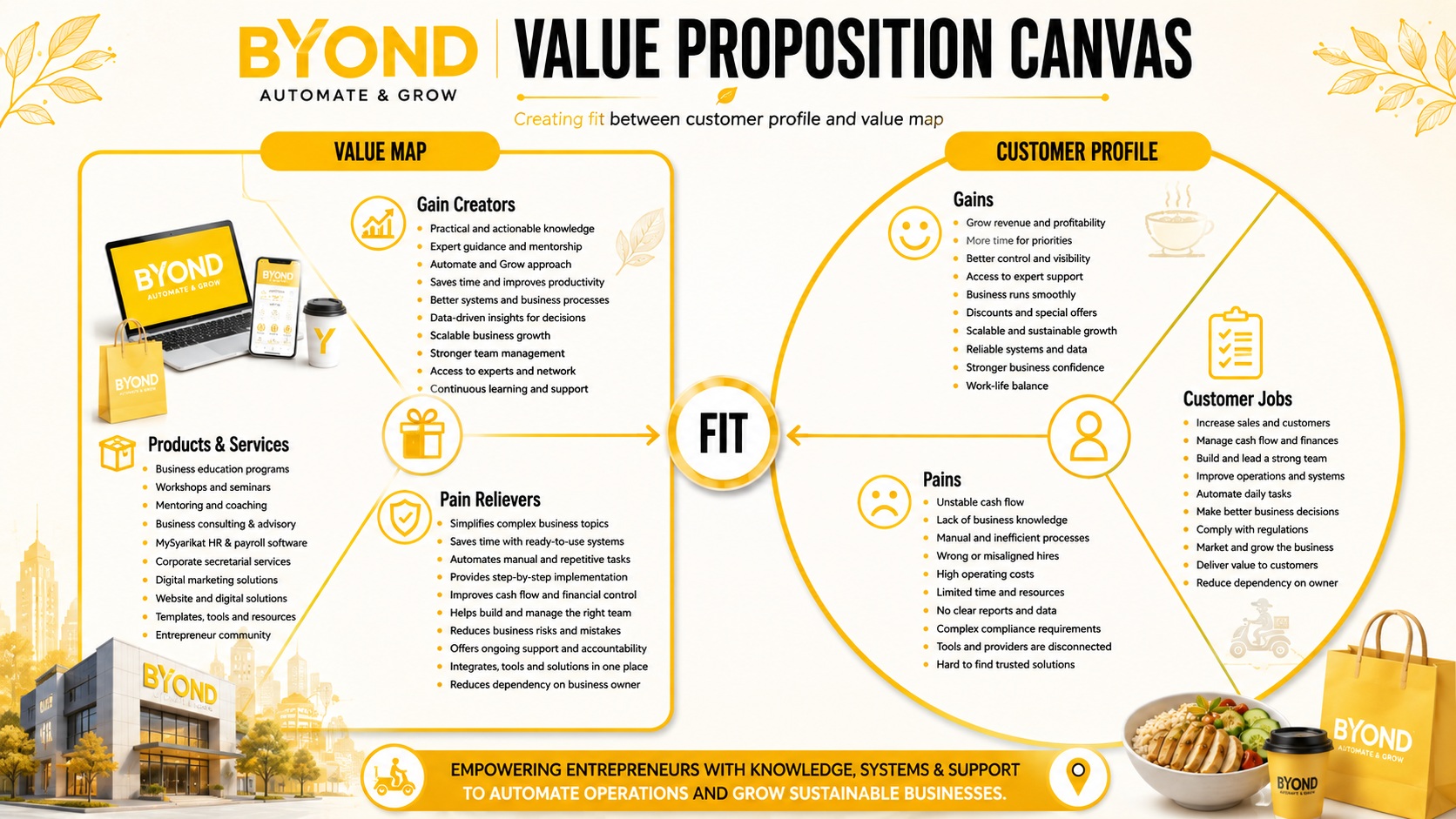
Byond VPC Diagram
The following should be the VPC diagram of Byond.
It should provide a visual view of how customer jobs, pains, and gains connect with Byond’s products and services, pain relievers, and gain creators.
Byond vs Hasbul Brothers and RichWorks Business Models
The Byond Business Model Canvas differs from Hasbul Brothers and RichWorks mainly in ecosystem breadth, technology ownership, professional-service integration, and customer-development structure.
Hasbul Brothers positions itself as a business-development organisation helping entrepreneurs grow and sustain their companies over the long term. Its public offer centres on seminars, consulting, practical business guidance, and entrepreneur communities. (Hasbul Brothers)
RichWorks operates primarily as an entrepreneur-development, training, events, and close-mentoring organisation. It promotes structured programmes intended to help entrepreneurs build stronger companies through education, guidance, and business communities. (RichWorks)
Comparison Table
| Dimension | Byond | Hasbul Brothers | RichWorks |
|---|---|---|---|
| Core positioning | Integrated SME automation, growth, mentoring, technology, and business-support ecosystem | Business-development guidance focused on profitable, scalable, and sustainable growth | Entrepreneur transformation through events, structured training, and close mentoring |
| Customer entry | Educational content, classes, seminars, programmes, and consultations | Business seminars, content, and growth-focused educational events | Large-scale events, seminars, workshops, digital learning, and introductory programmes |
| Premium relationship | Intensive mentoring, consulting, technology adoption, and professional services | Longer-term consulting, mentoring, and business-growth guidance | Tiered and close mentoring supported by programmes and entrepreneur communities |
| Role of technology | Direct business products such as MySyarikat, ByondGO, and related digital tools | Technology mainly supports marketing, engagement, and programme delivery | Technology supports digital learning, community engagement, and programme accessibility |
| Service breadth | Training, mentoring, HR technology, corporate management, marketing, and selected commercial ventures | More concentrated around business education, consulting, and entrepreneur development | More concentrated around training, mentorship, events, marketing, and entrepreneur development |
| Strategic strength | Ability to connect knowledge with operational tools and recurring services | Clear focus, specialist business-development positioning, and strong community identity | Brand scale, extensive programme architecture, mentoring visibility, and broad market reach |
| Main strategic risk | Diversification, subsidiary complexity, and uneven integration | Dependence on training demand and the continuing relevance of the advisory proposition | Founder and mentor-brand dependence, programme complexity, and customer outcome consistency |
No model is automatically superior.
Hasbul Brothers benefits from focus. RichWorks demonstrates scale and structured entrepreneur development, while Byond has the opportunity to differentiate through stronger integration between learning and operational infrastructure.
What Byond Can Learn from Hasbul Brothers
Hasbul Brothers presents a relatively focused proposition around helping entrepreneurs grow and sustain their businesses.
Its public positioning emphasises long-term business development, practical guidance, seminars, consulting, and community. (Hasbul Brothers)
Byond can learn three strategic lessons from this model.
First, a wide ecosystem still requires a simple central promise. Prospective customers should immediately understand the principal outcome Byond delivers.
Second, visible specialist trainers can reduce founder dependency. Presenting credible experts in operations, marketing, finance, leadership, and people management makes the organisation appear more institutional.
Third, community quality is more important than community size. A smaller group that shares practical knowledge and supports implementation may provide more value than a large but passive audience.
Byond should not copy Hasbul Brothers completely because its software and corporate-service capabilities create a different strategic opportunity.
A stronger approach would combine Hasbul Brothers’ focused business-growth message with Byond’s implementation infrastructure.
Training can define the problem, mentoring can support the change, and technology can embed the solution in daily operations.
What Byond Can Learn from RichWorks
RichWorks demonstrates how entrepreneur education can be organised into a broader development and mentoring architecture.
Its public positioning focuses on close mentoring, business knowledge, training programmes, events, and strategies designed to help entrepreneurs build successful businesses. (RichWorks)
The first lesson is the importance of customer progression. Different programmes can serve entrepreneurs according to their current level of business maturity.
Byond could develop a clearer pathway:
| Business Stage | Details | Relevant Byond Pathway |
|---|---|---|
| Exploring entrepreneurship | Individuals require foundational knowledge, opportunity assessment, and realistic expectations | Introductory education and basic entrepreneur programmes |
| Building initial revenue | Small businesses need customer acquisition, pricing, financial discipline, and consistent delivery | Sales, marketing, and business-management programmes |
| Establishing a team | Companies begin recruiting employees and need stronger operational control | HR software, employee-management training, and operational mentoring |
| Scaling the business | Owners require leadership, financial visibility, delegation, systems, and automation | Advanced mentoring, consulting, technology, and corporate services |
| Expanding strategically | Mature SMEs explore new markets, partnerships, financing, and investment readiness | Strategic advisory, regional networks, and specialised programmes |
A second lesson involves visible customer outcomes. Success stories help prospective customers understand what may be achievable.
Byond should document customer results rigorously, including starting conditions, interventions, timeframes, and measurable operational improvements.
Revenue growth alone is insufficient. Gross margin, cash flow, productivity, retention, and reduced founder dependency provide stronger evidence.
Competitive Advantages
The Byond Business Model Canvas highlights several reinforcing strengths that can make the group more defensible than standalone training providers.
- Integrated SME-support ecosystem: Byond can connect education, mentoring, technology, corporate management, marketing, and selected implementation services within one customer journey.
- Proprietary technology capabilities: Products such as MySyarikat provide a direct operational component that many training-oriented competitors do not offer.
- Training-led customer acquisition: Educational content, classes, and seminars allow Byond to establish trust before introducing more intensive or recurring services.
- Local and regional relevance: Programmes and services can be adapted to Malaysian language, culture, regulations, and SME operating realities.
- Cross-selling and recurring-revenue potential: Customers can progress from one-time learning into software subscriptions, corporate services, continuing mentoring, and other support.
Together, these strengths allow Byond to address more than one customer problem.
However, competitive advantage does not arise from product quantity alone. The ecosystem becomes defensible only when integration improves customer outcomes and makes implementation easier.
Risks and Challenges
Byond also faces material execution risks arising from the breadth and complexity of its model.
- Strategic overextension: Operating across training, technology, professional services, healthcare, trading, and other ventures can divide leadership attention and investment resources.
- Founder and leadership dependency: Heavy reliance on prominent individuals for brand credibility, programme sales, and customer trust may limit scale and succession.
- Uneven subsidiary performance: Different businesses may produce inconsistent service quality, financial returns, and customer experiences.
- Difficult software economics: Product development, infrastructure, cybersecurity, onboarding, and support require ongoing investment before subscription revenue reaches sufficient scale.
- Broad competitive pressure: Byond competes with Hasbul Brothers, RichWorks, specialised consultants, HR software companies, accountants, agencies, and free digital content.
These risks do not mean the model is inherently weak.
Instead, they show that Byond must continuously balance portfolio growth, customer outcomes, technology investment, service quality, and financial discipline.
Strategic Recommendations
Byond should strengthen the parts of its ecosystem that directly reinforce the “Automate and Grow” proposition.
Training, mentoring, employee-management technology, corporate services, and selected digital tools form a logical core because they address knowledge, implementation, and recurring operations.
Activities with weaker strategic connections should be assessed as separate investments rather than automatically treated as part of the customer ecosystem.
A second priority is customer segmentation. Byond should develop clear pathways based on business maturity, revenue, employee count, operating complexity, and management capability.
Technology must also be embedded more directly into the learning experience. For example, an employee-management programme should help customers configure job roles, attendance, leave, performance indicators, and training records within the relevant platform.
Recurring revenue requires greater focus, but quality matters more than billing frequency. Management should measure activation, renewal, churn, gross margin, support cost, and customer lifetime value.
Byond should also reduce founder dependency by standardising content, certifying trainers, documenting mentoring methods, and developing credible subsidiary leaders.
Finally, portfolio governance must become more disciplined. Each company should have clear objectives, financial targets, customer measures, capital limits, and accountable leadership.
Conclusion
Overall, the Byond Business Model Canvas explains how Byond is attempting to transform business education into an integrated SME growth and automation ecosystem.
Its model begins with content, classes, and seminars before extending into mentoring, consulting, technology, corporate management, and other implementation support.
Compared with Hasbul Brothers, Byond operates across a broader technology and service portfolio. Hasbul Brothers benefits from a clearer concentration on sustainable business growth, consulting, seminars, and entrepreneur communities.
RichWorks demonstrates greater visibility in structured entrepreneur development, events, and close mentoring. Byond’s strongest opportunity is to differentiate through the direct connection between education and operational tools.
Future performance will depend on whether the group can operate as one coherent system rather than a collection of subsidiaries.
Customers should be able to move logically from diagnosis to learning, implementation, automation, and continuing support.
Successful execution could position Byond not merely as another training company, but as a practical operating partner that helps SMEs become better managed, more scalable, and less dependent on their founders.
Disclaimer
This article is provided for educational and business-analysis purposes only. Its content is based on publicly available information, company websites, general market observations, and independent strategic interpretation.
It does not constitute financial advice, investment advice, legal advice, accounting advice, business advice, or an official statement from Byond Group of Companies, Byond Tech Global Berhad, MySyarikat, Hasbul Brothers, RichWorks, or any of their directors, shareholders, employees, customers, subsidiaries, or business partners.
Public information concerning private-company revenue, profitability, liabilities, ownership arrangements, customer retention, subsidiary performance, and cash flow may be limited.
Readers should conduct independent research and obtain suitable professional advice before making business or investment decisions.
All trademarks, logos, copyrights, company names, product names, and related materials mentioned or shown in this article belong to their respective owners.
Meta Description
Explore the Byond Business Model Canvas, nine BMC blocks, Value Proposition Canvas, comparison with Hasbul Brothers and RichWorks, advantages, risks, and strategic recommendations.

