



Share This Article


Domino’s Pizza Business Model Canvas: How Domino’s Competes Through Delivery, Digital Ordering, and Franchise Scale
BMC Article No: BMC #074
Updated in 2026: This article has been refreshed with Domino’s latest company scale, recent operating performance, deeper analysis of every BMC block, an expanded Value Proposition Canvas, a more relevant comparison with Pizza Hut, revised competitive advantages and risks, new strategic recommendations, and a structure aligned with the full Gerbang Bisnes BMC article format.
Introduction
Domino’s is more than a pizza delivery company. It is a global foodservice system built around franchising, digital ordering, compact store operations, delivery, carryout, marketing, customer data, and an integrated supply chain.
The Domino’s Pizza Business Model Canvas matters because the company does not depend only on selling pizzas from physical outlets. Its wider business model connects customers, franchise operators, technology platforms, supply-chain centres, food suppliers, delivery personnel, advertising funds, and international master franchisees.
That broader structure makes Domino’s strategically interesting. Unlike an independent pizza restaurant, the company can combine global brand recognition, standardised production, local franchise knowledge, digital convenience, customer loyalty tools, dense store coverage, and large-scale purchasing capabilities.
Domino’s ended fiscal 2025 with 22,142 stores worldwide. Approximately 99% of the network was operated by independent franchise owners, demonstrating how strongly the company relies on franchising to achieve international scale. (Domino’s)
What Is Domino’s Business Model?
Domino’s operates a branded pizza delivery and carryout business supported primarily by franchising. It sells pizzas, chicken, breads, sandwiches, pasta, desserts, beverages, and locally adapted menu items through stores, websites, mobile applications, telephone ordering, and selected third-party delivery platforms.
At its core, the Domino’s Pizza Business Model Canvas shows a company that earns through franchise royalties, supply-chain sales, company-owned store transactions, franchise fees, international royalty arrangements, and advertising contributions.
The structure contains three closely connected commercial engines.
First, Domino’s stores prepare and fulfil customer orders. Most outlets are designed around efficient food production, delivery, and carryout rather than extensive dine-in service.
Second, franchisees invest in locations and manage local operations while using Domino’s brand, recipes, technology, training, marketing, and operating procedures.
Third, Domino’s supply-chain network manufactures dough and distributes food ingredients, packaging, and operating supplies to participating stores in the United States and Canada.
This combination allows Domino’s to function as a restaurant brand, franchisor, digital-commerce platform, fulfilment network, and food distributor within one integrated system.
What Is Business Model Canvas?
Business Model Canvas, or BMC, is a practical framework used to explain how a company creates value, delivers that value, and captures revenue. Rather than focusing only on products, the framework maps the operating logic behind the entire organisation.
For Domino’s, BMC is particularly useful because success depends on more than pizza quality. Store density, digital ordering, kitchen productivity, delivery speed, franchisee capability, customer value, supply-chain efficiency, marketing, and menu design all influence performance.
That is why the Domino’s Pizza Business Model Canvas provides a useful strategic lens. It shows how Domino’s connects customer demand with food production, fulfilment, franchising, technology, and recurring corporate income.
| BMC Block | Main Question |
|---|---|
| Customer Segments | Who does the business serve? |
| Value Propositions | What value does the business offer? |
| Channels | How does the business reach customers? |
| Customer Relationships | How does the business build loyalty? |
| Revenue Streams | How does the business make money? |
| Key Resources | What assets does the business need? |
| Key Activities | What must the business do well? |
| Key Partnerships | Who helps the business operate? |
| Cost Structure | What are the major costs? |
Quick Overview of Domino’s
Domino’s was founded in Michigan, United States, in 1960. The company initially focused on pizza delivery before expanding nationally and internationally through franchising, digital ordering, carryout, supply-chain development, and local menu adaptation.
Over time, Domino’s became the world’s largest pizza company based on global retail sales. The business recorded approximately US$20.13 billion in worldwide retail sales during fiscal 2025, consisting of about US$9.95 billion from U.S. stores and US$10.17 billion from international stores. (Domino’s)
Scale matters because a large outlet network creates broader delivery coverage, stronger local visibility, higher advertising reach, greater purchasing volume, and more opportunities to collect customer and operational data.
During the first quarter of 2026, Domino’s added 180 net stores and increased its worldwide network to 22,322 locations. Global retail sales for the quarter reached approximately US$4.74 billion, although international same-store sales declined by 0.4% excluding foreign-currency effects (Domino’s).
Why Domino’s Is Strategically Interesting
Domino’s is strategically interesting because it combines the characteristics of a quick-service restaurant, technology platform, franchise system, logistics network, and food-distribution business.
A customer does not interact only with the pizza. The complete experience includes discovering an offer, selecting products, customising an order, making payment, monitoring preparation, receiving delivery or collecting the meal, evaluating food quality, and resolving problems when something goes wrong.
This end-to-end control creates an important competitive position. Domino’s can influence the transaction from digital discovery to final fulfilment rather than depending entirely on third-party marketplaces.
Another strategic advantage comes from its store format. Domino’s outlets generally require less dining space than traditional full-service restaurants because kitchens, carryout counters, and delivery operations form the operational core.
The model also produces reinforcing network effects. More stores can improve delivery coverage, while higher sales strengthen franchise royalties, advertising funds, supply-chain volume, customer data, and the attractiveness of opening additional outlets.
Latest Developments: What Is Changing Around Domino’s?
In 2026, the Domino’s Pizza Business Model Canvas is being shaped by four visible shifts.
First, customer value has become increasingly important as households face higher food, housing, energy, and transportation costs. Domino’s must preserve affordable entry points without weakening franchisee profitability through excessive discounting.
Second, digital ordering is no longer a unique capability. Independent restaurants and competing chains can access ordering applications, online payments, loyalty systems, and delivery marketplaces.
Third, third-party delivery partnerships are expanding customer reach. These arrangements can attract marketplace users, although they may introduce commissions, weaker data ownership, and direct comparison with competing restaurants.
Fourth, global performance remains uneven. Domino’s reported 0.9% U.S. same-store sales growth during the first quarter of 2026, while international same-store sales declined by 0.4% excluding foreign-currency effects. (Domino’s)
These developments make the model more demanding. Future performance will depend on balancing order growth, value perception, store expansion, digital convenience, and sustainable franchisee returns.
Domino’s Pizza Business Model Canvas Summary
Before examining each block in detail, the summary below provides a quick view of how Domino’s operates. It offers a compact snapshot of the complete model before the deeper analysis, making it easier to understand how the main building blocks connect.
This summary also shows why Domino’s is more than a pizza-delivery chain. Stores, digital platforms, franchising, advertising, fulfilment, and supply-chain operations function as one commercial system.
| BMC Block | Domino’s Application |
|---|---|
| Customer Segments | Families, individuals, students, young adults, office workers, groups, digital customers, value seekers, and franchise partners |
| Value Propositions | Convenient pizza, delivery and carryout access, digital ordering, customisation, promotional value, and consistent products |
| Channels | Stores, websites, mobile applications, delivery operations, telephone ordering, social media, and selected delivery platforms |
| Customer Relationships | Loyalty programmes, promotions, digital accounts, order tracking, personalised communication, and customer support |
| Revenue Streams | Franchise royalties, supply-chain sales, company-owned store sales, franchise fees, international royalties, and advertising contributions |
| Key Resources | Brand equity, franchise network, store footprint, technology, supply-chain centres, recipes, customer data, and operating knowledge |
| Key Activities | Food preparation, order fulfilment, delivery, digital-platform management, marketing, franchising, procurement, and quality control |
| Key Partnerships | Franchisees, master franchisees, suppliers, technology providers, payment companies, delivery platforms, and landlords |
| Cost Structure | Ingredients, labour, logistics, technology, marketing, packaging, facilities, franchise support, and corporate administration |
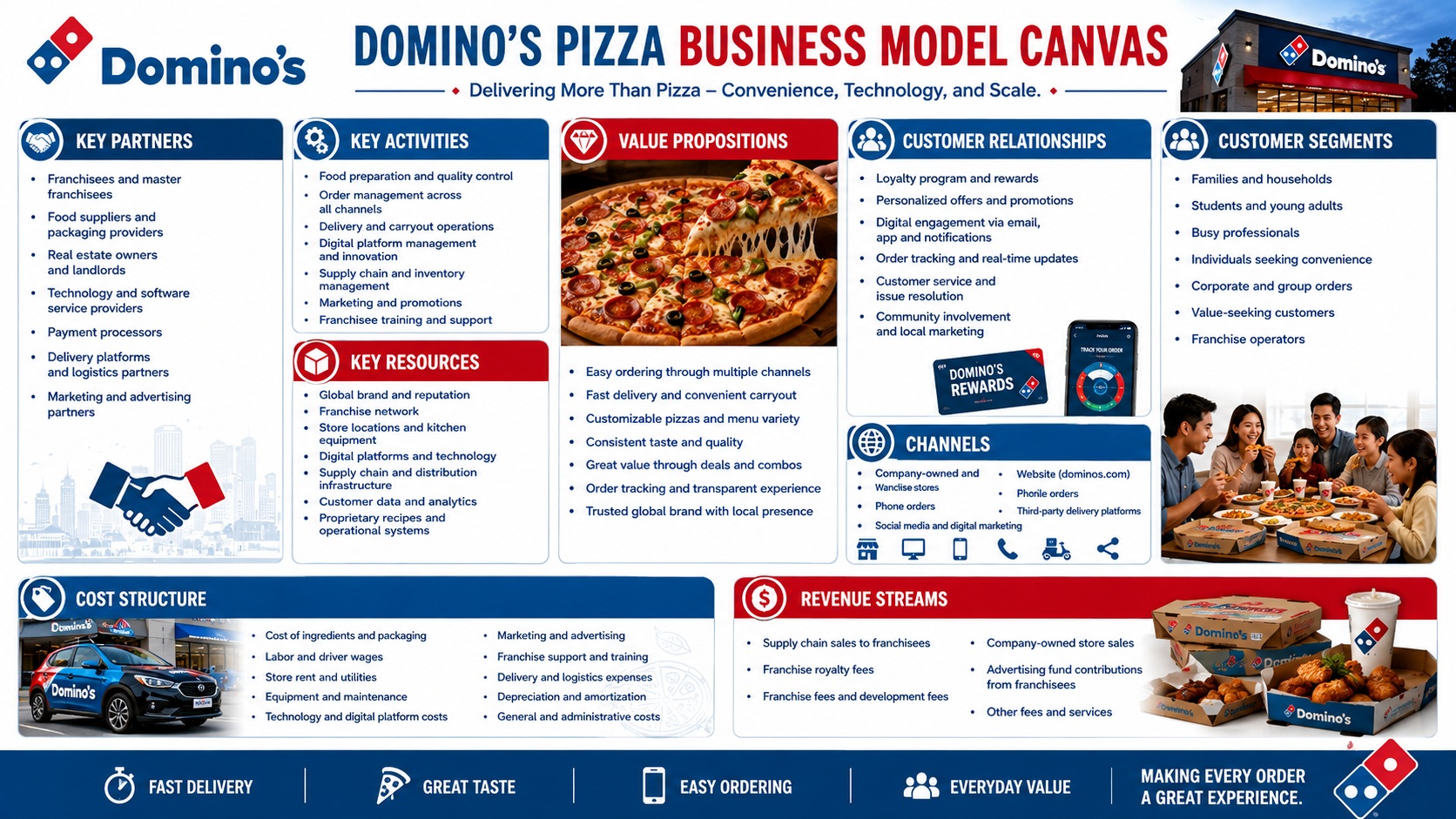
Domino’s BMC Diagram
The diagram for this section should provide a visual summary of how the nine blocks of Domino’s business model connect in one view. It helps readers move from the written overview into a simpler strategic snapshot before continuing to the detailed analysis.
BMC Analysis of Domino’s
The BMC analysis of Domino’s examines how the nine building blocks work together to support its global delivery, carryout, franchise, and supply-chain model.
Each block represents a particular business component, but Domino’s performance depends on how effectively the elements are aligned. A promotion that generates more orders also affects kitchen workload, ingredient demand, delivery capacity, labour scheduling, franchisee margins, and customer satisfaction.
Likewise, opening a new store can improve delivery coverage and brand visibility. Excessive outlet density, however, may transfer sales from an existing location instead of creating incremental market demand.
The following sections examine every block of the Domino’s Pizza Business Model Canvas in greater depth. Together, they explain how Domino’s creates customer value, delivers orders through its store and digital network, and captures income through restaurant sales, franchising, advertising, and supply-chain activity.
1. Customer Segments
Customer segments explain who Domino’s serves and why those buyers matter. Domino’s targets a broad consumer market, but its strength comes from addressing different meal occasions, household types, budgets, age groups, and ordering preferences through one operating system.
Families may order Domino’s for dinner, weekends, school holidays, or celebrations. Students and younger customers frequently respond to promotions, digital convenience, customisable products, and food suitable for sharing.
Office customers may purchase larger orders for meetings, training sessions, team lunches, or informal workplace gatherings. Individuals can also choose smaller pizzas, personal meals, carryout deals, or side products for convenient consumption.
Franchise operators represent another important customer segment because Domino’s must provide them with a commercially viable business opportunity, operating system, and path to sustainable returns.
Domino’s Customer Segments
| Segment | Details | Why It Matters |
|---|---|---|
| Families and households | Customers purchasing convenient meals for dinners, weekends, celebrations, and at-home consumption | Supports shareable orders, bundles, side dishes, desserts, and repeat household demand |
| Students and young adults | Price-sensitive customers attracted to promotions, mobile ordering, new products, and informal group meals | Builds relevance among younger consumers and supports digitally driven transaction volume |
| Individuals and convenience buyers | Customers seeking fast delivery, carryout, or meals requiring no preparation | Expands demand beyond large groups and increases ordering frequency |
| Corporate and group customers | Businesses, schools, organisations, and event organisers placing larger food orders | Produces higher-value transactions and extends demand beyond routine household occasions |
| Franchise operators | Entrepreneurs and experienced store managers investing in Domino’s locations | Provides capital, local management, operating expertise, and network-expansion capacity |
Domino’s succeeds because it serves both planned group occasions and immediate convenience requirements. One part of the model supports families and social gatherings, while another captures individual, carryout, and digitally initiated demand.
2. Value Propositions
The value proposition explains why customers select Domino’s rather than Pizza Hut, local pizza restaurants, fast-food chains, delivery alternatives, convenience stores, or home cooking.
Domino’s offers more than pizza. The company provides convenient ordering, product customisation, delivery and carryout choices, recognisable menu items, promotional value, and a relatively predictable customer experience.
Speed remains important, but reliability matters equally. Customers expect accurate orders, suitable food temperature, transparent pricing, secure payment, and reasonable fulfilment times.
Domino’s Value Propositions
| Value Proposition | Details | Why It Matters |
|---|---|---|
| Convenient ordering | Customers can order through websites, applications, telephone channels, stores, and selected marketplaces | Reduces purchasing effort and allows buyers to use their preferred ordering channel |
| Delivery and carryout | Domino’s supports home delivery together with collection from local stores | Provides fulfilment flexibility and serves customers with different cost and convenience priorities |
| Recognisable products | Familiar pizzas, crusts, toppings, chicken, breads, desserts, beverages, and other menu items | Reduces uncertainty and supports repeat purchasing based on known expectations |
| Product customisation | Customers can select pizza size, crust, sauce, toppings, quantities, and meal combinations | Accommodates different preferences and increases perceived control over the meal |
| Promotional value | Coupons, bundles, loyalty rewards, limited-time offers, and carryout deals | Improves affordability and stimulates demand among price-sensitive customers |
Customers do not choose Domino’s solely because they want pizza. Many select the brand because it combines a familiar product with simple ordering, convenient fulfilment, broad accessibility, and pricing options for different budgets.
3. Channels
Channels explain how Domino’s reaches customers and converts meal demand into completed orders. Within a delivery-oriented restaurant model, channels affect customer convenience, order economics, fulfilment speed, food condition, and ownership of customer data.
Domino’s uses physical stores, websites, mobile applications, telephone ordering, digital advertising, email, social media, delivery vehicles, and selected third-party marketplaces.
A family may order through the company’s application, while a commuter could collect a pizza from a nearby outlet. Another customer may discover Domino’s through a marketplace or search engine before completing a transaction.
Domino’s Channels
| Channel | Details | Why It Matters |
|---|---|---|
| Physical stores | Production locations supporting carryout, customer service, delivery dispatch, and limited dine-in in selected markets | Creates local presence, food-production capacity, and geographic fulfilment coverage |
| Direct digital channels | Domino’s websites, mobile applications, customer accounts, online menus, payments, and order tracking | Provides convenience, customer data, direct communication, and lower dependence on intermediaries |
| Delivery operations | Drivers, vehicles, dispatch systems, route planning, and store delivery zones | Translates Domino’s convenience promise into last-mile fulfilment |
| Third-party platforms | Delivery marketplaces that present Domino’s beside competing restaurants | Reaches marketplace-oriented customers and creates incremental ordering opportunities |
| Marketing channels | Search engines, social media, email, notifications, advertising, sponsorships, and outdoor media | Builds awareness, communicates promotions, and redirects demand towards ordering channels |
Channel breadth gives Domino’s more than transaction access. It creates local visibility, digital convenience, delivery coverage, and repeated opportunities to communicate with customers.
4. Customer Relationships
Customer relationships describe how Domino’s attracts, serves, retains, and reactivates buyers. These relationships are developed through marketing, loyalty rewards, digital accounts, promotions, order tracking, customer support, and consistent fulfilment.
Restaurant loyalty is rarely created by advertising alone. Customers may recognise Domino’s, but repeat purchasing depends on price, food quality, order accuracy, delivery reliability, application usability, and complaint resolution.
Domino’s therefore combines emotional brand familiarity with transactional convenience and operational consistency.
Domino’s Customer Relationships
| Relationship Type | Details | Why It Matters |
|---|---|---|
| Brand engagement | Advertising, product campaigns, social media, sponsorships, local communication, and seasonal promotions | Maintains awareness and keeps Domino’s visible within a crowded foodservice market |
| Loyalty and promotions | Rewards points, coupons, carryout deals, bundles, digital offers, and limited-time products | Encourages repeat purchases and provides incentives for value-conscious customers |
| Digital interaction | Customer profiles, saved addresses, order histories, stored preferences, notifications, and tracking | Reduces ordering friction and enables more relevant communication |
| Service recovery | Complaint handling, order replacement, refunds, credits, and customer-support processes | Protects trust when delivery, accuracy, or food quality falls below expectations |
| Local-store relationships | Store-level communication, delivery interaction, community marketing, and local sponsorship | Connects the international brand with neighbourhood customers and local demand |
Customer loyalty is both behavioural and emotional. Domino’s must remain familiar while making each transaction accurate, convenient, transparent, and satisfactory.
5. Revenue Streams
Revenue streams explain how Domino’s converts retail demand, franchise scale, brand recognition, and supply-chain capabilities into corporate income.
Unlike a conventional restaurant chain, Domino’s does not record all sales generated across its worldwide network as corporate revenue. Retail sales produced by franchised stores belong to franchisees, although those transactions influence royalty payments, advertising contributions, and supply-chain demand.
Global retail sales reached approximately US$20.13 billion in fiscal 2025. Domino’s uses this measure because franchise sales directly affect royalties, advertising fees, and supply-chain revenue even though those franchise transactions are not reported as Domino’s corporate revenue (Domino’s)
Domino’s Revenue Streams
| Revenue Stream | Details | Why It Matters |
|---|---|---|
| Supply-chain sales | Revenue from dough, ingredients, food products, packaging, and operating supplies sold to participating stores | Creates significant corporate income and connects profitability with franchise-store transaction volume |
| U.S. franchise royalties and fees | Percentage-based royalties and other payments from domestic franchise stores | Generates recurring, capital-efficient income linked to franchise sales and network growth |
| International franchise royalties | Payments received from master franchisees and international store systems | Enables global expansion without directly owning most overseas locations |
| Company-owned store sales | Food and beverage revenue generated by a limited number of corporate stores | Provides direct retail income and enables operational testing and learning |
| Advertising contributions | Franchise advertising payments administered through Domino’s marketing programmes | Funds national campaigns, digital marketing, value promotions, and brand development |
Not all revenue streams provide the same margin or strategic value. Supply-chain income requires substantial operating infrastructure, while franchise royalties generally need less direct investment in restaurant assets.
6. Key Resources
Key resources describe the assets that allow Domino’s to compete at global scale. The most important resources extend beyond recipes, ovens, and physical stores.
Competitive strength comes from the interaction between Domino’s brand, franchise network, store density, technology, supply-chain centres, customer data, marketing capabilities, operating standards, and accumulated fulfilment knowledge.
A smaller competitor may offer a comparable pizza, but it cannot quickly reproduce Domino’s international awareness, franchise system, digital platforms, delivery coverage, procurement volume, or operational experience.
Domino’s Key Resources
| Resource | Details | Why It Matters |
|---|---|---|
| Global brand | The Domino’s name, logo, identity, marketing assets, and customer familiarity | Reduces customer-acquisition difficulty and supports trust across existing and new markets |
| Franchise network | Independent operators providing investment, local management, employees, and market knowledge | Enables expansion while distributing capital requirements and operating responsibility |
| Store and delivery footprint | Kitchens, equipment, delivery zones, carryout counters, vehicles, and geographic coverage | Provides production capacity and positions stores closer to customers |
| Technology and data | Ordering platforms, mobile applications, customer profiles, payments, tracking, analytics, and cybersecurity capabilities | Supports digital commerce, customer retention, operational visibility, and performance management |
| Supply-chain infrastructure | Dough-manufacturing centres, warehouses, distribution systems, procurement capabilities, and quality controls | Improves product availability, consistency, purchasing efficiency, and franchise support |
These resources create barriers that are difficult to reproduce quickly. A competitor may copy a promotion or menu item, but building comparable brand awareness, delivery reach, franchise capability, and supply-chain scale requires substantial time and capital.
7. Key Activities
Key activities explain what Domino’s must execute effectively for the business model to work. Brand recognition may generate customer consideration, but everyday operations determine whether an order becomes a satisfactory experience.
Domino’s must coordinate food preparation, digital ordering, staffing, inventory, delivery, carryout, marketing, menu development, supply-chain management, quality assurance, and franchise governance.
Restaurant execution is particularly important because customer expectations are immediate. Incorrect orders, application failures, slow preparation, poor food temperature, or late delivery can damage trust after one transaction.
Domino’s Key Activities
| Activity | Details | Why It Matters |
|---|---|---|
| Store operations | Food preparation, hygiene, staffing, inventory control, payment processing, and outlet management | Determines food consistency, productivity, customer satisfaction, and franchise profitability |
| Delivery and carryout fulfilment | Order sequencing, packaging, dispatch, route coordination, collection handling, and delivery tracking | Protects convenience and product quality across Domino’s main fulfilment channels |
| Digital-platform management | Maintaining applications, websites, payments, loyalty systems, customer data, and order integrations | Enables transaction growth and reduces friction across the customer journey |
| Supply-chain management | Ingredient procurement, dough production, warehousing, quality control, and distribution | Supports product availability, consistency, purchasing scale, and outlet operations |
| Marketing and franchise support | Campaign planning, product launches, training, audits, performance review, and operating guidance | Converts brand awareness into sales and protects standards across independently operated stores |
Operational excellence matters because marketing can create demand only once. Reliable store execution is required to convert first-time buyers into repeat customers.
8. Key Partnerships
Key partnerships explain which external organisations help Domino’s operate and expand. Franchisees are the company’s most important partners because they invest in stores, employ local teams, manage daily operations, and deliver the customer experience.
Master franchisees perform a similar role across international territories. They may adapt menu items, pricing, promotions, technology, and outlet formats to fit local consumer behaviour and regulatory requirements.
Food suppliers provide cheese, flour, meat, vegetables, sauces, oils, beverages, packaging, and other materials. Technology and payment companies support digital transactions, cybersecurity, cloud infrastructure, and restaurant systems.
Domino’s Key Partnerships
| Partner | Details | Why It Matters |
|---|---|---|
| Franchise operators | Local businesses and experienced managers that finance, develop, and operate Domino’s stores | Accelerates expansion and provides local execution without requiring full corporate ownership |
| Master franchisees | Regional partners responsible for developing Domino’s across designated international markets | Supplies local knowledge, capital, organisational capability, and country-level scale |
| Food and packaging suppliers | Producers supplying cheese, flour, meat, vegetables, sauces, drinks, cardboard, and restaurant materials | Supports availability, food consistency, cost control, and compliance with quality standards |
| Technology and payment providers | Companies supporting cloud services, software, payments, cybersecurity, communications, and data tools | Enables digital ordering and coordinated store management |
| Delivery and marketplace partners | Third-party marketplaces, logistics providers, vehicle partners, and delivery-support companies | Extends customer access and strengthens fulfilment capacity where commercially appropriate |
Partnership quality affects resilience. A supplier failure may interrupt ingredient availability, while a technology disruption can prevent ordering across many locations simultaneously.
9. Cost Structure
Cost structure explains the expenses required to operate Domino’s corporate system and individual franchise stores.
At outlet level, major costs include ingredients, labour, delivery, rent, utilities, packaging, maintenance, insurance, payment fees, advertising contributions, royalties, and technology charges.
Corporate expenses include supply-chain centres, distribution, technology development, franchise support, advertising administration, company-owned stores, employees, product development, legal compliance, and governance.
Domino’s Cost Structure
| Cost Category | Details | Why It Matters |
|---|---|---|
| Ingredients and packaging | Cheese, flour, meat, vegetables, sauces, oils, beverages, boxes, containers, and other food inputs | Directly affects store margins, menu pricing, product quality, and promotional economics |
| Labour and delivery | Store employees, drivers, supply-chain workers, management, training, insurance, fuel, and vehicles | Represents a major expense and determines production and fulfilment capacity |
| Property and equipment | Rent, utilities, ovens, refrigeration, kitchen equipment, repairs, outlet development, and maintenance | Provides the physical infrastructure required for food production and customer access |
| Technology | Ordering platforms, point-of-sale systems, applications, data, cloud services, cybersecurity, and support | Enables digital transactions but requires continuous investment and maintenance |
| Marketing and franchise support | Advertising, promotions, loyalty programmes, field support, quality audits, training, and administration | Sustains demand while protecting consistency across the franchise network |
Cost discipline is essential because promotional pricing can increase order volume while reducing store-level contribution margins. Higher transactions create value only when each outlet can fulfil demand efficiently and profitably.
How the Nine BMC Blocks Work Together
The nine building blocks should not be evaluated independently. Domino’s competitive strength comes from how the blocks reinforce one another.
Customer segments create demand for convenient and shareable meals. Value propositions translate those requirements into digital ordering, delivery, carryout, customisation, and promotional affordability.
Channels provide access, while loyalty programmes and service recovery strengthen customer relationships. Revenue streams convert retail demand into franchise royalties, store sales, advertising contributions, and supply-chain income.
Key resources such as the brand, outlet network, technology, and supply chain support the activities required to prepare and fulfil orders. Partnerships provide local investment, ingredients, digital infrastructure, and market access.
The cost structure ultimately determines whether the system remains economically sustainable.
A successful promotion demonstrates these connections clearly. Marketing may increase customer demand, but stores require sufficient labour, ingredients, kitchen capacity, digital stability, and delivery availability.
Franchisees must also earn an acceptable return after discounts, royalties, advertising contributions, and operating expenses. Therefore, the model performs best when customer growth and franchise profitability improve together.
Domino’s Value Proposition Canvas
Before comparing Domino’s with Pizza Hut, it is useful to examine how Domino’s creates fit between what customers need and what the company delivers. That is the purpose of Value Proposition Canvas, or VPC.
While Business Model Canvas explains the overall structure of the company, VPC focuses more closely on the relationship between customer requirements and Domino’s actual offer.
For Domino’s, this framework is especially relevant because the brand serves several meal occasions. It must balance taste, convenience, delivery reliability, affordability, customisation, digital simplicity, and suitability for individual or group consumption.
In simple terms, VPC helps explain why the Domino’s Pizza Business Model Canvas works in practice. It shows how customer jobs, pains, and gains connect with Domino’s food, digital services, fulfilment channels, promotions, and recognised brand.
Customer Profile
The customer profile examines what Domino’s target customers are trying to accomplish, what frustrates them, and which outcomes they value most. Since the company serves a broad market, the profile reflects common customer needs across delivery and carryout occasions.
Customer Profile of Domino’s
| Customer Profile | Details |
|---|---|
| Customer Jobs | Find a convenient meal, avoid cooking, feed individuals or groups, organise food for family or social occasions, customise products, and order through a simple digital process |
| Customer Pains | Rising meal prices, delivery fees, long waiting times, cold food, inaccurate orders, confusing promotions, application problems, and difficulty satisfying several preferences |
| Customer Gains | Enjoyable taste, reliable quality, easy digital ordering, shareable portions, flexible customisation, transparent value, predictable fulfilment, and access to a familiar pizza brand |
This profile shows that Domino’s does not win only through pizza flavour. It also creates value by reducing meal-planning effort, simplifying group orders, and giving customers convenient ways to order and receive food.
Value Map
The value map explains how Domino’s responds to customer jobs, pains, and gains. The company uses a product, technology, and fulfilment strategy rather than relying on one pizza or one delivery promise.
That matters because customers may require different benefits on different occasions. Some need a family meal, others want fast carryout, while many simply seek a familiar option that can be ordered with minimal effort.
Value Map of Domino’s
| Value Map | Details |
|---|---|
| Products and Services | Pizzas, chicken, breads, sandwiches, pasta, desserts, beverages, meal bundles, delivery, carryout, websites, mobile applications, order tracking, customer accounts, and loyalty rewards |
| Pain Relievers | Digital ordering reduces purchasing effort, saved details simplify repeat transactions, tracking improves visibility, familiar products reduce uncertainty, bundles simplify group selection, and service recovery addresses failed orders |
| Gain Creators | Customisable pizzas, shareable meals, broad outlet coverage, convenient reordering, recognisable taste, carryout flexibility, loyalty benefits, promotional value, and products suitable for individual and group occasions |
This value map shows why Domino’s retains broad commercial relevance. The company does not rely solely on one signature product. It creates value by connecting familiar food with digital convenience, fulfilment flexibility, customisation, and different pricing options.
How Domino’s Creates Fit
The table below shows how customer requirements and Domino’s value offer connect more directly. This structure matches customer-side needs with company-side value creation in a clear and consistent format.
| Customer Profile | Details | Matching Value Map | How Domino’s Creates Fit |
|---|---|---|---|
| Customer Jobs | Customers want convenient meals that can serve individuals, families, colleagues, or social groups without cooking | Products and Services | Domino’s provides customisable pizzas, supporting menu items, meal bundles, delivery, carryout, digital ordering, and different portion sizes |
| Customer Pains | Buyers face price pressure, delivery uncertainty, ordering difficulty, incorrect items, cold food, and inconsistent service | Pain Relievers | Familiar recipes, bundled offers, order confirmation, tracking, standardised procedures, customer support, and service recovery reduce those concerns |
| Customer Gains | Customers value taste, convenience, customisation, reliable fulfilment, simple group ordering, and reasonable value | Gain Creators | Domino’s creates those gains through recognisable products, digital convenience, shareable formats, loyalty benefits, carryout access, and broad store coverage |
The fit is strongest because Domino’s solves more than hunger. It reduces planning and transaction effort while giving customers a convenient way to order familiar, customisable, and shareable meals.
Where the Fit Happens
The strongest fit occurs during family meals, informal gatherings, office lunches, celebrations, weekend dining, late-evening orders, and situations where customers want food without preparing it themselves.
Domino’s performs well when buyers require familiar products, convenient ordering, straightforward customisation, and reliable delivery or collection. A pizza can be shared, divided across different toppings, and combined with side dishes to accommodate several preferences.
This is where Domino’s focused operating model matters most. A full-service restaurant may provide a richer dining environment, while an independent pizza business could offer more local character.
Domino’s creates fit by concentrating on an efficient journey from digital selection to store preparation and final fulfilment. Its strongest customer value therefore emerges when convenience, value, product quality, order accuracy, and delivery reliability are achieved together.
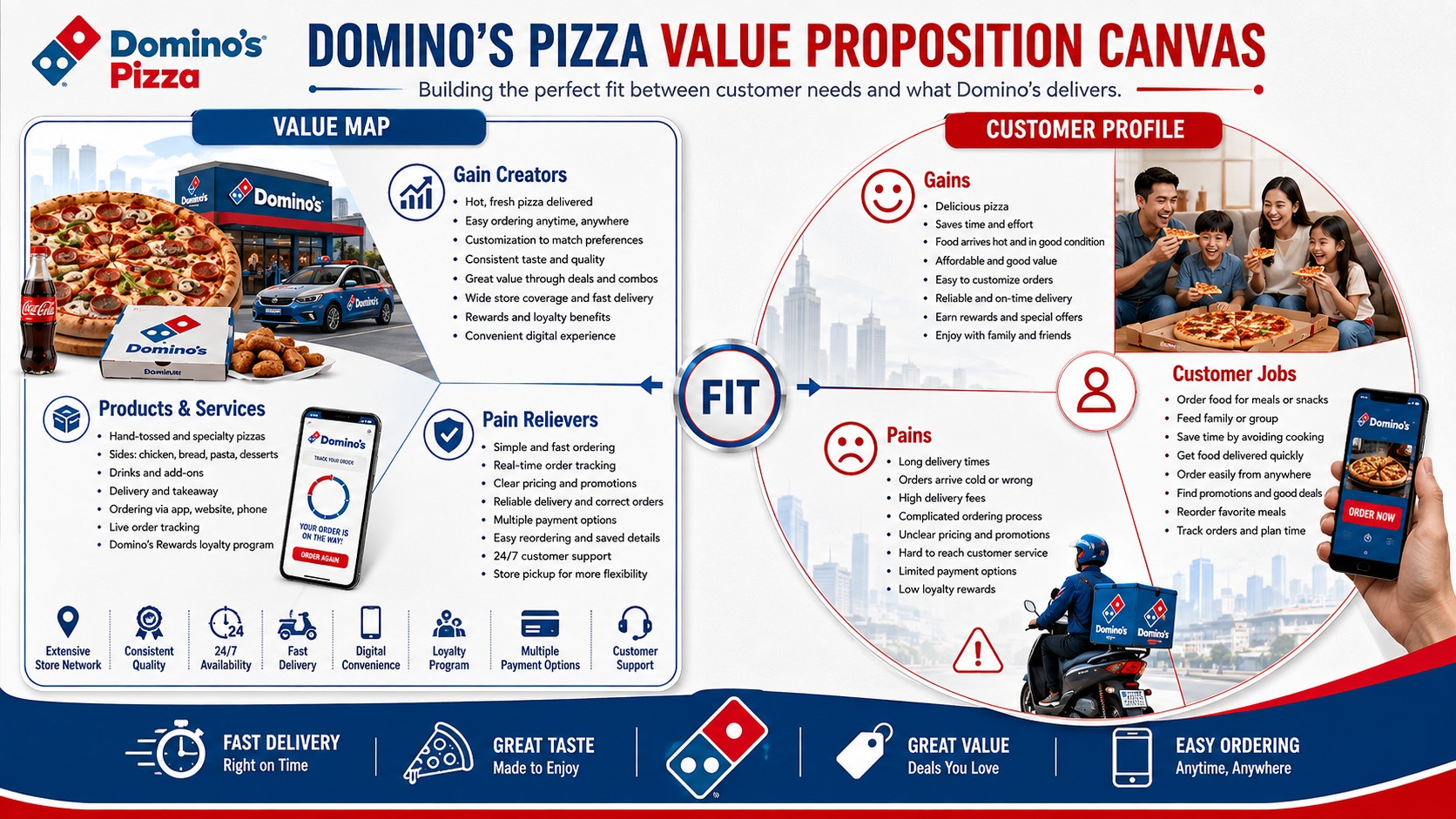
Domino’s VPC Diagram
The following is the VPC diagram of Domino’s. It provides a visual view of how customer jobs, pains, and gains connect with Domino’s products and services, pain relievers, and gain creators.
Domino’s vs Pizza Hut Business Model
The Domino’s Pizza Business Model Canvas differs from Pizza Hut mainly in store-format heritage, menu breadth, dining experience, and the strategic role of delivery.
Domino’s was founded in the United States in 1960 and developed around delivery and carryout convenience. The company later strengthened this position through digital ordering, compact outlets, operational consistency, supply-chain integration, and a highly franchised global network.
Pizza Hut traditionally operated through a broader combination of dine-in restaurants, takeaway locations, delivery stores, express counters, and hybrid formats. Its menu also tends to extend further into pasta, chicken, side dishes, desserts, and complete restaurant meals.
Neither structure is automatically superior. Each model is optimised around different customer occasions and operating priorities.
Comparison Table
| Dimension | Domino’s | Pizza Hut |
|---|---|---|
| Format logic | Predominantly delivery and carryout-focused stores designed for efficient order fulfilment | Mix of dine-in restaurants, delivery units, takeaway locations, express counters, and hybrid outlets |
| Customer occasion | Convenience-led delivery, collection, individual meals, family consumption, and informal group orders | Family dining, celebrations, takeaway, delivery, group meals, and casual restaurant visits |
| Menu breadth | Focused menu structured around pizza and products suitable for delivery or carryout | Broader restaurant menu including pizza, pasta, chicken, sides, desserts, and beverages |
| Brand positioning | Technology-enabled pizza delivery and collection brand focused on convenience and fulfilment | Familiar family pizza restaurant offering variety, dining experience, and multiple fulfilment options |
| Model strength | Operational focus, compact-store economics, supply-chain integration, digital ordering, and delivery efficiency | Broader occasion coverage, restaurant experience, menu variety, and international familiarity |
Domino’s benefits from a concentrated operating system designed primarily around delivery and carryout. Pizza Hut can participate in broader dining occasions and provide a fuller restaurant experience.
This comparison shows that Domino’s should not attempt to reproduce Pizza Hut’s dine-in model. A stronger approach is to maintain its fulfilment, technology, value, and compact-store advantages while improving food quality, customer experience, menu relevance, and franchisee economics.
Read Pizza Hut Business Model Canvas here.
Competitive Advantages
The Domino’s Pizza Business Model Canvas highlights several reinforcing strengths that make the company more defensible than smaller restaurant and delivery competitors.
- Strong global brand recognition: Domino’s is widely recognised across major international markets, reducing customer-acquisition barriers and supporting new-store development.
- Highly scalable franchise model: Independent franchisees finance and operate almost all Domino’s locations, allowing the network to expand without full corporate investment in every outlet.
- Delivery and carryout specialisation: Compact, production-focused stores can fulfil substantial order volume without the property and service requirements of large dine-in restaurants.
- Direct digital-ordering capability: Domino’s websites, applications, loyalty systems, payments, and tracking tools improve convenience and provide access to customer data.
- Integrated supply-chain operations: Dough production, ingredient distribution, packaging, and procurement support product consistency while generating corporate revenue.
- Dense store network: Locations positioned close to customers can shorten delivery distances, improve carryout access, and strengthen local brand visibility.
- Standardised operating systems: Recipes, kitchen procedures, training, technology, and quality controls support more consistent execution.
- Internally developed franchisees: More than 95% of Domino’s U.S. franchisees began as pizza makers or delivery drivers, helping preserve practical operating knowledge across the system. (biz.dominos.com)
- Shareable product format: Pizza remains suitable for families, offices, social gatherings, celebrations, and informal group meals.
- Large advertising platform: Franchise contributions create significant resources for national campaigns, product launches, value promotions, and digital marketing.
Risks and Challenges
Despite its scale and brand strength, Domino’s faces several strategic, operational, financial, and market-related challenges.
- Intense food-delivery competition: Marketplace applications allow customers to compare Domino’s with independent restaurants, pizza chains, burgers, fried chicken, convenience stores, and other cuisines.
- Pressure on customer value: Product-price increases, delivery fees, and complicated promotions may weaken Domino’s affordability positioning.
- Franchisee profitability challenges: Ingredients, labour, rent, fuel, insurance, utilities, royalties, technology fees, and advertising contributions can reduce outlet-level returns.
- Dependence on franchise execution: Service quality, hygiene, food consistency, employee management, and delivery reliability may vary between independently operated locations.
- Food-cost volatility: Cheese, meat, flour, vegetables, oils, cardboard, and transportation expenses can change rapidly.
- Technology and cybersecurity exposure: Application outages, payment failures, data breaches, cyberattacks, or integration problems can interrupt transactions and damage trust.
- Delivery-workforce constraints: Driver shortages, wage pressure, safety risks, insurance costs, and employment regulations can increase fulfilment expenses.
- Promotion dependency: Frequent discounting may train customers to delay purchases until attractive offers become available.
- Store cannibalisation: Excessive network density may shift demand between nearby Domino’s stores rather than generate new transactions.
- International market inconsistency: Purchasing power, consumer preferences, regulation, competition, property costs, and franchise capability differ by country.
- Third-party platform dependency: Marketplace commissions and limited customer-data ownership can weaken direct-channel economics.
- Changing health preferences: Consumer concerns about calories, sodium, processed ingredients, and dietary balance may reduce demand among certain segments.
Strategic Recommendations
Domino’s should strengthen the capabilities that distinguish it from dine-in pizza chains and smaller delivery competitors. Digital convenience, reliable fulfilment, strong value, compact-store productivity, and supply-chain scale should remain central to its strategic position.
1. Protect Customer Value Without Overusing Discounts
Domino’s should establish a clearer pricing architecture covering entry-level value, carryout offers, family bundles, mainstream products, and premium innovations.
Promotions need to increase profitable order volume rather than reduce prices without improving basket size. Offers should also remain simple enough for customers to understand without navigating excessive conditions.
2. Prioritise Franchisee Unit Economics
Management should evaluate new stores, menu launches, and promotions based on restaurant-level returns rather than system sales or outlet count alone.
Relevant measures include order contribution margin, labour productivity, delivery radius, ingredient waste, occupancy cost, customer frequency, and return on franchisee capital.
3. Strengthen Direct Digital Relationships
Domino’s should continue encouraging customers to use proprietary channels through better loyalty benefits, personalised offers, transparent pricing, easier reordering, and faster complaint resolution.
Third-party marketplaces can support customer acquisition, but direct ordering should remain central to customer-data ownership and transaction economics.
4. Optimise Delivery and Carryout Together
Delivery remains a central competitive capability, while carryout can provide attractive economics by reducing last-mile expenditure.
Store design, parking access, collection shelves, order notifications, carryout promotions, and service processes should make customer collection fast and predictable.
5. Localise Menus Selectively
International markets require adaptation in flavours, dietary preferences, portion sizes, price points, and product categories.
Localisation should remain disciplined because excessive menu complexity can slow kitchen operations, increase inventory, create waste, and weaken consistency.
6. Use Technology to Improve Store Productivity
Technology investment should generate measurable operating outcomes rather than introduce features without clear commercial value.
Priority areas include order accuracy, kitchen sequencing, staffing forecasts, delivery routing, demand planning, customer retention, fraud control, and service recovery.
7. Strengthen Franchise Governance and Support
Domino’s should maintain consistent food-safety controls, training, cybersecurity requirements, quality audits, customer-service standards, and performance monitoring.
Support must also remain practical. Underperforming franchisees may require targeted operational assistance, financial restructuring, territory review, or market-level corrective action.
8. Expand Flexible and Balanced Menu Choices
Smaller portions, vegetable-led products, transparent nutritional information, and more flexible meal combinations may increase relevance among health-conscious customers.
Domino’s does not need to become a health-food business, but greater choice can reduce the likelihood of being excluded from household or group purchasing decisions.
Recommendations for Entrepreneurs
Entrepreneurs can learn several practical lessons from Domino’s without attempting to reproduce its global scale.
First, convenience should be designed across the complete customer journey. A fast kitchen creates limited value when ordering, payment, collection, delivery, or complaint handling remains difficult.
Second, a focused operating model can become a competitive advantage. Domino’s built scale by concentrating on production, delivery, carryout, and repeatable store processes rather than attempting to serve every restaurant occasion.
Third, technology should strengthen the business model instead of functioning as a separate project. Ordering systems, customer data, inventory, loyalty, payments, and fulfilment need to support measurable operating outcomes.
Fourth, franchise growth must be economically sustainable. Opening more locations creates value only when individual operators can generate acceptable returns and reinvest in service quality.
Finally, customer value is broader than low pricing. Reliability, customisation, accessibility, transparency, product quality, and service recovery all contribute to whether customers believe a purchase is worthwhile.
Conclusion
Overall, the Domino’s Pizza Business Model Canvas explains how a pizza-delivery concept developed into a global franchise, digital-commerce, fulfilment, and supply-chain platform.
Domino’s strength comes from combining brand recognition, store density, digital ordering, compact production formats, delivery capability, franchisee investment, marketing scale, and supply-chain infrastructure.
No single component is sufficient by itself. Technology may initiate the transaction, but stores, employees, franchisees, suppliers, ingredients, and delivery operations ultimately determine customer satisfaction.
Future growth will increasingly depend on profitable order volume rather than expansion alone. Domino’s must therefore balance value promotions, menu innovation, digital convenience, direct customer relationships, store density, and franchisee economics.
The company remains well positioned because its model is difficult to reproduce at comparable scale. Nevertheless, sustained leadership requires operating discipline in every market and across every customer transaction.
Domino’s can continue strengthening its global position when growth benefits customers, franchisees, and the corporate system together.
Disclaimer
This article is provided for educational and business-analysis purposes only. Its content is based on publicly available company disclosures, general market observations, and strategic interpretation.
It does not constitute financial advice, investment advice, legal advice, tax advice, nutritional advice, franchise advice, or an official statement from Domino’s Pizza, Inc., Domino’s Pizza Enterprises Limited, Domino’s Pizza Group plc, Pizza Hut, or any related organisation.
Readers should conduct independent research and obtain appropriate professional advice before making business, investment, or franchise decisions.
All trademarks, logos, copyrights, brand names, product names, and related materials mentioned or shown in this article belong to their respective owners.
Meta Description
Explore the Domino’s Pizza Business Model Canvas, nine BMC blocks, Value Proposition Canvas, Pizza Hut comparison, advantages, risks, and strategic recommendations.

