



Share This Article


Bateriku Business Model Canvas: How Bateriku Builds a Connected Automotive Assistance Ecosystem
BMC Article No: BMC #006
Updated in 2026: This article has been comprehensively refreshed to reflect Bateriku’s transformation from an on-demand battery replacement company into a broader connected automotive ecosystem. Updates include the expansion beyond 250 Pitstops, broader roadside assistance services, the BHero and BPreneur network, proprietary battery brands such as ASTRA, digital ecosystem development, fleet and workshop capabilities, EV-related partnerships, a deeper analysis of all nine BMC blocks, an expanded Value Proposition Canvas, a comparison with CARPUT, revised competitive advantages and risks, and new strategic recommendations. (Bateriku Investor)
Introduction
Bateriku has developed far beyond its original identity as a company that delivers car batteries to stranded motorists. Today, it operates a technology-enabled automotive assistance ecosystem connecting vehicle owners, mobile technicians, physical Pitstops, entrepreneurs, workshops, corporate partners, battery products, roadside services, and digital platforms.
The Bateriku Business Model Canvas is strategically interesting because value is created through the integration of several capabilities rather than battery sales alone. A customer with a vehicle problem can potentially access battery replacement, jump-start assistance, towing, tyre services, fuel delivery, locksmith support, workshop services, and other automotive solutions through the wider ecosystem. (Bateriku.com)
Physical expansion has reinforced that model. Bateriku announced its 250th Pitstop in Putrajaya in April 2026, while earlier corporate information stated that it had served more than 1.5 million customers. (Bateriku Investor)
Consequently, Bateriku should increasingly be viewed as a mobility-support platform rather than simply a battery retailer.
What Is Bateriku’s Business Model?
Bateriku operates a distributed automotive-services model built around bringing assistance closer to motorists. Instead of requiring customers to find and travel to a conventional workshop, the company connects demand with technicians, Pitstops, partner workshops, products, and roadside-service providers.
At its core, the Bateriku Business Model Canvas combines several commercial engines.
First, the company sells and installs automotive batteries through mobile and physical channels. Second, its ecosystem provides additional roadside services such as towing, tyre assistance, jump-starts, fuel delivery, locksmith services, workshop support, and insurance-related offerings. (Bateriku.com)
Third, BHero creates a distributed mobile fulfilment workforce, while BPreneur enables entrepreneurs and existing automotive businesses to participate in the network. Bateriku describes BHero as an on-demand service programme and BPreneur as an entrepreneurship or licensee model. (Bateriku.com)
Digital technology coordinates those components through ordering, dispatch, customer management, service tracking, inventory, and operational data.
This combination turns Bateriku into a retailer, roadside-assistance provider, technology platform, distribution network, automotive-services aggregator, and entrepreneurship ecosystem.
What Is Business Model Canvas?
Business Model Canvas, or BMC, is a strategic framework used to explain how a company creates value, delivers that value to customers, and captures economic returns.
For Bateriku, the framework is particularly useful because its operations involve more than a conventional retail transaction. The Bateriku Business Model Canvas connects motorists requiring assistance with products, technicians, entrepreneurs, branches, technology, workshops, suppliers, and corporate partners.
The nine blocks provide a structured view of that system.
| BMC Block | Main Question |
|---|---|
| Customer Segments | Who does the business serve? |
| Value Propositions | What value does the business offer? |
| Channels | How does the business reach customers? |
| Customer Relationships | How does the business build trust and loyalty? |
| Revenue Streams | How does the business make money? |
| Key Resources | What assets does the business need? |
| Key Activities | What must the business execute well? |
| Key Partnerships | Who helps the business operate? |
| Cost Structure | What are its major costs? |
Understanding these connections helps explain why Bateriku’s competitive position increasingly depends on network density, response reliability, digital coordination, product availability, and ecosystem quality.
Quick Overview of Bateriku
Bateriku.com was established in 2014 as a business-to-consumer automotive battery service supported by gig-economy technicians. Its corporate history traces earlier capabilities to Astra Simfoni, established in 2005 for B2B supply, and Astra Manufacturing in 2009 for battery assembly and charging. (Bateriku Investor)
Over time, the Bateriku Business Model Canvas expanded considerably. A dealership or licence programme appeared in 2015, workshop-related development followed, and an Indonesian operation was established in 2023. (Bateriku Investor)
By April 2026, Bateriku had opened its 250th Pitstop. The company has also expanded its offering into broader roadside assistance, workshop services, fleet management, diagnostics, proprietary battery products, entrepreneurship programmes, and emerging EV-related services. (Bateriku Investor)
This progression is significant because Bateriku is gradually moving downstream and upstream simultaneously. It participates in products, distribution, service fulfilment, customer acquisition, technology, entrepreneurship, and automotive ecosystem development.
Why Bateriku Is Strategically Interesting
Bateriku is strategically interesting because it converts a relatively ordinary automotive component into the entry point for a much broader service ecosystem.
A car battery itself is largely substitutable. Motorists can purchase batteries from workshops, accessory shops, online marketplaces, authorised dealers, or competitors.
The Bateriku Business Model Canvas, however, competes through convenience, network availability, rapid fulfilment, trusted installation, digital ordering, physical coverage, and access to additional automotive services.
Its BHero model extends field-service capacity without requiring every technician to operate as a conventional full-time branch employee. BPreneur similarly allows external entrepreneurs and businesses to participate in the ecosystem. (Bateriku.com)
Pitstops provide another layer of physical presence. The combination creates a hybrid model where digital demand can be fulfilled through mobile personnel, branches, entrepreneurs, workshops, and partners.
Strategically, network density matters. More fulfilment points can shorten customer response time, generate more local visibility, improve service availability, and potentially increase utilisation across the ecosystem.
Latest Developments: What Is Changing Around Bateriku?
Several developments are reshaping the Bateriku Business Model Canvas in 2026.
First, physical coverage continues to expand. Bateriku opened its 250th Pitstop in Putrajaya in April 2026, strengthening its nationwide service footprint. (Bateriku Investor)
Second, the company is broadening beyond battery replacement. Its consumer platform now markets towing, tyre repair and replacement, fuel top-up, locksmith assistance, workshop services, jump-start support, and car insurance alongside batteries. (Bateriku.com)
Third, Bateriku is deepening vertical integration through products such as ASTRA, BForty, and GGR while continuing to offer batteries from established manufacturers. (Bateriku.com)
Fourth, emerging mobility is becoming strategically relevant. Bateriku announced collaborations involving Ryde EV in 2025 and SVOLT in April 2026, signalling development of capabilities around electric mobility and EV after-sales support. (Bateriku Investor)
Finally, partnerships such as its 2026 arrangement with WAHDAH extend the ecosystem into replacement-car solutions when motorists experience breakdowns. (Bateriku.com)
Bateriku Business Model Canvas Summary
Before analysing individual blocks, the Bateriku Business Model Canvas can be summarised as a technology-enabled automotive network built around fast access to products, technicians, physical locations, and roadside support.
The table provides a compact view of how its main business components connect.
| BMC Block | Bateriku Application |
|---|---|
| Customer Segments | Private motorists, motorcycle owners, fleet customers, corporate partners, entrepreneurs and automotive businesses |
| Value Propositions | Fast assistance, on-site service, nationwide accessibility, product choice, trusted installation and broader automotive support |
| Channels | Website, app, call centre, Pitstops, BHeroes, BPreneurs, partners, social media and digital platforms |
| Customer Relationships | Emergency support, service tracking, warranties, customer service, complaints handling and repeat automotive needs |
| Revenue Streams | Battery sales, automotive services, roadside assistance and ecosystem-related commercial activities |
| Key Resources | Brand, Pitstop network, BHeroes, BPreneurs, technology, inventory, data, product brands and operating know-how |
| Key Activities | Dispatch, battery fulfilment, roadside assistance, inventory, partner management, technology and network development |
| Key Partnerships | Battery suppliers, workshops, insurers, mobility companies, technology firms, entrepreneurs and roadside operators |
| Cost Structure | Inventory, personnel, network support, technology, logistics, marketing, facilities and partner management |
Bateriku BMC Diagram
The diagram for this section should visually connect Bateriku’s nine BMC blocks, highlighting how digital demand flows through technicians, Pitstops, products, partners, and services.

BMC Analysis of Bateriku
A deeper Bateriku Business Model Canvas analysis shows that the company’s competitive strength comes from integration.
Customers may initially enter the ecosystem because of an urgent battery problem. Once that relationship exists, Bateriku can potentially address additional vehicle needs through roadside assistance, workshops, tyres, towing, insurance, diagnostics, and future mobility services.
Each BMC block therefore affects another. Greater service coverage requires more technicians and partners. Wider product selection increases inventory requirements. Additional Pitstops improve physical accessibility but also increase network-management complexity.
Technology connects many of those moving parts. Bateriku’s digital infrastructure supports dispatching, service-fleet coordination and real-time product-sales monitoring, according to company material describing its technology operations. (Bateriku.com)
The following sections examine each block in greater depth.
1. Customer Segments
Customer segments explain who Bateriku serves and which groups generate demand across its ecosystem.
Private motorists remain central because vehicle breakdowns frequently require immediate assistance. Motorcycle owners provide another product opportunity through motorcycle batteries such as GGR.
Business customers also matter. Fleet operators need predictable vehicle availability, while insurers, mobility businesses, workshops, and automotive partners may require roadside or supporting services at larger scale.
Entrepreneurs form an unusual additional segment because Bateriku recruits BHeroes and BPreneurs into its fulfilment network.
Bateriku Customer Segments
| Segment | Details | Why It Matters |
|---|---|---|
| Private motorists | Drivers needing batteries or roadside assistance | Generates core consumer demand |
| Motorcycle owners | Riders requiring batteries and related products | Expands addressable vehicle categories |
| Fleet customers | Companies operating multiple vehicles | Creates recurring B2B service opportunities |
| Corporate ecosystem customers | Insurers, mobility providers and other organisations | Supports integrated service partnerships |
| Entrepreneurs and workshops | BHeroes, BPreneurs and automotive operators | Expands fulfilment without relying only on corporate branches |
The customer portfolio therefore extends beyond motorists. Bateriku simultaneously serves end users, organisations, and ecosystem participants.
2. Value Propositions
The Bateriku Business Model Canvas is built around reducing the inconvenience and uncertainty associated with vehicle problems.
Customers experiencing battery failure often have limited ability to travel to a workshop. Bateriku reverses the traditional journey by sending assistance to the customer.
Its website promotes free battery delivery, inspection and installation with service potentially arriving within 30 minutes, subject to applicable conditions. (Bateriku.com)
Bateriku Value Propositions
| Value Proposition | Details | Why It Matters |
|---|---|---|
| On-demand convenience | Assistance is delivered to the vehicle location | Removes workshop-travel friction |
| Rapid response | Distributed fulfilment supports fast service | Reduces breakdown downtime |
| Nationwide access | Pitstops and service partners extend coverage | Makes the brand relevant beyond major cities |
| One-stop automotive support | Battery, towing, tyres, fuel, locksmith and workshops | Increases usefulness beyond one problem |
| Product and service assurance | Installation, inspection, battery options and warranties | Reduces purchasing uncertainty |
Convenience is therefore broader than speed. Customers gain a coordinated solution covering diagnosis, product selection, delivery, installation and recovery.
3. Channels
Channels determine how motorists discover Bateriku, request assistance, purchase products, and receive services.
Digital ordering is important, but physical and human fulfilment remain essential because roadside assistance cannot be completed through software alone.
Bateriku Channels
| Channel | Details | Why It Matters |
|---|---|---|
| Website and mobile app | Product ordering, assistance requests and tracking | Creates direct digital access |
| Call centre | Human-assisted service requests and support | Serves urgent or less digital customers |
| Pitstops | Physical locations for products and automotive services | Builds local presence and inventory availability |
| BHero and BPreneur network | Mobile and entrepreneurial fulfilment channels | Extends geographic service reach |
| Digital and corporate partners | External platforms and organisations directing demand | Broadens customer acquisition |
Bateriku also promotes ordering through social media and e-commerce-related channels alongside its website and application. (Bateriku.com)
Channel integration becomes especially important during emergencies. Customers care less about organisational boundaries than whether help can be requested easily and delivered reliably.
4. Customer Relationships
Customer relationships in roadside assistance differ from conventional retail relationships because many transactions occur during stressful situations.
Trust must therefore be created rapidly through communication, technician professionalism, transparent pricing, response visibility, reliable products, and effective problem resolution.
Bateriku Customer Relationships
| Relationship Type | Details | Why It Matters |
|---|---|---|
| Emergency assistance | Rapid response when motorists are stranded | Builds trust during high-need moments |
| Digital interaction | App, website, tracking and customer information | Reduces uncertainty |
| Service assurance | Inspection, installation and warranty support | Increases confidence in purchase quality |
| Customer support | Call centre, feedback and complaint handling | Supports service recovery |
| Repeat ecosystem engagement | Additional roadside and workshop services | Extends the relationship beyond batteries |
The company’s website includes a customer complaint channel and promotes 24/7 access through its digital ecosystem. (Bateriku.com)
Strong relationships can convert an emergency transaction into longer-term automotive-service loyalty.
5. Revenue Streams
Revenue streams explain how Bateriku converts automotive demand and ecosystem participation into commercial returns.
Battery sales remain the most visible source because products are sold directly together with delivery and installation. Broader service expansion, however, creates additional opportunities around roadside support and automotive services.
Bateriku Revenue Streams
| Revenue Stream | Details | Why It Matters |
|---|---|---|
| Automotive battery sales | Batteries sold to motorists and other customers | Provides a major transactional revenue base |
| Roadside services | Towing, tyre, fuel, locksmith and related assistance | Diversifies income beyond battery replacement |
| Workshop services | Vehicle maintenance and repair-related services | Expands customer lifetime value |
| B2B and fleet services | Automotive support for business vehicles | Creates potential recurring demand |
| Ecosystem commercial activities | Product distribution, partnerships and network-related activities | Extends monetisation across the platform |
The exact revenue contribution of each category is not publicly disclosed in the sources reviewed.
Strategically, diversification reduces dependence on one product category while increasing cross-selling opportunities.
6. Key Resources
Key resources explain which assets allow Bateriku to deliver assistance quickly and consistently.
Physical coverage matters, but the network becomes more valuable when combined with technicians, inventory, brand trust, digital systems, product knowledge, partners, and customer data.
Key Resources of Bateriku
| Resource | Details | Why It Matters |
|---|---|---|
| Pitstop network | More than 250 locations reported in 2026 | Provides geographic presence and fulfilment capacity |
| BHero and BPreneur ecosystem | Mobile technicians and entrepreneurial operators | Creates distributed service capability |
| Technology platform | Ordering, dispatch, tracking and operational systems | Coordinates demand and fulfilment |
| Battery and product portfolio | ASTRA, BForty, GGR and external brands | Supports different customer and price segments |
| Brand and operating knowledge | Experience in on-demand automotive assistance | Strengthens trust and execution |
Bateriku also reported serving more than 1.5 million customers through its network in 2025.
Network scale becomes strategically valuable when it improves response time, inventory availability and utilisation.
7. Key Activities
Key activities represent what Bateriku must execute consistently for its model to function.
Customer acquisition alone is insufficient. Every order triggers a sequence involving diagnosis, product availability, dispatch, routing, installation, payment, service verification, and potentially warranty or complaint management.
Bateriku Key Activities
| Activity | Details | Why It Matters |
|---|---|---|
| Dispatch and fulfilment | Assigning nearby technicians and coordinating arrival | Determines response speed |
| Inventory management | Positioning suitable batteries and parts across the network | Prevents lost orders and delays |
| Roadside assistance | Battery, towing, tyre, fuel, locksmith and related services | Delivers the core customer outcome |
| Platform management | Operating apps, websites, data and dispatch systems | Connects customers with fulfilment resources |
| Network development | Recruiting, training and supporting Pitstops, BHeroes and BPreneurs | Enables scalable coverage |
Operational execution is especially important because breakdown customers have low tolerance for delays.
Reliable fulfilment therefore becomes part of the brand rather than merely a back-office activity.
8. Key Partnerships
Partnerships are central because Bateriku cannot economically own every capability required across Malaysia’s automotive ecosystem.
Battery manufacturers and suppliers provide product availability, while workshops, roadside operators, insurers, technology firms, mobility companies and entrepreneurs broaden fulfilment.
Bateriku Key Partnerships
| Partner | Details | Why It Matters |
|---|---|---|
| Battery and automotive suppliers | Product and component providers | Maintain assortment and availability |
| BHeroes and BPreneurs | Independent ecosystem participants | Expand distributed fulfilment |
| Workshops and roadside operators | Repair, towing and specialist service providers | Broaden problem-solving capability |
| Insurance and mobility companies | Companies connecting motorists with assistance | Generate demand and integrated services |
| Technology and strategic partners | Digital, EV, fleet and mobility ecosystem partners | Support innovation and new capabilities |
Bateriku publicly lists partners from insurance, banking, mobility, automotive, government and technology-related sectors. (Bateriku.com)
Its newer collaborations with SVOLT and WAHDAH illustrate how partnerships can move the business into EV support and replacement mobility. (Bateriku Investor)
9. Cost Structure
Cost structure explains what Bateriku must spend to maintain nationwide availability and dependable service.
Battery inventory is important because many product variants must be positioned close enough to customers for rapid fulfilment. Network expansion also introduces costs associated with people, technology, facilities, training and quality assurance.
Bateriku Cost Structure
| Cost Category | Details | Why It Matters |
|---|---|---|
| Product procurement | Batteries, parts and related automotive products | Represents core inventory investment |
| Fulfilment and personnel | Technicians, dispatch, service support and operations | Determines service capacity |
| Pitstop and network costs | Locations, equipment and partner support | Enables geographic coverage |
| Technology | Applications, platforms, integrations, data and cybersecurity | Coordinates the ecosystem |
| Marketing and administration | Customer acquisition, brand building and corporate functions | Supports demand and organisational scale |
Growth therefore creates a balancing challenge. More locations can improve coverage, yet excessive fixed costs or underutilised inventory may reduce network economics.
How the BMC Blocks Work Together
The strength of the Bateriku Business Model Canvas comes from interaction between the nine blocks rather than any single element.
Customer demand starts with a mobility problem. The value proposition responds through convenience, speed, product availability and broader roadside support.
Channels such as apps, websites, telephone support and Pitstops then convert demand into service requests. Customer relationships are strengthened through professional fulfilment, warranties, tracking and service recovery.
Revenue depends on converting those requests into profitable battery and automotive-service transactions.
Key resources such as technicians, inventory, Pitstops, technology and brand recognition enable fulfilment. Core activities coordinate dispatch, service delivery, inventory and network development, while partnerships provide specialised capabilities that would be expensive to build internally.
Costs ultimately determine whether network density creates economic value.
More locations and technicians may improve response times, but sustainable advantage requires sufficient transaction volume and productivity across the network.
Bateriku Value Proposition Canvas
Before comparing Bateriku with CARPUT, the Bateriku Business Model Canvas can be examined from the customer perspective using the Value Proposition Canvas, or VPC.
BMC explains how the whole organisation operates, whereas VPC focuses on the fit between customer needs and the company’s offer.
For Bateriku, this distinction is important because motorists rarely plan a roadside breakdown. A dead battery, flat tyre, lost key, empty fuel tank, or mechanical problem can instantly create urgency, uncertainty and inconvenience.
Bateriku must therefore remove customer pains while restoring mobility as quickly as possible.
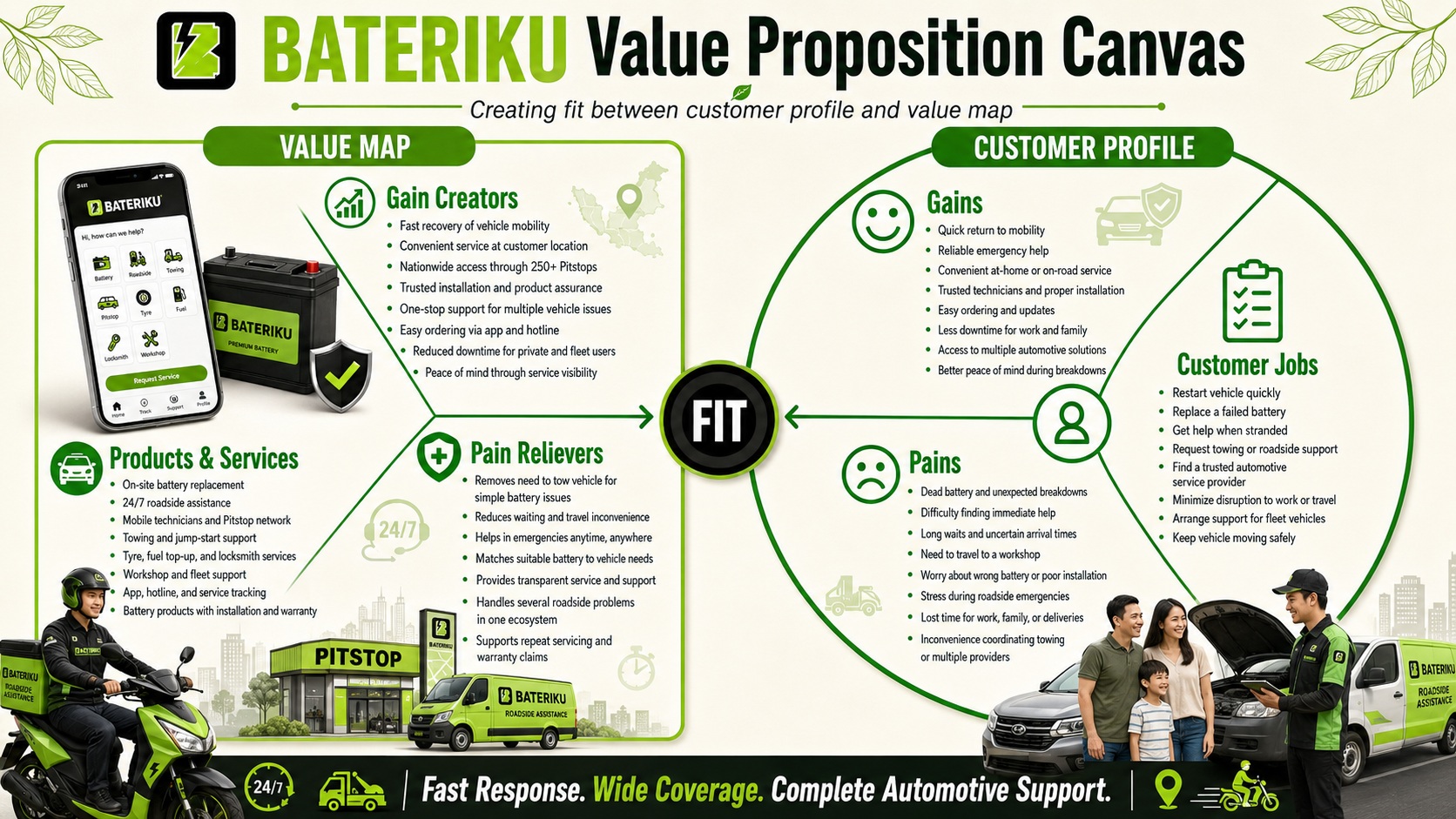
Customer Profile
The customer profile identifies what motorists are trying to accomplish, what frustrates them, and what outcomes they value.
Customer Profile of Bateriku
| Customer Profile | Details |
|---|---|
| Customer Jobs | Restart a vehicle, replace a failed battery, obtain roadside help, minimise downtime, find trustworthy automotive assistance and continue the journey |
| Customer Pains | Being stranded, uncertain diagnosis, long waiting times, towing inconvenience, unsuitable products, unexpected prices and unreliable technicians |
| Customer Gains | Fast arrival, accurate diagnosis, transparent options, professional installation, trusted products, convenient payment and successful journey continuation |
The customer is ultimately buying restored mobility rather than simply purchasing a battery.
That distinction explains why response quality can be as important as product specifications.
Value Map
The value map shows how Bateriku responds to the customer jobs, pains and gains identified above.
Its offer combines products, human assistance, physical locations and digital coordination.
Value Map of Bateriku
| Value Map | Details |
|---|---|
| Products and Services | Automotive batteries, battery installation, jump-starts, towing, tyres, fuel delivery, locksmith services, workshops, insurance-related solutions, digital ordering and physical Pitstops |
| Pain Relievers | On-site assistance, fast dispatch, product matching, inspection, installation, broad geographic coverage, tracking and access to multiple roadside solutions |
| Gain Creators | Reduced downtime, easier ordering, reliable technician access, one-stop assistance, nationwide service availability, product choice and convenient fulfilment |
The strongest value comes from combining physical service capability with digital access.
Technology may initiate the request, but human execution ultimately determines whether the customer gets moving again.
How Bateriku Creates Fit
The table below directly connects customer requirements with Bateriku’s response.
| Customer Profile | Details | Matching Value Map | How Bateriku Creates Fit |
|---|---|---|---|
| Customer Jobs | Restore vehicle mobility quickly | Products and Services | Provides batteries and multiple roadside solutions through one ecosystem |
| Customer Pains | Breakdown uncertainty, delays and difficulty finding help | Pain Relievers | Dispatches technicians and provides distributed service access |
| Customer Gains | Fast, trustworthy and convenient assistance | Gain Creators | Combines physical coverage, mobile fulfilment, digital ordering and product choice |
The fit is strongest when Bateriku can diagnose the problem, locate the appropriate resource, dispatch assistance, complete the service, and restore mobility with minimal customer effort.
Where the Fit Happens
The strongest fit occurs during unexpected breakdowns where convenience and response speed are more important than traditional workshop browsing.
A vehicle owner at home may need a replacement battery before leaving for work. Another motorist could be stranded in a car park or roadside location. Fleet operators may need fast intervention because vehicle downtime directly affects business productivity.
Physical Pitstops extend the fit beyond emergency situations by allowing customers to access products and automotive services through conventional locations.
Broader service categories also increase relevance. A customer whose problem is not battery-related may still remain within Bateriku’s ecosystem through towing, tyre assistance, fuel delivery, locksmith support or workshop services. (Bateriku.com)
Bateriku VPC Diagram
The VPC diagram should show customer jobs, pains and gains on the Customer Profile side and Bateriku’s products and services, pain relievers and gain creators on the Value Map side.
Bateriku vs CARPUT Business Model
The Bateriku Business Model Canvas overlaps most directly with CARPUT in on-demand battery replacement and roadside assistance.
CARPUT promotes battery delivery and installation, jump-start services and other roadside solutions, with its website positioning technicians as arriving at the customer’s location and completing the work on-site. (carput.my)
Only BMC blocks where the comparison is strategically relevant are included below.
Comparison Table
| Relevant BMC Block | Bateriku | CARPUT | Strategic Difference |
|---|---|---|---|
| Value Propositions | Broad automotive ecosystem covering batteries and multiple roadside needs | Strong on-demand roadside problem-solving proposition | Bateriku is increasingly positioned as a wider ecosystem |
| Channels | App, website, call centre, 250+ Pitstops, BHeroes, BPreneurs and partners | Primarily direct roadside-service and digital channels | Bateriku combines physical and distributed channels |
| Key Resources | Large Pitstop footprint, entrepreneurship network, technology and proprietary products | Technician network, service platform and roadside capabilities | Bateriku has invested more visibly in ecosystem breadth |
| Key Activities | Battery fulfilment, roadside services, workshops, network management and ecosystem development | Roadside assistance and on-site vehicle support | Bateriku operates across more adjacent activities |
| Key Partnerships | Extensive automotive, insurance, mobility, entrepreneur and technology ecosystem | Automotive and roadside-service partners | Partnership breadth supports Bateriku’s platform strategy |
The strategic difference is therefore not simply which company can deliver a battery faster. Competition increasingly concerns ecosystem coverage, fulfilment reliability, customer acquisition, network economics, and the ability to solve more vehicle problems per relationship.
Competitive Advantages
Bateriku possesses several reinforcing strengths that distinguish it from smaller battery retailers and traditional workshops.
- Extensive physical and mobile network: More than 250 Pitstops combined with distributed service personnel creates significant geographic reach. (Bateriku Investor)
- Strong emergency-convenience proposition: Assistance is brought to customers instead of requiring stranded motorists to arrange workshop transport.
- Broader automotive ecosystem: Towing, tyres, fuel delivery, locksmith services, workshops and other offerings create cross-selling opportunities beyond batteries. (Bateriku.com)
- Scalable entrepreneurship model: BHero and BPreneur programmes enable external participants to contribute fulfilment capacity and local market presence. (Bateriku.com)
- Growing vertical integration and innovation: Proprietary battery products, technology capabilities, fleet services, diagnostics and emerging EV partnerships extend Bateriku beyond a conventional reseller. (Bateriku Investor)
These advantages reinforce one another when network density improves customer convenience while higher demand improves utilisation of the ecosystem.
Risks and Challenges
Bateriku’s expansion also introduces meaningful strategic and operational challenges.
- Increasing ecosystem complexity: Managing technicians, entrepreneurs, branches, workshops, inventories and multiple service categories may make consistency harder as the network grows.
- Service-quality variability: Customer perception can be damaged if response time, technician professionalism or service standards differ materially between locations.
- Network utilisation risk: Rapid Pitstop expansion can create underperforming locations if local transaction volume does not justify operating costs.
- Competitive pressure: CARPUT, battery manufacturers, workshops, insurers, dealerships, marketplaces and other roadside providers can compete for the same motorists.
- Automotive technology transition: Growth in hybrid and electric vehicles may eventually change traditional lead-acid battery demand and require new technical capabilities, equipment, safety practices and investment.
Expansion therefore needs to be accompanied by tighter operating discipline rather than network growth alone.
Strategic Recommendations
Bateriku should protect the network advantages already created while improving economics, customer retention and capability depth. Expansion should increasingly be measured by profitable service density rather than the number of outlets or partners alone.
1. Increase Revenue per Customer
Bateriku should use battery replacement as an entry point into broader vehicle-care relationships.
Relevant offers could include scheduled battery checks, tyre services, workshop referrals, insurance renewal, diagnostics and preventive maintenance.
2. Optimise Pitstop Economics
Management should monitor transaction volume, contribution margin, inventory turns, service radius and customer acquisition by location.
New Pitstops should improve network economics rather than simply increase geographic coverage.
3. Strengthen Service Standardisation
BHero, BPreneur and partner quality should be supported through common training, certification, service procedures, customer ratings and performance monitoring.
Fast fulfilment has limited value if quality becomes unpredictable.
4. Build a Stronger Customer Data Advantage
Vehicle type, battery history, service records and purchasing behaviour can support proactive reminders and personalised offers.
Data should be converted into higher retention rather than used only for transaction processing.
5. Develop EV Capabilities Selectively
EV expansion should focus on areas where Bateriku’s existing network creates an advantage, including diagnostics, roadside support, auxiliary batteries, charging-related assistance and selected after-sales services.
6. Deepen B2B and Fleet Relationships
Fleet customers can create repeat service volume and improve network utilisation.
Service-level agreements, centralised billing, diagnostics and preventive maintenance could strengthen this segment.
7. Protect Direct Customer Relationships
Partnerships can generate valuable demand, but Bateriku should continue strengthening its own application, website, customer accounts, loyalty mechanisms and service history.
Direct relationships improve customer knowledge and reduce excessive dependence on intermediaries.
Recommendations for Entrepreneurs
Entrepreneurs can extract several useful lessons from Bateriku without attempting to reproduce its national scale.
First, solve the customer’s complete problem rather than simply selling the product. Motorists experiencing battery failure primarily want their mobility restored.
Second, convenience can justify a stronger value proposition. Bringing products and expertise to the customer removes significant friction.
Third, technology becomes powerful when connected to operational execution. An app alone does not create competitive advantage unless technicians, inventory and service processes can fulfil the request.
Fourth, networks can expand capacity more efficiently than owning every resource directly. Carefully structured partnerships allow businesses to access complementary expertise and geographic coverage.
Finally, adjacent services can increase customer lifetime value. Once trust has been established through one transaction, businesses can address additional related needs rather than repeatedly paying to acquire new customers.
Conclusion
Bateriku demonstrates how a relatively traditional automotive product can become the foundation of a technology-enabled service ecosystem.
The company began with a clear problem: motorists with failed batteries needed convenient assistance. Its model subsequently expanded through mobile technicians, physical Pitstops, entrepreneurship programmes, digital platforms, roadside services, workshops, product development, corporate partnerships and emerging mobility capabilities.
That evolution creates stronger competitive barriers than battery retailing alone. A competitor can sell the same battery, but reproducing geographic coverage, fulfilment capacity, customer relationships, operating data, partner networks and physical infrastructure takes considerably more effort.
Future performance will nevertheless depend on network economics. More Pitstops, technicians and services create value only when utilisation, service consistency, customer retention and margins remain healthy.
Bateriku’s next strategic challenge is therefore not simply becoming larger. It is turning its growing ecosystem into a more integrated, productive and recurring automotive relationship with each customer.
Disclaimer
This article is intended solely for educational, analytical and informational purposes. It represents an independent interpretation of Bateriku’s publicly observable business model and does not constitute official information, financial advice, investment advice, or a representation by Bateriku (M) Sdn. Bhd., CARPUT, or any other organisation mentioned.
The analysis is based on publicly available company websites, corporate announcements, news material and other information available at the time of writing in 2026. Certain commercial information, including detailed revenue composition, profitability, unit economics, contractual arrangements and internal operating metrics, is not publicly available.
Business models also evolve over time. Readers should therefore conduct additional research and obtain appropriate professional advice before making business, investment or strategic decisions based on this article.
All company names, brand names, logos, trademarks, service marks and other intellectual property referenced remain the property of their respective owners. The use of such names and marks is solely for identification, commentary, education and analysis and does not imply any affiliation or endorsement. Any images, screenshots, logos, product references or other copyrighted materials that may appear are used for commentary, discussion, identification and educational purposes. Copyright remains with the respective copyright holders.
Meta Description
Bateriku Business Model Canvas analysis updated in 2026 covering Bateriku’s nine BMC blocks, Value Proposition Canvas, CARPUT comparison, competitive advantages, risks and strategic recommendations.

