



Share This Article


CARPUT Business Model Canvas: Business Model, Strategy and Value Proposition Analysis
BMC Article No: BMC #075
Introduction
CARPUT represents a modern approach to automotive roadside assistance by bringing essential services directly to motorists instead of requiring customers to visit a workshop or battery outlet. Its model combines mobile battery replacement, roadside support, digital booking, technician dispatch and location-based fulfilment.
The CARPUT Business Model Canvas is particularly interesting because the company is not simply selling automotive batteries. It is packaging products, technical expertise, logistics and convenience into an on-demand service designed around a customer’s immediate mobility problem.
Battery replacement forms the core proposition, supported by jump-start assistance, towing and flat-tyre services. Digital channels make it easier for customers to request help, provide vehicle information and communicate their location, while technicians complete the physical service at the roadside, home or workplace.
CARPUT therefore operates across several business categories at the same time: automotive retail, mobile servicing, roadside assistance and digitally coordinated field operations.
This analysis explores how the nine BMC blocks work together, how CARPUT creates customer value, how it compares with Bateriku, BateriHub and MyAssist, and where future opportunities and strategic risks may emerge.
What Is CARPUT’s Business Model?
CARPUT operates primarily through an on-demand automotive assistance model in which products and technicians are brought directly to the customer.
At the centre of the CARPUT Business Model Canvas is mobile battery replacement. Customers who experience battery problems can request assistance, provide their vehicle and location details, and receive an appropriate battery together with installation services.
Three commercial mechanisms support the model.
First, CARPUT generates revenue through the sale and installation of automotive batteries. The product is bundled with convenience because customers avoid travelling to a workshop or battery store.
Second, roadside services such as jump-start assistance, towing and flat-tyre support expand the company’s ability to monetise different breakdown scenarios.
Third, digital coordination improves operational efficiency. Booking systems, customer information, location data and technician dispatch help match demand with available service capacity.
The model therefore competes on more than price. Customers are also paying for reduced downtime, fewer logistical complications and faster restoration of mobility.
CARPUT effectively transforms a conventional automotive purchase into a location-based service experience.
What Is Business Model Canvas?
The Business Model Canvas is a strategic framework used to explain how an organisation creates value, delivers that value and captures economic returns.
For CARPUT, the framework helps reveal the operating system behind what appears to the customer as a simple roadside transaction.
A technician arriving with a battery depends on multiple capabilities working together: customer acquisition, booking, vehicle identification, inventory availability, dispatch, transportation, installation, payment and after-sales support.
The CARPUT Business Model Canvas organises these activities into nine interconnected blocks.
| BMC Block | Main Question |
|---|---|
| Customer Segments | Who does CARPUT serve? |
| Value Propositions | Why would customers choose CARPUT? |
| Channels | How does CARPUT reach and serve customers? |
| Customer Relationships | How does the company build trust and repeat usage? |
| Revenue Streams | How does CARPUT earn income? |
| Key Resources | What assets enable service delivery? |
| Key Activities | What must CARPUT execute effectively? |
| Key Partnerships | Which external parties support the model? |
| Cost Structure | What are the major costs? |
Analysing all nine blocks together provides a more complete view of CARPUT than looking only at battery sales or roadside assistance.
Quick Overview of CARPUT
CARPUT operates within Malaysia’s automotive battery replacement and roadside assistance market.
Its core service model is built around solving selected vehicle problems at the customer’s location. Rather than asking motorists to move an immobilised vehicle, the company moves technicians, equipment and suitable battery inventory toward the customer.
The CARPUT Business Model Canvas benefits from strong demand density in urban locations. When customers are concentrated within manageable service zones, technicians can potentially complete more jobs while reducing travelling time.
Product availability is another important part of the model. Different vehicles require different battery sizes, capacities and technologies, meaning inventory must be sufficiently broad without creating excessive stockholding costs.
Technology provides the coordination layer. Digital booking and location information can help CARPUT determine what service is required, identify the vehicle and assign an appropriate technician.
Operational performance ultimately determines whether the model works. Fast marketing response is valuable only when the required battery and technician are actually available.
CARPUT must therefore manage demand generation, stock positioning and technician capacity as one integrated system.
Why CARPUT Is Strategically Interesting
CARPUT is strategically interesting because it transforms a traditional workshop-based automotive service into an on-demand convenience model.
A dead battery creates several customer problems simultaneously. The vehicle may not start, the driver may be late, the cause may be uncertain and transporting the car to a workshop may require additional effort.
The CARPUT Business Model Canvas addresses these frictions by taking the service directly to the customer.
Urgency also creates strong purchase intent. Motorists experiencing a breakdown are generally motivated to solve the problem immediately rather than delay the transaction.
That commercial advantage comes with higher expectations. Customers expect fast response, correct diagnosis, suitable products and clear communication.
Digital capability alone is therefore insufficient. A smooth booking experience loses value if the technician arrives late or does not carry the correct battery.
CARPUT’s strategic advantage depends on combining digital convenience with disciplined physical execution.
The business becomes more defensible when technology improves technician utilisation, inventory accuracy and service reliability rather than merely acting as another booking channel.
Business Model Developments Affecting CARPUT
The roadside assistance market is becoming increasingly digital, transparent and convenience-driven.
Consumers now expect service categories that were traditionally offline to provide easier booking, location sharing, status updates and cashless transactions.
Mobile automotive servicing is also becoming more accepted. Battery replacement, tyre support and basic roadside services no longer need to take place exclusively in workshops.
These developments strengthen the CARPUT Business Model Canvas, but they also lower barriers for competitors adopting similar digital channels.
Competition can come from dedicated battery companies, roadside assistance platforms, workshops, insurers, vehicle service networks and local mobile technicians.
Consequently, digital ordering alone is unlikely to provide sustainable differentiation.
Response speed, technician quality, battery availability and customer communication become increasingly important once multiple competitors offer similar booking convenience.
CARPUT therefore needs to treat operations as part of its brand proposition.
A customer who receives the correct solution quickly is more likely to remember the company positively than one who simply encounters an attractive website.
Long-term differentiation will depend on how consistently CARPUT turns customer requests into successful first-time resolutions.
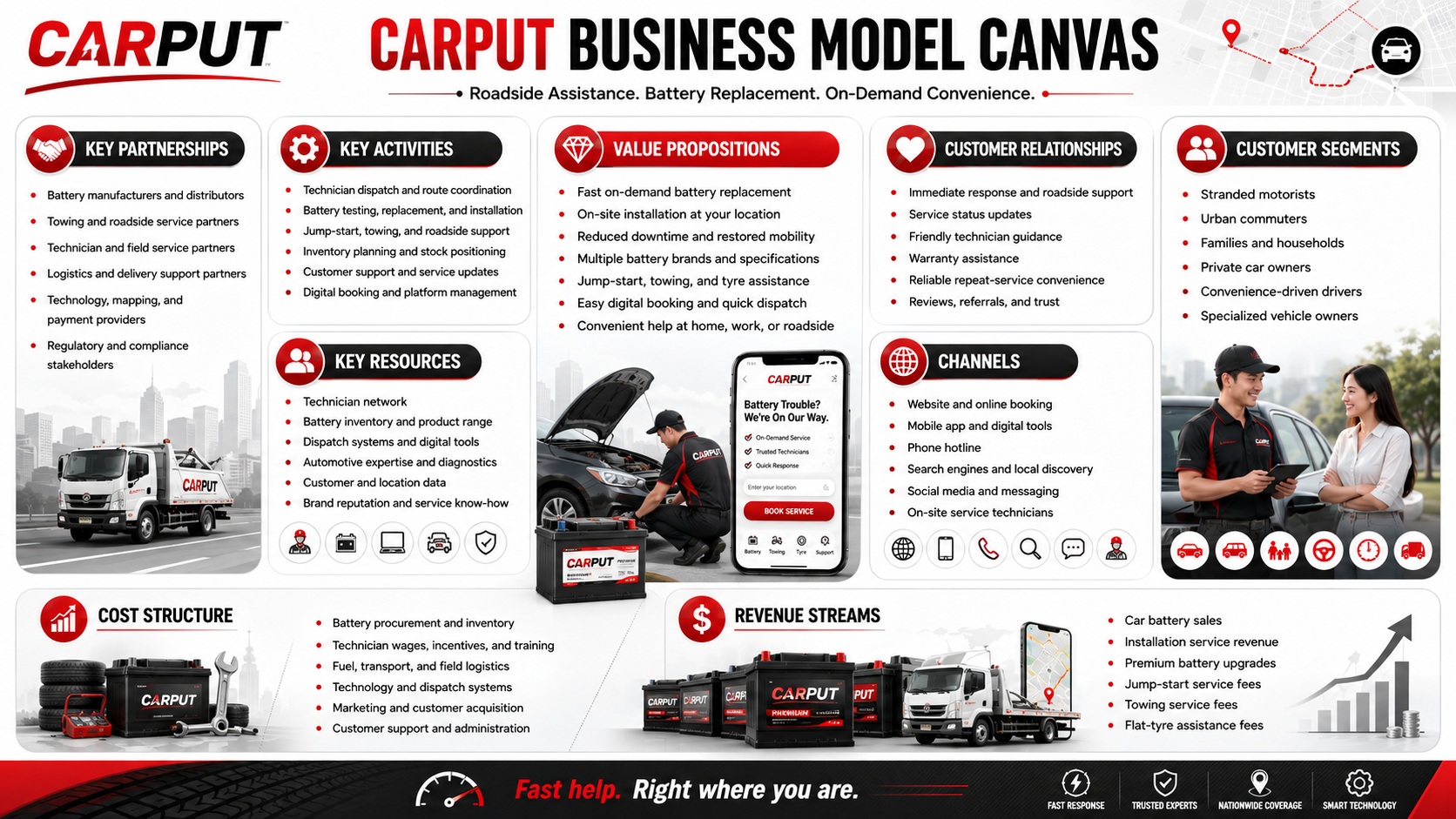
CARPUT Business Model Canvas Summary
The following table provides a high-level view of the CARPUT Business Model Canvas before each block is examined in detail.
Its structure combines automotive product sales, mobile field services and technology-enabled coordination.
| BMC Block | CARPUT Application |
|---|---|
| Customer Segments | Stranded motorists, urban commuters, households, convenience-oriented motorists and specialised vehicle owners |
| Value Propositions | On-demand battery replacement, fast assistance, roadside support, product choice and reduced inconvenience |
| Channels | Website, search engines, telephone, digital booking, social media and mobile technicians |
| Customer Relationships | Immediate support, service updates, technician interaction, warranty assistance and reviews |
| Revenue Streams | Battery sales, installation, jump-start, towing and flat-tyre services |
| Key Resources | Technician network, battery inventory, dispatch technology, brand and automotive expertise |
| Key Activities | Dispatch, installation, roadside assistance, inventory management, customer support and digital operations |
| Key Partnerships | Battery suppliers, technicians, towing providers, technology firms and payment providers |
| Cost Structure | Battery procurement, technician expenses, transportation, marketing, technology and customer support |
The model becomes stronger when these blocks reinforce one another rather than operating as separate functions.
Detailed CARPUT Business Model Canvas Analysis
Roadside assistance appears straightforward from the outside. A customer requests help, a technician arrives and the problem is resolved.
Behind that interaction, however, several operating variables must align simultaneously.
The CARPUT Business Model Canvas depends on having the right technician, battery, location information and equipment available at the right time.
A wider service area may create more potential customers, but it can also increase travelling distance and reduce technician productivity.
More battery options increase customer choice while simultaneously creating greater inventory complexity.
Marketing can increase booking volume, yet additional demand becomes valuable only when sufficient fulfilment capacity exists.
For this reason, CARPUT should not evaluate the nine BMC blocks independently.
Customer acquisition affects dispatch requirements. Service promises influence technician capacity. Inventory decisions affect response reliability, while geographical expansion changes the cost structure.
The following sections examine each block and its role within the overall business model.
1. Customer Segments
CARPUT primarily segments customers according to mobility problems, urgency and convenience requirements rather than demographics alone.
Stranded motorists represent the most immediate segment because a failed battery, tyre issue or other roadside problem creates urgent demand.
Urban commuters are important because vehicle downtime can interrupt work and daily schedules. Households also create opportunities because one family may own several vehicles and require repeated battery or roadside services over time.
Convenience-oriented motorists expand the market beyond emergencies. These customers may prefer battery installation at home or work even when their vehicle can still be driven.
Specialised vehicle owners represent another segment because premium, start-stop and technologically sophisticated vehicles may require more specific battery technologies.
CARPUT Customer Segments
| Segment | Details | Why It Matters |
|---|---|---|
| Stranded motorists | Drivers facing immediate roadside problems | Creates urgent purchase intent |
| Urban commuters | Motorists dependent on vehicles daily | Values speed and low downtime |
| Families and households | Owners of one or more vehicles | Supports repeat usage |
| Convenience customers | Customers preferring service at their location | Extends demand beyond emergencies |
| Specialised vehicle owners | Drivers requiring specific battery technologies | Supports higher-value transactions |
The CARPUT Business Model Canvas therefore serves customers united by one fundamental need: restoring or maintaining mobility with minimal effort. Emergency customers provide strong immediate demand, while households and convenience users offer repeat potential. Specialised vehicle owners can further increase transaction value. A balanced mix of these segments reduces dependence on breakdown-only demand and gives CARPUT opportunities to develop longer customer relationships around vehicle support.
2. Value Propositions
CARPUT’s value proposition extends beyond simply supplying an automotive battery.
Customers experiencing battery failure primarily want their mobility restored. The product is only one component of that outcome.
On-demand assistance eliminates the need to find a nearby shop or manually transport a replacement battery.
Mobile installation adds further convenience because testing, fitting and basic technical work are completed at the vehicle location.
Different battery choices allow customers to select products based on vehicle requirements, preferred brands and budget.
Roadside services broaden the proposition beyond batteries by addressing jump-start, tyre and towing requirements.
CARPUT Value Propositions
| Value Proposition | Details | Why It Matters |
|---|---|---|
| On-demand assistance | Technician travels to the vehicle | Minimises customer effort |
| Mobile battery replacement | Battery delivered, tested and installed on site | Removes workshop dependency |
| Product choice | Different brands and specifications | Supports varied customer requirements |
| Roadside assistance | Jump-start, towing and tyre support | Addresses more breakdown situations |
| Reduced downtime | Faster restoration of vehicle mobility | Solves the customer’s core problem |
The value proposition in the CARPUT Business Model Canvas is therefore built around convenient mobility recovery rather than battery retail alone. Speed removes downtime, on-site installation removes logistical friction and product choice improves suitability. Additional roadside services increase the number of customer problems CARPUT can resolve. The proposition becomes strongest when these elements work together, allowing the company to arrive quickly, identify the real problem and complete the appropriate solution during the first visit.
3. Channels
CARPUT requires channels capable of reaching motorists precisely when automotive problems occur.
Search engines are strategically important because roadside assistance often involves high-intent searches. Someone looking for an emergency battery replacement may be ready to purchase immediately.
The company website can provide information, explain services and convert customers into bookings.
Telephone communication remains useful when motorists require immediate reassurance or assistance choosing the correct service.
Digital booking allows structured collection of location and vehicle information.
Mobile technicians complete the final stage because fulfilment physically occurs where the vehicle is located.
CARPUT Channels
| Channel | Details | Why It Matters |
|---|---|---|
| Website | Service information and booking conversion | Captures online demand |
| Search engines | Reaches high-intent customers | Supports urgent acquisition |
| Telephone | Direct booking and customer assistance | Enables immediate communication |
| Digital booking | Captures location and vehicle information | Improves fulfilment accuracy |
| Mobile technicians | Deliver the physical service | Completes the customer journey |
CARPUT therefore follows a digital-to-physical channel structure. Online channels create visibility and capture demand, but technicians ultimately determine whether that demand converts into a successful service. Strong channel performance should consequently be measured beyond clicks or bookings. Accurate information capture, fast dispatch and successful first-time resolution matter just as much. Integrating acquisition, booking and field fulfilment tightly can reduce customer effort while improving technician utilisation and overall service consistency.
4. Customer Relationships
Customer relationships in roadside assistance are built under unusual circumstances because many customers contact the company while experiencing stress or disruption.
Responsiveness therefore becomes an important relationship mechanism.
Clear service updates can reduce anxiety by helping motorists understand what will happen next.
Technician interaction is particularly significant because the technician becomes the human face of CARPUT during the most important part of the journey.
Warranty assistance extends the relationship beyond the initial installation.
Positive reviews can influence future purchasing decisions because customers often look for trusted providers when selecting roadside assistance.
CARPUT Customer Relationships
| Relationship Type | Details | Why It Matters |
|---|---|---|
| Immediate support | Fast response during breakdowns | Builds confidence |
| Service updates | Communication on fulfilment progress | Reduces uncertainty |
| Technician interaction | Diagnosis and explanation on site | Creates personal trust |
| Warranty assistance | Support following battery installation | Reduces perceived risk |
| Reviews and referrals | Customer feedback and recommendations | Supports future acquisition |
The relationship model within the CARPUT Business Model Canvas therefore depends on reassurance before arrival, professionalism during service and support after completion. Each roadside interaction can influence whether CARPUT remains a one-time emergency provider or becomes a remembered automotive service brand. Good communication reduces uncertainty, while competent technicians build credibility. Warranty support and positive service recovery can strengthen retention. Consistency across these touchpoints is especially important because a single poor field experience can quickly affect reviews and future customer trust.
5. Revenue Streams
Automotive battery sales are likely to remain the principal revenue engine in CARPUT’s model.
Customers pay for the replacement product while receiving delivery and installation as part of the overall service experience.
Specialised battery products can generate higher transaction values because some modern vehicles require AGM, EFB or other specific technologies.
Jump-start assistance creates service revenue when replacement is not immediately necessary.
Towing generates income from situations that cannot be solved at the roadside.
Flat-tyre assistance creates another revenue source outside battery replacement.
CARPUT Revenue Streams
| Revenue Stream | Details | Why It Matters |
|---|---|---|
| Battery sales | Supply and installation of replacement batteries | Core revenue source |
| Specialised batteries | AGM, EFB and other premium specifications | Raises transaction value |
| Jump-start services | Restarting vehicles without replacement | Monetises smaller incidents |
| Towing | Vehicle transport for unresolved problems | Expands service revenue |
| Flat-tyre services | On-site tyre assistance | Diversifies income |
Revenue quality matters more than revenue volume alone. Battery margins, roadside service fees and premium products can generate attractive transactions, but profitability depends on technician time, travel distance, customer acquisition cost and inventory efficiency. Dense service areas can improve job economics because technicians spend less time travelling between customers. CARPUT should therefore evaluate revenue streams according to contribution per completed job and operating hour rather than focusing only on gross transaction value.
6. Key Resources
CARPUT requires a combination of human, physical, digital and intangible resources.
Technicians provide the field capacity necessary to deliver the actual service.
Battery inventory is equally important because customers require different specifications depending on vehicle type.
Dispatch technology helps connect incoming requests with available technicians and customer locations.
Automotive expertise supports accurate battery matching, diagnosis and installation.
Brand reputation provides confidence in a category where customers may be purchasing under time pressure.
CARPUT Key Resources
| Resource | Details | Why It Matters |
|---|---|---|
| Technician network | Personnel delivering roadside services | Determines fulfilment capacity |
| Battery inventory | Stock across relevant specifications | Enables first-visit replacement |
| Dispatch technology | Booking and technician coordination | Improves operational efficiency |
| Automotive expertise | Diagnosis and installation knowledge | Reduces service errors |
| Brand positioning | Customer recognition and credibility | Builds purchase confidence |
These resources must scale together rather than independently. Additional technicians provide little value without suitable battery inventory, while extensive stock does not improve service when field capacity is unavailable. Dispatch technology connects both resources to customer demand, and technical knowledge ensures the correct solution is delivered. Brand reputation ties the system together by influencing customer trust. CARPUT’s resource advantage therefore lies in integrating people, stock, information and operational capability into one reliable fulfilment network.
7. Key Activities
CARPUT’s most important activities revolve around coordinating customer demand with technicians and inventory.
Dispatch is critical because each request should be assigned to an appropriate technician within a reasonable distance.
Battery installation requires technical skill because the correct specification must be selected and fitted properly.
Inventory management helps ensure commonly requested batteries are available when required.
Roadside services allow the company to handle situations beyond battery replacement.
Digital platform management supports booking, communication and coordination.
CARPUT Key Activities
| Activity | Details | Why It Matters |
|---|---|---|
| Technician dispatch | Matching requests with nearby technicians | Protects response performance |
| Battery installation | Testing, fitting and replacement | Determines technical quality |
| Inventory management | Forecasting and positioning battery stock | Reduces stock-outs |
| Roadside assistance | Jump-start, towing and tyre support | Broadens service capability |
| Digital operations | Managing booking and coordination systems | Connects demand with fulfilment |
Operational excellence is central to the CARPUT Business Model Canvas because every customer promise must ultimately be executed in the field. Fast dispatch loses value when the wrong battery arrives, while perfect inventory availability is ineffective if technician allocation is slow. Roadside activities and digital coordination must therefore function as one workflow. Better integration can reduce failed visits, increase jobs completed per technician and strengthen the reliability customers associate with the CARPUT brand.
8. Key Partnerships
External partners allow CARPUT to expand its capabilities without owning every element of the automotive value chain.
Battery manufacturers and distributors support product availability, pricing and warranty arrangements.
Towing providers help CARPUT serve customers whose vehicles cannot be repaired or restarted at the roadside.
Technician partners may provide additional capacity and geographical flexibility.
Technology providers support communication, mapping, hosting and other digital functions.
Payment providers enable convenient transactions.
CARPUT Key Partnerships
| Partner | Details | Why It Matters |
|---|---|---|
| Battery suppliers | Manufacturers and distributors | Ensures product availability |
| Towing providers | Vehicle transport specialists | Handles unresolved breakdowns |
| Technician partners | Additional mobile service capacity | Supports wider coverage |
| Technology providers | Software, mapping and communications | Enables digital coordination |
| Payment providers | Electronic transaction services | Improves customer convenience |
Partnerships therefore extend the CARPUT Business Model Canvas beyond resources owned directly by the company. Reliable battery suppliers protect stock availability, towing partners expand problem-solving capability and technician partners can support demand peaks. Technology and payment providers reinforce the digital journey. Because customers usually perceive the entire experience as CARPUT’s responsibility, partner performance directly affects brand reputation. Service standards, response expectations and customer communication should consequently remain consistent across both internal and external providers.
9. Cost Structure
CARPUT combines the cost characteristics of a retailer, mobile service provider and digital operation.
Battery procurement represents a major variable cost because every replacement transaction requires physical inventory.
Technician expenses include wages, incentives, training or partner payments.
Transportation costs arise through fuel, motorcycles or service vehicles, maintenance and travel between jobs.
Technology expenses support digital booking, communications and dispatch.
Marketing and customer support generate and convert demand.
CARPUT Cost Structure
| Cost Category | Details | Why It Matters |
|---|---|---|
| Battery procurement | Purchasing and holding battery inventory | Major product cost |
| Technician expenses | Labour, incentives and training | Drives service capacity |
| Logistics | Fuel, vehicles and travel | Influences cost per job |
| Technology | Booking, dispatch and communications | Supports scalable coordination |
| Marketing and support | Acquisition and customer service | Generates and retains demand |
Cost efficiency ultimately depends on service density and operational productivity. Longer travelling distances increase fulfilment expense while reducing the number of jobs a technician can complete. Poor inventory planning ties up working capital or creates missed sales. Technology and marketing expenditure must also produce measurable operational value. CARPUT can strengthen its economics by positioning technicians and stock closer to demand, increasing successful first-time resolution and managing acquisition spending against contribution margin rather than transaction volume alone.
How the Nine BMC Blocks Work Together
The nine blocks do not operate independently.
Customer segments create demand from motorists who value mobility, convenience and rapid assistance.
Value propositions convert those needs into on-site battery replacement and roadside services.
Channels bring customers into the system, while customer relationships build confidence before, during and after service fulfilment.
Revenue streams monetise completed transactions.
Key resources supply the technicians, inventory, knowledge and technology necessary to deliver the promise.
Activities convert those resources into completed jobs, while partnerships expand capability.
The cost structure determines whether the entire system remains economically sustainable.
The CARPUT Business Model Canvas becomes strongest when customer density improves several blocks simultaneously. Concentrated demand can shorten travelling distance, improve technician utilisation and justify strategically positioned inventory.
Geographical expansion should therefore be managed carefully.
Serving more areas creates additional market potential, but excessive service radius can weaken response times, increase operating costs and require additional stock.
Profitable density is ultimately more important than coverage alone.
CARPUT Value Proposition Canvas
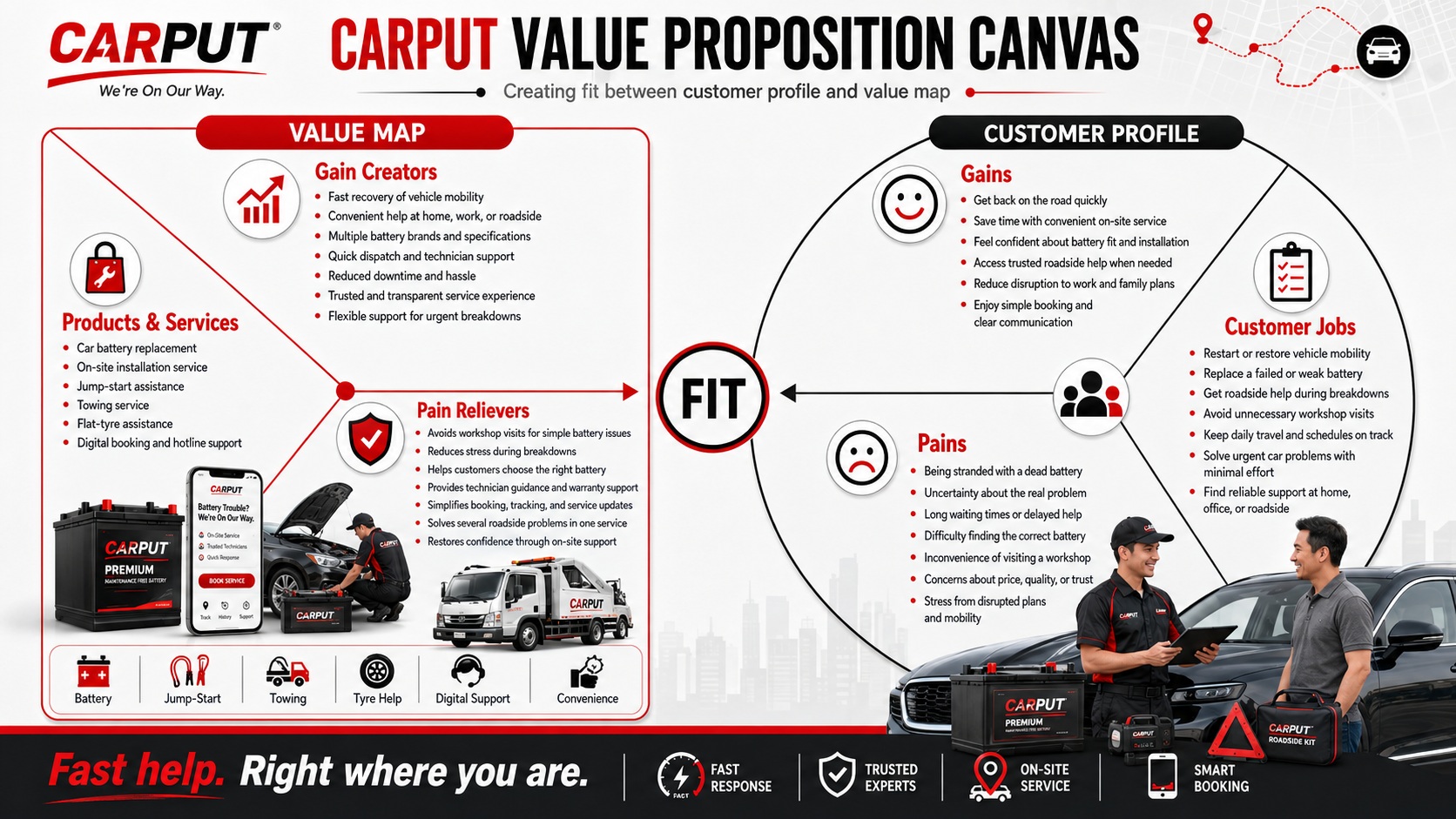
The Value Proposition Canvas provides a closer view of how CARPUT’s service offering matches customer needs.
While BMC explains how the overall company works, the VPC focuses on what motorists are trying to accomplish, what frustrates them and what outcomes they value.
The CARPUT Business Model Canvas becomes more meaningful when those customer requirements are connected directly to CARPUT’s products and services.
Motorists rarely want a battery for its own sake.
They want the vehicle to start, the problem solved quickly and their journey restored with minimal inconvenience.
CARPUT creates value when it reduces the time, effort and uncertainty involved in achieving those outcomes.
Customer Profile
The customer profile captures the practical and emotional considerations surrounding automotive breakdowns.
Customers may need to restart a vehicle, replace a faulty battery, get to work, continue a journey or move a disabled car safely.
Several pains can arise simultaneously. Motorists may not know the actual problem, which battery to purchase or how long roadside assistance will take.
Desired gains usually centre on speed, convenience and confidence.
CARPUT Customer Profile
| Customer Profile | Details |
|---|---|
| Customer Jobs | Restart the vehicle, replace a battery, restore mobility, continue travelling and minimise disruption |
| Customer Pains | Being stranded, uncertain diagnosis, waiting time, unsuitable batteries, unclear service and workshop inconvenience |
| Customer Gains | Fast assistance, correct diagnosis, suitable battery, convenient installation, dependable service and warranty support |
This profile shows that CARPUT competes against inconvenience and uncertainty as much as it competes against other battery providers.
Value Map
CARPUT’s value map describes the products and services used to solve those customer problems.
Battery replacement provides the core product and service combination.
Jump-start assistance addresses cases where immediate replacement may not be necessary.
Towing supports situations that require further workshop attention.
Flat-tyre assistance broadens the roadside proposition.
Digital booking and technician coordination reduce customer effort throughout the process.
CARPUT Value Map
| Value Map | Details |
|---|---|
| Products and Services | Battery replacement, installation, jump-start, towing, flat-tyre assistance and digital booking |
| Pain Relievers | On-site service, battery matching, technician dispatch and reduced workshop dependency |
| Gain Creators | Faster mobility recovery, convenience, service choice, product choice and simplified assistance |
The value map becomes strongest when CARPUT resolves the vehicle problem during the first service visit.
How CARPUT Creates Customer Fit
Customer fit occurs when CARPUT’s operating capabilities match the issues motorists consider most important.
Fast response is valuable, but only when the correct solution arrives.
Battery availability matters, although customers still expect professional installation and communication.
Convenience is strongest when the entire process requires little effort.
| Customer Profile | Details | Matching Value Map | How CARPUT Creates Fit |
|---|---|---|---|
| Customer Jobs | Restore vehicle mobility quickly | Products and Services | Brings automotive assistance directly to the vehicle |
| Customer Pains | Waiting, uncertainty and inconvenience | Pain Relievers | Uses dispatch and mobile service to reduce friction |
| Customer Gains | Fast, convenient and dependable recovery | Gain Creators | Combines product choice, service capability and location-based fulfilment |
The company therefore creates customer fit through coordinated execution rather than any single product feature.
CARPUT vs Bateriku vs BateriHub vs MyAssist
CARPUT competes within a Malaysian market that includes battery specialists, automotive service ecosystems and broader roadside assistance networks.
Bateriku follows a wider automotive ecosystem approach that combines battery replacement with several related roadside and vehicle services.
BateriHub emphasises battery retail and delivery supported by a substantial physical branch footprint.
MyAssist follows a broader roadside assistance model supported by fleet and panel-provider capabilities.
The CARPUT Business Model Canvas differs through its comparatively focused battery-first and speed-driven positioning.
CARPUT vs Bateriku vs BateriHub vs MyAssist (BMC-Based Comparison)
| BMC Block | CARPUT | Bateriku | BateriHub | MyAssist |
|---|---|---|---|---|
| Value Proposition | Fast on-demand battery replacement with focused roadside assistance (battery-first, speed-driven model) | Full automotive roadside ecosystem (battery, towing, locksmith, fuel, insurance support) | Battery-specialist retail + delivery with strong physical branch support | Broad roadside assistance covering multiple vehicle emergencies via network providers |
| Channels | Digital booking (web/app), phone, search, technician dispatch system | App, website, hotline, strong digital ecosystem + partner channels | Physical branches + delivery + walk-in + hotline | App, hotline, insurance/partner channels, panel provider network |
| Key Resources | Technician network, battery inventory, dispatch technology, brand positioning | Large service ecosystem, partner network, digital platform, nationwide coverage | 200+ physical branches, inventory hubs, retail infrastructure | Fleet + panel providers, nationwide service network, coordination system |
| Key Partnerships | Battery suppliers, technicians, towing partners, payment providers | Insurance companies, workshops, OEM partners, service vendors | Battery manufacturers, logistics partners, retail distributors | Panel workshops, towing partners, insurance companies, fleet partners |
| Revenue Streams | Battery sales + installation, jump-start, towing, flat tyre services | Multi-service revenue (battery, towing, locksmith, insurance-linked services) | Battery sales (core), installation services, retail upselling | Service-based revenue (battery, towing, roadside assistance packages) |
| Cost Structure | Technician cost, battery procurement, logistics, digital marketing, dispatch operations | High operational + partner coordination cost, platform + ecosystem maintenance | High fixed cost (branches, inventory, retail operations) | Network coordination cost, partner payouts, platform + fleet operations |
CARPUT’s strongest strategic position is likely to come from superior execution in its chosen niche rather than attempting to replicate the breadth of every competitor.
Competitive Advantages
Several competitive advantages emerge from the CARPUT Business Model Canvas.
- Focused battery-first proposition: Customers can quickly understand CARPUT’s core offer when they require urgent battery assistance.
- On-site convenience: Mobile fulfilment removes the need to travel to a workshop or battery outlet.
- Digital coordination: Booking, location information and dispatch capabilities can make the service journey faster and simpler.
- Multi-brand battery selection: Product variety enables CARPUT to serve different vehicle specifications, budgets and customer preferences.
- Complementary roadside services: Jump-start, towing and flat-tyre assistance allow the company to solve more customer problems.
These strengths work best when CARPUT avoids competing primarily on price.
Dependable fulfilment, accurate battery matching and professional roadside service can create stronger differentiation than discounts alone.
A focused brand position also allows CARPUT to communicate clearly what customers should expect when assistance is required.
Risks and Challenges
The business model also faces several strategic and operational challenges.
- Intense competition: Battery specialists, roadside platforms, workshops, insurers and automotive service providers compete for overlapping customers.
- Response-time pressure: Traffic, demand surges and technician shortages can undermine a speed-based promise.
- Inventory complexity: Different vehicle specifications require multiple battery types, increasing working-capital and stock-planning requirements.
- Technician consistency: Diagnosis, installation quality and customer communication need to remain consistent across the network.
- Customer acquisition cost: Competitive digital search terms can make emergency-demand acquisition increasingly expensive.
These challenges demonstrate why scale alone does not guarantee an attractive business.
CARPUT must protect service reliability as demand grows while ensuring that fulfilment costs remain commercially sustainable.
Operational data can become especially important for identifying where delays, stock-outs or inefficient technician movements reduce profitability.
Strategic Recommendations
The CARPUT Business Model Canvas can be strengthened through several strategic initiatives.
First, CARPUT should prioritise hyperlocal service density. Technician placement and battery inventory should reflect demand patterns by location, time and vehicle type.
Second, proactive battery replacement can reduce dependence on emergency transactions. Installation dates and vehicle histories could support reminders before expected battery failure.
Third, fleet and corporate customers represent an attractive recurring segment. Ride-hailing drivers, delivery businesses, leasing companies and corporate fleets can provide more predictable demand.
Fourth, vehicle and service data should become a strategic asset. Better records can improve battery matching, personalise offers and reduce failed dispatches.
Finally, membership-based services could increase retention. Priority assistance, periodic battery checks, service discounts and replacement reminders could create recurring relationships.
Together, these measures would gradually shift CARPUT from a breakdown-driven transaction model toward a broader vehicle-support platform.
Such evolution could improve customer lifetime value while making demand more predictable.
Conclusion
The CARPUT Business Model Canvas demonstrates how a traditional automotive product can be transformed into an on-demand service business.
CARPUT combines battery inventory, technicians, roadside assistance and digital coordination to solve a fundamental customer problem: restoring vehicle mobility with minimal inconvenience.
Its strongest competitive advantage is not technology by itself.
The website, booking tools and dispatch systems create value only when they enable faster, more reliable physical fulfilment.
Future growth should therefore balance customer acquisition with technician capacity, battery availability and service density.
Larger competitors may offer broader ecosystems or stronger physical networks, but CARPUT can differentiate through focus, speed and customer experience.
The longer-term opportunity lies in moving beyond emergency roadside transactions.
Proactive battery replacement, vehicle data, fleet relationships and membership programmes can increase recurring revenue and customer retention.
If these capabilities are developed successfully, CARPUT can evolve from a mobile battery and roadside assistance provider into a more comprehensive on-demand automotive convenience platform.
Disclaimer
This article is provided solely for educational and informational purposes. It represents an independent business model analysis based on publicly available information, market observations and strategic interpretation.
Nothing in this article constitutes financial, investment, legal, commercial, automotive or other professional advice. Readers should conduct their own research and obtain suitable professional advice before making business or investment decisions.
This article is not an official publication, endorsement, representation or statement from CARPUT, Bateriku, BateriHub, MyAssist or any related organisation.
All trademarks, company names, logos, product names, copyrights and other intellectual property referenced in this article remain the property of their respective owners.
Meta Description
Explore the CARPUT Business Model Canvas, nine BMC blocks, Value Proposition Canvas, competitor comparison, competitive advantages, risks and strategic recommendations.

