



Share This Article


Naelofar Business Model Canvas: How a Malaysian Modest Fashion Brand Built a Digital-Led Lifestyle Business
BMC Article No: BMC #004
Updated in 2026: This article has been rewritten with a stronger business story, clearer Business Model Canvas structure, Value Proposition Canvas view, competitive advantages, risks, and strategic lessons from Naelofar’s growth journey.
Introduction
Naelofar is a Malaysian modest fashion brand associated with celebrity entrepreneur Neelofa. The brand became known for modern hijabs, Muslimah fashion, stylish patterns, practical designs, and strong social media visibility.
This makes the Naelofar business model interesting. It is not only about selling hijabs. The brand competes through identity, trust, product design, influencer power, e-commerce access, and lifestyle positioning.
Muslimah fashion is also a fast-moving category. Customers want modest clothing, but they also want style, comfort, self-expression, and convenience. Naelofar serves this demand by combining fashion design with digital marketing and brand storytelling.
In this article, the Naelofar Business Model Canvas keyword is used as requested while the analysis focuses on Naelofar. We will examine how Naelofar creates value, reaches customers, earns revenue, manages cost, and protects its position in the modest fashion market.
What Is Naelofar’s Business Model?
Naelofar’s business model is built around branded modest fashion. The company sells hijabs, shawls, bawal scarves, instant hijabs, dresses, blouses, jubah, accessories, and selected lifestyle products through online channels, retail presence, social media campaigns, and collaborations.
Its main strength is brand aspiration. Customers are not buying fabric alone. They are buying confidence, elegance, convenience, and association with a recognizable Malaysian lifestyle brand.
However, fashion demand changes quickly. New colours, prints, materials, influencer trends, and customer preferences can shift within a season. Naelofar must keep refreshing its products without losing its core identity.
The Naelofar Business Model Canvas lens helps readers see that a fashion brand needs more than creative products. Design, sourcing, inventory, marketing, customer engagement, and distribution must work together.
What Is Business Model Canvas?
Business Model Canvas, or BMC, is a practical tool used to understand how a company works. It explains how a business creates value, delivers that value to customers, and converts it into revenue.
Instead of looking only at products, BMC breaks the business into nine operating blocks. These blocks make the model easier to analyze.
| BMC Block | Main Question |
|---|---|
| Customer Segments | Who does the business serve? |
| Value Propositions | What value does the business offer? |
| Channels | How does the business reach customers? |
| Customer Relationships | How does the business build loyalty? |
| Revenue Streams | How does the business make money? |
| Key Resources | What assets does the business need? |
| Key Activities | What must the business do well? |
| Key Partnerships | Who helps the business operate? |
| Cost Structure | What are the major costs? |
For Naelofar, BMC is useful because the brand involves design, celebrity-led branding, e-commerce, retail, suppliers, logistics, social media, and customer trust.
Quick Overview of Naelofar
Naelofar is widely recognized in Malaysia’s modest fashion space. The brand built visibility through hijab collections, Muslimah apparel, celebrity influence, and strong digital engagement.
Its early appeal came from a clear customer problem. Many Muslim women wanted hijabs that looked elegant but were still practical for work, study, events, travel, and daily wear. Naelofar responded with designs that balanced modesty, style, and convenience.
Recent developments show a broader modest lifestyle direction. Naelofar now highlights categories such as Raya 2026 products, Ramadan abaya collections, shawls, square hijabs, instant and semi-instant styles, khimar, printed hijabs, apparel, and NPOWER sportswear.
Over time, the brand expanded beyond basic hijabs into fuller wardrobe solutions. This wider product architecture allows Naelofar to increase basket size, serve more occasions, and reduce dependence on a single hijab category.
From a strategic view, the Naelofar Business Model Canvas structure shows why Naelofar is more than a product seller. It is a hybrid modest fashion platform built around customer identity, seasonal collections, digital reach, offline activation, and lifestyle relevance.
Why Naelofar Is Strategically Interesting
Naelofar is interesting because it turns modest fashion into an aspirational lifestyle category. The brand does not compete only on price. It competes on trust, personality, design appeal, social proof, and product accessibility.
A customer may buy Naelofar for workwear. Another customer may buy it for Raya, weddings, travel, or daily styling. Younger customers may follow the brand because of social media content and founder visibility.
This gives Naelofar more than one purchase occasion. The brand can release seasonal collections, limited designs, colour variants, campaign-based products, and collaborations. Its recent focus on Raya, Ramadan abayas, sportswear, and wider modestwear also shows how the brand can stretch from daily hijabs into occasionwear and lifestyle categories.
Strategically, the Naelofar Business Model Canvas perspective shows how brand equity can become an operating asset. When customers already recognize the name, new product launches can gain faster attention.
Naelofar BMC Summary
Before reviewing each block, the summary below gives a quick view of how Naelofar’s model works. It shows the customer base, value offered, channels used, revenue sources, and resources needed.
| BMC Block | Naelofar Application |
|---|---|
| Customer Segments | Muslim women, young professionals, students, modest fashion buyers, eventwear customers, sportswear buyers, gift buyers, and international Muslimah consumers. |
| Value Propositions | Stylish modest fashion, practical hijab designs, abaya collections, sportswear options, premium brand feel, comfort, confidence, and accessible online shopping. |
| Channels | Official website, social media, Shopee, boutiques, department stores, mall locations, stockists, campaign launches, influencer content, and community activations. |
| Customer Relationships | Social media engagement, product drops, customer service, loyalty offers, community identity, festive campaigns, roving retail activation, and campaign storytelling. |
| Revenue Streams | Hijab sales, apparel sales, abayas, sportswear, accessories, seasonal collections, collaborations, online sales, marketplace sales, and retail sales. |
| Key Resources | Brand equity, founder visibility, design capability, supplier network, digital platforms, customer data, and creative content. |
| Key Activities | Product design, sourcing, campaign planning, inventory management, marketing, fulfilment, customer service, and quality control. |
| Key Partnerships | Fabric suppliers, manufacturers, logistics providers, payment platforms, influencers, retail partners, and creative agencies. |
| Cost Structure | Material costs, production, staff, marketing, logistics, platform costs, retail operations, inventory holding, and campaign costs. |
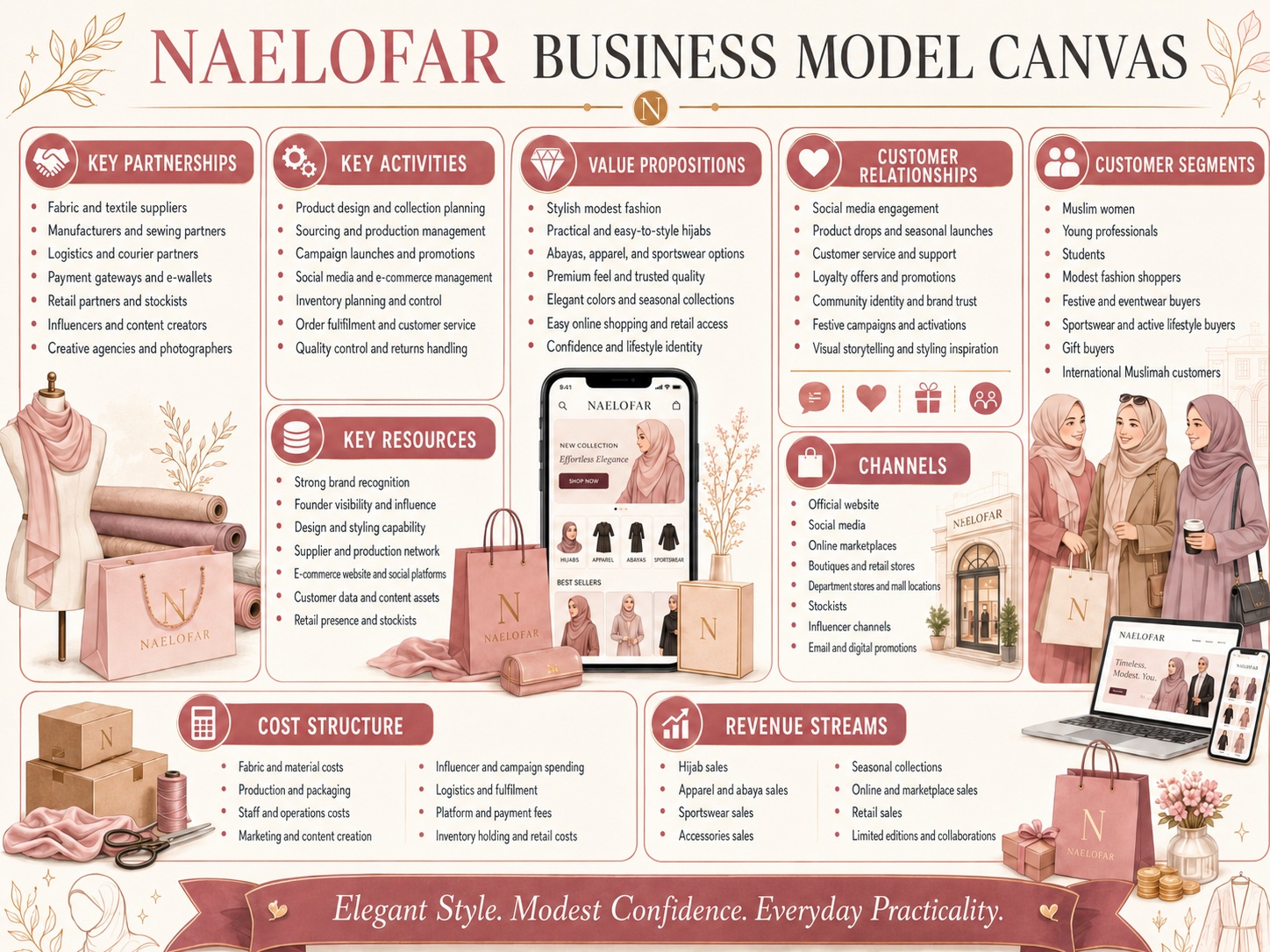
The following Naelofar BMC diagram summarizes how the brand creates value, reaches customers, generates revenue, and manages its key business activities.
1. Customer Segments
Customer segments describe who the business serves. Naelofar primarily serves Muslim women who want modest fashion that feels modern, polished, and practical.
The brand does not serve one narrow group only. It appeals to students, young professionals, working mothers, fashion-conscious women, gift buyers, and customers preparing for festive or formal occasions.
Different segments have different needs. A student may want an affordable and easy-to-style hijab. Professionals may prefer clean colours and premium materials. Event guests may look for elegant pieces that feel special.
| Customer Segment | What They Need | How Naelofar Serves Them |
|---|---|---|
| Young Muslim women | Trendy modest fashion with strong visual appeal. | Offers stylish colours, prints, and social media-led collections. |
| Working professionals | Comfortable hijabs and apparel for daily use. | Provides polished designs suitable for office and formal settings. |
| Students | Practical products at accessible price points. | Uses easy-to-wear styles and digital channels for discovery. |
| Eventwear customers | Elegant pieces for Raya, Ramadan, weddings, and functions. | Launches seasonal and occasion-based collections, including abaya-focused ranges. |
| Sportswear buyers | Modest activewear that supports movement, comfort, and coverage. | Offers NPOWER sportswear as a lifestyle extension of the brand. |
| International buyers | Malaysian modest fashion with trusted brand identity. | Uses online access, stockists, and brand recognition to reach wider markets. |
This analysis shows that Naelofar benefits from multiple customer occasions, not one single use case.
2. Value Propositions
Value proposition explains why customers choose Naelofar. The brand offers modest fashion that combines elegance, practicality, comfort, and brand confidence.
Customers buy Naelofar because the product helps them look presentable without spending too much time styling. Instant hijabs, soft materials, curated colours, and recognizable designs reduce buying effort.
Brand credibility is also part of the value. Founder visibility and consistent campaigns give customers a sense of familiarity. That familiarity matters in fashion because customers often buy from brands they trust.
| Value Proposition | Customer Benefit | Business Impact |
|---|---|---|
| Modern modest design | Customers can dress modestly without looking outdated. | Strengthens relevance among younger and urban buyers. |
| Practical hijab options | Customers save time when preparing for daily routines. | Supports repeat purchase for everyday use. |
| Premium brand feel | Customers gain confidence from a recognizable label. | Allows stronger brand differentiation. |
| Product variety | Customers can choose hijabs, abayas, apparel, sportswear, and accessories. | Expands basket size and purchase occasions. |
| Digital convenience | Customers can discover and buy products online. | Reduces dependency on physical stores. |
Naelofar’s value proposition is not only fashion. It is convenience, identity, confidence, and trust in one modest lifestyle brand. The move into abayas, sportswear, khimar, printed hijabs, and wider apparel also makes the brand more relevant across daily wear, festive occasions, travel, work, and active lifestyles.
3. Channels
Channels explain how Naelofar reaches customers. This block is critical because modern fashion is discovered visually before it is purchased.
Naelofar uses a mix of online and offline channels. The official website supports direct sales. Social media builds attention. Shopee and other digital marketplaces extend reach to customers already shopping online. Boutiques, department stores, mall locations, stockists, and community activations create product experience.
Visual content plays a major role. Customers want to see colours, fabric flow, styling ideas, size references, and real-life usage before buying. Strong photography and videos can therefore influence conversion.
| Channel | Examples | Strategic Role |
|---|---|---|
| Official website | Product catalogue, checkout, campaign pages. | Controls brand experience and direct customer data. |
| Social media | Instagram, Facebook, TikTok-style content, founder content. | Drives awareness, discovery, and campaign engagement. |
| Physical boutiques | Stores and selected retail locations. | Allows customers to touch, try, and compare products. |
| Marketplaces | Shopee and other online fashion or e-commerce platforms. | Expands reach to customers already shopping online. |
| Offline retail | Boutiques, department stores, mall locations, and stockists. | Strengthens accessibility and product confidence. |
| Community activation | Roving retail concepts such as festive truck experiences. | Brings the brand closer to customers during high-demand seasons. |
| Influencer channels | Styling videos, reviews, launches, collaborations. | Builds trust and social proof. |
The Naelofar Business Model Canvas structure highlights that Naelofar’s channels work best when content, commerce, and fulfilment are connected.
4. Customer Relationships
Customer relationships describe how Naelofar keeps customers engaged. The model depends on community, trust, product drops, service quality, and social media interaction.
Naelofar’s relationship is not purely transactional. Many customers follow the brand because they relate to the lifestyle image, founder story, and modest fashion identity. This creates a softer emotional bond.
Product launches also help maintain attention. New colours, festive collections, abaya drops, limited pieces, and styling campaigns give customers reasons to return. Community-led activations, such as roving retail experiences during festive periods, also make the brand feel more accessible and personal.
| Relationship Driver | How It Works | Example |
|---|---|---|
| Social media engagement | Content keeps customers close to the brand. | A customer sees styling ideas before a new launch. |
| Product drops | New designs create urgency and repeat visits. | A limited Raya collection encourages early purchase. |
| Customer service | Support reduces uncertainty in sizing, delivery, and returns. | Buyers ask about material, colour, or shipping status. |
| Community identity | Customers feel connected to modest fashion values. | Followers share looks and campaign content. |
| Festive activation | Seasonal events and mobile retail experiences bring the brand closer to communities. | Raya-focused activations can turn campaign awareness into physical engagement. |
| Loyalty offers | Promotions and member benefits encourage repeat buying. | Returning buyers respond to exclusive discounts. |
Strong relationships help Naelofar reduce dependence on one-time purchases. Repeat engagement is essential in a fashion business with frequent launches.
5. Revenue Streams
Revenue streams show how Naelofar makes money. The core engine is product sales across hijabs, apparel, abayas, sportswear, accessories, seasonal collections, and collaborations.
Hijabs remain an important revenue base because they are repeatable. Customers often buy multiple colours, materials, and styles for different occasions. Apparel can increase basket size because it supports a fuller modest wardrobe.
Online sales also matter. E-commerce allows Naelofar to sell beyond store traffic and reach customers who prefer convenience. Marketplace sales, official website campaigns, and festive product launches can create sales spikes when supported by strong content.
| Revenue Stream | Description | Why It Matters |
|---|---|---|
| Hijab sales | Shawls, bawal, instant hijabs, and signature designs. | Forms the core repeat-purchase category. |
| Apparel sales | Dresses, jubah, blouses, abayas, and modestwear items. | Expands customer wardrobe share. |
| Sportswear sales | Modest activewear under lifestyle-oriented product lines. | Opens a different use case beyond workwear and festive wear. |
| Accessories | Matching items and complementary fashion products. | Adds incremental basket value. |
| Seasonal collections | Raya, Ramadan, event, and limited-edition releases. | Creates urgency and higher campaign demand. |
| Online sales | Website, digital campaigns, Shopee, and marketplace transactions. | Extends reach beyond physical retail. |
The Naelofar Business Model Canvas view shows that Naelofar’s revenue depends on product freshness, repeat buying, and strong campaign execution.
6. Key Resources
Key resources are the assets Naelofar needs to deliver its model. The most important resources are brand equity, design capability, supplier relationships, digital platforms, and customer trust.
Brand equity matters because fashion buyers face many choices. A recognizable name reduces perceived risk and makes new collections easier to promote.
Design talent is another core resource. Naelofar must translate customer preferences into colours, cuts, materials, prints, and styles that feel current but still modest.
| Key Resource | Role in the Business Model | Strategic Value |
|---|---|---|
| Brand equity | Recognition, trust, and lifestyle positioning. | Helps the brand stand out in a crowded market. |
| Founder visibility | Public awareness linked to Neelofa’s influence. | Supports faster campaign attention. |
| Design capability | Product concepts, colours, materials, and styling. | Keeps collections relevant. |
| Supplier network | Fabric, manufacturing, packaging, and fulfilment inputs. | Supports product availability and quality. |
| Digital platforms | Website, social media, customer data, and content channels. | Enables discovery, sales, and engagement. |
| Customer trust | Confidence in quality, sizing, service, and delivery. | Encourages repeat purchases. |
Together, these resources make Naelofar a brand system rather than a simple fashion seller.
7. Key Activities
Key activities are the things Naelofar must do well. These include design, sourcing, production planning, quality control, marketing, campaign launches, inventory management, fulfilment, and customer support.
Design is the visible activity. Customers judge the brand through colour, fabric, shape, comfort, and styling. Poor design weakens demand even when the brand is well known.
Execution is equally important. Fashion businesses can lose sales if stock arrives late, sizing is inconsistent, popular colours run out, or delivery is slow.
| Key Activity | What It Involves | Why It Matters |
|---|---|---|
| Product design | Creating hijabs, apparel, colours, prints, and collections. | Drives customer desire and differentiation. |
| Sourcing and production | Managing fabric, manufacturers, lead times, and quality. | Protects availability and margin. |
| Campaign marketing | Planning launches, visuals, copy, influencers, and offers. | Converts attention into sales. |
| Inventory management | Forecasting demand, stock control, and replenishment. | Reduces overstock and missed sales. |
| Fulfilment and service | Packing, delivery, returns, and customer support. | Protects customer satisfaction. |
This BMC approach makes one point clear: fashion success depends on both creativity and operating discipline.
8. Key Partnerships
Key partnerships help Naelofar operate and scale. The brand needs suppliers, manufacturers, logistics partners, payment providers, influencers, creative teams, and retail partners.
Supplier quality is critical because material affects comfort, drape, colour, and durability. Manufacturing partners also influence consistency, lead time, and cost.
Marketing partners matter because fashion sells through visibility. Influencers, photographers, videographers, stylists, and media teams help transform products into desire.
| Partner Type | Examples | Contribution to the Model |
|---|---|---|
| Fabric suppliers | Textile mills, importers, and material providers. | Support comfort, design quality, and product variety. |
| Manufacturers | Sewing, printing, packaging, and apparel production partners. | Convert designs into sellable products. |
| Logistics providers | Warehousing, courier, and fulfilment services. | Ensure orders reach customers reliably. |
| Payment platforms | Online payment gateways and instalment options. | Make checkout easier and safer. |
| Influencers and creators | Fashion creators, stylists, photographers, and campaign partners. | Build attention, trust, and launch momentum. |
| Retail partners | Boutiques, malls, or selected stockists. | Extend physical access and customer experience. |
Strong partnerships allow Naelofar to focus on brand, design, customer engagement, and market growth.
9. Cost Structure
Cost structure explains where the money goes. Naelofar’s main costs include fabric, production, packaging, staff, marketing, warehousing, logistics, retail operations, platform fees, and inventory holding.
Fashion cost control is difficult because demand can be uncertain. Popular items may sell out quickly, while weak designs can create slow-moving stock. Both situations affect profitability.
Campaign spending is another major cost. Photography, videos, influencers, launch assets, paid ads, and content production are needed to compete in a visual market.
| Cost Category | Examples | Management Challenge |
|---|---|---|
| Materials | Fabric, labels, packaging, accessories, and trims. | Quality must be balanced against margin. |
| Production | Cutting, sewing, printing, finishing, and quality checks. | Delays can disrupt launches. |
| Marketing | Photoshoots, videos, influencers, ads, and campaigns. | Spending must convert into sales. |
| Logistics | Warehousing, packing, shipping, and returns. | Service quality affects repeat buying. |
| Retail operations | Rent, utilities, staff, displays, and store maintenance. | Fixed costs require strong sales productivity. |
| Inventory holding | Unsold stock, markdowns, and storage. | Forecasting errors can reduce profit. |
Naelofar must manage cost without weakening product quality or brand perception.
Strategic Lessons from Naelofar’s Business Model
Naelofar offers useful lessons for fashion founders, brand owners, and entrepreneurs.
The first lesson is that identity can be a business asset. Customers buy modest fashion because it supports how they want to present themselves. Brands that understand identity can build stronger loyalty.
Another lesson is that visibility must lead to conversion. Social media attention is valuable only when product, pricing, stock, website, and fulfilment are ready.
The third lesson is that product freshness matters. Fashion brands need newness, but too much variety can create inventory risk. Clear collection planning is therefore important.
A fourth lesson is that founder-led brands need systems. Personality can attract customers, but operations keep them satisfied.
Finally, the Naelofar Business Model Canvas view shows that a strong brand becomes stronger when design, distribution, content, and customer experience support each other.
Value Proposition Canvas View of Naelofar
The Value Proposition Canvas helps explain the fit between Naelofar’s offer and customer needs. It shows why customers choose the brand beyond basic clothing function.
Customer Profile
Customer jobs include dressing modestly, looking polished, saving preparation time, finding suitable outfits for work or events, and expressing personal style confidently.
Pain points include difficulty finding comfortable hijabs, limited stylish modestwear choices, uncertainty about fabric quality, sizing concerns, delivery delays, and high prices for premium-looking products.
Desired gains include elegant appearance, confidence, easy styling, trusted quality, colour variety, convenient purchase, and products that fit both daily and special occasions.
This customer profile remains specific to Naelofar’s modest fashion buyers.
Value Proposition
Naelofar’s products and services include hijabs, shawls, instant hijabs, semi-instant styles, bawal scarves, khimar, printed hijabs, dresses, blouses, jubah, abayas, sportswear, accessories, campaign collections, website purchasing, marketplace access, and customer support.
Pain relievers include practical designs, easy-to-wear options, trusted brand recognition, product visuals, online ordering, customer support, and delivery access. These reduce friction in the buying process.
Gain creators include elegant designs, curated colours, seasonal launches, abaya collections, sportswear extensions, founder association, social media styling, premium presentation, and modest lifestyle identity. These benefits make the purchase feel more meaningful than a basic fashion transaction.
Customer Profile and Value Proposition Fit
| Customer Profile | Details | Matching Value Proposition | How Naelofar Creates Fit |
|---|---|---|---|
| Customer Jobs | Customers want modest, stylish, practical outfits for daily, festive, active, and event use. | Products and Services | Hijabs, abayas, apparel, sportswear, accessories, campaign collections, website ordering, marketplace access, and customer support. |
| Customer Pains | Customers face limited choices, uncertain quality, sizing concerns, styling effort, and difficulty finding modest products for different occasions. | Pain Relievers | Practical designs, trusted visuals, customer service, online access, retail presence, and recognizable brand quality. |
| Customer Gains | Customers want confidence, elegance, convenience, variety, social value, and products that match lifestyle needs. | Gain Creators | Curated colours, seasonal launches, abaya ranges, sportswear extensions, premium presentation, founder visibility, and lifestyle branding. |
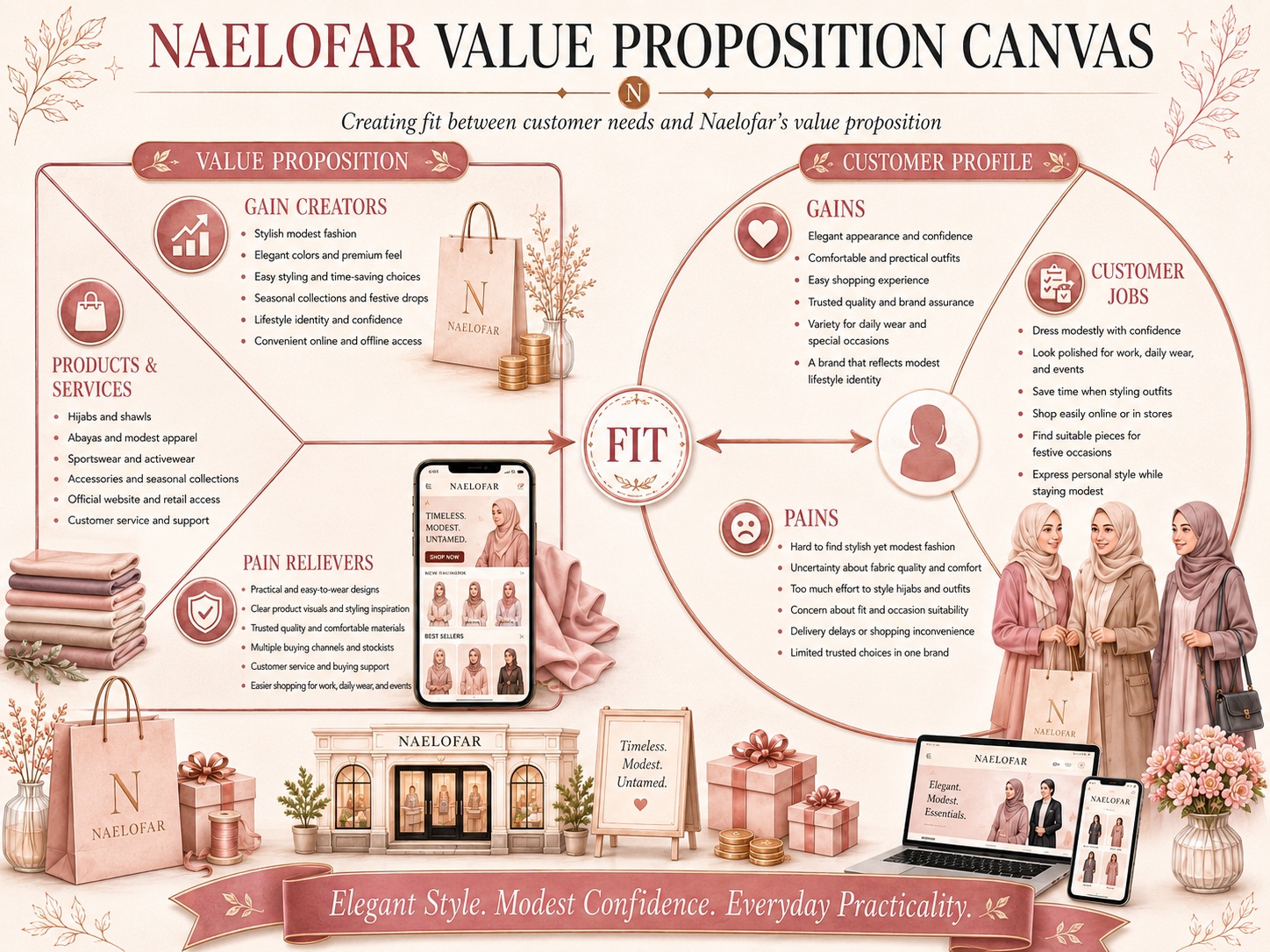
The following Naelofar VPC diagram summarizes the fit between customer jobs, pains, and gains with Naelofar’s products, pain relievers, and gain creators. This fit explains why Naelofar can compete beyond price. Customers are buying products that help them dress with confidence, convenience, and identity.
Competitive Advantage of Naelofar
Naelofar’s competitive advantage comes from several connected strengths:
- Brand recognition: The brand has strong visibility in Malaysia’s modest fashion market. Familiarity reduces customer hesitation and helps new launches gain faster attention.
- Founder influence: Neelofa’s public profile gives the brand a personality-led advantage. This makes campaigns more visible and easier to connect with lifestyle storytelling.
- Modest fashion focus: Naelofar understands the practical and emotional needs of Muslimah customers. Designs can therefore address both modesty and modern styling.
- Digital marketing strength: Social media content, campaign visuals, and influencer-style storytelling help the brand stay visible. Fashion buyers often discover products through visual content before visiting a store.
- Product range expansion: Hijabs, abayas, khimar, printed hijabs, apparel, sportswear, and accessories allow the brand to serve more occasions. A wider range can increase basket size and customer lifetime value.
- Omnichannel reach: Website sales, Shopee presence, boutiques, department stores, mall retail, stockists, and community activations help Naelofar serve customers across digital and physical touchpoints.
- Seasonal campaign engine: Raya and Ramadan collections give the brand strong annual sales moments. These campaigns create urgency, improve repeat visits, and support storytelling around festive lifestyle needs.
The Naelofar Business Model Canvas analysis shows that Naelofar competes through brand, design, trust, content, and customer identity rather than product alone.
Risks and Challenges
Naelofar also faces several business risks:
- Intense fashion competition: Modest fashion has many local brands, online sellers, boutiques, and influencer-led labels. Naelofar must keep design and brand relevance strong.
- Trend volatility: Colours, materials, prints, and styles can change quickly. Slow response may leave the brand with less attractive inventory.
- Inventory risk: Fashion forecasting is difficult. Overstock can force discounts, while understock can lead to missed sales and customer frustration. Wider product categories such as abayas, sportswear, and seasonal lines also increase planning complexity.
- Founder dependency: A founder-led brand can benefit from personality, but it may also become too dependent on one public figure. Strong brand systems are needed beyond personal influence.
- Margin pressure: Materials, production, marketing, retail, marketplace fees, and logistics costs can reduce profitability. Price-sensitive customers may resist large price increases.
- Omnichannel execution risk: A wider channel mix can improve reach, but it also creates operational pressure. Stock accuracy, fulfilment speed, store productivity, campaign timing, and customer service must remain consistent.
The Naelofar Business Model Canvas perspective suggests that Naelofar’s long-term success depends on managing brand relevance, product freshness, inventory discipline, and customer trust.
Conclusion
Naelofar’s business model shows how a modest fashion brand can grow by combining product design, celebrity-led visibility, digital marketing, customer identity, retail access, marketplace presence, and seasonal campaign execution.
Its strength does not come from hijabs alone. Recent category expansion into abayas, khimar, printed hijabs, apparel, sportswear, and festive collections shows a broader modest lifestyle direction. The real value comes from making modest fashion easier to discover, easier to style, easier to trust, and easier to buy.
For entrepreneurs, the lesson is direct. A fashion business needs more than attractive products. It needs clear positioning, reliable supply, strong content, customer understanding, and disciplined inventory management.
The Naelofar Business Model Canvas shows one clear business lesson: brand power works best when supported by operational consistency.
Disclaimer
This article is for educational and informational purposes only. The analysis is based on publicly available information, business observation, and Business Model Canvas interpretation. It is not affiliated with, endorsed by, or officially approved by Naelofar, Neelofa, or any related company. All trademarks, brand names, and product names belong to their respective owners.

