



Share This Article


Boost Business Model Canvas: How Boost Competes Through Payments, Digital Banking, Financing, and Merchant Solutions
BMC Article No: BMC #073
Boost Business Model Canvas: This article analyses Boost as an integrated fintech ecosystem covering consumer payments, digital banking, financing, merchant services, rewards, cross-border transactions, and enterprise payment solutions. It includes a detailed analysis of all nine Business Model Canvas blocks, a Value Proposition Canvas, a BMC-based comparison with Touch ‘n Go eWallet, GrabPay, and ShopeePay, competitive advantages, major risks, strategic recommendations, and practical lessons for entrepreneurs.
Introduction
Boost has evolved considerably from its original position as a Malaysian mobile wallet. Today, the business operates a broader financial technology ecosystem connecting consumers, merchants, borrowers, depositors, enterprises, banks, payment networks, and digital service providers.
The Boost Business Model Canvas is strategically important because the company no longer depends on a single payment product. Its ecosystem includes the Boost consumer app, BoostBiz merchant solutions, Boost PayFlex, business financing, payment gateway services, cross-border payment capabilities, rewards, and Boost Bank.
This structure allows Boost to participate across several stages of a customer’s financial journey. Consumers can make payments, settle bills, use instalment facilities, access banking products, and transact overseas. Merchants can accept digital payments, monitor transactions, manage outlets, obtain financing, and use business-support tools.
Boost’s strategic direction increasingly resembles a full-spectrum fintech and digital banking group rather than a conventional e-wallet operator. Its long-term value therefore depends not only on payment volume but also on product adoption, credit quality, customer trust, merchant retention, recurring revenue, and successful ecosystem integration.
Officially, Boost positions itself as an all-in-one fintech platform serving individual customers, small and medium-sized businesses, and enterprise clients. Its current product portfolio includes wallet payments, rewards, PayFlex, merchant services, business financing, payment infrastructure, and cross-border capabilities.
What Is Boost’s Business Model?
Boost operates a technology-enabled financial-services model combining digital payments, merchant acquiring, consumer financing, microbusiness financing, digital banking, loyalty programmes, cross-border transactions, and enterprise payment infrastructure.
At its core, the Boost Business Model Canvas shows how a platform can use everyday transactions as an entry point into broader financial relationships.
The model contains four interconnected commercial engines.
First, the consumer ecosystem enables users to pay merchants, settle bills, reload prepaid accounts, earn rewards, access instalments, and connect with digital banking services.
Second, BoostBiz provides merchants with QR acceptance, payment tracking, outlet management, employee access, payment gateways, merchant wallets, financing, and point-of-sale-related tools. Boost describes BoostBiz as an integrated merchant platform designed to help businesses receive payments, monitor transactions, and expand their operations.
Third, Boost’s credit products monetise demand for short-term liquidity and flexible payments. PayFlex can be used at DuitNow QR and Boost QR merchants, for bills, prepaid reloads, online purchases, wallet funding, and supported Mastercard transactions.
Fourth, Boost Bank extends the ecosystem into regulated deposits, savings, debit cards, transfers, and lending. Its growing loan portfolio shows that banking and financing are becoming increasingly important to Boost’s overall commercial model.
The resulting structure positions Boost simultaneously as a wallet, merchant platform, financing provider, digital bank, payment infrastructure operator, and embedded-finance partner.
What Is Business Model Canvas?
Business Model Canvas, or BMC, is a strategic management framework used to explain how an organisation creates value, delivers that value, and captures financial returns.
Rather than evaluating only a company’s products, the framework maps nine interconnected components covering customers, offerings, channels, customer engagement, revenue, resources, activities, partnerships, and costs.
For Boost, the framework is particularly useful because the organisation operates across several technology-intensive and regulated activities. Payment processing, credit assessment, merchant acquisition, banking, customer support, cybersecurity, fraud management, compliance, and data analytics must function as a coordinated system.
The Boost Business Model Canvas therefore explains how everyday financial transactions can create opportunities for deeper services such as deposits, financing, merchant tools, and enterprise payment solutions.
| BMC Block | Main Question |
|---|---|
| Customer Segments | Which consumers, businesses, and institutional customers does Boost serve? |
| Value Propositions | What practical and financial value does Boost offer each segment? |
| Channels | How are Boost’s products distributed and accessed? |
| Customer Relationships | How does Boost acquire, engage, support, and retain customers? |
| Revenue Streams | How does Boost monetise payments, banking, credit, and technology? |
| Key Resources | Which assets and capabilities make the model possible? |
| Key Activities | What must Boost execute consistently and effectively? |
| Key Partnerships | Which external organisations strengthen the ecosystem? |
| Cost Structure | What are the major expenses and economic pressures? |
Quick Overview of Boost
Boost began as a digital wallet before expanding into merchant services, consumer financing, cross-border payments, business funding, digital banking, and enterprise financial technology.
Its consumer proposition now includes merchant payments, bill settlement, prepaid reloads, rewards, PayFlex, wallet services, and access to banking-related capabilities. Merchant services cover DuitNow QR acceptance, instant settlement, transaction tracking, payment links, point-of-sale support, business analytics, loyalty solutions, and financing.
Commercially, Boost is moving from a growth model centred on wallet adoption towards a more diversified model involving credit, banking, enterprise services, and recurring merchant relationships.
Axiata reported that Boost’s bank loan book expanded by 32.7% quarter on quarter to RM310 million in its FY2025 results. Revenue also increased as the non-bank segment improved, although Boost continued to record an annual loss, demonstrating that scale and profitability remain separate strategic challenges.
Boost Bank has also developed its SME financing position. By May 2025, it had reportedly disbursed close to RM150 million to hundreds of SMEs, with an average financing size of approximately RM300,000.
The commercial priority is therefore not merely to add more services. Boost must convert its ecosystem breadth into sustainable revenue without allowing acquisition costs, credit losses, regulatory expenses, or technology complexity to grow faster than customer value.
Why Boost Is Strategically Interesting
Boost is strategically interesting because it connects payments with broader financial products rather than treating an e-wallet as an isolated transaction utility.
A consumer payment can generate information relating to transaction frequency, merchant categories, purchase values, repayment behaviour, and account activity. Subject to consent, privacy controls, and regulatory requirements, such information can support fraud prevention, personalisation, credit assessment, and product development.
Merchant transactions create another layer of potential value. Once a business accepts payments through Boost, the platform can offer transaction reporting, instant settlement, outlet management, promotional tools, working-capital financing, business analytics, and payment infrastructure.
Digital banking strengthens the structure further. Deposits deepen customer relationships, while lending may generate higher income than basic wallet transactions. Users who adopt several related services may also become less likely to switch platforms solely because a competitor offers temporary cashback.
The ecosystem can therefore create a reinforcing cycle. More customers attract merchants, wider merchant acceptance increases consumer utility, rising transaction activity produces additional insights, and better insights support relevant products and controlled underwriting.
However, the same cycle can amplify risk. Poor underwriting, fraud, service outages, confusing fees, or ineffective complaint resolution may affect several products simultaneously.
Strategic success therefore requires disciplined integration rather than expansion for its own sake.
Latest Developments: What Is Changing Around Boost?
Several developments are reshaping the Boost Business Model Canvas in 2026.
First, digital banking is becoming more central to Boost’s economics. Axiata’s reported loan-book expansion indicates that lending and banking income are becoming increasingly important compared with basic e-wallet activity.
Second, PayFlex has expanded beyond a narrow wallet feature. Eligible customers can use it through DuitNow QR, Boost QR, bill payments, online purchases, wallet cash-in, telecommunications payments, and the Beyond Mastercard at supported locations.
Third, Boost is extending flexible financing to business owners. PayFlex for Biz provides eligible merchants with short-term credit for business-related purchases, while Capital by Boost Credit offers larger Shariah-compliant financing facilities for qualifying businesses.
Fourth, overseas payment capability is widening. Boost’s UnionPay integration allows supported local and international QR transactions, including direct payment at participating Weixin Pay merchants in China.
Fifth, merchant tools are becoming more operationally relevant. BoostBiz offers transaction monitoring, payment links, instant settlement, analytics, outlet-related visibility, and point-of-sale support, strengthening its position beyond simple QR acceptance.
Together, these developments increase the potential value of Boost’s ecosystem. They also raise the operational burden because payments, lending, banking, merchants, cards, and cross-border services require robust governance, security, compliance, risk management, and customer support.
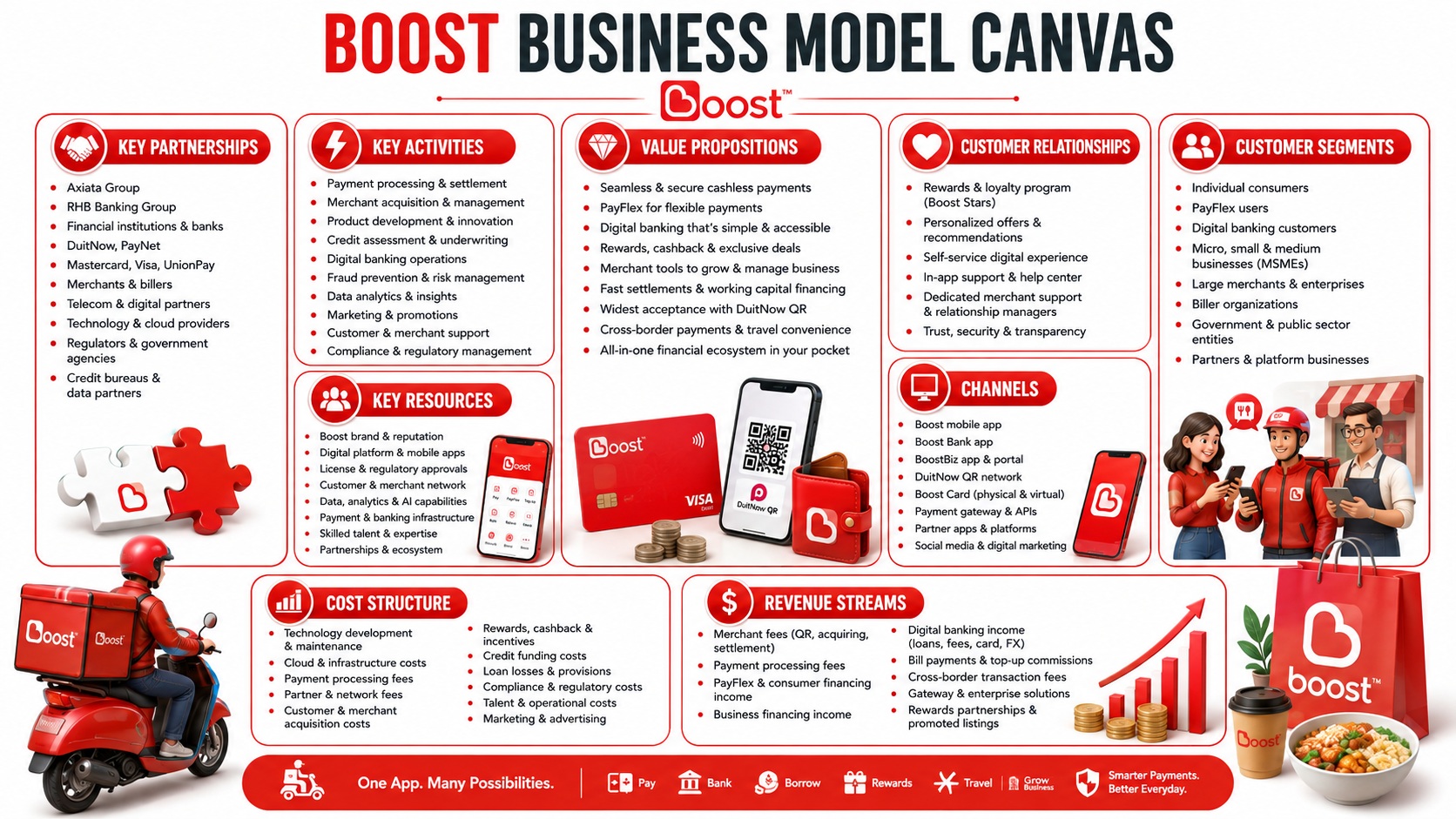
Boost Business Model Canvas Summary
Before examining each component in depth, the following table provides a consolidated view of Boost’s business model.
The summary demonstrates that Boost is not simply a consumer payment application. Its commercial logic depends on the interaction between users, merchants, financing, banking, technology, data, and strategic partners.
| BMC Block | Boost Application |
|---|---|
| Customer Segments | Consumers, digital banking customers, underbanked users, PayFlex customers, microbusinesses, SMEs, larger merchants, enterprises, and ecosystem partners |
| Value Propositions | Convenient payments, financial accessibility, flexible financing, digital banking, merchant tools, rewards, cross-border capabilities, and integrated financial services |
| Channels | Boost app, Boost Bank app, BoostBiz, websites, DuitNow QR, Boost QR, cards, payment gateways, merchant locations, APIs, and partner platforms |
| Customer Relationships | Rewards, personalised offers, self-service, recurring banking relationships, financing, customer support, merchant assistance, and ecosystem engagement |
| Revenue Streams | Merchant fees, payment processing, financing income, banking income, enterprise services, gateway fees, card-related income, and partner commissions |
| Key Resources | Brand, licences, technology, data, customer base, merchant network, banking infrastructure, credit models, partnerships, and specialist talent |
| Key Activities | Payment processing, lending, banking, merchant acquisition, product development, fraud prevention, compliance, cybersecurity, analytics, and customer support |
| Key Partnerships | Axiata, RHB, merchants, banks, DuitNow, UnionPay, Mastercard, billers, technology providers, telecommunications companies, and regulators |
| Cost Structure | Technology, cybersecurity, customer incentives, merchant acquisition, funding, credit losses, compliance, personnel, customer support, and marketing |
Boost BMC Diagram
The diagram for this section should present all nine blocks in a single visual. It should demonstrate how the consumer ecosystem, merchant network, credit products, Boost Bank, payment infrastructure, partnerships, and operational capabilities function as one integrated fintech model.
BMC Analysis of Boost
The nine components of the Boost Business Model Canvas should be analysed as an interconnected economic system rather than as separate organisational functions.
Payment activity creates customer access and transactional data, but basic wallet transactions may generate relatively limited margins. Financing and banking can increase revenue per customer, although they introduce funding, regulatory, affordability, and credit-loss considerations.
Merchant expansion improves payment acceptance and customer utility. Nevertheless, onboarding, identity verification, settlement, hardware, sales support, fraud monitoring, and account management create additional costs.
Partnerships accelerate distribution and capability development, but they can also introduce dependency. A payment-network disruption, banking integration problem, or third-party cybersecurity incident may affect customer experience and revenue.
The following sections explain how each BMC block contributes to Boost’s growth, differentiation, operating resilience, and long-term profitability.
1. Customer Segments
Customer segments identify the groups Boost serves, the problems experienced by each group, and the different economic opportunities created through those relationships.
Boost operates as a multi-sided financial platform. Consumers increase the value of its merchant network, while merchants provide the acceptance points and commercial use cases that make the consumer proposition useful.
Individual customers include frequent e-wallet users, bill payers, prepaid users, reward seekers, borrowers, travellers, and digital banking customers. Although these customers may access the same ecosystem, their financial needs, usage patterns, risk profiles, and profitability can differ considerably.
Underbanked consumers form another strategically important segment. Mobile onboarding and alternative credit assessment may improve access to financial products, but serving this group responsibly requires strong affordability controls and transparent communication.
Merchants range from individual traders and microbusinesses to SMEs and larger enterprises. Smaller businesses may prioritise simple payment acceptance and cash-flow support, while larger organisations require integration, reconciliation, reporting, cybersecurity, and dependable service levels.
Boost Customer Segments
| Segment | Details | Why It Matters |
|---|---|---|
| Everyday consumers | Users making retail payments, paying bills, reloading prepaid accounts, transferring funds, and earning rewards | Generates regular transaction activity, customer engagement, behavioural data, and opportunities to introduce other financial services |
| Digital banking customers | Customers using savings accounts, deposits, transfers, debit cards, and lending through Boost Bank | Creates deeper and potentially longer-lasting relationships than occasional wallet transactions |
| PayFlex and credit users | Eligible customers seeking instalments, short-term liquidity, or flexible payment arrangements | Supports financing income and product adoption while introducing affordability, default, and collection risks |
| Microbusinesses and SMEs | Merchants requiring QR payments, transaction tracking, outlet management, settlement services, and financing | Expands payment acceptance and creates opportunities for higher-value business solutions |
| Enterprises and ecosystem partners | Organisations requiring payment gateways, APIs, transaction infrastructure, integrations, or embedded financial capabilities | Supports larger commercial contracts, diversified income, and reduced dependence on consumer transaction fees |
Boost’s segmentation creates opportunities to move customers from one service into another. A payment user may become a depositor or PayFlex customer, while a QR merchant may adopt gateway services, outlet-management tools, or business financing.
Cross-selling can reduce customer-acquisition costs because the same relationship supports several products. Nevertheless, indiscriminate cross-selling may lead to low-quality adoption, poor customer outcomes, or unnecessary regulatory exposure.
Management should therefore distinguish registered users from active users, multi-product customers, profitable customers, and creditworthy borrowers. Merchant analysis should similarly consider transaction value, servicing costs, retention, financing demand, and lifetime contribution.
The most valuable segments are not always the largest. Customers who use several services responsibly and merchants that generate consistent activity may contribute more than promotion-driven users with high transaction volume but limited margins.
2. Value Propositions
The value proposition explains why consumers and merchants would select Boost instead of bank applications, cards, cash, Touch ‘n Go eWallet, GrabPay, ShopeePay, or standalone financing providers.
For consumers, Boost combines payments, bill settlement, prepaid services, rewards, PayFlex, international payment capabilities, and access to digital banking within a connected ecosystem.
Convenience represents the basic promise, but financial accessibility provides the more strategically important proposition. Boost attempts to make payments, banking, and financing available through mobile channels without requiring customers to manage multiple institutions or extensive physical processes.
Merchants receive a broader proposition than QR payment acceptance alone. BoostBiz supports transaction monitoring, instant settlement, business analytics, payment links, point-of-sale services, merchant wallets, and financing.
Boost Value Propositions
| Value Proposition | Details | Why It Matters |
|---|---|---|
| Integrated financial ecosystem | Payments, banking, rewards, bill settlement, financing, and merchant services are connected within the wider Boost ecosystem | Reduces the need to use multiple providers and creates opportunities for stronger multi-product relationships |
| Accessible flexible payments | PayFlex enables eligible customers to spread qualifying expenses over an agreed payment period | Provides greater purchasing flexibility and short-term liquidity when used responsibly |
| Digital banking access | Customers can access savings, transfers, debit cards, account services, and lending through Boost Bank | Extends engagement from occasional transactions into ongoing financial management |
| Merchant digitalisation | BoostBiz provides QR acceptance, reporting, outlet tools, gateways, payment hardware, analytics, and financing | Helps smaller businesses improve operations instead of merely replacing cash with digital payments |
| Domestic and cross-border utility | Boost supports DuitNow QR, Boost QR, card-based transactions, UnionPay, and selected international payment networks | Broadens the number of payment occasions and reduces reliance on proprietary Boost acceptance points |
Boost’s strongest differentiation does not come from one individual feature. Most payment, reward, banking, and financing functions are also available through competing platforms.
The strategic value comes from integration. Consumers can potentially move from payments to instalments, savings, and banking, while merchants can progress from QR acceptance to business management, financing, and enterprise payment services.
Execution determines whether this integration becomes useful or confusing. Separate applications, duplicated onboarding, unclear product ownership, inconsistent interfaces, or fragmented customer support can weaken the overall proposition.
Boost should therefore compete through simplicity, accessibility, transparency, and relevance rather than merely increasing the number of features. A smaller set of well-integrated services can create more customer value than a broad catalogue of disconnected products.
3. Channels
Channels explain how Boost reaches customers, enables transactions, distributes financial products, and supports merchants.
The Boost mobile application is the principal consumer channel. It provides access to payments, bills, prepaid services, rewards, PayFlex, wallet services, and selected financial journeys.
Boost Bank operates through its own digital interface while also connecting with the wider Boost ecosystem. This arrangement allows regulated banking functions to remain distinct while reducing unnecessary friction for customers moving between payments and banking.
BoostBiz serves merchants through mobile and web-based channels. Physical QR codes, payment hardware, soundboxes, online gateways, payment links, and merchant websites convert Boost’s technology into practical commercial acceptance points.
Partner channels include telecommunications platforms, banks, billers, payment networks, online platforms, and enterprise integrations.
Boost Channels
| Channel | Details | Why It Matters |
|---|---|---|
| Boost consumer app | Primary interface for payments, bills, reloads, rewards, PayFlex, and access to related financial services | Gives Boost direct access to customers and creates frequent opportunities for engagement and cross-selling |
| Boost Bank app | Digital channel for savings, deposits, transfers, debit cards, account management, and lending | Supports regulated banking relationships and increases the depth of customer engagement |
| BoostBiz platform | Merchant app and portal supporting onboarding, payment monitoring, instant settlement, analytics, and business tools | Establishes a dedicated merchant relationship rather than treating businesses only as payment-acceptance points |
| Payment acceptance network | Boost QR, DuitNow QR, cards, UnionPay, payment gateways, merchant websites, and physical locations | Expands practical usability and allows customers to transact across proprietary and shared networks |
| Partner and API channels | Telecommunications companies, banks, billers, enterprises, payment platforms, and embedded integrations | Accelerates distribution and supports scale without relying entirely on direct customer acquisition |
Boost’s channel model combines owned, shared, and partner-controlled distribution.
Owned channels provide greater control over customer experience, data, communication, and product presentation. Shared payment infrastructure expands acceptance efficiently, although competitors can often access the same networks.
Partner channels can produce faster growth, but Boost may have less control over pricing, customer visibility, technical performance, and data access. Enterprise integrations may also involve customised implementation and longer sales cycles.
The central strategic issue is channel coherence. Customers should be able to move between wallet, banking, credit, and merchant services without unnecessary verification, repeated data entry, or confusing navigation.
Boost should also avoid excessive dependence on app notifications and promotional campaigns. Merchant visibility, search, partner integration, referral, and physical acceptance signs remain important parts of distribution.
4. Customer Relationships
Customer relationships describe how Boost attracts, activates, supports, retains, and develops consumers and merchants.
Rewards and promotions have historically played an important role in e-wallet adoption. Cashback, vouchers, Boost Stars, referral incentives, and partner campaigns can encourage downloads and initial transactions.
Long-term retention requires habitual utility rather than permanent incentives. Customers are more likely to remain active when Boost becomes useful for recurring bills, payments, savings, financing, or business operations.
Banking and credit create deeper relationships because customers may maintain deposits, repayment schedules, cards, and recurring financial activities. These relationships also require higher standards of trust, transparency, communication, and dispute resolution.
Boost Customer Relationships
| Relationship Type | Details | Why It Matters |
|---|---|---|
| Rewards and campaigns | Boost Stars, cashback, vouchers, referral incentives, partner discounts, and promotional campaigns | Encourages acquisition, trial, transaction frequency, and reactivation among value-conscious customers |
| Digital self-service | Mobile onboarding, transaction histories, account settings, payment controls, help content, and automated support | Gives customers immediate control while reducing routine service costs |
| Recurring financial relationships | Deposits, savings, financing repayments, bill payments, cards, and scheduled transactions | Creates habitual engagement and potentially increases customer lifetime value |
| Customer support and service recovery | Fraud reporting, dispute handling, payment investigation, account recovery, refunds, and escalation | Protects customer trust when financial transactions or account access fail |
| Merchant relationship management | Onboarding, settlement support, transaction assistance, technical integration, analytics, and financing access | Improves merchant retention and creates opportunities to introduce additional business services |
Promotion-led relationships are relatively weak because customers can easily move between wallets in response to the latest campaign.
Savings, recurring payments, financing, merchant integrations, and operational tools create stronger switching costs. However, these relationships remain sustainable only when customers receive dependable service and fair treatment.
Boost should measure relationship quality through active usage, transaction frequency, complaint resolution, deposit retention, repayment behaviour, product depth, merchant churn, and lifetime contribution.
Trust becomes increasingly important as Boost expands into banking and credit. A delayed cashback reward may cause temporary frustration, but unresolved fraud, inaccessible deposits, or unclear financing charges can damage the entire brand.
Personalisation should therefore prioritise useful financial guidance, fraud prevention, and relevant product recommendations rather than excessive promotional messaging.
5. Revenue Streams
Revenue streams explain how Boost converts payment activity, merchant relationships, financing, banking, and technology capabilities into income.
Payment-related revenue may include merchant discount rates, transaction processing charges, gateway fees, settlement services, card-related income, and enterprise payment charges.
Financing produces income through PayFlex, consumer credit, business financing, and SME lending. These products may generate stronger returns than basic wallet transactions, but revenue must be considered together with funding costs, defaults, impairment, collections, and servicing expenses.
Boost Bank can earn income from lending, financing, transaction services, and financial assets. Deposits support funding capacity, although they also create capital, liquidity, governance, and regulatory obligations.
Boost Revenue Streams
| Revenue Stream | Details | Why It Matters |
|---|---|---|
| Merchant and payment fees | Charges associated with QR acceptance, payment processing, settlement, gateways, cards, and merchant services | Converts recurring transaction volume into platform income |
| Consumer financing income | Income generated through eligible PayFlex arrangements and other consumer credit products | Increases revenue per customer and monetises demand for payment flexibility |
| Merchant and SME financing income | Returns from financing provided to qualifying microbusinesses and SMEs | Deepens merchant relationships and supports business growth and retention |
| Digital banking income | Income from lending, financing, transactions, financial assets, and other permitted banking activities | Diversifies the business beyond lower-margin e-wallet transactions |
| Enterprise and platform services | Revenue from APIs, payment infrastructure, software, integrations, gateways, and commercial partnerships | Creates business-to-business income and reduces dependence on consumer payment activity |
The quality of revenue is as important as the amount reported.
Payment income may be recurring, but margins can be limited by network charges, competitive pricing, shared infrastructure, and merchant bargaining power. Financing can generate higher returns, although future losses may offset current income when underwriting or collections are weak.
Banking creates more diverse monetisation opportunities but requires disciplined capital, liquidity, and risk management. Enterprise services may produce larger contracts, although implementation expenses and customer concentration should be monitored.
Boost should prioritise recurring, risk-adjusted revenue. Contribution should be assessed after incentives, processing costs, funding expenses, credit losses, support costs, and customer acquisition.
Cross-selling improves economics when an additional product uses existing distribution and infrastructure efficiently. A service requiring separate systems, marketing, compliance, and support may increase revenue without improving profitability.
6. Key Resources
Key resources identify the assets, capabilities, regulatory permissions, and relationships required to operate Boost’s financial ecosystem.
Technology platforms form a fundamental resource. Mobile applications, payment engines, banking systems, APIs, risk platforms, fraud controls, analytics, and cloud infrastructure must process financial activity securely and reliably.
Licences and regulatory approvals are equally important because payments, banking, lending, data protection, and financial crime controls operate within formal regulatory frameworks.
Boost’s customer base and merchant network provide distribution and transaction opportunities, but their economic value depends on active use rather than registration numbers.
Axiata and RHB contribute strategic support, telecommunications reach, banking knowledge, institutional experience, capital access, and commercial credibility.
Boost Key Resources
| Resource | Details | Why It Matters |
|---|---|---|
| Technology infrastructure | Consumer applications, merchant systems, payment engines, banking platforms, APIs, cloud services, analytics, and cybersecurity controls | Enables Boost to deliver real-time financial services at scale |
| Licences and governance capabilities | Regulatory approvals, compliance processes, policies, audit arrangements, risk management, and financial-crime controls | Allows Boost to operate regulated services and protects institutional trust |
| Customer and merchant network | Consumers, borrowers, depositors, microbusinesses, SMEs, merchants, and enterprise clients | Generates transactions, distribution, data, and opportunities for cross-selling |
| Data and decision models | Transaction data, fraud indicators, credit models, merchant insights, and customer analytics | Supports underwriting, personalisation, fraud prevention, monitoring, and product development |
| Axiata and RHB support | Telecommunications reach, corporate resources, banking capabilities, capital support, and strategic relationships | Strengthens market access, financial credibility, and digital banking development |
The interaction between these resources creates a more defensible position than any individual asset.
Technology can be acquired, but an integrated financial platform also requires regulatory approvals, active customers, merchant distribution, data, specialist teams, and trusted partners.
A large user base has limited strategic value when engagement is shallow or dependent on subsidies. Similarly, customer data is commercially useful only when it is accurate, governed, secure, and applied responsibly.
Human expertise is also essential. Boost requires capable teams across banking, credit, cybersecurity, compliance, product development, merchant operations, fraud management, data science, and customer service.
The company must therefore protect not only its systems but also its institutional knowledge, regulatory credibility, and customer trust.
7. Key Activities
Key activities describe what Boost must perform consistently for its business model to remain functional, secure, compliant, and commercially viable.
Payment operations include authentication, transaction routing, fraud screening, settlement, reconciliation, merchant reporting, and dispute management.
Credit activities require customer acquisition, eligibility assessment, affordability analysis, underwriting, disbursement, repayment monitoring, collections, impairment recognition, and customer assistance.
Merchant operations cover onboarding, verification, QR deployment, gateway integration, settlement, account servicing, financing, and transaction monitoring.
Banking creates additional responsibilities relating to deposits, lending, liquidity, capital, governance, reporting, operational resilience, and consumer protection.
Boost Key Activities
| Activity | Details | Why It Matters |
|---|---|---|
| Payment operations | Transaction authentication, routing, fraud screening, settlement, reconciliation, and dispute handling | Determines reliability, merchant confidence, customer satisfaction, and transaction economics |
| Product and platform development | Designing, testing, integrating, and maintaining apps, banking journeys, merchant tools, APIs, cards, and automated services | Keeps the ecosystem relevant and allows Boost to respond to changing customer expectations |
| Credit and banking operations | Underwriting, lending, deposit management, collections, liquidity management, and risk monitoring | Generates higher-value income while controlling financial and regulatory exposure |
| Merchant ecosystem management | Merchant acquisition, onboarding, verification, technical support, hardware deployment, gateways, analytics, and financing | Expands payment acceptance and develops recurring commercial relationships |
| Security, fraud, and compliance | Cybersecurity, anti-money-laundering controls, privacy, fraud detection, audit, monitoring, and regulatory reporting | Protects customer funds, licences, reputation, and operational continuity |
Boost’s activities are highly interconnected. A customer may view a payment as a simple scan, but completion depends on identity controls, payment networks, merchant systems, settlement, monitoring, and customer support.
Automation can improve speed and reduce cost, although financial decisions should not rely on automation without appropriate governance and human oversight.
Credit growth requires particular discipline. Faster approvals can improve convenience, but weak affordability assessment or ineffective collections may damage profitability and customer welfare.
Operational resilience is also a core activity. Payment or banking outages can create immediate customer harm, merchant disruption, regulatory concern, and reputational damage.
Performance should therefore be measured through system availability, settlement accuracy, fraud loss, complaint resolution, credit quality, product adoption, merchant retention, and operating cost.
8. Key Partnerships
Key partnerships identify the external organisations that help Boost distribute services, expand acceptance, operate regulated products, and develop specialist capabilities.
Axiata is a central strategic stakeholder, providing corporate support, telecommunications relationships, regional reach, digital capabilities, and access to broader business ecosystems.
RHB Banking Group is the principal banking partner within Boost Bank. The relationship combines Boost’s technology and digital distribution capabilities with RHB’s banking expertise and institutional experience.
Payment networks such as DuitNow, UnionPay, and Mastercard extend customer and merchant access beyond Boost’s proprietary acceptance environment.
Merchants, banks, enterprises, billers, cloud providers, identity services, cybersecurity firms, and technology vendors also support the broader proposition.
Boost Key Partnerships
| Partner | Details | Why It Matters |
|---|---|---|
| Axiata Group | Strategic ownership, telecommunications relationships, regional presence, corporate capabilities, and ecosystem access | Supports distribution, capital access, partnership development, and regional expansion |
| RHB Banking Group | Banking expertise, governance capabilities, institutional experience, and participation in Boost Bank | Strengthens regulated banking operations and improves financial-sector credibility |
| Payment networks and financial institutions | DuitNow, UnionPay, Mastercard, banks, gateways, and payment infrastructure providers | Enables domestic interoperability, card payments, transfers, and international transactions |
| Merchants and enterprises | Retailers, SMEs, online businesses, billers, service providers, and larger organisations | Create transaction use cases, commercial distribution, and demand for payment services |
| Technology and data providers | Cloud, cybersecurity, identity, analytics, communications, and software vendors | Provide specialist capabilities required for scale, security, resilience, and innovation |
Partnerships allow Boost to expand faster than developing every capability internally.
DuitNow QR provides broad domestic acceptance, while Mastercard and UnionPay increase card and international payment utility. RHB contributes regulated banking knowledge, and Axiata creates access to telecommunications and regional opportunities.
Shared infrastructure can also reduce differentiation because competitors may use the same payment networks. Boost must therefore add value through customer experience, merchant tools, financing, and product integration.
Partner concentration introduces operational risk. A disruption affecting a cloud provider, payment network, banking interface, or telecommunications partner could interrupt several Boost services simultaneously.
Commercial agreements should therefore address cybersecurity, data protection, service levels, incident response, resilience, liability, monitoring, and exit arrangements.
9. Cost Structure
Cost structure identifies the expenses required to build, operate, secure, regulate, and promote Boost’s ecosystem.
Technology expenditure includes application development, cloud infrastructure, banking systems, payment processing, cybersecurity, fraud prevention, monitoring, testing, software licences, and operational resilience.
Customer acquisition involves rewards, cashback, advertising, referrals, deposit campaigns, merchant subsidies, and partner promotions. These expenses can stimulate activity, but they may produce weak retention when customers participate only during campaigns.
Lending introduces funding expenses, credit losses, impairment provisions, collections, servicing costs, and capital requirements.
Merchant operations require sales, onboarding, verification, settlement, technical integration, account management, equipment, and support.
Boost Cost Structure
| Cost Category | Details | Why It Matters |
|---|---|---|
| Technology and cybersecurity | Application development, cloud infrastructure, payment systems, banking platforms, software, monitoring, fraud controls, and resilience | Maintains service availability, protects customer data, and supports product competitiveness |
| Customer and merchant acquisition | Cashback, rewards, advertising, referrals, merchant incentives, sales teams, onboarding, and partner campaigns | Accelerates growth but can weaken unit economics when acquired users do not remain active |
| Funding and credit losses | Financing costs, defaults, impairment, collections, expected losses, and capital requirements | Determines whether lending and PayFlex growth create sustainable risk-adjusted returns |
| Compliance and governance | Regulatory reporting, audits, legal support, privacy, risk management, licensing, and financial-crime controls | Protects regulatory standing and reduces legal, financial, and reputational exposure |
| People and operations | Product teams, banking personnel, customer service, merchant support, data specialists, administration, and facilities | Provides the expertise required to operate complex financial and technology services |
Boost’s cost base contains both scale-efficient and scale-sensitive components.
Technology infrastructure may become more efficient as transaction volume increases, provided system architecture and vendor costs remain controlled. Conversely, fraud losses, credit impairments, complaints, and regulatory obligations may rise as the ecosystem expands.
Promotional spending should be evaluated according to incremental contribution rather than downloads or gross transaction value. A campaign creates genuine value only when acquired customers remain active or adopt profitable products.
Lending economics must account for expected losses, funding costs, collections, servicing, and capital consumption. High financing income can be misleading when future defaults are not adequately recognised.
Boost should therefore manage costs at product, channel, merchant, and customer-segment levels. Shared platforms may create efficiencies, but weak cost allocation can conceal unprofitable products or customer groups.
How the Nine BMC Blocks Work Together
The nine blocks of the Boost Business Model Canvas reinforce one another through distribution, transactions, data, banking, and merchant relationships.
Consumers create demand for payments, financing, savings, rewards, and other financial services. Merchants provide the everyday acceptance points that make those products useful.
Channels such as the Boost app, Boost Bank app, BoostBiz, DuitNow QR, cards, gateways, and partner platforms connect the different customer groups.
Customer relationships deepen when users move from promotion-driven transactions into recurring bills, savings, financing, or business tools.
Revenue is generated through payments, merchant services, financing, digital banking, and enterprise platforms. Those streams depend on key resources such as licences, technology, data, risk models, employees, and strategic partners.
Key activities ensure that payments settle, deposits remain accessible, credit risk is controlled, merchants receive support, and systems remain secure.
The cost structure ultimately determines whether ecosystem growth produces sustainable value. More users and transactions are beneficial only when revenue exceeds acquisition, servicing, technology, funding, compliance, fraud, and credit-loss expenses.
Boost Value Proposition Canvas
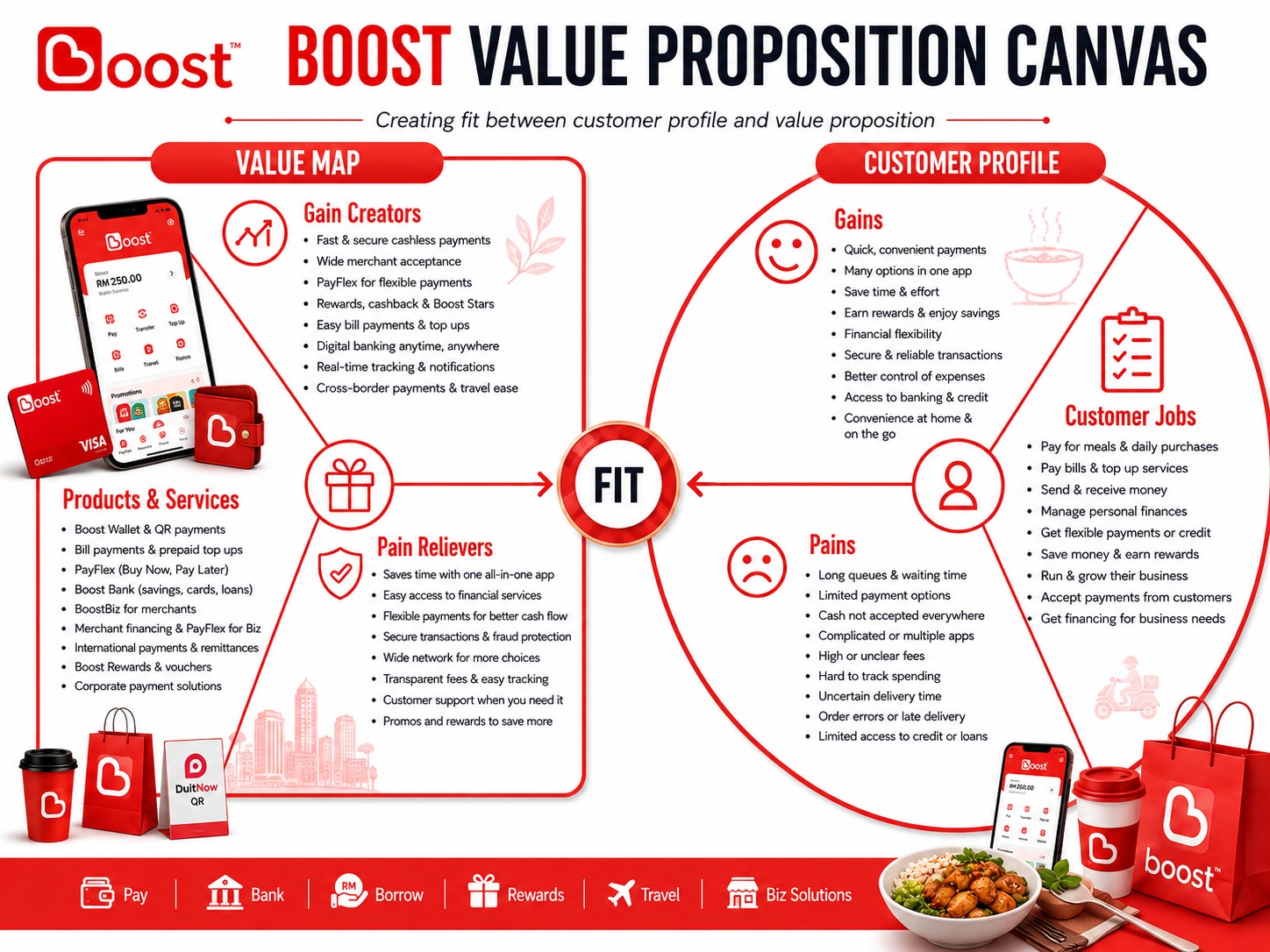
The Value Proposition Canvas, or VPC, examines how Boost’s products match the jobs, frustrations, and desired outcomes of its customers.
While BMC explains the overall organisation, VPC focuses on the connection between specific customer needs and Boost’s products.
For this analysis, the customer profile combines individual consumers and smaller merchants. Both groups require convenient financial tools, although their priorities differ.
The Boost Business Model Canvas becomes commercially stronger when its broad ecosystem solves genuine financial problems rather than merely increasing the number of available features.
Customer Profile
The customer profile identifies what customers want to accomplish, the problems they experience, and the outcomes they value.
Consumers want to pay quickly, control routine expenses, access financial services remotely, understand their transactions, and use credit responsibly when necessary.
Small businesses want to receive payments, confirm transactions, manage outlets, monitor cash flow, access working capital, and reduce administrative work.
Customer Profile of Boost
| Customer Profile | Details |
|---|---|
| Customer Jobs | Make payments, settle bills, transfer funds, save money, access instalments, accept customer payments, monitor sales, manage outlets, and obtain business financing |
| Customer Pains | Fragmented financial apps, limited credit access, transaction failures, fraud concerns, unclear fees, complex onboarding, cash-flow pressure, delayed support, and manual administration |
| Customer Gains | Convenient access, reliable payments, transparent information, flexible financing, useful rewards, wider acceptance, faster settlement, financial control, and practical merchant tools |
Customers do not simply want another payment method. Consumers seek greater control and flexibility, while merchants want financial tools that improve liquidity, productivity, and commercial visibility.
Value Map
The value map explains how Boost responds to customer jobs, pains, and expected gains.
Its offering combines payments, bill settlement, rewards, PayFlex, digital banking, merchant solutions, payment hardware, gateways, analytics, business financing, and international payment capabilities.
Integration is the central benefit. A consumer can move between payments, financing, and banking, while a merchant can progress from QR acceptance to transaction management and business tools.
Value Map of Boost
| Value Map | Details |
|---|---|
| Products and Services | Boost Wallet, Boost QR, DuitNow QR, bill payments, prepaid reloads, Boost Stars, PayFlex, Beyond Card, Boost Bank, BoostBiz, payment links, gateways, POS-related tools, business financing, analytics, and cross-border payments |
| Pain Relievers | Digital onboarding, consolidated transaction records, instant settlement, interoperable QR acceptance, financing access, fraud controls, merchant reporting, automated payment confirmation, and remote account management |
| Gain Creators | Mobile convenience, payment flexibility, banking access, rewards, broader acceptance, business visibility, outlet management, savings opportunities, and international payment utility |
The value map becomes less effective when eligibility, fees, interfaces, or support differ substantially across products. Boost must ensure that ecosystem breadth feels integrated rather than administratively fragmented.
How Boost Creates Fit
The following table connects customer requirements with relevant elements of Boost’s value proposition.
| Customer Profile | Details | Matching Value Map | How Boost Creates Fit |
|---|---|---|---|
| Customer Jobs | Consumers and merchants need to make, receive, manage, and finance transactions | Products and Services | Boost combines payment, banking, credit, merchant, and transaction-management services |
| Customer Pains | Users face fragmented platforms, cash-flow pressure, credit limitations, fraud concerns, and administrative work | Pain Relievers | Digital onboarding, QR interoperability, financing, transaction records, security controls, and merchant tools reduce friction |
| Customer Gains | Customers value convenience, flexibility, transparency, acceptance, rewards, and financial accessibility | Gain Creators | Mobile access, PayFlex, Boost Bank, BoostBiz, cross-border payments, and rewards create practical benefits |
The fit is strongest when customers can access relevant products through a clear journey without being encouraged to borrow beyond their financial capacity.
Where the Fit Happens
Strong consumer fit occurs during recurring activities such as bill payment, retail purchases, prepaid reloads, online shopping, travel spending, savings, and planned instalment purchases.
Merchant fit is created when microbusinesses and SMEs need an affordable way to receive digital payments, verify transactions, monitor outlets, access instant settlement, and manage cash flow.
Boost also creates fit among mobile-first customers who prefer digital onboarding or experience difficulty obtaining suitable services through conventional channels.
Nevertheless, a product does not create value simply because it is available. Financing must be affordable, fees must be transparent, transactions must remain reliable, and complaints must be resolved effectively.
The strongest fit therefore occurs when Boost combines convenience with responsible financing, operational reliability, customer protection, and practical merchant support.
Boost VPC Diagram
The VPC diagram should place the Value Map on the left and the Customer Profile on the right. Customer jobs, pains, and gains should connect directly with Boost’s products and services, pain relievers, and gain creators.
Boost vs Touch ‘n Go eWallet, GrabPay, and ShopeePay
The competitive position of Boost is clearer when the four platforms are compared using the same nine BMC blocks.
Each company participates in digital payments, but its wider ecosystem determines how customers are acquired, how merchants are served, how users are retained, and how transactions are monetised.
Touch ‘n Go eWallet benefits from strong domestic utility across toll-related services, transportation, parking, retail payments, and financial products. GrabPay is embedded within Grab’s mobility, food delivery, logistics, and merchant ecosystem. ShopeePay benefits from Shopee’s ecommerce marketplace, seller network, online checkout, and instalment services.
Boost differentiates itself through the combination of payments, PayFlex, BoostBiz, enterprise payment services, business financing, and Boost Bank.
Customer Segments Comparison
Customer segments determine which groups each platform prioritises and the use cases supporting customer acquisition.
| Company | Primary Customer Segments | BMC Analysis |
|---|---|---|
| Boost | Consumers, borrowers, depositors, SMEs, merchants, and enterprises | Maintains a broad connection between retail users, credit, digital banking, SME services, and enterprise payments |
| Touch ‘n Go eWallet | Drivers, commuters, everyday consumers, travellers, merchants, investors, and users of related financial products | Benefits from extensive domestic utility and transport-related use cases |
| GrabPay | Riders, food-delivery customers, Grab merchants, drivers, and users of Grab financial services | Acquires users through high-frequency mobility, delivery, and merchant activity |
| ShopeePay | Online shoppers, Shopee sellers, instalment users, and participating offline merchants | Concentrates strongly on commerce-oriented users and marketplace transactions |
Boost serves several financially distinct segments, but this breadth creates greater product, compliance, and risk complexity.
Touch ‘n Go eWallet benefits from infrastructure-related utility. GrabPay acquires users through frequent service consumption, while ShopeePay reaches customers at the point of online purchase.
Boost must therefore convert broad segmentation into relevant product journeys rather than attempting to offer every customer every product.
Value Propositions Comparison
Value propositions show the principal reason customers select one platform over another.
| Company | Primary Value Proposition | BMC Analysis |
|---|---|---|
| Boost | Integrated payments, financing, digital banking, and merchant solutions | Strongest when customers require several connected financial products |
| Touch ‘n Go eWallet | Broad everyday utility across transport, payments, transfers, and financial products | Benefits from habitual domestic use and strong merchant acceptance |
| GrabPay | Convenient payments and rewards embedded within Grab’s everyday services | Creates value by removing payment friction from rides, food delivery, and other Grab activities |
| ShopeePay | Convenient ecommerce checkout, promotional value, and instalment flexibility | Strongest around online shopping, marketplace campaigns, and seller transactions |
Boost’s proposition is broader from a financial-services perspective, while the other platforms have stronger associations with particular daily behaviours.
The central challenge is communication. Customers must understand why Boost’s combination of wallet, banking, financing, and merchant tools creates more value than using separate specialist applications.
Channels Comparison
Channels determine how effectively each competitor reaches customers and merchants.
| Company | Main Channels | BMC Analysis |
|---|---|---|
| Boost | Boost app, Boost Bank app, BoostBiz, QR networks, cards, gateways, enterprise integrations, and partners | Uses several financial and merchant channels but must maintain integration across different interfaces |
| Touch ‘n Go eWallet | E-wallet app, transport ecosystem, DuitNow QR, cards, merchants, and partners | Gains strong physical visibility from transportation and everyday infrastructure |
| GrabPay | Grab superapp, GrabFood, rides, merchants, delivery services, and driver network | Embeds financial services within high-frequency service journeys |
| ShopeePay | Shopee app, online checkout, seller ecosystem, QR merchants, and instalment services | Controls transaction access directly within a major ecommerce marketplace |
Boost’s channel diversity supports broader financial services. However, Grab and ShopeePay possess stronger captive channels because customers are already using the parent platforms for non-financial activities.
Touch ‘n Go eWallet also benefits from transport-related visibility that is difficult to reproduce through digital advertising alone.
Boost must therefore improve cross-platform integration and use merchants, partners, and enterprise channels to reduce dependence on paid consumer acquisition.
Customer Relationships Comparison
Customer relationship models influence retention, switching costs, and customer lifetime value.
| Company | Relationship Model | BMC Analysis |
|---|---|---|
| Boost | Rewards, deposits, financing, banking, bills, business tools, and merchant support | Can build deep financial relationships but must maintain high trust and service quality |
| Touch ‘n Go eWallet | Transport utility, everyday payments, recurring services, loyalty, and financial products | Retention is supported by practical domestic use and broad acceptance |
| GrabPay | Rewards and repeated engagement across rides, food, delivery, and financial services | High service frequency naturally returns users to the platform |
| ShopeePay | Marketplace promotions, vouchers, checkout convenience, and instalment payments | Relationships are reinforced through shopping frequency and promotional campaigns |
Boost may create deeper formal financial relationships through deposits, credit, and business financing.
GrabPay and ShopeePay benefit from repeated non-financial activity, reducing the need to manufacture engagement exclusively through rewards.
Touch ‘n Go eWallet’s transport and payment relevance creates another form of habitual retention.
Boost should therefore strengthen recurring financial and merchant relationships rather than compete only through cashback.
Revenue Streams Comparison
Revenue streams reveal how each platform captures value beyond basic wallet transactions.
| Company | Main Revenue Streams | BMC Analysis |
|---|---|---|
| Boost | Payment fees, consumer financing, SME financing, banking income, gateways, merchant services, and enterprise solutions | Has diversified monetisation but faces significant banking and credit-risk obligations |
| Touch ‘n Go eWallet | Merchant fees, payment services, remittances, financial products, advertising, and partnerships | Monetises a broad domestic ecosystem across several transaction and financial activities |
| GrabPay | Merchant fees, instalment income, financial products, advertising, and ecosystem transaction support | Financial services strengthen the economics of Grab’s mobility and delivery platform |
| ShopeePay | Merchant fees, instalment income, marketplace transactions, seller services, and financial products | Payments and credit directly support ecommerce conversion and marketplace activity |
Boost’s revenue diversification reduces dependence on payment fees.
Nevertheless, higher-yield banking and credit income must be evaluated after funding costs, defaults, impairment, collections, and compliance expenditure.
GrabPay and ShopeePay can justify payment and credit products partly through their effect on the wider ecosystem. Boost must demonstrate more directly that each financial service contributes sustainable standalone or cross-product value.
Key Resources Comparison
Key resources determine what each platform can leverage that competitors may struggle to reproduce.
| Company | Key Resources | BMC Analysis |
|---|---|---|
| Boost | Digital banking capabilities, credit platforms, BoostBiz, Axiata, RHB, licences, merchant data, and technology | Combines financial infrastructure with telecommunications and banking support |
| Touch ‘n Go eWallet | Established brand, transport ecosystem, broad merchant network, user scale, payment data, and financial partnerships | Possesses strong domestic visibility and deeply established everyday utility |
| GrabPay | Grab superapp, mobility network, delivery ecosystem, drivers, merchants, regional presence, and behavioural data | Benefits from frequent regional customer interactions across several services |
| ShopeePay | Shopee marketplace, seller ecosystem, ecommerce data, instalment services, and promotional infrastructure | Gains direct access to purchase intent, transaction behaviour, and marketplace demand |
Boost’s banking, financing, and merchant capabilities form important strategic resources.
Competitors nevertheless possess stronger anchor ecosystems that may support lower acquisition costs and more frequent natural engagement.
Boost’s advantage therefore lies in combining its resources effectively. Banking capability, merchant data, financing expertise, and Axiata distribution must operate as one system rather than as separate corporate assets.
Key Activities Comparison
Key activities show where each platform must execute particularly well.
| Company | Key Activities | BMC Analysis |
|---|---|---|
| Boost | Payments, lending, banking, merchant services, risk management, product development, and enterprise integration | Has diverse financial operating requirements and significant regulatory complexity |
| Touch ‘n Go eWallet | Payments, transport-related transactions, merchant management, financial distribution, and fraud prevention | Must maintain reliability across high-volume domestic transaction use cases |
| GrabPay | Embedded payments, merchant settlement, rewards, financing, and integration with Grab services | Financial activities must remain closely coordinated with mobility and delivery operations |
| ShopeePay | Marketplace checkout, QR payments, instalment services, seller support, risk assessment, and promotions | Focuses heavily on improving ecommerce conversion and purchase frequency |
Boost’s activities may create broader revenue opportunities, but operational complexity is also higher.
Banking, lending, payments, merchant services, and enterprise integrations require different control frameworks and specialised capabilities.
Competitors can focus their financial activities around clearer commercial anchors. Boost must therefore maintain stronger coordination across business units to prevent fragmented customer experiences and duplicated costs.
Key Partnerships Comparison
Partnerships expand capabilities and determine how quickly each platform can scale.
| Company | Key Partnerships | BMC Analysis |
|---|---|---|
| Boost | Axiata, RHB, DuitNow, UnionPay, Mastercard, merchants, banks, enterprises, and technology vendors | Combines telecommunications, banking, payments, and international networks |
| Touch ‘n Go eWallet | Touch ‘n Go ecosystem, transport operators, merchants, banks, insurers, and payment networks | Gains strong domestic infrastructure and established institutional relationships |
| GrabPay | Grab merchants, drivers, banks, insurers, payment networks, and regional service partners | Uses Grab’s broader platform relationships to distribute financial services |
| ShopeePay | Shopee sellers, merchants, logistics providers, payment networks, and financial partners | Partnerships remain closely connected to the ecommerce transaction cycle |
Boost’s Axiata-RHB combination is a distinctive partnership advantage because it connects telecommunications, digital distribution, and regulated banking expertise.
Competitors also possess powerful parent ecosystems that support customer acquisition, distribution, and data generation.
Partnership value therefore depends on integration quality. A strong corporate relationship creates limited commercial benefit when customers cannot experience the resulting service seamlessly.
Cost Structure Comparison
Cost structures reveal where each platform faces the greatest economic pressure.
| Company | Main Cost Drivers | BMC Analysis |
|---|---|---|
| Boost | Technology, banking operations, credit losses, funding, merchant support, compliance, personnel, and promotions | Carries substantial fixed and risk-related costs due to its broad financial model |
| Touch ‘n Go eWallet | Technology, incentives, merchant operations, security, transport integrations, and financial-product compliance | Benefits from scale but must support a wide range of domestic services |
| GrabPay | Rewards, payment operations, merchant support, financing risk, technology, and ecosystem integration | Some customer-acquisition costs are shared with Grab’s mobility and delivery businesses |
| ShopeePay | Promotions, instalment credit risk, merchant acquisition, technology, and marketplace incentives | Ecommerce campaigns can drive volume but may create substantial subsidy costs |
Boost’s cost base is highly exposed to banking infrastructure, credit risk, specialised personnel, compliance, and operational resilience.
GrabPay and ShopeePay may achieve acquisition efficiencies because financial services are embedded within existing high-frequency platforms.
Touch ‘n Go eWallet also benefits from established transport and payment utility.
Boost must therefore generate sufficient revenue per multi-product customer to justify its broader cost structure.
Overall BMC Competitive Position
The BMC comparison shows that each competitor has a different structural advantage.
Touch ‘n Go eWallet benefits from domestic payment reach, transport relevance, and habitual utility. GrabPay gains frequent engagement from mobility and delivery. ShopeePay controls valuable ecommerce purchase occasions and can integrate credit directly into checkout.
Boost’s principal advantage is the combination of payments, consumer financing, merchant solutions, SME funding, digital banking, and enterprise services.
The Boost Business Model Canvas is therefore broader from a financial-services perspective, but breadth alone does not guarantee leadership.
Boost must integrate its products more effectively than competitors integrate their anchor ecosystems. The company also needs to show that deeper financial relationships can generate higher customer lifetime value without creating excessive credit losses, acquisition expenses, or regulatory complexity.
Competitive Advantages
Boost has five principal competitive advantages that can strengthen its position against conventional wallets and financial applications.
- Integrated fintech and digital banking ecosystem: Boost combines consumer payments, PayFlex, merchant services, business financing, banking, cross-border transactions, and enterprise solutions within one portfolio.
- Direct connection with Boost Bank: Deposit, savings, card, and lending capabilities allow Boost to build deeper financial relationships than a payment-only wallet.
- Developed merchant proposition: BoostBiz provides QR acceptance together with instant settlement, transaction monitoring, payment links, analytics, hardware, and financing-related services.
- Credit and alternative-data capabilities: Experience in consumer and SME financing can support customers who may be underserved by traditional financial institutions.
- Strategic support from Axiata and RHB: Axiata contributes telecommunications reach and digital capabilities, while RHB provides banking knowledge and institutional credibility.
These advantages are mutually reinforcing. Their value, however, depends on active product adoption, responsible financing, customer trust, merchant retention, and operating efficiency.
Risks and Challenges
Boost faces five major risks that could weaken growth, customer confidence, or profitability.
- Intense ecosystem competition: Touch ‘n Go eWallet, GrabPay, ShopeePay, bank apps, credit cards, and DuitNow QR reduce differentiation in basic payment services.
- Credit and affordability exposure: Rapid PayFlex or lending growth may increase defaults, impairment, collections, customer hardship, and regulatory scrutiny.
- Operational complexity: Payments, banking, lending, merchant solutions, cards, and international transactions require different systems, controls, teams, and customer journeys.
- Cybersecurity and fraud risk: Scams, account takeover, identity fraud, data breaches, outages, and third-party vulnerabilities could damage several products simultaneously.
- High acquisition and incentive costs: Cashback, rewards, referrals, merchant subsidies, and deposit campaigns may create temporary activity without sustainable customer value.
These risks are interconnected. Aggressive customer acquisition may increase transactions, but weak controls or poor service recovery can reduce trust and create future financial losses.
Strategic Recommendations
Boost should prioritise the capabilities that distinguish it from basic wallets while improving unit economics, customer trust, and responsible financial inclusion.
1. Establish a Clear Financial-Progress Positioning
Boost should present one coherent promise explaining how its payments, banking, financing, and merchant tools help customers improve financial control.
Marketing based primarily on rewards may attract temporary users. A stronger position would show how Boost supports daily money management, savings, responsible payment flexibility, and business growth.
Clear positioning would also help customers understand the relationship between Boost Wallet, Boost Bank, PayFlex, and BoostBiz.
2. Integrate Boost and Boost Bank More Deeply
The journey between the two platforms should become increasingly seamless.
Unified identity verification, clear fund movement, coordinated customer support, integrated financial insights, and contextual product recommendations could increase adoption.
Customers must still understand which legal entity provides each service and which product terms apply.
Integration should simplify the experience without reducing regulatory transparency.
3. Prioritise Risk-Adjusted Credit Growth
Financing performance should be measured using profitability after funding, defaults, impairment, servicing, and collection costs.
Important indicators include affordability, delinquency migration, repeat borrowing, hardship cases, recovery rates, and lifetime contribution.
Transparent pricing and early customer assistance can reduce credit and reputational risk.
Growth targets should not reward disbursement volume without considering portfolio quality.
4. Develop BoostBiz into a Broader SME Platform
BoostBiz should continue expanding beyond payment acceptance.
Cash-flow forecasting, invoicing, accounting integrations, inventory visibility, outlet analytics, settlement planning, tax records, and financing eligibility could create stronger merchant retention.
A merchant operating platform is more defensible than a QR service that can be replaced easily.
Boost can also use merchant transaction data to provide practical benchmarks and business insights, subject to appropriate governance.
5. Reduce Reliance on Broad Promotional Subsidies
Rewards should encourage behaviours that produce long-term value.
Campaigns could prioritise recurring bill payments, deposit retention, responsible repayment, merchant frequency, multi-product adoption, or lower-cost transaction methods.
Partner-funded offers may reduce Boost’s direct campaign expenses.
Customer incentives should be measured through incremental profit and retention rather than gross transaction volume alone.
6. Make Security and Service Recovery a Differentiator
Boost should treat trust as part of its customer proposition rather than only a compliance requirement.
Rapid account protection, clear fraud alerts, effective dispute handling, human escalation, and transparent case updates can strengthen customer confidence.
Merchants should receive similarly structured support for settlement and transaction problems.
Visible security education can also help customers recognise scams and avoid social-engineering attacks.
7. Expand Regionally Through Reusable Capabilities
Regional growth does not always require launching another consumer wallet.
Boost could commercialise credit engines, payment orchestration, merchant financing, cross-border infrastructure, embedded banking, or enterprise APIs through local partners.
This approach may require less promotional spending than direct consumer acquisition.
Country selection should reflect regulatory feasibility, partner quality, market need, and the transferability of Boost’s existing capabilities.
8. Measure Ecosystem Profitability at Customer Level
Management should separate registered users from active, transacting, multi-product, and profitable customers.
Relevant measures include acquisition payback, revenue per active user, merchant churn, deposit retention, credit losses, cost per transaction, product penetration, and risk-adjusted contribution margin.
Product-level revenue should also be examined together with shared technology, compliance, support, and acquisition costs.
Better profitability measurement would help Boost decide which products deserve further investment, redesign, partnership, or withdrawal.
Recommendations for Entrepreneurs
Entrepreneurs can extract several practical lessons from the Boost Business Model Canvas without attempting to build a regulated fintech group.
First, an accessible entry product can create pathways to higher-value services. Payments generate customer relationships, while financing, merchant tools, and banking increase monetisation potential.
Second, multi-sided platforms must create value for every participant. Consumer acquisition without merchant utility, or merchant acquisition without active demand, produces limited strategic value.
Third, ecosystem growth should follow genuine customer needs. Additional products create value only when they solve related problems and share distribution, data, or operational capabilities.
Fourth, data must improve decisions and customer outcomes. Fraud prevention, responsible underwriting, relevant recommendations, and operational insights are more valuable than indiscriminate promotion.
Finally, growth metrics should be connected to economics. Downloads, registered accounts, gross transaction value, and financing disbursements are incomplete indicators when retention, margins, losses, and servicing costs are ignored.
Entrepreneurs should build adjacent products only when the new offering strengthens the core model. Expansion that adds complexity without increasing customer value may weaken rather than improve the business.
Conclusion
The Boost Business Model Canvas explains how Boost has developed from a Malaysian mobile wallet into a broader fintech and digital banking ecosystem.
Its model connects consumer payments, merchant acceptance, PayFlex, BoostBiz, business financing, cross-border transactions, enterprise solutions, and Boost Bank.
Boost’s strategic strength comes from the opportunity to convert everyday transactions into deeper financial relationships. Consumers create payment demand, merchants provide practical use cases, credit products improve financial flexibility, and digital banking extends engagement into deposits and lending.
However, the same breadth introduces considerable complexity. Sustainable growth requires reliable technology, responsible credit management, strong cybersecurity, transparent pricing, effective customer support, merchant value, regulatory compliance, and disciplined cost control.
Touch ‘n Go eWallet has stronger transport and domestic utility, GrabPay benefits from mobility and delivery frequency, while ShopeePay is closely integrated with ecommerce.
Boost differentiates itself through the breadth of its financial-services model and the combination of consumer, merchant, banking, credit, and enterprise capabilities.
Long-term success will depend on whether Boost can turn that breadth into active multi-product relationships, controlled credit losses, recurring revenue, merchant loyalty, customer trust, and sustainable risk-adjusted profitability.
Want to see a Business Model Canvas analysis of a specific company? Let us know in the comments below!
Disclaimer
This article is provided for educational and business-analysis purposes only. Its content is based on publicly available company information, official product descriptions, financial disclosures, market observations, and strategic interpretation available at the time of writing.
The article does not constitute financial, investment, banking, credit, legal, or tax advice. It is not an official statement from Boost, Boost Bank, Axiata Group Berhad, RHB Banking Group, Touch ‘n Go eWallet, TNG Digital, Grab, ShopeePay, or any related organisation.
Products, eligibility conditions, charges, profit rates, rewards, merchant fees, features, regulatory requirements, and geographic availability may change. Readers should verify current information directly with the relevant provider before making financial or commercial decisions.
All trademarks, logos, product names, copyrights, and brand materials mentioned belong to their respective owners.
Meta Description
Explore the Boost Business Model Canvas, nine BMC blocks, Value Proposition Canvas, competitor comparison, advantages, risks, and strategic recommendations.

