



Share This Article


TikTok Business Model Canvas: How TikTok Creates Value Through Discovery, Creators, Advertising, Commerce and AI
BMC Article No: BMC #013
Updated in 2026: This article has been comprehensively updated to reflect TikTok’s development from a short-form entertainment application into a broader discovery, advertising, creator, LIVE and commerce ecosystem. The revised TikTok Business Model Canvas incorporates the growing importance of TikTok Shop, creator-led commerce, artificial intelligence, search behaviour, advertising automation, platform safety and regulatory pressure.
The 2026 edition also adds deeper analysis for every BMC block, expanded closing analysis, a Value Proposition Canvas, comparison with Instagram and YouTube, five competitive advantages, five risks and challenges, strategic recommendations and a clearer explanation of how the different components of TikTok’s model reinforce one another. TikTok reported in March 2026 that its ecosystem contributed approximately RM20 billion in gross value added to Malaysia’s digital economy in 2025, illustrating how the platform increasingly extends beyond entertainment into commercial activity.
Introduction
TikTok began by popularising an extremely accessible form of mobile entertainment: short videos that could be created, consumed and distributed rapidly.
Its strategic importance now extends considerably further.
The platform brings together viewers, creators, advertisers, merchants, brands, affiliates and commercial partners within an algorithmically organised ecosystem. Rather than requiring users to establish extensive friendship networks before receiving useful content, TikTok can learn interests from viewing behaviour and immediately recommend videos through its For You feed.
The TikTok Business Model Canvas is therefore particularly interesting because TikTok is simultaneously an entertainment platform, recommendation engine, creator marketplace, advertising channel and increasingly a discovery-commerce environment.
Most users can access the core platform without direct payment. Revenue is instead generated from businesses that want audience access, merchants participating in commerce, and other monetisation mechanisms connected with content and transactions.
This structure creates a multi-sided platform in which one participant’s activity increases value for others.
Creators produce content. Users contribute attention and engagement. Advertisers purchase reach. Merchants convert discovery into transactions.
Understanding these interactions provides the foundation for analysing TikTok as a business rather than simply a social-media application.
What Is TikTok’s Business Model?
TikTok operates primarily as an algorithm-driven digital platform connecting audiences with entertainment, creators, brands, advertisers and increasingly merchants.
Most consumer access remains free, allowing TikTok to maximise participation and content consumption. Removing a direct subscription requirement also helps the platform accumulate large amounts of interaction that improve recommendation systems.
At the centre of the TikTok Business Model Canvas is an attention-and-discovery engine.
Three economic mechanisms are particularly important.
First, creators and users continually produce content that supplies the platform with entertainment and information.
Second, recommendation systems match that content with viewers according to inferred interests rather than relying primarily on established social relationships.
Third, businesses monetise this attention through advertising, creator collaborations and commerce.
TikTok Shop extends the model further by shortening the distance between discovering a product and purchasing it. Shoppable videos and LIVE sessions allow entertainment, recommendation and transactions to exist inside the same customer journey. TikTok describes this approach as discovery commerce, where users can encounter products through content rather than beginning with conventional product search.
TikTok consequently operates less like a conventional social network and more like an integrated discovery marketplace for attention, culture and commerce.
What Is Business Model Canvas?
The Business Model Canvas, commonly known as BMC, is a strategic framework used to understand how an organisation creates value, delivers value and captures economic returns.
It contains nine interconnected components.
For TikTok, the framework is particularly useful because the individuals consuming content are generally not the same customers producing most of the platform’s revenue.
The TikTok Business Model Canvas shows how users, creators, advertisers, merchants and partners interact within one economic system.
| BMC Block | Main Question |
|---|---|
| Customer Segments | Who does TikTok serve? |
| Value Propositions | What value does TikTok provide? |
| Channels | How does TikTok reach its stakeholders? |
| Customer Relationships | How does TikTok maintain engagement? |
| Revenue Streams | How does TikTok generate revenue? |
| Key Resources | Which assets make the model possible? |
| Key Activities | What must TikTok continuously perform? |
| Key Partnerships | Which external parties strengthen the ecosystem? |
| Cost Structure | What are TikTok’s major costs? |
Analysing the blocks individually is helpful. Greater strategic insight comes from understanding how they reinforce one another.
Quick Overview of TikTok
TikTok is owned by ByteDance and developed into a major global short-form video platform through its emphasis on personalised content discovery.
Its defining interface is the For You feed.
Instead of depending predominantly on people whom users already know or follow, the platform recommends content based on signals such as viewing behaviour, interaction and inferred interests.
That architecture lowers the discovery barrier for both audiences and creators.
A relatively unknown creator can potentially obtain substantial distribution when a video performs strongly with particular audiences. Users can similarly receive relevant entertainment without spending considerable time building a network.
Modern TikTok also extends beyond short videos.
LIVE content, search, messaging, music-related discovery, advertising solutions, creator tools and TikTok Shop have broadened the platform’s commercial ecosystem.
Commerce has become particularly significant. During TikTok Shop Singapore’s 2026 6.6 campaign, platform GMV reportedly increased 80% year over year, while livestream GMV doubled, illustrating the increasingly close relationship between content, creators and transactions.
TikTok should therefore be evaluated as a broader discovery platform rather than solely as a short-video application.
Why TikTok Is Strategically Interesting
TikTok demonstrates how an interest graph can compete with the traditional social graph.
Facebook historically creates value partly from relationships users have already established. TikTok can generate significant value before a new user follows many people because its recommendation engine continually tests and refines content according to behavioural signals.
This distinction makes the TikTok Business Model Canvas strategically important.
A creator does not necessarily require an existing celebrity audience to obtain distribution. Advertisers can enter conversations around rapidly developing interests and trends. Merchants may turn product demonstrations or creator recommendations directly into purchases.
Such characteristics create a reinforcing system.
More creators generate more content.
Greater content diversity improves the probability that users will find something relevant.
Additional attention makes the platform more attractive to advertisers and merchants.
Commercial opportunities then encourage more businesses and creators to participate.
The model nevertheless contains structural tension.
Algorithms must maximise relevance without creating harmful engagement incentives. Advertising must increase monetisation without degrading entertainment quality. Commerce must grow without turning the platform into an overcrowded shopping environment.
TikTok’s strategic challenge is therefore preserving the quality of discovery while extracting greater economic value from it.
Latest Developments: What Is Changing Around TikTok?
Several developments are reshaping the TikTok Business Model Canvas in 2026.
Commerce is becoming increasingly integrated with entertainment. TikTok Shop continues expanding geographically and connects discovery, creators, livestreams and checkout within a unified experience. The service expanded further across European markets in June 2026.
Artificial intelligence is another major development.
TikTok World 2026 introduced additional AI-powered advertising and creative capabilities intended to improve content production, campaign execution and movement from discovery to commercial action.
Search behaviour also increases TikTok’s strategic relevance. Consumers increasingly use content platforms for product, destination, lifestyle and informational discovery, creating competition that extends beyond traditional social media.
LIVE commerce continues developing as an important monetisation channel. TikTok has also invested in merchant and creator education across Southeast Asia, including programmes supporting MSMEs and training around digital marketing, e-commerce and livestreaming.
At the same time, regulatory, privacy, child-safety, content-governance and geopolitical concerns remain material strategic considerations.
TikTok must therefore expand monetisation without weakening the trust and entertainment experience supporting its underlying audience economics.
TikTok BMC Summary
Before examining each component individually, the TikTok Business Model Canvas can be summarised as a platform that converts creator-generated content and personalised discovery into attention, then monetises that attention through advertising and increasingly through commerce.
| BMC Block | TikTok Application |
|---|---|
| Customer Segments | Users, creators, advertisers, brands, merchants and affiliates |
| Value Propositions | Personalised discovery, entertainment, creator reach, advertising and commerce |
| Channels | TikTok app, For You feed, LIVE, search, TikTok Shop and business tools |
| Customer Relationships | Personalisation, communities, creator engagement and self-service tools |
| Revenue Streams | Advertising, commerce-related income, virtual transactions and other services |
| Key Resources | Recommendation algorithms, audience, creators, data, technology and brand |
| Key Activities | Recommendation, product development, advertising, commerce, moderation and infrastructure |
| Key Partnerships | Creators, advertisers, merchants, agencies, logistics and technology partners |
| Cost Structure | Technology, infrastructure, people, sales, moderation, commerce and compliance |
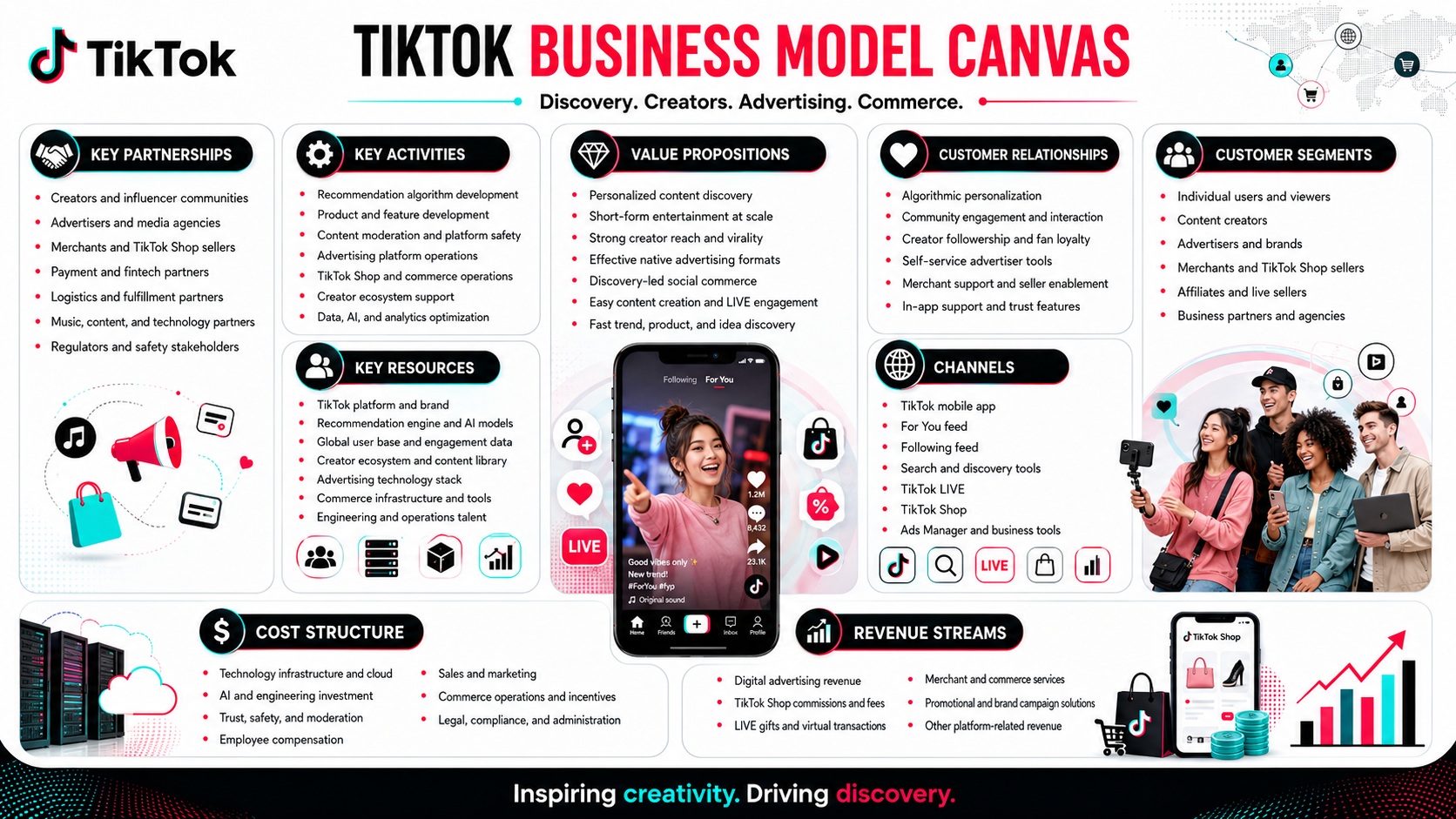
TikTok BMC Diagram
A complete TikTok BMC diagram should show all nine blocks simultaneously.
The most important flow runs from creators to content, from content to algorithmic recommendations, from recommendations to attention and from attention to advertising or commercial transactions.
Revenue then supports continued investment in technology, creators, infrastructure, commerce and platform integrity.
BMC Analysis of TikTok
The detailed TikTok Business Model Canvas reveals that TikTok’s competitive advantage does not depend on one feature.
Recommendation quality, creator supply, consumer attention, advertising technology and commerce reinforce one another.
A stronger recommendation engine can improve watch time. Greater engagement makes TikTok more valuable to advertisers. Higher commercial returns encourage brands and merchants to invest. Creator monetisation opportunities increase incentives to produce additional content.
Tensions also emerge across the model.
Too much sponsored or shopping-oriented material can weaken entertainment value. Rapid creator growth increases moderation requirements. More sophisticated AI requires infrastructure investment. Stronger commercialisation can attract greater regulatory scrutiny.
The nine blocks must consequently remain aligned.
The following sections examine each component in greater depth.
1. Customer Segments
TikTok operates as a multi-sided platform serving stakeholder groups with different motivations.
Individual users form the audience foundation. They consume entertainment, follow interests, search for information, participate in trends, communicate and increasingly discover products.
Creators supply much of the content responsible for attracting and retaining those users.
Advertisers and brands represent major paying customers. Their objectives range from awareness and engagement to application installs, leads and sales.
Merchants form an increasingly important segment through TikTok Shop, while affiliates connect audiences with products using creator-led content and LIVE sessions.
TikTok Customer Segments
| Segment | Details | Why It Matters |
|---|---|---|
| Individual users | View, search, interact and discover | Creates attention and behavioural signals |
| Creators | Produce videos and LIVE content | Generates the platform’s content supply |
| Advertisers and brands | Purchase promotional reach | Supports monetisation |
| Merchants | Sell through TikTok Shop | Expands transaction-based economics |
| Affiliates | Promote merchant products | Connects creators with commerce |
TikTok’s economic strength comes from connecting these segments rather than serving any one group independently.
Viewers attract creators, while creators provide the entertainment required to retain viewers. Audience scale attracts advertisers and sellers, whereas monetisation encourages additional creator participation.
Maintaining this cycle requires careful balance. If creator economics deteriorate, content supply could weaken. Excessive commercialisation could reduce user engagement.
Long-term performance therefore depends on sustaining value across the entire ecosystem rather than maximising revenue from paying customers alone.
2. Value Propositions
TikTok provides different benefits to each stakeholder group.
Users receive highly personalised entertainment and discovery without needing to establish a large social network.
Creators receive accessible production tools and potential distribution beyond their existing followers.
Advertisers gain access to highly engaged audiences, culturally relevant formats and performance-oriented marketing tools.
Merchants can combine awareness, creator recommendation, product demonstration and checkout within the same platform.
The TikTok Business Model Canvas becomes especially compelling when these propositions interact.
TikTok Value Propositions
| Value Proposition | Details | Why It Matters |
|---|---|---|
| Personalised discovery | Interest-driven recommendations | Creates immediate user relevance |
| Entertainment | Continuous short-form and LIVE content | Encourages frequent consumption |
| Creator distribution | Content can reach non-followers | Attracts creator participation |
| Advertising effectiveness | Native formats and optimisation tools | Monetises consumer attention |
| Discovery commerce | Content connects directly with products | Shortens the purchase journey |
TikTok’s central value is not simply video hosting.
Its deeper proposition is efficient matching between content and interest.
Creators gain distribution because algorithms can identify receptive audiences. Users obtain entertainment because the platform continually adapts recommendations. Businesses benefit because commercial messages can participate in the same discovery environment.
The risk is deterioration of relevance.
If recommendations become repetitive, commercial or untrustworthy, viewing behaviour may weaken. TikTok must therefore protect discovery quality as an economic asset.
Sustainable value depends on ensuring users would still find the platform compelling even without advertisements or shopping prompts.
3. Channels
TikTok reaches most stakeholders through digital channels that it can closely integrate.
The mobile application remains the primary consumer interface.
Within the application, the For You feed functions as the main discovery channel. Following feeds provide creator continuity, while search captures more deliberate information-seeking behaviour.
LIVE enables real-time interaction and commerce.
TikTok Shop integrates product discovery and purchasing, whereas advertising and seller-management interfaces provide specialised channels for commercial customers.
TikTok Channels
| Channel | Details | Why It Matters |
|---|---|---|
| TikTok mobile app | Main consumer interface | Creates persistent mobile access |
| For You feed | Algorithmic recommendation channel | Drives discovery and engagement |
| Search | Intent-oriented content discovery | Broadens platform utility |
| TikTok LIVE | Interactive creator and selling format | Supports engagement and commerce |
| TikTok Shop/business tools | Merchant and advertising interfaces | Connects attention with transactions |
Owning the user-facing experience gives TikTok substantial control over discovery and monetisation.
Dependency nevertheless remains elsewhere in the stack.
App stores, mobile operating systems, telecommunications networks, payment systems and local commerce infrastructure can influence availability and economics.
Channel resilience therefore requires more than application engagement. TikTok must maintain effective relationships with external distribution partners while strengthening search, LIVE, commerce and business interfaces.
The strongest channel strategy makes the platform useful across the entire discovery journey—from passive viewing to deliberate search and eventual purchase.
4. Customer Relationships
TikTok’s consumer relationships are primarily automated, personalised and behaviour-driven.
Recommendation algorithms continuously interpret user interactions to determine what content should appear next.
Following creators adds a more persistent relationship layer. Comments, sharing, messaging and LIVE interactions provide social participation around content.
Commercial customers interact differently.
Advertisers typically use self-service campaign tools, while merchants manage products, promotions, orders and creator partnerships through specialised commerce infrastructure.
TikTok Customer Relationships
| Relationship Type | Details | Why It Matters |
|---|---|---|
| Algorithmic personalisation | Content adapts to behavioural signals | Supports relevance and retention |
| Creator following | Users maintain recurring creator relationships | Creates continuity |
| Community interaction | Comments, sharing, trends and LIVE | Builds participation |
| Self-service advertising | Businesses manage campaigns digitally | Enables scalable monetisation |
| Seller ecosystem | Merchants manage commerce activity | Strengthens commercial retention |
The model scales because TikTok does not need human representatives to manage ordinary relationships with millions of users.
Automation creates efficiency but can also introduce distance.
Account restrictions, moderation disputes, fraudulent sellers or advertising problems may require more sophisticated support than automated systems provide.
Trust therefore becomes part of customer relationship management.
Users need confidence that recommendations are safe and authentic. Creators require transparent distribution and enforcement. Businesses expect reliable commercial infrastructure.
TikTok’s long-term relationship advantage will depend on combining personalisation at scale with sufficient transparency, control and support.
5. Revenue Streams
Advertising remains one of TikTok’s principal monetisation engines.
Brands can purchase different formats and campaign objectives designed to turn audience attention into awareness, engagement, traffic or conversion.
Commerce creates another increasingly important economic layer.
TikTok Shop can monetise marketplace activity through fees and other seller-related mechanisms that vary by market and programme. The company has also used commission reductions, shipping support and merchant incentives strategically to stimulate ecosystem participation. In Malaysia, TikTok Shop announced additional support for selected essential categories in June 2026.
TikTok Revenue Streams
| Revenue Stream | Details | Why It Matters |
|---|---|---|
| Digital advertising | Brands purchase audience access | Major scalable monetisation engine |
| Commerce fees | Income connected with TikTok Shop activity | Diversifies revenue |
| LIVE-related monetisation | Virtual transactions and creator interactions | Monetises engagement directly |
| Merchant services | Commercial ecosystem services | Expands seller economics |
| Other platform services | Emerging business and creator offerings | Creates diversification potential |
The revenue architecture is strategically stronger when advertising and commerce complement rather than cannibalise the user experience.
Advertising monetises attention without requiring consumer payment. Commerce goes further by capturing economic value closer to the transaction.
That diversification can improve resilience.
However, encouraging excessive purchasing content may undermine the entertainment environment that originally created TikTok’s audience.
Future monetisation therefore depends on integrating commercial intent naturally into discovery rather than maximising transaction density.
6. Key Resources
TikTok’s most important resources are predominantly digital, technological and ecosystem-based.
The recommendation engine is particularly critical because it determines which videos receive distribution and how effectively viewers are matched with content.
Large-scale user engagement provides behavioural signals that help refine these systems.
Creators supply the continuously changing inventory of entertainment, information and commercial content.
Advertising technology converts user attention into measurable business outcomes, while commerce infrastructure connects merchants, creators and consumers.
TikTok Key Resources
| Key Resource | Details | Why It Matters |
|---|---|---|
| Recommendation technology | Personalises content distribution | Drives the core experience |
| User attention | Large volume of viewing and interaction | Creates commercial inventory |
| Creator ecosystem | Continuous content production | Maintains content diversity |
| Data and AI capability | Supports recommendations and optimisation | Improves platform intelligence |
| Brand and cultural relevance | Strong association with trends and discovery | Attracts users and advertisers |
These resources form significant barriers to entry.
Competitors can replicate vertical-video interfaces relatively easily. Reproducing recommendation quality, creator activity, advertising infrastructure, global scale and cultural relevance is considerably harder.
The same resources also create responsibilities.
Behavioural data produces privacy concerns. Algorithmic influence creates regulatory exposure. Creator dependence requires fair ecosystem governance.
TikTok must consequently protect its strategic resources while demonstrating that they are managed responsibly.
Technology alone is insufficient; the resource system remains valuable only while users, creators and commercial partners trust the platform.
7. Key Activities
TikTok must continuously operate several sophisticated activities.
Product development improves video creation, feeds, search, LIVE, messaging, advertising and shopping.
Algorithm and AI development remain central because recommendation quality determines much of the consumer experience.
Advertising operations manage campaign delivery, optimisation and measurement.
Commerce operations must support merchant onboarding, product governance, fulfilment coordination, payments and promotional activity.
Trust and safety teams address harmful content, fraud, misinformation, policy violations and other forms of abuse.
TikTok Key Activities
| Key Activity | Details | Why It Matters |
|---|---|---|
| Product development | Improve platform features | Maintains relevance |
| AI and recommendation | Match users with content | Drives engagement |
| Advertising operations | Deliver and optimise campaigns | Produces revenue |
| Commerce operations | Manage marketplace ecosystem | Supports transaction growth |
| Trust and safety | Moderate content and commercial activity | Protects platform integrity |
TikTok’s operational complexity has increased as its business model has broadened.
Running a video feed is fundamentally different from managing a marketplace containing sellers, affiliates, payments and logistics dependencies.
Commercial growth consequently increases governance requirements.
Recommendation systems must also optimise beyond pure engagement. Fraud, low-quality content or misleading products could produce short-term interaction while damaging long-term trust.
The strongest operating model therefore treats safety, merchant quality, security and regulatory compliance as commercial capabilities rather than administrative overhead.
Sustainable engagement must remain more important than engagement at any cost.
8. Key Partnerships
TikTok relies on external partners to strengthen content supply, advertising demand and commerce.
Creators are among its most important ecosystem participants because they continually produce content that attracts audiences.
Advertisers and agencies provide commercial demand.
TikTok Shop merchants supply product inventory, while affiliates connect those products with relevant audiences.
Logistics, fulfilment, payment and technology partners become increasingly important as commerce expands.
TikTok Key Partnerships
| Key Partner | Details | Why It Matters |
|---|---|---|
| Creators | Produce entertainment and commercial content | Drives engagement |
| Advertisers and agencies | Purchase and manage campaigns | Supports revenue |
| Merchants and brands | Supply products for TikTok Shop | Builds commerce ecosystem |
| Affiliates | Promote products through content | Links discovery with conversion |
| Logistics and technology partners | Support fulfilment and infrastructure | Enables platform scale |
Partnerships allow TikTok to operate a much broader ecosystem without owning every capability directly.
Creators effectively decentralise content production. Merchants provide inventory. Logistics firms enable physical fulfilment.
External dependence nevertheless introduces risk.
Poor merchant behaviour can damage TikTok’s reputation even when TikTok does not manufacture the product. Creator controversies may affect brand safety. Logistics failures can undermine customer experience.
Partnership management must therefore focus on quality as well as ecosystem growth.
The platform becomes stronger when external participants increase value without transferring disproportionate operational or reputational risk back to TikTok.
9. Cost Structure
TikTok’s digital model can serve additional users without building physical branches, but global platform operations still require substantial investment.
Technology and infrastructure represent major cost categories.
AI development requires engineering talent and computing capacity. Content moderation, cybersecurity and trust-and-safety activities create substantial recurring operating requirements.
Sales and marketing support advertiser acquisition.
TikTok Shop introduces additional commerce-related expenses such as seller incentives, shipping programmes, customer service and marketplace governance.
TikTok Cost Structure
| Cost Category | Details | Why It Matters |
|---|---|---|
| Technology and infrastructure | Computing, storage and platform operations | Supports global scale |
| Product and AI development | Engineering and recommendation systems | Maintains competitiveness |
| Employees | Technology, sales, operations and management | Provides organisational capability |
| Trust, safety and compliance | Moderation, security and regulatory operations | Protects platform viability |
| Commerce investment | Incentives, seller support and marketplace operations | Accelerates TikTok Shop |
The cost structure increasingly reflects TikTok’s evolution from a pure digital-media application into a wider commercial platform.
Commerce can diversify revenue, but expansion introduces operational expenses that advertising-only models may avoid.
AI creates a similar trade-off.
More advanced models can improve recommendations, creative tools and advertising performance, yet computing costs must generate adequate economic returns.
TikTok therefore needs disciplined investment allocation.
Capital and operating expenditure should ultimately improve retention, monetisation, marketplace quality or operating efficiency rather than pursuing technological capability without clear commercial outcomes.
How the Nine BMC Blocks Work Together
The TikTok Business Model Canvas becomes most useful when all nine blocks are treated as one interconnected system.
Customer segments establish the ecosystem.
Users provide attention. Creators produce content. Advertisers provide marketing expenditure. Merchants supply commercial inventory.
Value propositions keep each group participating.
Recommendation systems connect users with relevant videos, creator tools encourage production, advertising products serve businesses and TikTok Shop converts discovery into transactions.
Channels distribute these propositions primarily through the app, For You feed, LIVE, search and commerce interfaces.
Personalisation and creator relationships strengthen retention.
Revenue generated through advertising and commerce finances key activities such as engineering, AI, moderation and marketplace operations.
Resources including algorithms, creators, data and infrastructure support those activities, while external partners extend the platform’s capabilities.
Problems emerge when these components stop reinforcing each other.
Weak recommendations reduce engagement. Lower engagement weakens advertiser demand. Poor merchant experiences damage commerce. Creator dissatisfaction reduces content quality.
TikTok’s long-term success therefore depends on maintaining a balanced flywheel rather than optimising any single BMC block independently.
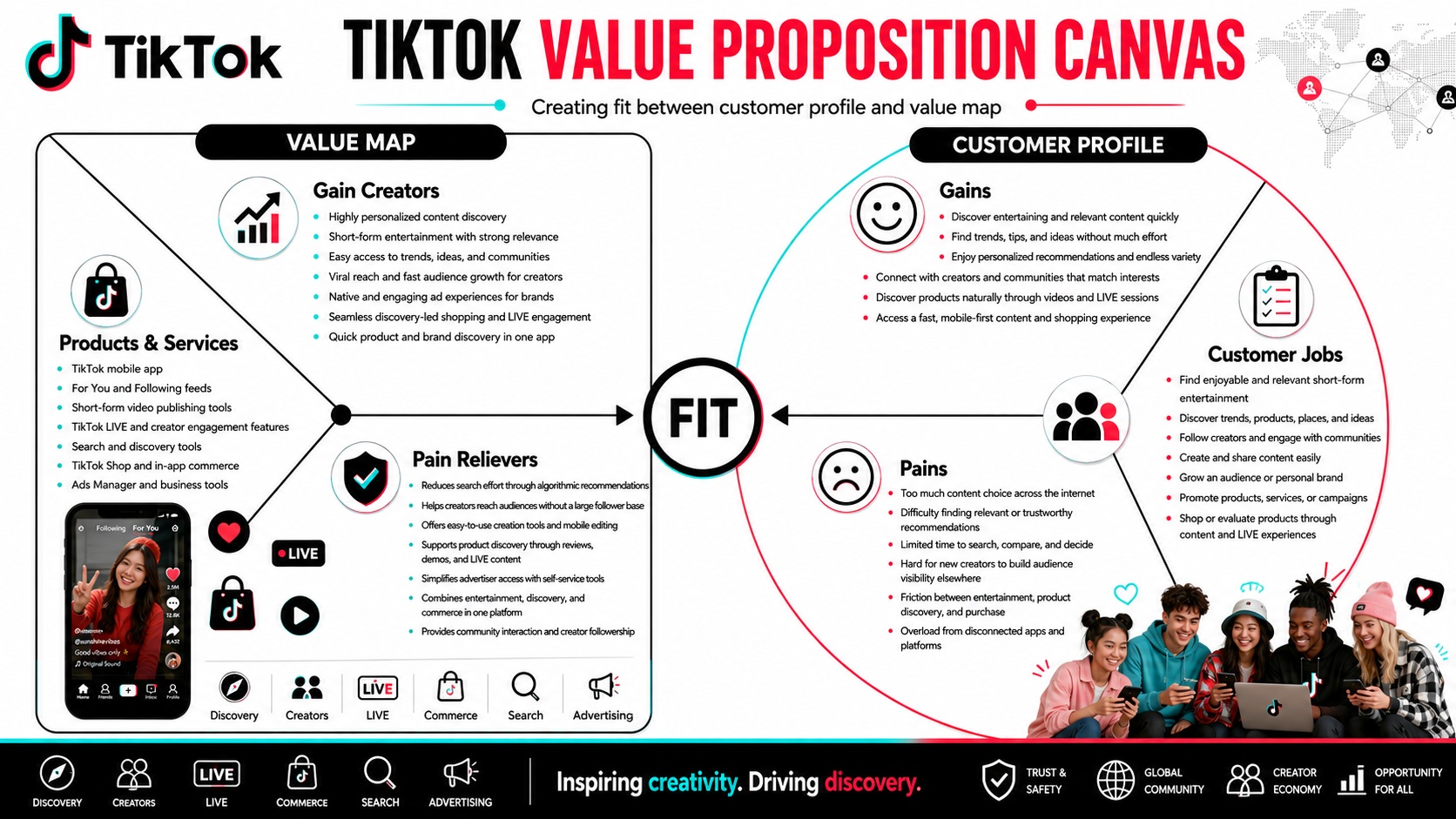
TikTok Value Proposition Canvas
The Value Proposition Canvas provides a more detailed examination of how TikTok creates value for its primary users.
While BMC evaluates the overall business system, VPC concentrates on customer jobs, pains and gains and how platform features respond to them.
The TikTok Business Model Canvas becomes clearer when the consumer value proposition is examined separately from advertiser and merchant monetisation.
Customer Profile
The customer profile below focuses primarily on ordinary TikTok users.
Their objective is no longer limited to short-form entertainment.
Audiences increasingly use TikTok to discover creators, products, trends, destinations, tutorials, opinions and communities.
Customer Profile of TikTok
| Customer Profile | Details |
|---|---|
| Customer Jobs | Find entertainment, discover information, follow interests, learn, participate in trends and explore products |
| Customer Pains | Irrelevant recommendations, repetitive content, misinformation, scams, excessive commercialisation, privacy concerns and harmful content |
| Customer Gains | Rapid discovery, personalised entertainment, useful recommendations, creator access, cultural participation and convenient shopping |
TikTok must reduce friction without making the platform overly predictable.
Weak personalisation creates irrelevant feeds.
Over-personalisation can create repetition or reduce users’ sense of control.
The challenge is maintaining both relevance and novelty.
Trust is equally important because recommendations increasingly influence not only entertainment choices but purchasing and informational decisions.
Value Map
TikTok responds to customer requirements through recommendation technology, creator content, search, LIVE and integrated commerce.
Value Map of TikTok
| Value Map | Details |
|---|---|
| Products and Services | For You feed, Following feed, search, short video, LIVE, messaging, creator tools and TikTok Shop |
| Pain Relievers | Recommendation controls, moderation, reporting, privacy features, merchant governance and security systems |
| Gain Creators | Personalised discovery, easy content creation, creator diversity, trends, product discovery and interactive LIVE experiences |
TikTok’s strongest gain creator is the speed with which it can deliver relevant content.
Users do not need to know exactly what they want beforehand.
Discovery can therefore precede intent.
That distinction becomes commercially powerful when TikTok Shop is integrated into the same experience. A viewer may move from entertainment to product awareness and then purchase without following a conventional search-first shopping journey.
The value map remains effective only when users perceive recommendations as useful rather than manipulative.
How TikTok Creates Fit
| Customer Profile | Details | Matching Value Map | How TikTok Creates Fit |
|---|---|---|---|
| Customer Jobs | Discover entertaining or useful content | Products and Services | Feed, search and LIVE provide continuous discovery |
| Customer Pains | Irrelevant, unsafe or misleading content | Pain Relievers | Moderation, controls and safety systems reduce negative experiences |
| Customer Gains | Personal relevance and effortless discovery | Gain Creators | AI recommendations match content with inferred interests |
Value fit improves when TikTok quickly understands what a user finds interesting while still delivering variety and novelty.
Commercial integration strengthens fit when product discovery solves genuine customer needs.
The experience deteriorates when promotional material becomes excessive, recommendations become repetitive or users lose confidence in content and sellers.
TikTok must therefore optimise simultaneously for relevance, discovery, safety and consumer control.
TikTok vs Instagram vs YouTube Business Models
The TikTok Business Model Canvas shares important characteristics with Instagram and YouTube because all three compete for consumer attention, creators, advertising budgets and increasingly shopping-related activity.
Their strategic foundations nevertheless differ.
TikTok is strongly centred on algorithmic interest discovery.
Instagram combines creator discovery with social relationships, messaging and Meta’s broader advertising ecosystem.
YouTube offers a wider video architecture spanning short-form content, long-form video, search, connected television and paid subscriptions.
Only the BMC blocks with the greatest strategic differences are compared below.
BMC Block Comparison
| Relevant BMC Block | TikTok | YouTube | |
|---|---|---|---|
| Customer Segments | Users, creators, advertisers, merchants and affiliates | Social users, creators, businesses and advertisers | Viewers, creators, advertisers and subscribers |
| Value Proposition | Fast personalised discovery and entertainment | Visual social connection plus creator discovery | Broad searchable video and creator ecosystem |
| Channels | For You, search, LIVE and TikTok Shop | Feed, Stories, Reels, Explore and messaging | Search, recommendations, Shorts, app and connected TV |
| Revenue Streams | Advertising plus commerce-related monetisation | Primarily advertising within Meta ecosystem | Advertising plus substantial subscription monetisation |
| Key Resources | Recommendation engine, creators and cultural relevance | Social graph, creators and Meta advertising technology | Video library, creators, search and Google infrastructure |
TikTok’s strongest distinction is its ability to create engagement without requiring established relationships or explicit search intent.
Instagram possesses greater integration with social identity and Meta’s wider application portfolio.
YouTube benefits from search, long-form content and subscription economics.
TikTok should therefore strengthen its discovery advantage while developing monetisation models that do not compromise that underlying experience.
Competitive Advantages
TikTok possesses several structural advantages that strengthen its competitive position.
- Powerful interest-based recommendation engine: TikTok can rapidly infer what individual users enjoy, enabling strong engagement even before they establish extensive follower networks.
- Low-friction creator discovery: New creators can potentially reach large audiences without first accumulating a large social graph, encouraging continuous experimentation and content supply.
- Strong cultural relevance: Trends, music, memes, products and creator formats can spread rapidly through the platform, giving TikTok an influential position within consumer culture.
- Integrated discovery commerce: TikTok Shop connects entertainment, creator recommendation, LIVE demonstrations and purchasing in one journey, differentiating it from conventional search-led e-commerce.
- Multi-sided monetisation potential: Advertising, commerce, creator activity and emerging services provide several ways to capture economic value from the same underlying discovery ecosystem.
These advantages reinforce one another.
Better discovery attracts viewers. Audience activity attracts creators. Creator content strengthens cultural relevance. Greater attention attracts advertisers and merchants.
Protecting this reinforcing cycle is more important than simply adding additional features.
Risks and Challenges
Despite its strengths, TikTok faces significant strategic and operational risks.
- Regulatory and geopolitical exposure: Government scrutiny involving ownership, data governance, national security, content regulation and youth protection can affect market access and operating requirements.
- Platform trust and safety: Harmful content, misinformation, scams, fraudulent sellers and unsafe behaviour can reduce user confidence and advertiser willingness to participate.
- Creator multi-homing: Creators can distribute content simultaneously through Instagram Reels, YouTube Shorts and other services, reducing TikTok’s ability to secure exclusive content advantages.
- Over-commercialisation: Excessive advertisements, affiliate videos or shopping content may weaken the entertainment experience that originally attracts audiences.
- Rising technology and commerce costs: AI infrastructure, moderation, compliance, merchant support, logistics incentives and international expansion can increase costs faster than monetisation improves.
The greatest threat may not be one catastrophic event.
Gradual weakening across several blocks could prove more damaging.
Lower content quality can reduce engagement. Declining engagement weakens advertising performance. Reduced creator opportunities can then diminish future content supply.
Management must therefore monitor ecosystem health rather than focusing exclusively on revenue growth.
Strategic Recommendations
TikTok should preserve its algorithmic discovery advantage while improving economic diversification, marketplace trust and long-term ecosystem resilience.
Growth should not depend simply on increasing the volume of advertisements or shopping content.
Instead, strategy should improve the value received by users, creators, advertisers and merchants simultaneously.
1. Protect the Quality of the For You Experience
TikTok should treat recommendation quality as its most important consumer asset.
Commercial content must remain relevant and proportionate rather than overwhelming entertainment.
Ranking systems should balance immediate engagement with longer-term satisfaction, content diversity and trust.
Protecting discovery quality safeguards the attention that supports every subsequent monetisation mechanism.
2. Build TikTok Shop Around Trusted Discovery
Commerce should remain closely connected with genuine creator recommendation, useful product demonstrations and high-quality sellers.
TikTok should strengthen merchant verification, product quality controls, review integrity and after-sales support.
A trustworthy marketplace can increase transaction frequency while protecting TikTok’s wider platform reputation.
3. Strengthen Creator Economics
Creators represent strategic supply rather than merely users of publishing tools.
TikTok should maintain competitive monetisation, analytics, collaboration tools and business opportunities for creators at different levels.
Stronger creator economics can improve content quality and reduce incentives to prioritise competing platforms.
4. Diversify Monetisation Carefully
Advertising and commerce should remain important, but TikTok can continue evaluating creator services, business tools, premium capabilities and other complementary revenue opportunities.
Diversification would reduce reliance on a single economic engine.
New revenue models should nevertheless solve genuine customer problems rather than adding friction to free consumer access.
5. Make AI Investment Economically Measurable
AI expenditure should connect directly with measurable outcomes.
Relevant metrics include recommendation satisfaction, advertising conversion, moderation effectiveness, creator productivity, fraud detection and customer-support efficiency.
Technology investments create strategic value only when they strengthen economic performance or platform quality.
6. Treat Trust and Safety as Core Infrastructure
Moderation, privacy, security, merchant governance and youth protection should be treated as components of the value proposition.
Platform integrity influences retention, advertising demand and regulatory confidence.
Investment in trust can therefore protect revenue rather than simply fulfil compliance requirements.
7. Expand Search and Intent-Based Discovery
TikTok should continue developing search without abandoning recommendation-led discovery.
Search creates opportunities when users have explicit informational or commercial intent.
Combining search with algorithmic recommendations could strengthen TikTok across both planned and unplanned discovery journeys while increasing its strategic relevance beyond entertainment.
Conclusion
Overall, the TikTok Business Model Canvas explains how TikTok has developed from a short-form video application into a sophisticated attention, discovery, advertising, creator and commerce ecosystem.
Its fundamental mechanism remains relatively straightforward.
Creators provide content.
Algorithms distribute that content according to predicted interests.
Users provide attention and behavioural signals.
Advertisers pay for access to audiences, while merchants and affiliates increasingly convert discovery into commercial transactions.
Complexity emerges underneath this flywheel.
AI must continuously improve recommendations. Infrastructure must process immense volumes of video and interaction. Trust and safety systems must manage platform integrity. Commerce capabilities must govern sellers and transactions.
TikTok’s future performance will therefore depend less on whether it can produce another viral feature and more on whether these interconnected elements remain mutually reinforcing.
Discovery remains the strategic foundation.
If TikTok can preserve recommendation quality while strengthening creator economics, trusted commerce, advertising performance, search utility and regulatory resilience, its business model can continue expanding beyond social entertainment into a broader global discovery economy.
Disclaimer
This article is provided solely for educational, informational and business-analysis purposes.
The analysis is based on publicly available company information, industry developments and strategic interpretation available at the time of writing. It is not official information issued, reviewed, approved or endorsed by ByteDance Ltd., TikTok, Meta Platforms, Inc., Instagram, Alphabet Inc., Google, YouTube or any other organisation mentioned.
Nothing in this article constitutes financial, investment, legal, regulatory, technology or other professional advice. It should not be considered investment advice or a recommendation to buy, sell or hold any security, asset or investment.
Business models, products, technologies, financial performance, market conditions and regulatory environments can change over time. Readers should conduct independent research and obtain appropriate professional advice before making investment, business or strategic decisions.
All trademarks, logos, copyrights, company names, product names and other intellectual-property rights belong to their respective owners. Any names or references used in this article are included solely for identification, educational and analytical purposes.
Meta Description
Explore the TikTok Business Model Canvas, including all nine BMC blocks, Value Proposition Canvas, Instagram and YouTube comparison, competitive advantages, risks and strategic recommendations updated for 2026.

