



Share This Article


Watsons Business Model Canvas: How Watsons Built a Scalable Health and Beauty Retail Model
BMC Article No: BMC #12
Updated in 2026: This article has been rewritten with a stronger business story, clearer Business Model Canvas structure, deeper analysis for each block, competitive advantages, risks, recommendations, and strategic lessons from Watsons’ health and beauty retail model.
Introduction
Watsons is more than a pharmacy or beauty store. It is a health and beauty retail platform built around convenience, product range, trusted brands, promotions, loyalty, pharmacy support, and digital shopping. That is why the Watsons Business Model Canvas is useful. It shows how a familiar retail chain can turn everyday personal care needs into repeat customer visits.
The strength of Watsons does not come from one product category alone. Its advantage comes from the combination of store network, private-label products, supplier relationships, member promotions, online ordering, pharmacy services, and health and beauty expertise. A customer may buy skincare today, vitamins next week, shampoo during a promotion, and medicine when needed.
This makes Watsons different from a normal convenience store. It competes in a category where customers want trust, availability, affordability, product advice, and easy access. The brand must serve both planned purchases and impulse purchases.
In this article, we will break down the Watsons business model and examine how it creates value, reaches customers, generates revenue, manages cost, and protects its position in the health and beauty retail market.
What Is Watsons’ Business Model?
Watsons’ business model is built around health and beauty retail at scale. The company sells skincare, cosmetics, personal care items, health products, vitamins, supplements, pharmacy products, baby care, household essentials, and selected exclusive brands through physical stores, online channels, mobile app features, loyalty programmes, and promotional campaigns.
Its core strength is accessibility. Customers can visit a nearby outlet, browse online, use the app, join Watsons Club, collect rewards, and benefit from frequent promotions. This creates a retail model that is both transactional and relationship-based.
Category breadth also matters. Watsons does not depend only on cosmetics or pharmacy products. It covers multiple consumption needs across beauty, wellness, hygiene, family care, and everyday essentials. This helps the company capture different spending occasions from the same customer base.
The Watsons Business Model Canvas therefore shows a business that looks simple at the store level, but depends on strong retail execution behind the scenes. Store location, merchandising, supplier terms, inventory control, loyalty data, app engagement, pharmacist availability, and promotional discipline must work together.
What Is Business Model Canvas?
Business Model Canvas, or BMC, is a tool used to understand how a business works. It explains how a company creates value, delivers that value to customers, and converts it into revenue. Instead of looking only at products, BMC breaks a business into nine practical building blocks.
| BMC Block | Main Question |
|---|---|
| Customer Segments | Who does the business serve? |
| Value Propositions | What value does the business offer? |
| Channels | How does the business reach customers? |
| Customer Relationships | How does the business build loyalty? |
| Revenue Streams | How does the business make money? |
| Key Resources | What assets does the business need? |
| Key Activities | What must the business do well? |
| Key Partnerships | Who helps the business operate? |
| Cost Structure | What are the major costs? |
For Watsons, BMC is useful because the business is not only about selling health and beauty products. It involves pharmacy trust, supplier management, private-label strategy, promotions, store expansion, customer data, digital commerce, and member engagement.
Quick Overview of Watsons and A.S. Watson Group
Watsons is part of A.S. Watson Group, one of the world’s largest international health and beauty retail groups. The brand has a long history that started in Hong Kong and later expanded across Asia, Europe, and the Middle East.
In Malaysia, Watsons is known as a leading health and beauty retailer with a strong physical store presence and an increasingly important digital channel. The brand sells international brands, local brands, exclusive products, pharmacy items, and private-label products.
Its parent group gives Watsons several strategic advantages. These include procurement scale, retail operating knowledge, technology support, supplier access, and regional brand experience. A small standalone retailer may struggle to match this level of buying power and retail discipline.
Local adaptation remains important. Malaysian customers care about price, promotions, halal-sensitive product choices, skincare trends, pharmacy access, family health, and online convenience. Watsons must therefore combine global retail strength with local customer insight.
The Watsons Business Model Canvas helps explain why the brand is strategically important. Watsons is not only a store. It is a repeat-purchase retail system supported by locations, products, suppliers, loyalty data, pharmacists, promotions, and digital infrastructure.
Why Watsons Is Strategically Interesting
Watsons is strategically interesting because it operates in a high-frequency category. Customers do not buy shampoo, skincare, medicine, vitamins, cosmetics, and personal care items once in a lifetime. They replenish these items repeatedly.
Repeat purchase gives Watsons a strong base. A customer who trusts the store for one product may return for related products. For example, a skincare buyer may also buy sunscreen, facial cleanser, supplements, cotton pads, and body care items.
Promotions strengthen this behaviour. Health and beauty shoppers often compare prices, wait for discounts, use loyalty points, and respond to bundle deals. Watsons turns this behaviour into a structured retail engine through member pricing, app promotions, e-vouchers, and seasonal campaigns.
Digital commerce adds another layer. Customers can discover products online, compare offers, check reviews, use app rewards, and purchase through digital channels. Physical stores still matter, but online and app experiences help Watsons stay relevant when shopping habits shift.
From a strategy perspective, Watsons shows how a retailer can combine category depth, store convenience, loyalty mechanics, pharmacy trust, and digital engagement to defend its position in a competitive market.
Latest Developments: What Is Changing Around Watsons?
Watsons operates in a market shaped by three major shifts: digital retail, beauty trend acceleration, and stronger price competition.
A.S. Watson Group has invested heavily in O+O retail, which means Offline plus Online. This approach connects physical stores with digital channels so customers can shop across store, website, and app experiences. For Watsons, this is important because health and beauty customers may discover products online but still want store pickup, pharmacy advice, or physical product testing.
Loyalty is also becoming more central. Watsons Club, app-exclusive offers, W Rewards, e-stamps, and member campaigns help the brand collect customer data and encourage repeat buying. This gives Watsons a stronger relationship with customers compared with retailers that depend only on walk-in traffic.
Competition is intensifying at the same time. Pharmacies, supermarkets, e-commerce platforms, beauty specialty stores, brand-owned online shops, TikTok sellers, and price-led marketplaces all compete for the same wallet.
This latest context changes how we read the business model. Scale is useful, but it is not enough. Watsons must protect trust, product relevance, pricing discipline, pharmacy credibility, app engagement, and store productivity.
Watsons Business Model Canvas Summary
Before going into each block, the summary below gives a quick view of how Watsons’ business model works. It shows who the brand serves, what value it offers, how it reaches customers, how revenue is generated, and what resources keep the model running.
| BMC Block | Watsons Application |
|---|---|
| Customer Segments | Beauty shoppers, health-conscious consumers, families, pharmacy customers, value seekers, digital shoppers, and working adults. |
| Value Propositions | Wide product range, trusted health and beauty retail, pharmacy access, promotions, loyalty rewards, convenience, and digital shopping. |
| Channels | Physical stores, website, mobile app, delivery, click-and-collect, social media, marketplaces, and promotional campaigns. |
| Customer Relationships | Watsons Club, app engagement, rewards, member pricing, pharmacist support, beauty advice, and personalized offers. |
| Revenue Streams | Product sales, pharmacy sales, private-label sales, exclusive brands, online orders, bundles, promotions, and supplier-funded campaigns. |
| Key Resources | Brand equity, store network, suppliers, pharmacists, inventory system, loyalty data, app platform, private labels, and retail teams. |
| Key Activities | Retail operations, merchandising, sourcing, pharmacy support, promotions, inventory control, digital commerce, and customer engagement. |
| Key Partnerships | A.S. Watson Group, suppliers, brands, landlords, logistics partners, payment providers, technology vendors, and healthcare stakeholders. |
| Cost Structure | Product procurement, rental, labour, logistics, marketing, technology, store fit-out, utilities, pharmacy compliance, and inventory costs. |
The Watsons Business Model Canvas shows a retailer that depends on scale, trust, product availability, and repeat customer relationships.
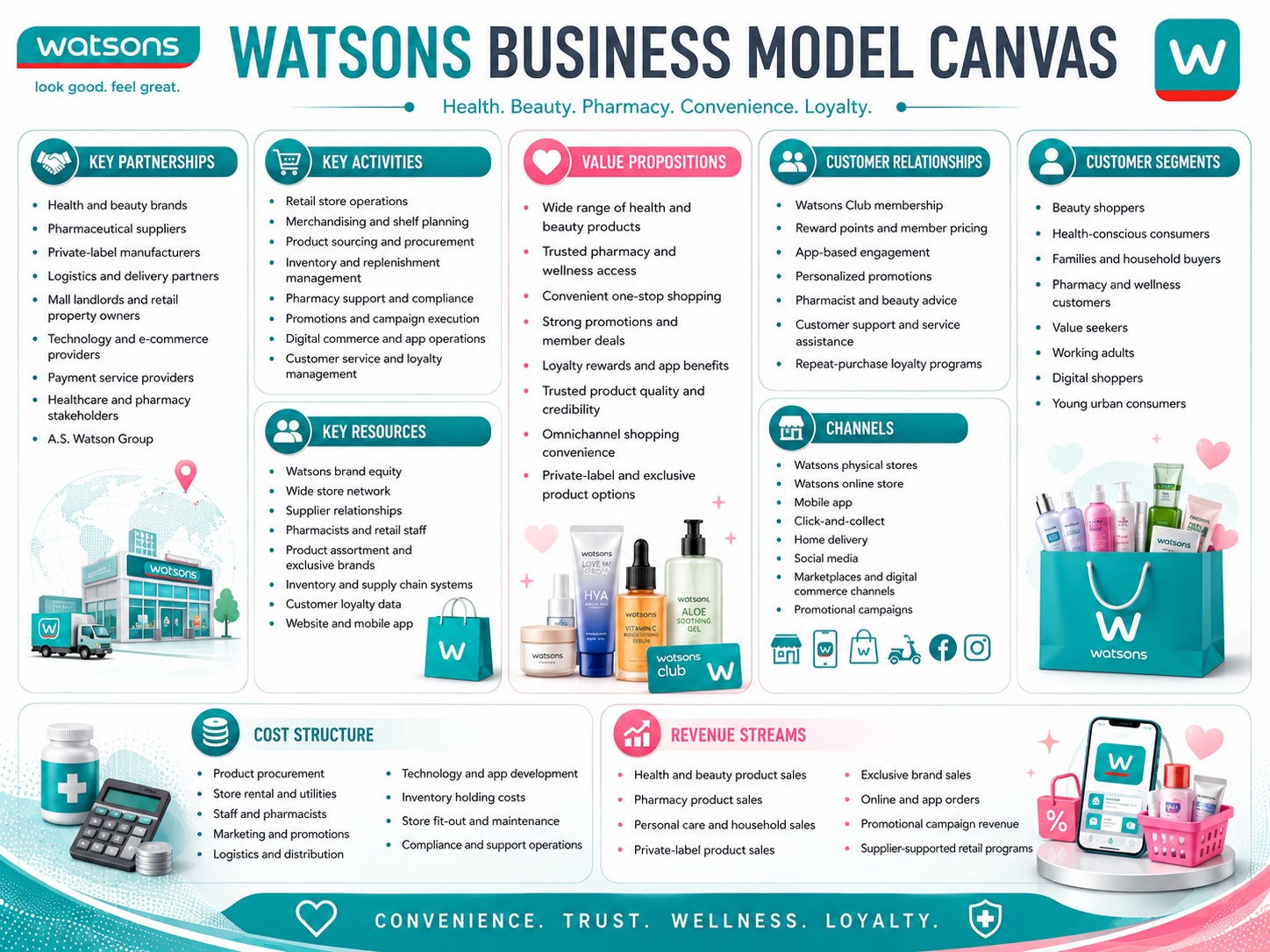
1. Customer Segments
Customer segments describe who the business serves. Watsons serves a broad consumer base, but its strongest segments are people who buy health, beauty, wellness, pharmacy, and personal care products regularly.
Different customers visit Watsons for different reasons. Beauty shoppers want skincare, cosmetics, masks, hair care, fragrances, and new product launches. Health-conscious customers look for vitamins, supplements, wellness products, and pharmacy items. Families buy baby care, hygiene products, oral care, and household essentials. Value seekers follow promotions, bundles, points, and member discounts.
Digital shoppers are increasingly important. They may browse the app, compare prices, use vouchers, and buy online when they want convenience. Working adults may visit outlets near offices, malls, transit areas, or residential neighbourhoods.
| Customer Segment | What They Need | How Watsons Serves Them |
|---|---|---|
| Beauty shoppers | Choice, trends, trusted brands, and deals. | Offers skincare, cosmetics, hair care, exclusives, and campaigns. |
| Health customers | Wellness, supplements, pharmacy access, and guidance. | Provides vitamins, OTC products, pharmacists, and health categories. |
| Families | Daily essentials and reliable product availability. | Sells baby care, hygiene, oral care, and personal care items. |
| Value seekers | Better prices and rewards. | Uses member pricing, bundles, points, and app offers. |
| Digital shoppers | Convenience and fast access. | Supports app shopping, online orders, and digital rewards. |
The Watsons Business Model Canvas shows that Watsons serves both need-based and promotion-driven customers. This is important because Watsons does not rely on a single buying reason. Some customers visit because they need health, pharmacy, or family care products immediately, while others return because promotions, rewards, app offers, and beauty campaigns make regular purchases feel more attractive.
2. Value Propositions
The value proposition explains why customers choose Watsons. At the simplest level, Watsons offers convenient access to health, beauty, and personal care products under one trusted retail brand.
Its first value is range. Customers can find skincare, cosmetics, vitamins, medicine, toiletries, hair care, baby care, and household essentials in one place. This reduces shopping effort and increases basket size.
Trust is another important value. Health and beauty products affect the body, skin, appearance, and wellbeing. Customers want reliable brands, safe products, clear labels, and credible pharmacy support. Watsons benefits from a long brand history and a retail environment that feels more specialized than a general store.
Promotional value also drives traffic. Member discounts, bundle deals, app vouchers, exclusive campaigns, and reward points make customers feel that they can save money while buying regular products.
| Value Proposition | Customer Benefit | Strategic Importance |
|---|---|---|
| Wide product range | Customers buy multiple categories in one trip. | Increases basket size and visit relevance. |
| Trusted retail environment | Shoppers feel safer buying health and beauty items. | Builds repeat purchase and brand confidence. |
| Pharmacy and wellness access | Customers get health-related products and support. | Differentiates Watsons from pure beauty retailers. |
| Promotions and loyalty | Members save money and return more often. | Encourages frequency and data capture. |
| Digital convenience | Customers shop through app and online channels. | Protects relevance as shopping shifts online. |
The Watsons Business Model Canvas shows that Watsons sells confidence, convenience, and savings, not only products. This matters because customers in health and beauty retail are not making purely functional purchases. They want to feel sure that the product is safe, the price is fair, the brand is reliable, and the buying process is easy across both store and digital channels.
3. Channels
Channels explain how Watsons reaches customers. This is one of the most important parts of Watsons’ model because retail success depends on availability.
Physical stores remain the main channel. Stores provide visibility, immediate purchase, product browsing, pharmacist interaction, and impulse buying. Location matters because customers often buy health and beauty products when they are already in malls, commercial areas, neighbourhood centres, or transit locations.
Digital channels extend the business beyond store opening hours. Customers can use the website or app to browse products, receive member offers, check promotions, and place orders. App-exclusive offers also give Watsons a direct channel to customers without relying only on rented mall traffic.
Social media supports discovery. Beauty trends, product launches, influencer content, festive campaigns, and limited-time promotions can move customers from awareness to purchase.
| Channel | Role | Strategic Value |
|---|---|---|
| Physical stores | Main shopping and service channel. | Builds reach, trust, and impulse sales. |
| Website and app | Digital shopping and loyalty access. | Supports convenience and data collection. |
| Click-and-collect | Bridges online and offline shopping. | Uses store network as fulfilment strength. |
| Delivery | Serves urgent or convenience-led demand. | Competes with e-commerce and marketplaces. |
| Social media | Drives awareness and campaign traffic. | Keeps the brand visible and trend-relevant. |
The Watsons Business Model Canvas shows a channel strategy built around store reach plus digital engagement. This is important because Watsons can serve customers at different stages of the buying journey. Some customers discover products through social media or the app, compare prices online, then complete the purchase in-store, while others use the physical store as a trusted fulfilment and service point.
4. Customer Relationships
Customer relationships explain how Watsons keeps customers coming back. In health and beauty retail, loyalty is important because switching is easy. Customers can buy similar products from pharmacies, supermarkets, marketplaces, brand websites, and social commerce sellers.
Watsons builds relationships through Watsons Club, member pricing, reward points, app-exclusive offers, e-stamps, birthday rewards, vouchers, and personalized campaigns. These mechanics make repeat purchase more attractive.
Service also matters. Pharmacy support, product recommendations, beauty advice, return processes, and clear promotion communication help customers feel more confident. A customer buying supplements or skincare may need more assurance than someone buying a simple household item.
Digital relationships are becoming stronger. The app gives Watsons a direct engagement channel. It can show promotions, recommend products, push offers, and encourage customers to redeem rewards.
| Relationship Method | How It Works | Business Impact |
|---|---|---|
| Watsons Club | Rewards and member benefits. | Increases repeat visits and customer data. |
| App engagement | Digital vouchers and exclusive offers. | Keeps customers connected outside stores. |
| Pharmacy support | Health-related advice and trust. | Improves credibility and service value. |
| Promotions | Frequent campaigns and bundles. | Drives traffic and purchase urgency. |
| Personalized offers | Relevant deals based on customer behaviour. | Improves conversion and basket relevance. |
Strong customer relationships help Watsons move from one-time transactions to habit-based retail behaviour. This is strategically valuable because health and beauty purchases are often repeated monthly or even weekly. When Watsons links these purchases to rewards, member pricing, app reminders, and trusted advice, it increases the chance that customers return before considering competitors.
5. Revenue Streams
Revenue streams show how the business makes money. Watsons generates revenue mainly through product sales, supported by pharmacy sales, private-label products, exclusive brands, digital orders, and promotional campaigns.
The core revenue engine is retail product sales. Customers buy skincare, cosmetics, toiletries, supplements, baby products, personal care items, and household essentials. These categories create recurring demand because many products must be replaced regularly.
Private-label and exclusive products can improve margins. When Watsons sells its own brand or exclusive ranges, it may capture better economics than selling only third-party branded products.
Supplier-funded promotions may also support revenue. Brands often want visibility in stores, campaigns, catalogues, app banners, and seasonal events. This can create commercial income beyond direct product margin.
| Revenue Stream | Description | Why It Matters |
|---|---|---|
| Product sales | Health, beauty, personal care, and daily essentials. | Forms the main revenue base. |
| Pharmacy sales | OTC products, health items, and pharmacy categories. | Adds trust and need-based traffic. |
| Private-label products | Watsons-owned or controlled product ranges. | Supports margin and differentiation. |
| Exclusive brands | Products customers may not find everywhere. | Reduces direct price comparison. |
| Online orders | Website, app, delivery, and click-and-collect sales. | Captures digital demand. |
| Supplier campaigns | Trade promotions and brand visibility programmes. | Supports retail economics and marketing activity. |
The Watsons Business Model Canvas shows a revenue model based on repeat purchase, category breadth, and promotional conversion. This revenue logic works because Watsons can earn from many small but frequent purchases across multiple categories. A single customer may contribute revenue through skincare, supplements, toiletries, pharmacy items, online orders, private-label products, and promotional bundles over time.
6. Key Resources
Key resources are the assets required to deliver the business model. For Watsons, the most important resources are brand equity, store network, suppliers, pharmacists, inventory systems, loyalty data, digital platforms, and retail operating know-how.
Brand equity is critical because customers must trust the retailer. Watsons sells products linked to health, skin, hygiene, and appearance. A recognized brand reduces customer hesitation.
Store network is another major resource. Physical locations create convenience and visibility. They also support click-and-collect, returns, pharmacy access, and local customer relationships.
Supplier access shapes competitiveness. Watsons needs strong relationships with beauty brands, health brands, pharmaceutical suppliers, distributors, and private-label manufacturers. Better supplier terms can support pricing, availability, promotions, and exclusive launches.
| Key Resource | Role in the Business Model | Strategic Value |
|---|---|---|
| Brand equity | Recognition and trust. | Supports repeat purchase and customer confidence. |
| Store network | Physical access and fulfilment base. | Improves convenience and market coverage. |
| Supplier relationships | Product availability and commercial terms. | Enables range, pricing, and promotions. |
| Pharmacists and staff | Service, advice, and execution. | Differentiates Watsons from pure online sellers. |
| Loyalty data | Customer behaviour and purchase patterns. | Improves targeting and retention. |
| Digital platforms | App, website, and O+O capabilities. | Supports omnichannel growth. |
The Watsons Business Model Canvas shows that data, trust, and stores are as important as products. This is because Watsons’ advantage does not come only from what sits on the shelf. It also comes from customer insight, supplier access, pharmacist credibility, store convenience, digital infrastructure, and the ability to connect these resources into one consistent shopping experience.
7. Key Activities
Key activities describe what Watsons must do well every day. The business depends on disciplined retail execution across stores, suppliers, inventory, promotions, pharmacy service, digital commerce, and customer engagement.
Merchandising is one core activity. Watsons must select the right products, arrange them clearly, manage shelf space, and refresh displays based on seasons, trends, and campaigns. Poor merchandising can reduce basket size even when store traffic is strong.
Inventory management is equally important. Health and beauty customers expect products to be available when needed. Stock-outs can push customers to competitors, while overstock can create markdown pressure.
Digital execution is now a major activity. App offers, online product listings, fulfilment, delivery coordination, loyalty campaigns, and customer data usage must work smoothly.
| Key Activity | Why It Matters | Example |
|---|---|---|
| Store operations | Ensures consistent customer experience. | Clean shelves, clear prices, fast checkout. |
| Merchandising | Converts traffic into purchases. | Skincare displays, bundle zones, seasonal shelves. |
| Inventory control | Protects availability and cash flow. | Replenishment, expiry control, stock forecasting. |
| Pharmacy support | Builds trust and service differentiation. | Pharmacist advice and health product guidance. |
| Digital commerce | Captures online and app demand. | Vouchers, app orders, click-and-collect. |
| Promotions | Drives traffic and purchase urgency. | Member days, bundles, festive campaigns. |
Watsons must execute these activities consistently because small retail failures can quickly reduce customer satisfaction. A missing product, unclear price, weak app experience, slow checkout, poor shelf display, or unreliable promotion can push customers to another pharmacy, marketplace, or beauty retailer. Operational discipline therefore becomes a direct driver of loyalty and margin protection.
8. Key Partnerships
Key partnerships explain who helps Watsons operate. A health and beauty retailer cannot succeed alone because it depends on suppliers, landlords, logistics providers, technology partners, payment providers, healthcare professionals, and marketing partners.
Suppliers are the most visible partners. Watsons needs reliable access to cosmetics, skincare, supplements, medicine, personal care products, and household essentials. Strong supplier partnerships improve product availability, exclusive launches, and promotional funding.
Landlords are also important. Many Watsons outlets operate in malls, shopping streets, commercial centres, and high-traffic locations. Good locations increase visibility and impulse purchases.
Technology and logistics partners support digital growth. Online orders, delivery promises, loyalty features, stock visibility, and app performance depend on strong backend systems.
| Partner Type | Role | Strategic Importance |
|---|---|---|
| A.S. Watson Group | Parent support and retail knowledge. | Provides scale, systems, and regional experience. |
| Product suppliers | Brands, distributors, and manufacturers. | Supports range, margin, and availability. |
| Landlords | Store locations and foot traffic. | Drives convenience and customer access. |
| Logistics partners | Distribution and delivery. | Protects stock flow and online fulfilment. |
| Technology providers | App, data, payments, and systems. | Enables O+O retail execution. |
| Healthcare stakeholders | Pharmacy and compliance support. | Strengthens trust and regulated operations. |
Strong partnerships help Watsons scale faster while maintaining product choice and service quality. These partnerships allow Watsons to access better products, secure stronger promotional support, operate in strategic locations, fulfil online orders, process payments efficiently, and maintain pharmacy-related standards. Without these partners, the business would find it harder to deliver convenience at scale.
9. Cost Structure
Cost structure explains the major costs required to operate Watsons. Retail scale brings revenue opportunity, but it also creates significant fixed and variable costs.
Product procurement is the largest cost area. Watsons must purchase inventory across thousands of items and manage supplier terms, stock levels, expiry dates, and markdown exposure. Health and beauty products can become costly when trends change or inventory moves slowly.
Store costs are another major component. Rental, utilities, staff, fixtures, maintenance, point-of-sale systems, and store renovation all affect profitability. A high-traffic location can increase sales, but rental must be justified by store productivity.
Digital commerce also creates cost. App development, e-commerce systems, digital marketing, delivery integration, cybersecurity, loyalty infrastructure, and customer service require ongoing investment.
| Cost Area | Description | Management Priority |
|---|---|---|
| Product procurement | Inventory from brands and suppliers. | Balance availability with margin. |
| Rental and store costs | Outlets, utilities, fit-out, and maintenance. | Improve sales per store. |
| Labour | Pharmacists, store teams, and support staff. | Maintain service quality and productivity. |
| Marketing and promotions | Campaigns, discounts, media, and loyalty offers. | Protect margin while driving traffic. |
| Technology | App, website, data, and retail systems. | Support omnichannel growth. |
| Logistics | Warehousing, delivery, and replenishment. | Improve speed and stock reliability. |
A strong cost structure requires Watsons to balance growth, margin, service, and customer value. This balance is critical because retail scale can become expensive if store productivity, inventory turnover, promotion discipline, and digital investment are not managed carefully. Watsons must keep prices attractive while still protecting profitability across stores, online channels, logistics, staff, and technology.
Value Proposition Canvas View of Watsons
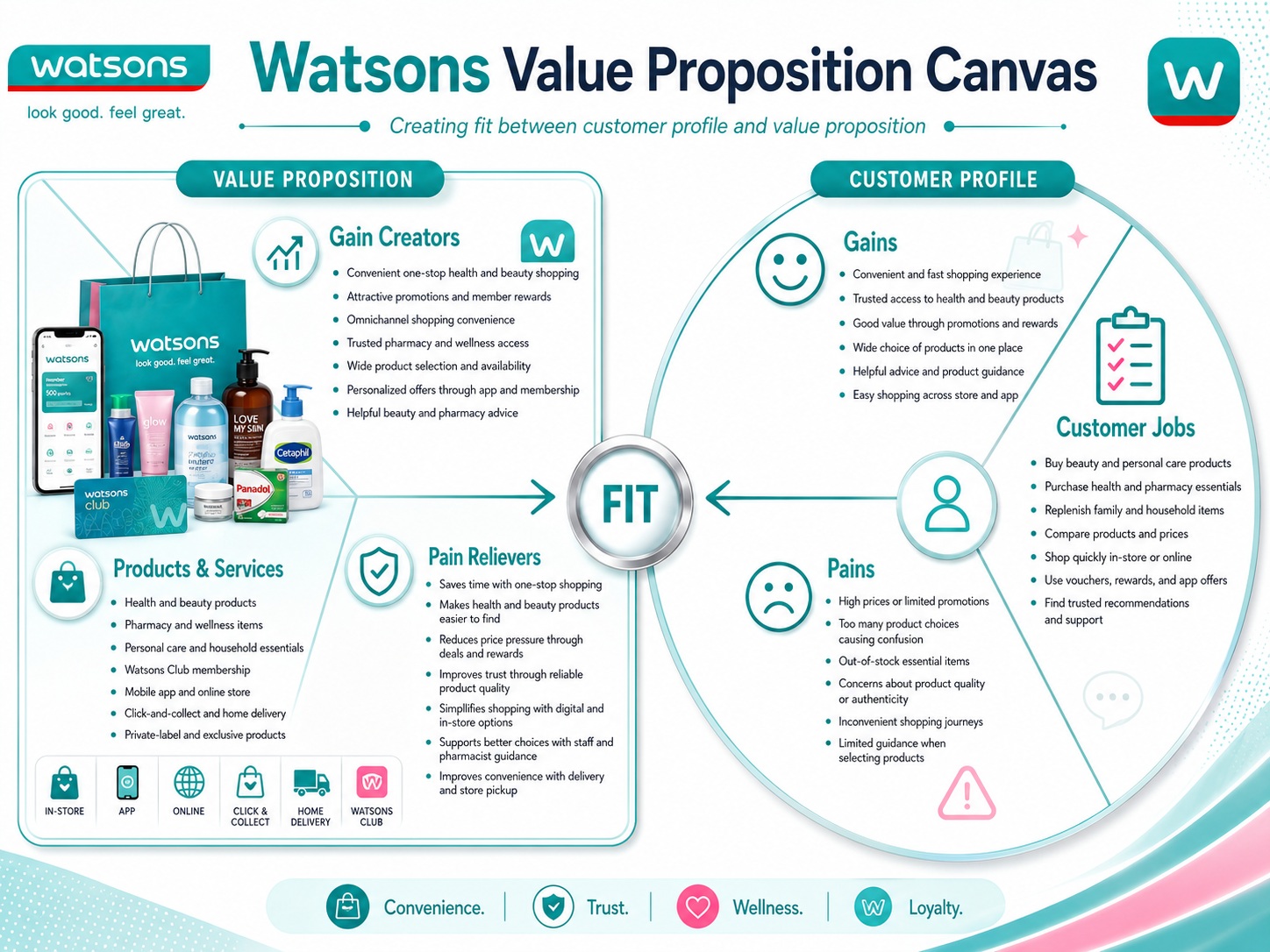
The Value Proposition Canvas helps explain the fit between Watsons’ offer and customer needs. It shows why customers choose Watsons not only because it sells health and beauty products, but because it solves practical, emotional, and trust-related needs.
Customer Profile
The customer profile explains what Watsons customers are trying to achieve, what problems they face, and what benefits they want. Watsons customers are often busy, value-conscious, health-aware, beauty-conscious, digitally connected, and influenced by promotions.
For customer jobs, Watsons helps customers buy daily personal care items, maintain health routines, improve appearance, compare beauty products, care for family members, and access pharmacy-related products conveniently. These jobs happen often because many health and beauty products require repeat purchase.
For customer pains, customers face high prices, confusing product choices, stock-outs, fake or unsafe online products, limited advice, and inconvenient shopping journeys. Watsons reduces these pains by offering trusted sourcing, pharmacy support, store access, app shopping, member promotions, and broad product availability.
For customer gains, customers want savings, confidence, convenience, rewards, product discovery, reliable service, and trusted recommendations. Watsons creates these gains through Watsons Club, app offers, exclusive products, clear categories, pharmacist access, and frequent campaigns.
Value Proposition
The value proposition explains how Watsons responds to those customer jobs, pains, and gains. Its core offer is simple: trusted health and beauty retail that is convenient, affordable, broad, and supported by loyalty benefits.
Watsons’ products and services include skincare, cosmetics, vitamins, supplements, pharmacy items, personal care products, baby care, household essentials, private-label products, online shopping, delivery, click-and-collect, and loyalty rewards.
Pain relievers include trusted retail sourcing, pharmacist support, frequent promotions, member pricing, app convenience, product availability, clear shelf categories, and multiple shopping channels. These benefits reduce friction when customers choose health and beauty products.
Gain creators include rewards, exclusive deals, product launches, private-label alternatives, beauty campaigns, personalized offers, and omnichannel convenience. These benefits make Watsons more valuable than a basic product seller.
Customer Profile and Value Proposition Fit
| Customer Profile | Details | Matching Value Proposition | How Watsons Creates Fit |
|---|---|---|---|
| Customer Jobs | Customers want health, beauty, pharmacy, family care, and personal care products that are easy to buy. | Products and Services | Watsons provides skincare, cosmetics, vitamins, pharmacy items, personal care, baby care, online shopping, and loyalty rewards. |
| Customer Pains | Customers face price pressure, product confusion, safety concerns, stock-outs, limited advice, and inconvenient access. | Pain Relievers | Watsons provides trusted retail sourcing, pharmacist access, promotions, member pricing, app shopping, delivery, and store availability. |
| Customer Gains | Customers want savings, confidence, convenience, rewards, product discovery, and reliable service. | Gain Creators | Watsons creates gains through Watsons Club, app offers, exclusive products, private labels, campaigns, and personalized recommendations. |
The table shows that Watsons fits the customer profile because it responds to three needs at the same time: convenience, trust, and value. Customers are not only buying products. They are buying confidence, savings, access, and repeat shopping ease.
This fit explains why the Watsons Business Model Canvas remains relevant in a competitive health and beauty market. Watsons must continue matching changing customer jobs, pains, and gains as customers move between stores, apps, marketplaces, pharmacies, and social commerce channels.
Competitive Advantages of Watsons
The Watsons Business Model Canvas highlights several advantages that help the brand compete in health and beauty retail.
- Strong brand trust: Watsons benefits from long-standing recognition in the health and beauty category. Customers are more likely to trust it for skincare, wellness, pharmacy, and personal care purchases.
- Large product range: The brand covers beauty, health, pharmacy, hygiene, baby care, household essentials, and private-label products. This breadth increases visit relevance and basket potential.
- Store network convenience: Physical outlets give customers immediate access, browsing experience, pharmacist support, and product confidence. Stores also support online fulfilment and returns.
- Loyalty and app engagement: Watsons Club, W Rewards, app-exclusive deals, e-stamps, and personalized offers help increase repeat purchase and customer stickiness.
- Parent group scale: A.S. Watson Group gives Watsons procurement strength, retail systems, regional knowledge, supplier relationships, and technology capability.
- O+O retail model: The combination of offline stores and online shopping allows Watsons to serve customers across different buying journeys.
- Private-label potential: Watsons-owned products can improve margin, support differentiation, and reduce dependence on external brands.
Risks and Challenges
Watsons has strong market advantages, but the business also faces important risks.
- Price competition: E-commerce platforms, marketplaces, supermarkets, and pharmacies can pressure Watsons through discounts and vouchers.
- Margin erosion: Frequent promotions may increase traffic but reduce profitability if discounts are not managed carefully.
- Changing beauty trends: Skincare, cosmetics, and wellness trends can change quickly. Slow product refresh may reduce relevance.
- Online substitution: Customers may buy directly from brand websites, marketplace sellers, or social commerce channels.
- Inventory risk: Slow-moving products, expired items, poor forecasting, and stock-outs can damage both margin and customer trust.
- Store productivity pressure: High rental and labour costs can weaken profitability if traffic or basket size declines.
- Pharmacy compliance: Health-related products and pharmacy services require careful regulatory and professional standards.
- Customer data expectations: More app usage means Watsons must manage privacy, cybersecurity, and data trust carefully.
Strategic Implication
These risks do not weaken Watsons automatically. They show that retail scale must be managed with discipline. Watsons has brand trust, supplier strength, and store reach, but long-term success depends on margin control, digital relevance, pharmacy credibility, and loyalty quality.
Strategic Lessons from Watsons’ Business Model
Watsons offers several useful lessons for entrepreneurs, retailers, and business strategists.
The first lesson is that repeat-purchase categories can become powerful when supported by trust and convenience. Health and beauty items are used regularly, but customers still need confidence before buying.
Another lesson is that range must be curated, not merely expanded. A large product catalogue is useful only when customers can find what they need quickly. Clear shelves, product education, online filters, and staff support help convert choice into sales.
A third lesson is that loyalty must create real value. Points alone are not enough. Customers return when rewards, prices, app offers, and product availability feel relevant.
The fourth lesson is that physical stores still matter in digital retail. Beauty and pharmacy customers often want to see products, ask questions, test items, or collect orders quickly.
Finally, Watsons shows that scale must be supported by operating discipline. Strong branding can attract customers, but inventory, pricing, staff training, fulfilment, and supplier execution determine whether the business stays profitable.
Recommendations
Watsons should strengthen its business model in four practical areas.
First, it should make the app more central to everyday shopping. The app can become a personal health and beauty assistant through refill reminders, personalized skincare recommendations, vitamin routines, pharmacy alerts, and smarter product discovery.
Second, Watsons should protect margin by improving promotional precision. Instead of broad discounting, it can use customer data to target offers by category preference, purchase frequency, basket value, and lifecycle stage.
Third, the company should expand trusted advisory content. Pharmacist tips, skincare education, product comparison guides, ingredient explainers, and wellness campaigns can make Watsons more than a transactional retailer.
Fourth, Watsons should increase private-label strength where trust is high. Categories such as cotton products, personal care, supplements, body care, masks, and hygiene essentials can support margin while giving customers affordable alternatives.
A stronger model will not depend only on more stores or more promotions. It will come from better customer data, sharper retail execution, stronger trust, and higher-value engagement.
Conclusion
Watsons is a strong example of how a health and beauty retailer can build a scalable, repeat-purchase business. Its success is based on product range, store convenience, supplier access, pharmacy trust, loyalty rewards, digital channels, and promotional discipline.
The business looks simple from the customer’s view. A shopper enters a store, opens the app, finds a product, uses a promotion, and completes a purchase. Behind that experience sits a complex system of procurement, merchandising, inventory control, store operations, digital commerce, customer data, and supplier management.
Future growth will depend on how well Watsons balances convenience with profitability. More promotions may attract traffic, but stronger customer relationships, better personalization, trusted advice, and private-label depth can create more durable value.
The Watsons Business Model Canvas shows that Watsons is not only selling health and beauty products. It is managing a retail platform built around repeat needs, customer trust, loyalty economics, and omnichannel convenience.
Disclaimer
This article is written for educational and business analysis purposes only. It is based on publicly available information, strategic interpretation, and Business Model Canvas analysis. It is not affiliated with, endorsed by, or sponsored by Watsons, A.S. Watson Group, or any related company. All trademarks, brand names, and logos belong to their respective owners.

