



Share This Article


Pos Malaysia Business Model Canvas: How Malaysia’s National Postal Operator Is Transforming Its Logistics, E-Commerce and Delivery Business
BMC Article No: BMC #029
Updated in 2026: This article has been comprehensively rewritten to reflect Pos Malaysia Berhad’s transition from a traditional postal operator towards an integrated postal, parcel, logistics and fulfilment provider. The update incorporates FY2025 financial performance, developments reported in the first half of 2026, increasing e-commerce competition, declining traditional mail volumes, network optimisation, digitalisation and changing customer expectations.
The 2026 edition also introduces deeper analysis of all nine Business Model Canvas (BMC) blocks, an integrated Value Proposition Canvas, a comparison with two major delivery competitors, five competitive advantages, five risks and challenges, potential business model failure scenarios, and strategic recommendations.
Introduction
Pos Malaysia Berhad has been part of Malaysia’s communication and delivery infrastructure for generations. Traditionally associated with post offices, letters and stamps, the organisation has evolved into a diversified service provider supporting parcel deliveries, e-commerce, logistics, fulfilment and selected retail services.
Its role, however, extends beyond competing for commercial delivery volumes. As Malaysia’s designated national postal service provider, Pos Malaysia also carries universal service responsibilities that require it to maintain broad geographical coverage, including areas where delivery operations may be commercially challenging.
The Pos Malaysia Business Model Canvas offers a useful perspective on how the company balances these responsibilities while adapting to structural changes in the postal and logistics industries.
The rise of e-commerce has created significant demand for parcel delivery services. At the same time, electronic communication, digital billing and online transactions have reduced the importance of traditional physical mail.
These trends create a strategic challenge: Pos Malaysia must develop new revenue opportunities while managing an extensive infrastructure originally built around a different operating environment.
Its future competitiveness will depend increasingly on operational productivity, customer experience, technology integration, commercial partnerships and the ability to monetise its nationwide network more effectively.
What Is Pos Malaysia’s Business Model?
Pos Malaysia operates an integrated service business built around postal distribution, parcel delivery, logistics infrastructure, aviation-related operations, retail access and supporting services.
Unlike a pure courier company, it combines commercial activities with a national postal mandate. Its operations therefore involve both market-driven service delivery and the maintenance of broad postal accessibility.
At the centre of the Pos Malaysia Business Model Canvas is a physical distribution network connecting individuals, businesses, online merchants, institutions and communities throughout Malaysia.
Its operating model generates revenue from several sources, including mail and parcel services, retail transactions, logistics operations, aviation-related activities and other business services.
Three economic engines are particularly important.
First, postal and parcel operations provide large-scale delivery infrastructure, customer relationships and national reach.
Second, logistics, fulfilment and aviation capabilities extend the company’s participation into broader supply-chain activities.
Third, retail locations and digital services provide additional customer access and commercial opportunities.
The strategic challenge lies in making these activities more productive together than they would be as separate businesses.
Pos Malaysia’s long-term prospects therefore depend not simply on delivering more parcels, but on improving the economics of every transaction moving through its network.
What Is Business Model Canvas?
The Business Model Canvas is a strategic management framework that explains how a company creates, delivers and captures value.
Developed by Alexander Osterwalder and Yves Pigneur, it examines nine interconnected components of a business model.
For Pos Malaysia, the framework helps explain the relationship between customers, service delivery, infrastructure, commercial partnerships, operating expenses and revenue generation.
| BMC Block | Main Question |
|---|---|
| Customer Segments | Who does Pos Malaysia serve? |
| Value Propositions | Why do customers choose its services? |
| Channels | How does it reach and serve customers? |
| Customer Relationships | How does it attract and retain customers? |
| Revenue Streams | How does the company generate income? |
| Key Resources | What assets and capabilities support operations? |
| Key Activities | Which activities create and deliver value? |
| Key Partnerships | Which external organisations support its business? |
| Cost Structure | What are the main operating expenses? |
These blocks should not be evaluated independently. A decision to expand delivery coverage, for example, can affect customer value, transportation requirements, workforce productivity, operating expenses and profitability simultaneously.
Quick Overview of Pos Malaysia
Pos Malaysia is a Malaysian listed company with a long-established presence in postal and logistics services.
Its historical postal operations evolved into a wider business supporting domestic and international deliveries, retail services and specialised logistics activities.
As reported in DRB-HICOM’s 2025 Integrated Annual Report, Pos Malaysia served more than 11 million addresses through over 3,500 network touchpoints nationwide. This extensive footprint is one of its most distinctive assets.
The group’s operations extend beyond the well-known Pos Laju delivery service. They also include logistics and aviation-related businesses, providing exposure to areas such as freight, cargo handling and inflight catering.
Its financial performance demonstrates the complexity of this business structure.
FY2025 financial snapshot
- Group revenue: RM1.84bn, Down from RM1.85bn in FY2024
- Net loss: RM209.3m, Compared with RM202.7m in FY2024
- Postal revenue: RM1.04bn, Approximately 57% of group revenue
- Parcel volume growth: +9%, Year on year in FY2025
Sources: FY2025 financial disclosures and Annual Report 2025.
These figures illustrate an important distinction between scale and profitability. Maintaining an established national footprint creates substantial commercial opportunities, but it also exposes the company to significant fixed and recurring operating expenses.
Why Pos Malaysia Is Strategically Interesting
Pos Malaysia provides an interesting business case because it must compete in a rapidly changing market while maintaining infrastructure designed to provide widespread national coverage.
Private courier companies can often concentrate resources on commercially attractive routes, customer segments and delivery volumes. Pos Malaysia’s universal service responsibilities create a different operating context.
Its nationwide infrastructure can therefore represent both a competitive advantage and a cost burden.
The Pos Malaysia Business Model Canvas illustrates how this dual responsibility influences strategic decisions.
A dense delivery network can improve customer accessibility, service reach and shipment consolidation. Conversely, maintaining underutilised facilities and low-density delivery routes can increase the cost of fulfilling each shipment.
The company must also respond to changing industry economics.
E-commerce growth supports parcel demand, yet marketplace bargaining power and intensive price competition can limit the revenue earned per delivery.
Success consequently depends on converting existing infrastructure into productive, customer-focused capabilities rather than relying exclusively on historical market presence.
Latest Developments: What Is Changing Around Pos Malaysia?
Several developments are particularly important when evaluating Pos Malaysia in 2026.
Traditional mail continues to face structural decline as individuals, businesses and institutions adopt electronic communication.
Parcel delivery offers growth opportunities, but competition among logistics providers creates pressure on service pricing, operating efficiency and delivery reliability.
Pos Malaysia has responded through initiatives involving network consolidation, alternative delivery arrangements and retail channel transformation.
Its 2025 transformation programme included the progressive integration of mail and parcel delivery networks, trials of alternate-day mail delivery and the conversion of selected post offices into partner-operated pick-up and drop-off points.
Fulfilment services have also become increasingly important. Pos Fulfill provides warehousing, inventory support, order fulfilment and last-mile delivery capabilities designed to extend customer relationships beyond individual shipments.
Financial performance in the second quarter of 2026 showed encouraging operational progress, although profitability remained a challenge.
The group reported Q2 FY2026 revenue of RM481.3 million, representing 9% year-on-year growth, while its loss before tax narrowed to RM41.8 million.
These developments suggest that Pos Malaysia is pursuing a transition towards a more integrated, efficient and commercially diversified business.
Pos Malaysia Business Model Canvas Summary
The nine-block overview provides a consolidated picture of how Pos Malaysia creates value through its infrastructure, customer relationships and distribution capabilities.
| BMC Block | Pos Malaysia Application |
|---|---|
| Customer Segments | Individuals, SMEs, online sellers, e-commerce platforms, corporations, institutions and logistics customers |
| Value Propositions | Nationwide accessibility, postal continuity, parcel delivery, integrated logistics, convenience and fulfilment |
| Channels | Post offices, Pos Laju service points, delivery personnel, digital platforms, business sales and partner-operated locations |
| Customer Relationships | Transactional support, shipment visibility, business contracts, account management and integrated logistics relationships |
| Revenue Streams | Mail and parcel charges, retail services, logistics, aviation-related activities, fulfilment and other services |
| Key Resources | National distribution network, workforce, postal infrastructure, brand, technology, logistics assets and delivery capabilities |
| Key Activities | Collection, sorting, transportation, delivery, fulfilment, network optimisation and customer support |
| Key Partnerships | E-commerce platforms, logistics partners, technology providers, agents, institutional customers and regulators |
| Cost Structure | Workforce, transportation, facilities, fleet operations, technology, maintenance and compliance |
Pos Malaysia BMC Diagram
A visual Business Model Canvas would place the nine blocks around Pos Malaysia’s nationwide operating infrastructure.
The main relationships are between customer demand, parcel and mail volumes, collection and sorting activities, delivery capacity, revenue and operating costs.
Increasing shipment density can improve asset utilisation, while fulfilment services may create additional revenue opportunities from existing commercial relationships.
However, the company must manage these opportunities against its extensive distribution commitments and ongoing infrastructure requirements.
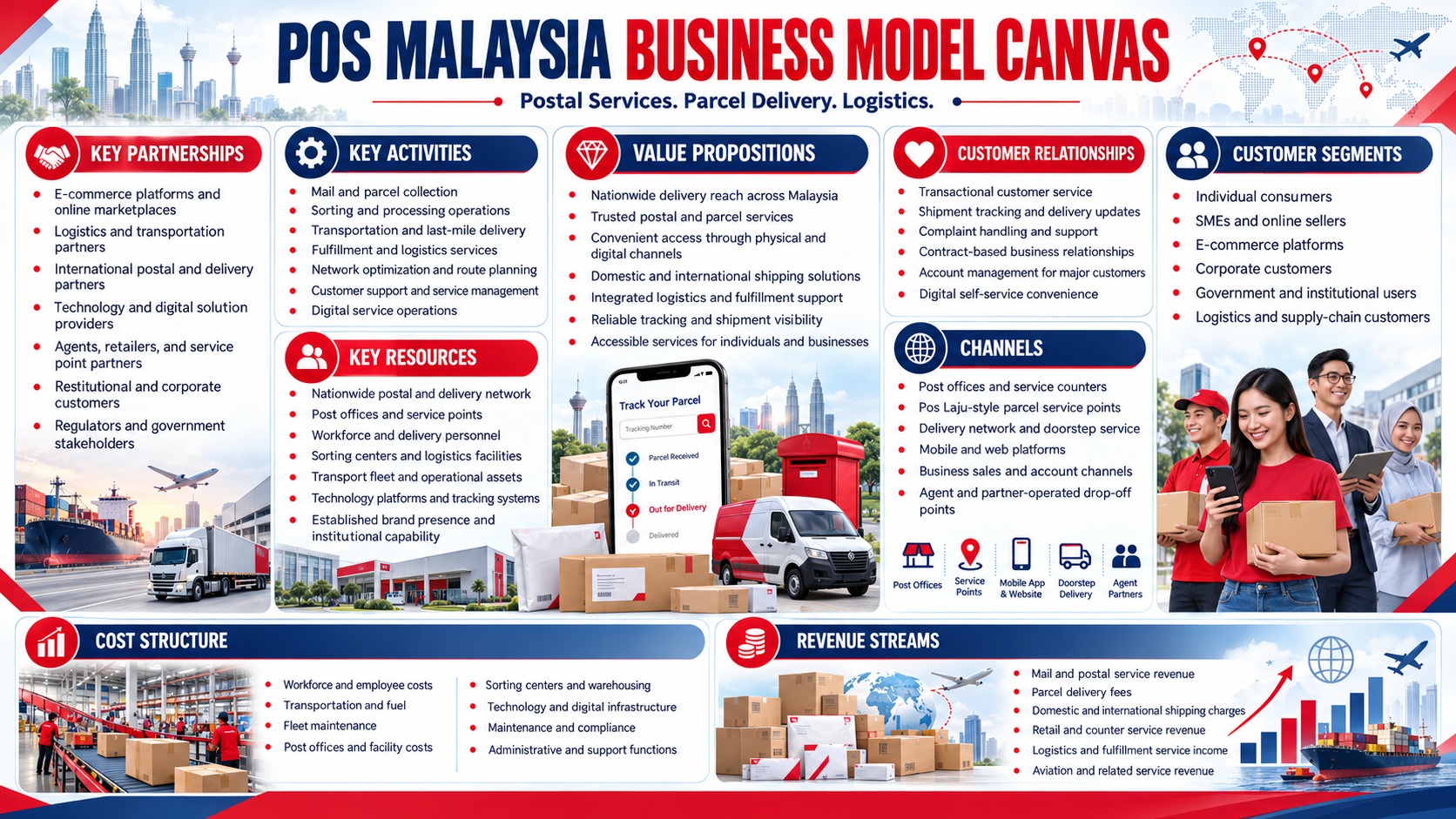
BMC Analysis of Pos Malaysia
The detailed Pos Malaysia Business Model Canvas reveals a business whose competitive position depends on the relationship between national reach and economic efficiency.
Its extensive network creates customer accessibility and distribution capacity. However, those same assets require sustained spending on facilities, transportation, employees and technology.
Higher parcel volume can improve productivity when it increases delivery density. Yet additional shipments do not necessarily improve profitability if prices are insufficient to cover processing, transportation and last-mile costs.
Fulfilment and integrated logistics can potentially strengthen revenue quality by extending customer relationships beyond individual delivery transactions.
The strategic objective is therefore to increase the value generated per customer, per delivery route and per operational asset.
The following sections examine each BMC component in greater depth.
1. Customer Segments
Pos Malaysia serves a broad customer base, ranging from individuals sending occasional parcels to major organisations requiring recurring distribution and logistics services.
Individual consumers use postal services for documents, correspondence, personal deliveries and other retail transactions.
Small and medium enterprises (SMEs), including online sellers, require reliable and affordable deliveries that can support business growth.
Large e-commerce platforms and high-volume merchants represent strategically important commercial customers because they generate recurring shipment volumes.
Corporations, government agencies and institutions use mail, document distribution, retail and logistics services. Meanwhile, industrial and supply-chain customers create demand for specialised freight, logistics and aviation-related capabilities.
The Pos Malaysia Business Model Canvas highlights why customer segmentation must consider both shipment requirements and long-term commercial potential.
Pos Malaysia Customer Segments
| Customer Segment | Details | Why It Matters |
|---|---|---|
| Individual consumers | Personal mail, parcels and postal transactions | Maintains mass-market relevance |
| SMEs and online sellers | Domestic and international shipments | Supports recurring commercial demand |
| E-commerce platforms | High-volume parcel distribution | Improves delivery network utilisation |
| Corporations and institutions | Bulk mail, documents and logistics | Creates contractual revenue |
| Logistics customers | Warehousing, freight and supply-chain services | Expands higher-value opportunities |
Pos Malaysia’s customer diversity reduces its dependence on a single type of transaction, but every segment has different commercial economics.
Large customers may offer higher shipment volumes while demanding lower prices and more sophisticated service commitments. Individual customers generally provide smaller, less predictable volumes but may pay standard retail rates.
The company must therefore distinguish revenue growth from profitable customer growth.
Effective segmentation should consider contribution margin, delivery density, service complexity and customer lifetime value. By targeting customers whose requirements align with existing network capacity, Pos Malaysia can improve utilisation without creating disproportionate operating expenses.
Long-term competitiveness will depend on prioritising relationships that strengthen both network productivity and customer value.
2. Value Propositions
Pos Malaysia’s central value proposition is its ability to connect customers throughout Malaysia through an established distribution and service network.
Nationwide accessibility is particularly important for customers outside major urban centres, where commercial delivery alternatives may be more limited.
Businesses benefit from domestic parcel distribution, international shipping connections and service options that support different delivery requirements.
E-commerce merchants increasingly require more than transportation. They need shipment tracking, reliable collection, predictable delivery performance and operational integration with their order-management processes.
Integrated fulfilment creates another opportunity by combining storage, order preparation and delivery into a broader supply-chain service.
The Pos Malaysia Business Model Canvas demonstrates that the company’s value proposition is evolving from delivering individual items towards simplifying customers’ distribution and logistics needs.
Pos Malaysia Value Propositions
| Value Proposition | Details | Why It Matters |
|---|---|---|
| Nationwide accessibility | Extensive reach across urban and rural Malaysia | Serves geographically diverse customers |
| Postal service continuity | Established mail and postal infrastructure | Supports essential communication needs |
| Parcel delivery | Domestic and international shipping services | Enables personal and commercial transactions |
| Integrated fulfilment | Warehousing, inventory and order processing | Reduces merchant operational complexity |
| Service convenience | Physical service points and digital interfaces | Improves customer accessibility |
Pos Malaysia’s nationwide footprint creates differentiation that cannot be assessed purely through delivery speed or price.
Its stronger opportunity is to offer dependable access and integrated services across multiple customer needs. A merchant that uses the company for storage, order fulfilment and delivery may obtain greater operational value than one purchasing courier services alone.
However, broad coverage does not automatically guarantee customer preference.
Customers ultimately evaluate whether shipments arrive reliably, prices remain competitive and problems are resolved efficiently. If competitors provide a substantially better experience, historical brand recognition and network reach may offer limited protection.
The company should therefore translate its national presence into measurable service advantages, making reliability, convenience and integrated solutions central to its competitive proposition.
3. Channels
Pos Malaysia uses both physical and digital channels to reach customers, receive shipments and deliver services.
Post offices and Pos Laju locations remain important because they provide direct access to postal and parcel services.
Delivery personnel extend the company’s reach to homes, businesses and other delivery destinations throughout the country.
Digital channels support activities such as shipment enquiries, tracking, service information and selected online transactions.
Commercial sales teams and account managers serve corporate customers, while partner-operated collection and drop-off facilities can extend accessibility without requiring every location to operate as a conventional post office.
Channel transformation is especially important because traditional counter-based postal transactions are increasingly complemented by digital self-service and parcel collection alternatives.
Pos Malaysia Channels
| Channel | Details | Why It Matters |
|---|---|---|
| Post offices | Physical postal and retail services | Provides nationwide customer access |
| Pos Laju service points | Parcel acceptance and collection | Supports courier transactions |
| Delivery network | Collection and last-mile delivery | Connects customers directly |
| Digital platforms | Tracking, enquiries and service access | Improves self-service convenience |
| Business sales and agents | Contracted services and partner touchpoints | Expands commercial reach |
Physical channels remain a distinguishing feature of Pos Malaysia, but their strategic value depends increasingly on utilisation.
A large service network creates accessibility while requiring expenditure on facilities, employees and operational support. Low transaction volumes can make conventional outlets expensive to maintain.
Digitalisation and partner-operated access points offer opportunities to redesign how services reach customers.
For instance, a collection location inside an existing retail business may preserve convenience with a lower dedicated operating cost.
The company should evaluate channels according to customer demand, transaction economics, service accessibility and delivery performance. Successful transformation will require the right combination of physical presence, digital convenience and commercially sustainable distribution arrangements rather than simply reducing the number of outlets.
4. Customer Relationships
Customer relationships at Pos Malaysia vary considerably across individual consumers, SMEs, major e-commerce merchants and institutional customers.
Individuals generally interact with the company through transactions involving shipment acceptance, delivery enquiries and customer support.
Small businesses may require more frequent communication, predictable pricing and assistance with shipment management.
Large corporate customers often expect formal contracts, service-level agreements, dedicated account management and operational reporting.
Digital tracking and automated notifications can reduce customer uncertainty, while responsive complaint resolution supports confidence when deliveries are delayed or disrupted.
Integrated logistics services may create deeper relationships because switching providers can affect warehousing, inventory management and order fulfilment processes.
Pos Malaysia Customer Relationships
| Relationship Type | Details | Why It Matters |
|---|---|---|
| Transactional service | Counter and shipment interactions | Serves occasional customers |
| Customer support | Enquiries, complaints and delivery assistance | Builds service confidence |
| Digital self-service | Tracking and online service access | Reduces customer effort |
| Contract relationships | Commercial pricing and service agreements | Supports recurring revenue |
| Account management | Coordination with major business customers | Encourages long-term retention |
Customer retention in logistics depends heavily on operational consistency.
Unlike subscription businesses, a courier provider cannot assume that customers will remain loyal simply because they have used its services previously. Many merchants can compare rates and redirect shipment volumes between competing providers.
Pos Malaysia must therefore build relationships around dependable performance and transparent communication.
Accurate delivery estimates, proactive exception notifications and efficient claims handling can be as important as competitive prices.
For major customers, deeper systems integration and joint operational planning may create stronger commercial relationships than discounts alone.
The company should measure customer satisfaction alongside repeat business, complaint resolution, contract renewals and shipment retention. Together, these indicators provide a more useful understanding of relationship quality and its contribution to sustainable revenue.
5. Revenue Streams
Pos Malaysia generates revenue from several business activities rather than relying solely on traditional postage.
Mail and parcel services remain central, encompassing domestic deliveries, international shipments and related postal products.
Retail operations contribute revenue through selected counter-based and other services.
The logistics business generates income from freight, transportation and supply-chain activities, while aviation operations contribute through activities that include cargo and inflight catering.
Fulfilment adds another revenue opportunity through warehousing, inventory handling, order processing and related distribution services.
The Pos Malaysia Business Model Canvas reveals the importance of this diversification as traditional mail continues to decline and parcel competition becomes more intense.
Pos Malaysia Revenue Streams
| Revenue Stream | Details | Why It Matters |
|---|---|---|
| Mail and parcel services | Domestic and international delivery charges | Core revenue foundation |
| Retail services | Postal retail and selected transactions | Monetises customer-facing network |
| Logistics services | Freight and specialised transportation | Diversifies commercial income |
| Aviation-related services | Cargo and inflight catering activities | Broadens business exposure |
| Fulfilment and other services | Warehousing, order processing and supporting solutions | Expands customer revenue potential |
Revenue diversification provides Pos Malaysia with multiple commercial opportunities, although it does not automatically improve profitability.
The FY2025 financial results reported group revenue of approximately RM1.84 billion despite continuing losses.
This highlights the need to examine contribution margins rather than revenue alone.
A large delivery contract may increase volume while generating limited returns if pricing fails to recover transportation, labour and last-mile expenses.
Fulfilment and specialised logistics can potentially strengthen customer lifetime value, but these activities also require capital, technology and operational expertise.
Pos Malaysia should therefore focus on revenue quality, including appropriate pricing, profitable customer segments and services that complement existing infrastructure. Growth becomes strategically meaningful when it improves overall financial performance rather than merely increasing activity.
6. Key Resources
Pos Malaysia’s most distinctive resource is its extensive national postal and delivery network.
This infrastructure includes service locations, processing facilities, delivery operations, transportation capabilities and established connections across Malaysian communities.
The company’s workforce is another essential resource, supporting parcel handling, transportation, customer service, retail operations, logistics management and corporate activities.
Technology systems enable tracking, operational coordination, shipment processing and interactions with business customers.
Its long-established brand provides recognition and institutional presence, while logistics and aviation-related capabilities extend the range of services the group can provide.
The Pos Malaysia Business Model Canvas demonstrates how these resources create significant entry barriers while simultaneously generating substantial fixed and recurring costs.
Pos Malaysia Key Resources
| Key Resource | Details | Why It Matters |
|---|---|---|
| Nationwide network | Post offices, service points and delivery coverage | Creates broad market accessibility |
| Workforce | Delivery, operations and specialist personnel | Enables service execution |
| Logistics infrastructure | Sorting, transportation and fulfilment facilities | Supports shipment processing |
| Technology systems | Tracking, routing and operational platforms | Improves coordination and visibility |
| Brand and institutional capabilities | Established identity and postal expertise | Supports trust and national relevance |
An extensive distribution network can be a strategic asset when sufficient demand flows through it.
Higher shipment density allows a delivery operation to spread certain fixed costs across more transactions. Conversely, underutilised assets may become a significant financial burden.
Pos Malaysia must therefore evaluate its resources according to productivity rather than physical scale alone.
Technology and network integration are particularly important because they can improve sorting efficiency, route planning and capacity utilisation.
The company should also recognise the value of organisational capabilities that are less visible than physical infrastructure, including regulatory expertise, operational knowledge and relationships with institutional customers.
Future competitiveness will depend on modernising these resources, removing duplication and ensuring that capital investment generates measurable service or productivity improvements.
7. Key Activities
Pos Malaysia’s core activities involve collecting, processing, transporting and delivering mail and parcels.
Sorting and distribution operations coordinate shipment movement between customers, processing facilities and delivery destinations.
Last-mile delivery is especially important because it directly influences customer experience and often represents a significant component of distribution cost.
The group also manages retail transactions, commercial logistics activities, fulfilment operations and aviation-related services.
Customer support, technology management, network planning and regulatory compliance provide essential operational support.
As shipment patterns change, the company must increasingly focus on improving route density, integrating delivery networks and automating repetitive activities.
Pos Malaysia Key Activities
| Key Activity | Details | Why It Matters |
|---|---|---|
| Mail and parcel processing | Collection, sorting and dispatch | Enables core service delivery |
| Transportation and last-mile delivery | Movement to final destinations | Determines cost and reliability |
| Fulfilment operations | Storage, picking, packing and shipping | Supports e-commerce customers |
| Network optimisation | Route planning, consolidation and facility management | Improves operating efficiency |
| Customer and commercial operations | Support, contracts and service management | Sustains demand and retention |
The economics of Pos Malaysia depend heavily on how efficiently these activities are performed.
A delivery route incurs labour, vehicle and fuel costs regardless of whether it carries a small or large number of shipments. Increasing deliveries per route can consequently improve productivity without requiring proportional growth in infrastructure.
However, efficiency improvements must not compromise service standards.
Poor sorting accuracy, delivery delays and weak exception handling can create additional costs through repeated delivery attempts, complaints and customer losses.
The company’s transformation should therefore combine process redesign, technology adoption and service-quality management.
Operational indicators such as cost per parcel, first-attempt delivery success, sorting productivity and route utilisation can help management evaluate whether activities are generating sustainable economic value.
8. Key Partnerships
Pos Malaysia operates within a broad ecosystem of commercial customers, technology providers, delivery partners, agents and government institutions.
E-commerce platforms are important because they can contribute substantial shipment volumes and recurring distribution demand.
International postal and logistics partners support cross-border shipment movement and delivery coordination.
Technology providers contribute software, automation equipment, digital systems and other capabilities required to modernise operations.
Commercial agents and retail partners offer opportunities to expand collection and drop-off access through shared infrastructure.
Regulators and relevant public institutions also influence the operating environment because of the company’s postal service obligations.
Pos Malaysia Key Partnerships
| Key Partner | Details | Why It Matters |
|---|---|---|
| E-commerce platforms | Shipment demand and operational integration | Generates recurring parcel volume |
| International delivery partners | Cross-border postal and logistics connections | Extends global service reach |
| Technology providers | Tracking, automation and operational systems | Supports digital transformation |
| Agents and retail partners | Collection and drop-off facilities | Improves access and cost flexibility |
| Government and regulators | Postal governance and service requirements | Supports regulatory alignment |
Partnerships allow Pos Malaysia to extend its capabilities without owning every component of the customer experience.
A retail agent, for example, may provide local parcel collection services using existing premises and personnel, reducing the need for dedicated infrastructure.
Nevertheless, dependence on powerful commercial partners can introduce financial and strategic risks.
Large e-commerce platforms may negotiate aggressively on price, change delivery allocations or develop their own logistics capabilities.
The company should therefore diversify its commercial relationships while improving its attractiveness to individual merchants and SMEs.
Partnerships must also be assessed for service quality, operational compatibility and long-term economic contribution.
The most valuable relationships will be those that increase shipment density, strengthen customer access, expand complementary services or improve the productivity of Pos Malaysia’s existing infrastructure.
9. Cost Structure
Pos Malaysia operates a cost-intensive business involving employees, transportation assets, facilities, operational systems and extensive distribution infrastructure.
Workforce expenditure is significant because postal processing and last-mile delivery require substantial operational capacity.
Transportation costs include fuel, vehicle maintenance, delivery operations and the movement of shipments between processing facilities.
Post offices, sorting centres, warehouses and other facilities generate occupancy, utilities, maintenance and depreciation expenses.
Technology investment adds further costs but may improve efficiency through automation, route optimisation and better operational visibility.
The Pos Malaysia Business Model Canvas highlights how the interaction between high fixed costs and competitive delivery pricing creates significant pressure on profitability.
Pos Malaysia Cost Structure
| Cost Category | Details | Why It Matters |
|---|---|---|
| Workforce | Delivery, sorting, retail and support personnel | Major operating cost driver |
| Transportation | Fleet operations, fuel and shipment movement | Influences cost per delivery |
| Facilities | Service outlets, processing centres and warehouses | Creates recurring overhead |
| Technology | Systems, automation and digital infrastructure | Enables operational modernisation |
| Maintenance and compliance | Asset upkeep, service obligations and regulatory requirements | Supports continuity and reliability |
Cost management is central to Pos Malaysia’s business transformation because revenue expansion alone may not resolve structural inefficiencies.
Maintaining nationwide service coverage requires operational capacity that cannot always be adjusted directly to commercial demand.
When traditional mail volumes decline, fixed costs can become increasingly difficult to recover unless other services use the same infrastructure productively.
Integrating mail and parcel delivery offers one potential approach to addressing this challenge.
However, the benefit of consolidation depends on practical execution, including employee productivity, routing efficiency, system integration and service reliability.
Pos Malaysia should evaluate costs at the route, facility, customer and service levels rather than relying exclusively on group-wide expenditure reductions.
The objective should be sustainable unit-cost improvement while protecting customer experience and essential national postal services.
How the Nine BMC Blocks Work Together
The Pos Malaysia Business Model Canvas becomes most useful when the nine components are viewed as one interconnected operating system.
Customer segments generate demand for postal, parcel, fulfilment and logistics services.
Value propositions determine why customers choose Pos Malaysia rather than alternative providers. Nationwide reach creates accessibility, while integrated logistics services can simplify business operations.
Channels connect customers to services through physical outlets, digital platforms, delivery operations and commercial partnerships.
Customer relationships support retention through delivery reliability, service contracts, shipment visibility and customer assistance.
Revenue streams convert these transactions into commercial income.
Key resources and activities provide the infrastructure and operational capabilities needed to deliver these services.
Partnerships extend reach, generate shipment demand and introduce additional capabilities.
Finally, the cost structure determines whether the entire system can generate sustainable financial returns.
The critical relationship is between shipment volume, network utilisation and unit costs.
Pos Malaysia’s potential operating flywheel
When these elements reinforce one another, Pos Malaysia can potentially improve both customer value and operating performance.
However, a breakdown in any major component can weaken the system.
For example, higher shipment volumes may increase revenue but fail to improve profitability if operating costs remain excessive.
Similarly, aggressive cost reductions may improve short-term expenditure but damage service quality and customer retention.
Sustainable transformation therefore requires coordinated improvements across the entire business model rather than isolated operational initiatives.
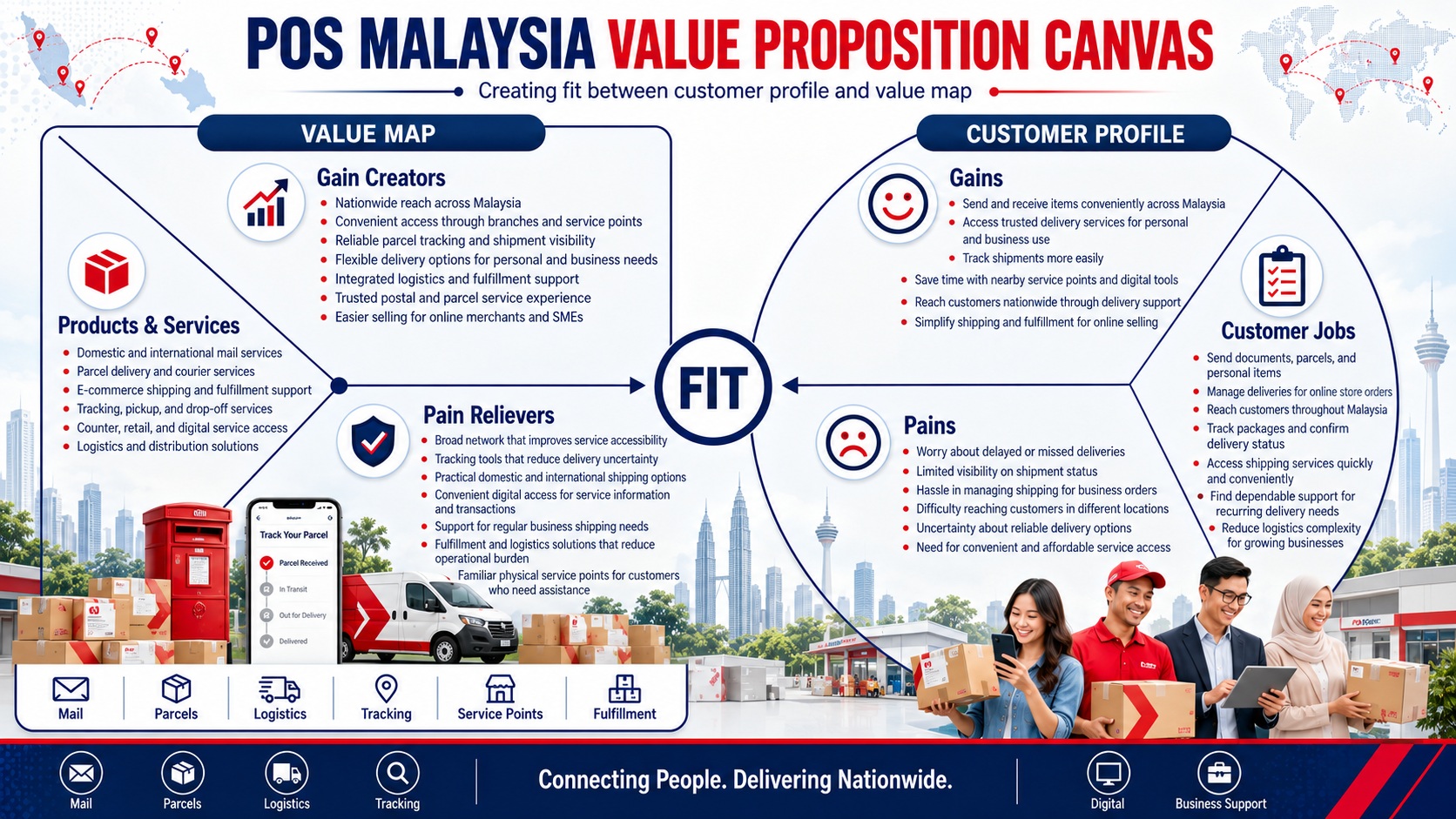
Pos Malaysia Value Proposition Canvas
The Value Proposition Canvas provides a more detailed understanding of how Pos Malaysia addresses customer needs.
While BMC explains the overall business, VPC examines the relationship between customer jobs, pains, gains and the products or services designed to meet them.
The Pos Malaysia Business Model Canvas becomes particularly useful when viewed through the needs of SMEs and e-commerce merchants.
These customers represent an important growth opportunity because successful online businesses frequently require ongoing shipping, inventory management and fulfilment support.
Customer Profile
The following customer profile focuses primarily on SMEs and online merchants using parcel delivery and related logistics services.
Their main objective is not simply to send parcels. They need to deliver products reliably while controlling costs, managing customer expectations and operating their businesses efficiently.
Customer Profile of Pos Malaysia
| Customer Profile | Details |
|---|---|
| Customer Jobs | Deliver customer orders, manage shipping costs, track shipments, handle returns and maintain customer satisfaction |
| Customer Pains | Delivery delays, high shipping expenses, failed deliveries, poor visibility, damaged parcels and complicated fulfilment processes |
| Customer Gains | Reliable delivery, competitive shipping rates, convenient collection, accurate tracking, wider market reach and simplified operations |
These requirements demonstrate why courier services are an important part of the customer experience rather than merely a transportation function.
An online seller’s reputation can suffer when customers experience delayed or missing deliveries, even when the merchant has fulfilled the order correctly.
Consequently, logistics performance can influence customer loyalty, repeat purchases and the merchant’s long-term competitiveness.
Value Map
Pos Malaysia addresses these customer needs through its national delivery network, postal and courier services, digital interfaces and integrated fulfilment capabilities.
The value map examines how these services may reduce operational difficulties and generate benefits for business customers.
Value Map of Pos Malaysia
| Value Map | Details |
|---|---|
| Products and Services | Domestic and international parcel delivery, postal services, tracking, collection and fulfilment solutions |
| Pain Relievers | Delivery network coverage, shipment visibility, collection options, operational support and consolidated logistics services |
| Gain Creators | Nationwide customer access, business scalability, integrated fulfilment, simpler shipping processes and potential operating efficiencies |
The strength of Pos Malaysia’s value map lies in its combination of physical reach and complementary logistics capabilities.
A small online merchant may initially need only parcel delivery. As the business grows, its requirements can expand to include warehousing, inventory management, order processing and more sophisticated shipment integration.
Pos Malaysia has an opportunity to support these changing needs within a broader service relationship.
However, each benefit must be supported by consistent operational performance.
Nationwide coverage provides limited value if customers encounter unreliable deliveries, unclear tracking information or complicated service processes.
How Pos Malaysia Creates Fit
Value proposition fit exists when the company’s services address important customer requirements more effectively than available alternatives.
The table connects the customer profile with the corresponding value map.
| Customer Profile | Details | Matching Value Map | How Pos Malaysia Creates Fit |
|---|---|---|---|
| Customer Jobs | Deliver products throughout Malaysia | Products and Services | Postal and courier networks enable nationwide distribution |
| Customer Pains | High costs, delays and complex shipment management | Pain Relievers | Tracking, collection options and integrated logistics can reduce delivery difficulties |
| Customer Gains | Reliable distribution and scalable operations | Gain Creators | Fulfilment and delivery services can support merchant growth |
The main strategic opportunity is to make Pos Malaysia increasingly valuable as a customer’s business becomes more complex.
An SME that uses only occasional delivery services may easily switch providers based on price.
However, a merchant using integrated warehousing, order processing, shipment management and delivery may develop a deeper commercial relationship.
Value fit improves when customers experience genuine convenience, predictable delivery outcomes and lower overall operational complexity.
The company should therefore focus on the complete customer journey rather than treating each parcel as an isolated transaction.
Pos Malaysia vs J&T Express vs DHL eCommerce Business Models
Pos Malaysia competes within Malaysia’s increasingly competitive delivery and logistics market.
Two relevant companies for comparison are J&T Express and DHL eCommerce.
All three provide parcel delivery services, but their business models differ in operating focus, network characteristics and customer propositions.
Pos Malaysia combines its universal postal service responsibilities with commercial delivery and diversified group activities.
J&T Express places strong emphasis on express parcel distribution, e-commerce partnerships and commercial shipping services.
DHL eCommerce focuses on parcel logistics and shipping solutions, particularly for businesses and online merchants, with broader DHL divisions providing additional specialised logistics services.
BMC Block Comparison
The following table compares only the BMC blocks most relevant to understanding the competitive differences.
| Relevant BMC Block | Pos Malaysia | J&T Express | DHL eCommerce |
|---|---|---|---|
| Customer Segments | Individuals, SMEs, institutions, e-commerce platforms and logistics customers | E-commerce merchants, platforms, businesses and consumers | Online merchants, SMEs, corporate shipping customers and consumers |
| Value Propositions | Nationwide postal reach, parcel delivery and integrated logistics | Parcel delivery, e-commerce logistics and flexible shipping options | Business-focused delivery, shipment visibility and logistics integration |
| Channels | Post offices, Pos Laju, delivery network, digital platforms and agents | Service points, collection networks, delivery personnel and digital platforms | ServicePoints, delivery network, business portals and integrations |
| Revenue Streams | Postal, parcel, retail, logistics, aviation and fulfilment services | Parcel shipping, express delivery and supporting logistics services | Domestic parcel delivery and related business shipping services |
| Key Resources | National postal network, facilities, workforce, logistics assets and brand | Parcel distribution infrastructure, delivery network and technology | Delivery infrastructure, technology, business systems and DHL network relationships |
| Cost Structure | National postal coverage, labour, facilities, fleet and logistics operations | Sorting, transportation, delivery personnel and distribution infrastructure | Transportation, parcel processing, technology and customer service operations |
The most significant difference is Pos Malaysia’s combination of broad postal obligations and commercial logistics activities.
J&T Express can focus its positioning more directly on competitive parcel services and e-commerce requirements. DHL eCommerce offers business-oriented shipping capabilities within a wider global logistics group.
Pos Malaysia’s advantage lies in its established national infrastructure and broader service mandate, but this also introduces additional operating complexity.
The company should avoid competing exclusively on the lowest parcel price.
Instead, its strongest opportunities may lie in dependable nationwide coverage, merchant integration, fulfilment and differentiated services that use existing infrastructure productively.
Competitive advantage will depend on whether these capabilities deliver superior customer outcomes at economically sustainable costs.
Competitive Advantages
The Pos Malaysia Business Model Canvas identifies several structural strengths that can support the company’s long-term competitiveness.
Its most important advantages arise from national reach, established infrastructure, brand recognition and opportunities to combine different services across the same operating network.
- Extensive nationwide network: Pos Malaysia’s distribution footprint provides access to customers across urban, suburban and rural locations. Replicating comparable geographical coverage would require substantial investment, making this infrastructure a potential competitive barrier.
- Established brand and institutional position: Its long operating history creates strong recognition among Malaysian consumers and businesses. The company’s national postal role also establishes relationships and operating capabilities that differ from those of purely commercial courier providers.
- Integrated postal and logistics infrastructure: Existing facilities, workforce capabilities and transportation operations create opportunities to combine mail, parcel and logistics activities. Better integration could improve asset utilisation and reduce duplicated costs.
- Diversified service portfolio: Postal services, parcel delivery, fulfilment, logistics, aviation-related activities and retail operations provide multiple commercial opportunities. This diversification can support customer relationships across different stages of the supply chain.
- Access to emerging fulfilment opportunities: Through services such as Pos Fulfill, the company can move beyond individual delivery transactions into warehousing, inventory management and order fulfilment, potentially creating deeper relationships with business customers.
These advantages are not guaranteed sources of profitability.
Their economic value depends on management’s ability to convert network scale, customer access and operational capabilities into competitive service performance and sustainable financial returns.
Risks and Challenges
Despite its established market position, Pos Malaysia faces structural and competitive challenges that could affect future performance.
Five issues are particularly important.
- Structural decline in traditional mail: Digital communication, electronic billing and online transactions continue to reduce demand for physical correspondence. As mail volumes decline, the company must manage infrastructure originally designed for significantly higher postal activity.
- Intense parcel delivery competition: Courier providers compete on price, delivery speed, merchant integration and service quality. Large e-commerce customers may exert additional pricing pressure, making it difficult to convert shipment growth into stronger margins.
- High operating and infrastructure costs: Maintaining nationwide coverage requires substantial spending on workforce, facilities, transportation and service continuity. Underutilised assets and low-density delivery routes can weaken overall cost efficiency.
- Transformation execution risk: Integrating networks, introducing automation, redesigning retail outlets and changing operating models require careful implementation. Delays, operational disruption or insufficient workforce adaptation may reduce anticipated benefits.
- Technology and customer experience expectations: Customers increasingly expect accurate tracking, convenient shipping interfaces, fast delivery and effective problem resolution. Weak digital experiences or inconsistent delivery performance can accelerate customer migration to competitors.
The central risk is that operating expenses and investment requirements may remain too high relative to the revenue and margins generated by the business.
Pos Malaysia must therefore balance service accessibility, operational efficiency and commercial competitiveness while maintaining its postal responsibilities.
How Could Pos Malaysia’s Business Model Fail?
The Pos Malaysia Business Model Canvas also provides a useful framework for examining potential failure scenarios.
A business model can become unsustainable even when customer demand exists, particularly when revenue growth does not translate into sufficient financial returns.
1. Parcel Growth Fails to Generate Profit
Increasing shipment volumes may appear positive, but lower delivery prices and rising operating expenses can offset the benefits.
If the contribution from additional parcels remains insufficient to cover processing, transportation and last-mile costs, volume growth may fail to improve profitability.
The company therefore needs to monitor unit economics rather than relying on shipment growth as its primary performance indicator.
2. Legacy Infrastructure Remains Underutilised
Traditional postal infrastructure requires ongoing expenditure regardless of changes in mail demand.
Should physical mail continue declining without corresponding improvements in network productivity, fixed costs may become increasingly difficult to recover.
Integrating mail and parcel operations, using shared facilities and redesigning customer access points could help address this structural problem.
3. Major Commercial Customers Become Too Powerful
Large e-commerce platforms can contribute significant volumes while possessing substantial bargaining power.
Heavy dependence on a limited number of customers may weaken pricing flexibility and create exposure to sudden changes in shipment allocation.
Diversifying customer segments and developing direct relationships with SMEs can reduce this risk.
4. Transformation Fails to Improve Customer Experience
Network restructuring and technology investments may reduce expenses but can also disrupt established processes.
If service reliability deteriorates during transformation, customers may shift to competitors.
Successful implementation requires simultaneous attention to operational productivity, delivery performance and customer satisfaction.
5. Diversification Creates Complexity Without Returns
Expanding into fulfilment and specialised logistics can support growth, but these activities also introduce additional investment and management requirements.
Without clear strategic priorities, diversification may increase complexity rather than improve earnings.
The company should therefore assess each business activity according to its contribution margin, capital requirements, strategic relevance and potential integration with existing operations.
Strategic Recommendations for Pos Malaysia
The analysis suggests that Pos Malaysia’s future competitiveness depends on converting its nationwide infrastructure into a more productive, customer-focused and financially sustainable operating model.
Rather than pursuing growth across every available service, the company should prioritise initiatives that improve network economics, strengthen customer relationships and generate higher-quality revenue.
The following recommendations focus on five strategic priorities.
1. Accelerate Integrated Network Transformation
Pos Malaysia should continue integrating mail and parcel operations where operationally and regulatorily appropriate.
A unified network can potentially reduce duplicated delivery routes, improve utilisation of sorting facilities and make workforce deployment more flexible.
However, integration should be supported by route-level demand analysis and service-quality monitoring.
Management should prioritise locations where consolidation can generate measurable cost reductions without weakening postal accessibility.
Suggested KPIs: Cost per delivery, route utilisation, deliveries per employee, network integration milestones and service-level compliance.
2. Strengthen SME and E-Commerce Merchant Relationships
Large e-commerce platforms provide valuable shipment volumes, but they can also create substantial pricing pressure.
Pos Malaysia should strengthen direct relationships with SMEs, independent online merchants and growing businesses.
Potential initiatives include simplified business account registration, integrated shipping tools, transparent commercial pricing and merchant-focused customer support.
Combining parcel services with fulfilment solutions may help increase customer retention and revenue per business account.
Suggested KPIs: Active SME accounts, recurring merchant revenue, customer retention, average revenue per merchant and contribution margin by segment.
3. Expand Higher-Value Fulfilment Services
Pos Malaysia should continue evaluating opportunities to grow integrated fulfilment where market demand and investment returns justify expansion.
Services such as warehousing, inventory management, order processing, returns management and delivery integration can address broader merchant requirements.
These solutions can create deeper relationships and reduce customers’ dependence on multiple logistics providers.
Expansion should nevertheless remain disciplined, with careful consideration of warehouse utilisation, automation requirements and customer profitability.
Suggested KPIs: Fulfilment revenue growth, warehouse occupancy, order processing cost, order accuracy and customer lifetime value.
4. Improve Digital Experience and Delivery Visibility
Digital capabilities should become a stronger differentiator across the customer journey.
Merchants need convenient shipment creation, reliable tracking, system integration and access to operational information.
Recipients increasingly value accurate delivery updates, convenient collection options and responsive issue resolution.
Pos Malaysia should use analytics, automation and customer feedback to identify friction points and continuously improve service performance.
Suggested KPIs: Tracking accuracy, customer satisfaction, first-attempt delivery success, digital adoption and complaint resolution time.
5. Introduce Stronger Unit-Economics Management
Network transformation should be supported by transparent measurement of profitability across services, customer groups and delivery routes.
Management should assess not only aggregate revenue and operating expenses but also the financial contribution of different shipment types and commercial contracts.
Activity-based costing and route-level analytics could help identify services requiring pricing adjustments, operational redesign or additional demand.
Investment decisions should be linked to measurable productivity improvements and financial returns.
Suggested KPIs: Contribution margin per parcel, delivery cost per route, customer profitability, return on invested capital and operating cash flow.
Taken together, these priorities would allow Pos Malaysia to improve the quality of growth rather than pursuing shipment volume as an end in itself.
The ultimate objective should be a more integrated operating model in which national coverage, commercial logistics capabilities and technology reinforce one another.
Conclusion
The Pos Malaysia Business Model Canvas demonstrates how an established national postal operator is adapting to fundamental changes in communication, commerce and logistics.
For generations, Pos Malaysia’s business was closely associated with delivering letters, documents and parcels through an extensive physical network.
Today, that model faces a different economic environment.
Traditional mail demand continues to decline, e-commerce has changed the distribution landscape and customer expectations increasingly revolve around delivery speed, convenience, transparency and reliability.
At the same time, logistics competition places pressure on service pricing and operational profitability.
Pos Malaysia possesses several important strengths, including nationwide infrastructure, established customer relationships, brand recognition and capabilities extending beyond conventional courier services.
However, these strengths must be assessed against the costs of maintaining extensive facilities, delivery operations and national postal accessibility.
The key strategic issue is no longer simply whether Pos Malaysia has sufficient market reach. It is whether the company can use that reach efficiently and profitably.
Network integration, digitalisation, fulfilment services and stronger customer segmentation offer opportunities to improve commercial performance.
Yet these initiatives must translate into measurable improvements in operating productivity, customer retention, service reliability and financial returns.
The company’s transformation ultimately depends on achieving the right balance between its national responsibilities and commercial competitiveness.
A sustainable business model will require more than delivering additional parcels. It will require building a logistics network that creates greater value from every customer relationship, facility, delivery route and operational investment.
For entrepreneurs and business leaders, Pos Malaysia provides a valuable lesson in business model transformation.
An established distribution network can be a powerful strategic asset, but historical scale does not automatically guarantee future success.
Long-term competitiveness comes from continuously adapting resources, activities, partnerships and customer propositions to changing market conditions.
That principle applies not only to postal and logistics businesses but to any established organisation navigating technological disruption and evolving customer expectations.
Disclaimer
This article is prepared solely for educational, informational and business analysis purposes. It is an independent interpretation of Pos Malaysia Berhad’s business model using the Business Model Canvas and Value Proposition Canvas frameworks.
The content is not official information, a corporate statement, or an endorsed publication of Pos Malaysia Berhad or any of the companies mentioned. Certain business model classifications, strategic assessments and recommendations represent the author’s analytical interpretation based on publicly available information.
This article does not constitute investment, financial or professional advice, nor does it represent a recommendation to buy, sell or hold any securities.
All company names, trademarks, service marks, logos, brand identities, images and copyrighted materials belong to their respective owners. References to these materials are made solely for identification, commentary, comparison and educational purposes. No affiliation, sponsorship or endorsement is implied.
Financial figures and operational information should be verified against the relevant companies’ latest official disclosures before being relied upon for business or investment decisions.
SEO Meta Description
Explore the Pos Malaysia Business Model Canvas, covering nine BMC blocks, logistics strategy, revenue, Value Proposition Canvas, competitors and 2026 updates.

