



Share This Article


FedEx Business Model Canvas: How FedEx Competes Through Global Networks, Express Delivery and Logistics
BMC Article No: BMC #077
This article examines FedEx’s business structure, latest operating developments, nine Business Model Canvas blocks, Value Proposition Canvas, comparison with UPS and DHL, competitive advantages, risks, challenges, and strategic recommendations.
Introduction
FedEx is considerably more than a parcel delivery company. Its business connects aircraft, ground transportation, sorting hubs, customs capabilities, digital platforms, data, commercial relationships, and thousands of operating facilities into a global logistics network.
The FedEx Business Model Canvas is particularly useful because the company creates value through coordination rather than through one standalone product. A package collected from a customer may move through local stations, sorting facilities, aircraft, customs processes, destination hubs, vehicles, and last-mile delivery operations before reaching its recipient.
Scale strengthens this system. FedEx reported revenue of approximately US$94.7 billion for fiscal 2026, compared with US$87.9 billion in fiscal 2025. The company also completed the separation of FedEx Freight into an independent publicly traded company on June 1, 2026. (FedEx Investors)
Network transformation has therefore become strategically important. FedEx is integrating previously separated operating structures, optimizing air and surface capacity, using technology more intensively, and reducing structural costs.
Customer expectations continue to rise simultaneously. Businesses increasingly expect shipment visibility, predictable transit times, customs support, flexible delivery choices, automated integration, and rapid problem resolution.
Understanding FedEx consequently requires examining how customers, infrastructure, technology, operations, partners, revenue, and costs reinforce one another.
What Is the FedEx Business Model?
FedEx operates a global transportation, parcel delivery, express shipping, e-commerce logistics, and business-services platform.
At its core, the FedEx Business Model Canvas represents a network business. Customers pay FedEx to move physical goods between locations while receiving different combinations of speed, reliability, visibility, handling, customs support, and service assurance.
Federal Express Corporation remains the central operating business after the FedEx Freight separation. Its services include time-definite express transportation, U.S. domestic parcel delivery, international transportation, freight-related services, and supporting logistics capabilities.
FedEx reaches more than 220 countries and territories through its international network. Its scale allows customers ranging from individual consumers to multinational corporations to access transportation infrastructure that would be economically impossible to replicate independently. (FedEx Investors)
Several commercial engines support this model.
First, shipment revenue is generated when customers purchase transportation services. Higher service levels, longer distances, heavier shipments, special handling, and international movement generally produce different pricing economics.
Second, enterprise relationships generate recurring shipment volumes and integrated logistics demand.
Third, digital systems facilitate booking, tracking, billing, customs documentation, customer support, and operational planning.
Finally, network density improves asset utilization when sufficient shipment volumes move through common hubs, routes, aircraft, and facilities.
FedEx therefore functions simultaneously as a transportation operator, logistics network, technology-enabled service provider, customs facilitator, and global commerce infrastructure company.
What Is a Business Model Canvas?
Business Model Canvas, or BMC, is a strategic framework used to explain how an organisation creates value, delivers that value to customers, and captures economic returns.
Unlike an analysis focused only on products or financial performance, BMC examines the complete operating logic behind a business.
For FedEx, the FedEx Business Model Canvas provides a particularly relevant perspective because delivery performance depends on interconnected capabilities. Aircraft alone cannot create the customer proposition, while software without physical infrastructure cannot move packages.
| BMC Block | Key Question |
|---|---|
| Customer Segments | Who are the primary customers? |
| Value Propositions | What value does FedEx provide? |
| Channels | How does FedEx reach and serve customers? |
| Customer Relationships | How are relationships maintained? |
| Revenue Streams | How does the company generate revenue? |
| Key Resources | Which assets enable the model? |
| Key Activities | What activities must FedEx execute effectively? |
| Key Partners | Which external parties support operations? |
| Cost Structure | What are the major operating costs? |
Evaluating these blocks together reveals the underlying economics of logistics.
Shipment volume creates demand for transportation capacity. Infrastructure provides fulfilment capability, while technology orchestrates the network. Pricing converts service performance into revenue, and route density determines whether expensive assets can be utilised efficiently.
That interaction is central to understanding FedEx as a system rather than merely as a courier company.
FedEx at a Glance
FedEx traces its origins to Federal Express, founded by Frederick W. Smith and launched operationally in 1973.
The original concept was strategically distinctive: use an integrated air-ground network organised around central sorting hubs to provide reliable overnight delivery.
Over subsequent decades, FedEx expanded internationally and developed a broader portfolio of parcel, freight, logistics, e-commerce, customs, and business services.
Scale is now fundamental to the business. FedEx has described its network as serving more than 220 countries and territories, supported by thousands of facilities and extensive aircraft and vehicle fleets. A recent company economic-impact report stated that the wider FedEx system handled approximately 17 million packages per day. (FedEx Investors)
Structural simplification has become another major strategic theme.
FedEx moved toward operating its historically separate Express and Ground networks more cohesively under Federal Express Corporation. Management has also pursued network optimisation, facility rationalisation, automation, aircraft modernisation, and lower structural costs.
Fiscal 2026 demonstrated the financial scale of those changes. Revenue reached US$94.7 billion, while reported operating income was US$5.46 billion. FedEx stated that transformation-related cost savings exceeded its US$1 billion target during the year. (FedEx Investors)
Future competitiveness will depend increasingly on turning that enormous physical network into a more flexible, data-driven and economically efficient platform.
Why Is FedEx Strategically Interesting?
FedEx is strategically interesting because logistics combines unusually high physical complexity with increasingly sophisticated digital coordination.
The FedEx Business Model Canvas illustrates how the company competes using network density, service reliability, global connectivity, technological integration, and brand trust rather than relying primarily on product differentiation.
Large-scale delivery networks also display elements of network economics. Additional shipment volume can improve utilisation of facilities, vehicles, aircraft, and routes when capacity is appropriately configured.
However, operating leverage works in both directions. Underutilised aircraft, facilities, or delivery routes can create significant cost pressure when shipment demand declines.
International trade adds another dimension. Customs regulations, tariffs, geopolitical disruption, aviation rights, security requirements, fuel prices, and cross-border documentation affect the movement of goods.
E-commerce has simultaneously altered shipment patterns. Residential delivery tends to create different economics from concentrated business-to-business routes because parcels are delivered across more dispersed destinations.
Technology therefore becomes operational infrastructure rather than merely a customer-facing tool. Accurate forecasting, route optimisation, shipment visibility, automated sorting, revenue management, and exception handling can materially influence margins.
The June 2026 separation of FedEx Freight further sharpens the strategic focus of the remaining organisation around parcel, express, international transportation, and integrated logistics capabilities. (FedEx Investors)
This company must ultimately balance speed and reliability with increasingly disciplined capital utilisation.
FedEx Business Model Canvas Summary
Before analysing each block individually, the table below summarises how the FedEx Business Model Canvas operates as an interconnected commercial system.
| BMC Block | Application at FedEx |
|---|---|
| Customer Segments | Consumers, SMEs, e-commerce merchants, corporations, multinational companies, healthcare organisations and public-sector customers |
| Value Propositions | Reliable delivery, speed, global reach, shipment visibility, convenience and logistics expertise |
| Channels | FedEx.com, mobile applications, APIs, sales teams, service centres, drop-off locations, pickup services and delivery network |
| Customer Relationships | Digital self-service, account management, contracts, tracking, customer support and customised enterprise solutions |
| Revenue Streams | Domestic package delivery, international express, freight transportation, surcharges and logistics-related services |
| Key Resources | Brand, aircraft, vehicles, hubs, facilities, technology, data, employees, licences and international network |
| Key Activities | Pickup, sorting, transportation, customs clearance, delivery, network planning, technology management and customer service |
| Key Partners | Contractors, aircraft suppliers, fuel providers, airports, technology vendors, customs authorities and commercial partners |
| Cost Structure | Labour, purchased transportation, fuel, aircraft, vehicles, facilities, technology, maintenance and depreciation |
FedEx BMC Diagram
A visual BMC diagram can place all nine elements on one page.
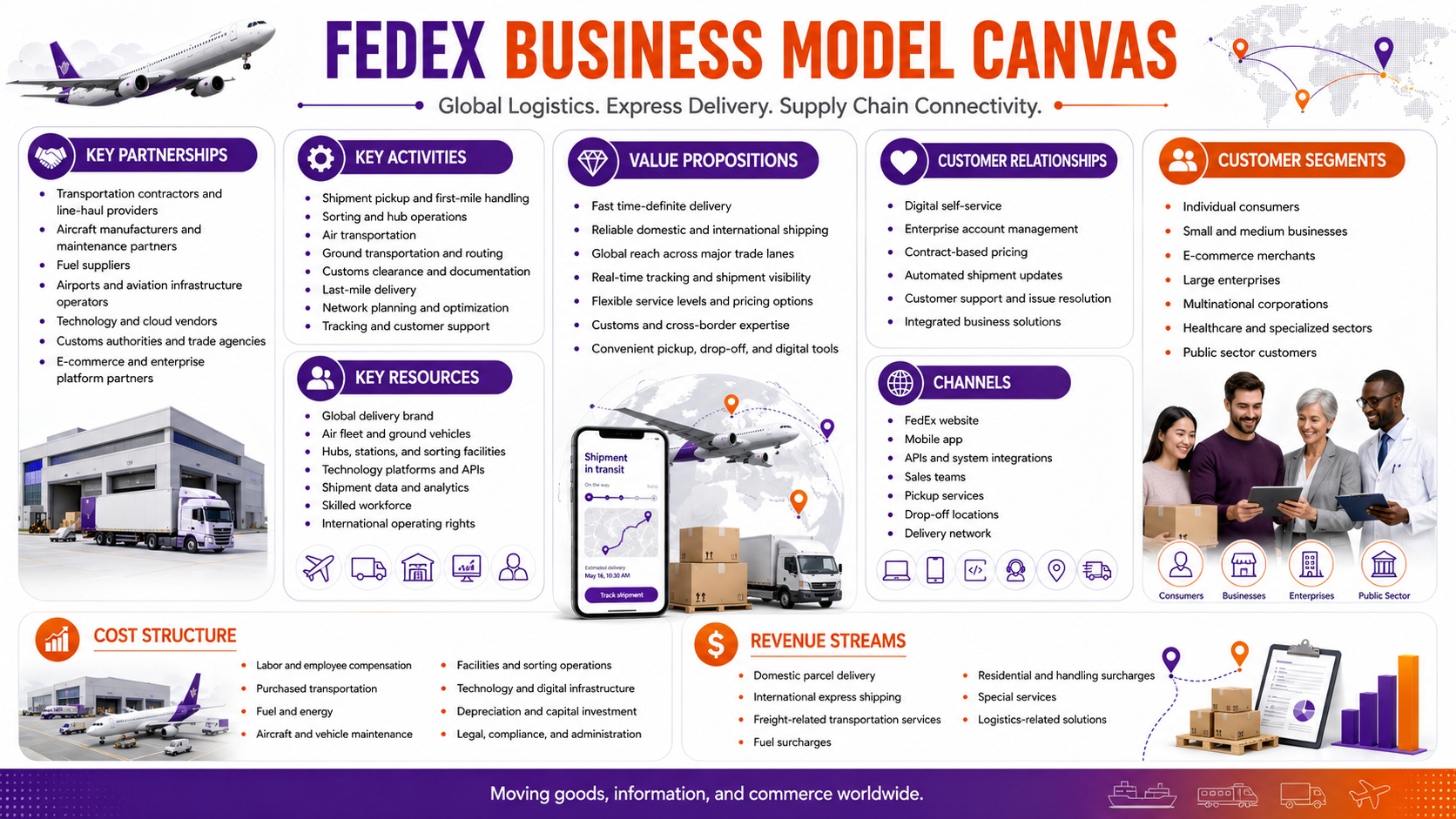
Such a diagram is particularly valuable for FedEx because it demonstrates that customer promises such as overnight delivery or international priority shipping cannot be separated from infrastructure, route planning, information systems, customs capabilities, and capital expenditure.
The business model works only when these components operate as one network.
FedEx Business Model Canvas Analysis
This section examines the nine BMC blocks underlying FedEx’s transportation and logistics system.
Each component performs a different function. Nevertheless, the FedEx Business Model Canvas is strongest when customer demand, network capacity, technology, service standards, and pricing remain aligned.
A premium international shipment, for example, may generate attractive revenue but require airport capacity, customs processing, aircraft space, ground transportation, sorting, tracking, and final delivery.
Likewise, increasing parcel volume does not automatically improve profitability. Shipments must fit available routes and network capacity without creating disproportionate incremental costs.
Understanding these interactions is essential when evaluating the individual blocks below.
1. Customer Segments
Customer segments describe the individuals and organisations that depend on FedEx to transport products, documents, components, and commercial inventory.
FedEx serves a broad market rather than a single type of shipper.
FedEx Customer Segments
| Customer Segment | Details | Why It Matters |
|---|---|---|
| Individual consumers | Personal parcels, documents, returns and occasional shipments | Expands retail demand and brand accessibility |
| Small and medium businesses | Regular domestic and international shipments | Creates recurring commercial volume |
| E-commerce merchants | Fulfilment, delivery and customer-return requirements | Supports structural parcel growth |
| Large enterprises | High-volume transportation across multiple locations | Produces significant contracted revenue |
| Multinational corporations | Cross-border and time-sensitive supply chains | Utilises FedEx’s global network |
| Healthcare and specialised sectors | Sensitive or time-critical shipments | Supports premium service requirements |
| Government and public sector | Documents, goods and operational logistics | Diversifies institutional demand |
The economic attractiveness of each segment differs.
Consumers may generate smaller and less predictable volumes, while large enterprises can provide substantial recurring traffic but usually possess greater bargaining power.
E-commerce merchants require competitive pricing and residential delivery capabilities. Healthcare customers, by contrast, may prioritise reliability and specialised handling over the lowest possible price.
This diversity reduces reliance on one customer category but increases operational complexity.
The FedEx Business Model Canvas consequently depends on segmenting service levels carefully so that customer requirements remain aligned with profitable network utilisation.
2. Value Propositions
Value propositions explain why customers choose FedEx instead of another logistics provider, postal operator, freight forwarder, local courier, or internal transportation solution.
The company primarily sells confidence that goods will reach their destination within an expected timeframe.
FedEx Value Propositions
| Value Proposition | Details | Why It Matters |
|---|---|---|
| Speed | Express and time-definite transportation options | Supports urgent business requirements |
| Reliability | Structured pickup, sorting and delivery processes | Builds customer confidence |
| Global reach | Service across more than 220 countries and territories | Enables international commerce |
| Shipment visibility | Tracking and digital status information | Reduces uncertainty |
| Service flexibility | Multiple delivery speeds, shipment types and service levels | Matches different budgets and urgency |
| Convenience | Pickup, drop-off, digital booking and automated integration | Reduces customer effort |
| Logistics expertise | Customs, routing and transportation capabilities | Simplifies complex shipments |
Price alone therefore does not define customer value.
A manufacturer sending an urgent replacement component may care primarily about delivery certainty. An online retailer could prioritise cost, returns management, tracking, and residential coverage.
International customers face additional complexities involving customs, duties, documentation, security, and border procedures.
FedEx creates value when its network removes these frictions while maintaining predictable service.
Importantly, premium delivery becomes less differentiated when competitors offer similar transit times. Visibility, exception management, customer support, integration, and reliability therefore become increasingly important sources of perceived value.
3. Channels
Channels determine how customers discover FedEx, purchase transportation, transfer shipments into the network, receive information, and ultimately complete delivery.
The company combines physical and digital touchpoints.
FedEx Channels
| Channel | Details | Why It Matters |
|---|---|---|
| FedEx website | Rates, booking, tracking and account management | Provides global digital self-service |
| Mobile applications | Shipment creation and tracking | Extends convenience to mobile users |
| APIs and integrations | Connect FedEx with merchant and enterprise systems | Embeds shipping into customer workflows |
| Sales organisation | Manages corporate and strategic accounts | Supports complex commercial relationships |
| Pickup network | Collects shipments from customer premises | Reduces fulfilment friction |
| Drop-off locations | Physical access for customer shipments | Expands service accessibility |
| Delivery network | Final physical connection with recipients | Completes the customer experience |
Digital channels have become especially important because shipping increasingly originates within e-commerce platforms, warehouse-management systems, enterprise resource planning applications, and marketplace workflows.
APIs can make FedEx effectively invisible inside the transaction. A merchant may simply select a shipping option while the underlying systems calculate rates, generate labels, transmit shipment information, and initiate tracking.
Physical channels remain indispensable because logistics ultimately requires possession and movement of goods.
FedEx therefore gains an advantage when digital ordering and information flow connect seamlessly with physical pickup and delivery.
Channel quality must consequently be measured across the complete shipment journey rather than only through website usability.
4. Customer Relationships
Customer relationships describe how FedEx acquires customers, manages ongoing interactions, resolves problems, and strengthens retention.
Relationship intensity varies considerably according to customer value and complexity.
FedEx Customer Relationships
| Relationship Type | Details | Why It Matters |
|---|---|---|
| Digital self-service | Booking, tracking, billing and account management | Reduces transaction friction |
| Account management | Dedicated support for larger commercial customers | Strengthens enterprise retention |
| Contractual relationships | Negotiated pricing and service arrangements | Encourages recurring volume |
| Customer support | Assistance with deliveries, claims and exceptions | Protects trust when problems occur |
| Automated notifications | Shipment status and delivery updates | Improves transparency |
| Integrated solutions | Technology connections with customer systems | Raises switching costs |
| Service recovery | Investigation and resolution of shipment issues | Protects long-term loyalty |
Logistics relationships are unusual because service failures are immediately visible.
Late delivery, damage, missing packages, customs delays, or inaccurate tracking can quickly affect trust.
Strong relationships therefore require both proactive communication and effective exception management.
Enterprise customers create another layer of complexity. Major retailers or manufacturers may expect pricing analysis, network design, technical integration, reporting, capacity planning, and executive-level engagement.
Digital integration can deepen retention because changing carriers may require software modifications and operating-process redesign.
Ultimately, FedEx must convert individual shipment transactions into dependable long-term relationships without allowing service costs to overwhelm customer economics.
5. Revenue Streams
Revenue streams explain how shipment volume and logistics capabilities are transformed into financial returns.
Transportation charges remain the central revenue engine.
FedEx Revenue Streams
| Revenue Stream | Details | Why It Matters |
|---|---|---|
| U.S. domestic packages | Priority and deferred parcel transportation | Provides substantial network volume |
| International packages | Cross-border express and parcel services | Supports premium global revenue |
| Freight services | Transportation of heavier shipments within continuing operations | Broadens customer applications |
| Fuel surcharges | Charges linked partly to energy-cost movements | Helps manage fuel volatility |
| Residential and handling surcharges | Charges reflecting additional delivery complexity | Improves cost recovery |
| Special services | Priority, oversized, dangerous or specialised shipments | Generates differentiated pricing |
| Logistics-related services | Supply chain and supporting solutions | Expands relationships beyond basic delivery |
Pricing is more sophisticated than multiplying distance by package weight.
Shipment density, dimensions, delivery location, urgency, customer contracts, fuel costs, peak demand, handling requirements, and route economics all influence revenue quality.
Fiscal 2026 FedEx revenue reached approximately US$94.7 billion before the FedEx Freight separation became effective on June 1, 2026. (FedEx Investors)
Yield management is therefore strategically important.
High shipment volume becomes economically valuable only when revenue exceeds incremental handling, transportation, labour, and capacity costs.
For this reason, the FedEx Business Model Canvas depends as much on disciplined pricing and mix management as it does on physical shipment growth.
6. Key Resources
Key resources are the assets and capabilities FedEx requires to provide transportation services at global scale.
Few competitors can replicate the complete network quickly because many resources require decades of investment, operating knowledge, regulatory approvals, and volume development.
FedEx Key Resources
| Key Resource | Details | Why It Matters |
|---|---|---|
| Global brand | Recognised logistics and delivery identity | Creates customer confidence |
| Aircraft network | Dedicated air transportation capacity | Enables long-distance express services |
| Ground fleet | Vehicles supporting pickup and delivery | Connects hubs with customers |
| Hubs and sorting facilities | Process large shipment volumes | Creates network efficiency |
| Technology platforms | Booking, routing, tracking and operational systems | Coordinates physical movement |
| Shipment data | Network and customer information | Supports optimisation and forecasting |
| Workforce | Drivers, pilots, handlers, technicians and professionals | Executes network operations |
| International operating rights | Regulatory permissions and market access | Enables global connectivity |
Infrastructure creates both competitive advantage and financial responsibility.
Aircraft must be maintained whether utilisation is excellent or weak. Facilities require labour, equipment, utilities, security, and capital.
Data increasingly enhances the value of those physical resources by helping FedEx anticipate capacity requirements and optimise movement.
Brand reputation is equally important because customers frequently entrust the company with commercially valuable or time-sensitive items.
The strongest resource is therefore not any single aircraft, hub, software application, or trademark.
Competitive strength comes from orchestrating all of these resources as one integrated system.
7. Key Activities
Key activities represent the processes FedEx must execute consistently for its value proposition to remain credible.
Transportation is only one part of the operating system.
FedEx Key Activities
| Key Activity | Details | Why It Matters |
|---|---|---|
| Shipment pickup | Collection from customers and drop-off points | Begins physical fulfilment |
| Sorting | Directing packages toward correct destinations | Enables network scale |
| Air transportation | Long-distance and international movement | Supports express delivery |
| Ground transportation | Regional and local movement | Connects facilities economically |
| Last-mile delivery | Final transportation to recipient | Determines customer experience |
| Customs processing | Documentation and cross-border facilitation | Supports international trade |
| Network planning | Capacity, routing and scheduling decisions | Improves asset utilisation |
| Technology operations | Tracking, cybersecurity and platform management | Maintains network visibility |
Operational precision determines whether the commercial promise is fulfilled.
A package may be scanned multiple times as it moves between collection, local sorting, hubs, aircraft or trucks, destination facilities, and final delivery.
Small process failures can therefore compound across millions of shipments.
Automation provides opportunities to improve sorting speed, route planning, package visibility, and labour productivity.
Network redesign has also become central to FedEx’s strategy as the company seeks to combine previously duplicated capabilities and move shipments through the most economical transportation mode.
Operational excellence ultimately converts expensive infrastructure into customer value.
8. Key Partners
Key partners provide capabilities, capacity, technology, infrastructure, and regulatory access that FedEx cannot or should not perform entirely by itself.
Despite owning substantial assets, the company operates within a large ecosystem.
FedEx Key Partners
| Key Partner | Details | Why It Matters |
|---|---|---|
| Transportation contractors | Supplement delivery and line-haul capacity | Adds network flexibility |
| Aircraft manufacturers | Supply aircraft and related technology | Supports fleet capability |
| Fuel suppliers | Provide aviation and vehicle fuels | Enable transportation operations |
| Airports | Provide gateways, slots and operating infrastructure | Support air connectivity |
| Technology vendors | Cloud, hardware, software and cybersecurity support | Strengthen digital operations |
| Customs authorities | Regulate cross-border movement | Enable international shipment clearance |
| Property partners | Facilities, stations and logistics locations | Support network coverage |
| Enterprise platforms | E-commerce and software integrations | Connect FedEx to shipment demand |
Partnership risk should not be underestimated.
Fuel supply disruption can affect transportation economics, while technology outages may impair booking or visibility.
Government relationships are particularly important in international logistics because customs, aviation, security, taxation, sanctions, and trade rules determine whether shipments can move efficiently.
Suppliers must also meet performance, safety, cybersecurity, sustainability, and compliance expectations.
FedEx consequently creates resilience by maintaining alternative capacity, supplier governance, operational contingency planning, and regulatory expertise.
Effective partnerships extend the network while allowing management to focus internal capital on areas where ownership creates the greatest strategic advantage.
9. Cost Structure
Cost structure explains the expenditures required to maintain and operate one of the world’s largest logistics networks.
FedEx combines significant fixed infrastructure with highly variable transportation and labour costs.
FedEx Cost Structure
| Cost Category | Details | Why It Matters |
|---|---|---|
| Labour | Drivers, handlers, pilots, technicians and corporate employees | Represents a major operating expense |
| Purchased transportation | Third-party transportation and contractor services | Provides flexible capacity |
| Fuel | Aviation and vehicle fuel | Creates commodity-price exposure |
| Aircraft | Acquisition, leasing, maintenance and depreciation | Enables express network |
| Vehicles | Delivery and ground transportation fleets | Supports pickup and last mile |
| Facilities | Hubs, stations, sorting centres and warehouses | Provides network infrastructure |
| Technology | Software, data, automation and cybersecurity | Coordinates operations |
| Maintenance | Aircraft, vehicles and sorting equipment | Protects safety and reliability |
Network economics create an important management challenge.
Reducing cost too aggressively can undermine delivery performance. Excess capacity, however, lowers asset productivity and margins.
FedEx spent approximately US$3.8 billion on capital expenditures during fiscal 2026, equivalent to around 4% of revenue and described by the company as its lowest annual capital-spending ratio. (FedEx Investors)
Management must therefore continuously balance resilience with utilisation.
Automation, route optimisation, fleet modernisation, facility consolidation, and improved demand forecasting can structurally reduce unit costs.
Cost discipline becomes sustainable only when efficiency improvements preserve service quality.
How the Nine BMC Blocks Reinforce One Another
The nine elements should not be interpreted independently.
The FedEx Business Model Canvas works because demand, infrastructure, technology, people, partnerships, pricing, and operational execution interact continuously.
Customer segments create demand for different combinations of speed, reliability, cost, and visibility. Value propositions translate those expectations into transportation services.
Channels allow shipments to enter the network, while customer relationships encourage recurring usage.
Revenue streams then monetise transportation based on service level, shipment characteristics, distance, and commercial agreements.
Key resources provide the aircraft, facilities, vehicles, technology, workforce, data, and brand required for fulfilment. Activities transform those resources into completed deliveries.
Partners extend infrastructure, transportation capacity, technology, and market access.
Cost structure finally determines whether each movement produces acceptable economic returns.
Consider overnight delivery.
A customer may purchase the service digitally, but the shipment still requires collection, sorting, aircraft capacity, hub processing, destination movement, tracking, and last-mile delivery.
Higher shipment density can distribute network costs across more packages. Conversely, inefficient routing or excessive capacity may damage margins despite high revenue.
Strategic performance therefore depends on optimising the complete system rather than one block at a time.
FedEx Value Proposition Canvas
Business Model Canvas explains the overall company architecture, whereas Value Proposition Canvas focuses specifically on the relationship between customer requirements and company offerings.
The FedEx Business Model Canvas establishes how the company operates. VPC subsequently shows why customers may prefer FedEx for a particular shipment.
A customer rarely wants transportation for its own sake.
Businesses want inventory delivered, replacement components received, customer orders fulfilled, documents transferred, production interruptions prevented, or international transactions completed.
FedEx therefore creates value when logistics complexity becomes less visible to the customer.
Customer Profile
Customer Profile identifies the jobs customers are attempting to complete, the difficulties surrounding those jobs, and the outcomes they expect.
FedEx Customer Profile
| Customer Profile | Details |
|---|---|
| Customer Jobs | Send goods, fulfil customer orders, move urgent documents, replenish inventory, manage returns and support international trade |
| Customer Pains | Delays, lost packages, uncertain arrival times, customs complexity, expensive delivery, damaged goods and poor visibility |
| Customer Gains | Reliable delivery, convenient booking, shipment tracking, broad coverage, flexible service levels and easier international shipping |
Different customer segments assign different importance to these factors.
An e-commerce seller may consider affordability and tracking essential. A healthcare organisation could place significantly greater value on time sensitivity and chain-of-custody reliability.
Corporate customers may also want consolidated billing, data integration, analytics, account support, and predictable capacity.
FedEx therefore must understand the commercial job behind each shipment rather than treating every parcel identically.
Value Map
Value Map explains how products and services address customer jobs, reduce pain points, and create desirable outcomes.
FedEx Value Map
| Value Map | Details |
|---|---|
| Products and Services | Express delivery, domestic parcels, international transportation, freight services, returns, customs support, tracking and digital shipping tools |
| Pain Relievers | Shipment visibility, delivery estimates, customs expertise, service options, notifications, customer support and operational standards |
| Gain Creators | Global reach, speed, convenience, automation, predictable service and integrated business solutions |
The strongest pain reliever is often predictability.
Customers can tolerate different delivery speeds when expectations are clear. Unexpected delays create considerably greater dissatisfaction because they disrupt downstream activities.
Digital visibility consequently complements physical transportation.
An organisation that knows a shipment will arrive tomorrow can plan around that information. Uncertainty forces it to maintain buffers, contact customers, adjust production schedules, or dedicate staff to resolving exceptions.
FedEx generates economic value by reducing those coordination costs as well as moving the shipment itself.
How FedEx Creates Fit
Value proposition fit occurs when FedEx’s services directly address important customer jobs, pains, and expected gains.
FedEx Value Proposition Fit
| Customer Profile | Details | Matching Value Map | How FedEx Creates Fit |
|---|---|---|---|
| Customer Jobs | Move goods reliably between locations | Products and Services | Multiple domestic and international transportation options address different requirements |
| Customer Pains | Delays, complexity and poor visibility | Pain Relievers | Tracking, customs expertise and service choices reduce uncertainty |
| Customer Gains | Speed, reliability and convenience | Gain Creators | Integrated network and digital tools simplify shipment management |
The quality of fit is strongest when customers value certainty enough to pay for it.
Urgent shipments demonstrate this principle clearly. A business facing a production stoppage may rationally pay considerably more for expedited delivery because the cost of downtime is far greater than the freight charge.
Less urgent shipments require a different balance between transit speed and affordability.
FedEx therefore needs a portfolio broad enough to capture customers across several willingness-to-pay levels without creating unnecessary network complexity.
Where the Fit Occurs
Value proposition fit is especially strong in situations where transportation performance has meaningful economic consequences.
Manufacturing companies may depend on FedEx for replacement components. Online merchants require delivery networks capable of reaching dispersed residential customers.
Professional-services firms may ship important documents, while healthcare organisations can require time-sensitive transportation.
International businesses gain additional value from global coverage and customs expertise.
Small businesses also benefit because FedEx gives them access to a sophisticated logistics network without requiring their own transportation infrastructure.
Fit weakens when customers primarily require the lowest-cost delivery and have little sensitivity to speed or service differentiation.
Competition consequently differs across shipment types.
Premium international express services reward network reach and reliability. Commodity parcel movements create stronger pressure around unit cost.
FedEx must continually position each service at the appropriate combination of speed, reliability, convenience, and price.
FedEx VPC Diagram
A Value Proposition Canvas diagram can visually connect customer jobs, pains, and gains with FedEx services, pain relievers, and gain creators.
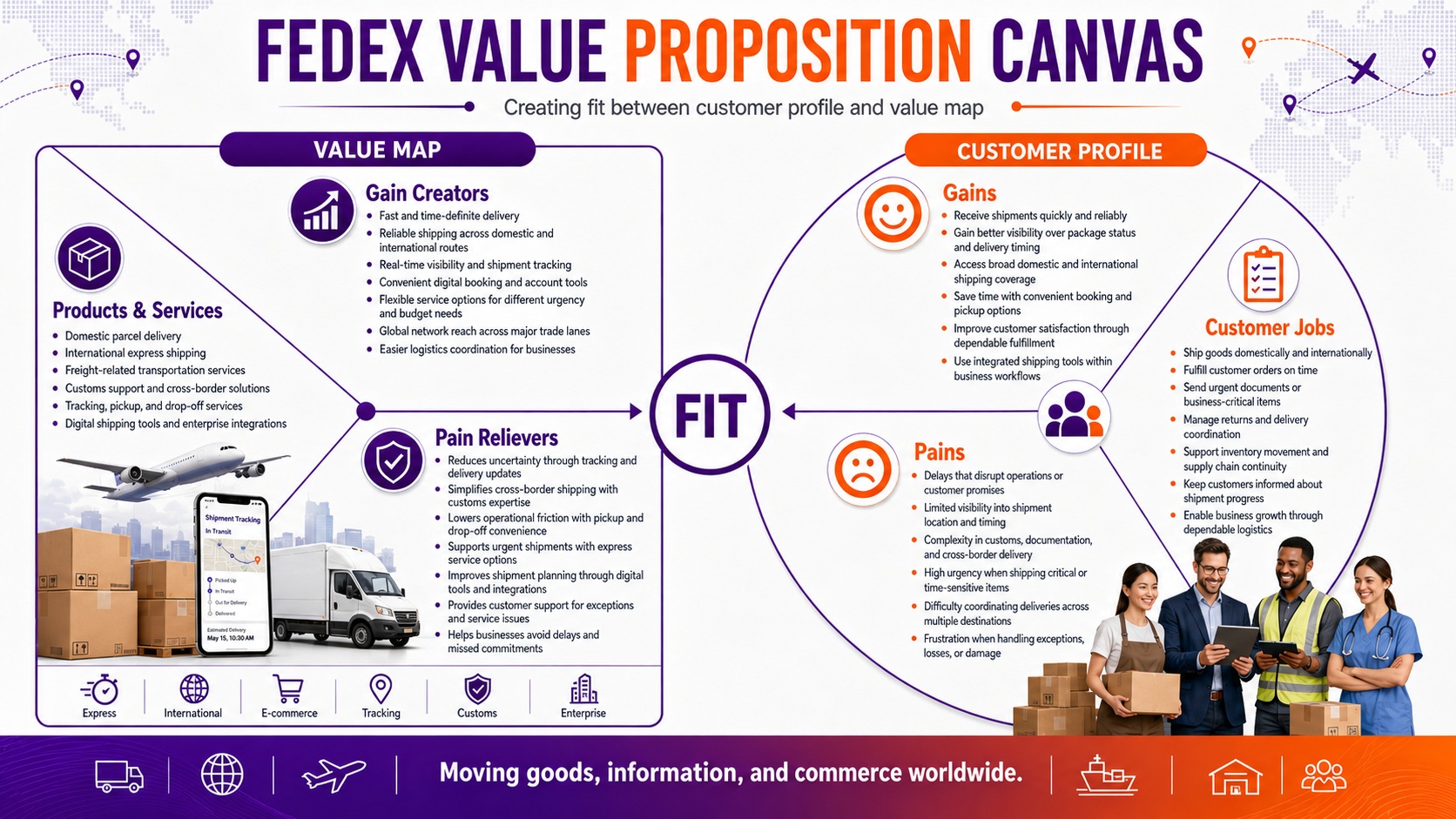
Such a diagram demonstrates that the company ultimately sells reduced logistics friction rather than merely transportation capacity.
FedEx vs UPS vs DHL Business Model Comparison
A useful way to interpret the FedEx Business Model Canvas is to compare FedEx with UPS and DHL Group across the BMC elements where strategic differences are most visible.
All three organisations operate at substantial global scale, but their portfolio structures and geographic strengths differ.
DHL Group reported approximately €82.9 billion of revenue during 2025 and operates across Express, Global Forwarding/Freight, Supply Chain, eCommerce, and Post & Parcel Germany. (FinancialFilings)
FedEx vs UPS vs DHL
| Relevant BMC Block | FedEx | UPS | DHL |
|---|---|---|---|
| Customer Segments | Strong exposure to parcel, express, e-commerce and enterprise customers | Strong parcel and enterprise customer base with major U.S. presence | Broad international customer base across express, forwarding, supply chain and e-commerce |
| Value Proposition | Speed, reliability, visibility and integrated global transportation | Dense parcel network, reliability and integrated logistics | International logistics breadth and extensive cross-border capabilities |
| Channels | Direct digital tools, APIs, sales teams, pickup and delivery network | Digital platforms, enterprise integration, access points and delivery network | Digital channels combined with extensive international logistics operations |
| Revenue Streams | Primarily parcel, express and related transportation services after Freight separation | Package operations plus supply-chain-related businesses | Diversified across Express, Forwarding, Supply Chain, eCommerce and German postal operations |
| Key Resources | Express air network, hubs, technology, vehicles and FedEx brand | Dense ground network, aircraft, hubs, technology and brand | International express network, forwarding capabilities, warehouses and logistics infrastructure |
| Key Activities | Express transportation, parcel delivery, sorting, customs and network optimisation | Parcel movement, delivery, international transport and logistics | Express, forwarding, contract logistics, e-commerce delivery and postal operations |
| Cost Structure | Labour, aircraft, purchased transport, fuel and facilities | Labour-intensive parcel network, transport, aircraft and facilities | Varies materially by division across transport, labour and logistics infrastructure |
No company dominates every dimension.
FedEx retains particular strength in express transportation and integrated parcel logistics. UPS possesses formidable package density, especially in the United States, while DHL has unusually broad international logistics exposure.
Strategic advantage therefore depends on customer requirement, geography, shipment profile, and required service complexity.
FedEx should compete where its integrated network provides superior value rather than attempting to imitate every element of its rivals.
FedEx Competitive Advantages
Several mutually reinforcing capabilities create meaningful barriers to entry.
- Global network scale: FedEx connects more than 220 countries and territories, allowing customers to use one transportation brand across numerous trade lanes rather than assembling separate local providers.
- Integrated express infrastructure: Aircraft, sorting hubs, ground transportation, customs capabilities, and delivery routes operate together, creating a system that would require enormous capital and operating expertise to replicate.
- Strong brand recognition: Decades of association with express delivery reduce perceived risk when customers entrust urgent, valuable, or commercially important shipments to the company.
- Technology and shipment data: Tracking, network analytics, automation, APIs, forecasting, and routing capabilities improve customer visibility while supporting operational productivity.
- Network density and operational experience: Large volumes moving through shared facilities and routes can improve utilisation, while decades of accumulated logistics expertise strengthen execution and exception management.
These advantages become more powerful when combined.
Aircraft without sufficient shipment density become expensive. Brand recognition without reliable operations deteriorates quickly.
FedEx’s principal moat is therefore the complete network and the organisational capability required to coordinate it consistently.
FedEx Risks and Challenges
Despite its scale, FedEx faces several structural risks that can materially affect revenue, cost, and service performance.
- High fixed-cost exposure: Aircraft, facilities, technology, and transportation infrastructure require substantial expenditure. Lower shipment demand can consequently reduce asset utilisation and pressure margins.
- Intense competition: UPS, DHL, postal operators, regional couriers, freight providers, and emerging technology-enabled logistics companies compete across different shipment categories.
- Global trade and regulatory uncertainty: Tariffs, customs requirements, sanctions, geopolitical disruption, aviation rules, and trade-policy changes can alter shipment flows and operating costs.
- Labour and transportation-cost inflation: Wages, contractor rates, fuel, maintenance, and purchased transportation can increase faster than pricing adjustments.
- Technology and cybersecurity dependence: Network operations rely heavily on digital systems. Significant outages, data breaches, cyberattacks, or integration failures could disrupt customer and operational processes.
These risks reinforce the need for flexibility.
A network designed around historical shipment patterns may become inefficient when trade lanes, customer behaviour, or e-commerce volumes change.
Management must therefore continuously redesign capacity rather than treating infrastructure as static.
Strategic Recommendations
Based on the FedEx Business Model Canvas, future value creation should focus less on simply increasing shipment volume and more on improving profitable network density.
1. Accelerate Network Optimisation
FedEx should continue consolidating overlapping operations and routing packages through the most economically appropriate transportation mode.
Facility, aircraft, and route decisions need to reflect current demand rather than historical organisational boundaries.
Network optimisation can improve asset utilisation while reducing duplicated handling.
Performance metrics should therefore emphasise cost per package, route density, capacity utilisation, service reliability, and return on invested capital.
2. Strengthen Direct Digital Integration
APIs should become an increasingly important customer-retention mechanism.
E-commerce merchants, manufacturers, and enterprise customers benefit when rates, labels, tracking, customs documentation, returns, and reporting are embedded directly inside their systems.
Deeper integration also increases switching costs because shipping becomes part of the customer’s operating architecture.
FedEx should consequently treat developer tools and platform reliability as strategic distribution channels rather than supporting technology.
3. Improve Revenue Quality
Volume growth should not become the primary objective when shipments generate inadequate margins.
Pricing needs to reflect residential complexity, dimensions, handling requirements, route economics, peak periods, and delivery density.
Analytics can help identify customers, products, and routes that consume disproportionate resources.
Management should also distinguish strategically valuable lower-margin volume that improves network density from business that simply absorbs capacity.
4. Expand Data-Driven Logistics Services
FedEx possesses enormous quantities of shipment and network information.
Used responsibly, these data can support forecasting, inventory planning, trade-flow intelligence, delivery optimisation, and supply-chain visibility.
Commercial opportunities consequently extend beyond tracking individual packages.
FedEx can increase customer value by transforming transportation information into decision-support capabilities.
Such services can also strengthen enterprise relationships without requiring equivalent growth in physical assets.
5. Continue Automation and AI Deployment
Automation should focus on areas with measurable operational impact.
Sorting, package identification, route planning, forecasting, customer service, fraud detection, maintenance scheduling, and workforce planning represent strong opportunities.
Artificial intelligence should complement rather than distract from operational discipline.
Technology investment is most valuable when it reduces handling cost, improves delivery accuracy, shortens exception resolution, or increases network utilisation.
6. Increase International SME Penetration
Cross-border commerce presents a substantial opportunity among smaller businesses that lack specialised customs and logistics teams.
FedEx can simplify international shipping through clearer landed-cost information, documentation assistance, integrated customs tools, and straightforward service selection.
Educational resources can also reduce perceived barriers.
Helping SMEs internationalise creates future shipment demand while positioning FedEx as an enabling partner rather than simply a transport provider.
7. Strengthen Resilience Across Trade Lanes
International logistics is increasingly exposed to geopolitical disruption.
FedEx should continue designing alternative routes, flexible capacity, customs expertise, supplier redundancy, and scenario-based network planning.
Resilience does not mean maintaining unlimited spare capacity.
Instead, management should identify critical points where operational alternatives have disproportionate strategic value.
Customers transporting high-value or time-sensitive goods may also be willing to pay for enhanced resilience.
8. Maintain Capital Discipline
Large networks can easily consume capital without creating proportional returns.
Fleet replacement, automation, facilities, technology, and network expansion should therefore be assessed against measurable productivity improvements.
FedEx reported fiscal 2026 capital expenditure of about US$3.8 billion, or approximately 4% of revenue. Maintaining disciplined investment will remain important as network modernisation continues. (FedEx Investors)
Growth should ultimately improve return on capital rather than simply enlarge infrastructure.
Recommendations for Entrepreneurs
Entrepreneurs can extract several useful principles from FedEx even when operating businesses with completely different economics.
First, reliability can itself be a value proposition. Customers often pay more for predictable execution than for an impressive product that produces inconsistent outcomes.
Second, density matters in businesses involving physical delivery. Ten deliveries within one neighbourhood can create better economics than ten deliveries spread across an entire city.
Third, technology should coordinate operations instead of existing only for appearance. Tracking, inventory, routing, workflow automation, and customer communication need measurable operational purposes.
Fourth, service levels should correspond with willingness to pay. Urgent customers may purchase premium service, whereas less time-sensitive customers require lower-cost alternatives.
Finally, utilisation is critical when the business owns significant fixed assets. Vehicles, kitchens, warehouses, equipment, or employees become more productive when sufficient demand passes through the same operating system.
FedEx demonstrates that scale alone is not the objective.
Profitable scale comes from repeatedly using shared infrastructure to serve growing demand while preserving quality.
Conclusion
The FedEx Business Model Canvas demonstrates how a transportation company can evolve into infrastructure supporting global commerce.
FedEx’s competitive strength comes from combining aircraft, ground transportation, hubs, digital technology, workforce expertise, international connectivity, customs knowledge, and brand trust.
No individual asset creates the complete advantage.
Aircraft provide speed, but sorting facilities determine network flow. Technology creates visibility, although drivers and operational teams ultimately complete delivery.
The company’s recent transformation reflects the need to operate these resources more cohesively. FedEx exceeded US$94 billion in fiscal 2026 revenue and completed the FedEx Freight separation on June 1, 2026, creating a more focused continuing business. (FedEx Investors)
Future success will increasingly depend on profitable network density, disciplined pricing, data-driven decision-making, automation, international trade capabilities, and capital efficiency.
Competition from UPS, DHL, postal networks, regional couriers, and specialised logistics providers will remain substantial.
Nevertheless, replicating FedEx at comparable global scale would require enormous capital, regulatory access, technology, customer demand, operating knowledge, and decades of network development.
The strategic challenge is therefore not simply becoming larger.
FedEx must continually make its existing network smarter, more flexible, more reliable, and more economically productive.
Disclaimer
This article is provided solely for educational and business-analysis purposes.
The information presented is based on publicly available corporate information, industry observations, and strategic interpretation. It should not be considered financial, investment, legal, tax, operational, or professional advice.
This publication is independent and is not an official publication of FedEx Corporation, UPS, DHL Group, or any organisation mentioned.
Readers should conduct their own research and obtain appropriate professional advice before making business or investment decisions.
All company names, product names, logos, trademarks, service marks, copyrighted materials, and other intellectual-property rights mentioned in this article remain the property of their respective owners.
Meta Description
Explore the FedEx Business Model Canvas, nine BMC blocks, Value Proposition Canvas, UPS and DHL comparison, competitive advantages, risks, and strategic recommendations.

