



Share This Article


7-Eleven Business Model Canvas: How 7-Eleven Creates Value Through Convenience, Location, Food and Digital Services
BMC Article No: BMC #027
Updated in 2026: This article has been comprehensively updated to reflect changes in 7-Eleven’s global convenience-store strategy, stronger emphasis on fresh food and proprietary products, digital delivery through 7NOW, store-network optimisation, supply-chain transformation and changing consumer expectations.
The 2026 update also provides deeper analysis of every BMC block, expanded closing analysis, a Value Proposition Canvas, comparison with Lawson and FamilyMart, competitive advantages, risks and challenges, strategic recommendations, and analysis of how the business model works as an integrated system.
Introduction
7-Eleven began as a small retail operation in the United States but has developed into one of the world’s most recognisable convenience-store brands.
Its underlying proposition appears simple: locate stores close to customers, operate for extended hours, stock frequently needed products and make purchasing fast. Beneath that simplicity sits a sophisticated retail system involving franchising, logistics, merchandise planning, food development, technology, supplier coordination and increasingly digital commerce.
The 7-Eleven Business Model Canvas helps explain how these components reinforce one another.
Seven & i Holdings reported in 2025 that its global 7-Eleven network comprised approximately 87,000 stores serving around 62.4 million customers each day. Its strategic direction increasingly emphasises food, private brands, proprietary merchandise, supply-chain capabilities and digital convenience. (7andi.com)
Understanding 7-Eleven therefore requires looking beyond the traditional image of a neighbourhood convenience store. The company is increasingly combining physical proximity with foodservice, customer data, delivery and digitally enabled retail services.
What Is 7-Eleven’s Business Model?
At its core, the 7-Eleven Business Model Canvas represents a high-frequency retail model built around convenient locations, fast transactions, carefully selected merchandise and extensive store coverage.
Customers generally pay a premium for convenience rather than choosing 7-Eleven solely because it offers the lowest price.
Several economic engines support the model.
First, stores generate merchandise sales from beverages, snacks, ready-to-eat food, groceries and everyday necessities. Second, proprietary and private-label products can improve product differentiation and gross margins. Third, franchise arrangements enable store-network expansion while distributing part of the operating responsibility to local entrepreneurs.
Additional services such as payments, reloads, parcel collection and digital delivery can create more reasons for customers to visit.
Modern 7-Eleven increasingly extends this model beyond the physical store. Seven & i identifies 7NOW delivery, fresh food, proprietary products and optimised store formats as important growth areas. (7andi)
The result is an ecosystem where store density creates convenience, convenience drives customer traffic, traffic improves merchandise economics, and greater scale supports better sourcing, logistics and digital capabilities.
What Is Business Model Canvas?
Business Model Canvas, commonly called BMC, is a strategic framework for understanding how an organisation creates, delivers and captures value.
Nine interconnected blocks form the framework.
| BMC Block | Main Question |
|---|---|
| Customer Segments | Who does 7-Eleven serve? |
| Value Propositions | Why do customers choose 7-Eleven? |
| Channels | How does 7-Eleven reach customers? |
| Customer Relationships | How does it encourage repeat visits? |
| Revenue Streams | How does the business generate income? |
| Key Resources | Which assets make the model possible? |
| Key Activities | What must the organisation perform consistently? |
| Key Partnerships | Which external parties support the model? |
| Cost Structure | What are the major operating costs? |
The 7-Eleven Business Model Canvas is particularly useful because convenience retail depends on interaction among location, assortment, inventory availability, operating speed, franchise execution and supply-chain efficiency.
Examining one component alone may therefore provide an incomplete picture.
Quick Overview of 7-Eleven
7-Eleven traces its origins to 1927 in Dallas, Texas, when an ice company began offering everyday grocery items to customers. The 7-Eleven name was introduced in 1946 to reflect the extended operating hours of 7 a.m. to 11 p.m. (Gerbang Bisnes)
Extended hours eventually developed into a broader promise of accessibility and convenience.
International expansion transformed the brand further. Japan became particularly important to the development of sophisticated convenience-store merchandising, store-level inventory management, fresh-food capability and dense distribution networks.
Today, the brand operates across multiple markets under different ownership, licensing and franchise arrangements.
Its formats also vary by geography. Certain markets emphasise fuel and large stores, while others concentrate on dense urban locations, ready-to-eat food or neighbourhood convenience.
This flexibility allows the company to adapt the same fundamental concept—proximity and convenience—to different consumer environments.
Why 7-Eleven Is Strategically Interesting
Convenience retail demonstrates an important strategic principle: customers do not always optimise exclusively for price.
Someone buying a drink late at night, collecting a parcel, purchasing breakfast before work or replacing a missing household item may value time and accessibility more than a small price difference.
7-Eleven monetises this willingness to pay for convenience.
Store density creates another advantage. A large network can increase purchasing power, strengthen supplier relationships, improve brand visibility and make distribution infrastructure more economical.
Fresh food adds an additional dimension because prepared meals and beverages can increase both purchase frequency and margin potential.
Digital delivery extends convenience beyond walking distance from the store.
The 7-Eleven Business Model Canvas is therefore strategically interesting because the company is not merely selling merchandise. It is effectively monetising proximity, availability, speed and increasingly immediate fulfilment.
Latest Developments: What Is Changing Around 7-Eleven?
Several developments are reshaping the business in 2026.
Fresh food and proprietary merchandise have become increasingly important differentiation tools. Seven & i has stated that it intends to strengthen fresh food, private brands and proprietary products across the Group. (7andi)
Digital convenience is developing simultaneously.
7NOW has become an important growth platform. Seven & i reports that the service has generated approximately US$1 billion in annual sales in North America, while its coverage and rollout continue expanding. (7andi)
Store design is changing as well. Larger formats, food-led locations, restaurants and remodelled stores can address consumption occasions that traditional small convenience stores may not capture.
Meanwhile, supply-chain optimisation remains strategically important because fresh food requires more precise forecasting, replenishment and logistics than packaged merchandise.
These developments show that the 7-Eleven Business Model Canvas is shifting from traditional convenience retail toward a broader ecosystem combining foodservice, retail, digital ordering and rapid fulfilment.
7-Eleven Business Model Canvas Summary
Before examining every component individually, the 7-Eleven Business Model Canvas can be summarised as a retail system that converts accessibility, merchandise availability, food, services and time savings into frequent customer transactions.
| BMC Block | 7-Eleven Application |
|---|---|
| Customer Segments | Commuters, neighbourhood shoppers, travellers, workers, students and convenience-oriented consumers |
| Value Propositions | Accessibility, speed, extended hours, immediate consumption and product availability |
| Channels | Physical stores, apps, digital delivery and loyalty platforms |
| Customer Relationships | Convenience, habitual purchasing, promotions, loyalty and personalisation |
| Revenue Streams | Merchandise, food, beverages, fuel in selected markets, franchise income and services |
| Key Resources | Store network, brand, supply chain, franchise system, data and proprietary products |
| Key Activities | Merchandising, procurement, logistics, store operations, food development and digital fulfilment |
| Key Partnerships | Franchisees, manufacturers, suppliers, logistics partners and digital-service providers |
| Cost Structure | Merchandise, labour, occupancy, logistics, technology, food operations and marketing |
7-Eleven BMC Diagram
A complete visual canvas should show the nine blocks as one connected retail system.
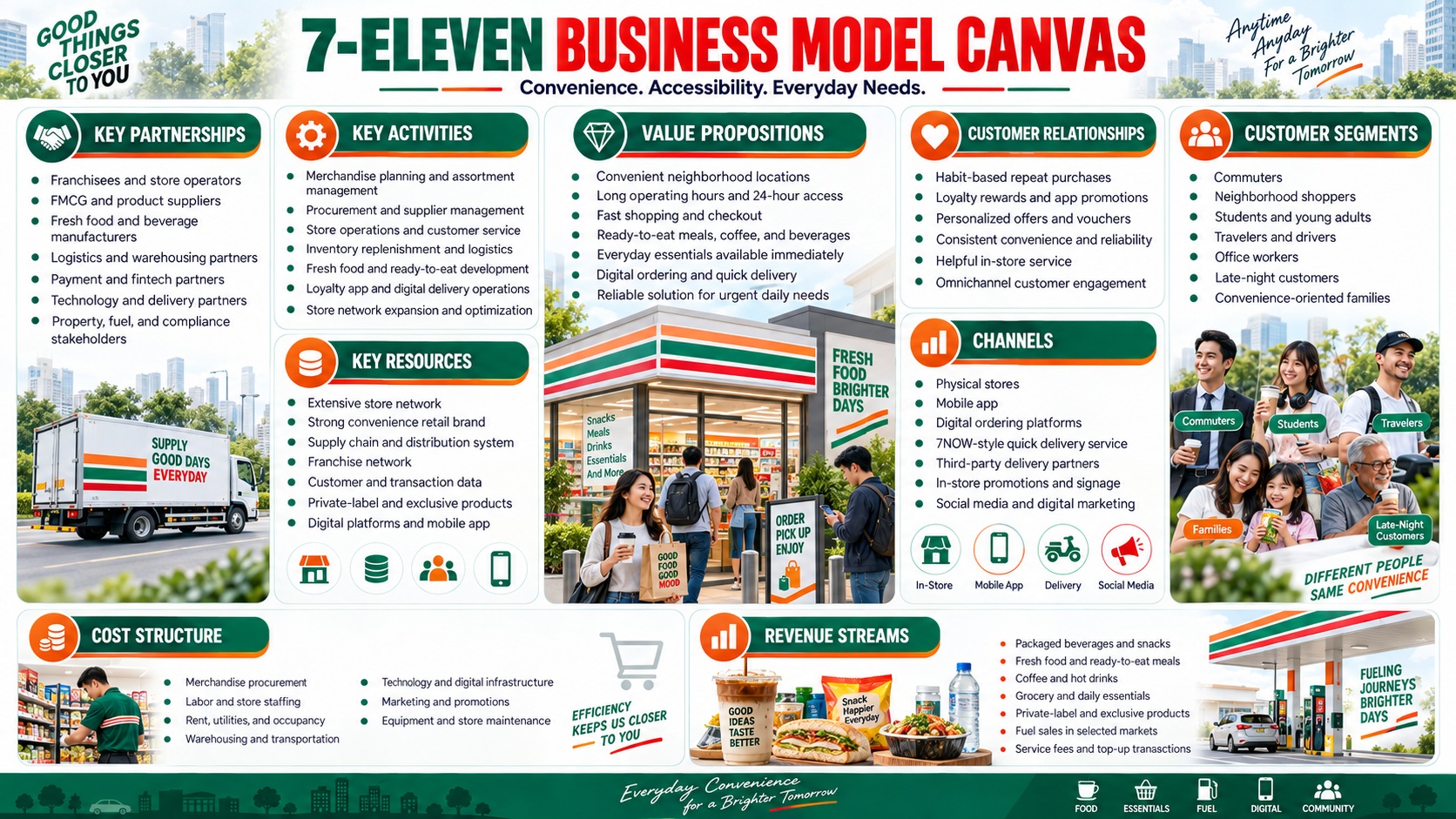
Store locations attract customers. Merchandise and food convert traffic into sales. Logistics maintain availability. Franchise partners extend operating reach. Customer data improves promotions and assortment decisions.
Revenue generated from those activities can then be reinvested in stores, products, technology and distribution.
BMC Analysis of 7-Eleven
The detailed 7-Eleven Business Model Canvas shows that competitive advantage does not originate from any single product.
A bottle of water, sandwich or packaged snack can normally be purchased elsewhere.
Value comes from making those products available at the appropriate place, time and level of convenience.
Scale subsequently strengthens sourcing, distribution and brand recognition. Digital capabilities extend that accessibility, while proprietary food and beverages can provide differentiation that competing retailers cannot immediately replicate.
The following sections examine each component more closely.
1. Customer Segments
7-Eleven serves a broad customer base, but most segments share one characteristic: they place relatively high value on convenience.
Commuters may buy breakfast or coffee before work. Travellers purchase drinks, snacks and fuel in selected markets, while neighbourhood customers may use stores for everyday essentials or urgent purchases.
Students and younger consumers represent another important group, particularly for snacks, beverages, prepared food and app-based promotions.
Late-night customers value availability when many alternatives are closed.
7-Eleven Customer Segments
| Segment | Details | Why It Matters |
|---|---|---|
| Commuters | Breakfast, beverages and food on the move | Generates predictable high-frequency traffic |
| Neighbourhood shoppers | Daily necessities and immediate needs | Supports recurring local demand |
| Travellers | Food, drinks, fuel and travel essentials | Captures convenience-driven purchases |
| Students and younger consumers | Snacks, drinks, meals and promotions | Supports frequent impulse purchases |
| Late-night customers | Purchases outside standard retail hours | Strengthens the availability proposition |
The strategic strength of these segments is frequency rather than exceptionally large individual transactions.
Customers may spend modest amounts during each visit but return repeatedly throughout the week.
Location selection therefore becomes central to segmentation. Instead of merely defining customers by age or income, 7-Eleven can effectively segment demand by occasion: breakfast, commuting, lunch, refreshment, emergency shopping, travel and late-night consumption.
That occasion-based perspective helps explain why merchandise assortment can differ considerably between stores.
2. Value Propositions
7-Eleven creates value primarily by reducing the time, distance and effort required to complete everyday purchases.
Customers can enter a nearby store, locate a familiar selection of products and complete transactions quickly.
Extended operating hours increase the value of this proposition because availability continues when traditional retailers may be closed.
Prepared food, coffee, beverages and proprietary products expand the proposition from emergency retail toward everyday meal occasions.
7-Eleven Value Propositions
| Value Proposition | Details | Why It Matters |
|---|---|---|
| Convenient locations | Stores positioned near everyday customer activity | Reduces travel time |
| Extended availability | Long operating hours and many 24-hour locations | Captures time-sensitive demand |
| Fast transactions | Small-format stores and focused assortment | Saves customer time |
| Ready-to-consume food | Meals, snacks, coffee and beverages | Increases visit frequency |
| Everyday services | Payments, reloads and other services in some markets | Creates additional reasons to visit |
The 7-Eleven Business Model Canvas becomes stronger when convenience is interpreted as more than location.
True convenience combines accessibility, inventory availability, transaction speed, product relevance and operating hours.
Food can strengthen differentiation because consumers may deliberately visit for a preferred meal, coffee or proprietary product rather than merely choosing whichever retailer happens to be nearby.
Digital ordering further expands the proposition from “a store close to you” toward “products delivered quickly to you.”
Long-term differentiation consequently depends on improving both physical and digital convenience rather than relying solely on store density.
3. Channels
Physical stores remain 7-Eleven’s most important customer channel.
Their locations function simultaneously as sales outlets, fulfilment points, advertising surfaces and distribution nodes.
Mobile applications increasingly provide another customer interface through loyalty programmes, promotions, store discovery and digital ordering.
Delivery platforms extend store inventory to customers who prefer immediate fulfilment without travelling.
In Malaysia, for example, the My7E app combines rewards, vouchers, promotions, points and store-locator functionality. (7-Eleven Malaysia)
7-Eleven Channels
| Channel | Details | Why It Matters |
|---|---|---|
| Physical stores | Primary retail and service locations | Creates proximity and immediate access |
| Mobile applications | Loyalty, offers and customer interaction | Builds digital relationships |
| 7NOW | On-demand delivery in supported markets | Extends convenience beyond store visits |
| Delivery partners | Third-party digital fulfilment | Expands customer reach |
| Digital marketing | Promotions and product communication | Stimulates visits and purchases |
The 7-Eleven Business Model Canvas benefits from an important channel advantage: stores can function as a distributed physical infrastructure network.
Digital competitors must often build warehouses or fulfilment facilities before entering rapid-delivery markets. A dense convenience-store chain already has inventory positioned close to customers.
However, successful omnichannel retail requires accurate inventory data, fast picking and reliable delivery economics.
Digital ordering therefore creates value only when physical-store operations are integrated effectively with technology.
4. Customer Relationships
Convenience stores traditionally depend less on intensive personalised service than many other retail formats.
Relationships are built primarily through reliability and habit.
Customers return because they expect the store to be open, conveniently located and stocked with products suitable for immediate needs.
Loyalty programmes can make this relationship more measurable.
Apps allow retailers to provide points, digital vouchers, targeted promotions and personalised incentives rather than relying entirely on generic store-level promotions.
7-Eleven Customer Relationships
| Relationship Type | Details | Why It Matters |
|---|---|---|
| Habitual purchasing | Frequent everyday visits | Supports recurring revenue |
| Loyalty programmes | Points, rewards and promotions | Encourages retention |
| Digital personalisation | Offers based on customer interaction | Can increase relevance |
| Reliable convenience | Consistent hours and product access | Builds behavioural trust |
| Customer service | In-store and digital support | Protects service quality |
The 7-Eleven Business Model Canvas depends heavily on behavioural loyalty.
A customer may not demonstrate the emotional attachment associated with a luxury brand yet can still visit the same convenience store several times per week because it fits naturally into a daily routine.
Digital loyalty can strengthen this relationship by making repeat behaviour visible and rewardable.
Nevertheless, the underlying relationship remains fragile. If queues become excessive, products are unavailable or nearby competitors provide better food and pricing, established habits can change quickly.
Operational consistency therefore functions as a form of customer relationship management.
5. Revenue Streams
Merchandise sales form the economic foundation of most 7-Eleven stores.
Major categories include packaged beverages, snacks, food, groceries, tobacco where permitted, household necessities and other convenience products.
Fresh and proprietary food can provide strategically important revenue because differentiated products reduce direct price comparison.
Fuel contributes significantly in markets where convenience stores operate alongside service stations.
Franchising can also generate economic returns through fees, royalties or profit-sharing arrangements depending on the market and contract structure.
7-Eleven Revenue Streams
| Revenue Stream | Details | Why It Matters |
|---|---|---|
| Merchandise sales | Snacks, drinks, groceries and essentials | Core retail revenue |
| Fresh food and beverages | Meals, coffee and prepared products | Supports frequency and differentiation |
| Proprietary products | Private-label and exclusive merchandise | Can improve margin and brand distinction |
| Fuel | Major category in selected markets | Generates traffic and additional sales |
| Franchise and service income | Franchise arrangements and selected services | Broadens economic sources |
The 7-Eleven Business Model Canvas increasingly benefits from shifting the sales mix toward categories customers actively seek rather than merely stock-up purchases.
Prepared meals, beverages and proprietary products can create stronger destination value and potentially better economics.
Digital delivery provides an additional growth path but must be managed carefully because picking and last-mile delivery introduce new costs.
Services such as payments or parcel collection may generate limited direct revenue individually yet increase store traffic that can lead to additional merchandise purchases.
Revenue quality therefore matters as much as total sales.
6. Key Resources
7-Eleven’s store network represents one of its most visible strategic resources.
A dense footprint provides access to customers and creates distributed inventory close to demand.
Brand recognition lowers the uncertainty customers experience when visiting unfamiliar locations.
Supply-chain capabilities are equally important because thousands of stores require dependable replenishment.
Franchise relationships increase operating reach, while proprietary products and food-development capabilities create differentiation.
7-Eleven Key Resources
| Key Resource | Details | Why It Matters |
|---|---|---|
| Store network | Extensive physical footprint | Creates proximity and distribution reach |
| Brand | Globally recognised convenience-store identity | Builds familiarity and trust |
| Supply chain | Procurement and replenishment systems | Maintains product availability |
| Franchise network | Local operating partners | Enables scalable expansion |
| Customer and retail data | Transaction and loyalty information | Supports merchandising decisions |
These resources become particularly powerful when combined.
Store data can inform product assortment. Greater purchasing volumes can strengthen supplier economics. Distribution infrastructure supports frequent replenishment, while strong product availability reinforces customer expectations.
Physical scale alone is insufficient, however.
An oversized network with weak store economics can become expensive to maintain. Poor franchise relationships can undermine execution, and inefficient logistics can destroy the advantages created by store density.
Resource quality should therefore be evaluated based on productivity rather than simply quantity.
7. Key Activities
Merchandising is one of the most important activities across the convenience-store system.
The retailer must determine which limited selection of products deserves shelf space in thousands of small-format stores.
Demand forecasting and replenishment are equally important because lost availability can translate immediately into missed sales.
Fresh-food development adds complexity through shorter shelf lives, food safety requirements and demand variability.
7-Eleven Key Activities
| Key Activity | Details | Why It Matters |
|---|---|---|
| Merchandising | Select products and optimise assortments | Maximises limited shelf productivity |
| Procurement | Source products at scale | Supports availability and margins |
| Logistics | Replenish stores reliably | Reduces stock-outs |
| Food development | Develop fresh and proprietary products | Strengthens differentiation |
| Store operations | Maintain service, cleanliness and availability | Protects customer experience |
Digital fulfilment is becoming another significant activity as 7NOW expands.
Technology must connect ordering, store inventory, payment, picking and delivery into a reliable customer experience.
Store-network optimisation also requires constant attention because consumer traffic patterns change over time.
The challenge is synchronisation. Excellent food development creates little value if stores regularly run out of the product. Efficient logistics cannot compensate for weak assortment decisions, while strong locations may underperform when service quality is inconsistent.
Operating discipline therefore converts strategic resources into actual retail performance.
8. Key Partnerships
Franchisees are among the most important partners within the 7-Eleven ecosystem.
They provide local operating capability and entrepreneurial investment while implementing the broader brand system.
Suppliers and manufacturers ensure stores receive branded, private-label and proprietary merchandise.
Food manufacturers become increasingly important as fresh-food strategy expands.
Logistics companies and distribution facilities connect these suppliers with individual outlets.
7-Eleven Key Partnerships
| Key Partner | Details | Why It Matters |
|---|---|---|
| Franchisees | Operate stores under the brand system | Enables network expansion |
| Product suppliers | Provide branded merchandise | Supports assortment |
| Food manufacturers | Produce fresh and proprietary food | Enables differentiation |
| Logistics partners | Transport goods to stores | Maintains availability |
| Technology and delivery partners | Support payments, digital ordering and fulfilment | Extends digital convenience |
Partnership management determines how consistently customers experience the brand across thousands of locations.
Franchise economics require particular attention because store owners must remain commercially motivated to invest, maintain standards and execute new initiatives.
Supplier relationships also involve strategic trade-offs. Large purchasing volumes may create bargaining strength, but excessive concentration can expose the network to supply disruption.
Effective partnerships should therefore improve scale without creating unnecessary dependency.
9. Cost Structure
Convenience retail involves substantial operating costs despite comparatively small store footprints.
Merchandise procurement represents a major variable cost.
Labour remains essential because stores require staffing across long operating hours.
Occupancy costs depend heavily on location, with high-traffic urban areas potentially commanding substantial rents.
Distribution expenses are significant because frequent deliveries are necessary to maintain fresh inventory and product availability.
7-Eleven Cost Structure
| Cost Category | Details | Why It Matters |
|---|---|---|
| Merchandise | Products purchased for resale | Major variable cost |
| Labour | Store and organisational employees | Necessary for extended operations |
| Occupancy | Rent, utilities and property expenses | Location quality affects economics |
| Logistics | Warehousing and frequent deliveries | Supports product availability |
| Technology and marketing | Apps, systems, promotions and digital services | Enables modern convenience |
Food-led growth can increase both revenue opportunity and operational complexity.
Fresh food requires specialised equipment, temperature control, forecasting and tighter waste management.
Delivery introduces additional fulfilment and last-mile costs.
The objective should therefore not be simply to minimise expenditure.
Some costs directly strengthen the proposition. Premium locations improve access, frequent deliveries reduce stock-outs, and better technology may improve ordering.
Strong economics emerge when each investment produces sufficient additional sales, margin, customer frequency or operational efficiency to justify its cost.
How the Nine BMC Blocks Work Together
The 7-Eleven Business Model Canvas becomes most useful when all nine components are viewed as an integrated system.
Customer segments generate demand for immediate convenience.
Value propositions attract those customers through proximity, availability, speed and relevant products.
Channels provide access through physical stores and increasingly digital ordering.
Customer relationships create repeat purchasing through habit, reliability and loyalty programmes.
Revenue from merchandise, food, fuel and related activities funds the resources required to maintain the network.
Key activities transform stores, products, supply chains and technology into actual customer experiences.
Partners expand capabilities and reduce the need for complete vertical integration.
Costs ultimately determine whether this entire system produces sustainable returns.
A disruption in one block can weaken several others. Poor logistics reduce availability, weak assortment reduces traffic, falling traffic hurts franchise economics, and weaker franchise investment can damage store quality.
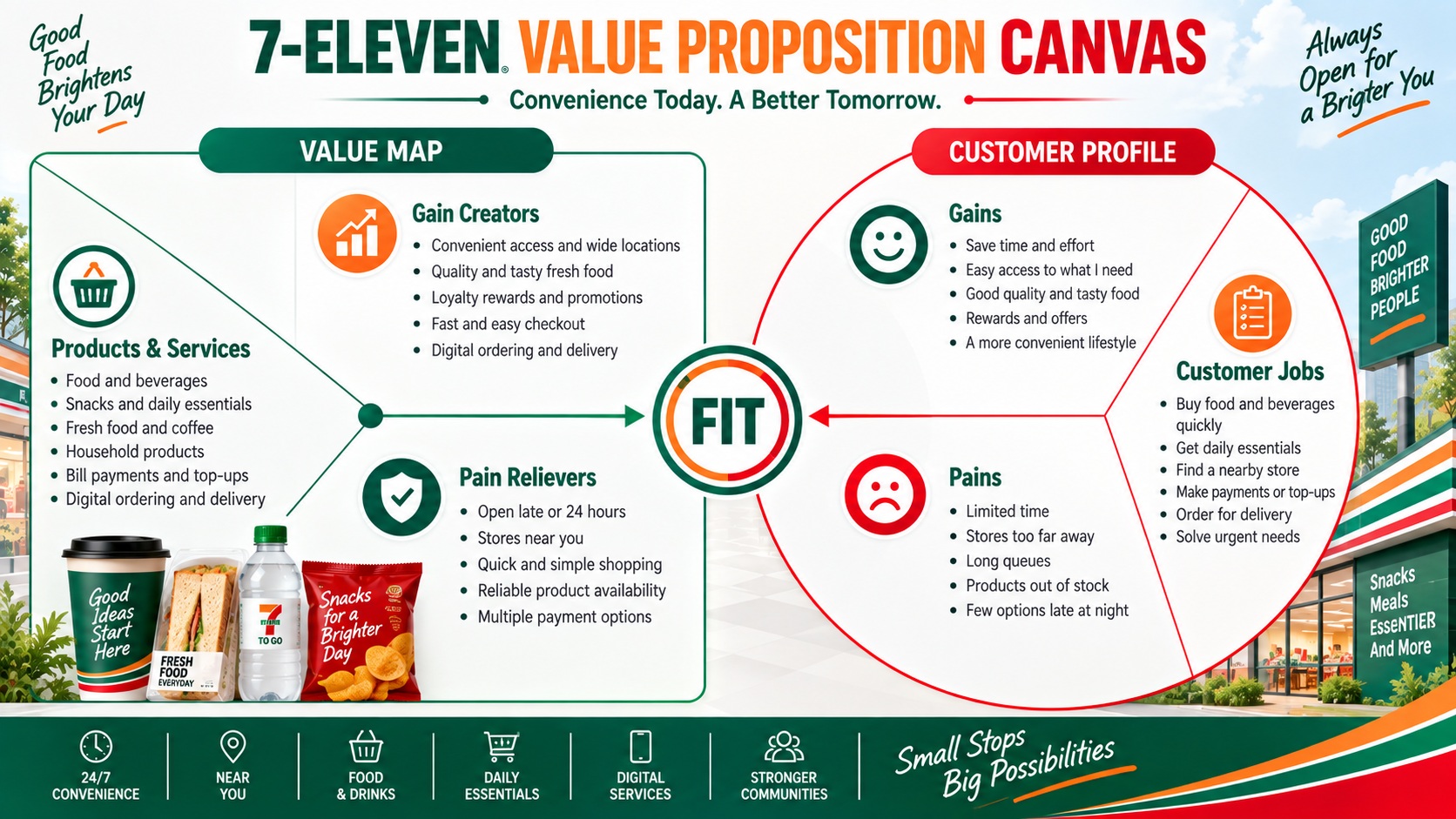
7-Eleven Value Proposition Canvas
The 7-Eleven Business Model Canvas explains the overall business system, while the Value Proposition Canvas provides a more focused view of how 7-Eleven addresses customer jobs, pains and desired gains.
Customer Profile
A typical convenience-store customer is usually trying to complete a relatively simple task quickly.
They may need breakfast, coffee, a drink, an immediate meal, a forgotten household item or something during hours when larger retailers are inconvenient.
Customer Profile of 7-Eleven
| Customer Profile | Details |
|---|---|
| Customer Jobs | Buy food, drinks and necessities quickly; solve immediate needs; save travel time |
| Customer Pains | Long queues, travelling far, unavailable products, closed stores and complicated shopping |
| Customer Gains | Fast transactions, nearby locations, reliable availability, fresh food and easy digital ordering |
Customer expectations are therefore heavily time-sensitive.
Reducing friction can sometimes create greater value than offering the lowest price.
Value Map
7-Eleven responds with a combination of stores, merchandise, services and digital capabilities.
Value Map of 7-Eleven
| Value Map | Details |
|---|---|
| Products and Services | Snacks, beverages, meals, groceries, coffee, everyday necessities and selected services |
| Pain Relievers | Nearby stores, extended hours, focused assortments, digital payment and rapid fulfilment |
| Gain Creators | Fresh food, proprietary products, loyalty rewards, digital promotions and delivery |
The strongest value proposition occurs when availability and relevance work together.
A nearby store offers limited value if the required product is repeatedly unavailable.
Likewise, a broad assortment may not create convenience if shopping takes too long.
How 7-Eleven Creates Fit
| Customer Profile | Details | Matching Value Map | How 7-Eleven Creates Fit |
|---|---|---|---|
| Customer Jobs | Complete everyday purchases quickly | Products and Services | Focused assortment covers frequent immediate needs |
| Customer Pains | Distance, queues and limited operating hours | Pain Relievers | Dense locations and extended hours reduce friction |
| Customer Gains | Speed, availability and easy access | Gain Creators | Food, loyalty and delivery expand convenience |
Value fit becomes stronger when customers can predict that 7-Eleven will solve an immediate need reliably.
7-Eleven vs Lawson vs FamilyMart Business Models
7-Eleven, Lawson and FamilyMart operate fundamentally similar convenience-store models but emphasise different combinations of network scale, food, technology, customer engagement and local-market execution.
Lawson reported more than 14,500 stores in Japan and more than 7,000 overseas around its 50th anniversary in 2025, while highlighting its “Real × Tech Convenience” strategy. FamilyMart reported more than 25,000 stores globally as of February 2026 and continues integrating its physical network with FamiPay and other digital customer touchpoints. (Lawson)
Relevant BMC Block Comparison
| Relevant BMC Block | 7-Eleven | Lawson | FamilyMart |
|---|---|---|---|
| Customer Segments | Convenience shoppers, commuters, travellers and neighbourhood customers | Local communities and convenience-focused consumers | Local customers, commuters and digitally connected shoppers |
| Value Proposition | Proximity, availability, food and rapid convenience | Community convenience combining physical service and technology | Neighbourhood convenience with products, services and digital engagement |
| Channels | Stores, apps and 7NOW | Stores plus digitally enabled services | Stores, FamiPay and digital commerce |
| Key Resources | Global brand, store scale, supply chain and franchise network | Store network, franchise system, technology and community presence | Franchise network, stores, digital customer base and brand |
| Key Activities | Merchandising, logistics, food development and delivery | Store operations, merchandise optimisation and technology | Store operations, product development, franchise support and digital integration |
| Revenue Streams | Retail, food, fuel in selected markets, franchising and services | Retail sales and franchise-based convenience operations | Retail sales and franchise-based convenience operations |
The key strategic distinction is not the basic convenience-store format, which all three share.
Competitive separation increasingly comes from execution: food quality, proprietary products, digital engagement, loyalty ecosystems, supply-chain efficiency and store-level productivity.
Competitive Advantages
7-Eleven retains several structural advantages that can reinforce its competitive position.
- Global store scale: A vast store footprint creates purchasing power, brand visibility, local accessibility and extensive physical distribution capacity.
- High-frequency customer behaviour: Food, drinks and everyday necessities can generate repeated visits rather than occasional shopping trips.
- Established convenience brand: Strong recognition allows customers to understand the proposition quickly across multiple markets.
- Food and proprietary-product capability: Fresh food, beverages and private-label products create differentiation while potentially strengthening gross margins.
- Physical-digital fulfilment network: Dense stores can act as local fulfilment nodes for platforms such as 7NOW rather than functioning only as conventional retail outlets.
The strongest advantages work together.
Scale supports supply-chain investment, better logistics support availability, stronger availability reinforces convenience, and greater traffic improves the economics of food and digital services.
Competitive advantage will therefore depend increasingly on how effectively these assets operate as one system.
Risks and Challenges
Despite its scale, 7-Eleven faces several significant strategic and operational risks.
- Intense retail competition: Convenience stores compete with supermarkets, pharmacies, fast-food chains, petrol stations, delivery platforms and other convenience-store networks.
- Inflation and price sensitivity: Rising food, merchandise and labour costs may pressure margins while customers become increasingly value-conscious.
- Franchise economics: Weak profitability or dissatisfaction among franchisees could reduce investment, execution quality and network growth.
- Fresh-food and supply-chain complexity: Greater reliance on prepared food increases food-safety, forecasting, waste and logistics requirements.
- Digital execution risk: Delivery and app-based services require technology investment, reliable inventory data, cybersecurity and viable last-mile economics.
Seven & i itself identifies issues including logistics disruption, food safety, competition, information-security problems and the ability to respond to changing customer needs as relevant business risks. (7andi)
The most serious threat would involve several pressures occurring simultaneously.
Weaker traffic, squeezed franchise economics, higher operating costs and poor product availability could undermine multiple BMC blocks together.
Strategic Recommendations
7-Eleven should continue modernising convenience rather than treating its historical store network as sufficient protection against future competition.
Physical scale remains valuable, but future growth will increasingly depend on improving what each store sells, how efficiently it operates and how effectively the network connects with digital channels.
1. Accelerate the Shift Toward Food-Led Convenience
Prepared meals, coffee, snacks and fresh products can increase visit frequency while creating stronger differentiation from supermarkets and general retailers.
Product development should continue adapting to local meal occasions and consumer tastes.
Food quality should become a reason to choose 7-Eleven rather than merely an additional purchase after entering the store.
2. Increase Proprietary and Private-Label Penetration
Exclusive products reduce direct price comparison with competing retailers.
Greater private-label participation can also improve control over product development, pricing and margins.
The strongest opportunities are categories where 7-Eleven already has significant transaction frequency and customer insight.
3. Turn Stores Into Distributed Fulfilment Nodes
7NOW demonstrates that the physical network can support a broader rapid-commerce model.
Inventory accuracy, picking processes and delivery density should be continuously improved.
Stores could increasingly function simultaneously as retail locations, pickup points and micro-fulfilment assets.
4. Improve Franchisee Economics and Productivity
Franchise partners remain essential to network quality.
Automation, simplified processes, better workforce scheduling, improved forecasting and more productive assortments can reduce operational pressure.
Digital transformation should therefore improve store-level economics rather than merely adding new corporate technology.
5. Use Data to Localise Assortments
Convenience demand can change significantly by neighbourhood and time of day.
Stores near offices may require different products from residential, university or transport locations.
More precise local assortment planning can improve inventory turnover while reducing waste and stock-outs.
6. Strengthen the Loyalty Ecosystem
Digital loyalty should progress beyond generic discounting.
Personalised promotions, food recommendations, subscription-style benefits and integrated delivery rewards could increase customer lifetime value.
Greater digital engagement would also reduce dependence on anonymous walk-in transactions.
7. Maintain Cost Discipline During Transformation
Food, delivery, technology and larger store formats all require investment.
Management should link expansion to measurable improvements in store sales, traffic, margins and return on invested capital.
Innovation should strengthen convenience economics rather than create complexity without sufficient returns.
Conclusion
Overall, the 7-Eleven Business Model Canvas demonstrates how a seemingly straightforward convenience-store concept can develop into a highly sophisticated global retail system.
Its fundamental promise remains easy to understand.
Customers want frequently needed products with minimal effort, and 7-Eleven attempts to position inventory close enough to satisfy that demand quickly.
The infrastructure supporting this promise is considerably more complex.
Supply chains replenish thousands of locations. Franchise systems coordinate local entrepreneurs. Merchandising systems determine what limited shelf space should contain. Fresh-food capabilities create new consumption occasions, while digital platforms extend convenience beyond store walls.
Future competitive strength will depend increasingly on improving the productivity of this entire ecosystem.
Physical scale remains a major advantage, but scale alone cannot guarantee customer preference.
Better food, stronger proprietary products, reliable inventory, healthier franchise economics and seamless digital fulfilment will determine whether 7-Eleven can redefine convenience for another generation.
When these elements reinforce one another, each store becomes more than a small retail outlet. It becomes part of a distributed network designed to make everyday consumption faster, easier and more accessible.
Disclaimer
This article is provided solely for educational, informational and business-analysis purposes.
The information is based on publicly available company information, industry observations and strategic interpretation available at the time of writing.
This article is not official information, communication, representation or endorsement from 7-Eleven, Inc., Seven & i Holdings Co., Ltd., 7-Eleven Malaysia Sdn. Bhd., Lawson, Inc., FamilyMart Co., Ltd. or any other company mentioned.
Nothing contained in this article constitutes financial, investment, legal, accounting, commercial or other professional advice. Readers should conduct their own research and obtain appropriate professional advice before making investment or business decisions.
Company strategies, operations, financial performance, store networks, products and market conditions may change over time.
All trademarks, logos, brand names, company names, product names, copyrights and other intellectual-property rights belong to their respective owners. References to such intellectual property are used solely for identification, educational and analytical purposes.
Meta Description
Explore the 7-Eleven Business Model Canvas, covering all nine BMC blocks, Value Proposition Canvas, Lawson and FamilyMart comparison, competitive advantages, risks and strategic recommendations updated for 2026.

