



Share This Article


TikTok Shop Business Model Canvas: How TikTok Turns Content, Creators and Discovery Into Commerce
BMC Article No: BMC #014
Updated in 2026: This article has been comprehensively updated to reflect TikTok Shop’s evolution from an embedded social-commerce feature into a broader discovery-commerce ecosystem connecting consumers, sellers, brands, creators, affiliates, advertising tools, payments and logistics.
The 2026 update incorporates the increasing importance of LIVE commerce, creator-led selling, affiliate commerce, shopping search, automated advertising solutions such as GMV Max, stronger seller-support programmes and greater integration between content discovery and purchase conversion. In Malaysia, TikTok reported in August 2026 that almost six in ten TikTok Shop users preferred LIVE shopping, LIVE sales had increased 48% year-on-year and the format contributed almost one-third of platform sales. TikTok also announced cumulative support of up to RM250 million for local sellers and creators during 2026 through initiatives including JomLokal Booster 2.0. (TikTok Newsroom)
This edition also provides deeper analysis of every BMC block, expanded closing analysis, a Value Proposition Canvas, comparison with Shopee and Lazada, competitive advantages, risks and challenges, strategic recommendations and a more integrated assessment of how the business model works.
Introduction
TikTok began primarily as a short-form entertainment platform, but the addition of commerce has significantly changed its strategic role.
Instead of requiring consumers to visit a traditional marketplace with an existing purchase intention, TikTok Shop can introduce products while people are watching videos, following creators, searching for information or participating in LIVE sessions. Commerce consequently becomes embedded within entertainment and discovery.
The TikTok Shop Business Model Canvas is particularly interesting because it combines several business models that traditionally existed separately. A social-media platform supplies audience attention, creators supply content and influence, sellers provide merchandise, affiliate arrangements provide performance-based distribution, advertising tools accelerate demand and commerce infrastructure enables transactions.
Consumers can therefore move from discovering a product to evaluating it and purchasing it without following the conventional journey from social media to an external e-commerce website.
That compressed journey is central to TikTok Shop’s strategic proposition.
Success, however, depends on more than generating viral product videos. TikTok must simultaneously maintain consumer trust, seller economics, creator incentives, product quality, reliable fulfilment and engaging content.
Understanding these interdependencies provides a clearer picture of why TikTok Shop represents more than another online marketplace.
What Is TikTok Shop’s Business Model?
TikTok Shop operates as a multi-sided discovery-commerce marketplace connecting shoppers, sellers, brands, creators and affiliates within the wider TikTok content ecosystem.
Traditional e-commerce usually begins with shopping intent. Consumers open a marketplace, enter a search query, compare products and eventually purchase.
The TikTok Shop Business Model Canvas demonstrates a different mechanism.
Demand can begin with content rather than search.
A consumer may watch a skincare demonstration, food review, fashion video or LIVE session without initially intending to purchase anything. Recommendation algorithms distribute that content according to predicted interests, while embedded product links make an immediate transaction possible.
Three economic engines reinforce this system.
First, creators and sellers generate content capable of stimulating product discovery.
Second, TikTok’s recommendation infrastructure distributes relevant content and products to potentially interested audiences.
Third, transactions, merchant services and commercial advertising enable the platform to capture economic value.
TikTok Shop therefore combines attention generation, demand creation and transaction completion within the same environment.
Its strategic objective is not merely to become another catalogue containing millions of products. The stronger opportunity lies in making shopping an extension of entertainment, recommendations and creator interaction.
What Is Business Model Canvas?
The Business Model Canvas, commonly known as BMC, is a strategic framework for analysing how an organisation creates, delivers and captures value.
Nine interconnected blocks form the framework.
For the TikTok Shop Business Model Canvas, those components are particularly useful because different stakeholder groups perform different economic roles.
| BMC Block | Main Question |
|---|---|
| Customer Segments | Who does TikTok Shop serve? |
| Value Propositions | What value does the platform provide? |
| Channels | How does TikTok Shop reach its stakeholders? |
| Customer Relationships | How does it develop engagement and retention? |
| Revenue Streams | How does the platform monetise commerce? |
| Key Resources | Which assets make the model possible? |
| Key Activities | What must TikTok Shop continuously perform? |
| Key Partnerships | Which external participants strengthen the ecosystem? |
| Cost Structure | What are the major costs required to operate the model? |
Examining each block separately explains individual components.
Greater strategic insight emerges when the relationships between them are considered together.
Creators influence consumers. Consumer activity attracts sellers. More sellers expand product variety. Greater selection produces additional content opportunities, while increasing transactions make the platform commercially more valuable.
Quick Overview of TikTok Shop
TikTok Shop integrates e-commerce functionality directly into TikTok.
Its model enables merchants and brands to list products while creators can recommend eligible products through short-form videos, LIVE sessions and affiliate collaborations. TikTok’s official affiliate programme enables sellers to work with creators and compensate them when attributable sales occur. (TikTok Shop)
The commerce journey can therefore combine discovery, product demonstration, social proof, audience interaction and checkout within a relatively compressed customer funnel.
Search is also becoming increasingly relevant.
TikTok reported in 2025 that TikTok Shop was recording more than 100 million product searches daily in Malaysia, demonstrating that the platform was developing beyond purely passive product discovery. Shopping capabilities had also expanded through services such as Mall returns, flexible payment options and delivery initiatives. (TikTok Newsroom)
The broader TikTok Shop Business Model Canvas consequently sits between social media and conventional e-commerce.
Its strongest strategic differentiation comes from using content and creators not simply as advertising channels but as integral components of the marketplace itself.
Why TikTok Shop Is Strategically Interesting
TikTok Shop is strategically interesting because it attempts to collapse the traditional marketing funnel.
Conventional digital commerce frequently separates awareness, consideration and conversion across different platforms.
A consumer might discover a product through social media, search Google for reviews, compare prices on marketplaces and eventually buy through another website.
TikTok Shop seeks to keep more of those activities inside one ecosystem.
The TikTok Shop Business Model Canvas therefore illustrates the economics of discovery commerce.
Creators produce demonstrations and recommendations. Algorithms distribute relevant content. LIVE sessions enable real-time questions. Affiliates earn commissions from conversion. Sellers receive traffic, while consumers can purchase through embedded commerce interfaces.
Network effects can emerge across multiple sides of the market.
More shoppers make participation attractive to sellers and creators. Additional sellers increase assortment. Greater assortment provides creators with more monetisation opportunities. Higher-quality creator content may then attract additional shoppers.
The strategic challenge is maintaining the quality of that flywheel.
Poor products, misleading demonstrations, excessive commercialisation or weak fulfilment can damage consumer confidence. Unattractive seller economics can reduce assortment, while insufficient creator rewards may weaken the content engine.
Scale is valuable only when each participant continues receiving sufficient value.
Latest Developments: What Is Changing Around TikTok Shop?
Several developments are reshaping TikTok Shop in 2026.
LIVE commerce has become particularly important in Malaysia. TikTok reported in August 2026 that LIVE sales increased 48% year-on-year and represented almost one-third of TikTok Shop platform sales, while almost six in ten users identified LIVE shopping as their preferred shopping format. (TikTok Newsroom)
Seller ecosystem development is also accelerating.
The same announcement stated that TikTok Shop initiatives were supporting 400,000 local sellers and creators and approximately 800,000 local products through #JomLokal-related programmes. TikTok further reported 140% year-on-year sales growth for participating #JomLokal sellers when comparing June 2026 with June 2025. (TikTok Newsroom)
Artificial intelligence is becoming more closely integrated into commercial optimisation.
At TikTok World 2026, TikTok announced further development of GMV Max, including capabilities designed to consider seller costs such as affiliate commissions, coupons and platform fees when optimising advertising performance. Asset Manager and expanded commerce analytics were also introduced. (TikTok Newsroom)
The TikTok Shop Business Model Canvas is therefore moving toward a more sophisticated commerce infrastructure where content, advertising, affiliate distribution, data and transactions increasingly operate as one system.
TikTok Shop Business Model Canvas Summary
Before examining each component individually, the TikTok Shop Business Model Canvas can be summarised as a discovery-commerce platform that converts audience attention, creator influence and product content into marketplace transactions.
| BMC Block | TikTok Shop Application |
|---|---|
| Customer Segments | Shoppers, sellers, brands, creators and affiliates |
| Value Propositions | Discovery commerce, entertainment-led shopping, creator distribution and integrated conversion |
| Channels | For You feed, LIVE, search, Shop interfaces, creator content and advertising |
| Customer Relationships | Personalisation, creator interaction, promotions, reviews and self-service seller tools |
| Revenue Streams | Seller commissions and fees, commerce advertising and related platform services |
| Key Resources | TikTok audience, recommendation algorithms, creator ecosystem, commerce infrastructure and data |
| Key Activities | Recommendation, marketplace operations, seller enablement, advertising, trust and safety and product development |
| Key Partnerships | Sellers, brands, creators, affiliates, logistics providers and payment ecosystem partners |
| Cost Structure | Technology, incentives, logistics support, personnel, safety, marketing and compliance |
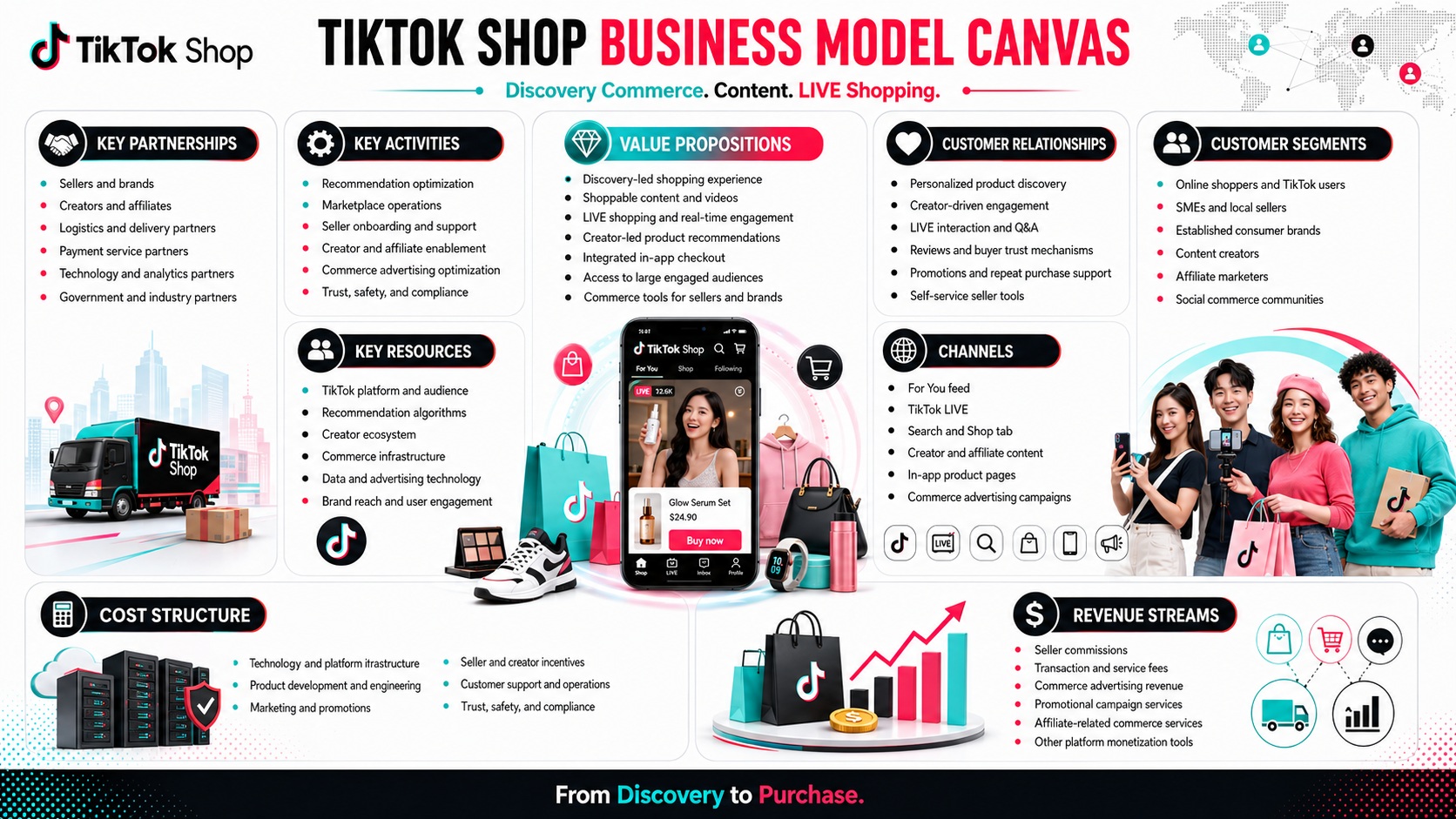
TikTok Shop BMC Diagram
A TikTok Shop BMC diagram should show all nine blocks while emphasising the interaction between content, discovery, creators, sellers, shoppers and transactions.
A simplified strategic flow is:
Creators and Sellers → Content and LIVE → Recommendation Engine → Product Discovery → Purchase → Platform Revenue → Ecosystem Investment
The cycle becomes stronger when successful transactions encourage sellers to provide more products and creators to produce more commerce-oriented content.
BMC Analysis of TikTok Shop
Detailed analysis reveals that TikTok Shop’s competitive position does not come from any single commerce feature.
The TikTok Shop Business Model Canvas works because several capabilities reinforce each other.
Recommendation technology generates discovery. Creator content produces product demonstrations and social proof. Marketplace infrastructure completes transactions, while affiliate economics turn creators into performance-based distribution partners.
Commercial advertising can further amplify successful products.
Yet the same integration creates operational complexity.
TikTok must prevent commercial content from damaging entertainment quality, manage seller standards, control fraudulent activity, maintain competitive fees, protect consumers and coordinate fulfilment without removing the spontaneity that differentiates the platform.
The following nine blocks explain how that system operates.
1. Customer Segments
TikTok Shop serves several interconnected customer segments rather than one conventional buyer group.
Consumers represent the demand side. Some arrive with explicit purchase intentions through search or Shop interfaces, while others discover products passively through entertainment content.
Sellers range from small merchants and local entrepreneurs to established consumer brands. Their objectives include customer acquisition, sales conversion, product launches and scalable digital distribution.
Creators occupy a particularly important position because they can simultaneously generate entertainment, product education and transactions.
Affiliates extend this role through performance-based promotion.
The TikTok Shop Business Model Canvas consequently depends on balancing commercial outcomes across every participant.
TikTok Shop Customer Segments
| Segment | Details | Why It Matters |
|---|---|---|
| Consumers | Users discovering and purchasing products | Generates marketplace demand |
| SMEs and local sellers | Businesses seeking accessible digital commerce | Expands assortment and seller participation |
| Established brands | Larger companies selling directly to consumers | Strengthens credibility and product range |
| Creators | Content producers demonstrating or recommending products | Converts attention into product discovery |
| Affiliates | Performance-based promoters earning from attributable sales | Creates scalable sales distribution |
Consumers are not merely final purchasers; their watching, searching, commenting and purchasing behaviour also improves demand signals throughout the platform.
Creators transform those signals into culturally relevant commercial content, while sellers provide the inventory required to monetise demand.
This structure can generate powerful cross-side network effects.
However, incentives can easily become misaligned. Buyers want trustworthy products and competitive prices. Sellers require profitable customer acquisition. Creators seek attractive commissions, while TikTok needs sustainable platform economics.
Long-term performance therefore depends on maintaining attractive economics across the ecosystem rather than maximising extraction from one segment. A fee increase, deterioration in content quality or decline in buyer trust can weaken several sides of the marketplace simultaneously.
2. Value Propositions
TikTok Shop provides different forms of value to each stakeholder group.
Consumers receive entertainment-led product discovery, product demonstrations, creator recommendations, LIVE interaction and convenient purchasing.
Sellers gain access to audiences that might not have actively searched for their products.
Creators receive opportunities to monetise influence through affiliate commerce and commercial collaborations. TikTok officially positions its affiliate system as a mechanism where sellers can connect with creators and creators can earn commissions when their content generates sales. (TikTok Shop)
The TikTok Shop Business Model Canvas becomes especially differentiated when these benefits occur within one customer journey.
TikTok Shop Value Propositions
| Value Proposition | Details | Why It Matters |
|---|---|---|
| Discovery commerce | Products appear during entertainment and browsing | Generates demand before explicit purchase intent |
| Shoppable content | Products can be connected directly to videos | Shortens the path from interest to purchase |
| LIVE shopping | Demonstrations, interaction and purchasing occur together | Adds immediacy and social proof |
| Creator-led selling | Sellers can distribute products through creators | Expands performance-based customer acquisition |
| Integrated commerce tools | Seller, affiliate, advertising and analytics capabilities operate around the marketplace | Reduces fragmentation across the sales funnel |
TikTok Shop’s strongest proposition is not simply convenience.
Traditional marketplaces already provide convenient search, checkout and fulfilment.
Its deeper differentiation lies in creating demand while simultaneously providing the infrastructure to capture that demand.
A creator can demonstrate an unfamiliar product, explain how it works, answer questions and provide a direct purchasing pathway. That capability can be particularly valuable for visually demonstrable categories such as beauty, fashion, home products, food, accessories and consumer gadgets.
The principal strategic tension involves commercial intensity.
If every video begins to resemble an advertisement, the entertainment proposition may weaken. Conversely, insufficient commercial visibility reduces seller economics.
Sustainable value therefore requires commerce to feel relevant to the surrounding content rather than merely inserted into it.
3. Channels
TikTok Shop relies primarily on channels contained within the wider TikTok ecosystem.
The For You feed is particularly powerful because products can reach users according to predicted interests rather than only through deliberate shopping searches.
LIVE provides another distinctive channel where sellers or creators can demonstrate products and interact with potential buyers in real time.
Search and dedicated shopping interfaces support consumers who have stronger purchase intent.
Creator profiles, affiliate content, advertising placements and notifications provide additional routes into the transaction journey.
TikTok Shop Channels
| Channel | Details | Why It Matters |
|---|---|---|
| For You feed | Algorithmically distributed short-form content | Creates scalable product discovery |
| TikTok LIVE | Interactive real-time product demonstrations | Combines education, urgency and conversion |
| Search and Shop interfaces | Intent-driven product exploration | Captures consumers already considering purchases |
| Creator and affiliate content | Product recommendations distributed through creators | Extends seller reach |
| Commerce advertising | Paid promotion and automated commerce campaigns | Allows sellers to accelerate demand |
TikTok Shop controls an unusually important part of its own demand-generation channel.
A seller does not necessarily need to purchase external traffic before reaching potential customers because organic recommendation, creator distribution, LIVE and paid advertising can operate inside the same platform.
That creates strategic efficiency.
Nevertheless, dependence on a single ecosystem also creates concentration risk for sellers.
Algorithmic changes can alter traffic rapidly. A merchant that becomes excessively dependent on TikTok Shop may therefore lose bargaining power and customer access if distribution economics change.
For TikTok, the challenge is different. Commercial channels must remain effective without overwhelming entertainment experiences.
Channel quality should consequently be evaluated using both conversion and long-term user engagement rather than short-term sales alone.
4. Customer Relationships
Customer relationships are largely digital, personalised, community-influenced and transaction-driven.
Algorithms personalise product discovery based on user behaviour and content interests.
Creators add a more human layer through demonstrations, reviews, comments and LIVE interaction.
Ratings, reviews, promotions and platform guarantees can reduce perceived transaction risk, while seller tools and analytics support commercial participants.
Consumer relationships may therefore exist simultaneously with the platform, individual sellers and creators.
TikTok Shop Customer Relationships
| Relationship Type | Details | Why It Matters |
|---|---|---|
| Algorithmic personalisation | Content and products are matched to predicted interests | Improves relevance and discovery |
| Creator relationships | Audiences interact with trusted or familiar creators | Adds influence and social proof |
| LIVE interaction | Buyers can ask questions during demonstrations | Reduces information gaps |
| Marketplace trust mechanisms | Reviews, policies and buyer-protection processes | Supports transaction confidence |
| Seller and creator enablement | Self-service tools, analytics, campaigns and support | Helps commercial participants grow |
Customer relationships are stronger when algorithmic relevance and human influence reinforce one another.
A recommendation engine may identify a potential interest, but an authentic creator demonstration can provide the confidence required to purchase.
LIVE strengthens this mechanism because consumers can observe products, ask questions and react alongside other viewers.
Scale introduces a corresponding challenge.
Marketplace disputes, counterfeit concerns, poor seller behaviour, misleading creator claims or fulfilment failures can quickly undermine confidence. Automated customer service may also struggle when cases become complicated.
Trust therefore becomes an economic asset rather than merely a compliance requirement.
TikTok Shop must continually improve seller quality, creator disclosure, customer support, fraud controls and dispute resolution. Strong relationships will depend on whether users believe recommendations are useful and purchases are dependable, not simply whether the platform can generate another viral shopping trend.
5. Revenue Streams
TikTok Shop can monetise commerce through several complementary mechanisms.
Transaction-related seller fees and commissions provide a direct connection between marketplace activity and revenue.
Advertising creates another important commercial engine because sellers and brands can pay to increase product visibility and optimise conversion.
Newer solutions further integrate advertising economics with commerce performance. TikTok stated in 2026 that expanded GMV Max capabilities were designed to consider elements such as affiliate costs, coupons and fees when helping advertisers optimise campaigns. (TikTok Newsroom)
Fee structures vary across countries, seller categories and programmes and can change over time.
The TikTok Shop Business Model Canvas therefore benefits from diversified monetisation tied to overall commerce activity rather than one fixed fee.
TikTok Shop Revenue Streams
| Revenue Stream | Details | Why It Matters |
|---|---|---|
| Seller commissions | Percentage-based charges on eligible transactions | Monetises marketplace GMV |
| Platform and transaction fees | Applicable marketplace service charges | Generates additional commerce revenue |
| Commerce advertising | Sellers and brands pay to increase reach and sales | Monetises competition for customer attention |
| Promotional services | Commercial programmes supporting marketplace visibility | Broadens seller monetisation |
| Ecosystem services | Additional commerce-related capabilities depending on market | Creates future revenue diversification |
Marketplace revenue has attractive scaling characteristics when higher transaction volumes can be processed without equivalent increases in physical retail infrastructure.
Advertising can further increase monetisation because the platform earns not only when commerce occurs but also when merchants compete for demand.
However, aggressive monetisation carries strategic risk.
Higher seller fees may increase TikTok’s revenue per transaction while simultaneously reducing merchant margins. Sellers can respond by increasing prices, reducing creator commissions or shifting inventory toward competing marketplaces.
TikTok must consequently optimise total ecosystem value rather than individual fee rates.
The stronger economic model is one where seller profitability improves alongside platform monetisation because expanding merchant success produces greater advertising demand, creator activity and future transaction volume.
6. Key Resources
TikTok Shop’s most valuable resources are technological, behavioural and ecosystem-based.
The TikTok audience provides the attention pool from which commerce demand can emerge.
Recommendation algorithms represent another critical resource because they determine which content and products users encounter.
Creators supply cultural relevance, demonstrations and influence.
Commerce infrastructure enables product listing, order management and transaction execution, while accumulated behavioural information improves personalisation and campaign optimisation.
TikTok Shop Key Resources
| Key Resource | Details | Why It Matters |
|---|---|---|
| TikTok audience | Large and highly engaged consumer base | Provides immediate potential commerce demand |
| Recommendation technology | Algorithms distribute relevant content and products | Powers discovery commerce |
| Creator ecosystem | Creators generate content, influence and product education | Differentiates the sales process |
| Commerce infrastructure | Seller, product, order and transaction systems | Converts discovery into purchases |
| Data and advertising technology | Behavioural signals, measurement and campaign optimisation | Improves matching and monetisation |
The strategic value of these resources comes from combination rather than ownership in isolation.
A recommendation algorithm without merchants cannot generate marketplace sales. Product inventory without engaging content resembles a conventional catalogue. Creators without transaction infrastructure must redirect users elsewhere to purchase.
Integration creates the advantage.
TikTok can potentially observe the journey from content exposure through engagement to transaction, generating signals that may improve future recommendations and advertising optimisation.
Such capabilities also increase responsibility.
Extensive personalisation creates privacy and regulatory requirements. Marketplace scale increases fraud exposure, while creator commerce introduces questions around disclosure and product claims.
TikTok must therefore treat governance, trust and security as resources that protect the economic value of its algorithms, audience and commerce infrastructure.
7. Key Activities
TikTok Shop must coordinate activities spanning both technology-platform operations and e-commerce marketplace management.
Recommendation remains fundamental because product discovery depends heavily on content distribution.
Marketplace operations include seller onboarding, catalogue management, transaction processing and commercial programme administration.
Creator and affiliate ecosystem management ensures sellers have access to content-based distribution.
Advertising development improves seller acquisition and conversion, while trust and safety activities protect customers from abuse.
TikTok Shop Key Activities
| Key Activity | Details | Why It Matters |
|---|---|---|
| Recommendation optimisation | Match users with relevant content and products | Drives discovery and engagement |
| Marketplace operations | Manage sellers, products, orders and transactions | Enables reliable commerce |
| Seller and creator enablement | Training, campaigns, analytics and affiliate infrastructure | Strengthens ecosystem supply |
| Advertising optimisation | Develop automated commerce and performance marketing tools | Improves seller growth and monetisation |
| Trust, safety and compliance | Address fraud, prohibited products and marketplace abuse | Protects platform credibility |
TikTok Shop effectively operates two businesses simultaneously.
The first is an attention platform that must keep users entertained.
The second is a marketplace that must deliver reliable commercial outcomes.
Those objectives occasionally conflict.
Content optimised aggressively for conversion can reduce entertainment quality, while entertainment that produces no measurable sales offers limited economic benefit to merchants.
Marketplace activities therefore require a broader optimisation objective than GMV alone.
TikTok should consider customer satisfaction, repeat purchases, seller profitability, creator economics, product quality, fulfilment performance and content engagement together.
Long-term success depends on creating sustainable commerce rather than merely producing temporary spikes in viral demand.
8. Key Partnerships
TikTok Shop depends on external partners across the commerce ecosystem.
Sellers and brands provide products and commercial inventory.
Creators and affiliates supply product-oriented content and distribution.
Logistics providers connect digital transactions to physical delivery, while payment participants support transaction completion.
Government agencies, trade organisations and ecosystem-development partners can also influence seller participation.
Malaysia provides a current example. TikTok Shop has worked with government bodies including the Ministry of Domestic Trade and Cost of Living and the Ministry of Entrepreneur and Cooperatives Development in programmes intended to support local merchants and consumers. (TikTok Newsroom)
The Company Key Partnerships
| Key Partner | Details | Why It Matters |
|---|---|---|
| Sellers and brands | Supply products and marketplace inventory | Creates commercial assortment |
| Creators and affiliates | Promote products through content and LIVE | Generates scalable discovery |
| Logistics providers | Support collection, shipping and delivery | Completes physical fulfilment |
| Payment ecosystem partners | Support transaction and settlement capabilities | Enables convenient purchasing |
| Government and industry partners | Participate in seller-development and ecosystem programmes | Strengthens market adoption and local participation |
Partnership quality directly influences customer experience.
TikTok may control the digital interface, but a consumer ultimately evaluates the complete transaction.
Poor packaging, slow delivery, low-quality merchandise or misleading creator claims can damage the platform even when TikTok did not directly manufacture or fulfil the product.
Partner governance is consequently crucial.
Sellers need appropriate incentives to maintain quality. Creators require transparent economics and product-selection standards. Logistics providers must meet service expectations, while payment arrangements must support reliable transactions.
The platform becomes more resilient when partners generate mutual value rather than becoming dependent on temporary subsidies or promotional campaigns.
TikTok should therefore assess partnerships according to sustainable contribution to customer trust and marketplace economics.
9. Cost Structure
Operating TikTok Shop requires expenditure across technology, commerce infrastructure, customer acquisition and ecosystem support.
Technology costs include recommendation systems, software engineering, computing infrastructure and data processing.
Marketplace operations require personnel, seller-support capabilities, trust and safety systems, customer service and compliance resources.
Promotions can represent another substantial economic investment.
Shipping rebates, buyer discounts, merchant subsidies, creator incentives and seller-development programmes may accelerate adoption but require careful assessment against lifetime economic returns.
TikTok Shop Cost Structure
| Cost Category | Details | Why It Matters |
|---|---|---|
| Technology and infrastructure | Algorithms, computing, software and platform operations | Supports large-scale discovery and transactions |
| Employees and operations | Engineering, commerce, sales and support teams | Maintains marketplace execution |
| Seller and creator incentives | Campaigns, training, subsidies and ecosystem programmes | Accelerates supply and participation |
| Marketing and promotions | Vouchers, discounts and demand-generation activities | Encourages transactions and repeat purchasing |
| Trust, safety and compliance | Fraud prevention, moderation, governance and regulatory operations | Protects marketplace integrity |
TikTok’s 2026 commitment of up to RM250 million in cumulative support for Malaysian sellers and creators illustrates how substantial ecosystem investment can become part of platform strategy. (TikTok Newsroom)
Such expenditure may be economically rational when it accelerates marketplace scale, improves merchant retention or establishes behavioural habits.
Permanent subsidy dependence would be less attractive.
A marketplace eventually needs transaction economics strong enough to sustain growth without requiring disproportionate incentives.
TikTok must therefore distinguish between investment that builds durable capabilities and spending that temporarily purchases GMV.
Better recommendation technology, seller tools, fraud prevention and creator infrastructure can create lasting productivity benefits. Excessive discounts may disappear as soon as subsidies are withdrawn.
Cost discipline should consequently focus on the quality and durability of growth rather than simply reducing expenditure.
How the Nine BMC Blocks Work Together
The TikTok Shop Business Model Canvas becomes most useful when all nine blocks are viewed as one connected commercial system.
Consumers provide demand.
Sellers and brands provide inventory, while creators transform products into content capable of generating discovery and trust.
Value propositions encourage each participant to remain active.
Consumers receive entertaining discovery and convenient purchasing. Sellers receive access to audiences. Creators gain monetisation opportunities.
Channels such as the For You feed, LIVE, search and Shop interfaces distribute those propositions.
Customer relationships deepen through personalisation, creator interaction, reviews and marketplace protections.
Revenue emerges as transactions, fees and commercial advertising expand.
Those revenues support key activities including recommendation development, marketplace operations, creator programmes and trust systems.
Core resources such as algorithms, audience scale and commerce infrastructure make those activities possible.
Partnerships complete fulfilment and expand ecosystem capacity, while the cost structure determines whether growth remains economically sustainable.
A healthy flywheel can therefore look like:
More engaging content → more discovery → more transactions → greater seller participation → more creator opportunities → more product content → better discovery.
Weakness in one component can break that cycle.
Poor products reduce trust. Weak creator economics reduce content supply. Excessive fees weaken sellers. Irrelevant commercial content damages engagement.
TikTok Shop consequently succeeds when the entire ecosystem expands together.
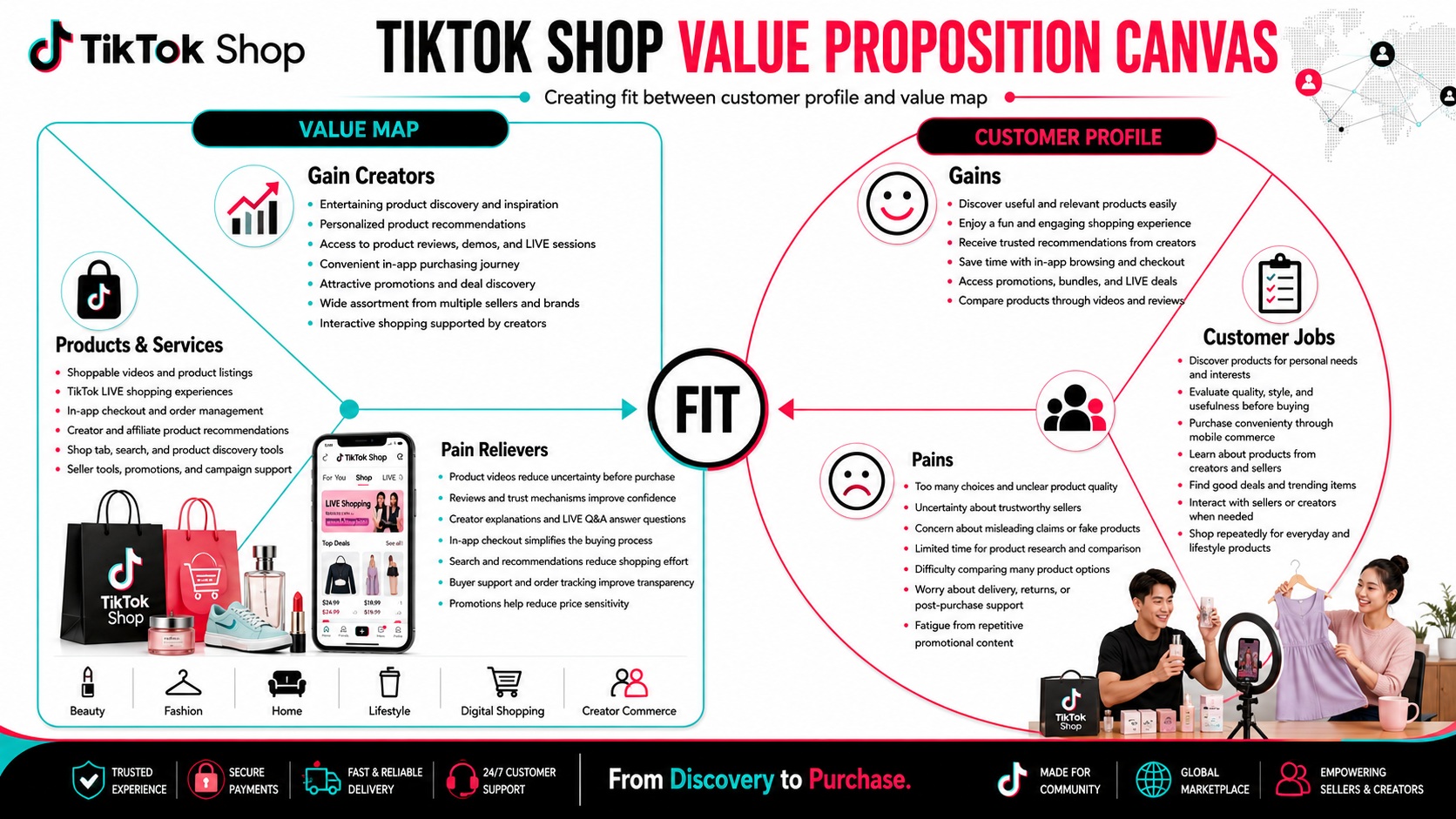
TikTok Shop Value Proposition Canvas
The Value Proposition Canvas provides a closer examination of customer jobs, pains and gains.
While BMC analyses the overall business system, VPC focuses on the fit between consumer requirements and the services designed to address them.
The TikTok Shop Business Model Canvas becomes easier to understand when the primary shopper proposition is separated from the wider multi-sided ecosystem.
Customer Profile
The customer profile below focuses primarily on consumers using TikTok Shop.
Their objectives extend beyond simply purchasing the cheapest available product.
Many users want inspiration, product information, authentic demonstrations, convenient comparison, entertainment and confidence that a purchase will meet expectations.
Customer Profile of TikTok Shop
| Customer Profile | Details |
|---|---|
| Customer Jobs | Discover products, evaluate options, learn how products work, compare value, purchase conveniently and find recommendations |
| Customer Pains | Misleading promotions, low-quality products, counterfeit concerns, unreliable sellers, information overload and fulfilment problems |
| Customer Gains | Entertaining discovery, useful demonstrations, attractive deals, trustworthy reviews, convenient checkout and interactive LIVE shopping |
TikTok Shop creates substantial customer value when discovery reduces the effort required to find relevant products.
Content can demonstrate characteristics that conventional marketplace listings may communicate poorly.
A short video showing how a kitchen product operates, for example, may answer questions more effectively than static photographs.
The risk emerges when entertainment and persuasion overpower reliable information.
Consumers need mechanisms to distinguish genuine recommendations from purely commission-driven promotion.
Value fit therefore depends heavily on trust.
Value Map
TikTok Shop responds to these consumer requirements through a combination of content, commerce and marketplace functions.
Value Map of TikTok Shop
| Value Map | Details |
|---|---|
| Products and Services | Shoppable videos, LIVE shopping, Shop interfaces, search, product listings, checkout, reviews and order-management functions |
| Pain Relievers | Ratings, marketplace policies, buyer-protection processes, seller controls, reporting mechanisms and transaction support |
| Gain Creators | Personalised discovery, creator demonstrations, interactive LIVE sessions, promotions and convenient in-platform purchasing |
The platform’s principal gain creator is its ability to make shopping more contextual.
Instead of examining products as isolated catalogue listings, users can observe them within demonstrations, tutorials, comparisons or entertainment.
LIVE adds additional context through real-time interaction.
Pain relief remains equally important.
Recommendation alone cannot compensate for unreliable sellers, poor product quality or problematic delivery.
TikTok must consequently improve both sides of the equation: better discovery and lower transaction risk.
How TikTok Shop Creates Fit
| Customer Profile | Details | Matching Value Map | How TikTok Shop Creates Fit |
|---|---|---|---|
| Customer Jobs | Discover and evaluate relevant products | Products and Services | Videos, LIVE, search and listings shorten discovery and evaluation |
| Customer Pains | Uncertainty about sellers, claims and product quality | Pain Relievers | Reviews, policies, reporting and platform controls reduce perceived risk |
| Customer Gains | Convenient, engaging and personalised shopping | Gain Creators | Algorithms, creators, promotions and integrated checkout combine entertainment with commerce |
Strong fit occurs when users discover products they genuinely value while remaining confident about the resulting transaction.
Weak fit appears when recommendation becomes repetitive, creator promotion feels inauthentic or purchased products fail to match expectations.
Sustainable discovery commerce therefore requires TikTok Shop to optimise for post-purchase satisfaction as carefully as pre-purchase conversion.
TikTok Shop vs Shopee vs Lazada Business Models
The TikTok Shop Business Model Canvas overlaps significantly with Shopee and Lazada because all three connect consumers with third-party merchants and compete for digital-commerce spending.
Their starting points, however, are different.
This company developed commerce around a content and entertainment platform.
Shopee and Lazada developed primarily as e-commerce marketplaces and subsequently expanded their content, affiliate, video and LIVE capabilities.
For example, Shopee operates Shopee Live, Shopee Video, affiliate programmes and paid advertising alongside its marketplace, illustrating how traditional marketplaces are also moving toward content commerce. (Shopee Help Center)
BMC Block Comparison
| Relevant BMC Block | TikTok Shop | Shopee | Lazada |
|---|---|---|---|
| Customer Segments | Shoppers, sellers, brands, creators and affiliates | Shoppers, sellers, brands and affiliates | Shoppers, merchants, brands and ecosystem partners |
| Value Proposition | Entertainment-led discovery connected directly to commerce | Large marketplace, search, promotions and increasingly content-led commerce | Marketplace breadth, brand commerce and integrated shopping infrastructure |
| Channels | For You feed, LIVE, search, Shop and creator content | Marketplace app, search, Shopee Live, Shopee Video and affiliates | Marketplace app, search, campaigns, seller stores and content features |
| Revenue Streams | Transaction fees, seller commissions, advertising and commerce services | Marketplace fees, advertising and seller services | Marketplace commissions, advertising and seller services |
| Key Resources | Recommendation engine, creator ecosystem, audience and commerce infrastructure | Marketplace scale, buyer-seller network, logistics ecosystem and commerce technology | Marketplace infrastructure, merchant network, Alibaba ecosystem capabilities and logistics relationships |
The most important strategic distinction concerns where discovery begins.
Shopee and Lazada remain strongly associated with deliberate shopping behaviour. Consumers commonly enter those platforms already intending to browse or buy.
TikTok Shop has a stronger opportunity to generate commerce before explicit purchase intention exists.
That advantage is meaningful because demand creation can be more valuable than simply competing for existing demand.
Nevertheless, Shopee and Lazada possess mature marketplace behaviour, strong shopping associations and extensive seller ecosystems.
Competition is therefore converging.
Traditional marketplaces are becoming more content-driven, while TikTok is becoming more marketplace-oriented.
Competitive Advantages
TikTok Shop possesses several competitive advantages that may be difficult for conventional e-commerce platforms to reproduce completely.
- Discovery before purchase intent: TikTok’s recommendation engine can introduce products while users are consuming entertainment, allowing sellers to reach consumers who may not yet be searching for a product.
- Integrated creator-commerce ecosystem: Creators can generate awareness, demonstrations, social proof and conversion within a single platform rather than functioning only as external advertising channels.
- Strength in LIVE commerce: Real-time product demonstration and interaction create a format particularly suited to persuasive, education-intensive and visually demonstrable product categories. TikTok’s 2026 Malaysia figures indicate the growing economic importance of this channel. (TikTok Newsroom)
- Compressed marketing funnel: Discovery, consideration, engagement, promotion and checkout can occur within one ecosystem, potentially reducing friction between marketing and transaction stages.
- Powerful behavioural feedback loop: Content engagement and commercial activity can provide signals for recommendation, advertising and seller optimisation, strengthening the platform as usage expands.
These advantages reinforce one another.
Creator content supplies engagement, recommendation technology provides distribution and integrated commerce converts attention into measurable sales.
The strategic moat becomes stronger when TikTok can improve every part of that loop simultaneously.
Risks and Challenges
Despite its growth potential, TikTok Shop faces significant strategic and operational risks.
- Trust and product-quality risk: Counterfeit goods, misleading claims, fraudulent sellers or inconsistent product quality can damage consumer confidence across the marketplace.
- Over-commercialisation of TikTok: Excessive shoppable content could weaken the entertainment experience that originally created the audience and reduce organic user engagement.
- Seller profitability pressure: Fees, advertising expenditure, discounts, affiliate commissions and fulfilment expenses can compress merchant margins even when gross sales appear attractive.
- Regulatory and platform-governance exposure: E-commerce regulation, consumer protection, privacy, content governance, product safety and wider scrutiny of TikTok can create restrictions or additional operating costs.
- Intense marketplace competition: Shopee, Lazada and other platforms can respond through discounts, logistics investment, creator programmes, video commerce and LIVE shopping, reducing differentiation.
The greatest risk is a deterioration of ecosystem economics rather than one isolated operational problem.
If sellers become less profitable, they may reduce creator commissions and advertising. Creators would then have weaker incentives to promote products, causing commerce content to decline.
Poorer content could reduce discovery, while weaker consumer trust could lower conversion.
Several BMC blocks would consequently weaken together.
TikTok must therefore evaluate growth through ecosystem health rather than GMV alone.
Strategic Recommendations
TikTok Shop should continue expanding discovery commerce while protecting the entertainment ecosystem and ensuring that growth creates sustainable economic value for consumers, sellers and creators.
Strategic priorities should strengthen structural advantages rather than depend excessively on subsidies, temporary promotions or viral product cycles.
1. Make Trust a Core Commerce Differentiator
TikTok Shop should treat trust as part of its value proposition rather than only a marketplace-control function.
Stronger seller verification, product authenticity controls, transparent reviews, rapid dispute resolution and better identification of misleading creator claims can reduce consumer uncertainty.
Reliable transactions increase the probability that first-time social-commerce buyers become repeat customers.
2. Optimise for Seller Profitability, Not GMV Alone
Gross merchandise value can increase even when merchants generate weak margins.
TikTok should provide sellers with clearer profitability analytics incorporating advertising costs, platform fees, affiliate commissions, discounts, returns and fulfilment expenses.
The direction of GMV Max in 2026, including consideration of additional seller costs, represents an important step toward stronger economic optimisation. (TikTok Newsroom)
3. Protect the Entertainment-to-Commerce Balance
TikTok Shop should avoid allowing commercial content to overwhelm the wider TikTok experience.
Recommendation systems could manage commercial frequency according to user interest and engagement rather than maximising immediate conversion.
A user who continues enjoying TikTok provides more lifetime commerce opportunity than someone who disengages because every feed experience feels transactional.
4. Strengthen Creator Quality and Commercial Credibility
Creator commerce should move beyond maximum affiliate volume.
TikTok could reward creators based partly on customer satisfaction, return rates, product quality and repeat purchases rather than attributable sales alone.
Such incentives would encourage creators to recommend products that genuinely fit their audiences.
5. Convert Viral Purchases Into Repeat Shopping Behaviour
Viral demand can produce spectacular short-term sales without creating customer loyalty.
TikTok Shop should strengthen personalised repurchase suggestions, store following, wish lists, reorder functionality and post-purchase recommendations.
The strategic objective should be progression from occasional discovery purchases toward habitual marketplace usage.
6. Build Stronger Search and High-Intent Commerce
Discovery should remain TikTok Shop’s differentiation, but stronger search capability can capture consumers after purchase intent has formed.
Better product taxonomy, comparison tools, review quality and query relevance could help TikTok compete across more stages of the customer journey.
Combining entertainment-led discovery with high-intent search would create a broader commerce proposition.
7. Reduce Dependence on Subsidised Growth
Promotions, shipping support and merchant incentives can accelerate marketplace adoption, particularly during expansion.
Long-term economics nevertheless require organic demand and merchant productivity.
TikTok should progressively measure how much sales activity persists after incentives decline.
Investment should increasingly favour infrastructure, seller capabilities, recommendation accuracy, creator productivity and trust mechanisms that provide durable returns.
Conclusion
TikTok Shop represents a significant evolution in digital commerce because it changes where the customer journey begins.
Traditional marketplaces largely capture existing shopping intention.
TikTok can manufacture that intention through entertainment, creators, recommendation algorithms and LIVE interaction before converting interest into an integrated transaction.
The resulting business model connects shoppers, sellers, brands, creators, affiliates, advertisers and logistics participants in a complex multi-sided ecosystem.
Its strongest economic mechanism is straightforward.
Creators and sellers produce content. Algorithms distribute relevant material. Consumers discover products. Marketplace infrastructure enables transactions. Commercial activity generates revenue, and that revenue supports further investment in technology and ecosystem development.
The TikTok Shop Business Model Canvas shows why this combination can create substantial competitive advantage.
Yet future success depends on more than increasing transaction volume.
TikTok must maintain entertainment quality while commercial activity expands. Consumer confidence must improve as marketplace scale grows. Sellers need sustainable margins, while creators require incentives that reward credible recommendations rather than indiscriminate promotion.
Shopee, Lazada and other marketplaces are simultaneously developing stronger content-commerce capabilities, making continued innovation necessary.
If TikTok Shop can combine superior discovery with trusted transactions, sustainable seller economics, authentic creator participation and increasingly effective search, it could occupy a distinctive position between social entertainment and conventional e-commerce.
That position represents its greatest strategic opportunity.
Disclaimer
This article is provided solely for educational, informational and business-analysis purposes.
The content is based on publicly available company information, platform materials, industry observations and independent strategic interpretation available at the time of writing. It is not official information, communication, endorsement or representation from TikTok, TikTok Shop, ByteDance, Shopee, Sea Limited, Lazada, Alibaba Group or any other company mentioned.
Nothing contained in this article constitutes financial, investment, legal, regulatory, tax, technology, e-commerce or professional advice. This article should not be interpreted as investment advice or as a recommendation to purchase, sell or hold any security, investment or financial instrument.
Business models, platform features, fees, regulations, products, financial performance and market conditions may change over time. Readers should conduct independent research and obtain appropriate professional advice before making business, strategic or investment decisions.
All trademarks, logos, copyrights, company names, product names and other intellectual-property rights mentioned or illustrated belong to their respective owners. Any use of such names, trademarks, logos or copyrighted materials is solely for identification, reference, educational and analytical purposes and does not imply affiliation or endorsement.
Meta Description
Explore the TikTok Shop Business Model Canvas, including all nine BMC blocks, Value Proposition Canvas, Shopee and Lazada comparison, competitive advantages, risks and strategic recommendations updated for 2026.

