



Share This Article


How 99 Speedmart builds value, convenience, and high-frequency retail demand in Malaysia
BMC Article No: BMC #023
This article was updated in 2026 to make the analysis more comprehensive. The revised version includes a broader Business Model Canvas breakdown, a Value Proposition Canvas section, recent developments around 99 Speedmart, deeper strategic analysis, and more detailed recommendations.
Introduction
99 Speedmart is one of Malaysia’s most recognisable mini-market chains. Its stores are located close to residential areas, shop lots, neighbourhood roads, and local communities. This makes the brand part of everyday shopping rather than occasional retail visits.
The company’s model is stronger than a basic convenience-store format. It combines affordable pricing, compact store formats, high outlet density, fast-moving consumer goods, private-label items, bulk sales, bill-payment services, and a disciplined supply chain. Its official website describes 99 Speedmart as an established Malaysian minimarket chain committed to convenience and value, with services such as 99 Bulksales and Speedpoint.
This Speedmart Business Model Canvas matters because Malaysia’s retail market is changing. Customers want low prices, nearby access, product availability, fast checkout, and practical services in one place. 99 Speedmart stays relevant because it turns these needs into a simple, repeatable, and scalable retail system.
In this article, we will break down how 99 Speedmart creates value, reaches customers, earns revenue, manages costs, and protects its position in Malaysia’s neighbourhood retail market.
What Is 99 Speedmart’s Business Model?
99 Speedmart’s business model is built around neighbourhood mini-market retail. The company sells daily essentials such as packaged food, beverages, household goods, personal care products, snacks, basic groceries, and selected private-label products through a large store network.
The model also extends beyond ordinary product sales. Speedpoint services, bulk sales, payment-related transactions, and supplier-supported promotions add more reasons for customers to visit. These services increase transaction frequency and make the store more useful in daily life.
A major strength of the model is volume. 99 Speedmart does not depend on high-ticket purchases. It wins through many small transactions from customers who shop frequently because the stores are nearby, affordable, and easy to use.
However, the model also requires strong execution. Low-price retail creates margin pressure. Store expansion increases operating complexity. Competition from supermarkets, convenience stores, online grocery platforms, and traditional shops continues to pressure pricing and availability. The Speedmart Business Model Canvas shows how 99 Speedmart uses scale, simplicity, and cost discipline to compete in this environment.
What Is Business Model Canvas?
Business Model Canvas, or BMC, is a practical tool used to explain how a company works. It helps readers understand how a business creates value, delivers that value to customers, and captures revenue from the market.
Instead of looking only at products, BMC looks at the full operating system behind the business. It connects customers, value propositions, channels, relationships, revenue, resources, activities, partners, and costs in one view.
This makes BMC useful for analysing 99 Speedmart because the company is not only selling groceries or household goods. Its performance depends on outlet density, low-cost operations, supplier relationships, inventory control, store productivity, and high-frequency customer visits.
The Speedmart Business Model Canvas helps explain how these elements work together.
| BMC Block | Main Question |
|---|---|
| Customer Segments | Who does the business serve? |
| Value Propositions | What value does the business offer? |
| Channels | How does the business reach customers? |
| Customer Relationships | How does the business keep customers coming back? |
| Revenue Streams | How does the business make money? |
| Key Resources | What assets does the business need? |
| Key Activities | What must the business do well? |
| Key Partnerships | Who helps the business operate? |
| Cost Structure | What are the major costs? |
Quick Overview of 99 Speedmart
99 Speedmart started from a small sundry store founded by Lee Thiam Wah in 1987 in Klang, Selangor. The company has since become a listed retail group. Reuters reported that 99 Speed Mart Retail Holdings raised RM2.36 billion in its 2024 listing, making it Malaysia’s largest IPO in seven years at that time.
Its expansion has continued after listing. The Star reported that 99 Speedmart reached 3,037 outlets as of 31 December 2025, after opening 259 new outlets during FY2025. It also reported FY2025 revenue of RM11.4 billion and net profit of RM614.2 million.
This scale matters because the business is not built around destination shopping. It is built around proximity. Customers visit because the store is close, the prices are attractive, and the product range is practical for everyday needs.
Why 99 Speedmart Is Strategically Interesting
99 Speedmart is strategically interesting because it turns basic daily shopping into a scalable retail engine. Many retailers can sell snacks, drinks, groceries, and household goods. 99 Speedmart competes by combining low prices, convenient locations, simple store formats, and efficient replenishment.
The store format is central to the model. It is usually compact, practical, and located near daily demand. This allows customers to shop quickly without visiting larger supermarkets or travelling far from home.
Another important factor is cost discipline. Low-price retail only works when the company controls procurement, logistics, labour, rent, inventory, and store operations tightly. From a strategy perspective, the Speedmart Business Model Canvas shows how operational simplicity can become a competitive advantage.
Its growth also shows the power of neighbourhood economics. Each outlet may serve a relatively local customer base, but thousands of outlets create strong national reach. When customers repeatedly buy essentials in small baskets, the business can generate large revenue through frequency and scale.
Latest Developments: What Is Changing Around 99 Speedmart?
99 Speedmart’s business model is changing in several important ways.
First, the company has moved from private retail operator to public listed company. Its 2024 IPO gave the business more visibility, stronger capital market access, and additional resources for expansion.
Second, the company continues expanding its outlet network. The Star reported that 99 Speedmart exceeded its FY2025 annual target of 250 new outlets by opening 259 outlets, bringing the total to 3,037 outlets as of 31 December 2025.
Third, customer traction remains strong. The Star also reported that total sales transactions grew 17.4% to 141.7 million in the fourth quarter of FY2025, while average basket size increased to RM21.70 from RM21.40 in 4Q2024.
Fourth, the business is expanding beyond simple store retail through services such as 99 Bulksales and Speedpoint. The official website lists 99 Bulksales, Speedpoint services, and store operations as key product and service areas.
These developments make the Speedmart Business Model Canvas more important. The company’s core strength remains physical retail, but future growth will depend on better outlet productivity, stronger supply chain execution, disciplined cost control, and sharper use of customer and store-level data.
Speedmart Business Model Canvas Summary
Before going into each block in detail, the table below shows how the business works as one connected system.
| BMC Block | 99 Speedmart Application |
|---|---|
| Customer Segments | Mass-market households, price-conscious families, workers, students, small traders, and local communities needing affordable daily essentials. |
| Value Propositions | Low prices, nearby access, practical product range, fast shopping, essential services, and neighbourhood convenience. |
| Channels | Physical stores, local promotions, official website, 99 Bulksales, Speedpoint services, supplier promotions, and neighbourhood visibility. |
| Customer Relationships | Habit-based repeat purchases, affordable pricing, store familiarity, practical service utility, and local community relevance. |
| Revenue Streams | Retail product sales, private-label products, bulk sales, service transactions, supplier promotions, and commercial income. |
| Key Resources | Store network, brand recognition, supplier base, logistics infrastructure, distribution centres, operating systems, and trained workforce. |
| Key Activities | Procurement, merchandising, inventory control, replenishment, store operations, pricing, promotions, and expansion management. |
| Key Partnerships | Suppliers, manufacturers, landlords, logistics providers, payment partners, service partners, technology vendors, and local authorities. |
| Cost Structure | Store operations, rent, labour, logistics, inventory, technology, marketing, utilities, and expansion costs. |
The Speedmart Business Model Canvas shows a business that depends less on premium differentiation and more on disciplined execution across many small daily transactions.
Speedmart Business Model Canvas:
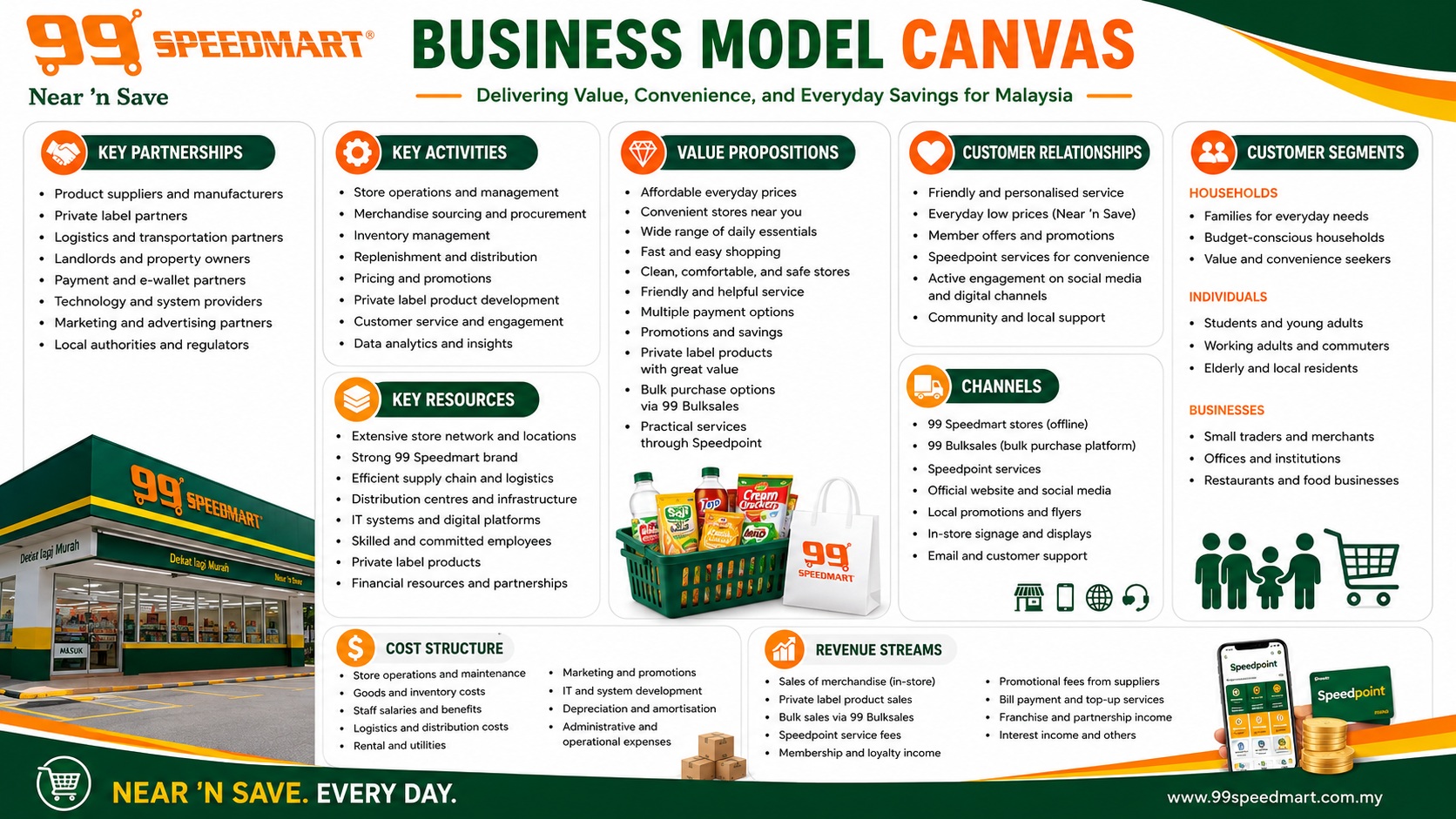
1. Customer Segments
Customer segments explain who the business serves. 99 Speedmart mainly targets mass-market customers who want affordable daily essentials near their homes or workplaces. This includes households, working adults, students, small communities, and price-sensitive shoppers.
The customer base is broad, but the shared need is clear. People want to buy essential products quickly without travelling far or paying supermarket-level basket costs. This is why 99 Speedmart’s neighbourhood positioning is so powerful.
| Customer Segment | Main Need | How 99 Speedmart Serves Them |
|---|---|---|
| Households | Affordable daily essentials | Nearby stores with practical product ranges |
| Price-conscious families | Better control over daily spending | Low-price positioning and frequent promotions |
| Workers and commuters | Fast shopping before or after work | Compact stores in accessible local areas |
| Students and young adults | Snacks, drinks, basic goods, and small purchases | Affordable impulse products and easy access |
| Small traders and bulk buyers | Lower-cost product sourcing | 99 Bulksales and selected high-volume purchases |
| Local communities | Convenient neighbourhood retail | Stores located close to residential demand |
The Speedmart Business Model Canvas is strong here because the company serves frequent, practical demand. Customers may not visit for luxury or lifestyle reasons. They visit because they need affordable goods quickly.
This gives 99 Speedmart a resilient customer base. Even when consumers reduce discretionary spending, they still need food, drinks, household products, and personal care items. That makes the business more defensive than retailers that depend heavily on seasonal or premium purchases.
2. Value Propositions
The value proposition explains why customers choose 99 Speedmart instead of a supermarket, convenience store, traditional sundry shop, or online grocery platform.
The answer is not only low prices. It is low prices combined with nearby access, product availability, and store simplicity.
99 Speedmart offers daily essentials at competitive prices in locations that are easy for local customers to reach. The store format is practical. Customers can enter, find what they need, pay, and leave quickly. This reduces the time and effort involved in routine shopping.
The company also creates value through familiarity. Customers know what kind of products to expect, how the store is arranged, and why the brand exists. Its “Near n’ Save” positioning reinforces the idea of neighbourhood access and everyday savings. The official website also describes the company as committed to convenience and value for the communities it serves.
| Value Proposition | Customer Benefit | Business Impact |
|---|---|---|
| Affordable everyday pricing | Helps customers manage household budgets | Drives traffic and repeat purchases |
| Nearby store locations | Reduces travel time and shopping effort | Strengthens neighbourhood relevance |
| Practical product range | Covers essential daily needs | Increases basket frequency |
| Fast and simple shopping | Saves time for busy customers | Supports high transaction volume |
| Bulk sales options | Supports larger purchases and small traders | Adds another revenue opportunity |
| Speedpoint services | Allows customers to complete practical transactions | Adds utility beyond product sales |
The Speedmart Business Model Canvas works because the company solves ordinary problems repeatedly. Customers do not need to think deeply before visiting. They know the store is nearby, the prices are competitive, and the products are useful.
This kind of value proposition may look simple, but it is strategically powerful. In neighbourhood retail, the winning formula is often not luxury or novelty. It is availability, price, access, and consistency.
3. Channels
Channels describe how the business reaches customers and delivers value. For 99 Speedmart, the physical store network is the most important channel. The stores create visibility, convenience, and habit.
Local presence is also a channel. A 99 Speedmart outlet near a residential area can attract regular customers without requiring heavy advertising. The store signboard, location, and daily traffic become part of the marketing system.
The company also uses its official website, 99 Bulksales, Speedpoint services, supplier promotions, and local campaigns to support customer engagement. The official website states that it is not an e-commerce website, but it does include information on bulk purchases, bill payments, and store-related services.
99 Speedmart Channels:
| Channel | Examples | Strategic Role |
|---|---|---|
| Physical stores | Neighbourhood mini-markets across Malaysia | Core sales and customer access channel |
| Local visibility | Signboards, storefronts, and high-traffic areas | Builds daily brand awareness |
| In-store promotions | Price offers, bundle deals, and supplier campaigns | Converts foot traffic into sales |
| 99 Bulksales | Bulk purchase platform or service | Supports larger baskets and small business demand |
| Speedpoint services | Payment and service transactions | Adds reasons to visit stores |
| Official website | Store information, corporate information, and service details | Supports brand credibility and customer information |
The channel mix works because it starts with physical proximity. 99 Speedmart does not need to depend only on mass media or digital advertising to create demand. Each outlet acts as a direct channel to the neighbourhood.
This gives the company a strong local advantage. When a store is close to daily routines, customers can visit frequently for small but repeated purchases. That is the channel logic behind the Speedmart Business Model Canvas.
4. Customer Relationships
Customer relationships in 99 Speedmart are built through routine, price trust, and convenience. The relationship is not highly emotional. It is practical and repeated.
Customers return because they believe the store will help them save money, find basic goods, and shop quickly. Over time, that repeated experience becomes a habit. In retail, habit can be more valuable than occasional brand excitement.
99 Speedmart also builds relationships through consistent store format, affordable pricing, local availability, and practical services. When customers can buy essentials, make small transactions, or purchase bulk items through the same brand, the store becomes part of their daily or weekly routine.
99 Speedmart Customer Relationships:
| Relationship Driver | How It Works | Example |
|---|---|---|
| Price trust | Customers associate the brand with savings | A family returns for lower-priced household items |
| Shopping habit | Nearby stores encourage frequent visits | A customer stops by several times a week |
| Store familiarity | Similar format reduces shopping effort | Customers know where to find common items |
| Practical utility | Services add reasons to visit | A customer pays a bill and buys groceries together |
| Local relevance | Stores serve neighbourhood needs | Residents use the outlet as a regular daily shop |
| Promotion engagement | Deals encourage repeat visits | Customers return for weekly offers or bulk savings |
The Speedmart Business Model Canvas benefits from this relationship model because it supports transaction frequency. 99 Speedmart does not need every customer to buy a large basket each time. It needs many customers to return often.
That is why consistency matters. If pricing, stock availability, service speed, or store cleanliness weakens, the relationship can decline. In this model, customer loyalty is earned through reliable usefulness.
5. Revenue Streams
Revenue streams show how the company makes money. The main revenue stream comes from retail sales of fast-moving consumer goods. These include food, drinks, snacks, household items, personal care products, basic groceries, and other daily essentials.
The company also benefits from private-label products, bulk sales, promotional income, and service-related transactions. Private-label products can improve margins because the retailer has more control over sourcing, pricing, and positioning.
Supplier promotions can also create value. In a high-traffic retail network, suppliers may pay for visibility, campaigns, shelf placement, or promotional support. This helps the retailer monetise its store traffic beyond direct product margins.
99 Speedmart Revenue Streams:
| Revenue Stream | Description | Why It Matters |
|---|---|---|
| Retail product sales | Sales of daily essentials, packaged goods, household products, and personal care items | Forms the main revenue base |
| Private-label products | Products sold under retailer-controlled brands | Supports margin improvement and differentiation |
| Bulk sales | Larger-volume purchases through 99 Bulksales | Captures higher basket demand |
| Service transactions | Speedpoint and payment-related services | Adds utility and potential fee income |
| Supplier promotions | Campaigns, product visibility, and trade marketing arrangements | Monetises store traffic and shelf space |
| New outlet sales | Revenue from continued store expansion | Supports growth through broader market coverage |
This revenue model is attractive because it combines frequency, volume, and scale. The company earns from many small transactions rather than a few large purchases.
The Star reported that 99 Speedmart’s FY2025 revenue grew 14.5% to RM11.4 billion from RM9.98 billion in FY2024. This shows how outlet expansion, transaction growth, and basket size can combine to strengthen the revenue engine.
The Speedmart Business Model Canvas is effective because revenue is supported by everyday demand. Customers buy products they need repeatedly, not items they purchase only once or twice a year.
6. Key Resources
Key resources are the assets that make the model work. For 99 Speedmart, the most important resource is its store network. A large number of outlets gives the company reach, visibility, and customer convenience.
Its second major resource is logistics infrastructure. A mini-market model depends on fast replenishment and reliable stock availability. If products are missing from shelves, customers may switch to another nearby retailer.
Supplier relationships are also critical. 99 Speedmart needs competitive procurement terms to support its low-price positioning. Strong supplier access helps the company offer broad product variety while protecting margins.
Brand recognition is another important resource. Customers understand the brand promise. They associate 99 Speedmart with affordable prices and neighbourhood convenience. That reduces customer acquisition friction.
99 Speedmart Key Resources:
| Key Resource | Role in the Business Model | Strategic Value |
|---|---|---|
| Store network | Provides neighbourhood access and customer reach | Creates convenience and market coverage |
| Brand recognition | Builds customer familiarity and trust | Encourages repeat visits |
| Supplier relationships | Secures products at competitive cost | Supports low-price positioning |
| Logistics infrastructure | Moves stock efficiently to stores | Protects availability and scale |
| Distribution centres | Support replenishment across regions | Improve operating control |
| Workforce | Runs stores, warehouses, and operations | Enables daily execution |
| Operating systems | Support inventory, pricing, and store control | Improves efficiency and consistency |
The Speedmart Business Model Canvas depends on how these resources work together. A large store network alone is not enough. It must be supported by strong procurement, logistics, inventory systems, and store discipline.
This is where the model becomes harder to copy. Competitors can open stores, but replicating the full system across thousands of outlets requires capital, process maturity, supplier trust, and operational depth.
7. Key Activities
Key activities are the actions the company must perform well every day. For 99 Speedmart, procurement and inventory control are central. The company must buy products at competitive cost and ensure the right stock reaches the right outlet.
Store operations are equally important. Each outlet must manage shelves, checkout, cleanliness, staff, promotions, and customer service. Since the business operates at scale, small execution gaps can become large problems if repeated across many stores.
Merchandising and pricing are also critical. 99 Speedmart must decide which products to carry, how to price them, where to place them, and how to run promotions that attract shoppers without damaging margins.
99 Speedmart Key Activities:
| Key Activity | What It Involves | Why It Matters |
|---|---|---|
| Procurement | Buying goods from suppliers at competitive terms | Supports low-price positioning |
| Inventory management | Monitoring demand and stock levels | Prevents stockouts and excess inventory |
| Replenishment | Moving products from warehouses to stores | Protects availability |
| Store operations | Running outlets, checkout, displays, and staff | Keeps customer experience consistent |
| Pricing and promotion | Managing discounts, offers, and supplier campaigns | Drives traffic and basket size |
| Outlet expansion | Opening new stores in suitable locations | Supports growth and market coverage |
| Service operations | Supporting Speedpoint and other practical transactions | Adds customer utility |
Strong execution in these activities turns the model from a simple retail concept into a scalable business system. Without procurement discipline, low prices may damage margins. Then, without replenishment discipline, stores may lose customer trust. Without store discipline, convenience becomes inconsistent.
That is why the Speedmart Business Model Canvas is built on execution. Strategy matters, but daily operational control is what protects the model.
8. Key Partnerships
Key partnerships allow 99 Speedmart to operate efficiently and scale faster. Suppliers are the most important partners because the company depends on a broad product range and competitive pricing.
Manufacturers also play a major role in private-label products, promotional campaigns, and category development. Strong relationships with manufacturers can help 99 Speedmart secure better product terms and improve margin quality.
Landlords and property owners are also strategic partners. Store location affects traffic, visibility, rent, and outlet profitability. In neighbourhood retail, the right location can determine whether an outlet becomes a daily habit or an underperforming store.
Payment and service partners support Speedpoint-related transactions. Logistics partners, technology vendors, and local authorities also help the business operate smoothly at scale.
99 Speedmart Key Partnerships:
| Partner Type | Examples | Contribution to the Business Model |
|---|---|---|
| Product suppliers | FMCG companies, household product suppliers, beverage brands | Maintain assortment and product availability |
| Manufacturers | Local and regional product manufacturers | Support private-label and cost-efficient sourcing |
| Landlords | Shop lot owners and property partners | Provide strategic store locations |
| Logistics partners | Transport and warehousing service providers | Support distribution and replenishment |
| Payment partners | Banks, payment processors, service providers | Enable Speedpoint and transaction services |
| Technology vendors | POS, inventory, reporting, and operational systems | Support scale and efficiency |
| Local authorities | Licensing and compliance stakeholders | Support store operations and expansion |
This partnership structure matters because 99 Speedmart’s advantage is not created alone. It depends on a network of partners that help the company maintain product availability, low prices, location access, and operational continuity.
The Speedmart Business Model Canvas becomes stronger when partnerships improve customer value and store economics at the same time.
9. Cost Structure
Cost structure shows the major expenses required to run the business. For 99 Speedmart, store operating costs are significant. These include rent, staff salaries, utilities, maintenance, store equipment, and outlet setup.
Inventory is another major cost area. The company must purchase and hold large volumes of stock across many categories. Good inventory control is essential because too much stock increases working capital pressure, while too little stock causes lost sales.
Logistics and distribution costs are also central. A wide store network requires warehouses, trucks, fuel, delivery planning, and replenishment systems. These costs are necessary to keep shelves stocked.
Technology, marketing, promotion, compliance, and expansion costs also matter. As the company grows, cost discipline becomes more important because small cost increases can multiply across thousands of outlets.
99 Speedmart Cost Structure:
| Cost Area | Examples | Business Impact |
|---|---|---|
| Store operations | Rent, utilities, maintenance, equipment, and store fit-out | Major cost across the network |
| Labour | Store staff, warehouse workers, supervisors, and support teams | Required for daily execution |
| Inventory | Product purchasing and stock holding | Affects cash flow and margins |
| Logistics | Warehousing, transport, fuel, distribution, and replenishment | Protects availability and scale |
| Technology | POS systems, inventory tools, reporting, and operational platforms | Supports control and efficiency |
| Promotions | Discounts, campaigns, displays, and supplier-linked offers | Drives traffic but affects margins |
| Expansion | New outlet setup, renovation, licensing, and opening costs | Supports growth but requires capital |
The challenge is to keep costs low without weakening customer value. If the company cuts too much, stock availability, service quality, or store standards may suffer. If it spends too freely, the low-price model may lose margin strength.
Long-term success depends on balancing affordability, availability, and operating efficiency.
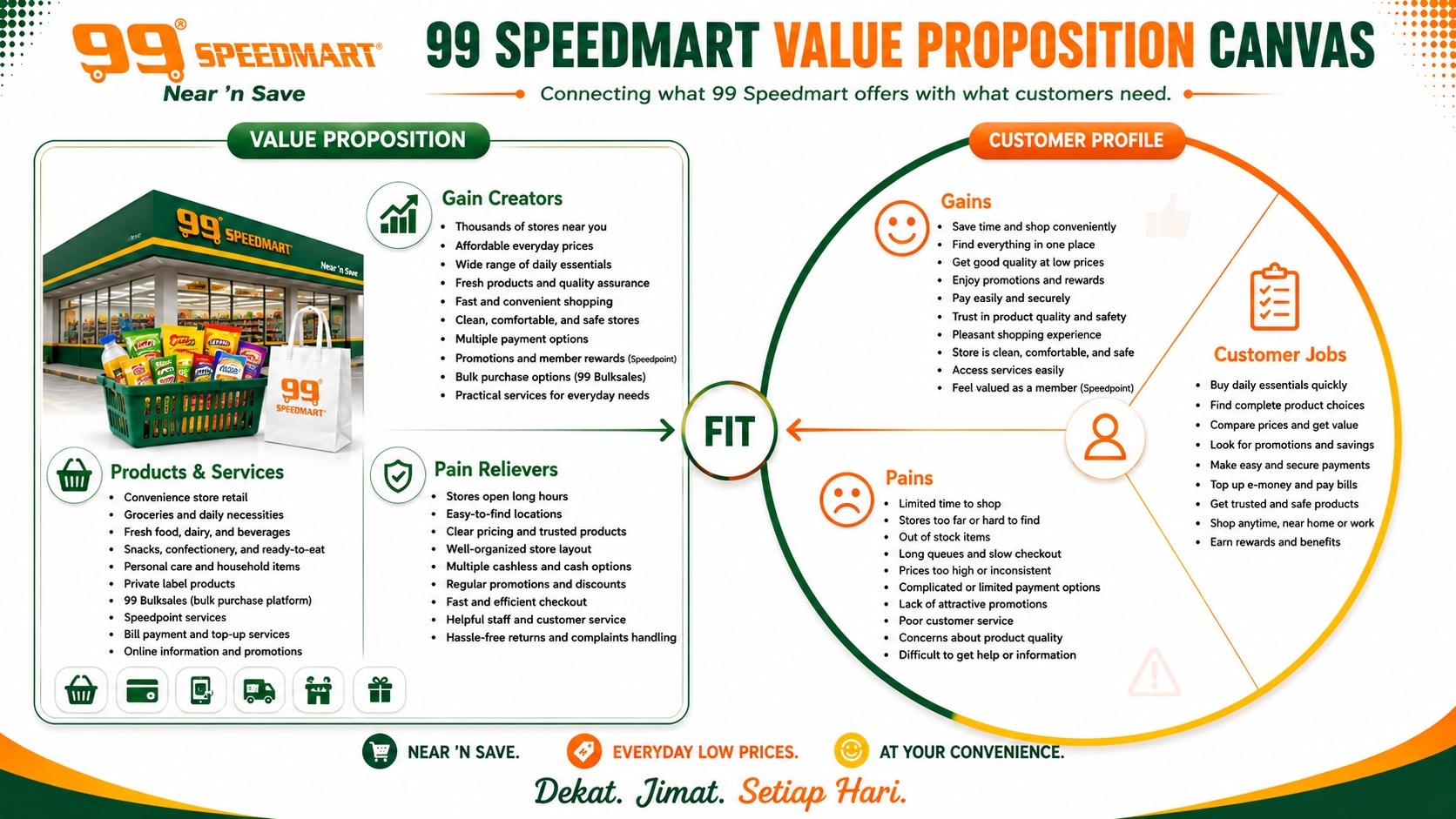
Value Proposition Canvas of 99 Speedmart
The Value Proposition Canvas adds another layer to the Speedmart Business Model Canvas by showing how the company’s offer connects with what customers actually need.
While BMC explains the full business model, VPC focuses on customer jobs, pains, gains, and how the company’s products and services respond to them.
For 99 Speedmart, this section matters because the company does not compete through luxury, deep product storytelling, or lifestyle branding. It competes by reducing friction in daily shopping.
Customers want affordable essentials, nearby access, quick shopping, reliable stock, and practical services. 99 Speedmart creates value by making these needs easier to fulfil.
Customer Profile
The customer profile explains what 99 Speedmart customers are trying to get done, what frustrations they want to avoid, and what benefits they hope to gain.
Many customers want to buy food, drinks, household goods, personal care items, snacks, and basic groceries near home. Some want to save money. Others want to avoid long queues, traffic, large supermarkets, or unnecessary travel.
Small traders or larger households may also value bulk buying. Customers who use Speedpoint services want to complete practical transactions in one familiar place.
Customer Profile Analysis
| Customer Profile Analysis | Details |
|---|---|
| Customer Jobs | Customers want to buy daily essentials quickly, save money on household purchases, find nearby products, complete small errands, and sometimes buy in larger quantities. |
| Pains | Customers face rising living costs, limited time, traffic, inconvenient supermarket trips, uncertain prices, stock shortages, and the hassle of visiting multiple stores. |
| Gains | Customers want affordable prices, nearby access, fast checkout, reliable availability, useful promotions, simple store navigation, and practical services in one place. |
Value Map
The value map explains how 99 Speedmart responds to the customer profile. It shows what the company offers, how those offers reduce customer pain, and how they create additional benefits.
The company’s products and services include daily essentials, packaged food, drinks, household items, personal care products, private-label products, bulk sales, Speedpoint services, and local promotions.
These offerings reduce customer pain by making daily shopping cheaper, faster, and more accessible. Customers do not need to travel far for basic goods. They can buy small baskets frequently or purchase selected items in larger quantities when needed.
99 Speedmart also creates gains through price confidence, convenience, and store familiarity. The customer knows what the brand stands for. That makes repeat visits easier.
Value Map Analysis
| Value Map Element | Analysis |
|---|---|
| Products and Services | Daily essentials, packaged food, beverages, household products, personal care items, private-label goods, 99 Bulksales, Speedpoint services, and promotional offers. |
| Pain Relievers | Nearby stores, competitive pricing, practical product range, quick shopping, familiar layouts, bulk options, and service transactions. |
| Gain Creators | Better daily savings, neighbourhood convenience, reliable access, simple shopping, useful promotions, and stronger value for frequent household purchases. |
Where the Fit Happens
The fit happens when 99 Speedmart’s offer clearly matches what customers are trying to achieve. Customers want daily shopping that is affordable, nearby, fast, and reliable. 99 Speedmart creates that fit through low prices, store density, practical assortment, and simple operations.
The fit becomes visible when a family buys household products near home, a worker grabs drinks after work, a student buys snacks, or a small trader purchases selected goods in larger quantities. Each transaction may be small, but the total value becomes large because the behaviour repeats often.
This is why the Speedmart Business Model Canvas works well. The company builds value through frequency, proximity, affordability, and operational discipline.
VPC Table
| Customer Profile | Details | Matching Value Proposition | How 99 Speedmart Creates Fit |
|---|---|---|---|
| Customer Jobs | Customers want to buy daily essentials quickly, save money, complete errands, and access goods near home or work. | Products and Services | Daily essentials, private-label goods, bulk sales, Speedpoint services, and local promotions help customers complete routine tasks. |
| Pains | Customers face rising costs, limited time, traffic, inconvenient supermarket trips, and uncertain stock availability. | Pain Relievers | Nearby stores, affordable pricing, compact layouts, practical assortment, and quick checkout reduce these frustrations. |
| Gains | Customers want savings, convenience, reliable stock, simple shopping, and useful promotions. | Gain Creators | Low-price positioning, local access, familiar store experience, bulk options, and promotional deals create these gains. |
Fit also happens when 99 Speedmart removes small frictions that customers experience every week. Travel time, budget pressure, uncertainty, and shopping effort become easier to manage when a nearby store offers essential goods at competitive prices.
At the same time, 99 Speedmart creates gains through convenience, familiarity, and affordability. This makes the brand useful not only as a shop, but as part of how customers manage daily household spending.
Speedmart Value Proposition Canvas:
Competitive Advantages
99 Speedmart has several competitive advantages that reinforce each other and make the model harder to challenge over time.
- Dense outlet coverage gives the brand strong neighbourhood visibility. This matters because mini-market retail depends heavily on proximity. A customer is more likely to visit the store that is closest, simplest, and easiest to use.
- Low-price positioning attracts price-sensitive customers. In a market where many households watch daily spending closely, affordability becomes a strong traffic driver.
- Strong store simplicity supports operational efficiency. Compact formats, focused product ranges, and standardised operations help the company manage costs and scale.
- Supplier relationships support competitive pricing and product availability. Strong procurement can help the business maintain value while protecting margins.
- Logistics and replenishment capabilities support scale. A large store network only works when products move efficiently from suppliers to distribution points and then to outlets.
- Brand familiarity reduces customer uncertainty. Customers know what 99 Speedmart offers, why it exists, and when to use it.
- Expansion momentum strengthens market presence. The company’s growth in store count increases customer reach and reinforces its national retail footprint.
The Speedmart Business Model Canvas is powerful because these advantages work together. Location supports traffic. Pricing supports conversion. Logistics supports availability. Store discipline protects the customer experience.
Risks and Challenges
99 Speedmart also faces meaningful risks and challenges that could affect margins, growth, and long-term competitiveness.
- Competition remains intense. Supermarkets, convenience stores, traditional shops, online grocery platforms, and other mini-market operators all compete for daily household spending.
- Low-price positioning creates margin pressure. Customers expect savings, but suppliers, rent, labour, utilities, and logistics costs may continue rising.
- Store expansion can create execution complexity. Opening many outlets requires strong site selection, workforce management, replenishment, and local demand analysis.
- Outlet cannibalisation may occur in dense areas. When stores are located too close to each other, network visibility may improve, but individual store productivity may weaken.
- Inventory risk is high in fast-moving retail. Overstocking can pressure cash flow, while understocking can cause lost sales and customer dissatisfaction.
- Digital expectations are rising. Customers increasingly compare prices, availability, delivery options, and convenience across physical and online channels.
- Regulatory and compliance costs may increase. Labour rules, local licensing, food safety, reporting obligations, and public company governance can add operating complexity.
These risks are manageable, but they require strong discipline. The model remains attractive only when 99 Speedmart protects both customer value and store economics.
Recommendations
99 Speedmart should continue strengthening the parts of the model that improve frequency, margin quality, and outlet productivity.
First, the company should use store-level data more aggressively. Each neighbourhood has different buying behaviour. Better data can improve assortment, replenishment, promotions, and local pricing decisions.
Second, it should protect its low-price promise while improving margin mix. Private-label products, supplier negotiations, bulk sales, and trade promotions can help support profitability without weakening customer value.
Third, outlet expansion should remain disciplined. New stores should be assessed not only by growth potential, but also by cannibalisation risk, rent quality, traffic patterns, and long-term productivity.
Fourth, the company should strengthen digital support without losing its core physical advantage. The website, bulk sales, service information, loyalty mechanics, and customer communication can be improved to support offline traffic.
Fifth, operational excellence should remain the main priority. In this model, small improvements in inventory, logistics, checkout speed, labour planning, and shrinkage control can create large benefits across thousands of outlets.
The Speedmart Business Model Canvas suggests a clear strategic priority: protect neighbourhood value leadership while improving cost discipline, data use, and outlet-level productivity.
Conclusion
99 Speedmart’s business model is strong because it is built around everyday behaviour. Customers do not need to make complex decisions. They visit because the store is nearby, affordable, familiar, and useful.
Its real advantage is not only the number of stores. The stronger advantage is the operating system behind those stores. Procurement, logistics, supplier relationships, store discipline, pricing, and customer habit all work together.
The Speedmart Business Model Canvas shows a retail model that is practical, scalable, and deeply connected to Malaysian household spending. This 2026 update makes the article more comprehensive by adding the Value Proposition Canvas, latest developments, expanded block-by-block analysis, competitive advantages, risks, and clearer recommendations.
Future growth will depend on how well 99 Speedmart balances expansion, affordability, cost control, store productivity, and customer convenience.
Disclaimer
This article is for educational and business analysis purposes only. It is based on publicly available information, general market observation, and strategic interpretation. It is not financial advice, investment advice, legal advice, or an official statement from 99 Speedmart, 99 Speed Mart Retail Holdings Berhad, or any related company. Readers should conduct their own research before making business, investment, or strategic decisions.

