



Share This Article


KK Mart Business Model Canvas: How KK Mart Creates Value Through Convenience, Accessibility and Neighbourhood Retail
BMC Article No: BMC #028
Updated in 2026: This article has been comprehensively updated to reflect KK Mart’s continued national expansion, its network of more than 1,000 outlets, digital initiatives, KK Rewards, KK e-Mart, cashless payment services, KK Concept Store, the KK Signature unmanned-store concept, and its broader role as a neighbourhood convenience retailer.
The 2026 update also provides deeper analysis for all nine Business Model Canvas blocks, substantially expanded closing analysis for each block, a Value Proposition Canvas, comparison with 99 Speedmart and 7-Eleven Malaysia, five competitive advantages, five risks and challenges, and strategic recommendations.
Introduction
Founded in 2001 with its first outlet in Kuchai Lama, Kuala Lumpur, KK Mart has developed from a neighbourhood grocery concept into one of Malaysia’s significant convenience-store networks. Its official store locator reported 1,088 outlets as of September 2026, demonstrating the scale that the company has achieved across Malaysia.
The KK Mart Business Model Canvas is particularly interesting because the company sits between several retail formats. It carries a much broader assortment than many traditional convenience stores, yet its stores are generally designed to remain accessible, neighbourhood-oriented and suitable for quick purchases.
Around-the-clock availability is another important differentiator. KK Mart describes its core format as a 24-hour convenience chain offering almost 6,000 daily essentials at competitive prices, complemented by bill payment, mobile reload, e-wallet and other services.
Digitalisation is gradually extending this proposition. KK Rewards connects membership benefits across physical and online shopping, while KK e-Mart provides an additional online purchasing channel.
Understanding these interconnected components explains why KK Mart is more than simply a collection of convenience stores.
What Is KK Mart’s Business Model?
KK Super Mart (KK Mart) primarily operates a high-frequency neighbourhood retail model built around convenience, proximity, extended opening hours, broad product availability and competitive pricing.
At the centre of the KK Mart Business Model Canvas is a straightforward economic mechanism: establish outlets near populated communities, stock products that consumers purchase frequently, keep stores accessible around the clock, and generate recurring sales from thousands of everyday transactions.
Scale strengthens this mechanism.
A larger store network increases purchasing requirements and potentially improves negotiating power with suppliers. Greater procurement volume can help support competitive pricing, while denser outlet coverage makes the brand more convenient for customers.
Additional services deepen store utility. Customers can use KK Mart for bill payments, mobile reloads, e-wallet transactions, card payments and selected e-parking payments rather than visiting only for groceries.
Newer formats expand the proposition further. KK Concept Store incorporates ready-to-eat products and hot meals, while KK Signature demonstrates a technology-led, unmanned self-checkout format.
KK Mart therefore competes not merely by selling products, but by making frequent everyday transactions easier and closer to customers.
What Is Business Model Canvas?
The Business Model Canvas, commonly known as BMC, is a strategic framework for understanding how an organisation creates, delivers and captures value.
It contains nine interconnected components.
For the KK Mart Business Model Canvas, the framework helps explain the relationship between physical locations, customers, suppliers, product assortment, logistics, store operations, digital services and the economics of high-frequency retailing.
| BMC Block | Main Question |
|---|---|
| Customer Segments | Who does KK Mart serve? |
| Value Propositions | What value does KK Mart provide? |
| Channels | How does KK Mart reach customers? |
| Customer Relationships | How does KK Mart retain customers? |
| Revenue Streams | How does KK Mart generate revenue? |
| Key Resources | Which assets make the model possible? |
| Key Activities | What must KK Mart continuously execute? |
| Key Partnerships | Which partners support the model? |
| Cost Structure | What are KK Mart’s major costs? |
Individual blocks provide useful insights, but the stronger analysis comes from understanding how they reinforce one another.
Quick Overview of KK Mart
KK Mart was established by Datuk Seri Dr. KK Chai in 2001. According to the company, its first store began in Kuchai Lama with initial capital of RM60,000 before the chain expanded beyond 1,000 outlets.
Its underlying concept remains remarkably consistent: a modernised neighbourhood store that gives customers convenient access to frequently needed products.
That simplicity should not be mistaken for a simple operating system.
Managing more than 1,000 outlets requires effective purchasing, inventory planning, distribution, workforce management, property selection, pricing, technology and supplier coordination. Small improvements in product availability, basket size or operating productivity can create significant impact when multiplied across the network.
The company has also broadened the customer experience.
KK Concept Store offers ready-to-eat food, snacks and hot meals at selected locations. KK Signature introduces self-checkout technology, while KK Rewards and KK e-Mart connect physical retail with digital engagement.
Retail scale is therefore increasingly being combined with format experimentation and digitalisation.
Why KK Mart Is Strategically Interesting
KK Mart demonstrates how a relatively traditional retail concept can build considerable scale without fundamentally abandoning its original customer problem.
Consumers repeatedly need food, beverages, household supplies and personal necessities.
Instead of attempting to manufacture that demand, the company competes on where, when and how conveniently those needs can be fulfilled.
Location density is therefore strategically important.
A neighbourhood outlet can become part of a customer’s routine because switching to another retailer may require additional travelling time. Once a store becomes the nearest convenient option, even small purchases can generate recurring traffic.
KK Mart also occupies an interesting position between convenience stores and minimarkets.
Traditional convenience stores may focus more heavily on immediate-consumption products, while minimarkets typically emphasise household groceries and value. KK Mart combines elements of both.
This hybrid position expands potential shopping missions, from purchasing a late-night drink to buying household necessities.
Successful execution creates a retail flywheel: more stores generate more customer traffic, greater volume strengthens purchasing scale, improved economics support competitive prices, and attractive prices help generate further traffic.
Latest Developments: What Is Changing Around KK Mart?
Several developments have become more important to the KK Mart Business Model Canvas in 2026.
Expansion remains fundamental. The company reported 1,088 outlets as of September 2026, compared with the 900-store milestone highlighted in its 2024 corporate timeline.
Digital customer relationships are also becoming more visible.
The KK Rewards application allows customers to earn and use KK Coins across physical and online stores, creating a mechanism for encouraging repeat purchases and connecting transactions across channels.
Online retail has emerged through KK e-Mart, adding digital ordering to the traditional store network.
Format innovation represents another change. KK Signature uses self-checkout technology in an unmanned environment, while KK Concept Store increases emphasis on ready-to-eat products and hot meals.
Government-linked essential-goods programmes are relevant as well. KK Mart participates in the Sumbangan Asas Rahmah programme through selected outlets, strengthening its role in everyday household purchasing.
These developments indicate gradual evolution from a purely physical convenience chain toward a broader neighbourhood retail ecosystem.
KK Mart Business Model Canvas Summary
Before examining each component individually, the KK Mart Business Model Canvas can be summarised as a high-frequency retail system that converts convenient locations, long operating hours, product availability and competitive pricing into recurring consumer purchases.
| BMC Block | KK Mart Application |
|---|---|
| Customer Segments | Residents, workers, students, families and convenience-oriented shoppers |
| Value Propositions | 24-hour access, nearby locations, wide assortment, competitive prices and useful services |
| Channels | Physical outlets, KK e-Mart, KK Rewards and digital communication |
| Customer Relationships | Convenience, consistent availability, loyalty rewards and customer support |
| Revenue Streams | Merchandise sales, online retail, service-related income and proprietary products |
| Key Resources | Store network, locations, brand, workforce, suppliers, systems and product assortment |
| Key Activities | Procurement, merchandising, inventory, store operations, logistics and expansion |
| Key Partnerships | Suppliers, landlords, payment providers, service partners and logistics providers |
| Cost Structure | Inventory, labour, rent, utilities, logistics, technology and expansion |
KK Mart BMC Diagram
A visual BMC diagram should show how all nine components form one operating system.

Stores attract nearby customers. Product range gives them reasons to visit, while 24-hour availability increases accessibility.
Procurement and supplier relationships maintain inventory.
Revenue generated from customer purchases funds store operations, employees, logistics, rent and further expansion.
Technology increasingly strengthens this cycle through rewards, online shopping, payments and more automated store formats.
BMC Analysis of KK Mart
The detailed KK Mart Business Model Canvas shows that the company’s competitive position depends less on one extraordinary product than on consistently executing thousands of ordinary retail transactions.
Physical accessibility, product availability, competitive pricing and operational discipline must work together.
A convenient store with poor stock availability loses value.
Competitive prices become unsustainable if procurement and logistics are inefficient.
Rapid expansion can create scale, but poorly selected locations can increase fixed costs without producing enough sales.
The nine blocks therefore need to remain aligned as the network grows.
1. Customer Segments
KK Mart serves multiple customer groups united by a common need for convenient access to everyday products.
Nearby residents provide recurring household demand, while workers and students may make smaller but more frequent purchases. Late-night customers form another segment because 24-hour operations capture demand outside conventional retail hours.
Families buying groceries broaden the basket beyond immediate consumption.
KK Mart Customer Segments
| Customer Segment | Details | Why It Matters |
|---|---|---|
| Neighbourhood residents | People living near outlets | Generates recurring local demand |
| Workers | Commuters and nearby employees | Supports convenience-led purchases |
| Students | Younger customers buying food and essentials | Creates frequent smaller transactions |
| Families | Household grocery shoppers | Increases basket diversity |
| Late-night shoppers | Customers needing products after normal hours | Monetises 24-hour availability |
The KK Mart Business Model Canvas benefits from serving shopping missions rather than relying on a narrow demographic profile.
Someone may visit for bread in the morning, reload a mobile account later, buy household products in the evening and purchase snacks at midnight.
That flexibility spreads demand across different hours and product categories.
Location selection consequently becomes inseparable from segmentation. Each outlet must understand the micro-market surrounding it. Residential areas, transport hubs, workplaces and student communities produce different demand patterns.
Better local assortment can increase stock turnover while reducing inventory that occupies valuable shelf space without selling.
Long-term growth therefore requires KK Mart to combine national-scale systems with increasingly localised customer understanding.
2. Value Propositions
Convenience forms the centre of KK Mart’s customer proposition, but convenience involves several dimensions.
The company combines 24-hour operation, strategic locations, a broad product range and competitive prices. Nearly 6,000 daily essentials are offered through the core format, according to KK Mart.
Payment, reload and other transactional services increase reasons to visit.
KK Mart Value Propositions
| Value Proposition | Details | Why It Matters |
|---|---|---|
| 24-hour availability | Core outlets operate around the clock | Captures demand at almost any time |
| Neighbourhood accessibility | Stores target populated locations | Reduces customer travel effort |
| Broad assortment | Nearly 6,000 daily essentials | Supports multiple shopping missions |
| Competitive prices | Value-for-money positioning | Broadens appeal beyond emergency purchases |
| Additional services | Bills, reloads, payments and e-wallet services | Makes stores multifunctional |
The strategic strength comes from combining these features.
A retailer offering only long opening hours can easily be substituted. Similarly, low prices have limited value when the nearest outlet is inconveniently located or frequently out of stock.
KK Mart instead attempts to bundle accessibility, availability, assortment and value.
Its newer formats expand the proposition further. Concept Stores add food-oriented experiences, while KK Signature explores friction reduction through self-checkout.
Protecting the value proposition requires maintaining operational consistency across a growing estate.
Customers should encounter suitable inventory, acceptable pricing, functional payment systems and dependable service regardless of which outlet they enter.
Scale creates value only when that consistency survives expansion.
3. Channels
Physical stores remain KK Mart’s dominant distribution channel because immediate proximity is fundamental to convenience retailing.
Digital channels increasingly complement rather than replace this estate.
KK e-Mart provides online purchasing, while KK Rewards creates an app-based customer interface. Social platforms, the corporate website and promotional communications support product discovery and store traffic.
KK Mart Channels
| Channel | Details | Why It Matters |
|---|---|---|
| Physical outlets | More than 1,000 locations | Primary sales and fulfilment channel |
| KK e-Mart | Online shopping platform | Extends access beyond store visits |
| KK Rewards | Loyalty and engagement application | Connects digital and physical interactions |
| Website and store locator | Store, product and service information | Supports customer discovery |
| Digital communication | Promotions and social engagement | Stimulates visits and awareness |
KK Mart’s channel strategy is evolving toward omnichannel convenience rather than pure e-commerce.
Physical outlets retain advantages for immediate purchases because customers can obtain products without delivery delays or minimum-order considerations.
Online channels become valuable when shopping missions involve larger baskets or customers prefer delivery.
Rewards can bridge both environments by giving consumers a consistent identity across physical and digital transactions.
The physical network can eventually become more strategically useful if stores support additional fulfilment functions such as rapid delivery, pickup or hyperlocal inventory visibility.
Digital development should consequently strengthen the economics of the store network rather than create a disconnected parallel business.
4. Customer Relationships
Retail relationships are often built less through personal account management and more through repeated satisfactory transactions.
KK Mart historically relied heavily on proximity, familiarity and consistent access. Its customer relationship is now becoming more structured through KK Rewards.
Members can earn KK Coins and use benefits across physical and online stores.
KK Mart Customer Relationships
| Relationship Mechanism | Details | Why It Matters |
|---|---|---|
| Everyday convenience | Accessible stores and long hours | Encourages habitual purchasing |
| KK Rewards | Coins and membership benefits | Supports repeat behaviour |
| Familiar neighbourhood presence | Frequent local interaction | Builds brand familiarity |
| Customer service | Corporate support channels | Helps resolve problems |
| Promotions | Recurring product offers | Creates additional visit triggers |
Habit is one of the most valuable forms of customer retention in convenience retail.
A customer who instinctively visits the nearest KK Mart when milk, drinks or household products are needed represents a stronger relationship than someone who visits only when a promotion appears.
Rewards can reinforce this behaviour, but the programme becomes substantially more valuable when used for personalisation rather than simply distributing discounts.
Transaction history could help improve promotions, assortment decisions and customer segmentation while remaining consistent with applicable privacy obligations.
However, loyalty cannot compensate for poor fundamentals.
Reliable stock, acceptable prices, store cleanliness and fast transactions ultimately determine whether customers return.
The strongest relationship therefore combines digital recognition with operational trust.
5. Revenue Streams
Retail merchandise represents the core economic engine.
The KK Mart Business Model Canvas generates revenue primarily when customers purchase groceries, beverages, snacks, household products and other everyday items.
Online sales through KK e-Mart provide another transaction channel. Proprietary products offer potential opportunities for differentiation and improved economics, with the company explicitly stating that expanding proprietary products forms part of its mission.
KK Mart Revenue Streams
| Revenue Stream | Details | Why It Matters |
|---|---|---|
| Retail merchandise | Everyday products sold through stores | Core revenue engine |
| Online merchandise | Purchases through KK e-Mart | Extends retail monetisation digitally |
| Proprietary products | KK-controlled product ranges | Supports differentiation and margin potential |
| Convenience services | Payment, reload and related services | Broadens monetisation opportunities |
| Food-oriented formats | Ready-to-eat products and hot meals | Potentially increases basket value |
Revenue quality matters as much as revenue volume.
High sales can produce weak returns when merchandise margins are low, wastage increases or operating expenses become excessive.
Product mix is therefore strategically important.
Ready-to-eat food, proprietary merchandise and differentiated products can potentially create stronger economics than highly commoditised branded groceries, although they also require additional capabilities.
Service transactions may generate modest direct economics but still create valuable store traffic.
A customer entering to pay a bill might purchase a drink or household item at the same time.
Management should therefore evaluate revenue streams not independently but according to their contribution to traffic, basket size, margin and repeat visits.
6. Key Resources
KK Mart’s most important assets combine physical infrastructure with intangible capabilities.
Its store estate is central because neighbourhood convenience depends directly on location.
Supplier relationships, employees, technology, product assortment and brand recognition enable those locations to function effectively.
KK Mart Key Resources
| Key Resource | Details | Why It Matters |
|---|---|---|
| Store network | 1,088 outlets reported in September 2026 | Creates accessibility and retail scale |
| Strategic locations | Presence in populated communities | Generates recurring traffic |
| Supplier network | Broad vendor relationships | Supports product availability |
| Brand | Established Malaysian retail identity | Reduces customer uncertainty |
| Workforce and systems | Operational personnel and technology | Enable consistent execution |
Physical density can become a strategic asset once the network reaches sufficient scale.
Competitors cannot easily replicate hundreds of suitable locations because attractive retail sites are finite and must be secured gradually.
Scale also creates data.
Transactions across more than 1,000 outlets can reveal product preferences, seasonal patterns, local demand and price sensitivity. Properly analysed, those signals can improve assortment and purchasing.
Yet a large store estate carries obligations.
Every outlet requires rent, labour, inventory, utilities and operational oversight. Poorly performing sites can therefore turn an apparent resource into a financial burden.
KK Mart needs continuously to evaluate outlet productivity rather than equating store count automatically with competitive strength.
The quality and economics of the network matter more than expansion alone.
7. Key Activities
Retail success depends on repetitive operational execution.
Purchasing teams must acquire suitable products at workable prices. Inventory systems need to position stock where demand exists, while store teams must replenish shelves, process transactions and maintain service standards.
Expansion adds site acquisition and store development to the activity portfolio.
KK Mart Key Activities
| Key Activity | Details | Why It Matters |
|---|---|---|
| Procurement | Source products from suppliers | Influences price, margin and availability |
| Inventory management | Balance stock with local demand | Reduces stockouts and excess inventory |
| Store operations | Run outlets continuously | Delivers the core proposition |
| Merchandising | Allocate shelves and promotions | Improves sales productivity |
| Network expansion | Identify and open viable locations | Extends market coverage |
The operational challenge becomes increasingly complex as scale grows.
A decision that produces only a small efficiency improvement per outlet can become economically significant when replicated more than 1,000 times.
Conversely, small inefficiencies can accumulate rapidly.
Poor forecasting creates excess stock or stockouts. Weak store execution reduces customer satisfaction, while badly designed promotions may generate sales without sufficient margin.
Technology should therefore be applied to the less visible parts of the model as aggressively as to customer-facing innovations.
Forecasting, workforce scheduling, replenishment, pricing, shrinkage detection and store productivity analytics can potentially produce more sustainable value than novelty alone.
Operational excellence remains the foundation supporting all customer-facing innovation.
8. Key Partnerships
KK Mart depends on an extensive external ecosystem.
Manufacturers, distributors and other vendors supply thousands of products. Property owners provide retail locations, while financial-service providers enable card and e-wallet transactions.
Government and community partnerships can extend the company’s role in essential-goods distribution.
KK Mart Key Partnerships
| Key Partner | Details | Why It Matters |
|---|---|---|
| Product suppliers | Provide branded and essential merchandise | Maintain assortment and availability |
| Property partners | Provide suitable store locations | Enable network expansion |
| Payment providers | Support cards and e-wallet transactions | Improve transaction convenience |
| Service partners | Enable bill payments and reload services | Increase store utility |
| Programme partners | Support initiatives such as MyKasih/SARA | Extends community relevance |
Supplier relationships are especially important because procurement influences several BMC blocks simultaneously.
Better sourcing can improve prices, margins, assortment and stock availability.
Landlord relationships are similarly strategic. Strong retail concepts still fail when rental economics are unsustainable.
As the network expands, KK Mart can use scale to build deeper partnerships rather than purely transactional purchasing relationships.
Joint forecasting, exclusive products, promotional planning and improved distribution coordination may generate mutual benefits.
Nonetheless, excessive dependence on individual suppliers or technology providers should be avoided where alternatives are practical.
A resilient partnership portfolio reduces the risk that disruption in one relationship affects a large portion of the store network.
9. Cost Structure
Convenience retail carries substantial recurring operating expenses.
Inventory procurement is a major cost because stores must continuously replenish thousands of products.
Labour, rental expenses and utilities are also important, particularly within a model built around long operating hours.
KK Mart Cost Structure
| Cost Category | Details | Why It Matters |
|---|---|---|
| Merchandise procurement | Inventory purchased from suppliers | Largest direct input into retail sales |
| Labour | Store and corporate employees | Essential for continuous operations |
| Rent | Retail locations and related occupancy | Strongly affects outlet economics |
| Utilities | Electricity and other operating expenses | Elevated by long opening hours |
| Logistics and technology | Distribution, systems and digital capabilities | Support network scale and efficiency |
The KK Mart Business Model Canvas must absorb these costs while competing in a price-sensitive market.
That creates an important strategic tension.
Customers expect value, yet aggressive price competition can reduce gross margins. Longer operating hours increase convenience but simultaneously raise staffing and utility expenses.
Expansion adds another layer of fixed-cost exposure.
Opening an outlet creates value only when customer traffic and gross profit exceed the incremental costs of rent, people, utilities, inventory and support.
Disciplined site economics therefore remain crucial.
Technology, energy efficiency, automation and better workforce allocation can gradually lower operating costs, while data-driven assortment can improve gross profit generated from each square metre of retail space.
Cost optimisation should avoid damaging the customer proposition. Empty shelves, insufficient staffing or deteriorating stores may lower expenses temporarily but weaken long-term economics.
How the Nine BMC Blocks Work Together
The KK Mart Business Model Canvas becomes more useful when viewed as an integrated retail engine rather than nine independent categories.
Customer segments create demand for convenient daily necessities.
Value propositions respond with nearby stores, long operating hours, broad assortment and competitive prices.
Channels place this proposition within physical neighbourhoods while KK Rewards and KK e-Mart extend customer interaction digitally.
Relationships strengthen through repeated transactions and loyalty mechanisms.
Revenue emerges predominantly from merchandise purchases.
Those sales fund procurement, employees, property, technology and logistics.
Key resources such as stores, locations, suppliers, systems and brand recognition enable key activities including purchasing, inventory management and store operations.
External partners complete the ecosystem.
A reinforcing cycle emerges when all components work effectively: strong locations increase traffic, traffic improves sales volume, greater scale strengthens purchasing economics, attractive value encourages repeat visits and recurring demand supports further network growth.
Weakness in one block can also spread quickly.
Poor inventory management damages the value proposition, while excessive rental costs undermine outlet economics regardless of customer demand.
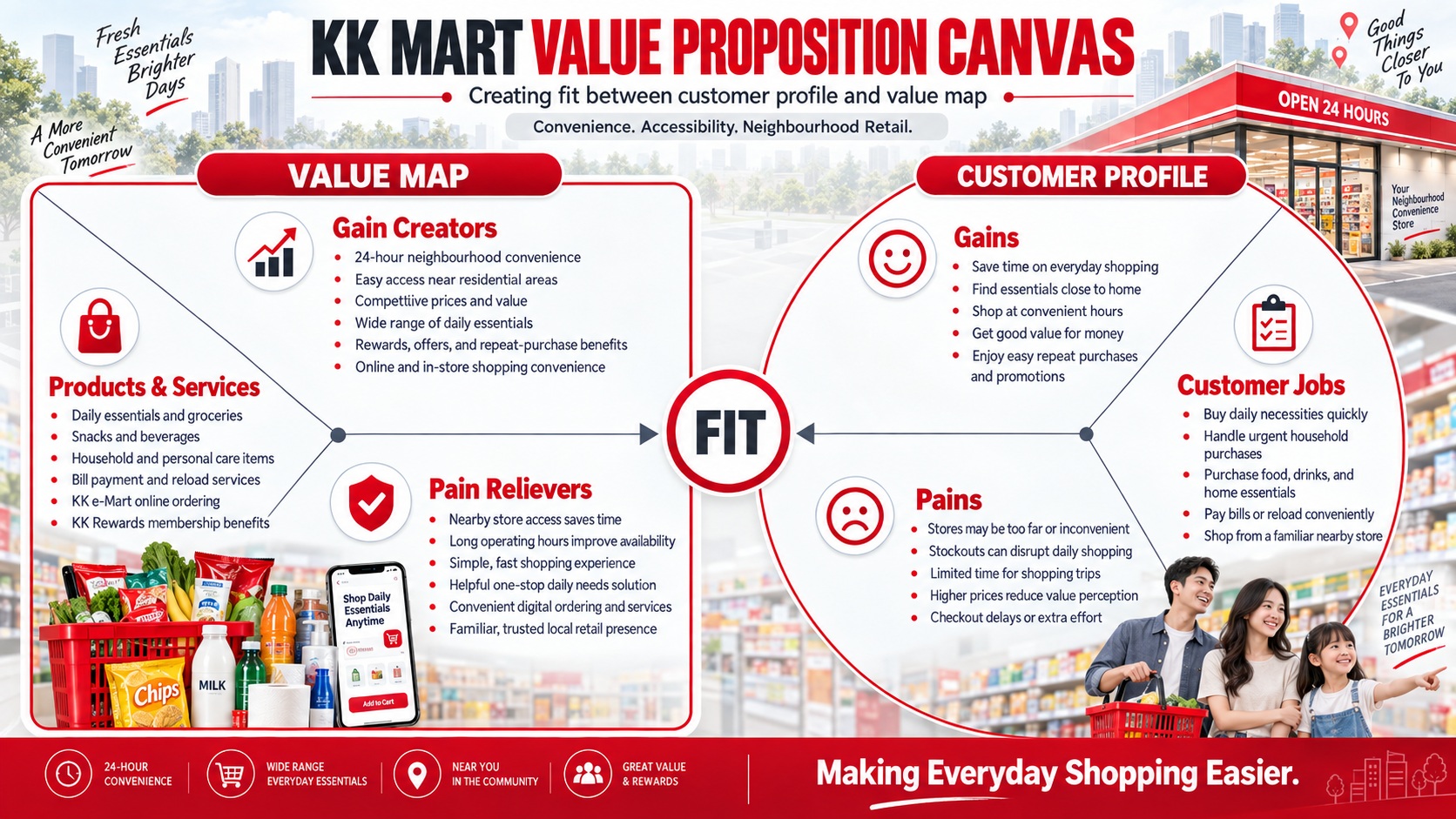
KK Mart Value Proposition Canvas
The Value Proposition Canvas examines the customer side of the KK Mart Business Model Canvas more closely.
Where the BMC explains the entire business system, VPC evaluates whether KK Mart’s products and services effectively address customer jobs, pains and desired gains.
The primary profile considered here is an everyday convenience shopper.
Customer Profile
Consumers generally want to obtain frequently needed products quickly without travelling to a large supermarket.
Immediate access becomes particularly important when the purchase is urgent, small or made outside normal shopping hours.
Customer Profile of KK Mart
| Customer Profile | Details |
|---|---|
| Customer Jobs | Buy groceries, food, beverages and household essentials quickly; make payments; reload services; solve urgent everyday needs |
| Customer Pains | Travelling far, closed stores, stockouts, queues, high convenience premiums and limited payment choices |
| Customer Gains | Nearby access, long opening hours, broad assortment, competitive prices, quick transactions and useful additional services |
KK Mart reduces the effort required to complete relatively small but frequent purchasing tasks.
Convenience has economic value because consumers often optimise for time rather than price alone.
Nevertheless, value-oriented customers still compare prices.
The ideal proposition therefore does not merely save time; it provides enough price competitiveness that convenience does not feel excessively expensive.
Value Map
KK Mart responds through a combination of products, locations, services and increasingly digital capabilities.
Value Map of KK Mart
| Value Map | Details |
|---|---|
| Products and Services | Daily essentials, groceries, drinks, snacks, household goods, ready-to-eat products, bill payments, reload services and online shopping |
| Pain Relievers | 24-hour access, neighbourhood locations, broad availability, cashless payments and quick shopping |
| Gain Creators | Competitive prices, KK Rewards, nearly 6,000 products, KK e-Mart and multiple service functions |
The strongest pain reliever is proximity.
Large supermarkets may provide a broader range and attractive pricing, but the additional travel and shopping time can be disproportionate for small purchases.
Long opening hours address another pain by reducing dependence on conventional retail schedules.
Digital channels broaden this utility.
KK Rewards can improve repeat-purchase value, while KK e-Mart gives customers an alternative when physical visits are less convenient.
How KK Mart Creates Fit
| Customer Profile | Details | Matching Value Map | How KK Mart Creates Fit |
|---|---|---|---|
| Customer Jobs | Obtain everyday necessities quickly | Products and Services | Broad assortment solves multiple shopping missions |
| Customer Pains | Distance, closing times and inconvenience | Pain Relievers | Nearby 24-hour outlets reduce time and access barriers |
| Customer Gains | Value, speed and flexibility | Gain Creators | Competitive pricing, rewards, digital shopping and services increase utility |
Value fit is strongest when customers can reliably find what they need at a nearby outlet without paying an unreasonable convenience premium.
That fit deteriorates when stock availability weakens, checkout becomes slow, prices become uncompetitive or store standards vary significantly.
Operational discipline therefore determines whether the intended value proposition becomes an actual customer experience.
KK Mart vs 99 Speedmart vs 7-Eleven Business Models
The KK Mart Business Model Canvas shares characteristics with both 99 Speedmart and 7-Eleven Malaysia, but the strategic emphasis differs.
99 Speedmart has built an exceptionally large minimarket network supported by distribution centres and logistics capabilities. It reached 3,000 outlets nationwide in November 2025, while its current store directory lists more than 3,200 locations.
7-Eleven Malaysia operates more conventionally as a convenience-store brand but is increasingly differentiating through fresh food and CAFé by 7-Eleven. It reported 2,735 convenience stores at the end of 2025, including 859 CAFé-format stores.
Relevant BMC Block Comparison
| Relevant BMC Block | KK Mart | 99 Speedmart | 7-Eleven Malaysia |
|---|---|---|---|
| Customer Segments | Neighbourhood residents and convenience shoppers | Household and value-focused neighbourhood shoppers | Convenience, immediate-consumption and food-to-go customers |
| Value Proposition | 24-hour access, broad essentials and competitive pricing | Near-home shopping and value pricing | Convenience plus fresh food and differentiated products |
| Channels | Stores, KK e-Mart and KK Rewards | Extensive physical minimarket network | Stores including expanding CAFé format |
| Revenue Streams | Retail products, services and online merchandise | Predominantly high-volume merchandise retail | Merchandise with increasing fresh-food contribution |
| Key Resources | 1,000+ locations, assortment, suppliers and brand | Very large store network, distribution and logistics infrastructure | Brand, convenience network, fresh-food capabilities and store formats |
KK Mart occupies a strategically useful middle position.
Compared with 99 Speedmart, it emphasises 24-hour convenience more strongly.
Relative to 7-Eleven, its nearly 6,000-item range gives it stronger characteristics of a neighbourhood minimarket.
That positioning can be valuable, but it also means KK Mart faces competition from both sides of the market.
Competitive Advantages
KK Mart possesses several capabilities that support its position in Malaysian convenience retail.
- Large and growing physical footprint: A network of 1,088 outlets as of September 2026 gives KK Mart considerable proximity to customers and creates barriers for smaller chains attempting to replicate similar coverage.
- 24-hour neighbourhood positioning: Continuous operation extends the addressable shopping window and differentiates KK Mart from retailers with conventional operating hours.
- Broad product assortment: Nearly 6,000 daily essentials allow the company to capture grocery, immediate-consumption, household and emergency purchasing missions within one format.
- Combination of value and convenience: Competitive pricing reduces the traditional trade-off between neighbourhood convenience and supermarket-style value.
- Emerging physical-digital ecosystem: KK Rewards, KK e-Mart, Concept Stores and KK Signature provide foundations for loyalty, online shopping, food-oriented formats and retail automation.
These advantages reinforce one another.
A larger network creates more opportunities to capture customer demand. Higher traffic creates transaction data and purchasing volume, while stronger purchasing scale can support competitive pricing.
The long-term advantage therefore lies less in any individual feature than in integrating scale, proximity, assortment, pricing and technology more effectively than competitors.
Risks and Challenges
A large store network also exposes KK Mart to material strategic and operational risks.
- Intense retail competition: 99 Speedmart, 7-Eleven, supermarkets, petrol-station retailers, independent minimarkets and delivery platforms compete for overlapping customer spending.
- Margin pressure: Consumers remain price sensitive while labour, rental, utilities, logistics and inventory costs can increase faster than selling prices.
- Expansion execution risk: Opening stores faster than management systems and demand can support may create cannibalisation or underperforming outlets.
- Operational complexity: Maintaining stock availability, service standards, cleanliness, security and pricing consistency becomes progressively harder across more than 1,000 locations.
- Changing consumer behaviour: E-commerce, rapid delivery, fresh-food concepts and digital loyalty programmes can reduce the attractiveness of conventional convenience retail if KK Mart does not continue adapting.
These risks are interconnected.
Rising costs can encourage retailers to increase prices, yet higher prices may reduce traffic. Aggressive expansion can grow revenue but simultaneously weaken store productivity.
Digital investment creates opportunity but also increases complexity and expenditure.
The most serious threat would therefore be gradual deterioration across multiple BMC blocks rather than one isolated problem.
Sustained competitiveness requires outlet growth, margins, inventory, technology and customer value to improve together.
Strategic Recommendations
KK Mart should preserve the fundamental neighbourhood-convenience model that has enabled its growth while strengthening the capabilities required for the next stage of scale.
The recommendations below focus on reinforcing existing structural advantages rather than transforming the company into a fundamentally different retailer.
1. Increase Revenue per Existing Store Before Prioritising Store Count
Expansion should continue selectively, but store productivity deserves equal strategic attention.
Management can increase same-store performance through better assortment, stronger promotions, improved stock availability and higher-margin categories.
Metrics such as sales per square foot, transactions per day, average basket size and gross profit per outlet should guide investment decisions.
Growth produced from existing infrastructure can generate stronger economics than expansion requiring new rent, employees and inventory.
2. Develop Stronger Localised Assortment
Not every neighbourhood requires the same merchandise mix.
A store near university accommodation may require different products from one serving families in a suburban residential area.
Transaction data should be used to create store clusters and optimise assortment accordingly.
Localisation can increase inventory turnover, reduce slow-moving stock and improve customer relevance without abandoning the efficiencies of central procurement.
3. Expand Proprietary and Exclusive Products
KK Mart already identifies development of proprietary products as part of its corporate mission.
This area could become increasingly strategic.
Private-label and exclusive products can provide greater differentiation because identical items cannot be price-compared directly with every competitor.
Strong proprietary products may also improve gross margins and customer loyalty.
Priority categories could include beverages, snacks, household products, personal care and selected everyday staples where customers are willing to switch brands.
4. Build KK Rewards Into a Data and Personalisation Platform
KK Rewards should develop beyond a basic points programme.
Customer transaction data can support targeted offers, personalised recommendations and improved understanding of shopping behaviour.
Someone frequently purchasing household necessities should receive different promotions from a customer primarily buying snacks and beverages.
Personalisation can improve promotion efficiency because discounts are directed toward customers most likely to respond rather than distributed universally.
Privacy, security and transparency should remain integral to the programme.
5. Use the Store Network as an Omnichannel Fulfilment Asset
KK e-Mart should complement the physical network rather than operate as an isolated e-commerce channel.
Selected outlets could function as hyperlocal fulfilment points where economically appropriate.
Real-time inventory visibility, click-and-collect and rapid local fulfilment could transform physical proximity into a digital advantage.
Pure online competitors require dedicated fulfilment infrastructure, while KK Mart already possesses inventory positioned across many communities.
That footprint could become strategically more valuable as consumer expectations move toward faster fulfilment.
6. Expand Ready-to-Eat Food Selectively
KK Concept Store demonstrates KK Mart’s ability to move further into food-to-go and ready-to-eat categories.
Expansion should be data-driven rather than universal.
Locations with strong commuter, student or office traffic may support hot food and beverage concepts more effectively than purely residential outlets.
Fresh food can improve visit frequency and margins but introduces wastage, food safety and operational complexity.
The objective should therefore be profitable food capability rather than merely copying competing convenience-store cafés.
7. Scale Automation Where Economics Are Proven
KK Signature provides an important experimental platform for self-service retail.
Automation should be evaluated through measurable outcomes such as checkout time, labour productivity, shrinkage, transaction volume and customer satisfaction.
Self-checkout may be attractive in selected high-volume or controlled environments, but technology should solve an economic problem rather than become an end in itself.
Successful capabilities can then be introduced selectively across conventional outlets.
Conclusion
The KK Mart Business Model Canvas illustrates how an apparently straightforward neighbourhood convenience concept can become a sophisticated retail system when expanded beyond 1,000 outlets.
Its fundamental economic logic remains clear.
Locate stores near customers.
Keep them accessible for extended hours.
Stock products people regularly need.
Offer prices that remain competitive enough to encourage repeat purchases.
Add useful services that give customers more reasons to visit.
Behind that simple proposition lies substantial operational complexity.
Procurement must support thousands of products. Inventory needs to be allocated across a large store network. Employees must operate stores consistently, while landlords, suppliers, payment providers and technology partners collectively influence customer experience.
KK Rewards and KK e-Mart indicate how the model is becoming more digitally connected.
Concept Stores create opportunities in ready-to-eat food, while KK Signature provides a platform for testing retail automation.
Future competitiveness will depend on whether KK Mart can transform its physical scale into higher productivity rather than focusing on outlet numbers alone.
More personalised customer relationships, stronger proprietary products, localised merchandising, efficient fulfilment and disciplined automation could strengthen the underlying economics.
The enduring strategic principle is nevertheless unlikely to change: make everyday shopping easier, closer and available when customers need it.
If KK Mart can preserve that promise while increasing operational efficiency and digital integration, its neighbourhood network can remain a meaningful competitive asset even as Malaysia’s retail landscape continues to evolve.
Disclaimer
This article is provided solely for educational, informational and business-analysis purposes.
The analysis is based on publicly available company information, industry observations and strategic interpretation available at the time of writing. It is not official information from KK Mart Retail Berhad, KK Group, 99 Speedmart, 7-Eleven Malaysia or any other company mentioned.
Nothing in this article constitutes financial, investment, legal, commercial or other professional advice. The article should not be treated as investment advice or as a recommendation to buy, sell or hold any investment or security.
Business models, store numbers, products, services, technologies, financial performance and market conditions may change over time. Readers should conduct independent research before making business, strategic or investment decisions.
All trademarks, company names, logos, product names, images, copyrights and other intellectual-property rights belong to their respective owners. Any reference to them in this article is used solely for identification, educational and analytical purposes and does not imply endorsement or affiliation.
Meta Description
Explore the KK Mart Business Model Canvas, including all nine BMC blocks, Value Proposition Canvas, comparison with 99 Speedmart and 7-Eleven, competitive advantages, risks and strategic recommendations updated for 2026.

