



Share This Article


KFC Business Model Canvas: How KFC Creates Value Through Brand, Franchising, Chicken, Convenience and Global Scale
BMC Article No: BMC #025
Updated in 2026: This article has been comprehensively updated to reflect KFC’s global expansion, continued franchise-led development, growing digital capabilities, menu innovation, restaurant modernisation, increasing competition in the chicken category and Yum! Brands’ investment in restaurant technology.
The 2026 update also provides deeper analysis of every BMC block, an expanded Value Proposition Canvas, comparison with McDonald’s and Popeyes, competitive advantages, risks and challenges, strategic recommendations and an assessment of the relationships that make KFC’s business model scalable.
Introduction
Few restaurant brands have transformed a relatively simple product—fried chicken—into a global operating system as effectively as KFC.
Founded around Colonel Harland Sanders’ Original Recipe, the company has developed from a restaurant concept into one of the world’s largest quick-service restaurant networks. KFC reported more than 34,000 restaurants across over 150 countries in June 2026, demonstrating the exceptional international reach of the brand.
The KFC Business Model Canvas is particularly interesting because the company does not create value through food alone. Its economics depend on a combination of brand recognition, proprietary recipes, franchise partners, standardised operating systems, supply-chain capabilities, restaurant locations, digital ordering and continual menu adaptation.
Most restaurants are operated within a franchise-led system rather than directly by the corporate organisation.
Consequently, KFC can expand its global restaurant network while franchise partners provide much of the capital and local operating capability required to open and run outlets.
Understanding this relationship between brand ownership and decentralised restaurant operations is essential to understanding KFC.
What Is KFC’s Business Model?
KFC operates primarily as a global quick-service restaurant franchising system centred on chicken products, convenience and a highly recognisable consumer brand.
At the centre of the KFC Business Model Canvas is a model in which customers purchase prepared food from restaurants, drive-thrus, delivery platforms and digital channels, while franchisees operate most locations under KFC’s brand standards and operating system.
Three economic engines support the model.
First, restaurants generate consumer demand through chicken meals, burgers, wraps, sides, beverages, family bundles and locally adapted products.
Second, franchise partners invest capital in restaurant development, staffing and local market execution.
Third, Yum! Brands captures value primarily through franchise fees, royalties and related franchise economics while also benefiting from selected company-operated restaurants.
This arrangement separates consumer-level economics from corporate-level economics.
Customers pay restaurants for meals, whereas franchisees generally provide KFC’s corporate organisation with recurring economics linked to the restaurants they operate.
Scale strengthens the model further. More restaurants increase consumer accessibility, larger purchasing volumes strengthen supply-chain economics and wider market presence increases brand awareness.
What Is Business Model Canvas?
Business Model Canvas, commonly called BMC, is a strategic framework used to examine how an organisation creates, delivers and captures value.
Nine interconnected components form the framework.
For KFC, analysing these elements is useful because restaurant-level operations, franchisee economics and corporate value creation are closely connected.
The KFC Business Model Canvas shows how these relationships work together.
| BMC Block | Main Question |
|---|---|
| Customer Segments | Who does KFC serve? |
| Value Propositions | What value does KFC provide? |
| Channels | How does KFC reach customers? |
| Customer Relationships | How does KFC encourage loyalty and repeat visits? |
| Revenue Streams | How does KFC generate revenue? |
| Key Resources | Which assets make the model possible? |
| Key Activities | What must KFC continuously perform? |
| Key Partnerships | Which partners strengthen the system? |
| Cost Structure | What are the major costs? |
Examining each component independently provides useful insight.
Greater strategic value, however, comes from understanding how restaurant economics, franchising, customer demand and global brand management reinforce one another.
Quick Overview of KFC
Colonel Harland Sanders developed the Original Recipe that later became the foundation of Kentucky Fried Chicken.
Rather than remaining a single restaurant operation, the concept expanded through franchising and gradually became an international quick-service restaurant system.
Modern KFC extends significantly beyond traditional bone-in fried chicken.
Menus can include chicken burgers, wraps, tenders, nuggets, rice meals, sides, desserts, sauces and market-specific products. Localisation allows the company to retain a recognisable global identity while accommodating regional food preferences.
By June 2026, KFC said its network exceeded 34,000 restaurants in more than 150 countries, with a new restaurant opening somewhere globally approximately every 3.5 hours on average.
Yum! Brands describes KFC as the largest chicken restaurant concept globally and reports approximately $36.4 billion in system sales for the brand.
Such scale makes KFC more than a restaurant chain.
Its competitive position depends on a global system connecting intellectual property, franchise capital, supply chains, operating processes, technology and local market execution.
Why KFC Is Strategically Interesting
Restaurant growth traditionally requires substantial investment in property, kitchens, equipment and employees.
Franchising changes that equation.
Through the KFC Business Model Canvas, KFC demonstrates how a restaurant brand can use franchise partners to separate much of the capital required for expansion from ownership of the underlying brand and operating system.
Franchisees receive the right to participate in an established restaurant concept.
Customers provide restaurant-level demand because they recognise the brand, menu and expected experience.
Suppliers gain high-volume purchasing opportunities as the network grows.
Yum! Brands benefits from recurring franchise economics and the expansion of system sales.
These participants reinforce one another.
More successful restaurants can attract additional franchise development. Greater unit density improves convenience for consumers, while larger purchasing volumes can strengthen procurement economics.
However, franchising introduces an important strategic trade-off.
KFC gains rapid expansion and local entrepreneurship but sacrifices some direct control over daily execution.
Poor service, inconsistent food quality or weak restaurant maintenance at individual franchise locations can damage a brand shared by the entire network.
Latest Developments: What Is Changing Around KFC?
Several developments are reshaping the KFC Business Model Canvas in 2026.
Brand modernisation has become particularly visible.
In June 2026, KFC announced a new global chapter involving menu innovation, restaurant redesign and refreshed branding, initially highlighted through developments in the UK and Ireland. Boneless chicken, sauces and more contemporary restaurant experiences are becoming increasingly important components of its consumer proposition.
Technology is evolving simultaneously.
Yum! Brands introduced Byte by Yum!, an AI-driven restaurant technology platform covering capabilities intended to improve customer and team-member experiences across its restaurant brands, including KFC.
International expansion remains another major driver.
KFC’s enormous geographic footprint gives the business access to growth markets where chicken is culturally adaptable and frequently more acceptable across different dietary traditions than some alternative proteins.
Competitive intensity is increasing at the same time.
Popeyes, McDonald’s, local fried-chicken operators, convenience retailers, delivery-first restaurants and independent brands all compete for meal occasions.
Future growth therefore requires KFC to combine network expansion with stronger comparable restaurant performance, digital engagement and menu relevance.
KFC Business Model Canvas Summary
Before examining every block individually, the KFC Business Model Canvas can be summarised as a franchise-led restaurant system that converts brand equity, recipes, operating standards and consumer demand into restaurant sales and recurring franchise economics.
| BMC Block | KFC Application |
|---|---|
| Customer Segments | Individuals, families, groups, convenience seekers and franchisees |
| Value Propositions | Distinctive chicken, convenience, familiarity, sharing meals and local relevance |
| Channels | Restaurants, drive-thru, takeaway, apps, websites and delivery platforms |
| Customer Relationships | Brand familiarity, promotions, loyalty, digital engagement and consistent experience |
| Revenue Streams | Franchise fees, royalties, company restaurant sales and related franchise income |
| Key Resources | Brand, recipes, franchise network, restaurant system, technology and supply chain |
| Key Activities | Brand management, menu innovation, franchising, operations, marketing and technology |
| Key Partnerships | Franchisees, suppliers, delivery platforms, technology partners and landlords |
| Cost Structure | Labour, ingredients, occupancy, technology, marketing, corporate functions and restaurant development |
KFC BMC Diagram
A visual KFC BMC should place all nine components within a single operating system.
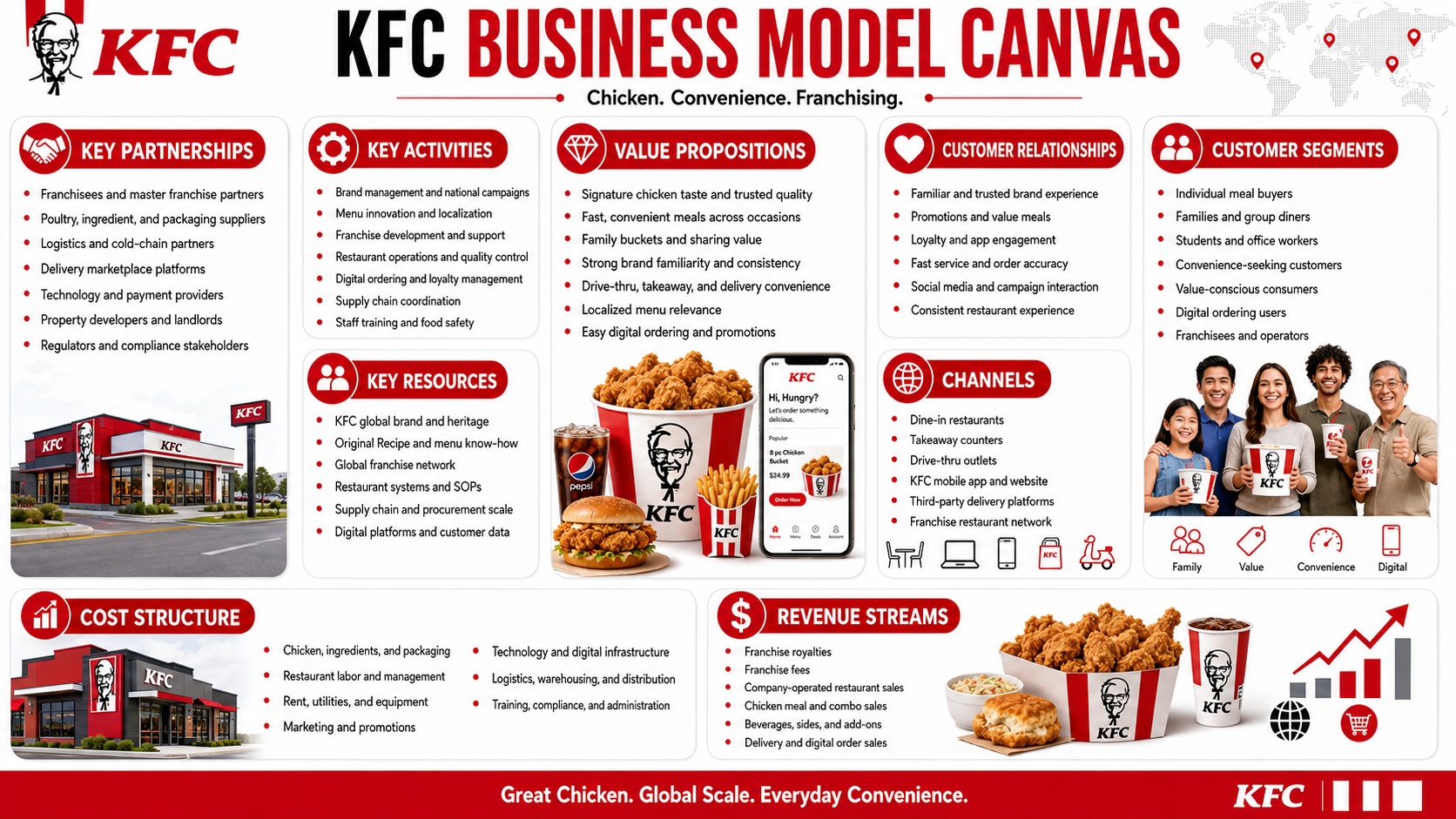
The central relationship begins with consumer demand.
Restaurants convert that demand into transactions, franchisees provide operating capacity and capital, suppliers support product availability, while Yum! provides the brand, standards, technology and strategic direction.
BMC Analysis of KFC
The detailed KFC Business Model Canvas demonstrates that KFC’s strongest competitive capability is not simply fried chicken.
Brand equity makes customer acquisition easier, franchising accelerates development, supply-chain scale supports thousands of restaurants and standardisation allows the customer experience to be reproduced internationally.
No BMC block operates independently.
Menu innovation can attract customers but increases operational complexity.
Additional restaurants improve accessibility but may reduce unit economics if locations are opened too aggressively.
Digital delivery increases convenience while introducing platform commissions and potential quality problems when food travels long distances.
Franchise expansion reduces corporate capital requirements, although weak franchise execution can undermine the brand.
KFC therefore must manage the business as an integrated system rather than maximise restaurant count alone.
Sustainable growth requires attractive consumer demand, strong franchisee returns and disciplined brand governance simultaneously.
The following sections examine each component in greater detail.
1. Customer Segments
KFC serves multiple customer groups across different meal occasions.
Individual consumers include workers, students, commuters and other diners seeking convenient meals.
Families represent another important segment because chicken buckets, sharing meals and bundles naturally support group consumption.
Value-conscious customers respond to meal deals and promotional combinations, while digital customers increasingly prioritise ordering convenience and delivery.
Franchisees form a strategically different customer group because they invest capital to operate restaurants under the KFC system.
The KFC Business Model Canvas consequently contains both food-service customers and business partners whose economics must remain attractive.
KFC Customer Segments
| Segment | Details | Why It Matters |
|---|---|---|
| Individual diners | Customers purchasing personal meals | Generates frequent transactions |
| Families and groups | Customers buying buckets and sharing meals | Supports larger order values |
| Convenience seekers | Takeaway, drive-thru and delivery customers | Expands meal occasions |
| Value-conscious customers | Consumers responding to bundles and promotions | Supports traffic generation |
| Franchisees | Businesses investing in KFC restaurants | Provides expansion capital and operating capability |
KFC must create enough consumer demand for restaurants to produce attractive unit economics.
Franchise partners will continue expanding only when expected returns justify capital investment.
Balancing affordability, traffic and franchise profitability is therefore central to sustainable growth.
2. Value Propositions
Customers generally choose KFC because the brand combines distinctive product taste with convenience and familiarity.
The Original Recipe and associated brand heritage provide differentiation in a category where competitors can otherwise offer similar chicken formats.
Convenience expands the proposition beyond food itself.
Restaurants, takeaway, drive-thru and delivery allow customers to access meals across multiple occasions.
Sharing formats create another advantage because buckets and group bundles position KFC for family meals and social occasions.
The KFC Business Model Canvas becomes stronger when these propositions operate together rather than independently.
KFC Value Propositions
| Value Proposition | Details | Why It Matters |
|---|---|---|
| Distinctive chicken | Signature recipes and recognised flavour | Differentiates the core product |
| Brand familiarity | Globally recognised identity and heritage | Reduces purchase uncertainty |
| Convenience | Fast service, takeaway, drive-thru and delivery | Expands consumption occasions |
| Sharing occasions | Buckets and group meal formats | Raises relevance for families |
| Local adaptation | Market-specific flavours and menu items | Improves regional relevance |
KFC cannot depend entirely on historical brand recognition.
Consumers continually compare taste, price, convenience and novelty across competing restaurants.
Preserving a distinctive core product while allowing disciplined local innovation therefore remains critical.
3. Channels
Restaurant locations remain KFC’s most important physical distribution channel.
Traditional dine-in outlets provide visibility, food preparation and customer service, while takeaway supports customers seeking convenience.
Drive-thru locations can capture highly efficient car-based transactions where real estate permits.
Digital channels have become increasingly important because customers can browse menus, place orders, receive promotions and access loyalty programmes through apps and websites.
Third-party delivery platforms provide additional reach but introduce commissions and reduce direct control over the customer relationship.
KFC Channels
| Channel | Details | Why It Matters |
|---|---|---|
| Restaurants | Dine-in and counter-service locations | Core physical distribution network |
| Drive-thru | Vehicle-based ordering and collection | Supports speed and convenience |
| KFC digital channels | Apps and websites for ordering | Creates direct digital relationships |
| Delivery platforms | Third-party ordering marketplaces | Expands delivery reach |
| Takeaway | Restaurant collection and grab-and-go | Serves convenience-led occasions |
Channel economics differ considerably.
A dine-in transaction uses restaurant seating, while drive-thru prioritises throughput and delivery adds last-mile economics.
KFC should therefore evaluate channels by contribution margin and customer lifetime value rather than sales volume alone.
Greater direct digital ordering can also reduce dependence on external aggregators.
4. Customer Relationships
KFC’s customer relationships are primarily transactional but increasingly supported by digital engagement.
Brand familiarity creates an important baseline relationship.
Customers generally know what KFC represents before entering a restaurant, reducing perceived purchase risk.
Promotional campaigns encourage trial and repeat visits.
Digital applications, loyalty systems and personalised offers can strengthen relationships by making future ordering easier and providing incentives for customers to return.
Restaurant employees remain important because service speed, cleanliness and order accuracy directly affect perceived value.
KFC Customer Relationships
| Relationship Type | Details | Why It Matters |
|---|---|---|
| Brand relationship | Familiarity with KFC and Colonel Sanders | Encourages trust and recognition |
| Repeat purchasing | Recurring visits for familiar products | Supports transaction frequency |
| Promotions | Bundles, limited offers and value meals | Stimulates traffic |
| Digital engagement | Apps, loyalty and personalised offers | Builds direct customer access |
| Restaurant service | Employee interaction and order fulfilment | Shapes customer satisfaction |
Repeat behaviour cannot be assumed merely because the brand is famous.
Customers can easily switch between competing QSR chains.
Stronger first-party digital relationships could therefore help KFC increase visit frequency while learning more about customer behaviour.
5. Revenue Streams
KFC’s revenue architecture must be understood at two different levels.
Individual restaurants generate sales from chicken meals, beverages, sides, desserts and other products.
Corporate economics operate differently because the predominantly franchise-led system allows Yum! Brands to capture fees and royalties associated with franchise operations.
The KFC Business Model Canvas consequently combines high-volume restaurant transactions with comparatively asset-light franchise income at the parent-system level.
KFC Revenue Streams
| Revenue Stream | Details | Why It Matters |
|---|---|---|
| Franchise royalties | Recurring payments linked to franchised operations | Creates scalable corporate income |
| Franchise fees | Payments associated with restaurant development and agreements | Supports network expansion economics |
| Company restaurant sales | Revenue from selected directly operated locations | Provides direct restaurant economics |
| Food transactions | Meals, beverages, sides and add-ons | Drives system sales |
| Delivery and digital orders | Transactions through digital channels | Expands accessible demand |
Yum! describes KFC as generating approximately $36.4 billion in system sales, illustrating the scale of consumer spending flowing through the restaurant network.
System sales, however, should not be confused with Yum! Brands’ accounting revenue.
The franchise structure allows corporate economics to grow without requiring ownership of every restaurant.
6. Key Resources
KFC’s brand is arguably its most valuable strategic resource.
Colonel Sanders, the distinctive visual identity and Original Recipe heritage create recognition that independent restaurants would find difficult to reproduce.
Recipes and menu know-how provide another important asset.
The franchise network contributes physical restaurant capacity and local operating expertise without requiring KFC’s corporate organisation to own every location.
Supply-chain capabilities support consistent ingredients across large markets, while technology increasingly coordinates digital ordering, restaurant operations and customer engagement.
KFC Key Resources
| Key Resource | Details | Why It Matters |
|---|---|---|
| Global brand | KFC identity, heritage and recognition | Creates customer awareness |
| Recipes and menu IP | Signature products and preparation methods | Supports differentiation |
| Franchise network | Thousands of local operators and restaurants | Enables capital-efficient expansion |
| Supply-chain system | Large-scale sourcing and distribution capability | Supports availability and consistency |
| Technology | Digital ordering and restaurant systems | Improves convenience and productivity |
These assets reinforce one another.
A famous brand attracts customers and franchisees, while franchise growth expands physical availability.
Greater scale subsequently strengthens purchasing power and provides more transactions through which technology investments can generate returns.
7. Key Activities
Brand management is one of KFC’s most important ongoing activities.
Marketing teams must keep the brand culturally relevant while protecting its core identity.
Menu development is similarly important because consumer expectations continue changing across markets.
Franchise development involves selecting operators, approving locations and supporting restaurant expansion.
Operational standards cover food preparation, service, cleanliness and safety.
Technology development has become increasingly important as Yum! deploys digital and AI-enabled restaurant capabilities through platforms such as Byte by Yum!.
KFC Key Activities
| Key Activity | Details | Why It Matters |
|---|---|---|
| Brand management | Positioning, campaigns and identity | Maintains consumer relevance |
| Menu innovation | Develop new and localised products | Encourages traffic and differentiation |
| Franchise development | Recruit operators and expand restaurants | Drives network growth |
| Operational management | Maintain food, service and safety standards | Protects consistency |
| Digital development | Ordering, loyalty and restaurant technology | Improves customer and operator experience |
Operational discipline becomes harder as the network grows.
New products, channels and technologies can improve revenue but also increase kitchen complexity.
KFC must therefore innovate without undermining speed, consistency or restaurant-level profitability.
8. Key Partnerships
Franchisees represent KFC’s most strategically important partner group.
Their capital, management teams and local market knowledge enable the brand to operate thousands of restaurants across very different economies.
Suppliers are equally important because restaurant consistency depends on reliable chicken, cooking oil, packaging, beverages and other inputs.
Delivery platforms extend off-premise distribution.
Technology vendors contribute payment, ordering and operational capabilities, while property owners and developers provide restaurant locations.
KFC Key Partnerships
| Key Partner | Details | Why It Matters |
|---|---|---|
| Franchisees | Invest in and operate restaurants | Enables scalable global expansion |
| Food suppliers | Provide chicken and other ingredients | Supports quality and availability |
| Delivery platforms | Provide digital marketplaces and logistics | Extends off-premise reach |
| Technology partners | Support payments and restaurant technology | Enables digital operations |
| Property partners | Landlords and developers supporting locations | Provides physical distribution |
Franchise relationships require particularly careful governance.
Aggressive corporate initiatives can create conflict if franchisees bear costs without sufficient returns.
Conversely, underinvestment by operators may damage customer experience.
Long-term alignment therefore depends on attractive unit economics, clear standards and shared incentives for reinvestment.
9. Cost Structure
Restaurant operations have significant variable and fixed costs.
Food ingredients represent a major expense, particularly chicken, cooking oil, packaging and other commodities exposed to price volatility.
Labour is another critical cost because restaurants require employees for preparation, service, cleaning and management.
Occupancy expenses vary by restaurant format and location.
Technology, equipment maintenance, utilities and delivery costs further influence restaurant margins.
Corporate-level expenditure also includes marketing, franchise support, product development and administrative functions.
KFC Cost Structure
| Cost Category | Details | Why It Matters |
|---|---|---|
| Food ingredients | Chicken, oil, sides, packaging and beverages | Directly affects restaurant margins |
| Labour | Restaurant employees and management | Essential for service delivery |
| Occupancy | Rent, property and related costs | Influences unit economics |
| Marketing | Brand campaigns and promotions | Generates demand |
| Technology and operations | Equipment, digital systems and support | Enables efficient service |
Franchising shifts much restaurant-level expenditure to franchise operators.
That advantage does not eliminate economic risk.
Persistent ingredient inflation, higher wages or expensive delivery commissions can weaken franchise profitability even when corporate royalties remain strong.
Protecting restaurant-level economics is therefore essential to maintaining system growth.
How the Nine BMC Blocks Work Together
The KFC Business Model Canvas becomes most useful when all nine elements are viewed as one reinforcing system.
Customer demand provides the starting point.
Distinctive chicken, recognised branding and convenience create the value proposition.
Restaurants, drive-thrus and digital ordering deliver that value through multiple channels.
Positive experiences, promotions and loyalty mechanisms encourage repeat purchasing.
Those transactions generate restaurant sales and ultimately support franchise-related income.
Key resources such as brand equity, recipes, franchise operators and supply chains enable the system to function.
Marketing, product innovation, restaurant development and operational management maintain those resources.
External partners provide capital, ingredients, technology, property and delivery capability.
Cost economics determine whether franchisees can continue investing.
Healthy unit-level returns can create a powerful growth loop: profitable restaurants attract development capital, additional restaurants increase accessibility and greater scale strengthens the brand.
Misalignment can reverse the same mechanism.
Weak traffic reduces restaurant returns, poorer returns discourage reinvestment and ageing restaurants can further weaken customer demand.
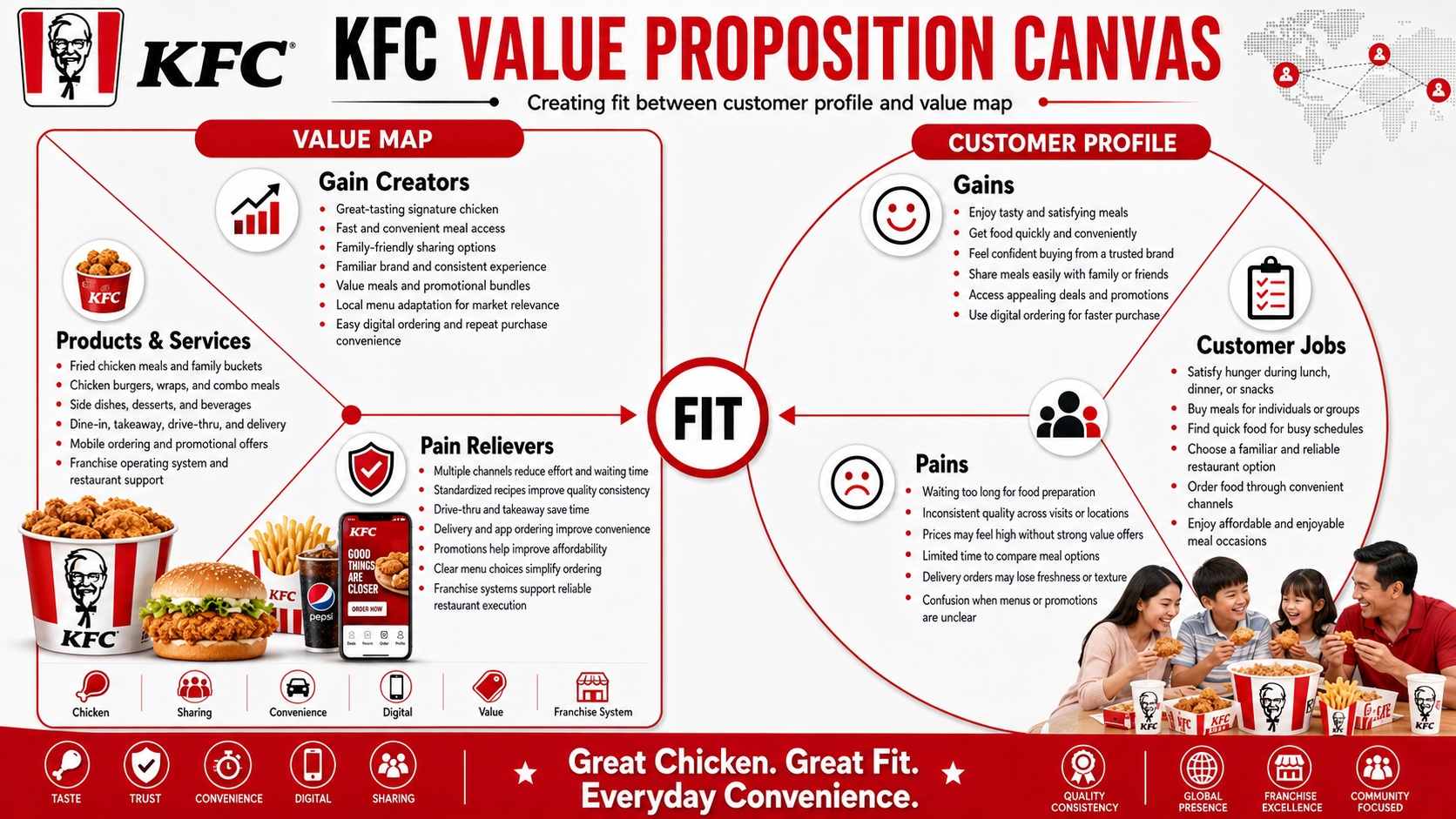
KFC Value Proposition Canvas
The Value Proposition Canvas provides a closer view of how KFC responds to customer jobs, pains and desired gains.
While BMC explains the entire business architecture, VPC examines whether specific products and services genuinely solve customer problems.
The KFC Business Model Canvas becomes easier to interpret when the consumer proposition is separated from the franchise system supporting it.
Customer Profile
The profile below focuses primarily on restaurant customers rather than franchisees.
People frequently purchase quick-service food because they need convenient, enjoyable and predictable meals.
Customer Profile of KFC
| Customer Profile | Details |
|---|---|
| Customer Jobs | Eat conveniently, satisfy hunger, buy meals for groups, order food quickly and enjoy familiar chicken |
| Customer Pains | High prices, waiting time, inconsistent quality, incorrect orders, delivery deterioration and limited healthy choices |
| Customer Gains | Good taste, generous portions, convenience, dependable quality, promotions and easy group ordering |
KFC must minimise friction around ordering, waiting and fulfilment.
Food quality also needs to remain consistent across channels.
A meal that performs well immediately after cooking may deteriorate during delivery, making packaging and fulfilment part of the value proposition.
Value Map
KFC responds to customer requirements through products, service formats and brand familiarity.
Value Map of KFC
| Value Map | Details |
|---|---|
| Products and Services | Fried chicken, burgers, wraps, tenders, sides, beverages, desserts, family meals, takeaway, drive-thru and delivery |
| Pain Relievers | Fast ordering, bundles, restaurant availability, digital ordering, familiar menu formats and operational standards |
| Gain Creators | Signature flavour, sharing meals, convenience, promotions, menu innovation and trusted brand recognition |
The brand creates value through more than taste.
Accessibility reduces the effort required to find a meal, while multiple order formats allow customers to choose between dine-in, takeaway, drive-thru and delivery.
Menu innovation adds novelty without forcing KFC to abandon its core chicken identity.
How KFC Creates Fit
| Customer Profile | Details | Matching Value Map | How KFC Creates Fit |
|---|---|---|---|
| Customer Jobs | Obtain a convenient meal | Products and Services | Restaurants and digital ordering provide fast access |
| Customer Pains | Waiting, uncertainty and inconsistent food | Pain Relievers | Standardisation and convenient ordering reduce friction |
| Customer Gains | Enjoyable taste and easy sharing | Gain Creators | Signature chicken and bundles create recognisable value |
Strong fit occurs when KFC provides a meal that is tasty, accessible, appropriately priced and operationally reliable.
Value deteriorates when customers encounter slow service, shrinking perceived value, poor delivery quality or inconsistency between restaurants.
Continuous operational improvement is therefore as important as advertising.
KFC vs McDonald’s vs Popeyes Business Models
The KFC Business Model Canvas shares important characteristics with McDonald’s and Popeyes.
All three operate large quick-service restaurant systems, rely substantially on franchising and compete for convenience-led dining occasions.
Their strategic positions nevertheless differ.
McDonald’s competes across a broader set of categories and has particularly substantial digital and loyalty capabilities. Its 2025 annual report stated that the company ended the year with nearly 210 million 90-day active loyalty users across 70 markets.
Popeyes competes more directly with KFC around chicken and forms part of Restaurant Brands International, whose four brands collectively operated more than 33,000 restaurants across over 120 countries and territories at the end of 2025.
BMC Block Comparison
| Relevant BMC Block | KFC | McDonald’s | Popeyes |
|---|---|---|---|
| Value Proposition | Signature chicken, sharing and global familiarity | Broad menu, convenience, value and consistency | Louisiana-style chicken and bold flavour |
| Channels | Restaurants, drive-thru, takeaway and delivery | Restaurants, drive-thru, app, delivery and kiosks | Restaurants, drive-thru and delivery |
| Revenue Model | Franchise-led restaurant system | Franchise-led system with significant scale | Franchise-led restaurant system |
| Key Resources | Chicken brand, recipes, franchise network | Brand, property system, scale and digital ecosystem | Brand, recipes and RBI franchise platform |
| Key Activities | Chicken innovation, brand management and global expansion | Menu, technology, operations and restaurant development | Chicken innovation, franchising and expansion |
KFC’s major distinction is global leadership within chicken rather than menu breadth.
Competitive Advantages
KFC possesses several structural advantages that new restaurant concepts would struggle to reproduce quickly.
- Exceptional global brand recognition: Colonel Sanders, the KFC name and Original Recipe heritage provide immediate recognition across diverse markets.
- Massive international footprint: More than 34,000 restaurants across over 150 countries create consumer accessibility, purchasing scale and geographic diversification.
- Highly scalable franchise model: Franchise partners provide much of the capital and operating expertise required for restaurant development, allowing network expansion without equivalent corporate ownership investment.
- Strong chicken-category positioning: KFC is closely associated with fried chicken, providing clearer category ownership than competitors whose identities extend across many protein and meal formats.
- Global scale with local adaptability: Market-specific products allow KFC to accommodate local tastes while maintaining common brand assets and operating principles.
Together, these advantages create a significant barrier to replication.
A competitor may reproduce fried chicken relatively easily.
Replicating KFC’s global distribution, brand memory, franchise relationships and operating infrastructure is considerably more difficult.
Risks and Challenges
Large scale does not eliminate fundamental restaurant-industry risks.
- Intensifying chicken competition: Popeyes, McDonald’s, local chains, delivery brands and independent operators continuously compete on flavour, price and convenience.
- Franchise execution inconsistency: Poor food, service or restaurant conditions at individual outlets can damage customer perceptions of the entire brand.
- Commodity and labour inflation: Higher chicken, oil, packaging, energy and wage costs can weaken restaurant-level profitability and franchise investment capacity.
- Value perception pressure: Repeated price increases may cause customers to perceive quick-service meals as increasingly expensive compared with alternatives.
- Digital disruption and channel economics: Greater reliance on delivery aggregators can increase commissions, weaken first-party customer ownership and expose product-quality limitations during transportation.
The most dangerous scenario would involve deterioration across several areas simultaneously.
Weak customer traffic could reduce franchise profitability, discourage restaurant reinvestment and slow new-unit development.
That combination would eventually undermine both physical accessibility and brand momentum.
Strategic Recommendations
KFC should protect its distinctive chicken positioning while strengthening the economic system that allows franchisees to expand profitably.
Competitive strategy should focus on improving both consumer relevance and restaurant-level returns rather than restaurant count alone.
1. Strengthen Category Leadership Around Chicken
KFC should continue treating chicken expertise as its central strategic territory.
Boneless products, sauces, tenders, burgers and emerging formats can extend usage occasions without diluting the brand into a generic QSR menu.
Innovation should reinforce the idea that KFC understands chicken better than generalist competitors.
2. Build Stronger Direct Digital Relationships
Greater emphasis should be placed on first-party applications, loyalty programmes and customer data.
Direct digital relationships allow KFC to personalise offers, encourage repeat purchasing and reduce excessive dependence on delivery marketplaces.
McDonald’s scale in loyalty demonstrates how strategically significant this capability can become.
3. Protect Franchisee Unit Economics
Expansion should remain disciplined around restaurant-level profitability.
Menu complexity, discount programmes, delivery commissions and technology investment should be assessed according to their impact on franchise returns.
Sustainable franchise economics ultimately determine whether operators reinvest and open additional restaurants.
4. Use AI to Simplify Restaurant Operations
Yum!’s technology investments should reduce operational complexity rather than simply add digital features.
AI-assisted forecasting, labour scheduling, inventory management and ordering could improve restaurant productivity.
Byte by Yum! creates an organisational platform through which these capabilities can potentially be deployed across the system.
5. Modernise Restaurants Without Losing Brand Identity
Restaurant redesign should improve convenience, digital fulfilment and contemporary customer expectations.
KFC’s 2026 global brand initiative already points toward more modern restaurant experiences.
Future formats could allocate space differently for dine-in, drive-thru, pickup and delivery according to local demand.
6. Increase Local Innovation Within Global Guardrails
Regional teams should retain flexibility to respond to local flavours and eating habits.
Rice meals may be strategically important in some Asian markets, while sandwiches, tenders or sauce-led products may perform better elsewhere.
Global systems should provide consistency without forcing identical menus in fundamentally different markets.
7. Manage Growth Through Market Quality, Not Unit Count Alone
Restaurant development remains a major competitive strength, but every additional location should strengthen rather than cannibalise the network.
Market planning should evaluate density, accessibility, expected unit volumes and franchise returns.
KFC’s rapid development pace demonstrates substantial expansion capability; disciplined location economics will determine whether that growth creates enduring value.
Conclusion
Overall, KFC demonstrates how a distinctive food product can become the foundation of a highly scalable global restaurant system.
Its underlying mechanism remains relatively straightforward.
Customers purchase chicken and related meals.
Franchisees provide restaurant capital and local operating capability.
KFC supplies brand equity, recipes, standards, marketing, technology and system knowledge.
Suppliers and other partners support physical fulfilment.
Franchise economics allow Yum! Brands to capture value from an enormous restaurant network without owning every outlet directly.
The sophistication lies in coordinating these components across more than 150 countries.
Future success will depend less on restaurant count in isolation and more on whether each new and existing location produces compelling consumer value and attractive franchise returns.
Chicken-category leadership, stronger digital relationships, disciplined menu innovation and better restaurant technology could reinforce KFC’s competitive position.
Conversely, inconsistent execution, declining value perception or weakened franchise economics could damage several parts of the operating system simultaneously.
KFC’s long-term advantage therefore depends on maintaining the balance between global scale, local relevance, operational simplicity and franchise profitability.
Disclaimer
This article is provided solely for educational, informational and business-analysis purposes.
Information presented is based on publicly available company materials, industry observations and strategic interpretation available at the time of writing.
Nothing contained in this article constitutes financial, investment, business, legal, franchise, accounting, operational or other professional advice.
The analysis should not be interpreted as an official statement, endorsement, representation or recommendation by Yum! Brands, Inc., KFC, McDonald’s Corporation, Restaurant Brands International, Popeyes or any other company mentioned.
Business models, restaurant counts, financial performance, technologies, products, franchise arrangements and market conditions may change over time.
Readers should conduct independent research and obtain appropriate professional advice before making business, investment, franchise or strategic decisions.
All trademarks, logos, copyrights, company names, brand names, product names and other intellectual-property rights belong to their respective owners. Any references to brands, trademarks or logos are used solely for identification, commentary and educational purposes.
Meta Description
Explore the KFC Business Model Canvas, including all nine BMC blocks, Value Proposition Canvas, McDonald’s and Popeyes comparison, competitive advantages, risks and strategic recommendations updated for 2026.

