CARPUT Business Model Canvas
Explore the CARPUT Business Model Canvas, nine BMC blocks, Value Proposition Canvas, competitor comparison, competitive advantages, risks and strategic recommendations.
GrabCar is an app-based transportation service that allows users to book private vehicles for travel from one place to another. Previously, users only had options like public transport, such as taxis and buses. Now, as one of Grab's services, GrabCar has become a leading e-hailing service provider in various Southeast Asian countries.
BMC Article No: BMC #003
Updated in 2026: This GrabCar Business Model Canvas article has been rewritten with a clearer structure, stronger strategic analysis, a Value Proposition Canvas view, recent Grab business context, and a more detailed Business Model Canvas breakdown.
GrabCar is not just an e-hailing service. It is part of a larger mobility platform built around convenience, trust, technology, pricing, driver supply, and everyday urban movement.
That makes the business model interesting. A customer may use GrabCar to go to work, attend a meeting, visit a shopping mall, go to the airport, return home safely at night, or move around a city without owning a car. At the same time, drivers use the platform to earn income from their vehicles and available time.
This means GrabCar sits between several business categories. It is partly a transport service, partly a technology platform, partly a marketplace, and partly a data-driven urban mobility business. Its strength comes from connecting passengers and drivers at scale. Its challenge comes from balancing price, driver income, customer experience, safety, regulation, and competition.
In this article, we will break down the GrabCar Business Model Canvas and examine how GrabCar creates value, reaches customers, generates revenue, manages cost, and competes in the e-hailing market.
GrabCar’s business model is built around app-based private-hire transportation. In this GrabCar Business Model Canvas, the platform connects passengers who need rides with driver-partners who are willing to provide transport services using their own vehicles or vehicles arranged through related programmes.
The model works because GrabCar solves problems on both sides of the market.
For passengers, it offers convenience, price visibility, cashless payment, ride tracking, driver ratings, and access to cars on demand. For drivers, it offers access to customer demand, flexible earning opportunities, platform tools, navigation, incentives, and a structured way to participate in the mobility economy.
Its main strength is network scale. As passenger demand grows, more drivers are attracted to the platform. A larger driver base improves availability and waiting time. Better availability improves customer trust. Stronger customer trust creates more transactions.
Its main challenge is platform balance. Low fares may push drivers away. High fares may push passengers toward taxis, public transport, competitors, or private cars. GrabCar must continuously manage this balance.
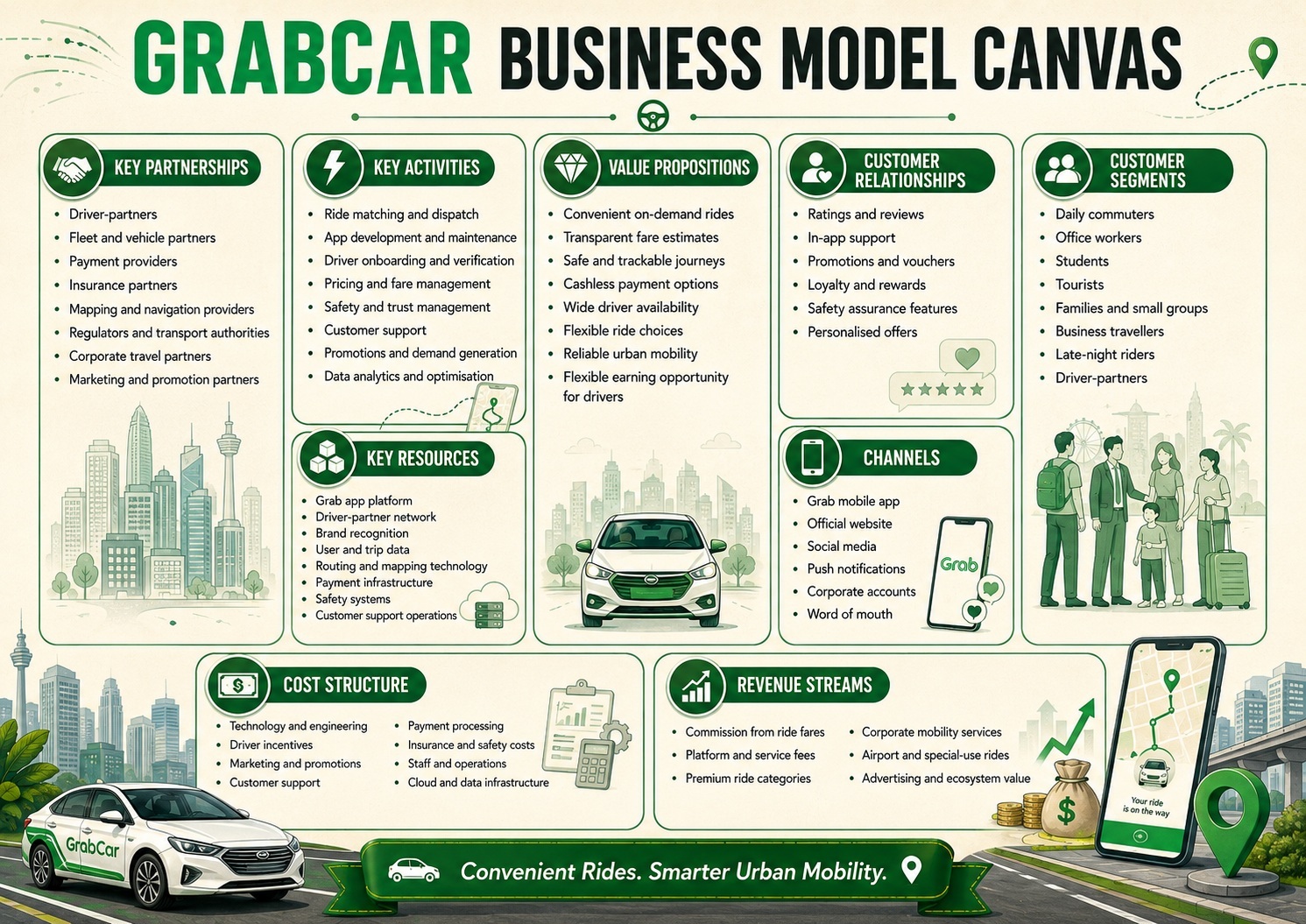
Business Model Canvas, or BMC, is a simple tool used to understand how a business works. It breaks a company into nine key building blocks:
| BMC Block | Main Question |
|---|---|
| Customer Segments | Who does the business serve? |
| Value Propositions | What value does the business offer? |
| Channels | How does the business reach customers? |
| Customer Relationships | How does the business build loyalty? |
| Revenue Streams | How does the business make money? |
| Key Resources | What assets does the business need? |
| Key Activities | What must the business do well? |
| Key Partnerships | Who helps the business operate? |
| Cost Structure | What are the major costs? |
For GrabCar, the BMC is useful because the business is not only about booking rides. The GrabCar Business Model Canvas shows how passenger demand, driver supply, pricing algorithms, safety features, regulatory compliance, mapping, payments, incentives, customer support, and platform trust work together.
Grab started in Malaysia in 2012 as MyTeksi, with the early mission of making taxi rides safer and more reliable. Over time, the company expanded from taxi booking into private-hire cars, food delivery, parcel delivery, digital payments, financial services, and other everyday services across Southeast Asia.
GrabCar is one of Grab’s core mobility services. This GrabCar Business Model Canvas helps explain how users can book private cars through the Grab app. Depending on market availability, customers may choose different ride categories, such as standard private car rides, larger vehicles, premium options, airport rides, or other mobility formats.
The wider Grab platform is important because GrabCar does not operate in isolation. It benefits from the Grab superapp, existing user accounts, digital payments, loyalty mechanics, cross-selling with other services, and brand familiarity across Southeast Asia.
Recent Grab financial results also show why mobility remains important. For full-year 2025, Grab’s Mobility revenue grew to US$1.219 billion, while Mobility Gross Merchandise Value reached US$7.901 billion. This shows that ride-hailing remains a major engine in Grab’s broader platform strategy.
GrabCar is interesting because it changed how many Southeast Asian customers think about urban transport.
Before app-based e-hailing became common, many customers had to depend on street taxis, public buses, trains, private cars, or informal arrangements. These options often created friction. Customers faced uncertainty over availability, fare negotiation, route transparency, waiting time, payment method, and safety.
GrabCar reduced much of that friction through the app.
Customers can see the estimated fare before booking. Driver location can be tracked in the app. Trip details can be shared with others for safety. Payment can be made by card, e-wallet, or cash where available. After the ride, customers can rate the driver. Ride types can also be selected based on budget, comfort, or group size.
For entrepreneurs, GrabCar is a useful case because it shows how technology can redesign a traditional industry. The core service is still transportation. The business model, however, is not traditional transportation. GrabCar does not need to own every car. It uses technology, data, pricing, driver-partner supply, and trust mechanisms to coordinate demand and supply at scale.
The main question is not only whether GrabCar provides rides. The bigger question is how GrabCar builds a reliable mobility marketplace that passengers and drivers continue to use.
| BMC Block | GrabCar Example | Strategic Meaning |
| Customer Segments | Passengers, commuters, professionals, tourists, families, driver-partners | Serves both demand side and supply side of the mobility marketplace |
| Value Propositions | Convenient rides, price transparency, safety features, flexible driver income | Solves trust, access, convenience, and earning problems |
| Channels | Grab app, website, social media, partnerships, corporate channels | App is the primary channel, supported by digital and partner touchpoints |
| Customer Relationships | Ratings, support, promotions, loyalty, safety assurance | Builds trust and encourages repeat usage |
| Revenue Streams | Commission from fares, platform fees, premium rides, corporate mobility, advertising and ecosystem effects | Monetises ride transactions and platform activity |
| Key Resources | App, data, brand, drivers, mapping, payment infrastructure, safety systems | Platform capability is more important than vehicle ownership |
| Key Activities | Matching rides, pricing, driver onboarding, safety management, app development, support | Daily platform execution determines service reliability |
| Key Partnerships | Drivers, regulators, payment providers, insurers, mapping providers, fleet partners, corporate clients | Partnerships help GrabCar operate, comply, scale, and reduce risk |
| Cost Structure | Technology, incentives, marketing, support, compliance, insurance, staff, cloud infrastructure | Profitability depends on scale, efficiency, and marketplace balance |
Customer Segments explain who the business serves. In the GrabCar Business Model Canvas, this block is important because GrabCar operates as a two-sided marketplace. It must serve both passengers and drivers.
For GrabCar, the customer base is broad. It includes daily commuters, office workers, students, tourists, families, business travellers, late-night users, airport passengers, and people who need transport but do not want to drive or own a car.
The driver side is equally important. GrabCar depends on driver-partners who use the platform to find passengers and earn income. These may include full-time e-hailing drivers, part-time drivers, vehicle owners looking for extra income, or drivers connected through fleet arrangements.
The main customer segments are:
| Customer Segment | Example |
| Daily commuters | Workers travelling between home, office, train stations, or business districts |
| Students and young adults | Users without private vehicles who need affordable and convenient rides |
| Professionals | Executives attending meetings, client visits, airport trips, or events |
| Tourists | Visitors who want safe, app-based transport in unfamiliar cities |
| Families and small groups | Customers needing larger vehicles, comfort, or door-to-door convenience |
| Late-night users | Passengers who need safer transport after public transport hours |
| Driver-partners | Vehicle owners or drivers seeking flexible earning opportunities |
| Corporate customers | Companies arranging business travel or staff mobility through Grab for Business |
This is important because GrabCar must serve different use cases. Students may care most about affordability. Business travellers often focus on reliability. Tourists may prioritise safety and language convenience. Driver-partners usually look at earnings, incentives, route efficiency, and platform fairness.
The opportunity is large demand coverage. Managing different expectations in one platform remains the challenge.
Value Proposition explains why customers choose one business over another. In the GrabCar Business Model Canvas, the value proposition is broader than “book a car.” It is about reducing uncertainty in urban transport.
For passengers, GrabCar offers convenience, speed, fare visibility, safety features, ride tracking, driver ratings, digital payment, and different ride options. These features make transportation easier to plan and more predictable.
For drivers, GrabCar offers access to demand. Instead of waiting randomly for passengers, drivers can receive bookings through the app. The platform provides navigation, trip information, customer matching, incentives, earnings records, and support tools.
The main value propositions are:
| Value Proposition | Example |
| Convenience | Book a ride through the app without street-hailing or calling a taxi |
| Price transparency | Estimated fare shown before confirming the booking |
| Safety and trust | Driver details, ratings, trip tracking, emergency features, and customer support |
| Flexible ride options | Standard cars, larger vehicles, premium rides, or airport-related options where available |
| Cashless payment | Card, e-wallet, or other supported payment methods through the app |
| Driver income opportunity | Driver-partners can use their vehicles and time to earn income |
| Platform reliability | Matching, routing, payment, support, and trip records managed through one system |
The real advantage is that GrabCar competes on trust and convenience, not transport alone. A normal car ride moves a customer from one place to another. GrabCar adds predictability, payment convenience, safety visibility, and digital accountability.
The strength is clear customer utility. Expectation inflation is the risk. Once customers get used to fast booking and transparent pricing, they become less tolerant of long waiting times, surge pricing, poor driver behaviour, or weak support.
Channels explain how a business reaches, sells to, and serves customers. For GrabCar, the primary channel is the Grab mobile app.
The app is where customers search for rides, compare prices, choose ride types, confirm bookings, track drivers, pay, rate the trip, and contact support. This makes the app more than a sales channel. It is the operating system of the service.
GrabCar also uses other channels to build awareness, trust, and usage. These include the Grab website, social media, app notifications, email campaigns, promo codes, corporate partnerships, airport visibility, driver referral programmes, and community campaigns.
The main channels are:
| Channel | Example |
| Grab mobile app | Booking, payment, tracking, support, and ratings |
| Grab website | Service information, driver-partner information, corporate solutions |
| App notifications | Promotions, ride updates, safety reminders, campaign alerts |
| Social media | Brand campaigns, service announcements, public engagement |
| Driver referral channels | Recruitment of new driver-partners |
| Corporate channel | Grab for Business for company travel and employee transport |
| Physical touchpoints | Driver centres, airport pickup points, selected event or transport locations |
| Word of mouth | Recommendations from regular passengers and drivers |
The channel strategy works because it is highly digital. The app reduces manual booking friction and allows Grab to manage many activities at once: booking, pricing, payment, route visibility, driver supply, customer communication, and service recovery.
The opportunity is scalability. App dependency remains the challenge. If the app experience is weak, confusing, slow, or unreliable, the whole customer experience suffers.
Customer Relationships explain how a business attracts, retains, and grows its customer base. For GrabCar, relationships are built through repeated trips and accumulated trust.
Most passengers do not use GrabCar once and stop. They may use it weekly or even daily, depending on location, lifestyle, car ownership, public transport availability, weather, working hours, and promotions. This makes retention critical.
GrabCar builds customer relationships through ratings, customer support, safety features, loyalty programmes, ride history, promotions, personalised offers, payment convenience, and service reliability. The platform also builds driver relationships through onboarding, support, incentives, training, earnings tools, and communication channels.
The main customer relationship methods are:
| Customer Relationship Method | Example |
| Ratings and reviews | Passengers rate drivers, and drivers rate passengers |
| In-app support | Help centre, complaint handling, trip issue reporting |
| Loyalty and rewards | Rewards, points, promotions, or member benefits where available |
| Personalised promotions | Targeted vouchers or discounts based on usage pattern |
| Safety assurance | Trip sharing, emergency support, driver identity, ride records |
| Driver-partner engagement | Training, incentives, driver communications, driver centres |
| Corporate account management | Business travel reporting, billing, and company mobility management |
Trust is the real currency of the platform. A passenger must trust the driver, the price, the route, the payment, and the support process. A driver must trust that the platform can provide demand, fair rules, and payment reliability.
The opportunity is habit formation. Once users see GrabCar as part of their daily mobility routine, the platform becomes harder to replace. Trust erosion is the risk. Poor safety incidents, weak complaint resolution, pricing frustration, or driver dissatisfaction can damage the relationship quickly.
Revenue Streams explain how the business makes money. In the GrabCar Business Model Canvas, revenue is mainly linked to ride transactions.
When a passenger completes a ride, the fare is paid through the platform or through supported payment methods. Grab typically earns from commissions, platform-related fees, or service fees associated with completed rides. The exact structure may vary by country, regulation, ride type, driver arrangement, and local market practice.
GrabCar may also generate revenue from premium ride categories, airport services, corporate mobility solutions, advertising exposure inside the wider Grab app, partnerships, and ecosystem effects from users who also use GrabFood, GrabExpress, GrabPay, or financial services.
The main revenue streams are:
| Revenue Stream | Example |
| Commission from ride fares | Grab takes a portion of completed ride transactions |
| Platform or service fees | Fees linked to booking, technology, or service facilitation where applicable |
| Premium ride categories | Higher-priced ride options for comfort, larger vehicles, or premium service |
| Corporate mobility | Grab for Business rides, staff travel, client visits, and company transport reporting |
| Airport and special-use rides | Higher-frequency use cases such as airport transfers or event travel |
| Advertising and ecosystem value | Visibility inside the Grab app and cross-platform engagement |
| Financial services linkage | Payments, wallet usage, lending, insurance, or other services connected to the wider Grab ecosystem |
This revenue model is powerful because GrabCar is not just monetising transportation. It is monetising marketplace coordination. The platform creates value by matching passengers and drivers, processing payments, managing risk, improving availability, and increasing ride frequency.
Margin pressure remains a key risk. E-hailing platforms often spend heavily on driver incentives, passenger promotions, technology, insurance, support, and regulatory compliance. Revenue growth must therefore be supported by efficient operations and strong marketplace density.
Key Resources explain what assets the business needs to deliver its value proposition. The GrabCar Business Model Canvas makes one point clear: the most important resources are not cars alone. The most important resources are platform capability, driver supply, customer demand, data, trust, and operating infrastructure.
GrabCar needs a reliable app, driver-partner network, mapping technology, pricing algorithms, payment systems, customer support, driver onboarding processes, regulatory knowledge, safety features, and a strong brand.
It also needs data. Trip demand, traffic patterns, pickup points, cancellation rates, waiting times, driver availability, customer behaviour, and pricing response all help the platform improve performance.
The main key resources are:
| Key Resource | Example |
| Grab app | Booking, tracking, payment, support, ratings, and ride management |
| Driver-partner network | Supply of available vehicles and drivers across cities |
| Brand and trust | Customer confidence in Grab as a familiar mobility platform |
| Data and analytics | Demand forecasting, pricing, routing, fraud detection, and service improvement |
| Mapping and routing capability | Navigation, pickup accuracy, estimated arrival time, and trip efficiency |
| Payment infrastructure | Cashless payment, wallet support, receipts, settlement, and transaction records |
| Safety systems | Driver verification, ratings, emergency tools, trip sharing, and support process |
| Regulatory capability | Licensing, compliance, market rules, and government engagement |
| Customer and driver support | Help centre, issue handling, driver assistance, and dispute management |
GrabCar’s advantage depends on infrastructure most customers never see. Customers see a simple button that says “book.” Behind that button sits routing, pricing, matching, fraud detection, driver allocation, payment processing, risk management, and support.
The strength is technology-enabled scale. Reliability remains the challenge. If any core resource becomes weak, such as driver availability, payment reliability, mapping accuracy, or support quality, the customer experience can decline quickly.
Grab has been investing in artificial intelligence and platform efficiency. Recent updates from Grab highlighted AI-powered experiences, driver support tools, merchant tools, and continued focus on affordability and service adoption. This matters for GrabCar because mobility platforms depend heavily on prediction, matching, pricing, routing, and driver productivity.
In simple terms, better technology can help GrabCar reduce waiting time, improve driver allocation, manage demand peaks, detect fraud, support drivers, and personalise customer experience.
Key Activities explain what the business must do well every day to operate successfully. For GrabCar, execution quality is everything.
The platform must match passengers with drivers quickly. Fare calculation needs to be accurate. Payments have to be processed reliably. Cancellations require clear handling. Complaints must be resolved with discipline. Driver engagement has to remain active. Regulatory requirements need to be met. Safety must keep improving. App performance has to remain stable. Customer demand also needs to stay active through pricing, promotions, and reliability.
The main key activities are:
| Key Activity | Example |
| Ride matching | Connecting passengers with nearby available drivers |
| Pricing and fare management | Dynamic pricing, upfront fare estimates, promotion handling |
| Driver onboarding | Registration, verification, training, documentation, compliance checks |
| Safety management | Driver screening, incident response, ride tracking, emergency support |
| App development | Feature updates, bug fixes, user experience improvement, platform stability |
| Customer support | Handling complaints, refunds, lost items, driver issues, payment problems |
| Driver engagement | Incentives, communications, performance management, driver support |
| Demand generation | Promotions, campaigns, corporate adoption, cross-selling with other Grab services |
| Regulatory management | Compliance with transport rules, data rules, and market-specific requirements |
| Data analytics | Demand prediction, supply planning, fraud control, route improvement |
Operational discipline is where the business model becomes real. Customers do not judge the business based on strategy. Their judgement depends on whether the car arrives, whether the fare is acceptable, whether the driver behaves professionally, whether the route makes sense, and whether support helps when something goes wrong.
The opportunity is repeat usage. Service breakdown during peak periods, bad weather, major events, holidays, or supply shortages is the risk.
Key Partnerships explain which external parties help the business operate, grow, or reduce risk. GrabCar is a platform business, so partnerships are central to its model.
The most important partners are driver-partners. Without drivers, the platform cannot serve passenger demand. Other partners include regulators, payment providers, insurance companies, mapping or location technology partners, fleet owners, vehicle maintenance providers, fuel or charging partners, corporate customers, airports, malls, event organisers, and technology providers.
The main key partnerships are:
| Key Partner | Example |
| Driver-partners | Individuals providing rides through the platform |
| Fleet partners | Vehicle owners or fleet operators supporting driver supply |
| Regulators and government agencies | Transport licensing, e-hailing rules, safety, and compliance |
| Payment providers | Cards, e-wallets, banking partners, settlement systems |
| Insurance partners | Ride-related coverage, driver or passenger protection products |
| Mapping and technology partners | Location accuracy, routing, traffic data, infrastructure support |
| Vehicle and maintenance partners | Car rental, servicing, tyre, fuel, or EV-related support |
| Corporate clients | Grab for Business customers using rides for staff and business travel |
| Airports and property owners | Pickup and drop-off coordination at high-traffic locations |
| Marketing partners | Campaigns, promotions, co-branded offers, and user acquisition |
Technology alone is not enough for GrabCar to operate effectively. The business also needs real-world coordination. Drivers must be available. Regulators need to allow operations. Payment systems have to work. Insurance should reduce risk. Airports and malls must manage pickup flows. Corporate clients can increase recurring demand.
The opportunity is stronger platform reach. Dependency remains the challenge. If regulations change, driver supply weakens, fuel costs rise, or partner economics become unattractive, the business model is affected.
Cost Structure explains the major costs required to operate the business. In the GrabCar Business Model Canvas, costs are linked to technology, people, incentives, safety, support, compliance, marketing, and platform operations.
Unlike a traditional taxi company, GrabCar may not need to own every vehicle. However, this does not mean the business is asset-light in every sense. It still requires heavy investment in technology, data, engineering, marketing, customer support, driver operations, trust and safety, regulatory engagement, and incentives.
The major cost categories are:
| Cost Category | Example |
| Technology and engineering | App development, backend systems, security, cloud infrastructure |
| Driver incentives | Bonuses, campaigns, guaranteed earnings, supply activation |
| Passenger promotions | Discounts, vouchers, campaign subsidies, loyalty rewards |
| Customer and driver support | Help centre, issue resolution, operations team, dispute handling |
| Safety and compliance | Driver verification, insurance, incident management, regulatory processes |
| Marketing | Brand campaigns, digital advertising, partnerships, referral programmes |
| Payment processing | Transaction fees, wallet integration, settlement operations |
| Data and platform operations | Analytics, fraud detection, marketplace monitoring, system reliability |
| Staff and administration | Country teams, operations, legal, finance, product, and management |
| Partner-related costs | Airport arrangements, fleet support, corporate servicing, technology partners |
Cost discipline is critical because marketplace businesses can grow quickly but also burn cash if incentives and promotions are not controlled. If GrabCar needs to keep spending heavily to attract passengers and drivers, profitability can be pressured.
The opportunity is operating leverage. Once the platform reaches strong density, each additional ride can become more efficient. Cost escalation from competition, regulation, driver incentives, insurance, or customer acquisition remains the risk.
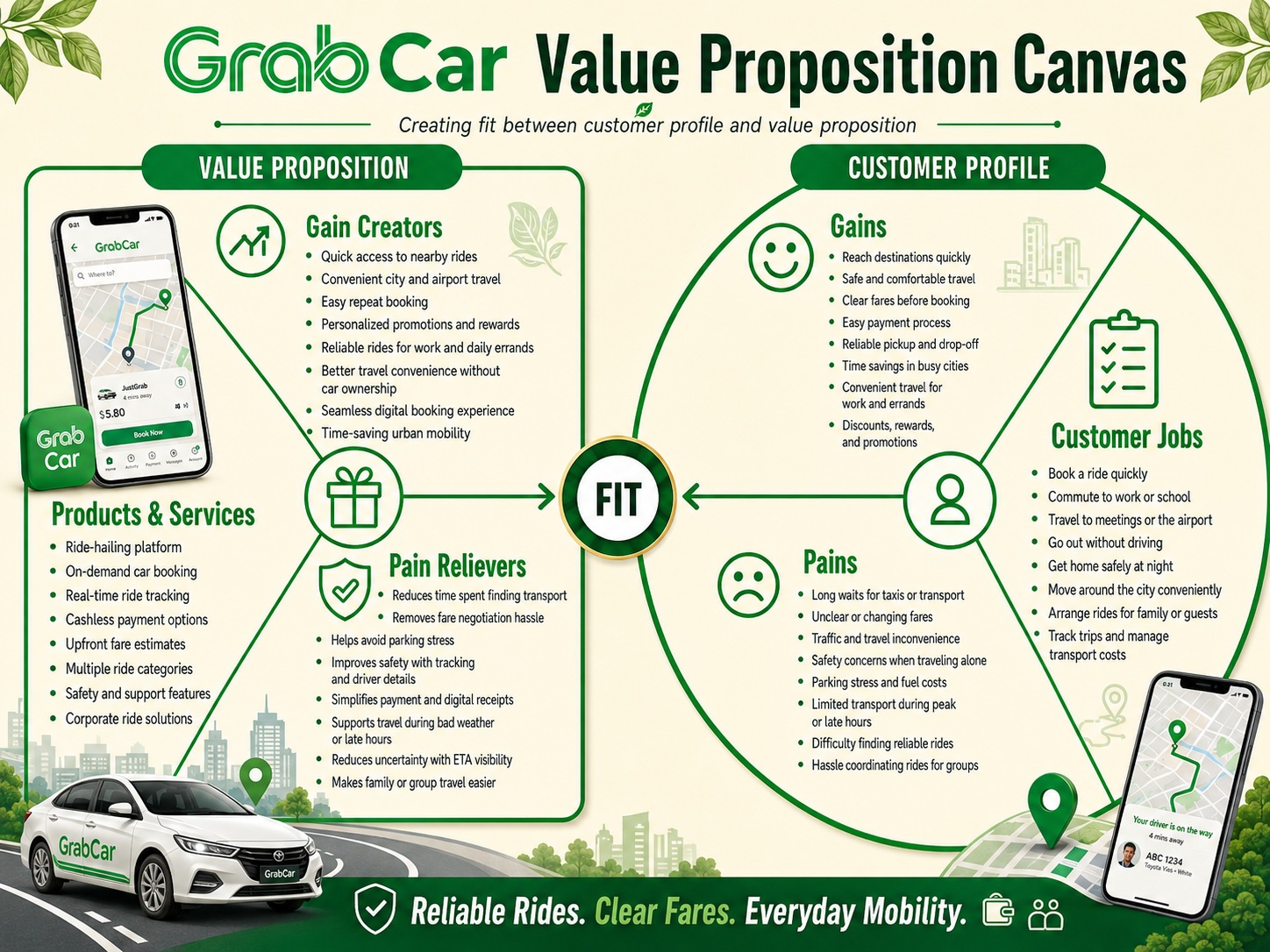
A Value Proposition Canvas, or VPC, helps explain whether a business offer fits what customers actually need. The core idea is simple: the Customer Profile must connect clearly with the Value Proposition.
The Customer Profile looks at three areas: Customer Jobs, Pains, and Gains. These explain what customers are trying to do, what problems they face, and what outcomes they want. The Value Proposition also has three areas: Products and Services, Pain Relievers, and Gain Creators. These explain what the business offers, how it reduces customer problems, and how it creates better outcomes.
For GrabCar, the fit is created by connecting everyday transport needs with a practical app-based mobility offer. Customers want to move safely, easily, and predictably. Drivers want access to earning opportunities. GrabCar connects both sides through the platform.
The Customer Profile explains the demand side of the canvas. It focuses on what passengers and drivers need before looking at what GrabCar offers.
| Customer Profile Area | GrabCar Customer Example | What It Means |
| Customer Jobs | Book a ride, reach a destination, avoid parking, travel safely, commute to work, go to the airport, earn income as a driver | Customers want practical mobility and drivers want access to demand |
| Pains | Taxi uncertainty, long waiting time, unclear pricing, safety concerns, lack of parking, public transport gaps, driver income uncertainty | Customers and drivers want to reduce friction, uncertainty, and risk |
| Gains | Fast booking, clear fare, reliable pickup, safe trip, cashless payment, flexible earning, good route guidance | Customers and drivers want convenience, predictability, and better outcomes |
This profile shows that GrabCar is not only solving a ride problem. Several related problems are also addressed: how to find transport, how to trust the driver, how to know the fare, how to pay, how to track the trip, and how drivers can access passenger demand.
The Value Proposition explains the supply side of the canvas. It shows how GrabCar responds to the customer profile.
| Value Proposition Area | GrabCar Example | Strategic Meaning |
| Products and Services | Private-hire rides, ride categories, app booking, cashless payment, trip tracking, driver ratings, driver-partner tools | Provides mobility, payment, trust, and earning infrastructure in one platform |
| Pain Relievers | Upfront fare estimate, driver details, route visibility, safety tools, support, ratings, cashless payment, driver demand access | Reduces uncertainty, safety concerns, payment friction, and driver income access problems |
| Gain Creators | Faster booking, convenience, loyalty, flexible ride options, reliable travel records, driver flexibility, platform scale | Creates stronger reasons for passengers and drivers to keep using GrabCar |
This matters because GrabCar’s value proposition is not limited to passenger convenience. The model only works if drivers also see value. If passengers love the app but drivers leave, availability falls. If drivers join but passengers do not book, earning opportunity weakens.
The strongest VPC fit happens when the customer profile and the value proposition connect directly.
| Customer Need | GrabCar Response | Fit Created |
| Need quick transport | App-based ride booking and nearby driver matching | Convenience fit |
| Need fare certainty | Upfront estimated fare before booking | Price transparency fit |
| Need safer ride experience | Driver details, trip tracking, ratings, support, emergency tools | Trust and safety fit |
| Need to avoid parking | Door-to-door ride service | Urban convenience fit |
| Need airport or business travel | Private car ride categories and corporate options | Professional mobility fit |
| Need income flexibility | Driver-partner access to platform demand | Earning opportunity fit |
| Need payment convenience | Cashless payment and digital receipts | Payment fit |
| Need repeat daily mobility | Same app used for rides, food, delivery, and payments | Habit fit |
This fit is the reason GrabCar became more than a taxi alternative. It became part of daily mobility behaviour in many Southeast Asian cities.
The VPC also highlights the main risk. The wider the platform promise, the harder it is to maintain fit. If waiting time becomes too long, fares become too high, drivers become dissatisfied, or support becomes weak, the connection between customer need and GrabCar’s offer becomes weaker.
In short, GrabCar’s Value Proposition Canvas shows that the brand creates fit by matching passenger and driver needs with technology, trust, pricing, convenience, and platform scale.
GrabCar competes across several mobility occasions.
| Customer Occasion | Competitor Type | GrabCar’s Possible Advantage |
| Daily commute | Public transport, private cars, taxis | Door-to-door convenience and predictable booking |
| Business travel | Taxis, company cars, private vehicles | Digital receipts, corporate account management, reliability |
| Airport transfer | Airport taxis, buses, private cars | App booking, fare visibility, route tracking |
| Late-night travel | Taxis, friends or family rides, private vehicles | Safety features and availability where public transport is limited |
| Tourist movement | Taxis, car rental, public transport | Easy booking, less language friction, digital route visibility |
| Family or group travel | Private cars, taxis, larger vehicle services | Larger ride options where available |
| Driver income | Taxi driving, delivery work, freelance work | Flexible platform-based earning opportunity |
This is what makes GrabCar’s business model interesting. It does not compete only with taxis. The competitive set also includes public transport, private car ownership, car rental, chauffeur services, informal transport arrangements, and other e-hailing platforms.
Before looking at the risks, it is useful to understand why GrabCar’s business model remains powerful. Its strength does not come from one ride alone. The real advantage comes from the way GrabCar connects demand, supply, technology, payments, trust, and data into one mobility platform.
GrabCar benefits from marketplace network effects.
More passengers create more earning opportunities for drivers. A larger driver base improves availability for passengers. Better availability reduces waiting time. Shorter waiting time improves customer satisfaction. Higher satisfaction increases repeat usage.
This cycle can make the platform stronger over time.
Transport is a repeat need.
People need to commute, meet clients, visit malls, attend events, travel to airports, go home late, and move between places. This gives GrabCar more frequent use potential than businesses that depend on occasional purchases.
Grab is already familiar to many Southeast Asian users through rides, food delivery, payments, and other services.
This matters because trust reduces adoption friction. A user who already has the Grab app and payment method may find it easier to book GrabCar than try a new mobility platform.
GrabCar can use data to improve matching, pricing, routing, demand forecasting, driver allocation, fraud detection, and customer experience.
This gives the business a learning advantage. Every trip can generate operational signals that help improve the platform.
GrabCar sits inside the wider Grab superapp.
A customer may use GrabCar for transport, GrabFood for meals, GrabExpress for parcel delivery, GrabPay for payment, and other services for daily needs. This creates cross-usage potential and improves customer stickiness.
GrabCar depends on driver-partners. If drivers feel earnings are too low, incentives are unattractive, costs are too high, or platform rules are unfair, supply may weaken.
This can lead to longer waiting times, higher fares, and poorer customer experience.
Customers like convenience, but they still compare prices.
If fares rise too much, users may switch to public transport, taxis, competitors, carpooling, or private cars. If fares are too low, driver income may suffer. GrabCar must manage this tension carefully.
E-hailing is closely connected to public transport policy, road safety, licensing, insurance, taxation, and labour issues.
Regulatory changes can affect driver onboarding, vehicle requirements, fare structures, operating rules, insurance obligations, and market access.
GrabCar competes with other e-hailing platforms, taxis, public transport, private vehicles, car rental, and future mobility formats.
Competition can increase promotion spending, driver incentives, and customer acquisition costs.
Safety is central to mobility.
A single serious incident can damage customer confidence. GrabCar must keep strengthening driver verification, trip monitoring, support response, complaint handling, and safety communication.
Managing ride-hailing across different cities is difficult.
Traffic patterns, customer behaviour, driver supply, local regulations, weather, pickup points, and payment preferences vary by market. A model that works well in one city may need adjustment in another.
To compare GrabCar with other platform and service business models, you may also read these related articles:
You can read more examples of Business Model Canvas articles here.
The GrabCar Business Model Canvas gives several useful lessons for entrepreneurs.
First, solve a real friction point. GrabCar did not invent transportation. It improved the way people access transportation. The lesson is clear: strong business models often start by removing daily pain from existing behaviour.
Second, build trust into the product. Driver details, trip tracking, ratings, payment records, and support are not small features. They are trust mechanisms. In platform businesses, trust is part of the product.
Third, understand both sides of the marketplace. A platform cannot focus only on customers. It must also serve suppliers. GrabCar needs passengers, but it also needs drivers. If one side becomes weak, the whole model suffers.
Fourth, use data to improve execution. Pricing, demand forecasting, routing, incentives, and support can all improve when the platform learns from user behaviour.
Fifth, do not ignore regulation. Mobility businesses operate in the real world. Roads, safety, labour rules, licences, insurance, and public policy matter. Entrepreneurs must design for compliance, not treat it as an afterthought.
Sixth, build for habit. The strongest digital platforms are used repeatedly. GrabCar becomes more valuable when customers see it as part of their normal routine, not as an emergency option only.
GrabCar’s Business Model Canvas shows that e-hailing is not just about cars and passengers. It is about marketplace design, technology, trust, payments, driver economics, safety, regulation, and daily mobility behaviour.
GrabCar’s strength lies in its ability to reduce transport friction. Customers can book rides more easily, view fares, track trips, pay digitally, and rate the experience. Drivers can access demand and earn through the platform. Grab benefits by coordinating both sides at scale.
However, the same model also creates challenges. GrabCar must balance passenger affordability with driver earnings. Safety and trust need constant management. Regulatory compliance must be maintained. Incentives, marketing costs, and platform complexity need tight control. Customer experience also has to keep improving as competition grows.
For entrepreneurs, GrabCar is a useful case study because it shows how a traditional service can be transformed through platform thinking. The car is only one part of the model. The real business is the system that connects people, vehicles, payments, data, and trust.
What do you think is GrabCar’s strongest advantage: convenience, safety, pricing transparency, driver network, or the wider Grab ecosystem? Share your view in the comments.
The content published on this blog is intended for informational and educational purposes only and represents the personal opinions of the author. It does not constitute official information from the companies involved in this article (if any). The information is based on limited sources, such as websites and related articles. While every effort is made to ensure the accuracy of the information, the author and the blog do not provide any warranty or guarantee regarding its completeness, reliability, or accuracy. Readers are advised to conduct their own research and seek professional advice before making any decisions based on the content provided. The blog and its author are not responsible for any actions taken as a result of reliance on the information presented.
Explore the CARPUT Business Model Canvas, nine BMC blocks, Value Proposition Canvas, competitor comparison, competitive… Read More
Explore the Boost Business Model Canvas, nine BMC blocks, Value Proposition Canvas, competitor comparison, advantages,… Read More
Explore the Domino's Pizza Business Model Canvas, nine BMC blocks, Value Proposition Canvas, Pizza Hut… Read More
Explore the Mie Gacoan Business Model Canvas, including its customer segments, value propositions, revenue streams,… Read More
Restaurant Business Model Canvas: A Practical Guide to Designing, Evaluating, and Improving Restaurant Business Models… Read More
Learn how the Food and Beverage Business Model Canvas helps restaurants, cafés, beverage brands, and… Read More