CARPUT Business Model Canvas
Explore the CARPUT Business Model Canvas, nine BMC blocks, Value Proposition Canvas, competitor comparison, competitive advantages, risks and strategic recommendations.
Grab, a technology company headquartered in Singapore, offers various services, including transportation, food delivery, and digital payments. Founded in 2012 by Anthony Tan and Tan Hooi Ling, Grab has rapidly grown into one of Southeast Asia's leading tech companies. Initially launched as a taxi app known as MyTeksi in Malaysia, Grab expanded its services across other Southeast Asian countries.
BMC Article No: BMC #002
Updated in 2026: This article has been expanded with strategic analysis, a Value Proposition Canvas view, recent business updates, and a more detailed Business Model Canvas breakdown.
GrabFood is not only a food delivery service. It is part of a larger digital platform that connects customers, restaurants, riders, advertisers, payment providers, and Grab’s wider superapp ecosystem.
That makes GrabFood different from a normal restaurant business. A restaurant sells food. GrabFood sells access, convenience, demand, delivery capacity, data, visibility, and digital ordering infrastructure.
For customers, GrabFood solves a simple problem: getting food without travelling, queuing, or waiting at the restaurant. As for merchants, it offers access to a wider customer base. For delivery partners, it creates income opportunities through flexible gig work. Eventually for Grab, it strengthens user engagement inside the superapp.
This is why GrabFood is an interesting Business Model Canvas case. It is not built around one product. It is built around a multi-sided platform.
In this article, we will break down the GrabFood Business Model Canvas and examine how GrabFood creates value, reaches users, generates revenue, manages costs, and competes in Southeast Asia’s food delivery market.
GrabFood’s business model is built around on-demand food delivery. The platform connects three main groups: customers who want food, merchants who want more orders, and delivery partners who complete the last-mile delivery.
Its main strength is network scale. The more customers use GrabFood, the more attractive it becomes to restaurants. Next, the more restaurants join the platform, the more useful it becomes to customers. The more orders available, the more earning opportunities exist for riders.
Its main challenge is platform economics. GrabFood must balance customer affordability, merchant profitability, rider incentives, delivery speed, promotional spending, and platform margins. This is why the GrabFood Business Model Canvas is useful for understanding both growth and profitability.
Grab reported that its Deliveries revenue grew 21% year-on-year to US$1.8 billion for the full year 2025, driven by Deliveries GMV growth and stronger advertising contribution. This shows that delivery remains a major part of Grab’s business model.
GrabFood’s business model is built around on-demand food delivery. The platform connects three main groups: customers who want food, merchants who want more orders, and delivery partners who complete the last-mile delivery.
Its main strength is network scale. First, the more customers use GrabFood, the more attractive it becomes to restaurants. Second, the more restaurants join the platform, the more useful it becomes to customers. Third, the more orders available, the more earning opportunities exist for riders.
Its main challenge is platform economics. GrabFood must balance customer affordability, merchant profitability, rider incentives, delivery speed, promotional spending, and platform margins. This is why the GrabFood Business Model Canvas is useful for understanding both growth and profitability.
Grab reported that its Deliveries revenue grew 21% year-on-year to US$1.8 billion for the full year 2025, driven by Deliveries GMV growth and stronger advertising contribution. This shows that delivery remains a major part of Grab’s business model.
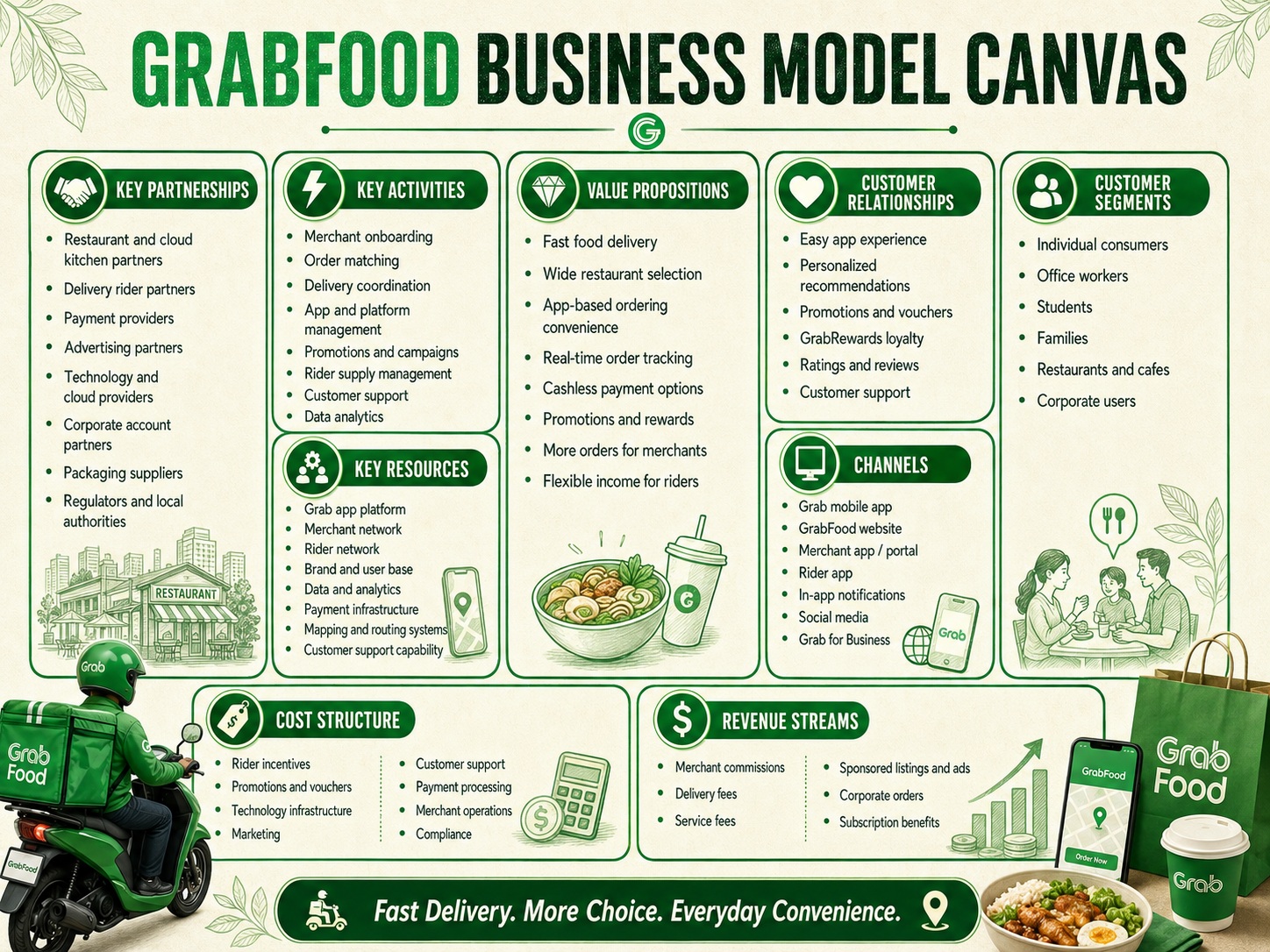
Business Model Canvas, or BMC, is a simple tool used to understand how a business works. It breaks a company into nine key building blocks:
| BMC Block | Main Question |
|---|---|
| Customer Segments | Who does the business serve? |
| Value Propositions | What value does the business offer? |
| Channels | How does the business reach customers? |
| Customer Relationships | How does the business build loyalty? |
| Revenue Streams | How does the business make money? |
| Key Resources | What assets does the business need? |
| Key Activities | What must the business do well? |
| Key Partnerships | Who helps the business operate? |
| Cost Structure | What are the major costs? |
For GrabFood, the BMC is useful because the business is not only about delivering food. The GrabFood Business Model Canvas shows how platform technology, merchant acquisition, rider operations, payment systems, promotions, advertising, customer service, data analytics, and ecosystem integration work together.
GrabFood is the food delivery service within the Grab app. Grab describes GrabFood as a service that delivers users’ favourite food to their doorstep, while Grab’s wider app also includes mobility, grocery delivery, parcel delivery, payments, rewards, and restaurant discovery services.
Grab itself started in Malaysia as MyTeksi before expanding across Southeast Asia. Over time, it moved from ride-hailing into a broader superapp model that includes mobility, deliveries, financial services, and enterprise solutions.
GrabFood is important because it increases customer usage frequency. A customer may not take a Grab ride every day, but may order food, groceries, or other daily services more frequently. This makes food delivery a powerful engagement engine inside Grab’s wider platform. The GrabFood Business Model Canvas helps explain why this daily-use behaviour matters.
For readers who want to understand the basic structure first, read our Business Model Canvas guide. For a deeper customer-fit view, you may also read our Value Proposition Canvas guide.
Grab’s story is useful because it shows how a local ride-hailing idea became a regional digital platform.
Grab started in Malaysia in 2012 under the name MyTeksi. The first idea was to make taxi booking safer, easier, and more reliable. Over time, Grab expanded into ride-hailing, food delivery, parcel delivery, grocery delivery, payments, advertising, digital banking, and other app-based services.
By 2026, Grab has operated for about 14 years. This matters because GrabFood is not only a pandemic-era delivery story. It is part of a long-term platform strategy across Southeast Asia.
Grab now serves more than 900 cities across eight Southeast Asian countries: Malaysia, Singapore, Indonesia, Thailand, Vietnam, the Philippines, Cambodia, and Myanmar. This gives GrabFood access to different food cultures, merchant types, income levels, and urban markets.
For the full year 2025, Grab reported revenue of US$3.37 billion, up 20% year-on-year. Its Deliveries segment, which includes GrabFood, generated US$1.8 billion in revenue, up 21% year-on-year.
Grab also reached its first full year of net profit in 2025, with profit for the year of US$200 million. It also crossed 50 million monthly transacting users.
Another important fact is advertising. In Q4 2025, Grab reported 228,000 quarterly active advertisers on its self-serve advertising platform. This shows that GrabFood is not only a delivery service. It is also a digital advertising channel for restaurants and brands.
The key lesson is simple. GrabFood sits inside a larger platform of users, merchants, riders, payments, advertising, data, and financial services. The GrabFood Business Model Canvas shows why that ecosystem makes its business model stronger than a normal food delivery business.
GrabFood is interesting because it operates as a platform, not as a traditional food business.
A restaurant owns the menu, kitchen, staff, and dining experience. GrabFood owns the digital ordering layer, delivery coordination, customer interface, payment integration, merchant discovery, and platform data.
This creates a different type of business model.
GrabFood does not need to cook the food. It does not need to own every restaurant. It does not need to hire every delivery worker as a full-time employee. Instead, it connects market participants and takes revenue from the transactions, services, and visibility it enables.
This model is powerful because it can scale across cities and countries. However, it is also difficult because every side of the platform must remain satisfied.
Customers want low prices, fast delivery, good food choices, and reliable service. Restaurants want more orders, fair commissions, and visibility. Riders want fair earnings and enough jobs. Grab needs enough margin to sustain the platform.
That balance is the heart of GrabFood’s business model. It is also the reason the GrabFood Business Model Canvas must be viewed as a platform model, not a restaurant model.
| BMC Block | GrabFood Example | Strategic Meaning |
| Customer Segments | Consumers, restaurants, delivery partners, corporate users, advertisers | Multi-sided platform serving different market participants |
| Value Propositions | Food convenience, restaurant reach, rider earning opportunities, digital visibility | Creates value by connecting demand, supply, and delivery capacity |
| Channels | Grab app, GrabFood website, merchant app, rider app, social media, promotions | Digital-first distribution supported by ecosystem reach |
| Customer Relationships | App experience, promotions, GrabRewards, customer support, reviews, personalization | Retention depends on convenience, reliability, and repeat use |
| Revenue Streams | Merchant commissions, delivery fees, service fees, advertising, subscriptions, corporate orders | Multiple monetization layers beyond delivery fees |
| Key Resources | Technology platform, brand, user base, merchant network, rider network, data, payment infrastructure | Scale and trust are core assets |
| Key Activities | Platform management, order matching, merchant onboarding, rider operations, marketing, support | Execution quality affects all sides of the platform |
| Key Partnerships | Restaurants, riders, payment providers, cloud and technology providers, regulators, advertisers | Partners make the platform operationally viable |
| Cost Structure | Rider incentives, promotions, technology, customer support, marketing, operations, compliance | Profitability depends on scale, efficiency, and cost discipline |
Customer Segments explain who the business serves. GrabFood does not serve only one group. It serves several sides of the same platform.
The first segment is individual consumers. These include office workers, students, families, busy professionals, and home users who want convenient meals without travelling, queuing, or waiting at restaurants.
The second segment is restaurants and food merchants. These include fast-food chains, cafés, mamak restaurants, kopitiams, cloud kitchens, small stalls, and F&B brands that want online orders.
The third segment is delivery partners. They are essential platform participants because they complete the last-mile delivery.
The fourth segment is corporate users. Companies may use GrabFood or Grab for Business for staff meals, meetings, overtime work, or client-related food orders.
The fifth segment is advertisers. Restaurants and brands may pay for stronger visibility inside the Grab platform.
The main customer segments are:
| Customer Segment | Example |
| Individual consumers | Office workers, students, families, home users |
| Restaurants and merchants | Fast food, cafés, local restaurants, cloud kitchens |
| Delivery partners | Riders completing food delivery orders |
| Corporate users | Companies ordering meals for staff or meetings |
| Advertisers | Restaurants and brands buying in-app visibility |
| Frequent Grab users | Customers using food, ride, payment, rewards, and other Grab services |
Strategically, this matters because GrabFood is a multi-sided business. In the GrabFood Business Model Canvas, every customer segment affects the others. First, if customers face high delivery fees, demand may fall. Second, if merchants face high commissions, participation may weaken. Third, If riders earn too little, delivery supply may drop.
Value Proposition explains why customers choose one business over another. For GrabFood, the answer depends on which user group we analyse.
The main value propositions are:
| Value Proposition | Example |
| Food delivery convenience | Customers can order meals from the app |
| Wide restaurant selection | Local food, fast food, cafés, desserts, drinks, and more |
| Time savings | Customers avoid travelling, queuing, and waiting |
| Merchant reach | Restaurants can sell beyond physical foot traffic |
| Rider earning opportunity | Delivery partners can earn from completed orders |
| Promotions and rewards | Discounts, vouchers, GrabRewards, campaign offers |
| Cashless ordering | GrabPay, cards, online payment options |
| Advertising visibility | Restaurants can promote listings and campaigns |
Strategically, GrabFood’s value is not the food itself. Restaurants provide the food. GrabFood provides discovery, ordering, payment, delivery, tracking, and visibility. The risk is commoditization if another platform offers better prices, speed, coverage, or merchant selection.
Channels explain how a business reaches, sells to, and serves its customers. For GrabFood, the most important channel is the Grab mobile app.
The app allows customers to search restaurants, compare menus, apply promotions, place orders, make payments, track delivery, rate service, and reorder previous meals.
The second channel is the GrabFood website. It supports food discovery and online ordering in selected markets.
The third channel is merchant-facing technology. Restaurants use merchant tools to receive orders, update menus, manage availability, track sales, and participate in campaigns.
The fourth channel is the rider app. Delivery partners use it to receive jobs, navigate routes, confirm pickup, and complete delivery.
The fifth channel is marketing. GrabFood uses in-app banners, notifications, digital ads, social media, partnerships, vouchers, and seasonal promotions.
The main channels are:
| Channel | Example |
| Grab mobile app | Main customer ordering channel |
| GrabFood website | Food discovery and online ordering |
| Merchant app or portal | Order management, menu updates, merchant campaigns |
| Rider app | Delivery job allocation and fulfilment |
| In-app marketing | Banners, vouchers, promotions, recommendations |
| Social media | Campaigns, merchant promotions, festive offers |
| Payment ecosystem | GrabPay, cards, e-wallet integrations |
| Corporate channel | Grab for Business and company meal orders |
Strategically, GrabFood is a digital-first business. The customer experience starts in the app, but the model still depends on restaurant accuracy, food preparation, rider availability, and delivery reliability.
Customer Relationships explain how a business attracts, retains, and grows its users. For GrabFood, relationships are built through convenience, trust, promotions, personalization, service recovery, and ecosystem engagement.
Customers return when the app is easy to use, restaurant selection is strong, delivery time is reasonable, pricing is acceptable, and problems are resolved quickly.
Grab also strengthens retention through GrabRewards, vouchers, subscriptions, personalized recommendations, push notifications, and cross-service usage. A user who already uses Grab for rides or payments may find it easier to order food from the same app.
Restaurants build relationships with GrabFood through merchant support, campaign tools, analytics, delivery access, and digital visibility.
Riders build relationships with the platform through app reliability, order availability, incentives, support, and earnings transparency.
The main customer relationship methods are:
| Customer Relationship Method | Example |
| App convenience | Easy search, order, payment, and tracking |
| Promotions | Discounts, free delivery campaigns, vouchers |
| Loyalty | GrabRewards, points, membership benefits |
| Personalization | Suggested restaurants and repeat orders |
| Customer support | Refunds, missing item reports, order issue handling |
| Merchant support | Menu management, campaign support, sales tools |
| Rider support | Delivery app, incentives, help centre, operational guidance |
| Reviews and ratings | Customer feedback on restaurants and delivery experience |
Strategically, food delivery loyalty is fragile. Customers can switch for cheaper delivery, better vouchers, faster riders, or exclusive restaurants. GrabFood must therefore build habit, not only awareness.
Revenue Streams explain how the business makes money. GrabFood has several monetization layers.
The first revenue stream is merchant commission. Restaurants typically pay a commission or platform fee on orders generated through GrabFood.
The second revenue stream is delivery fees charged to customers. The fee may vary based on distance, demand, timing, merchant participation, and promotions.
The third revenue stream is service fees or small order fees. These help cover platform, payment, support, and operational costs.
The fourth revenue stream is advertising. Restaurants may pay for sponsored listings, better placement, search visibility, campaign participation, or other promotional formats. This matters because advertising can improve margins without requiring more physical deliveries.
The fifth revenue stream is subscription or loyalty-linked revenue, where available. These offers encourage repeat usage through delivery savings, discounts, or rewards.
The sixth revenue stream is corporate ordering through business accounts.
The main revenue streams are:
| Revenue Stream | Example |
| Merchant commissions | Percentage or fee from restaurant orders |
| Delivery fees | Customer-paid delivery charges |
| Service fees | Platform or order-related fees |
| Advertising revenue | Sponsored listings, promoted merchants, campaign placements |
| Subscription-linked revenue | Delivery savings or loyalty bundles where available |
| Corporate orders | Staff meals, business meals, company accounts |
| Payment ecosystem value | Higher usage of GrabPay and related financial services |
Strategically, GrabFood is not dependent only on delivery fees. In the GrabFood Business Model Canvas, revenue comes from several connected sources. The risk is price sensitivity. If the total order cost becomes too high, customers may reduce usage or order directly from restaurants.
Key Resources explain what assets the business needs to deliver its value proposition.
For GrabFood, the most important resource is the technology platform. This includes the consumer app, merchant tools, rider app, payment system, order matching, maps, routing, data analytics, fraud detection, customer support systems, and promotion engine.
The second key resource is the user base. A large customer base attracts restaurants. Next, a large merchant base attracts customers. Then, a large rider network improves delivery coverage.
The third key resource is brand trust. Customers must trust the app with payment, order accuracy, refunds, delivery tracking, and personal data.
The fourth key resource is data. GrabFood can use order history, location, demand patterns, merchant performance, customer preferences, and delivery times to improve operations.
The main key resources are:
| Key Resource | Example |
| Technology platform | Grab app, rider app, merchant portal, order system |
| Brand | Grab’s recognition across Southeast Asia |
| Customer base | App users ordering food and using other Grab services |
| Merchant network | Restaurants, cafés, food stalls, chains, cloud kitchens |
| Rider network | Delivery partners fulfilling orders |
| Data and analytics | Demand forecasting, personalization, route efficiency |
| Payment infrastructure | GrabPay, card payments, wallet integration |
| Customer support capability | Issue resolution, refunds, complaints, service recovery |
| Advertising tools | Sponsored listings and merchant visibility products |
Strategically, GrabFood’s strongest asset is not a kitchen. It is the network. The challenge is maintaining trust as more users, merchants, riders, data, and payments flow through the same system.
Key Activities explain what the business must do well every day to operate successfully.
For GrabFood, the first key activity is platform management. The app must be stable, fast, easy to use, and reliable during lunch, dinner, weekends, and festive campaigns.
The second key activity is order matching and delivery coordination. GrabFood must connect customers, restaurants, and riders efficiently. Delivery speed depends on preparation time, rider availability, distance, traffic, and routing.
The third key activity is merchant acquisition and management. GrabFood must attract restaurants, onboard them, support menu updates, run campaigns, and maintain service quality.
The fourth key activity is rider supply management. The platform needs enough delivery partners in the right locations and at the right times.
The fifth key activity is customer support. Food delivery has many exceptions, including missing items, wrong orders, late delivery, cancelled orders, unavailable riders, payment issues, and refund requests.
The main key activities are:
| Key Activity | Example |
| Platform development | App updates, system reliability, new features |
| Order matching | Connecting customers, merchants, and riders |
| Delivery coordination | Pickup, routing, tracking, completion |
| Merchant onboarding | Restaurant registration, menu setup, training |
| Rider operations | Supply planning, incentives, delivery standards |
| Marketing and campaigns | Vouchers, seasonal promotions, merchant campaigns |
| Customer support | Refunds, complaints, missing orders, service recovery |
| Data analytics | Personalization, demand forecasting, pricing, fraud detection |
| Advertising operations | Merchant visibility, sponsored placements, campaign tools |
Strategically, execution quality drives repeat usage. Customers judge GrabFood by speed, accuracy, price, food condition, and problem resolution.
Key Partnerships explain which external parties help the business operate, grow, or reduce risk.
For GrabFood, the most visible partners are restaurants and merchants. They provide the food supply, including international chains, local restaurants, cafés, hawkers, kopitiams, mamak restaurants, and cloud kitchens.
Delivery partners are another critical group. They perform the last-mile delivery that connects merchant supply with customer demand.
Payment providers, banks, and e-wallet partners support cashless transactions. Technology partners support cloud systems, analytics, cybersecurity, maps, and communication tools.
Regulators are also important. GrabFood operates in areas linked to food safety, consumer protection, platform work, taxation, data protection, transport rules, and competition policy.
Advertisers and brand partners help create campaign revenue and merchant visibility products.
The main key partnerships are:
| Key Partner | Example |
| Restaurants and merchants | Food outlets supplying menu items |
| Delivery partners | Riders completing orders |
| Payment providers | Cards, e-wallets, banks, payment gateways |
| Technology providers | Cloud, analytics, maps, cybersecurity, communication tools |
| Regulators | Food safety, transport, labour, tax, data, competition authorities |
| Corporate clients | Companies using Grab for Business |
| Advertising partners | Brands and merchants running campaigns |
| Packaging partners | Food containers, drink packaging, delivery bags |
| Strategic ecosystem partners | Promotions, rewards, and cross-service campaigns |
Strategically, GrabFood cannot operate alone. If restaurants prepare food slowly, riders are unavailable, or payment systems fail, customers still blame the platform.
Cost Structure explains the major costs required to operate the business.
For GrabFood, the first major cost is delivery partner incentives. Food delivery platforms often need incentives to attract enough riders during peak hours, bad weather, or high-demand periods.
The second cost is customer promotions. Vouchers, free delivery campaigns, discounts, and loyalty offers can increase order volume but reduce margins.
The third cost is technology. GrabFood requires app development, cloud infrastructure, data systems, cybersecurity, mapping, payment systems, customer support tools, merchant systems, and rider systems.
The fourth cost is marketing. GrabFood must remain visible against other delivery platforms, restaurant-owned ordering channels, quick commerce services, and offline dining.
The fifth cost is customer support and operations. Food delivery creates many service issues that require fast resolution.
The main cost categories are:
| Cost Category | Example |
| Rider incentives | Bonuses, peak-hour incentives, delivery supply support |
| Promotions | Vouchers, discounts, free delivery campaigns |
| Technology | App development, servers, data systems, cybersecurity |
| Marketing | Digital ads, campaigns, partnerships, brand promotions |
| Customer support | Refund handling, complaints, order issue resolution |
| Merchant operations | Onboarding, account management, campaign support |
| Payment processing | Transaction fees and payment infrastructure |
| Compliance | Legal, tax, regulatory, data protection, safety requirements |
| Platform operations | Fraud prevention, quality control, analytics, internal teams |
Strategically, food delivery is cost-sensitive. Scale can improve efficiency, but subsidy dependence is risky. If customers only order when discounts are high, profitability becomes harder.
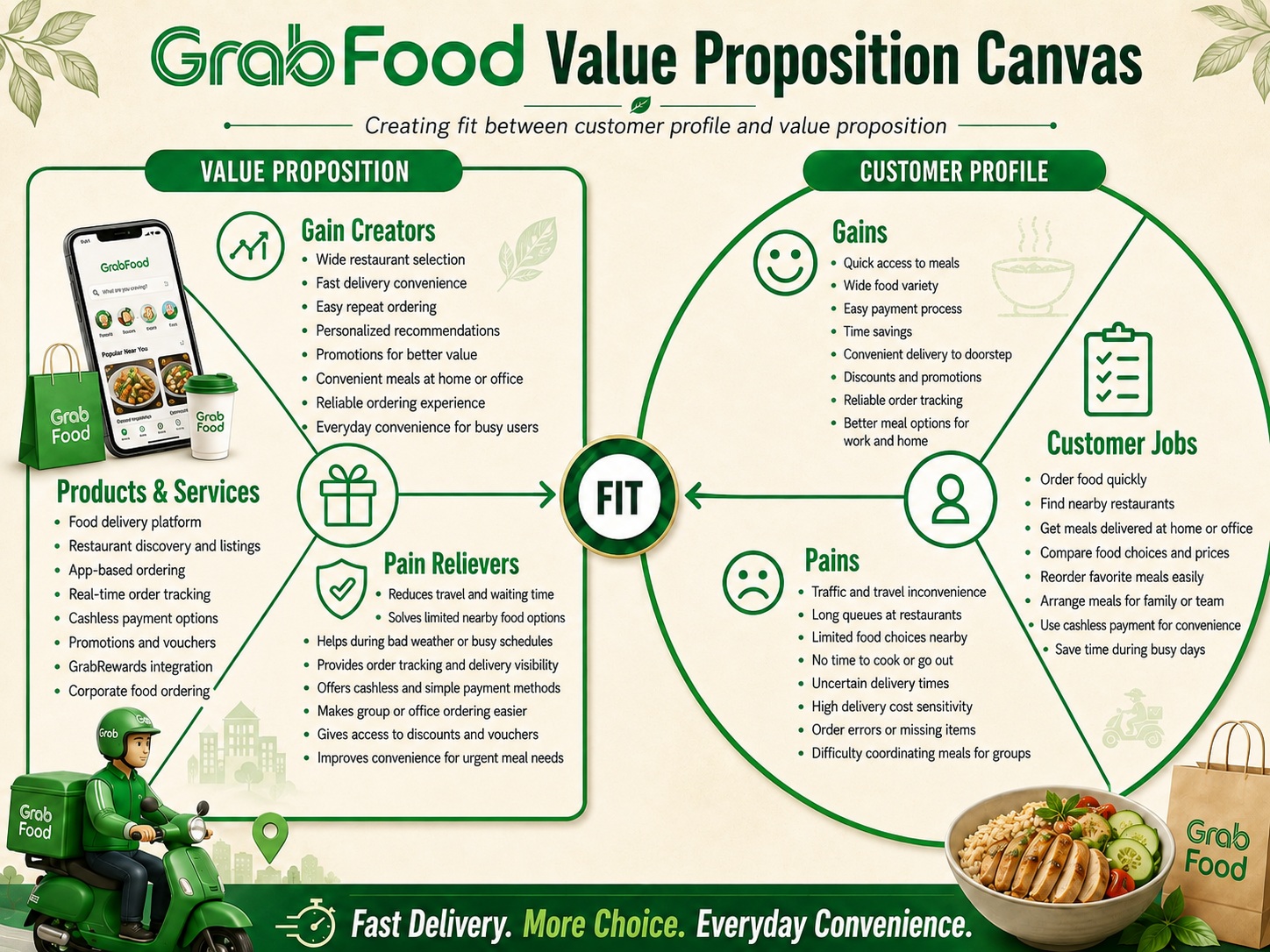
A Value Proposition Canvas, or VPC, helps explain whether a business offer fits what customers actually need.
The Customer Profile looks at three areas: Customer Jobs, Pains, and Gains. These explain what customers are trying to do, what problems they face, and what outcomes they want.
The Value Proposition also has three areas: Products and Services, Pain Relievers, and Gain Creators. These explain what the business offers, how it reduces customer problems, and how it creates better outcomes.
For GrabFood, the fit is created by connecting everyday food needs with digital convenience, delivery coverage, merchant variety, cashless payment, and order tracking.
| Customer Profile Area | GrabFood Customer Example | What It Means |
| Customer Jobs | Order meals, avoid queues, save travel time, compare restaurants, send food to family, arrange office meals | Customers want food access with less effort |
| Pains | Traffic, long queues, limited nearby options, bad weather, no time to cook, uncertain delivery time, high delivery cost | Customers want to reduce time, effort, uncertainty, and inconvenience |
| Gains | Fast delivery, wide food choice, discounts, reliable tracking, easy payment, repeat orders, food delivered to doorstep | Customers want convenience, variety, savings, and confidence |
This profile shows that GrabFood customers are not only buying food. They are buying time, convenience, choice, and reduced friction.
An office worker may need lunch between meetings. A parent may need dinner without cooking. A student may want affordable food during study time. A company may need food for a team meeting.
| Value Proposition Area | GrabFood Example | Strategic Meaning |
| Products and Services | Food delivery, restaurant listings, menu browsing, order tracking, cashless payment, promotions, merchant ads | Gives customers a complete food ordering system |
| Pain Relievers | Delivery to doorstep, app-based ordering, estimated delivery time, reviews, refunds, vouchers, multiple payment methods | Reduces waiting, travelling, uncertainty, and payment friction |
| Gain Creators | Wide food choice, personalized recommendations, rewards, repeat-order convenience, merchant campaigns, superapp integration | Creates stronger reasons to use GrabFood regularly |
This matters because GrabFood’s offer is built around convenience fit. Customers may not always choose the cheapest food. They often choose the option that is easiest, fastest, most familiar, and most reliable.
| Customer Need | GrabFood Response | Fit Created |
| Need food without travelling | App-based food ordering and delivery | Convenience fit |
| Need more food choices | Large merchant network | Variety fit |
| Need quick lunch or dinner | Delivery tracking and rider network | Time-saving fit |
| Need payment convenience | GrabPay, cards, and cashless options | Payment fit |
| Need savings | Promotions, vouchers, rewards | Price fit |
| Need office meals | Corporate ordering and business account use | Corporate fit |
| Need restaurant visibility | Sponsored listings and merchant campaigns | Merchant growth fit |
| Need flexible earning | Rider delivery opportunities | Partner income fit |
The strongest fit happens when GrabFood becomes part of the customer’s daily routine. The customer does not need to think too much. They open the app, reorder a familiar meal, apply a voucher, pay digitally, and track the rider.
The VPC also highlights the main risk. If delivery becomes too expensive, food arrives late, restaurants cancel orders, or customer support is poor, the fit weakens quickly.
GrabFood competes across several customer occasions and business categories.
| Customer Occasion | Competitor Type | GrabFood’s Possible Advantage |
| Lunch at work | Nearby restaurants, office cafeteria, direct takeaway | Delivery convenience and wider choice |
| Dinner at home | Home cooking, dine-in, direct restaurant ordering | Saves time and effort |
| Late-night meals | Mamak, fast food, convenience stores | App-based discovery and delivery |
| Group meals | Restaurants, catering, corporate ordering | Easier ordering and payment |
| Promotions-driven orders | Other delivery apps, restaurant apps | Vouchers, rewards, and superapp loyalty |
| Restaurant discovery | Google Maps, social media, walk-in browsing | Menu, pricing, ordering, and delivery in one place |
This is what makes GrabFood’s business model interesting. It does not compete only with other delivery apps. It also competes with eating out, cooking at home, takeaway, restaurant-owned delivery, convenience stores, and workplace food options.
GrabFood benefits from Grab’s wider ecosystem. Customers may already use Grab for rides, payments, rewards, grocery delivery, parcel delivery, or restaurant deals. This reduces friction when they decide to order food.
Grab’s Malaysia website positions Grab as an everyday app covering GrabFood, GrabMart, GrabExpress, Grab DineOut, GrabPay, and GrabCoins.
GrabFood becomes more valuable when more users, merchants, and riders join the platform.
More customers attract more restaurants. Then, more restaurants attract more customers. Subsequently, more orders attract more riders. More riders improve delivery coverage.
This is the core advantage of platform businesses.
GrabFood can earn from merchant commissions, delivery fees, service fees, advertising, corporate orders, and ecosystem-linked services.
The advertising layer is especially important because it gives GrabFood a higher-value revenue stream beyond basic delivery economics.
GrabFood has data on order patterns, location demand, customer preferences, restaurant performance, delivery timing, and campaign effectiveness.
This data can improve recommendations, promotions, merchant tools, delivery allocation, and pricing decisions.
Food is a recurring need. Customers may order several times per week, especially in urban areas.
This makes GrabFood valuable because it keeps users active inside the Grab app.
Food delivery can be expensive to operate. Promotions, rider incentives, customer support, payment processing, and technology costs can reduce profitability.
If customers become too dependent on discounts, the platform may need to spend heavily to maintain order volume.
Restaurants may complain if commissions are too high. Some merchants may push customers to order directly through WhatsApp, their own website, or phone calls.
GrabFood must prove that the platform brings enough incremental demand to justify the fees.
Delivery partners are critical to service quality. If earnings are unattractive, rider supply can fall. If rider incentives are too high, platform costs increase.
This creates a difficult balancing act.
Customers compare total order cost, not only menu price. Delivery fees, service fees, small order fees, and price markups can affect demand.
When the final bill feels too high, customers may choose takeaway, dine-in, or home cooking.
GrabFood must manage millions of operational variables: restaurant preparation time, rider availability, traffic, weather, customer location, order accuracy, payment success, and support issues.
A small failure can damage the customer experience.
GrabFood competes with other delivery platforms, restaurant-owned ordering channels, social media ordering, direct WhatsApp ordering, dine-in, takeaway, and convenience food options.
This means GrabFood must continue improving affordability, selection, delivery speed, and customer trust.
To compare GrabFood with other F&B and platform business models, you may also read these related articles:
Richiamo Coffee Business Model Canvas, especially if you want to understand how delivery platforms influence café and F&B economics.
MIXUE Business Model Canvas, especially if you want to compare affordable F&B expansion models.
Shopee Business Model Canvas, especially if you want to compare marketplace platform economics.
GrabCar Business Model Canvas, especially if you want to compare mobility and delivery platform models.
You can read more examples of Business Model Canvas articles here.
GrabFood’s BMC gives several useful lessons for entrepreneurs.
First, platform businesses must serve more than one side. GrabFood cannot focus only on customers. It must also serve restaurants, riders, advertisers, and corporate users.
Second, convenience is a strong value proposition. Customers often pay for time savings, simplicity, and reduced effort, especially when they are busy, tired, or constrained by location.
Third, data can become a strategic asset. More transactions help the business understand demand, pricing, location patterns, customer behaviour, and merchant performance.
Fourth, growth must be balanced with unit economics. More orders do not automatically mean better profit if delivery incentives, discounts, and support costs are too high.
Fifth, trust is operational. Customers judge GrabFood based on whether food arrives correctly, quickly, safely, and at a fair total price.
Sixth, ecosystem integration can increase retention. GrabFood becomes stronger when connected to payments, rewards, grocery delivery, ride-hailing, corporate accounts, and advertising.
For entrepreneurs, the lesson is practical: build value for all parties in the model, not only the end buyer.
The GrabFood Business Model Canvas shows that food delivery is not only about transporting meals from restaurants to customers. It is about building a digital platform that connects demand, supply, delivery, payment, promotion, data, and customer experience.
Its strength lies in platform scale. GrabFood serves customers who want convenience, restaurants that want more orders, riders who want earning opportunities, and advertisers who want visibility.
However, the same strength also creates challenges. GrabFood must balance delivery cost, merchant commissions, rider incentives, customer affordability, promotions, and service reliability.
For entrepreneurs, GrabFood is a useful case study because it shows how a business can create value without owning the product itself. GrabFood does not cook the food. It controls the platform layer that helps food move faster, easier, and more visibly between restaurants and customers.
What do you think is GrabFood’s strongest advantage: convenience, restaurant variety, delivery speed, promotions, or its connection to the wider Grab ecosystem? Share your view in the comments.
Disclaimer: The content published on this blog is intended for informational and educational purposes only and represents the personal opinions of the author. It does not constitute official information from the companies involved in this article (if any). The information is based on limited sources, such as websites and related articles. While every effort is made to ensure the accuracy of the information, the author and the blog do not provide any warranty or guarantee regarding its completeness, reliability, or accuracy. Readers are advised to conduct their own research and seek professional advice before making any decisions based on the content provided. The blog and its author are not responsible for any actions taken as a result of reliance on the information presented.
Explore the CARPUT Business Model Canvas, nine BMC blocks, Value Proposition Canvas, competitor comparison, competitive… Read More
Explore the Boost Business Model Canvas, nine BMC blocks, Value Proposition Canvas, competitor comparison, advantages,… Read More
Explore the Domino's Pizza Business Model Canvas, nine BMC blocks, Value Proposition Canvas, Pizza Hut… Read More
Explore the Mie Gacoan Business Model Canvas, including its customer segments, value propositions, revenue streams,… Read More
Restaurant Business Model Canvas: A Practical Guide to Designing, Evaluating, and Improving Restaurant Business Models… Read More
Learn how the Food and Beverage Business Model Canvas helps restaurants, cafés, beverage brands, and… Read More