FedEx Business Model Canvas
Explore the FedEx Business Model Canvas, nine BMC blocks, Value Proposition Canvas, UPS and DHL comparison, competitive advantages, risks, and strategic recommendations.
Explore the Mie Gacoan Business Model Canvas, including its customer segments, value propositions, revenue streams, operations, competitive advantages, risks, and strategic recommendations.
BMC Article No: BMC #072
Explore the Mie Gacoan Business Model Canvas, including its customer segments, value propositions, revenue streams, operations, competitive advantages, risks, and strategic recommendations.
Mie Gacoan has transformed a relatively simple spicy noodle concept into one of Indonesia’s most recognisable restaurant brands. Its success is not based solely on taste or low prices. The company combines accessible pricing, distinctive menu branding, high-volume restaurant operations, youth-oriented marketing, and rapid outlet expansion.
The Mie Gacoan Business Model Canvas is strategically interesting because the company operates differently from a conventional restaurant. Instead of maximising profit from each individual dish, the model appears designed to attract large customer volumes, increase table turnover, encourage additional purchases, and replicate the same operating formula across many locations.
Strong demand is supported by an offer that is easy to understand. Customers choose a noodle variant, select a spice level, add dim sum or snacks, and complete the meal with an affordable beverage. This structure simplifies ordering while creating opportunities to increase the average transaction value.
Behind the visible queues is a tightly connected business system. Product standardisation supports kitchen efficiency, social media strengthens customer acquisition, affordable prices encourage frequent visits, and outlet expansion increases brand visibility.
Mie Gacoan operates a high-volume, affordable casual dining model centred on spicy noodles, side dishes, dim sum, and beverages. The company targets price-sensitive mass-market consumers, particularly students, young adults, families, and groups seeking an inexpensive social dining experience.
At its core, the Mie Gacoan Business Model Canvas shows how low menu prices can be supported through sales volume, operational standardisation, limited product complexity, cross-selling, and economies of scale. Noodle dishes attract customers, while snacks, dim sum, and drinks help expand the total value of each order.
Restaurants also function as social destinations rather than purely transactional food outlets. Many locations provide relatively large dining areas where customers can eat, meet friends, work informally, or spend time in groups.
Digital ordering and delivery platforms extend the model beyond physical dining. However, the outlet remains central because it creates visibility, accommodates large crowds, and reinforces the brand’s popularity through social proof.
The Business Model Canvas or BMC, is a strategic framework used to explain how an organisation creates value, delivers that value, and earns revenue. It divides the business into nine connected components rather than examining products or marketing in isolation.
For a restaurant chain, the framework helps readers understand how menu design, customer targeting, outlet operations, supplier relationships, pricing, marketing, and cost management support one another.
The Mie Gacoan Business Model Canvas is particularly useful because affordable prices cannot be evaluated separately from operating volume. Lower prices place pressure on unit margins, which means the company must maintain strong demand, efficient preparation, disciplined procurement, and sufficient customer spending across complementary menu items.
| BMC Block | Main Question |
|---|---|
| Customer Segments | Who does the business serve? |
| Value Propositions | Why do customers choose the restaurant? |
| Channels | How does the business reach and serve customers? |
| Customer Relationships | How does the company attract and retain customers? |
| Revenue Streams | How does the business generate income? |
| Key Resources | What assets and capabilities are required? |
| Key Activities | What must the company perform effectively? |
| Key Partnerships | Which external parties support the business? |
| Cost Structure | What are the main operating costs? |
Mie Gacoan is an Indonesian food and beverage brand operated by PT Pesta Pora Abadi. The business began expanding in 2016 and developed a strong presence across major Indonesian cities through a standardised restaurant concept.
Spicy noodles form the core offer, supported by non-spicy alternatives, dim sum, fried snacks, and colourful beverages. Menu names, spice-level choices, restaurant design, and digital content give the brand a youthful and recognisable identity.
Affordability remains one of its most important commercial characteristics. Rather than positioning spicy noodles as a premium speciality product, Mie Gacoan makes the experience accessible to customers who may visit repeatedly or purchase in groups.
Operational scale strengthens the model. A growing outlet network can improve procurement leverage, spread marketing costs, standardise staff training, and create national brand recognition.
Mie Gacoan demonstrates how a focused food concept can achieve mass-market relevance without relying on an extensive menu. The company concentrates customer attention on a small number of recognisable product categories and provides variation through spice levels, sides, and beverages.
This approach reduces decision complexity. Customers can quickly understand the offer, while kitchen teams can repeat similar preparation processes at scale.
Another interesting feature is the relationship between affordability and social experience. Low prices attract students and young consumers, but spacious outlets and group-friendly seating turn the meal into a social activity.
Brand visibility is further strengthened by queues, online reviews, user-generated content, and food-delivery exposure. Popularity therefore becomes part of the value proposition because customers often associate crowded outlets with good value and strong demand.
Before examining each component, the Mie Gacoan Business Model Canvas summary below provides an overview of how the restaurant creates, delivers, and captures value.
| BMC Block | Mie Gacoan Application |
|---|---|
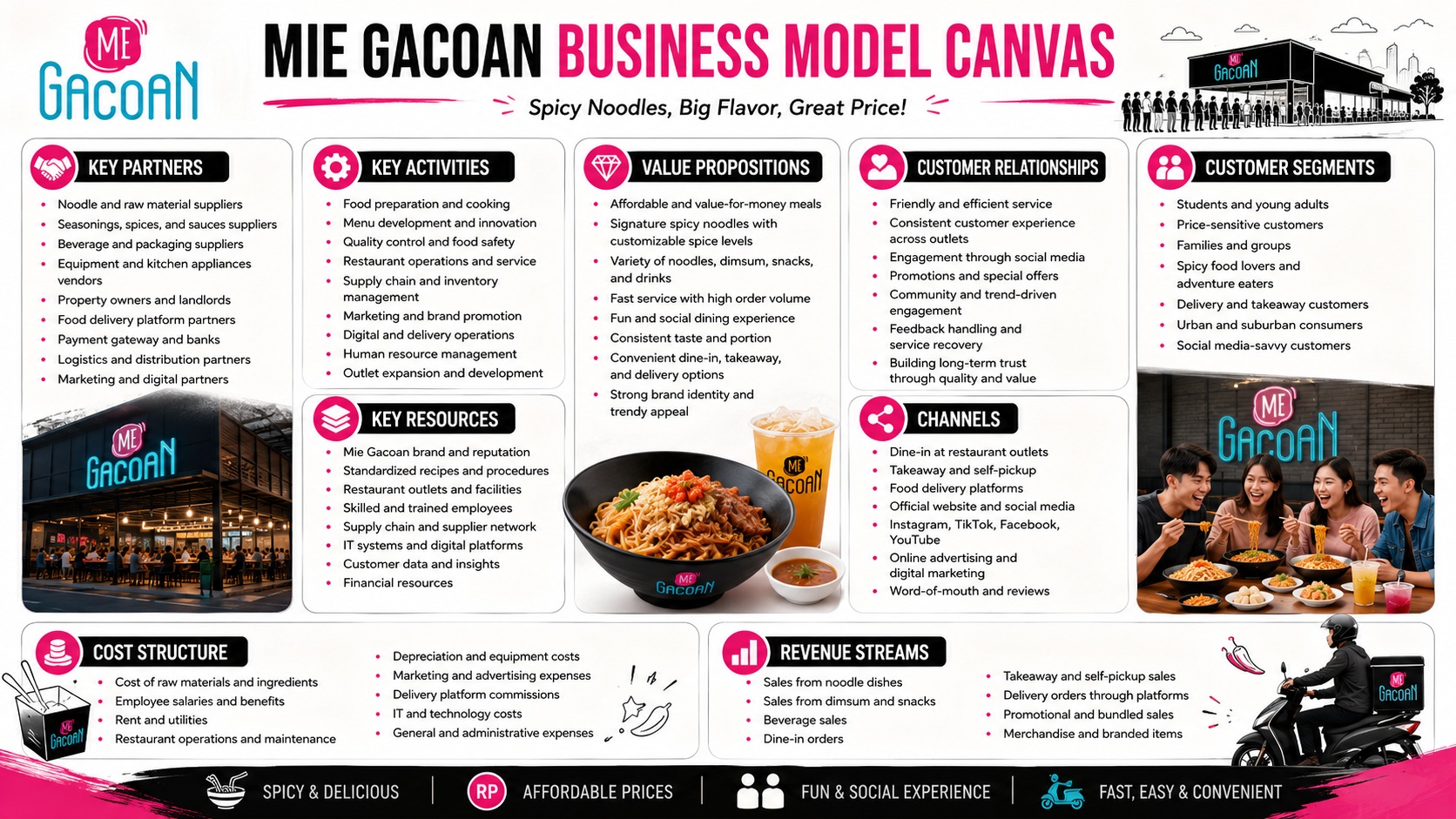
| Customer Segments | Students, young adults, price-sensitive consumers, families, groups, delivery customers, and spicy-food enthusiasts |
| Value Propositions | Affordable meals, distinctive spicy noodles, customisable spice levels, social dining, fast service, and recognisable branding |
| Channels | Physical outlets, takeaway, food-delivery platforms, social media, digital maps, and word-of-mouth |
| Customer Relationships | Mass-market service, social media engagement, consistent experience, promotions, and community-driven popularity |
| Revenue Streams | Noodle sales, dim sum, snacks, beverages, takeaway orders, delivery orders, and bundled purchases |
| Key Resources | Brand, recipes, outlet network, employees, kitchen systems, supplier network, customer data, and operating procedures |
| Key Activities | Food preparation, procurement, quality control, outlet operations, marketing, expansion, and staff development |
| Key Partnerships | Ingredient suppliers, landlords, delivery platforms, payment providers, equipment vendors, and logistics partners |
| Cost Structure | Ingredients, labour, rent, utilities, equipment, outlet development, delivery commissions, marketing, and technology |
The following diagram provide a visual summary of the nine interconnected business model blocks.
The following section breaks the Mie Gacoan Business Model Canvas into its nine core building blocks. Each block helps explain how the company creates value, delivers that value to customers, and supports a high-volume restaurant model through consistent operations, accessible pricing, and scalable execution.
Customer segments explain who Mie Gacoan serves and why these groups are commercially attractive. Although the restaurant appeals to a broad market, its strongest positioning is among young and value-conscious consumers.
Students and early-career employees are important because they tend to seek affordable meals, informal gathering places, and shareable experiences. Groups also represent a valuable segment because one dining visit can generate several noodle orders, multiple drinks, and shared side dishes.
Families broaden the customer base beyond youth culture. Non-spicy options, snacks, beverages, and accessible prices allow parents and children with different preferences to dine together.
Delivery customers form another segment. These consumers prioritise convenience and may order from workplaces, homes, campuses, or shared accommodation.
| Segment | Details | Why It Matters |
|---|---|---|
| Students and young adults | Price-sensitive customers attracted by spicy food, social settings, and trend-led brands | Generate frequent visits, online engagement, and group demand |
| Mass-market diners | Consumers seeking filling meals at accessible prices | Provide high transaction volume across different locations |
| Families and groups | Customers ordering several meals, snacks, and drinks together | Increase basket size and support dine-in demand |
| Delivery customers | Buyers ordering through digital food platforms | Extend sales beyond restaurant capacity and physical catchment areas |
The Mie Gacoan Business Model Canvas benefits from customer overlap. A student can visit with friends, order delivery later, and return with family, allowing one customer to participate in several consumption occasions.
The value proposition explains why customers choose Mie Gacoan instead of another noodle restaurant, café, or fast-food outlet. Affordability is central, but the total proposition includes taste, customisation, convenience, social experience, and brand familiarity.
Spice-level selection gives customers control over the dining experience. Some buyers want an intense challenge, while others prefer a milder or non-spicy option.
Distinctive menu naming makes the offer memorable and easier to discuss online. Visual beverages, compact side dishes, and recognisable presentation also support social media sharing.
Restaurant environments provide additional value. Customers are not only purchasing food; they gain access to an informal place for meeting, eating, and spending time without premium café prices.
| Value Proposition | Details | Why It Matters |
|---|---|---|
| Affordable meals | Low entry prices make noodles and sides accessible to a broad market | Encourages trial, repeat visits, and group purchases |
| Customisable spice | Customers can select an intensity that matches their preference | Expands appeal and creates a participative experience |
| Distinctive brand | Memorable names, visual identity, and social media relevance differentiate the offer | Improves recall and strengthens word-of-mouth |
| Convenient social dining | Large outlets, quick ordering, takeaway, and delivery support different occasions | Combines food value with convenience and social utility |
The Mie Gacoan Business Model Canvas is strong because value is created through the complete experience rather than through noodles alone. Price attracts customers, while flavour, customisation, atmosphere, and brand recognition encourage repeat demand.
Channels describe how Mie Gacoan attracts customers, accepts orders, delivers meals, and remains visible. Physical outlets are the main channel because they support dine-in sales, takeaway orders, brand exposure, and high-volume production.
Outlet location is strategically important. Sites near universities, residential areas, commercial districts, and high-traffic roads can attract recurring demand throughout the day.
Food-delivery applications provide a second major route to market. These platforms increase convenience, expose the brand to customers searching by category, and allow outlets to generate orders beyond available seating.
Social media functions as an awareness and engagement channel. Customer reviews, videos, photographs, and queue-related content create digital visibility without depending entirely on conventional advertising.
| Channel | Details | Why It Matters |
|---|---|---|
| Physical outlets | Dine-in restaurants located in accessible urban and suburban areas | Generate volume, visibility, and direct customer experience |
| Takeaway | Orders collected from outlets for consumption elsewhere | Improves convenience and serves customers avoiding queues |
| Delivery platforms | Third-party applications providing ordering, payment, and delivery | Expands reach and creates additional sales occasions |
| Social and digital channels | Social media, online reviews, digital maps, and search platforms | Support discovery, reputation, and user-generated promotion |
The Mie Gacoan Business Model Canvas relies on channels that reinforce one another. Digital popularity brings customers to outlets, visible restaurant crowds create social proof, and delivery availability captures customers who prefer convenience.
Customer relationships explain how Mie Gacoan attracts customers, manages the restaurant experience, and encourages repeat visits. The model is primarily transactional, but brand engagement and community visibility create a stronger emotional layer.
Standardised service helps customers know what to expect. Familiar ordering processes, consistent menu categories, and recognisable outlet designs reduce uncertainty when visiting a new location.
Social media keeps the brand connected with younger audiences. Product content, customer posts, memes, reviews, and online conversations maintain visibility between purchases.
Affordability also supports loyalty. Customers may not require a formal loyalty programme when the value proposition already makes frequent repurchase financially practical.
| Relationship Type | Details | Why It Matters |
|---|---|---|
| Standardised service | Similar menus, processes, and customer experiences across outlets | Builds familiarity and reduces purchase uncertainty |
| Digital engagement | Brand content and customer-generated posts across social platforms | Maintains relevance and strengthens organic reach |
| Value-based loyalty | Accessible pricing encourages customers to return frequently | Supports repeat business without heavy loyalty rewards |
| Service recovery | Complaint handling, order correction, and feedback management | Protects reputation in a high-volume environment |
Customer relationships are therefore supported by reliability rather than extensive personalisation. The company must provide an experience that feels familiar, affordable, and socially relevant each time customers return.
Revenue streams show how Mie Gacoan converts customer traffic into income. Noodle sales generate the core transaction, but complementary items are essential to the overall economics.
Side dishes and dim sum can raise the average order value without significantly complicating the customer decision. Beverages provide another important contribution because many customers purchase drinks to balance spicy food.
Group dining creates natural cross-selling opportunities. A table may order individual noodle dishes, several beverages, and shared snacks within one transaction.
Delivery adds incremental revenue, although commissions and promotional discounts can reduce the margin earned from each order. Takeaway orders may provide better economics when customers collect food directly.
| Revenue Stream | Details | Why It Matters |
|---|---|---|
| Noodle sales | Core menu items offered in several flavour and spice variations | Drive customer traffic and establish the main price anchor |
| Dim sum and snacks | Complementary side dishes added to individual or group orders | Increase basket size and support product variety |
| Beverage sales | Cold drinks designed to accompany spicy food | Improve transaction value and balance the low noodle price |
| Delivery and takeaway | Off-premise orders through outlets and digital platforms | Expand sales beyond available seating capacity |
The Mie Gacoan Business Model Canvas depends on transaction composition, not only noodle volume. A low-priced core item becomes more commercially sustainable when customers add drinks, snacks, or multiple products to the order.
Key resources are the assets and capabilities required to operate the restaurant network consistently. The Mie Gacoan brand is one of the most visible resources because recognition reduces customer acquisition costs and supports new-outlet demand.
Standardised recipes and operating procedures are equally important. Customers expect similar taste, portion size, spice intensity, and service processes across different locations.
Employees represent another critical resource. Kitchen teams, cashiers, servers, outlet supervisors, procurement personnel, marketers, and expansion teams must coordinate within a high-volume environment.
Supplier relationships and procurement scale support ingredient availability and cost control. Reliable information systems also help manage transactions, inventory, ordering, and operational performance.
| Resource | Details | Why It Matters |
|---|---|---|
| Brand and intellectual property | Brand name, visual identity, menu concepts, recipes, and operating knowledge | Differentiate the restaurant and support national recognition |
| Outlet network | Restaurant locations, kitchens, equipment, and dining capacity | Provide physical reach and production capability |
| Employees and management | Frontline teams, supervisors, trainers, and corporate functions | Maintain service, food quality, and expansion execution |
| Supply and operating systems | Suppliers, procurement processes, inventory tools, and standard procedures | Support consistency, efficiency, and cost control |
Competitive strength comes from combining these resources into a repeatable operating system. A competitor may copy spicy noodles, but reproducing the same brand awareness, traffic volume, supplier scale, and outlet discipline is more difficult.
Key activities describe what Mie Gacoan must perform well every day. Food preparation is the most visible activity, but the broader model requires procurement, quality assurance, staffing, outlet maintenance, marketing, and expansion management.
Kitchen workflow must process high order volumes without sacrificing consistency. Ingredient preparation, cooking sequences, assembly, order verification, and collection processes therefore require careful standardisation.
Procurement teams must secure sufficient ingredients at commercially sustainable prices. Inventory planning also needs to minimise shortages, spoilage, and excessive stock.
Marketing activities keep the brand relevant among younger consumers. Meanwhile, site selection and outlet development determine whether new restaurants can generate enough traffic to justify their investment.
| Activity | Details | Why It Matters |
|---|---|---|
| High-volume food production | Preparing noodles, sides, and drinks through repeatable kitchen processes | Supports speed, consistency, and customer throughput |
| Procurement and quality control | Sourcing ingredients and monitoring food standards | Protects cost efficiency and customer trust |
| Outlet operations | Managing staff, queues, cleanliness, equipment, and service | Converts brand demand into a reliable experience |
| Brand building and expansion | Marketing, location selection, outlet development, and market entry | Sustains awareness and creates future growth |
Operational excellence is fundamental because low prices leave limited room for waste, service failures, or inconsistent productivity. Efficient execution protects both customer satisfaction and unit economics.
Key partnerships explain which external organisations help Mie Gacoan operate and expand. Ingredient suppliers provide noodles, seasonings, proteins, vegetables, cooking oil, beverages, and packaging materials.
Property owners and developers are important because outlet performance depends partly on location quality, building suitability, parking access, customer flow, and rental terms.
Food-delivery platforms connect restaurants with digital customers. Payment providers also enable cashless transactions and simplify checkout.
Equipment vendors, maintenance contractors, logistics providers, and technology suppliers support operational continuity. Local authorities and certification bodies affect licensing, food safety, employment compliance, and restaurant approvals.
| Partner Type | Details | Why It Matters |
|---|---|---|
| Food and packaging suppliers | Providers of ingredients, beverages, containers, and consumables | Support product consistency, availability, and cost management |
| Property partners | Landlords, developers, and site-related service providers | Enable outlet access in commercially attractive areas |
| Delivery and payment platforms | Digital ordering, payment, promotion, and delivery providers | Improve convenience and expand customer reach |
| Operational vendors | Equipment, maintenance, logistics, technology, and professional service firms | Keep outlets functioning and support scalable operations |
Partnership quality influences both growth and resilience. Reliable suppliers reduce disruption, suitable landlords support long-term outlet economics, and digital platforms create additional demand.
Cost structure explains the main expenses required to maintain affordable prices and operate a large restaurant network. Ingredients represent a significant variable cost because sales volume increases consumption of noodles, seasonings, proteins, cooking oil, beverages, and packaging.
Labour is another major component. High-volume restaurants require sufficient employees to handle preparation, ordering, cleaning, customer service, supervision, and extended operating hours.
Property costs include rent, deposits, renovations, maintenance, and outlet-related charges. Utilities can also be substantial because kitchens use electricity, gas, water, refrigeration, ventilation, and cooking equipment throughout the day.
Expansion introduces additional capital requirements. New locations require site evaluation, construction, equipment, recruitment, training, and launch marketing before stable sales are achieved.
| Cost Category | Details | Why It Matters |
|---|---|---|
| Food and packaging | Ingredients, beverages, cooking materials, takeaway containers, and consumables | Directly affect gross margin and pricing sustainability |
| Labour | Salaries, benefits, training, uniforms, and workforce management | Determine service capacity and operating consistency |
| Property and utilities | Rent, renovation, maintenance, electricity, water, and gas | Represent major fixed and semi-variable outlet expenses |
| Expansion and platforms | New-outlet investment, technology, delivery commissions, and promotions | Support growth but may pressure cash flow and margins |
Cost discipline must focus on productivity rather than indiscriminate reduction. Cutting staff, ingredients, or maintenance too aggressively could weaken service speed, food quality, and customer trust.
The Value Proposition Canvas explains how Mie Gacoan’s products and services address customer jobs, pains, and desired gains.
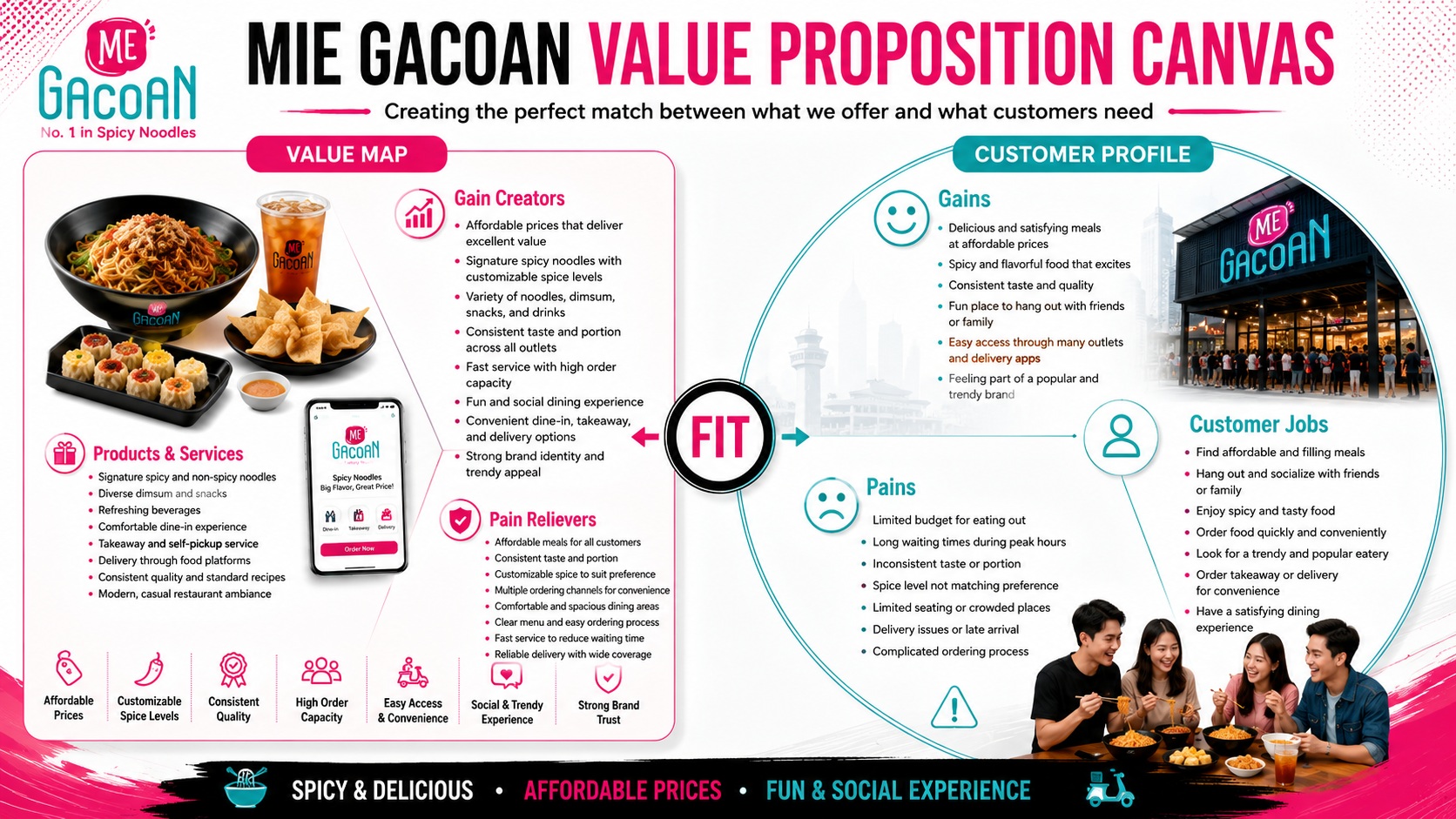
The customer profile explains what Mie Gacoan’s target customers are trying to achieve, what frustrates them during the dining journey, and what outcomes they value most. This section helps clarify why affordability, spicy flavour, convenience, and social relevance matter so much in the broader value proposition.
| Customer Profile | Details |
|---|---|
| Customer Jobs | Find an affordable meal, satisfy hunger, enjoy spicy food, meet friends, order conveniently, and experience a popular restaurant brand |
| Customer Pains | Limited budgets, expensive cafés, inconsistent food quality, long waiting times, unsuitable spice levels, and delivery inconvenience |
| Customer Gains | Filling food, enjoyable flavours, price transparency, social atmosphere, customisable spice, convenient ordering, and shareable experiences |
Customers are not only trying to purchase noodles. Many are seeking an inexpensive combination of food, entertainment, convenience, and social interaction.
The value map explains how Mie Gacoan’s products, services, and experience are designed to respond to customer needs. It shows the practical ways the brand creates gains, reduces frustrations, and turns an affordable spicy noodle concept into a broader dining experience that feels convenient, social, and memorable.
| Value Map | Details |
|---|---|
| Products and Services | Spicy and non-spicy noodles, dim sum, fried snacks, beverages, dine-in service, takeaway, and delivery |
| Pain Relievers | Affordable prices, standardised menus, spice-level options, multiple ordering channels, and recognisable outlet formats |
| Gain Creators | Distinctive flavours, memorable branding, social dining spaces, visually appealing drinks, and group-friendly menu combinations |
The value map works because it addresses both functional and emotional needs. Food satisfies hunger, while the brand and environment make the visit feel more entertaining and socially relevant.
This section shows how Mie Gacoan connects its products, service model, and brand experience to what customers actually want. The fit becomes visible when affordable meals, convenient access, consistent quality, and social appeal directly address customer jobs, reduce key frustrations, and strengthen the gains customers are looking for.
| Customer Profile | Details | Matching Value Map | How Mie Gacoan Creates Fit |
|---|---|---|---|
| Customer Jobs | Customers want an affordable, filling, and convenient meal suitable for individual or group dining | Products and Services | Noodles, sides, drinks, dine-in, takeaway, and delivery provide several ways to complete the meal |
| Customer Pains | Buyers face budget limits, inconsistent flavours, limited spice choice, and inconvenient access | Pain Relievers | Standardised products, accessible pricing, spice levels, and multiple channels reduce these barriers |
| Customer Gains | Diners value taste, social atmosphere, convenience, customisation, and memorable experiences | Gain Creators | Distinctive branding, group-friendly outlets, menu variety, and digital visibility make the experience more engaging |
Fit occurs when customers perceive that they are receiving more than the price paid. Affordable food attracts initial demand, while consistency and social relevance support repeat visits.
The strongest fit occurs during informal and price-sensitive dining occasions. Students may visit after classes, employees may order lunch, groups may meet during evenings, and families may choose the restaurant for an affordable shared meal.
Another important fit happens in digitally influenced decisions. Customers who see food videos, outlet reviews, or social media posts may choose Mie Gacoan because the brand appears popular, recognisable, and low risk.
Delivery creates fit when convenience matters more than atmosphere. Physical outlets become more valuable when customers want a social setting, immediate consumption, or access to the full restaurant experience.
The following space can be used for a Value Proposition Canvas diagram showing how customer jobs, pains, and gains connect with products and services, pain relievers, and gain creators.
Mie Gacoan differs from many conventional noodle restaurants in positioning, operating structure, and growth ambition. A traditional operator may depend heavily on one location, owner involvement, flexible recipes, and local word-of-mouth. Mie Gacoan uses a more standardised chain model.
| Dimension | Mie Gacoan | Conventional Noodle Restaurant |
|---|---|---|
| Market positioning | Mass-market, youthful, affordable, and experience-oriented | Often local, product-focused, and dependent on neighbourhood demand |
| Menu structure | Focused core menu with spice levels, sides, and beverages | May offer a broader or less standardised selection |
| Operating model | Repeatable processes designed for high volume and multiple outlets | Frequently reliant on individual cooks or owner supervision |
| Customer acquisition | Brand recognition, social media, queues, digital reviews, and delivery platforms | Local reputation, passing traffic, and customer referrals |
| Expansion approach | Structured outlet growth supported by a central brand and systems | Usually slower and limited by capital or management capacity |
| Revenue logic | High volume plus cross-selling of sides and drinks | Margin may depend more heavily on each main dish |
Neither model is automatically superior. A conventional restaurant may offer greater flexibility and local authenticity, while Mie Gacoan gains stronger scalability, consistency, and brand visibility.
The Mie Gacoan Business Model Canvas highlights several interconnected advantages that make the brand difficult to challenge through product imitation alone.
Together, these advantages create a reinforcing system. Affordability generates traffic, traffic creates visibility, visibility attracts new customers, and higher volume supports further expansion.
Mie Gacoan’s growth model also creates material operational, financial, and reputational risks.
These risks do not invalidate the model. Instead, they show that growth must be supported by stronger controls, outlet-level data, disciplined site selection, and consistent operating standards.
Mie Gacoan should protect affordability while developing a more deliberate price architecture. Entry-level noodles can remain accessible, while premium sides, bundles, beverages, and limited products provide higher-margin alternatives.
Management should strengthen queue and capacity management. Digital pre-ordering, clearer collection systems, kitchen performance dashboards, and outlet-specific staffing can reduce customer frustration during peak periods.
Health-conscious options deserve measured expansion. Vegetable additions, lighter side dishes, transparent nutritional information, and moderate-spice choices could broaden the addressable market without weakening the core identity.
Outlet growth should remain disciplined. Site decisions need to consider demand density, rental economics, delivery potential, parking, traffic access, labour availability, and cannibalisation from nearby restaurants.
Customer data can support better commercial decisions. Direct ordering, digital receipts, feedback systems, and loyalty functionality may reduce dependence on third-party platforms while improving purchase insight.
Supply resilience is another priority. Multiple approved suppliers, food-safety audits, standard ingredient specifications, and contingency planning can reduce disruption as the network expands.
Finally, the brand should balance menu innovation with operational simplicity. New items should increase visit frequency or transaction value without creating excessive kitchen complexity.
Overall, the Mie Gacoan Business Model Canvas explains how an affordable noodle restaurant can become a scalable mass-market platform. Its competitive strength comes from combining low entry prices, high sales volume, focused products, operational standardisation, social dining, and youth-oriented branding.
Mie Gacoan does not compete only through spicy flavour. The company sells an accessible experience where customers can eat, customise, socialise, and participate in a widely recognised food trend.
Future performance will depend on execution quality. Stronger queue management, supply controls, food safety, site selection, workforce development, and customer data capabilities will become increasingly important as the outlet network grows.
The model remains powerful as long as affordability does not undermine profitability and expansion does not weaken consistency. When those two tensions are managed effectively, Mie Gacoan can continue building scale while protecting the customer value that made the brand popular.
This article is provided for educational and business analysis purposes only. Its content is based on publicly available information, general market observations, and strategic interpretation. It does not constitute financial advice, investment advice, legal advice, franchise advice, or an official statement from PT Pesta Pora Abadi or Mie Gacoan.
Readers should conduct their own research before making any business, investment, partnership, or strategic decisions. All trademarks, logos, copyrights, brand names, menu names, images, and related materials mentioned or shown in this article belong to their respective owners.
Explore the FedEx Business Model Canvas, nine BMC blocks, Value Proposition Canvas, UPS and DHL… Read More
Explore the Quipper Business Model Canvas, nine BMC blocks, Value Proposition Canvas, Ruangguru and Pahamify… Read More
Explore the CARPUT Business Model Canvas, nine BMC blocks, Value Proposition Canvas, competitor comparison, competitive… Read More
Explore the Boost Business Model Canvas, nine BMC blocks, Value Proposition Canvas, competitor comparison, advantages,… Read More
Explore the Domino's Pizza Business Model Canvas, nine BMC blocks, Value Proposition Canvas, Pizza Hut… Read More
Restaurant Business Model Canvas: A Practical Guide to Designing, Evaluating, and Improving Restaurant Business Models… Read More