



Share This Article


FashionValet Business Model Canvas: Growth, Strategic Pivot, and Lessons from a Malaysian Fashion Platform
BMC Article No: BMC #010
Updated in 2026: This article has been comprehensively revised to reflect the closure of FashionValet’s original multi-brand marketplace, the company’s shift towards proprietary brands, publicly reported investment developments, changing fashion e-commerce conditions, deeper analysis of all nine Business Model Canvas blocks, an expanded Value Proposition Canvas, a competitor comparison, possible reasons for the business difficulties, and updated strategic recommendations.
Introduction
FashionValet was one of Malaysia’s most prominent fashion e-commerce ventures. Founded in 2010 by Vivy Yusof and Fadzarudin Shah Anuar, the company initially created a digital platform connecting consumers with Malaysian and Southeast Asian fashion designers.
The FashionValet Business Model Canvas is strategically important because the company was not simply an online clothing retailer. Its operating model combined fashion curation, e-commerce technology, inventory management, digital marketing, logistics, physical stores, customer service, proprietary product development, and regional expansion.
Such a structure created significant growth opportunities. FashionValet could aggregate products from multiple designers, attract consumers to one platform, manage transactions, improve product presentation, and provide a more consistent shopping experience.
However, every additional brand, product category, store, and market increased operational complexity. FashionValet eventually closed its original multi-brand marketplace and concentrated more heavily on proprietary brands such as dUCk and LILIT.
Its journey therefore provides valuable lessons about marketplace economics, customer acquisition, brand ownership, inventory risk, physical retail expansion, investor expectations, and the importance of sustainable unit economics.
What Is FashionValet’s Business Model?
FashionValet originally operated a curated fashion marketplace supported by online commerce and physical retail. The platform selected products from independent designers, presented them through a central digital storefront, processed customer transactions, and coordinated product delivery.
At its core, the FashionValet Business Model Canvas describes a company that attempted to create value for two sides of the market. Consumers received convenient access to regional fashion, while designers gained exposure, digital infrastructure, marketing support, and access to a broader customer base.
FashionValet generated income through product sales, retail margins, proprietary-brand sales, physical-store transactions, seasonal collections, and selected collaborations.
Over time, the company developed greater emphasis on brands it owned or controlled. dUCk became known for scarves, bags, accessories, cosmetics, stationery, and lifestyle products, while LILIT focused on modest and contemporary apparel.
This transition changed the commercial model. A multi-brand retailer receives only part of the value generated by third-party products. An owned-brand company can control product design, manufacturing, pricing, distribution, customer data, and brand positioning.
FashionValet announced the closure of its multi-brand marketplace in 2022 and redirected its attention towards dUCk and LILIT. The decision represented a strategic pivot from broad product aggregation towards more focused brand ownership.
What Is Business Model Canvas?
Business Model Canvas, or BMC, is a strategic framework used to explain how an organisation creates value, delivers that value to customers, and captures financial returns.
Rather than analysing only products or revenue, the framework connects nine important business components. These components include customers, value propositions, delivery channels, customer relationships, revenue sources, resources, activities, partnerships, and costs.
For FashionValet, the framework is useful because commercial performance depended on more than fashion demand. Product selection, website traffic, supplier relationships, inventory turnover, fulfilment expenses, returns, marketing costs, physical-store productivity, and customer retention all affected profitability.
The FashionValet Business Model Canvas therefore provides a structured view of how FashionValet’s creative, commercial, operational, and financial activities worked together.
| BMC Block | Main Question |
|---|---|
| Customer Segments | Who does the business serve? |
| Value Propositions | What value does the business offer? |
| Channels | How does the business reach customers? |
| Customer Relationships | How does the business build loyalty? |
| Revenue Streams | How does the business generate income? |
| Key Resources | What assets does the business require? |
| Key Activities | What must the business execute effectively? |
| Key Partnerships | Which external parties support the business? |
| Cost Structure | What are the organisation’s major costs? |
Quick Overview of FashionValet
FashionValet was established in Kuala Lumpur in 2010. Its early proposition was to make Southeast Asian fashion easier to discover and purchase online, particularly when many independent designers had limited e-commerce capabilities.
The company provided designers with access to an existing audience, online merchandising, payment processing, marketing support, customer service, and fulfilment infrastructure. Consumers received a central destination where they could browse multiple brands without visiting individual boutiques or websites.
By 2018, FashionValet reportedly carried more than 400 brands and approximately 15,000 products. Khazanah Nasional invested RM27 million for a 9% stake when the company was positioned as a high-growth Malaysian e-commerce platform.
FashionValet later expanded through physical stores and proprietary brands. Retail outlets allowed customers to inspect materials, evaluate sizing, receive assistance, and experience the brand physically.
Nevertheless, the multi-brand marketplace was closed in 2022. FashionValet subsequently concentrated its resources on house brands, particularly dUCk and LILIT, creating a more focused but operationally different business model.
Why FashionValet Is Strategically Interesting
FashionValet is strategically interesting because it combined several business models within one organisation.
The company operated as a fashion marketplace, digital retailer, physical-store operator, brand developer, media platform, logistics coordinator, and customer-service provider.
A customer did not interact only with a clothing product. The complete experience included discovering a brand, evaluating the design, reviewing size information, making payment, receiving the order, inspecting the packaging, requesting an exchange, and engaging with promotional content.
FashionValet also depended heavily on founder-led communication. Vivy Yusof’s social-media presence provided the company with substantial audience reach and helped create an aspirational identity around FashionValet and its related brands.
Marketplace growth and owned-brand growth, however, require different capabilities. A marketplace prioritises supplier acquisition, catalogue variety, transaction volume, and platform traffic. A proprietary-brand business must manage design, manufacturing, demand forecasting, pricing, inventory, and long-term brand equity.
The company’s evolution illustrates how a digital intermediary may eventually determine that greater strategic control lies in owning the products and brands rather than distributing products from external suppliers.
Latest Developments: What Is Changing Around FashionValet?
In 2026, the FashionValet Business Model Canvas is shaped by four major developments.
First, FashionValet no longer operates as the broad multi-brand marketplace that originally defined the company. The platform was closed in 2022 as management shifted attention towards proprietary brands.
Second, dUCk and LILIT became central to the group’s future direction. This transition indicated that management saw stronger commercial potential in controlling product design, brand positioning, customer experience, and margins.
Third, FashionValet’s historical financial performance and investor exits received significant public attention. Khazanah Nasional and Permodalan Nasional Berhad originally invested a combined RM47 million before selling their interests for RM3.1 million, resulting in a reported investment loss of RM43.9 million. Khazanah cited the pandemic, difficult fundraising conditions, and the company’s capital requirements among the challenges affecting the investment.
Fourth, fashion retail has become increasingly competitive. Independent labels can now reach consumers through their own websites, social media, live commerce, Shopee, TikTok Shop, Zalora, and other digital channels.
Together, these developments transformed FashionValet from a regional marketplace growth story into a case study of strategic restructuring, cost pressure, and business-model focus.
FashionValet Business Model Canvas Summary
Before examining each block, the following summary provides a concise view of the FashionValet Business Model Canvas and how its major components connect.
The overview includes both the original marketplace operation and FashionValet’s later emphasis on proprietary brands. This distinction matters because the two formats have different revenue economics, operational responsibilities, and strategic risks.
| BMC Block | FashionValet Application |
|---|---|
| Customer Segments | Fashion-conscious women, modest-fashion customers, professionals, gift buyers, regional consumers, independent designers, and fashion labels |
| Value Propositions | Curated regional fashion, convenient discovery, trusted presentation, premium experiences, exclusive collections, and access to proprietary brands |
| Channels | E-commerce website, physical stores, social media, email, influencers, events, and brand collaborations |
| Customer Relationships | Founder-led storytelling, social engagement, customer service, product launches, community building, and personalised communication |
| Revenue Streams | Third-party product sales, proprietary-brand sales, physical-store transactions, collaborations, and seasonal collections |
| Key Resources | Brand reputation, customer data, digital infrastructure, proprietary brands, supplier network, retail locations, and fashion expertise |
| Key Activities | Product development, merchandising, inventory management, marketing, fulfilment, retail operations, and customer service |
| Key Partnerships | Designers, manufacturers, suppliers, logistics companies, payment providers, landlords, technology vendors, and investors |
| Cost Structure | Inventory, manufacturing, fulfilment, rent, payroll, technology, marketing, warehousing, returns, and markdowns |
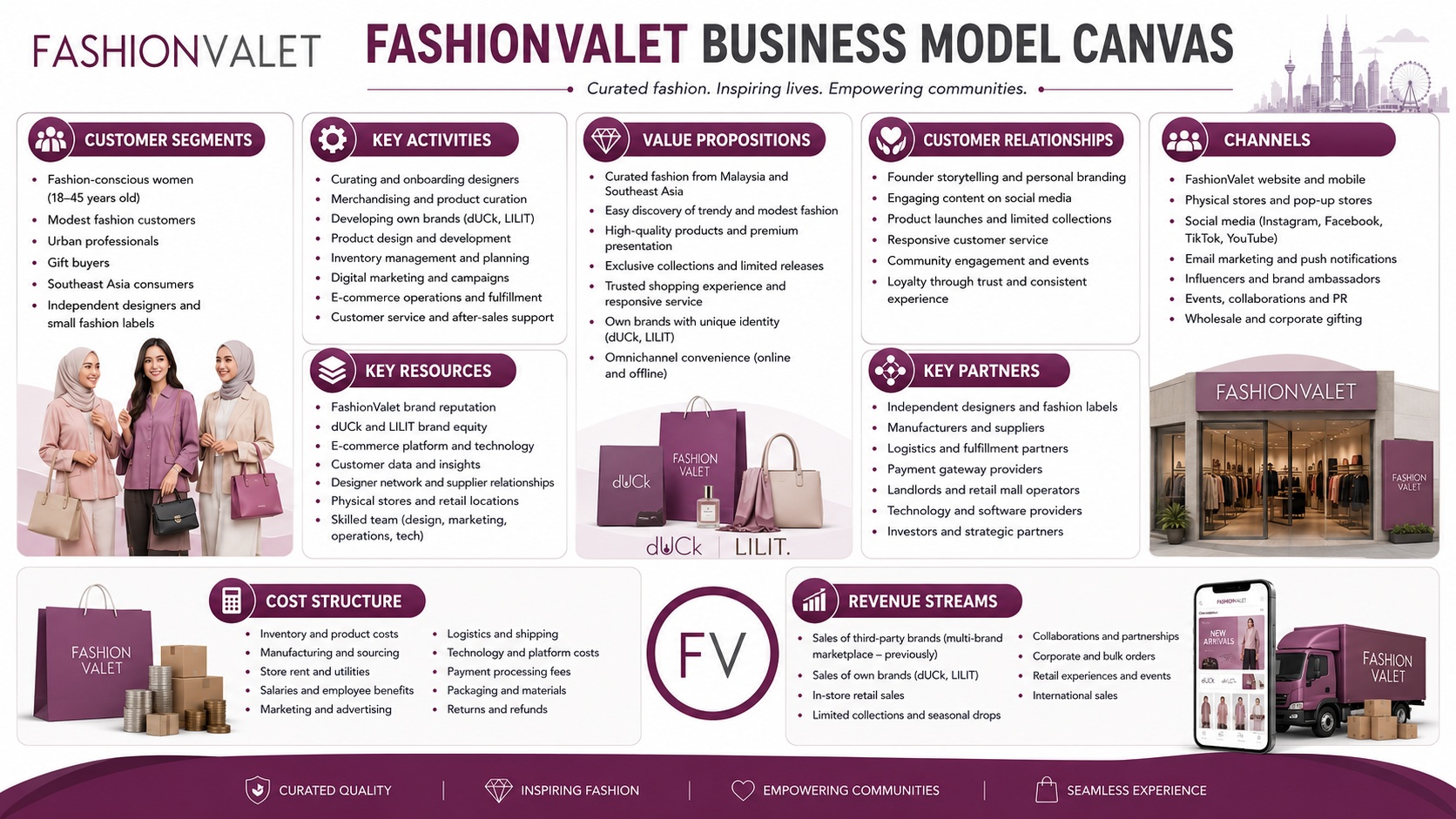
FashionValet BMC Diagram
The FashionValet BMC diagram provides a visual summary of how the company’s customer proposition, operating activities, resources, partners, revenue sources, and cost commitments connect within one commercial system.
BMC Analysis of FashionValet
The detailed FashionValet Business Model Canvas analysis examines how the nine building blocks supported FashionValet’s marketplace and proprietary-brand operations.
Each block represents a distinct area of the company, but performance depended on alignment across product selection, customer demand, supplier participation, marketing, inventory, fulfilment, retail stores, and financial controls.
For example, expanding the product range could improve customer choice but also increase merchandising and inventory complexity. Opening physical stores strengthened brand visibility, although rental, staffing, renovation, and store-level stock increased fixed-cost exposure.
Similarly, proprietary brands could provide better margins and stronger differentiation. They also transferred responsibility for manufacturing, demand forecasting, quality, and unsold inventory directly to FashionValet.
The following sections explain how each BMC block contributed to the business and where strategic pressure may have emerged.
1. Customer Segments
Customer segments explain who FashionValet served and why those groups mattered.
FashionValet primarily targeted digitally active women seeking modern, modest, premium, and regionally relevant fashion. Young professionals could use the platform to purchase workwear, occasion wear, accessories, and festive clothing.
Modest-fashion consumers represented an especially relevant segment. These customers wanted products combining style, comfort, cultural relevance, and suitable coverage.
Gift buyers formed another attractive customer group. Premium scarves, accessories, packaging, and limited-edition collections made brands such as dUCk suitable for birthdays, festive occasions, corporate gifts, and celebrations.
The original marketplace also served designers and independent labels. These businesses needed customer exposure, online merchandising, payment infrastructure, promotional support, and access to FashionValet’s established audience.
FashionValet Customer Segments
| Segment | Details | Why It Matters |
|---|---|---|
| Fashion-conscious women | Customers seeking contemporary, distinctive, and regionally relevant fashion | Supported demand for curated designers and exclusive products |
| Modest-fashion customers | Consumers looking for fashionable products aligned with modest dressing preferences | Created a focused category for dUCk, LILIT, and related collections |
| Professionals and urban consumers | Digitally active buyers purchasing workwear, lifestyle products, and occasion wear | Supported online convenience, premium positioning, and repeat purchases |
| Designers and fashion labels | Independent brands requiring market access and e-commerce support | Provided the variety needed by the original marketplace |
FashionValet needed to create sufficient value for both shoppers and designers. Weakening value on either side could reduce product availability, customer traffic, or marketplace relevance.
2. Value Propositions
The value proposition explains why customers and designers selected FashionValet instead of alternative channels.
For consumers, FashionValet offered convenient access to curated Malaysian and Southeast Asian fashion. Rather than browsing multiple designer websites or visiting separate boutiques, customers could discover different brands through one platform.
Professional product presentation also reduced purchase uncertainty. Photography, descriptions, payment processing, delivery coordination, and customer support made smaller labels appear more accessible and trustworthy.
Independent designers received another form of value. FashionValet offered exposure to an established customer base, centralised digital infrastructure, marketing assistance, and potentially broader geographical reach.
FashionValet Value Propositions
| Value Proposition | Details | Why It Matters |
|---|---|---|
| Curated regional fashion | Selected products from Malaysian and Southeast Asian designers | Reduced discovery effort and differentiated FashionValet from mass marketplaces |
| Convenient shopping | Centralised browsing, payment, delivery, and customer support | Simplified purchases involving unfamiliar or fragmented fashion labels |
| Premium presentation | Professional imagery, storytelling, packaging, and physical retail environments | Increased trust and strengthened the perceived value of regional products |
| Proprietary fashion brands | Exclusive products under dUCk, LILIT, and related collections | Created stronger differentiation and reduced supplier dependence |
FashionValet’s proposition became more defensible when it offered products unavailable through competing platforms. Owned brands strengthened that position because customers could not bypass FashionValet to purchase directly from an external designer.
3. Channels
Channels describe how FashionValet reached customers and converted interest into transactions.
The e-commerce website served as the company’s central digital channel. Customers could browse collections, review product information, choose sizes, make payments, and arrange delivery.
Physical stores addressed several limitations of online fashion retail. Visitors could inspect materials, compare colours, try garments, receive assistance, and experience the brand in a premium environment.
Social media was equally important. Instagram, Facebook, influencer content, videos, founder communication, and campaign announcements helped FashionValet maintain customer attention and create demand around product launches.
FashionValet Channels
| Channel | Details | Why It Matters |
|---|---|---|
| E-commerce website | Platform for product discovery, purchasing, payment, and customer information | Enabled nationwide and cross-border market access |
| Physical stores | Locations where customers could inspect, try, and purchase products | Reduced sizing uncertainty and supported premium brand experiences |
| Social media | Product launches, campaigns, styling ideas, and audience interaction | Generated awareness and maintained customer engagement |
| Email and direct marketing | Promotions, launch announcements, and customer updates | Supported retention, repeat purchasing, and targeted communication |
Channel breadth increased FashionValet’s accessibility but also created complexity. Prices, inventory, promotions, service levels, and customer information had to remain coordinated across digital and physical operations.
Each channel therefore required evaluation based on contribution margin, customer acquisition, repeat purchasing, and brand impact rather than sales alone.
4. Customer Relationships
Customer relationships describe how FashionValet attracted customers, maintained engagement, and encouraged repeat purchasing.
Founder-led storytelling was one of the company’s most distinctive relationship mechanisms. Vivy Yusof’s public profile connected fashion products with entrepreneurship, lifestyle, family, and personal identity.
Limited releases and seasonal collections created anticipation. Customers frequently encountered new designs, collaborations, festive products, and promotional campaigns.
Customer service also influenced trust. Fashion buyers often require assistance with sizing, product availability, delivery, exchanges, returns, and quality concerns.
FashionValet Customer Relationships
| Relationship Type | Details | Why It Matters |
|---|---|---|
| Founder-led storytelling | Personal communication connecting products with lifestyle and identity | Built emotional connection and differentiated FashionValet from anonymous marketplaces |
| Product launches | Limited editions, festive collections, collaborations, and new releases | Generated urgency, repeat visits, and social conversation |
| Customer support | Assistance through online channels, social media, email, and stores | Reduced purchase uncertainty and supported service recovery |
| Community engagement | Events, campaigns, styling content, and customer participation | Encouraged loyalty extending beyond individual transactions |
Personality-led marketing accelerated brand awareness, but it also concentrated reputation around visible individuals.
A resilient customer relationship model should combine founder influence with independent brand equity, reliable service, loyalty programmes, strong products, and customer communities.
5. Revenue Streams
Revenue streams explain how FashionValet converted products, customer demand, and brand awareness into income.
The original marketplace earned revenue through the sale of third-party fashion products. Depending on the commercial arrangement, income could come from wholesale mark-ups, consignment margins, commissions, or related retail terms.
Proprietary brands created another income source. FashionValet could control the design, production, retail price, marketing, and distribution of dUCk and LILIT products.
Physical locations generated in-store transactions, while collaborations and festive collections provided additional opportunities for limited-edition and occasion-based sales.
FashionValet Revenue Streams
| Revenue Stream | Details | Why It Matters |
|---|---|---|
| Multi-brand product sales | Revenue generated from products supplied by independent designers | Supported catalogue variety without internally designing every product |
| Proprietary-brand sales | Sales of products under dUCk, LILIT, and other controlled collections | Increased control over pricing, margins, products, and customer experience |
| Physical-store sales | Transactions completed through retail locations | Added customer access and supported experiential shopping |
| Collaborations and seasonal collections | Limited releases, partnerships, and festive products | Created urgency, differentiation, and potentially higher transaction values |
Not every ringgit of revenue contributed equally to profitability. Delivery subsidies, returns, discounts, marketing, payment fees, and inventory markdowns could reduce the actual contribution generated by sales.
The FashionValet Business Model Canvas therefore depended on revenue quality, not merely transaction volume or headline growth.
6. Key Resources
Key resources describe the assets that enabled FashionValet to operate and differentiate itself.
Brand reputation was one of the company’s most important resources. FashionValet became closely associated with Malaysian fashion, modest-fashion growth, digital entrepreneurship, and regional designer discovery.
Customer reach and social-media visibility also created commercial value. New collections could be introduced to an existing audience rather than requiring the company to build awareness from the beginning.
The designer network supported marketplace variety. Later, dUCk and LILIT became more strategically important because FashionValet controlled the products, positioning, and customer proposition.
FashionValet Key Resources
| Resource | Details | Why It Matters |
|---|---|---|
| FashionValet brand | Recognition built through digital commerce, media, designers, and retail expansion | Supported customer trust and supplier participation |
| dUCk and LILIT | Proprietary fashion and lifestyle brands | Created controlled intellectual property and product differentiation |
| Digital platform and customer data | Website, transaction systems, purchase history, and audience information | Enabled online sales, analysis, and targeted communication |
| Fashion and merchandising capabilities | Teams selecting, designing, sourcing, presenting, and promoting products | Connected creative decisions with commercial execution |
Not every resource automatically created an advantage. Stores, warehouses, technology, and employees became expensive when sales productivity or asset utilisation was insufficient.
FashionValet needed to distinguish between assets that built long-term brand equity and assets that mainly increased fixed costs or working-capital requirements.
7. Key Activities
Key activities explain what FashionValet needed to perform consistently.
The marketplace required designer selection, merchandising, product presentation, supplier coordination, digital marketing, order fulfilment, inventory monitoring, and customer service.
Product curation was fundamental. A relevant assortment could attract customers, whereas excessive catalogue expansion could weaken differentiation and complicate inventory decisions.
Owned brands introduced further responsibilities. FashionValet had to design products, source materials, coordinate manufacturing, monitor quality, forecast demand, and determine suitable production quantities.
FashionValet Key Activities
| Activity | Details | Why It Matters |
|---|---|---|
| Product curation and merchandising | Selecting brands, organising products, setting prices, and managing promotions | Determined whether customers found the assortment distinctive and relevant |
| Product development | Designing, sourcing, and producing proprietary collections | Supported differentiation and improved control over product economics |
| Inventory management | Forecasting demand, allocating stock, monitoring sales, and managing markdowns | Protected working capital and reduced unsold-stock exposure |
| Marketing and customer acquisition | Social campaigns, advertising, collaborations, content, and product launches | Converted audience attention into customer demand |
| Fulfilment and customer service | Processing orders, arranging delivery, managing returns, and resolving enquiries | Influenced satisfaction, trust, and repeat purchasing |
Fashion forecasting involves unavoidable uncertainty. Ordering too little results in missed sales, while excessive quantities produce storage costs, markdowns, and cash-flow pressure.
Operational discipline was therefore as important as creativity. Every new category, collection, store, or market required stronger data, controls, and performance monitoring.
8. Key Partnerships
Key partnerships identify the external parties that supported FashionValet’s operations.
Independent designers were central to the original marketplace. Their products created the variety and regional positioning that attracted customers.
Manufacturers became increasingly important when FashionValet expanded proprietary brands. These partners had to meet expectations covering materials, product quality, production quantity, cost, and delivery timelines.
Logistics companies managed domestic and cross-border delivery, while payment providers supported secure and convenient transactions.
Landlords enabled physical retail expansion. Technology vendors supplied e-commerce, analytics, communication, cybersecurity, and operational systems.
FashionValet Key Partnerships
| Partner | Details | Why It Matters |
|---|---|---|
| Designers and fashion labels | Independent brands supplying products to FashionValet | Created variety and strengthened the regional-fashion proposition |
| Manufacturers and suppliers | Partners producing apparel, scarves, accessories, packaging, and lifestyle products | Enabled owned-brand production without fully internal manufacturing |
| Logistics and payment providers | Companies supporting delivery, returns, payments, and transaction security | Completed customer transactions and enabled online scale |
| Landlords, technology vendors, and investors | Partners supplying retail space, systems, and growth capital | Supported expansion, digital infrastructure, and business development |
Designer relationships became more difficult to defend as direct-to-consumer tools became widely available. Labels could sell through their own websites, social channels, live commerce, and larger marketplaces.
FashionValet consequently needed to provide more than basic digital exposure. Exclusive customer demand, superior fulfilment, regional distribution, useful data, and measurable sales conversion were necessary to retain supplier participation.
9. Cost Structure
Cost structure explains the main expenses required to operate FashionValet’s marketplace, retail locations, and proprietary brands.
Inventory and product procurement represented significant costs. FashionValet had to purchase third-party stock, manage consignment arrangements, or fund production for its own collections.
Physical stores added rent, renovation, utilities, employees, maintenance, security, and store-level inventory. These commitments remained even when sales or customer traffic declined.
Marketing was another important expense. Fashion businesses must continuously produce content, launch products, organise campaigns, collaborate with influencers, and maintain consumer attention.
FashionValet Cost Structure
| Cost Category | Details | Why It Matters |
|---|---|---|
| Inventory and manufacturing | Third-party purchasing and production of owned-brand collections | Required working capital and created unsold-product exposure |
| Retail operations | Rent, employees, utilities, renovations, maintenance, and store stock | Increased fixed costs and exposure to weak physical footfall |
| Marketing and customer acquisition | Advertising, content, promotions, launches, collaborations, and discounts | Supported demand but could reduce transaction-level profitability |
| Fulfilment and technology | Warehousing, packing, delivery, returns, payments, and digital systems | Directly affected customer experience and contribution margins |
| Payroll and administration | Fashion, merchandising, technology, operations, finance, and management teams | Supported scale but required sufficient productivity and revenue |
Fashion retailers can record high sales while generating weak cash flow. Inventory may be funded months before being sold, while slow-moving products often require discounts.
Strong cost management must therefore be linked with product, channel, and customer strategy. Revenue alone cannot determine whether a collection, campaign, store, or market creates economic value.
FashionValet Value Proposition Canvas
Before comparing FashionValet with a major competitor, it is useful to examine how the company connected customer needs with its products and services.
The Value Proposition Canvas focuses on customer jobs, pains, and desired gains. It then connects those requirements with the company’s products, pain relievers, and gain creators.
For FashionValet, this framework is relevant because fashion customers evaluate design, fit, quality, trust, exclusivity, convenience, price, and delivery before completing a purchase.
In practical terms, the FashionValet Business Model Canvas explains the entire organisation, while the Value Proposition Canvas shows why particular customers may choose FashionValet’s offer.
Customer Profile
The customer profile explains what FashionValet’s target buyers wanted to achieve, which problems they experienced, and what outcomes they valued.
FashionValet’s main consumers wanted to discover stylish products, find suitable outfits, prepare for special occasions, express their identity, and purchase fashion conveniently.
Customer Profile of FashionValet
| Customer Profile | Details |
|---|---|
| Customer Jobs | Discover fashionable products, compare designs, find suitable outfits, purchase gifts, prepare for work or special occasions, and express personal identity |
| Customer Pains | Fragmented designer availability, sizing uncertainty, inconsistent product presentation, quality concerns, limited physical access, delivery delays, and complicated returns |
| Customer Gains | Convenient discovery, distinctive products, premium presentation, trusted curation, exclusive collections, reliable service, and confidence in product quality |
FashionValet reduced more than the effort of buying clothing. It also helped customers discover designers, evaluate products, and navigate a fragmented regional fashion market.
Value Map
The value map explains how FashionValet’s products and services addressed customer requirements.
Different parts of the model solved different problems. Digital commerce increased convenience, while stores helped customers assess fit and materials.
Curated brands reduced the need to search through undifferentiated product listings. Premium packaging, limited launches, and proprietary products created emotional and social value.
Value Map of FashionValet
| Value Map | Details |
|---|---|
| Products and Services | Designer apparel, modest fashion, scarves, accessories, footwear, beauty products, proprietary brands, online shopping, and physical retail |
| Pain Relievers | Curated products, centralised discovery, structured information, secure payments, delivery support, customer service, and physical fitting opportunities |
| Gain Creators | Exclusive collections, premium packaging, regional fashion access, styling inspiration, limited launches, and aspirational storytelling |
The strongest value came from experiences or products that customers could not obtain easily elsewhere. Proprietary brands improved this position by providing greater exclusivity.
How FashionValet Creates Fit
The following table connects FashionValet’s customer profile with its value map.
| Customer Profile | Details | Matching Value Map | How FashionValet Creates Fit |
|---|---|---|---|
| Customer Jobs | Customers want to discover stylish regional fashion, find suitable products, and purchase conveniently | Products and Services | FashionValet provides apparel, scarves, accessories, owned brands, online shopping, and physical retail |
| Customer Pains | Buyers face fragmented access, sizing concerns, inconsistent quality, and delivery uncertainty | Pain Relievers | FashionValet centralises products, improves presentation, supports transactions, provides delivery, and offers customer assistance |
| Customer Gains | Customers value distinctiveness, convenience, trust, exclusivity, and premium experiences | Gain Creators | FashionValet creates these gains through curated brands, proprietary products, limited collections, packaging, and storytelling |
Fit was strongest when FashionValet reduced both functional and emotional purchasing barriers. Customers received convenience while also gaining confidence, inspiration, exclusivity, and social value.
Where the Fit Happens
The strongest fit occurred when customers wanted regionally relevant fashion without searching across multiple boutiques, websites, or social-media accounts.
FashionValet also created fit around Hari Raya, weddings, workwear, gifts, product launches, and other important purchasing occasions.
Physical stores improved fit when customers wanted to evaluate fit, colour, or material before purchasing. Digital channels performed better when convenience and quick product discovery were the main priorities.
The fit became weaker when designers began offering comparable experiences through their own direct channels. Consumers could bypass FashionValet, while designers could retain greater control over pricing, customer information, and margins.
Proprietary brands addressed this weakness by connecting FashionValet’s customer knowledge directly with product development, branding, and commercial returns.
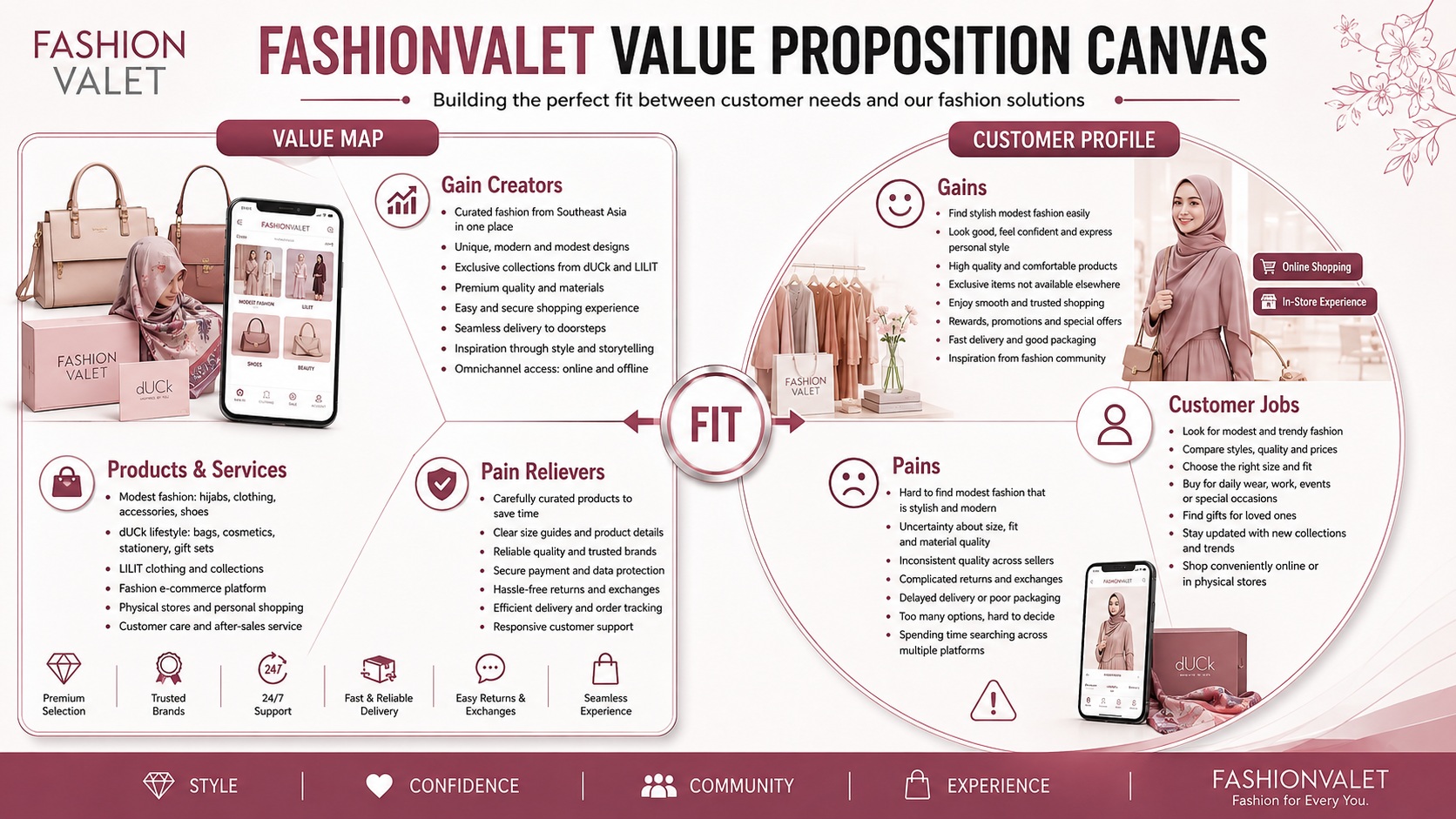
FashionValet VPC Diagram
The FashionValet VPC diagram provides a visual representation of how customer jobs, pains, and gains connect with the company’s products and services, pain relievers, and gain creators.
FashionValet vs Zalora Business Model
The FashionValet Business Model Canvas differs from Zalora primarily in market positioning, assortment scale, brand ownership, customer relationships, and regional operating scope.
Zalora operates as a broad fashion and lifestyle e-commerce platform across several Southeast Asian markets. Its assortment includes international brands, local labels, beauty products, accessories, sportswear, and private-label products.
FashionValet developed a more focused identity around Malaysian and Southeast Asian designers, modest fashion, proprietary brands, founder-led communication, and premium product storytelling.
Neither model is automatically superior. Each structure reflects different strategic priorities.
| Dimension | FashionValet | Zalora |
|---|---|---|
| Platform positioning | Curated regional and modest-fashion business that later focused on owned brands | Broad regional fashion and lifestyle e-commerce platform |
| Product strategy | Southeast Asian designers, dUCk, LILIT, and selected lifestyle products | International brands, regional labels, private labels, sportswear, beauty, and accessories |
| Geographic approach | Originated in Malaysia with selected regional expansion | Multi-country Southeast Asian market coverage |
| Customer relationship | Founder influence, community engagement, launches, and brand storytelling | Platform-led promotions, loyalty, personalisation, and broad digital access |
| Model strength | Proprietary brands, modest-fashion specialisation, curation, and emotional engagement | Assortment scale, regional infrastructure, marketplace reach, and digital-commerce capabilities |
FashionValet’s focused positioning supported deeper emotional engagement. Zalora benefited from a broader platform, larger assortment, and more diversified regional reach.
FashionValet should therefore avoid competing primarily through product volume. A more defensible position would emphasise exclusive products, controlled brands, customer community, design capability, and disciplined product development.
Competitive Advantages
FashionValet developed several strengths that helped it become a recognisable Malaysian fashion business.
- Early position in fashion e-commerce: FashionValet entered the market when many regional designers lacked mature digital-commerce capabilities, enabling the company to establish early supplier relationships and customer awareness.
- Strong founder-led visibility: Vivy Yusof’s public profile and social reach provided direct access to a substantial audience and supported frequent product communication.
- Curated regional-fashion identity: The platform presented Malaysian and Southeast Asian products within a more organised and premium environment than many general marketplaces.
- Proprietary brands: dUCk and LILIT gave FashionValet greater control over product design, pricing, positioning, customer experience, and brand equity.
- Integrated online and physical channels: Digital commerce offered accessibility, while physical stores enabled fitting, product inspection, personal assistance, and premium brand experiences.
These advantages created real market value. Their financial contribution, however, depended on disciplined inventory management, store productivity, customer-acquisition economics, and sustainable operating costs.
Risks and Challenges
FashionValet faced several risks arising from its marketplace, proprietary-brand, retail, and digital operations.
- High operating complexity: Managing designers, proprietary brands, stores, technology, fulfilment, inventory, and regional activities placed substantial demands on management.
- Inventory and working-capital exposure: Incorrect demand forecasts could produce ageing stock, markdowns, write-offs, and cash-flow pressure.
- Supplier disintermediation: Designers could bypass FashionValet through their own websites, social commerce, live selling, and larger online marketplaces.
- Founder and reputation concentration: Strong founder visibility supported customer acquisition but also closely connected corporate reputation with individual personalities.
- Intense market competition: Customers could compare FashionValet with Zalora, Shopee, TikTok Shop, designer websites, social sellers, physical boutiques, and international fashion platforms.
These risks do not mean that FashionValet lacked customer value. They show that strong branding must be supported by sustainable margins, operational discipline, capital efficiency, and defensible market positioning.
Why Might the Original FashionValet Business Have Failed?
The closure of FashionValet’s marketplace should be distinguished from the continuation of its proprietary brands. The strategic difficulty concerned the sustainability of the original multi-brand platform and expansion model.
One possible reason was that operating complexity increased faster than commercial productivity. FashionValet managed third-party designers, house brands, stores, technology, logistics, customer service, and regional activities simultaneously.
Physical-store expansion may have added further pressure. Premium locations strengthened brand visibility but introduced long-term rental, renovation, payroll, inventory, maintenance, and utility commitments.
The COVID-19 pandemic intensified these challenges. Store traffic was disrupted, consumer behaviour changed, supply chains became less predictable, and smaller designers faced their own financial difficulties. Khazanah subsequently identified the pandemic, difficult fundraising conditions, and the company’s capital requirements as important factors affecting FashionValet.
Supplier disintermediation likely weakened the marketplace proposition. Designers gained affordable access to websites, social media, live commerce, and established digital marketplaces.
Prolonged losses also suggest that revenue growth did not translate into sustainable profitability. High marketing expenditure, delivery costs, returns, inventory commitments, store expenses, and overhead could have reduced the economic value of each transaction.
The marketplace therefore may have struggled because several structural problems reinforced one another rather than because of one isolated mistake.
Strategic Recommendations
FashionValet’s future strategy should focus on the capabilities that remain differentiated, controllable, and financially defensible.
The company can apply the following recommendations to improve focus, reduce capital exposure, strengthen brand equity, and build more sustainable commercial performance.
1. Prioritise Defensible Proprietary Brands
FashionValet should concentrate resources on brands demonstrating strong margins, repeat purchasing, customer loyalty, and pricing power.
Each brand should have a defined target market, product architecture, design direction, and separate financial accountability.
2. Adopt More Asset-Light Retail Formats
Permanent stores should be limited to locations with strong store-level economics and clear strategic value.
Pop-up outlets, shop-in-shop arrangements, appointment studios, seasonal stores, and event-based retail can provide physical experiences with lower fixed-cost commitments.
3. Strengthen Inventory and Demand Planning
Management should use smaller production batches, waiting lists, pre-orders, historical sell-through, customer voting, and collection-level forecasting.
Inventory ageing, markdown exposure, stock cover, and cash conversion should be monitored by product, size, colour, category, and sales channel.
4. Build Brand Equity Beyond Founder Visibility
Founder communication can remain useful, but dUCk and LILIT should develop independent identities and communities.
Customers should remain loyal because of design, quality, service, product meaning, and consistent experiences rather than relying mainly on one personality.
5. Measure Contribution Margin by Channel
Websites, physical stores, collaborations, marketplaces, and international sales should be evaluated after direct costs.
Relevant expenses include delivery, returns, discounts, commissions, payment fees, fulfilment, marketing, and store operations.
6. Use Selective Designer Collaborations
FashionValet does not need to recreate a broad marketplace. Limited collaborations with relevant designers can create novelty without reintroducing excessive catalogue complexity.
Each partnership should provide exclusivity, strong margins, customer-acquisition benefits, or entry into a strategic product category.
7. Strengthen Governance and Capital Discipline
Expansion decisions should be supported by investment thresholds, realistic payback periods, downside scenarios, and working-capital analysis.
Board and management reporting should include store profitability, inventory ageing, cash conversion, customer-acquisition payback, return rates, repeat purchasing, and brand-level contribution.
Conclusion
The FashionValet Business Model Canvas shows how FashionValet developed from a regional fashion marketplace into a more focused proprietary-brand business.
Its original strength came from combining designer discovery, digital convenience, professional presentation, social influence, customer service, and a growing fashion community.
However, the marketplace became harder to sustain as operating complexity increased, physical retail created fixed commitments, designers gained direct-selling capabilities, competition intensified, and the pandemic disrupted both demand and supply.
The strategic shift towards dUCk and LILIT represented an attempt to concentrate resources on products and brands that FashionValet could control more directly.
Future performance will depend on the company’s ability to balance brand aspiration with inventory discipline, profitable customer acquisition, efficient channels, strong governance, and controlled expansion.
The central lesson for entrepreneurs is straightforward. Rapid growth and customer visibility are valuable, but a durable business must convert attention into recurring cash flow while keeping costs, inventory, complexity, and capital requirements within sustainable limits.
Disclaimer
This article is provided solely for educational, informational, and business-analysis purposes. It is based on publicly available information, general market observations, and independent interpretation of FashionValet’s business model.
The article does not constitute financial, investment, legal, accounting, tax, or professional advice. Readers should conduct their own research and obtain advice from qualified professionals before making investment, commercial, legal, or strategic decisions.
References to the closure, failure, or difficulties of FashionValet relate primarily to the discontinuation of its original multi-brand marketplace and the financial or strategic challenges publicly associated with its earlier operating model. Such references should not be interpreted as a statement that all FashionValet-related entities, brands, stores, products, or commercial activities have ceased.
The discussion of factors that may have contributed to the company’s difficulties is analytical and based on publicly reported information. It does not represent a legal finding, allegation of misconduct, determination of negligence, or conclusion concerning the personal liability of any founder, director, shareholder, employee, investor, adviser, or business partner.
FashionValet, dUCk, LILIT, Zalora, Khazanah Nasional Berhad, Permodalan Nasional Berhad, and all related trademarks, logos, product names, and brand assets belong to their respective owners. This article is not sponsored, endorsed, approved, or commissioned by any of these organisations or individuals.
Corporate information, ownership arrangements, financial figures, product portfolios, store networks, management structures, and operating activities may change over time. Readers should verify current information through official corporate announcements, regulatory filings, company websites, and other reliable sources.
Meta Description
Explore the FashionValet Business Model Canvas, including its nine BMC blocks, Value Proposition Canvas, Zalora comparison, competitive advantages, business risks, possible reasons for failure, and strategic recommendations.

