



Share This Article


Airbnb Business Model Canvas: How Airbnb Creates Value Through Homes, Experiences, Services, and a Global Marketplace
BMC Article No: BMC #011
Updated in 2026: This article has been comprehensively updated to reflect Airbnb’s expansion beyond vacation rentals into experiences, services and boutique hotels, its increasing use of artificial intelligence, changes to pricing and payment flexibility, international expansion, evolving host economics, stronger competition from online travel agencies and continued regulatory pressure. Airbnb reported $12.2 billion of revenue for 2025, while its Q2 2026 revenue reached $3.61 billion amid continued global travel demand.
The 2026 update provides substantially deeper analysis of every Airbnb Business Model Canvas block, longer closing analysis, an expanded Value Proposition Canvas, comparison with Booking.com and Vrbo, five competitive advantages, five major risks and challenges, and strategic recommendations based on Airbnb’s changing position in the global travel industry.
Introduction
Airbnb began with a relatively simple idea: enable ordinary people to offer accommodation to travellers through a digital marketplace. The company was founded after its early hosts welcomed guests into their San Francisco home, but the concept eventually expanded from rooms into apartments, entire homes and vacation rentals.
Modern Airbnb is considerably broader. Its platform connects guests with homes, experiences and services, while its 2026 product expansion also includes boutique and independent hotels and additional travel-related services. Airbnb says more than 5.5 million hosts have welcomed more than 2.5 billion guest arrivals globally.
The Airbnb Business Model Canvas is particularly interesting because Airbnb does not normally own the accommodation being sold. Instead, it orchestrates a marketplace connecting independent supply with global demand.
Hosts contribute accommodation and services. Guests contribute demand and booking expenditure. Airbnb provides discovery, payments, trust mechanisms, technology, customer support and marketplace coordination.
Understanding this interaction explains how Airbnb can achieve global scale without carrying the traditional property ownership structure of a hotel chain.
What Is Airbnb’s Business Model?
Airbnb operates primarily as a two-sided travel marketplace connecting hosts who provide accommodation, experiences or services with guests who want to purchase them.
At the centre of the Airbnb Business Model Canvas is an asset-light intermediary model. Airbnb generally does not own the homes guests book and presents itself as an agent rather than the provider controlling the accommodation inventory. Revenue is therefore recorded primarily from service fees rather than the total accommodation value.
Three economic mechanisms support the model.
First, hosts create supply by listing homes, experiences and services.
Second, Airbnb uses search, ranking, reviews, payments, trust systems and increasingly AI-powered technology to match supply with relevant demand.
Third, the platform monetises completed transactions by charging service fees. Airbnb states that substantially all of its revenue still comes from stays, although experiences and services are expanding the addressable marketplace.
This creates a marketplace flywheel. More attractive supply can bring more guests. Greater guest demand increases earning opportunities for hosts. Additional hosts expand selection, which can make the platform more useful.
Airbnb therefore operates less like a traditional hotel company and more like a technology-enabled global travel marketplace.
What Is Business Model Canvas?
Business Model Canvas, commonly abbreviated as BMC, is a strategic framework used to examine how an organisation creates, delivers and captures value.
The framework contains nine interconnected blocks. For Airbnb, these blocks are especially useful because the company must create value for both hosts and guests while monetising the transactions between them.
The Airbnb Business Model Canvas provides a structured way to understand those relationships.
| BMC Block | Main Question |
|---|---|
| Customer Segments | Who does Airbnb serve? |
| Value Propositions | What value does Airbnb provide? |
| Channels | How does Airbnb reach hosts and guests? |
| Customer Relationships | How does Airbnb maintain participation and trust? |
| Revenue Streams | How does Airbnb generate revenue? |
| Key Resources | Which resources make the marketplace possible? |
| Key Activities | What activities must Airbnb continuously perform? |
| Key Partnerships | Which external partners strengthen the marketplace? |
| Cost Structure | What are Airbnb’s major operating costs? |
Individual blocks explain specific components, but strategic insight comes from understanding how they reinforce one another.
Quick Overview of Airbnb
Airbnb originated in 2007 when two hosts welcomed three guests into their San Francisco home. The platform subsequently evolved into a global marketplace operating across more than 220 countries and regions.
Its original proposition centred on alternative accommodation. That positioning has expanded significantly.
Guests can now search millions of vacation rentals alongside experiences and services. Airbnb’s 2026 Summer Release added more service categories, expanded experiences, introduced boutique and independent hotels and incorporated additional AI-powered capabilities into its application.
The Airbnb Business Model Canvas must consequently be evaluated as an evolving travel platform rather than only a short-term rental marketplace.
Financial scale reinforces this transformation. Airbnb generated $12.2 billion of revenue, $91.3 billion of Gross Booking Value and 533 million Nights and Seats Booked during 2025.
By Q2 2026, revenue had reached $3.61 billion for the quarter, while Nights and Seats Booked increased to 148.3 million.
These figures demonstrate the scale already achieved by the core marketplace while Airbnb continues widening the range of products available through it.
Why Airbnb Is Strategically Interesting
Airbnb illustrates how digital platforms can separate asset ownership from customer access.
Traditional hotel groups usually create accommodation capacity through owned, leased, managed or franchised properties. Airbnb instead enables millions of external hosts to contribute supply while the company concentrates on marketplace technology, payments, discovery, trust and demand generation.
That structure gives the Airbnb Business Model Canvas an important network-effect dimension.
Guests are attracted by greater choice. Hosts participate because a large pool of travellers can generate bookings. Increased demand encourages additional supply, while broader supply can make Airbnb relevant for more destinations, budgets and trip types.
A second strategic characteristic is supply flexibility. Homes can exist in residential neighbourhoods and leisure destinations where conventional hotel inventory may be limited.
However, marketplace scale does not automatically create permanent advantage. Airbnb acknowledges that hosts frequently have multiple listing options and may cross-list their properties. Guests can similarly compare alternatives across Booking.com, Expedia, Vrbo, hotels and other platforms.
Airbnb must therefore earn both sides of the marketplace repeatedly through attractive economics, product quality and trust rather than relying only on historical network scale.
Latest Developments: What Is Changing Around Airbnb?
Several developments are changing Airbnb’s strategic position in 2026.
Most importantly, the company is broadening beyond homes. Its 2026 product release expanded services and experiences while bringing more boutique and independent hotels onto the platform.
Artificial intelligence is also becoming more important. Airbnb is introducing AI-powered tools for trip discovery, planning and customer assistance, while management has highlighted AI as an important mechanism for improving efficiency and product development.
The Airbnb Business Model Canvas is consequently shifting from a home-sharing marketplace toward a broader travel ecosystem.
Payment flexibility represents another development. Airbnb expanded Reserve Now, Pay Later after strong adoption among eligible bookings.
Hotel supply is growing as well. During Q2 2026, Airbnb reported that hotel nights were expanding at nearly three times the rate of homes, although hotels remained a single-digit share of total nights booked.
These initiatives create growth opportunities but also increase direct competition with comprehensive travel platforms such as Booking.com and Expedia Group.
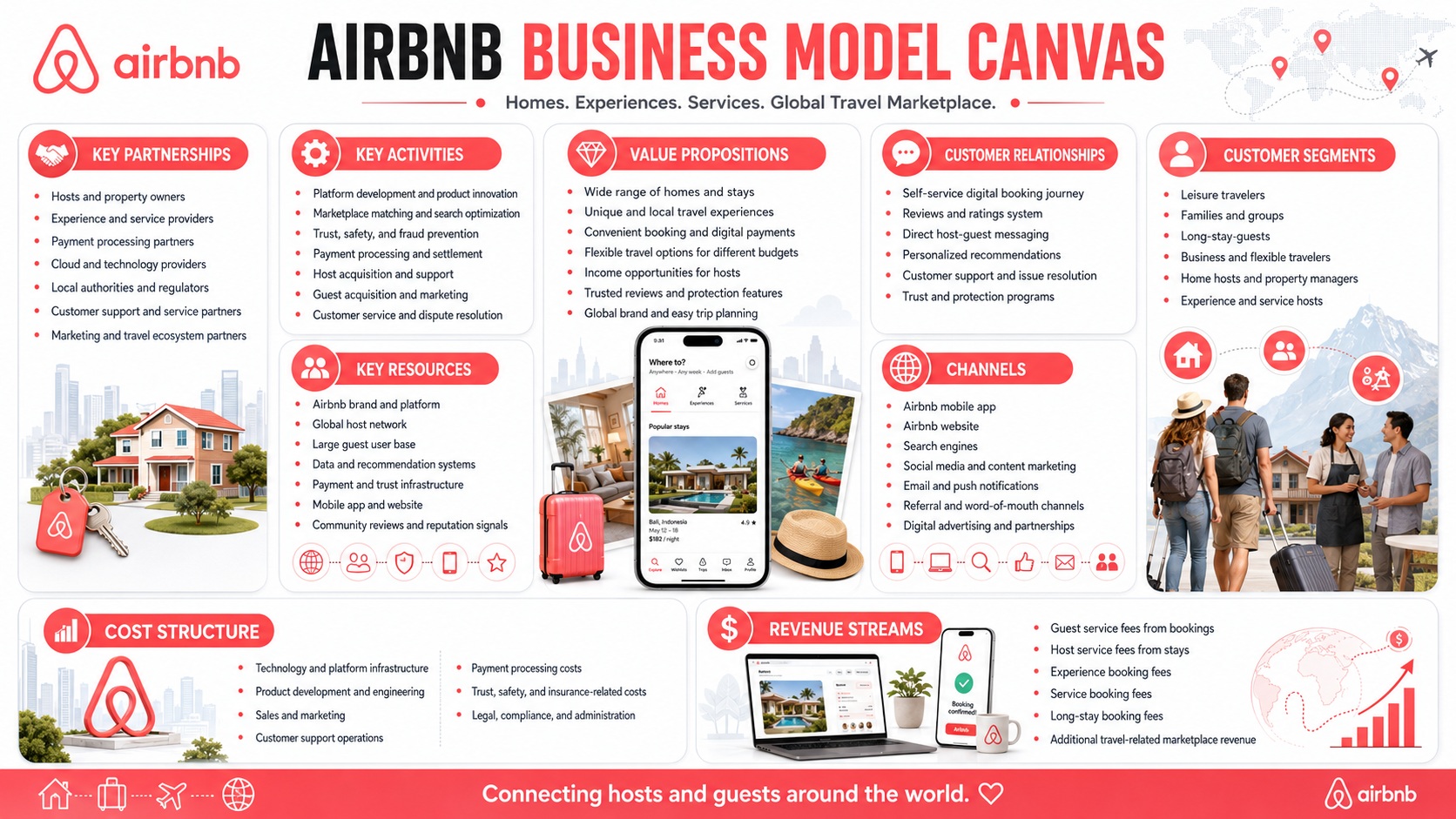
Airbnb Business Model Canvas Summary
Before examining each component individually, the Airbnb Business Model Canvas can be summarised as a marketplace that connects distributed travel supply with global demand and captures revenue primarily through transaction-based service fees.
| BMC Block | Airbnb Application |
|---|---|
| Customer Segments | Leisure travellers, families, groups, business travellers, long-stay guests, hosts and service providers |
| Value Propositions | Diverse accommodation, local experiences, flexible supply, host income opportunities and trusted booking infrastructure |
| Channels | Mobile app, website, search engines, social media, referrals and destination marketing |
| Customer Relationships | Self-service platform, reviews, personalisation, messaging, AirCover and customer support |
| Revenue Streams | Primarily booking service fees from stays, plus fees from experiences and services |
| Key Resources | Brand, host network, guest network, platform, data, AI, reviews and payments infrastructure |
| Key Activities | Marketplace management, product development, matching, payments, trust, safety, support and marketing |
| Key Partnerships | Hosts, payment providers, cloud and technology providers, local authorities and service partners |
| Cost Structure | Technology, product development, marketing, payment processing, support, insurance, personnel and compliance |
The summary highlights Airbnb’s central dependency: marketplace liquidity must remain strong enough that guests find attractive supply while hosts continue receiving worthwhile demand.
Airbnb BMC Diagram
A visual BMC diagram should place all nine blocks within one integrated marketplace.
Hosts create accommodation and service supply. Guests create demand. Technology matches both groups. Reviews, identity systems and protections support trust. Payments enable transactions, while service fees generate revenue.
That revenue funds product development, marketing, support, technology and further marketplace expansion.
BMC Analysis of Airbnb
Detailed examination of the Airbnb Business Model Canvas shows that Airbnb’s competitive strength comes from the interaction between global demand, distributed supply, brand recognition, marketplace technology and trust infrastructure.
No block operates independently.
Increasing host supply is valuable only when sufficient guest demand exists.
More guests create greater earning potential for hosts, but poor-quality inventory can damage guest trust.
Higher service fees may increase monetisation, yet they can weaken host economics or make total trip pricing less competitive.
Expanding into services, experiences and hotels can increase transaction opportunities, although broader scope also raises product complexity and exposes Airbnb to more competitors.
The central management challenge is therefore not maximising any single variable.
Airbnb must continually optimise marketplace liquidity, affordability, host earnings, selection, safety, service quality and economic returns simultaneously.
The following sections examine how each BMC block contributes to that system.
1. Customer Segments
Airbnb serves multiple customer groups on both the demand and supply sides of its marketplace.
Travellers remain the largest demand-side segment. Their requirements vary from affordable short stays to premium homes, family trips, group accommodation and longer stays.
Hosts form the critical supply side. They include individual homeowners, professional operators, experience hosts and service providers. Boutique and independent hotels are becoming an additional accommodation-supply segment following Airbnb’s 2026 expansion.
Airbnb Customer Segments
| Segment | Details | Why It Matters |
|---|---|---|
| Leisure travellers | Individuals and couples booking trips | Generates core booking demand |
| Families and groups | Guests requiring larger homes and shared space | Strengthens whole-home demand |
| Long-stay guests | Travellers requiring extended accommodation | Broadens usage beyond vacations |
| Home hosts | Individuals or operators listing accommodation | Creates marketplace inventory |
| Experience and service hosts | Providers of activities and travel services | Expands transaction categories |
Airbnb’s marketplace depends on maintaining alignment between these groups.
Hosts need sufficient booking volume, attractive economics and manageable operating requirements. Guests need competitive prices, reliable quality, useful choice and confidence that the property matches its description.
Adding new customer groups increases growth potential but also creates operational complexity. A guest booking a private home may expect different standards from someone reserving a boutique hotel or private chef.
Long-term strength therefore depends not only on attracting more customers but on serving increasingly diverse use cases without weakening the simplicity and trust that made the original marketplace scalable.
2. Value Propositions
Airbnb provides different benefits to guests and hosts.
Guests receive access to a broad selection of accommodation, including homes in destinations and neighbourhoods where conventional hotels may provide less variety. Experiences and services extend that proposition beyond the accommodation itself.
Hosts gain access to global demand, booking technology, payments infrastructure, marketing visibility and protection mechanisms without having to create their own travel marketplace.
Airbnb Value Propositions
| Value Proposition | Details | Why It Matters |
|---|---|---|
| Accommodation variety | Homes across different locations, sizes and price points | Expands guest choice |
| Distinctive stays | Properties can provide experiences different from standard hotels | Supports differentiation |
| Local experiences | Activities hosted by local experts | Extends value beyond accommodation |
| Host earning opportunity | Property owners can monetise available space | Encourages marketplace supply |
| Trust infrastructure | Reviews, verification, payments, support and protections | Reduces marketplace friction |
The model is powerful because a single platform produces different forms of value for both sides.
Guests benefit when supply becomes broader, more reliable and easier to discover. Hosts gain when Airbnb can aggregate enough demand to generate economically attractive bookings.
Quality remains critical. More listings do not automatically create greater value if travellers struggle to identify suitable properties or encounter inconsistent standards.
Airbnb must therefore optimise not only supply volume but useful supply. Search quality, accurate descriptions, transparent pricing, reliable reviews and effective support determine whether theoretical selection becomes genuine customer value.
The strongest proposition combines marketplace breadth with confidence that the selected booking will meet expectations.
3. Channels
Airbnb reaches customers primarily through digital channels.
Its mobile application and website are the central transaction channels, supporting search, discovery, booking, payments, communication and trip management.
Mobile is increasingly important. Airbnb reported that its app accounted for 64% of total nights booked in Q4 2025, up from 60% one year earlier.
Airbnb Channels
| Channel | Details | Why It Matters |
|---|---|---|
| Mobile app | Search, bookings, messaging and trip management | Builds direct customer access |
| Website | Global discovery and transaction platform | Supports broad digital reach |
| Search engines | Organic and paid travel discovery | Acquires high-intent travellers |
| Social and content marketing | Inspiration, brand campaigns and destinations | Stimulates travel consideration |
| Email and notifications | Booking communication and personalised engagement | Encourages repeat usage |
Direct app adoption is strategically valuable because it can reduce dependence on external customer-acquisition channels.
Search engines remain important, but Airbnb itself identifies changing search behaviour, AI interfaces and the influence of platforms such as Google as competitive risks.
This creates an important channel objective: convert occasional travellers acquired externally into repeat customers who begin travel searches directly inside Airbnb.
Achieving that shift improves more than marketing economics. Direct usage gives Airbnb greater control over discovery, personalisation, communication and cross-selling of experiences or services.
As the platform broadens, the app may become even more important because one interface can connect accommodation, activities, services and trip planning within a unified customer journey.
4. Customer Relationships
Airbnb combines digital self-service with trust, personalisation and human support.
Guests generally search, compare, reserve and pay without interacting directly with Airbnb employees. Hosts similarly create listings, manage calendars, adjust prices and communicate with guests through digital tools.
Human support becomes more important when bookings fail, disputes occur or safety concerns arise.
Airbnb Customer Relationships
| Relationship Type | Details | Why It Matters |
|---|---|---|
| Self-service | Guests and hosts manage activity digitally | Enables global operating scale |
| Reviews and ratings | Participants evaluate completed stays | Creates marketplace reputation signals |
| Host–guest messaging | Direct communication around reservations | Reduces transaction uncertainty |
| Personalisation | Search and recommendations adapt to users | Improves discovery |
| Customer support | Assistance with booking, refunds and problems | Protects trust during exceptions |
Airbnb offers 24/7 support and describes verification, secure messaging and payments as important elements of marketplace trust.
The scalable part of this relationship model is automation. Millions of transactions can occur without direct employee involvement.
The difficult part is exception management.
Accommodation is a physical service delivered by independent providers, so problems can include cancellations, cleanliness, property inaccuracies, damaged homes, guest behaviour or safety concerns.
Customer loyalty therefore depends heavily on what happens when the marketplace does not work as expected.
AI can reduce service costs and improve response speed, but automation should complement rather than eliminate effective escalation. Trust is strengthened when important problems can be resolved predictably, transparently and fairly.
5. Revenue Streams
Airbnb generates revenue primarily from service fees associated with bookings.
The company states that its revenue consists of service fees, net of incentives and refunds. Substantially all revenue currently comes from stays, while experiences and services generate host fees.
Airbnb began transitioning certain stay bookings from its historical split-fee structure toward a single-fee structure charged to hosts in October 2025.
Airbnb Revenue Streams
| Revenue Stream | Details | Why It Matters |
|---|---|---|
| Stay service fees | Percentage-based fees linked to accommodation bookings | Main revenue engine |
| Experience fees | Fees charged on experience reservations | Diversifies marketplace transactions |
| Service fees | Fees generated from service bookings | Expands monetisation beyond lodging |
| Longer-stay bookings | Service fees generated on extended accommodation | Broadens demand occasions |
| Expanded travel inventory | New hotel and related travel supply | Increases addressable booking volume |
Airbnb’s revenue architecture is attractive because revenue can grow without equivalent investment in owned accommodation.
For 2025, revenue increased 10% to $12.2 billion while Gross Booking Value reached $91.3 billion.
Transaction monetisation still creates strategic limits.
Airbnb cannot simply maximise fees without considering the total price paid by guests and net income retained by hosts. Excessive monetisation can make competing channels more attractive.
Growth therefore depends on increasing marketplace activity, widening use cases and improving conversion while preserving favourable economics for both sides.
Experiences, services and hotels can diversify transaction sources, although stays are likely to remain the economic foundation in the near term.
6. Key Resources
Airbnb’s most important resources are largely intangible.
The company’s host network provides supply, while its guest base creates demand. Brand awareness helps connect these groups at global scale.
Technology then makes the marketplace usable by organising listings, search results, pricing information, reviews, payments and communications.
Airbnb Key Resources
| Key Resource | Details | Why It Matters |
|---|---|---|
| Host network | Distributed global accommodation and service supply | Creates inventory without owning most assets |
| Guest network | Large base of travellers | Generates demand for hosts |
| Brand | Globally recognised travel marketplace | Reduces customer-acquisition friction |
| Platform and data | Search, booking, payment and recommendation technology | Coordinates transactions |
| Trust and reputation systems | Reviews, identity tools and protections | Makes peer-to-peer transactions more credible |
The interaction between these resources creates more value than any resource independently.
Technology without attractive hosts would have little inventory to distribute. Supply without travellers would create weak host economics. Large demand without effective trust systems could increase transaction problems.
Data becomes increasingly strategic because millions of searches and bookings can improve matching, recommendation and marketplace management.
AI further raises the importance of technology capabilities. Airbnb is incorporating AI-powered tools into discovery, trip planning and customer support.
Yet the hardest resource to replicate may ultimately be marketplace liquidity: enough relevant hosts and guests participating simultaneously across destinations and travel dates.
That liquidity must continuously be earned because both groups can use alternative platforms.
7. Key Activities
Airbnb must continuously manage and improve the marketplace.
Product development is a major activity. The company invested approximately $2.35 billion in product development during 2025, reflecting the importance of platform engineering, new products and existing-product improvements.
Airbnb Key Activities
| Key Activity | Details | Why It Matters |
|---|---|---|
| Platform development | Improve app, website and booking functionality | Maintains usability and innovation |
| Marketplace matching | Search, ranking and recommendation | Converts supply into bookings |
| Trust and safety | Verification, fraud prevention and protections | Supports marketplace confidence |
| Payments | Collection, settlement and currency handling | Enables global commerce |
| Demand and supply growth | Marketing and host acquisition | Maintains marketplace liquidity |
Operating a marketplace requires more than maintaining software.
Airbnb must recruit and retain hosts, generate guest demand, remove poor-quality supply, resolve disputes, comply with local requirements, process payments and continuously improve conversion.
Payments are especially important because Airbnb supports integrated payments across approximately 50 currencies while serving demand across more than 220 countries and regions.
As Airbnb expands into additional travel categories, activity complexity rises.
Hotels introduce different inventory and operating requirements. Experiences create activity-specific quality considerations. Services can involve professionals delivering physical services at homes or travel destinations.
Expansion therefore requires operational discipline.
The company should resist adding categories merely because they increase theoretical market size. Each new marketplace should generate sufficient demand, quality and repeat usage to justify the additional product, safety, support and compliance requirements.
8. Key Partnerships
Airbnb depends on a broad external ecosystem.
Hosts are the most fundamental partners because they create the accommodation, experience and service inventory sold through the platform.
Technology and payment partners provide infrastructure that allows transactions to occur globally.
Airbnb Key Partnerships
| Key Partner | Details | Why It Matters |
|---|---|---|
| Hosts | Supply homes, experiences and services | Create the marketplace inventory |
| Payment providers | Support payment processing and settlement | Enable transactions globally |
| Technology providers | Cloud, mapping and other infrastructure | Support platform operation |
| Local authorities | Regulate short-term rentals and tourism | Affect supply availability |
| Service and support providers | External operational capabilities | Extend platform capacity |
Airbnb discloses reliance on third parties for areas including payment processing, community support, cloud infrastructure, maps and location data. Google Maps and other services contribute functionality important to the platform.
Partnership dependence produces both leverage and risk.
External providers allow Airbnb to scale capabilities without building everything internally. Hosts similarly allow accommodation supply to grow without Airbnb funding property development.
However, dependency creates exposure when regulation changes, providers experience outages or local authorities restrict short-term rentals.
Government relationships are therefore strategically important rather than merely administrative.
Cities increasingly influence how much supply can operate, under what conditions and at what cost.
Airbnb’s partnership strategy should consequently balance scalability with resilience, ensuring critical infrastructure, payments, host relationships and regulatory engagement do not become single points of failure.
9. Cost Structure
Airbnb operates an asset-light accommodation model, but the platform itself requires substantial expenditure.
Major costs include payment processing, technology infrastructure, customer operations, host protections, product development, sales and marketing, employees, legal functions and regulatory compliance.
Airbnb Cost Structure
| Cost Area | Details | Why It Matters |
|---|---|---|
| Technology and hosting | Infrastructure, software and third-party data centres | Keeps the marketplace operational |
| Product development | Engineering, AI and new product development | Supports innovation |
| Sales and marketing | Brand, performance marketing and market development | Generates demand and supply |
| Operations and support | Customer service, refunds and host protections | Maintains trust |
| Payments and compliance | Merchant fees, chargebacks, legal and regulatory costs | Enables secure global transactions |
Airbnb spent approximately $2.59 billion on sales and marketing and $2.35 billion on product development during 2025. Total operating costs and expenses were approximately $9.7 billion.
The cost advantage compared with traditional hospitality comes largely from avoiding ownership of most accommodation inventory.
That advantage does not mean the marketplace is inexpensive to operate.
Trust and safety, global payments, customer support, marketing, insurance and regulation become more expensive as transaction volume and geographic scope increase.
Expansion into new categories can add further complexity.
Management must therefore evaluate new initiatives based not only on incremental bookings but on contribution after support, marketing, technology, protection and compliance costs.
An asset-light model remains economically powerful only when operating complexity does not consume the scalability advantage.
How the Nine BMC Blocks Work Together
The Airbnb Business Model Canvas becomes most useful when its nine components are viewed as one integrated marketplace.
Customer segments create the starting point.
Guests bring demand. Hosts create accommodation and service supply.
Value propositions encourage both sides to participate. Travellers gain selection, flexibility and distinctive experiences, while hosts obtain access to global booking demand.
Channels bring participants into the marketplace through the app, website, search, marketing and direct communication.
Customer relationships then support retention through reviews, personalisation, messaging, protections and customer support.
Transactions generate service-fee revenue.
Those revenues fund key activities such as product engineering, marketing, payments, support, trust and safety.
Key resources—especially the host network, guest demand, brand, technology and data—strengthen those activities.
Partnerships provide additional infrastructure and supply, while the cost structure determines whether the entire system remains economically sustainable.
A healthy marketplace creates reinforcement.
More useful supply attracts demand. Greater demand improves host economics. Better host economics can attract additional supply.
Problems appear when this flywheel becomes misaligned.
Weak demand can cause hosts to leave. Poor-quality supply can reduce guest trust. Higher fees can encourage off-platform behaviour. Regulation can reduce available inventory.
Airbnb therefore succeeds when all nine blocks remain aligned rather than when any single metric is maximised.
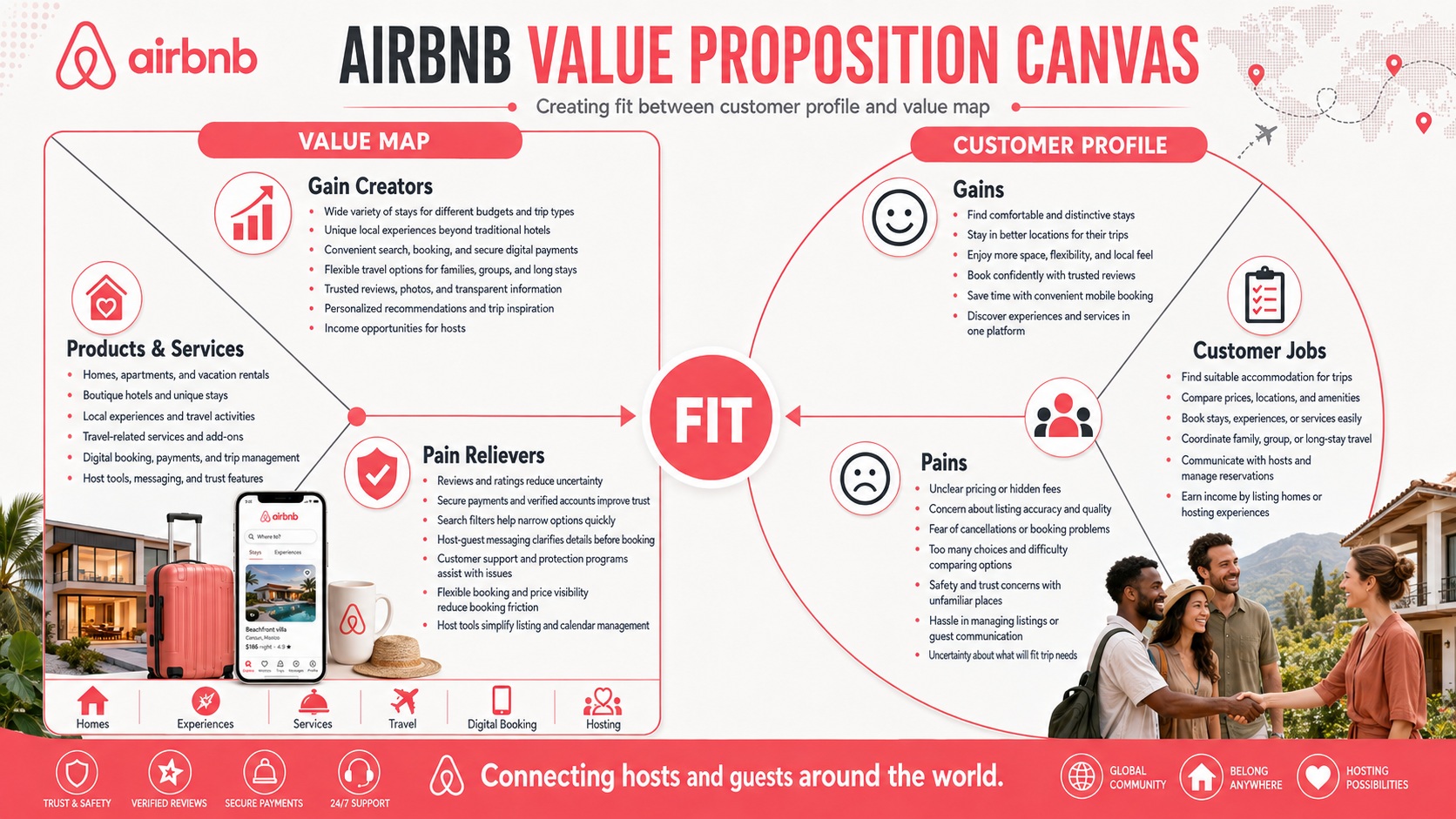
Airbnb Value Proposition Canvas
The Value Proposition Canvas examines how Airbnb addresses specific customer jobs, pains and gains.
While BMC describes the complete business system, VPC looks more closely at whether a particular offering solves meaningful customer problems.
The Airbnb Business Model Canvas becomes easier to interpret when the guest value proposition is separated from the broader marketplace structure.
Customer Profile
The following profile focuses primarily on travellers.
Guests are not simply purchasing a room. They are trying to secure suitable accommodation while managing budget, location, group requirements, convenience, safety and uncertainty.
Customer Profile of Airbnb
| Customer Profile | Details |
|---|---|
| Customer Jobs | Find accommodation, compare alternatives, organise trips, stay near desired locations and book experiences |
| Customer Pains | High prices, misleading listings, cancellations, hidden costs, inconsistent quality, safety concerns and poor support |
| Customer Gains | More space, distinctive properties, convenient locations, transparent information, flexibility and memorable travel experiences |
Airbnb must reduce uncertainty while preserving the variety that differentiates its marketplace.
Greater selection creates value, yet highly heterogeneous supply also increases comparison difficulty.
Reviews, verification, photographs, detailed listing information and search filters therefore convert marketplace variety into usable customer choice.
Value deteriorates quickly when expectations and reality diverge.
A property does not need to resemble a hotel, but it must deliver what the guest reasonably expected when booking.
Value Map
Airbnb addresses traveller requirements through accommodation supply, discovery technology, booking infrastructure, payments and trust mechanisms.
Value Map of Airbnb
| Value Map | Details |
|---|---|
| Products and Services | Homes, vacation rentals, boutique hotels, experiences, services, booking tools and trip management |
| Pain Relievers | Reviews, verified information, secure payments, support, AirCover, search filters and cancellation policies |
| Gain Creators | Diverse locations, larger spaces, unique properties, local experiences, personalisation and flexible options |
Airbnb’s value is strongest when travellers receive more than accommodation choice.
A large house can solve a family’s need to stay together. A neighbourhood apartment can offer access to a location poorly served by hotels. Experiences can add activities to the trip, while services can make the stay more convenient.
The risk is fragmentation.
Adding more products only creates value when customers can discover, understand and purchase them easily.
Airbnb should therefore use personalisation and AI to simplify the expanded marketplace rather than merely increasing the number of options displayed.
Customer–Value Fit
| Customer Profile | Need | Matching Value Map | How Airbnb Creates Fit |
|---|---|---|---|
| Customer Jobs | Find suitable accommodation | Products and Services | Large marketplace offers multiple property types |
| Customer Pains | Booking uncertainty | Pain Relievers | Reviews, payments, verification and support reduce risk |
| Customer Gains | Distinctive, flexible travel | Gain Creators | Homes, experiences and services broaden trip possibilities |
Value fit improves when Airbnb helps travellers identify the right option quickly and complete the booking confidently.
Fit deteriorates when final prices appear uncompetitive, listing quality becomes inconsistent or customer support cannot resolve booking failures.
The strategic objective is therefore not maximum variety.
Useful variety matters more.
Airbnb should continuously improve matching, quality signals and transparency so that marketplace scale reduces customer effort instead of increasing it.
Airbnb vs Booking.com vs Vrbo Business Models
The Airbnb Business Model Canvas shares several characteristics with Booking.com and Vrbo because all three connect travellers with accommodation supply.
Airbnb itself identifies Booking Holdings and Expedia Group—including Vrbo—as major online travel competitors.
Their strategic emphasis differs.
Booking.com offers a particularly broad accommodation marketplace, with approximately 4.4 million properties at the end of 2025, including hotels and millions of homes, apartments and other places to stay.
Vrbo is more strongly positioned around whole-home vacation rentals, families and groups, with more than two million bookable vacation rentals advertised globally.
BMC Block Comparison
| Relevant BMC Block | Airbnb | Booking.com | Vrbo |
|---|---|---|---|
| Customer Segments | Guests, hosts, experience and service providers | Travellers and broad accommodation partners | Vacation-home travellers, families, groups and property owners |
| Value Proposition | Distinctive homes plus experiences and services | Broad travel accommodation choice and convenience | Whole-home space, privacy and group travel |
| Channels | App, website, search and direct marketing | App, website and extensive online travel distribution | App, website and Expedia Group ecosystem |
| Revenue Streams | Primarily transaction service fees | Primarily travel reservation-related commissions and fees | Vacation-rental booking monetisation within Expedia Group |
| Key Resources | Host community, brand, marketplace, reviews and technology | Large accommodation inventory, demand scale and travel technology | Whole-home inventory plus Expedia Group technology and distribution |
The most important distinction is becoming less about whether each company offers vacation homes.
All increasingly overlap in accommodation.
Airbnb’s differentiation must therefore come from the character of its supply, host ecosystem, brand, experiences, services and ability to create a more integrated trip proposition.
Competitive Advantages
Airbnb retains several advantages that remain difficult for smaller travel marketplaces to reproduce.
- Global two-sided marketplace: Millions of hosts and extensive guest demand create marketplace liquidity across a large number of destinations. Airbnb reported more than 5.5 million hosts and more than 2.5 billion cumulative guest arrivals by mid-2026.
- Strong consumer brand: Airbnb has become closely associated with alternative accommodation and home-based travel, reducing the explanation required when entering new destinations or categories.
- Asset-light supply model: Most accommodation is supplied by independent hosts, allowing inventory to expand without Airbnb financing equivalent hotel real estate.
- Distinctive accommodation network: Residential homes, cabins, apartments and unusual properties provide inventory that can differ materially from standard hotel supply.
- Expanding travel ecosystem: Experiences, services, boutique hotels and AI-powered trip functionality create opportunities to increase transaction frequency and customer relevance beyond accommodation alone.
These advantages reinforce one another.
Brand attracts demand. Demand attracts hosts. Supply increases selection. Greater selection strengthens guest utility.
The challenge is preserving this cycle as Booking.com, Vrbo, hotels and emerging AI travel interfaces compete for the same traveller journey.
Risks and Challenges
Despite its marketplace scale, Airbnb faces several significant strategic risks.
- Regulatory restrictions: Cities and national authorities can restrict short-term rentals, impose registration requirements or increase compliance obligations, potentially reducing available supply.
- Marketplace quality inconsistency: Independent properties vary considerably, making guest trust dependent on accurate listings, reviews, standards and effective dispute resolution.
- Intensifying competition: Airbnb competes with Booking.com, Expedia, Vrbo, Trip.com, hotels, property managers and increasingly AI-enabled travel discovery platforms.
- Host multi-homing and disintermediation: Hosts may list properties across competing platforms, while repeat guests and hosts can have incentives to transact outside the marketplace.
- Expansion complexity: Experiences, services and hotels widen Airbnb’s opportunity but introduce additional quality, operational, support and competitive requirements.
The most serious threat is not necessarily one competitor replacing Airbnb.
A more damaging scenario would combine weaker host economics, less differentiated supply, rising customer-acquisition costs, regulatory restrictions and declining guest trust.
Such a combination could weaken several BMC blocks simultaneously.
Marketplace businesses are particularly vulnerable when deterioration occurs on both sides at once because reduced supply can weaken demand, while weaker demand further discourages supply.
Strategic Recommendations
Airbnb should protect the marketplace economics and brand differentiation that created its existing scale while carefully extending the platform into adjacent travel categories.
Expansion should strengthen the original marketplace rather than turn Airbnb into an undifferentiated online travel agency.
1. Protect the Core Homes Marketplace
Airbnb should continue improving the reliability, affordability and quality of home-based accommodation.
Homes remain the economic foundation of the company. Substantially all current revenue still comes from stays.
Quality programmes, clearer pricing, easier hosting tools and better search should therefore receive sustained investment even as the company launches new categories.
The objective should be to make Airbnb the strongest platform for distinctive accommodation rather than merely the platform with the most categories.
2. Make Experiences and Services Complement the Stay
Experiences and services should be integrated directly into the accommodation journey.
A traveller booking a villa could receive relevant recommendations for airport transfers, chefs, photographers, fitness instructors or local activities.
Contextual cross-selling could increase transaction value without forcing customers to browse unrelated marketplace categories.
Success should be measured through attachment rates, repeat usage, contribution margin and customer satisfaction rather than listing growth alone.
This approach would turn diversification into an extension of the core trip rather than a collection of disconnected products.
3. Use Hotels Selectively
Boutique and independent hotels can fill inventory gaps in destinations where homes are unavailable, restricted or poorly suited to short stays.
Airbnb should nevertheless avoid becoming indistinguishable from a conventional OTA.
Its strongest hotel proposition is likely to involve properties with distinctive design, local character and experiences compatible with the Airbnb brand.
Selective hotel supply can strengthen marketplace completeness while preserving differentiation.
Hotel expansion should therefore solve customer availability problems rather than simply chase Booking.com on inventory volume.
4. Turn AI Into a Marketplace Advantage
AI should reduce the effort required to navigate Airbnb’s expanding supply.
Guests could describe a trip conversationally—such as a family holiday near public transport with child-friendly activities—and receive accommodation, service and experience recommendations as one itinerary.
Hosts could receive better pricing, listing-quality and demand-management assistance.
Support automation can lower servicing costs, but high-impact disputes should retain effective human escalation.
The commercial test should remain measurable: higher conversion, stronger retention, lower support cost and improved marketplace quality.
5. Strengthen Host Economics
Marketplace supply depends on hosts believing Airbnb produces sufficient economic value.
The company should continually simplify hosting, improve occupancy tools, reduce avoidable cancellations and provide clearer insight into pricing and local demand.
Professional tools should not come at the expense of casual hosts, whose individually distinctive properties contribute to Airbnb’s differentiation.
Host economics should be evaluated beyond booking volume.
Net earnings after fees, operating costs, regulation and time commitment determine whether hosts remain active or migrate toward alternative platforms.
Healthy hosts ultimately strengthen guest selection.
6. Treat Trust as Economic Infrastructure
Trust should be managed as a revenue-protecting capability rather than only a support function.
Verified listings, reliable reviews, fraud prevention, identity controls, transparent prices and rapid issue resolution lower the perceived risk of booking unfamiliar properties.
These mechanisms influence conversion before a reservation and loyalty after it.
Airbnb already emphasises verification, secure messaging, payments and 24/7 support.
Further investment should concentrate particularly on high-severity failures where marketplace confidence can be damaged disproportionately.
7. Reduce Dependence on External Travel Discovery
Airbnb should increase the percentage of customers who begin their travel journey directly in its app.
External search remains useful for acquisition, yet dependence on Google, AI search interfaces or other intermediaries can increase customer-acquisition costs and reduce control over discovery. Airbnb itself identifies this as a strategic risk.
Experiences, wish lists, trip planning, personalised recommendations and loyalty-like benefits could give customers more reasons to open Airbnb before searching elsewhere.
Direct demand strengthens both marketing economics and host value.
Conclusion
Overall, the Airbnb Business Model Canvas explains how Airbnb transformed a simple home-sharing concept into a global travel marketplace.
Its fundamental economic mechanism remains straightforward.
Hosts supply accommodation, experiences and services. Guests generate demand. Airbnb coordinates discovery, matching, payments, trust and customer support while earning service fees from marketplace transactions.
Complexity increases as the platform expands.
Homes still generate substantially all current revenue, yet experiences, services, boutique hotels and AI-powered trip tools are widening Airbnb’s strategic ambition.
That expansion can produce a larger addressable market, higher booking frequency and deeper customer relationships.
It can also weaken differentiation if Airbnb becomes another broad travel marketplace competing mainly on inventory.
The company’s strongest strategic asset is therefore not simply its application.
Its advantage comes from the system connecting distinctive supply, host participation, global guest demand, brand recognition, marketplace technology and trust.
Future success will depend on keeping those elements aligned.
Airbnb should continue expanding where new services strengthen the trip, improve host economics or solve guest problems, while avoiding categories that add complexity without creating meaningful differentiation.
If it maintains that discipline, Airbnb can evolve from a home-booking marketplace into a broader travel platform without sacrificing the characteristics that originally made the business model distinctive.
Disclaimer
This article is provided solely for educational, informational and business-analysis purposes.
The content is based on publicly available information, company disclosures, industry observations and strategic interpretation available at the time of writing.
Nothing in this article constitutes financial, investment, legal, regulatory, tax, travel or other professional advice. It should not be interpreted as an investment recommendation or as advice to buy, sell or hold any security.
This analysis is not an official statement, publication, endorsement or representation by Airbnb, Inc., Booking Holdings Inc., Booking.com, Expedia Group, Vrbo or any other company mentioned.
Business models, financial results, pricing structures, regulations, services, technologies and market conditions may change over time. Readers should independently verify relevant information before making business, investment or strategic decisions.
All company names, trademarks, service marks, logos, product names, copyrighted materials and other intellectual-property rights mentioned belong to their respective owners. Their use in this article is solely for identification, commentary, education and analysis.
Meta Description
Explore the Airbnb Business Model Canvas, including all nine BMC blocks, Value Proposition Canvas, Booking.com and Vrbo comparison, competitive advantages, risks and strategic recommendations updated for 2026.

