Quipper Business Model Canvas
Explore the Quipper Business Model Canvas, nine BMC blocks, Value Proposition Canvas, Ruangguru and Pahamify comparison, competitive advantages, risks, and strategic recommendations.
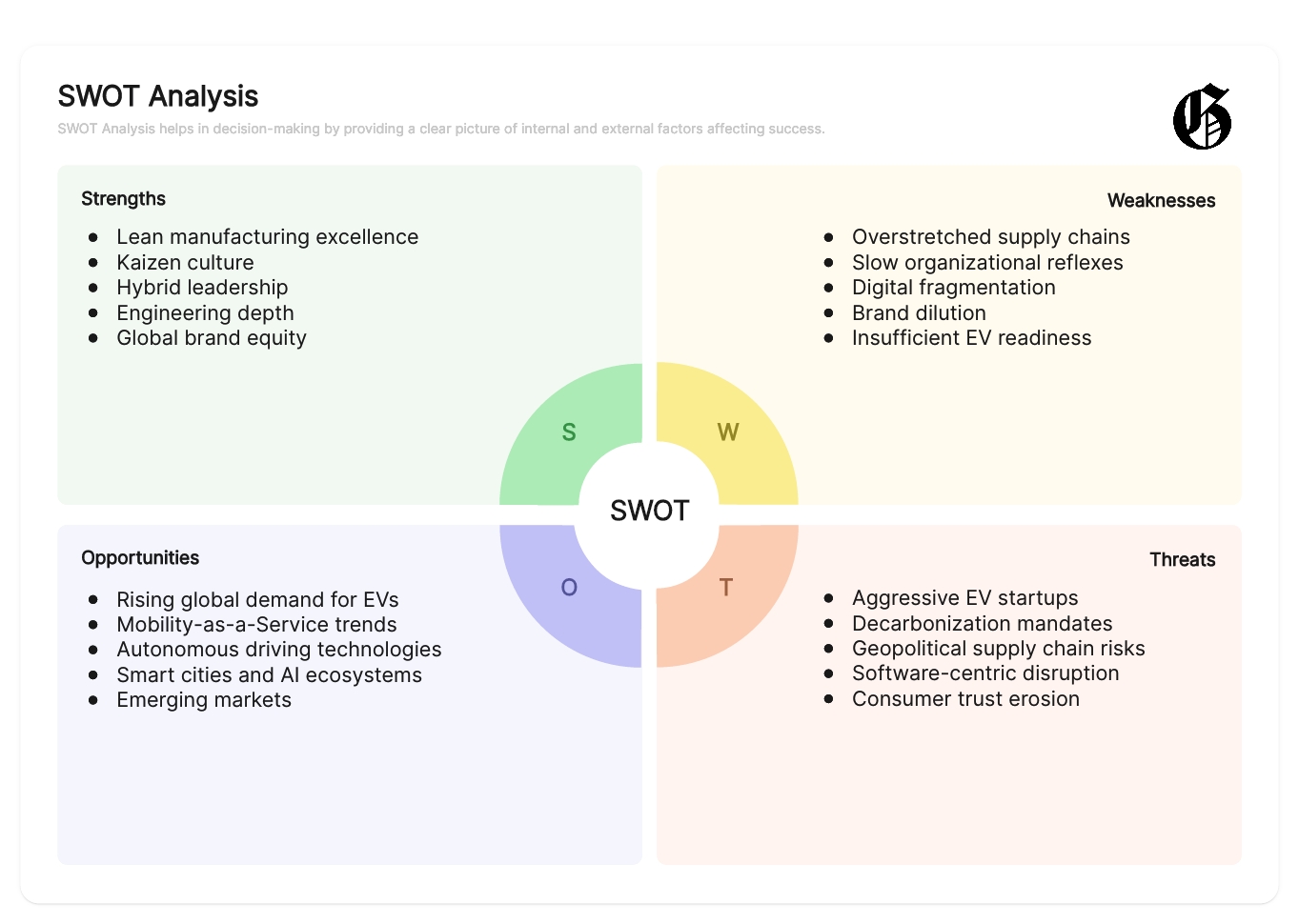
Rather than reacting hastily or defensively, Toyota leaned into its strategic DNA. Known for structured decision-making and reflective learning, the company revisited its fundamentals. The Toyota SWOT Analysis became central to this strategic introspection. It was not merely a review exercise—it was an urgent diagnostic.
Toyota is synonymous with reliability, precision, and lean operations. For decades, it led the automotive world in efficiency and innovation. Yet even global icons face disruption when internal strengths are challenged by external shocks.
In the late 2000s, Toyota encountered a perfect storm of headwinds: large-scale recalls damaged its sterling quality reputation, public trust waned under media scrutiny, and global cost pressures undermined profitability. Simultaneously, fast-rising competitors emerged—some with electric-only platforms, others with agile software capabilities Toyota lacked.
Rather than reacting hastily or defensively, Toyota leaned into its strategic DNA. Known for structured decision-making and reflective learning, the company revisited its fundamentals. The Toyota SWOT Analysis became central to this strategic introspection. It was not merely a review exercise—it was an urgent diagnostic.
By systematically diagnosing internal capabilities and external forces, Toyota launched a multi-year transformation that blended tradition with innovation. The company sought to preserve its operational strengths while reengineering its value chain and product portfolio to meet 21st-century demands.
This article dissects how Toyota turned SWOT insights into decisive actions that revitalized its operations, repositioned its product strategy, and solidified its long-term competitive edge.
Toyota has always embraced structured thinking as a fundamental part of its decision-making culture. Tools like A3 reports, root cause analysis, and value stream mapping are deeply ingrained in its operational DNA. These methodologies have empowered continuous improvement on the production floor. However, when navigating strategic crossroads, Toyota turned to broader tools like SWOT analysis to reflect on external forces and internal capabilities simultaneously.
Unlike many corporations that treat SWOT as a one-off planning tool, Toyota likely integrated it into its ongoing strategic dialogue. This allowed executives and board members to triangulate across market signals, technological disruption, and operational realities. The result was a clear-eyed view of where the company stood and where it needed to go next.
Toyota may have used SWOT analysis to:
The Toyota SWOT Analysis enabled executive clarity, drove scenario planning, and served as a platform for cross-functional debate. It acted as a bridge between reactive tactical firefighting and a broader push toward long-term strategic reinvention. It helped transform reflection into concrete, high-impact decision-making aligned with Toyota’s transformation goals.
Toyota’s operations are the envy of the auto industry. Over decades, the company cultivated systems thinking, precision engineering, and employee-driven improvement. Its Toyota Production System (TPS) not only pioneered just-in-time manufacturing and lean principles but became the gold standard studied and replicated across sectors worldwide.
The TPS emphasized waste elimination, flow efficiency, and respect for people—philosophies that deeply influenced both strategic and operational decisions. As Toyota scaled globally, these practices gave it unmatched flexibility, scalability, and cost resilience.
Key strengths identified in the Toyota SWOT Analysis included:
Rather than resting on these strengths, Toyota used them as strategic anchors. It scaled these advantages further, embedding them into transformation programs and innovation efforts to maintain long-term agility and competitiveness.
Rapid expansion brought unintended complexity. As Toyota scaled its operations globally, it began to face significant growing pains. Internal systems, once streamlined for regional operations, became increasingly fragmented and disconnected. Departments that once collaborated closely now operated in isolated silos. This growing disjointedness eroded the company’s ability to detect and resolve quality concerns quickly.
Simultaneously, the pressure to maintain high production volumes and speed in global markets began to compromise Toyota’s traditionally rigorous quality assurance processes. Local teams often lacked real-time insight into broader operational changes, leading to inconsistency across production hubs and customer experience.
The Toyota SWOT Analysis flagged multiple critical weaknesses that required urgent attention:
To confront these challenges, Toyota undertook a sweeping internal reform. It streamlined global governance to clarify decision rights and accountability. It also accelerated its digital transformation agenda, consolidating IT platforms and embedding real-time data into operations. Most importantly, Toyota established cross-functional product teams empowered to act with speed and agility in responding to market and quality needs.
While many legacy automakers hesitated in the face of change, Toyota recognized that long-term competitiveness depended on bold innovation. Instead of defending past success, Toyota explored the future. The SWOT analysis served as a structured window into shifting customer behaviors, macroeconomic signals, and technology-led disruption.
It revealed a new reality: the automotive world was evolving beyond vehicles to holistic, intelligent mobility systems. Toyota saw that the race ahead was not only about electrification, but also about digital ecosystems, data, and urban integration.
The Toyota SWOT Analysis highlighted multiple high-potential opportunities:
To seize these opportunities, Toyota significantly increased its R&D investment and diversified its innovation pipeline. It expanded its partnerships with tech firms, launched strategic mobility pilots, and began construction of Woven City—a 175-acre prototype city near Mt. Fuji. This experimental ecosystem aims to blend AI, renewable energy, robotics, and autonomous transport in a real-world setting—positioning Toyota as a mobility innovator beyond the assembly line.
Disruption didn’t just come from Silicon Valley. Regulation, cyber threats, and climate mandates were forcing a complete industry reset. Toyota had to evolve or risk obsolescence.
Key threats flagged in the Toyota SWOT Analysis included:
In response, Toyota invested in battery tech, revamped its cybersecurity governance, and reframed itself as a “mobility company.”
Toyota didn’t let the SWOT findings remain in PowerPoint or get buried in strategy decks. Instead, the company turned insights into actionable roadmaps. Each key observation from the analysis was mapped to tangible programs, with timelines, budgets, and accountable owners. These initiatives weren’t driven in isolation—they were guided from the top and executed across multiple layers of the organization.
Insights were translated into core KPIs, board-level priorities, and operating model overhauls that reshaped how Toyota planned, built, and delivered mobility solutions. Every function—from engineering and supply chain to HR and marketing—had a role to play in execution.
Actions resulting from the Toyota SWOT Analysis included:
These weren’t isolated projects—they were orchestrated as part of an integrated transformation blueprint. Cross-functional teams, milestone reviews, and performance metrics ensured accountability and learning loops. Toyota’s ability to act decisively on its SWOT insights made the difference between stagnation and sustained reinvention.
Toyota’s reinvention story offers powerful lessons that extend well beyond the auto sector. When disruption strikes, many organizations scramble to act, often choosing instinct over insight. Toyota chose differently. It embraced introspection, used structured frameworks, and prioritized deep strategic analysis. The Toyota SWOT Analysis became the company’s compass, offering clarity and prioritization during a moment of chaos.
This approach helped Toyota shed organizational inertia, realign leadership, and sharpen its focus on core capabilities. The company didn’t just recover—it redefined its ambition. It turned a period of disruption into a platform for transformation, ensuring that new strategic goals were not just bold, but achievable and grounded in data. From reimagining mobility solutions to embedding digital capabilities into manufacturing, Toyota’s post-crisis vision was comprehensive.
Today, Toyota is not simply an automaker known for lean efficiency. It has evolved into a forward-looking mobility ecosystem builder, influencing how cities, vehicles, and people interact in a digital, sustainable future. Its ability to anticipate shifts, learn from setbacks, and execute cross-functional strategy at scale now defines its competitive edge.
For any business leader facing uncertainty, Toyota demonstrates that a well-executed SWOT analysis isn’t just a planning tool—it’s a strategic reset. It provides an evidence-based framework to challenge assumptions, align stakeholders, and move confidently toward reinvention.
Explore the Quipper Business Model Canvas, nine BMC blocks, Value Proposition Canvas, Ruangguru and Pahamify… Read More
Explore the CARPUT Business Model Canvas, nine BMC blocks, Value Proposition Canvas, competitor comparison, competitive… Read More
Explore the Boost Business Model Canvas, nine BMC blocks, Value Proposition Canvas, competitor comparison, advantages,… Read More
Explore the Domino's Pizza Business Model Canvas, nine BMC blocks, Value Proposition Canvas, Pizza Hut… Read More
Explore the Mie Gacoan Business Model Canvas, including its customer segments, value propositions, revenue streams,… Read More
Restaurant Business Model Canvas: A Practical Guide to Designing, Evaluating, and Improving Restaurant Business Models… Read More