Quipper Business Model Canvas
Explore the Quipper Business Model Canvas, nine BMC blocks, Value Proposition Canvas, Ruangguru and Pahamify comparison, competitive advantages, risks, and strategic recommendations.
Explore the Quipper Business Model Canvas, nine BMC blocks, Value Proposition Canvas, Ruangguru and Pahamify comparison, competitive advantages, risks, and strategic recommendations.
Article BMC No: BMC #076
This analysis reflects Quipper’s current education-platform positioning, its school-based learning ecosystem, digital content, Quipper School Premium, Quipper Campus, competitive dynamics in Indonesian EdTech, and the strategic relationships between its nine Business Model Canvas blocks.
Quipper operates differently from a conventional tutoring company. Its model combines digital learning content, a learning management system, school partnerships, teacher tools, student services, academic assessment, exam preparation, and university discovery within a technology-enabled education ecosystem.
The Quipper Business Model Canvas is particularly useful because value is created across several participants rather than through a simple one-to-one transaction. Students need accessible learning resources, teachers require efficient classroom tools, schools seek better academic management, and parents ultimately expect stronger educational outcomes.
Founded in London in 2010, Quipper now provides services in markets including Indonesia, Japan, and the Philippines. Its Indonesian operations have been part of the country’s education ecosystem since 2015. (Quipper)
Current figures published by Quipper Indonesia indicate more than 6 million registered students and over 400,000 participating teachers. Its platform also provides more than 60,000 practice questions. (Quipper)
Scale alone, however, does not explain the model. Quipper’s strategic relevance comes from linking individual learning with institutional education infrastructure.
Quipper functions as an education-technology platform connecting students, teachers, schools, educational content, assessments, and university information.
At its core, the Quipper Business Model Canvas reveals a hybrid B2C and B2B education model. Students can interact directly with digital learning services, while schools can adopt Quipper School Premium as an institutional platform supported by technology, teaching materials, reporting, and implementation assistance.
Three interconnected engines support this structure.
First, Quipper provides learning technology that allows teachers to distribute materials, assignments, examinations, and assessments while students complete learning activities digitally.
Second, premium school solutions transform the platform from a basic learning tool into an institutional service. Quipper School Premium includes ready-made teaching materials, learning analytics, assessment capabilities, teacher support, and curriculum-related resources. (Quipper)
Third, Quipper extends the student relationship beyond classroom learning through Quipper Campus, which provides information covering universities, programmes, scholarships, careers, and student-development assessments. (Quipper Campus)
Together, these activities position Quipper as more than an online tutoring application. The company operates as a learning platform, educational-content provider, school technology partner, and student decision-support ecosystem.
Business Model Canvas, or BMC, is a strategic framework used to explain how an organisation creates value, delivers that value, and captures economic returns.
For an education-technology company, the framework must look beyond digital content. Platform adoption depends on curriculum relevance, teacher acceptance, student engagement, technology accessibility, learning outcomes, school relationships, customer support, pricing, and continuous content development.
The Quipper Business Model Canvas therefore helps explain how technology and education interact commercially.
| BMC Block | Main Question |
|---|---|
| Customer Segments | Who does the business serve? |
| Value Propositions | What value does the business offer? |
| Channels | How does the business reach users? |
| Customer Relationships | How does the business build engagement and retention? |
| Revenue Streams | How does the business generate income? |
| Key Resources | What assets enable the model? |
| Key Activities | What must Quipper execute effectively? |
| Key Partnerships | Which organisations support delivery and growth? |
| Cost Structure | What costs sustain the platform? |
Educational platforms become stronger when these blocks reinforce one another rather than operating independently.
Quipper was established in the United Kingdom in 2010 with a mission focused on expanding access to quality education. Indonesia subsequently became an important market, with Quipper participating in the country’s education ecosystem since 2015. (Quipper)
Unlike an education company built around physical tuition centres, Quipper uses software and reusable digital content to reach learners across geographic locations.
Its Indonesian ecosystem currently includes Quipper School, Quipper School Premium, Quipper Video resources, and Quipper Campus. Quipper School functions as a digital-school platform where teachers can manage materials, examinations, assignments, and student grades. (Quipper)
Meanwhile, Quipper School Premium adds institutional support, curriculum resources, diagnostic tools, teaching content, learning reports, and UTBK-SNBT preparation capabilities.
Quipper Campus extends the relationship towards higher-education decision-making. Its directory covers more than 500 domestic and international universities alongside information about study programmes, careers, scholarships, and assessments. (Quipper Campus)
Such breadth creates an opportunity to participate in several stages of a student’s educational journey instead of depending on one examination cycle.
Quipper is strategically interesting because the same technology infrastructure can serve several stakeholders with different objectives.
Students want understandable content, examination preparation, convenience, and better academic outcomes. Teachers require teaching materials, assessments, classroom administration, and visibility into student performance.
Schools have another set of requirements. Administrators may seek digitalisation, operating efficiency, curriculum support, teacher development, academic monitoring, and differentiated educational services.
The Quipper Business Model Canvas becomes especially compelling when these needs interact. A school adopting the platform can introduce teachers to Quipper, those teachers can encourage student usage, and higher student activity can make the institutional platform more valuable.
Digital content creates another scalability advantage. One well-designed lesson, question bank, or assessment framework can potentially serve many learners without requiring a new physical classroom for every additional user.
Nevertheless, educational scale is more complicated than software scale. Curriculum changes, teaching quality, learning outcomes, local educational culture, internet accessibility, and teacher adoption all influence whether technology actually produces value.
Quipper consequently competes not merely on platform functionality but on its ability to become embedded within everyday educational workflows.
Several developments are shaping Quipper’s strategic environment in 2026.
Digital learning has moved beyond the emergency remote-learning environment that accelerated during the pandemic. Schools increasingly expect technology to improve classroom productivity, assessment, teaching preparation, student visibility, and academic outcomes rather than simply replicate physical classes online.
Quipper School Premium reflects that shift. Its current proposition highlights digital administration, integrated learning reports, ready-made teaching materials, teacher resources, literacy and numeracy content, Kurikulum Merdeka support, and UTBK-SNBT preparation. (Quipper)
Competition is also broadening. Ruangguru now offers self-directed learning, live teaching, physical learning centres, private tutoring, English education, AI-supported learning, and multiple K-12 services. (Ruangguru)
Pahamify continues to compete around animated learning content, examination preparation, question banks, tryouts, interactive classes, and university-entry preparation. (Pahamify | Taklukkan UTBK)
Consequently, differentiation increasingly depends on ecosystem integration rather than simply possessing video lessons.
Quipper’s school relationships may therefore become strategically more important as consumer EdTech products become easier to compare.
Before examining the individual blocks, the Quipper Business Model Canvas can be summarised as an ecosystem connecting educational content, school technology, teachers, students, academic assessment, and university guidance.
Each block supports another component of the system.
| BMC Block | Quipper Application |
|---|---|
| Customer Segments | Students, teachers, schools, school leaders, parents indirectly, and education partners |
| Value Propositions | Accessible learning, digital classroom management, ready-made content, assessments, learning visibility, exam preparation, university guidance |
| Channels | Websites, applications, schools, teachers, direct sales, digital marketing, support teams |
| Customer Relationships | School support, teacher engagement, self-service platforms, academic content, customer service, ongoing platform usage |
| Revenue Streams | Premium school subscriptions, education-service packages, institutional solutions, and related paid learning services |
| Key Resources | Platform technology, curriculum content, question banks, educator network, school relationships, brand, data, support capabilities |
| Key Activities | Content creation, software development, school implementation, assessment development, platform operations, support, marketing |
| Key Partnerships | Schools, educators, universities, technology providers, app ecosystems, education stakeholders |
| Cost Structure | Technology, content production, academic specialists, support, sales, marketing, infrastructure, administration |
The structure demonstrates why Quipper should be analysed as both an education company and a technology platform.
A Business Model Canvas diagram can visually connect the nine blocks above, showing how institutional school adoption, teacher activity, student learning, educational content, technology, and premium services reinforce the overall model.
Detailed analysis shows that Quipper’s strength does not come from any single educational product.
Instead, the Quipper Business Model Canvas depends on coordination between platform technology, content quality, institutional distribution, student engagement, educator acceptance, assessment capabilities, and sustainable monetisation.
A new school partnership, for example, can increase teacher adoption and introduce hundreds of students to the platform simultaneously. Greater utilisation then generates learning data and creates stronger reasons for the institution to continue using the service.
Conversely, software functionality alone cannot guarantee renewal. Poor teacher adoption, irrelevant materials, weak support, unreliable systems, or low student engagement can reduce perceived institutional value.
The nine blocks below illustrate how Quipper attempts to create alignment across these requirements.
Customer segments identify the individuals and organisations whose needs Quipper must satisfy.
Students are the most visible users, but teachers and schools are strategically important because institutional adoption can aggregate large groups of learners through a single relationship.
Secondary-school students use Quipper for lessons, assignments, examinations, practice questions, revision, and university preparation. Teachers interact with the platform to prepare materials, manage learning, distribute assessments, and review performance.
School leaders represent another stakeholder group because technology purchasing decisions frequently depend on institutional priorities such as digitalisation, academic quality, teacher productivity, and student outcomes.
| Segment | Details | Why It Matters |
|---|---|---|
| Secondary students | Learners requiring curriculum content, assignments, revision, assessment, and exam preparation | Creates platform usage and educational demand |
| Teachers | Educators managing lessons, assignments, examinations, and performance | Drives classroom adoption and recurring usage |
| Schools | Institutions purchasing or implementing premium educational technology | Creates scalable B2B distribution and potential recurring revenue |
| School leaders | Principals and academic administrators monitoring performance and digitalisation | Influence purchasing, renewal, and wider deployment |
| University-bound students | Learners researching universities, programmes, careers, and scholarships | Extends Quipper beyond classroom instruction |
The Quipper Business Model Canvas benefits from multi-stakeholder distribution because one school relationship can influence many teachers and students simultaneously.
Value propositions explain why students, educators, and schools would use Quipper rather than conventional teaching materials, other LMS platforms, tuition centres, or competing EdTech services.
Convenience is one component, but institutional productivity is equally important.
Quipper School allows teachers to manage learning materials, tests, assignments, and student grades digitally. Premium services add prepared content, reporting, teacher resources, support, curriculum implementation tools, and university-entry preparation. (Quipper)
Students receive structured resources without being limited to physical classroom hours.
| Value Proposition | Details | Why It Matters |
|---|---|---|
| Accessible digital learning | Students can access lessons, assignments, questions, and learning tools online | Extends learning beyond classroom time and location |
| Teacher productivity | Ready-made teaching resources, assessments, reports, and digital workflows | Reduces repetitive administrative and preparation effort |
| School digitalisation | LMS capabilities bring learning, assessment, and monitoring into one platform | Helps institutions modernise teaching operations |
| Academic preparation | Curriculum materials, question banks, diagnostics, and UTBK-SNBT resources | Connects platform usage with measurable academic priorities |
| Education-pathway support | Quipper Campus provides university, programme, career, scholarship, and assessment information | Extends customer value beyond everyday schoolwork |
The Quipper Business Model Canvas is strongest when these propositions create value simultaneously for learners, teachers, and institutional decision-makers.
Channels describe how Quipper acquires users, distributes educational services, and supports ongoing platform engagement.
Digital applications and websites provide direct access, yet school distribution gives Quipper an important institutional route to market.
A teacher can introduce a class to the platform, while a school-wide deployment can expose hundreds or thousands of students to the service. Direct sales and demonstrations also matter for premium institutional offerings because school purchases usually require more consultation than an individual app subscription.
| Channel | Details | Why It Matters |
|---|---|---|
| Quipper platforms | Websites and mobile applications provide learning and teaching functionality | Enables scalable digital service delivery |
| Schools | Institutional deployments introduce Quipper to groups of teachers and students | Reduces reliance on individual customer acquisition |
| Teachers | Educators distribute assignments and encourage platform participation | Creates trusted classroom-level adoption |
| Direct sales and demonstrations | School representatives can request demonstrations and premium-package information | Supports higher-value institutional conversion |
| Digital marketing and content | Search, educational articles, social media, campaigns, and online resources | Builds awareness among students, educators, and parents |
Multiple channels reduce dependence on pure consumer advertising while embedding Quipper more deeply into educational environments.
Customer relationships describe how Quipper attracts users, supports schools, encourages engagement, and improves retention.
The nature of the relationship differs substantially between a student and an institution.
Students primarily require intuitive self-service access, useful content, relevant learning recommendations, and reliable technical support. Schools need deeper implementation assistance because platform value depends on teacher adoption and operational integration.
Quipper School Premium explicitly includes support for schools, teachers, and students rather than supplying software alone. (Quipper)
| Relationship Type | Details | Why It Matters |
|---|---|---|
| Self-service learning | Students access lessons, assessments, and digital resources directly | Supports scalable engagement |
| Teacher-led engagement | Educators assign work and integrate Quipper into classroom activities | Increases habitual platform usage |
| Institutional support | Premium schools receive implementation and support services | Improves adoption and renewal potential |
| Academic engagement | Assessments, reports, practice questions, and progress information create repeated interaction | Links platform activity with learning outcomes |
| Customer support | Digital and human assistance resolves user and institutional issues | Protects trust and reduces abandonment |
Long-term retention depends less on registration volume than on whether Quipper becomes part of recurring learning and teaching behaviour.
Revenue streams explain how Quipper converts educational value into sustainable income.
Public information indicates that Quipper School itself offers free functionality for students, while Quipper School Premium is a paid institutional service with package and pricing information provided directly to interested schools. (Quipper)
This creates a freemium-style acquisition logic. Basic digital participation can expand platform awareness, while more comprehensive functionality and support can be monetised through premium services.
Institutional contracts are strategically attractive because one commercial relationship can cover many users.
| Revenue Stream | Details | Why It Matters |
|---|---|---|
| School Premium subscriptions | Schools pay for enhanced learning technology, content, reporting, and support | Generates institutional recurring revenue |
| Institutional packages | Education solutions can be configured around school requirements | Creates higher-value B2B relationships |
| Premium learning services | Paid content or learning packages can monetise individual academic demand | Diversifies income beyond schools |
| Academic preparation services | Exam-oriented content and support can form part of paid offerings | Captures willingness to pay around high-stakes outcomes |
| Education ecosystem opportunities | Related services can monetise deeper institutional or learner relationships | Expands lifetime value across the student journey |
Revenue sustainability within the Quipper Business Model Canvas ultimately depends on demonstrating enough educational and operational value to justify paid upgrades and renewals.
Key resources are the assets required to develop and sustain Quipper’s education ecosystem.
Technology infrastructure is fundamental, although content may be equally important. Schools do not adopt an education platform merely because it has software functionality; teachers require credible teaching materials, assessments, curriculum alignment, and classroom usefulness.
This company currently promotes extensive teaching resources through its Premium service, including more than 120,000 videos and practice questions available for teaching and learning activities. (Quipper)
| Resource | Details | Why It Matters |
|---|---|---|
| Technology platform | LMS, applications, learning interfaces, reporting, and assessment systems | Forms the infrastructure supporting digital education |
| Educational content | Videos, lessons, questions, assessments, and teaching materials | Converts technology into practical academic value |
| Academic expertise | Educators, curriculum specialists, content developers, and assessment professionals | Protects educational relevance and quality |
| School network | Relationships with schools, teachers, administrators, and learners | Creates institutional distribution and adoption |
| Brand and learning data | Market recognition plus usage and performance information | Supports trust, product improvement, and decision-making |
Resource defensibility comes from combining technology with education expertise and institutional relationships rather than relying on software alone.
Key activities describe what Quipper must perform consistently for its business model to remain useful and competitive.
Content development is particularly demanding because educational materials must remain accurate, engaging, curriculum-relevant, and suitable for different learner abilities.
Software also requires continuous improvement. Students expect intuitive experiences, while teachers and school administrators need reliability, efficient workflows, usable reporting, and secure handling of information.
| Activity | Details | Why It Matters |
|---|---|---|
| Content development | Producing lessons, videos, questions, assessments, and teacher resources | Maintains academic relevance |
| Platform development | Building and improving LMS, mobile, reporting, testing, and user functionality | Protects usability and competitiveness |
| School implementation | Demonstrations, onboarding, training, deployment, and adoption support | Converts institutional sales into actual usage |
| Academic quality management | Reviewing curriculum alignment, teaching materials, and assessments | Builds credibility with educators |
| Marketing and engagement | Promoting services and encouraging continuous student and teacher activity | Supports acquisition and retention |
Execution quality directly influences renewal because institutional customers can evaluate whether technology meaningfully improves teaching and learning.
Key partnerships explain which external organisations and stakeholder groups contribute resources, credibility, distribution, or technology.
Schools are particularly important because they function simultaneously as customers, distribution partners, and implementation environments.
Teachers also operate as ecosystem partners. Their willingness to use Quipper determines whether institutional deployment becomes embedded into daily teaching.
Universities contribute relevance to Quipper Campus because students require accurate information about academic programmes and future education options.
| Partner | Details | Why It Matters |
|---|---|---|
| Schools | Institutions deploying Quipper across teaching and learning activities | Provide scalable access to teachers and students |
| Teachers and educators | Professionals applying content and platform functionality in classrooms | Drive adoption and educational credibility |
| Universities and education providers | Institutions represented within education-pathway information | Strengthen Quipper Campus usefulness |
| Technology providers | Cloud, communications, security, payment, analytics, and software partners | Support platform reliability and scalability |
| Education ecosystem stakeholders | Curriculum, assessment, training, and related organisations | Improve market relevance and solution breadth |
Partnership strength matters because education technology succeeds through adoption inside real educational environments rather than through product development alone.
Cost structure explains the investment required to operate a technology-intensive education company.
Software businesses can distribute digital products at relatively low incremental cost, but developing high-quality educational platforms is not inexpensive.
Quipper needs software engineers, product teams, academic specialists, content creators, sales personnel, school-support teams, infrastructure, cybersecurity capabilities, and administrative functions.
Marketing expenditure may also be significant because consumer EdTech companies compete aggressively for student attention around school terms and examination periods.
| Cost Category | Details | Why It Matters |
|---|---|---|
| Technology development | Engineering, applications, LMS functionality, testing, analytics, security, and product development | Sustains the core digital platform |
| Educational content | Teachers, curriculum specialists, production teams, assessments, and content updates | Maintains learning quality |
| Sales and school support | Institutional sales, demonstrations, onboarding, training, and account management | Enables B2B growth and renewal |
| Infrastructure | Cloud services, data storage, communications, software tools, and cybersecurity | Ensures reliable digital delivery |
| Marketing and administration | Advertising, promotions, personnel, finance, legal, management, and corporate operations | Supports acquisition and organisational scale |
Healthy economics require scalable content and technology to grow faster than the support and acquisition costs needed to serve additional customers.
The nine blocks should not be interpreted independently.
Students generate learning demand, while teachers provide an important adoption mechanism. Schools aggregate those relationships and create institutional purchasing opportunities.
Value propositions then address each stakeholder differently. Learners receive accessible education and exam preparation; educators receive teaching and assessment tools; institutions obtain digitalisation, management visibility, and support.
Channels connect the platform to those groups through applications, websites, teachers, school partnerships, direct sales, and digital marketing.
Revenue is captured when free engagement or initial adoption converts into premium learning and institutional services.
The Quipper Business Model Canvas becomes more defensible when resources and activities reinforce this cycle. Educational content attracts usage, technology distributes that content efficiently, school relationships expand access, and accumulated experience improves subsequent products.
Costs nevertheless increase when implementation requires substantial human support.
Quipper must therefore balance educational depth with software scalability. The strongest model is one where technology simplifies teaching while support concentrates on activities that materially improve adoption, retention, and outcomes.
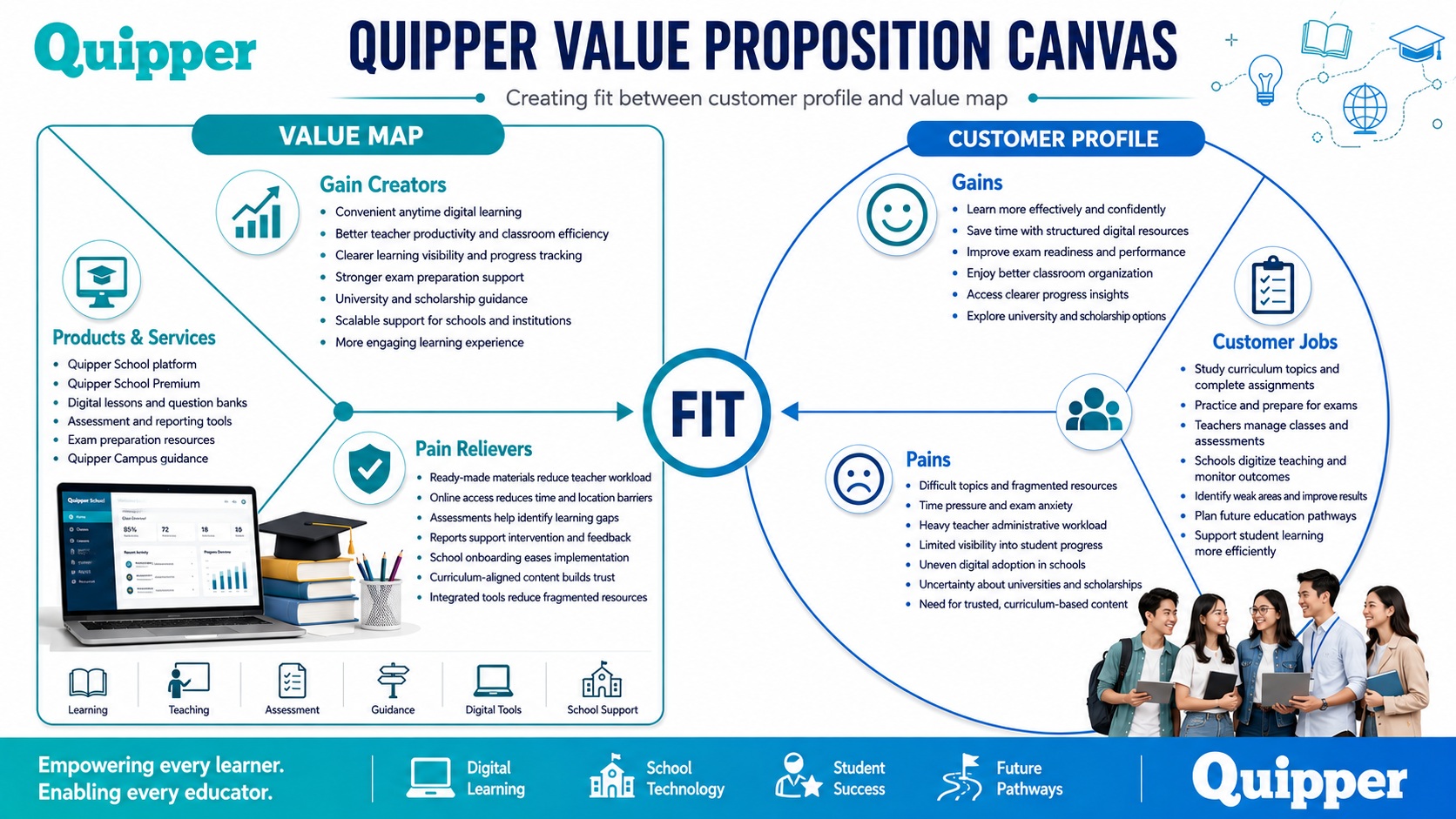
Business Model Canvas explains the overall organisation, while Value Proposition Canvas examines how customer needs connect with Quipper’s solutions.
The Quipper Business Model Canvas becomes easier to understand through this closer customer perspective because education purchases involve both functional and emotional outcomes.
Students want academic improvement, but they may also seek confidence, convenience, reduced examination anxiety, and clearer university choices.
Teachers need efficient systems without losing control over their classrooms.
Schools expect technology to improve education rather than create additional administrative complexity.
Value Proposition Canvas therefore separates customer jobs, pains, and desired gains before connecting them with Quipper’s products, pain relievers, and gain creators.
The strongest value fit occurs when technology reduces work while simultaneously improving visibility and learning effectiveness.
The customer profile focuses primarily on students and educators because these groups interact most frequently with Quipper.
Students need to understand curriculum topics, complete schoolwork, prepare for examinations, identify academic weaknesses, and make future education decisions.
Teachers face a different workload involving lesson preparation, classroom administration, assessment, grading, monitoring, and instructional improvement.
| Customer Profile | Details |
|---|---|
| Customer Jobs | Learn curriculum topics, complete assignments, prepare for assessments, improve academic performance, manage classes, distribute materials, evaluate progress, and plan future education |
| Customer Pains | Difficult topics, limited learning time, exam anxiety, fragmented resources, repetitive teacher administration, slow assessment, low student engagement, and limited performance visibility |
| Customer Gains | Better understanding, convenient learning, stronger exam readiness, efficient teaching, faster assessment, useful progress information, and clearer education pathways |
Different stakeholders therefore share one common requirement: improving educational outcomes with less unnecessary friction.
Quipper’s value map explains how its services respond to those customer requirements.
Platform functionality alone provides limited value unless the features solve genuine teaching or learning problems.
Quipper combines digital classroom tools with structured educational content, assessments, learning reports, exam preparation, institutional support, and higher-education information.
| Value Map | Details |
|---|---|
| Products and Services | Quipper School, Quipper School Premium, learning content, assessments, question banks, digital teaching tools, student reports, exam preparation, and Quipper Campus |
| Pain Relievers | Ready-made materials reduce preparation work, automated digital processes simplify administration, assessments identify learning gaps, and online access reduces geographic constraints |
| Gain Creators | Structured resources improve learning convenience, reports increase visibility, exam tools strengthen preparation, and university information supports better future decisions |
Value grows when these components function as one educational journey rather than separate digital products.
Fit occurs when customer problems are directly matched with useful platform outcomes.
The table below illustrates that relationship.
| Customer Profile | Details | Matching Value Map | How Quipper Creates Fit |
|---|---|---|---|
| Customer Jobs | Students must learn, practise, complete assessments, and plan future studies; teachers must manage learning efficiently | Products and Services | Quipper combines LMS functionality, educational content, assessments, reporting, exam preparation, and university information |
| Customer Pains | Learners encounter difficult topics and fragmented resources while teachers face repetitive preparation and administration | Pain Relievers | Prepared materials, digital distribution, assessment tools, automated workflows, and online access reduce friction |
| Customer Gains | Users want stronger academic understanding, efficiency, visibility, confidence, and clearer progression | Gain Creators | Learning resources, performance reports, exam preparation, institutional support, and university guidance create those outcomes |
Quipper creates the greatest fit when its technology makes education easier without reducing teaching quality.
Strongest fit occurs in schools that want digital tools but do not want teachers to construct every digital resource from the beginning.
Educators can use prepared materials, assessments, and reporting capabilities while retaining responsibility for classroom teaching.
Students benefit when school activities, revision, examinations, and learning resources are accessible through a familiar digital environment.
University-bound learners create another important fit. Quipper Campus connects academic learning with decisions concerning programmes, universities, scholarships, careers, and personal potential. (Quipper Campus)
The Quipper Business Model Canvas consequently produces its highest value when Quipper becomes part of an ongoing education workflow rather than an application opened only immediately before an examination.
Platform relevance can then extend across several years of a learner’s development.
A Quipper Value Proposition Canvas diagram should visually connect customer jobs, pains, and gains with Quipper’s products and services, pain relievers, and gain creators.
The Indonesian EdTech market contains several competing models rather than one standard approach.
Ruangguru has developed a broad education ecosystem covering digital self-learning, live instruction, physical learning centres, private tuition, English education, school solutions, and other specialised products. (Ruangguru)
Pahamify maintains a more student-centred proposition around animated videos, question banks, examinations, interactive tutoring, UTBK preparation, and university-entry support. (Pahamify | Taklukkan UTBK)
By comparison, the Quipper Business Model Canvas places relatively strong strategic emphasis on integration between school technology, educators, institutional support, learning content, and student progression.
None of the three structures is inherently superior. Their strengths correspond to different BMC priorities.
| Relevant BMC Block | Quipper | Ruangguru | Pahamify |
|---|---|---|---|
| Customer Segments | Students, teachers, schools, and university-bound learners | Broad K-12 learners, parents, tutoring customers, schools, and lifelong-learning users | Primarily secondary students and university-entry candidates |
| Value Proposition | School LMS, teaching tools, educational content, assessment, support, exam preparation, and university guidance | Broad integrated learning ecosystem combining self-study, live teaching, tutoring, physical centres, and specialised programmes | Engaging digital learning, exam practice, interactive tutoring, and university-entry preparation |
| Channels | Schools, teachers, apps, web platforms, direct institutional sales | Apps, web, physical centres, teachers, advertising, direct digital sales | Primarily mobile and digital consumer channels |
| Revenue Logic | Premium school solutions plus paid education services | Subscription packages, tutoring, courses, physical-centre programmes, and education services | Consumer learning subscriptions and exam-preparation programmes |
| Key Activities | Content, LMS development, assessments, school implementation, educator support | Content, tutoring, centre operations, technology, marketing, teaching, and product diversification | Content creation, live learning, exam preparation, technology, and student engagement |
| Model Strength | Institutional integration between schools, teachers, and students | Breadth of product ecosystem and extensive consumer-market reach | Focused student experience and exam-preparation relevance |
Strategically, Quipper should avoid competing solely on consumer advertising or feature quantity.
Its stronger position lies in making schools and educators an integral part of the platform ecosystem.
Several reinforcing capabilities strengthen Quipper’s competitive position.
Sustainable advantage depends on turning these capabilities into measurable outcomes rather than merely providing a large number of features.
Quipper also faces structural risks common to education technology and institutional software businesses.
The strategic challenge is therefore not simply acquiring more registered users but converting adoption into sustained educational usage and renewal.
Future development should strengthen the areas where the Quipper Business Model Canvas can create advantages that consumer-only education applications find harder to reproduce.
Quipper should aim to become part of routine academic operations rather than remaining an optional teaching application.
Assignments, assessments, curriculum planning, performance analytics, learning interventions, and teacher resources should connect through a unified workflow.
Greater integration raises switching costs because schools become dependent on accumulated processes, historical information, and familiar teacher practices.
Product development should nevertheless prioritise simplicity. Additional features create value only when teachers can use them with minimal administrative effort.
A strong school operating-system position would give Quipper a clearer strategic identity against consumer-focused tutoring competitors.
Registered-user figures provide evidence of reach but do not necessarily demonstrate platform effectiveness.
Management should prioritise active-learning metrics such as assignment completion, monthly teacher activity, assessment frequency, improvement by competency, student retention, premium-school renewal, and intervention effectiveness.
Institutional customers could receive simple dashboards translating platform data into academic action.
For example, school leaders could identify subjects where students consistently underperform while teachers receive recommendations for remedial content.
Outcome measurement would help Quipper shift the sales discussion from software features towards educational impact.
Teachers can become one of Quipper’s most powerful growth channels.
The platform should make successful lesson plans, assessment structures, teaching practices, and professional knowledge easier to share among educators where appropriate.
Recognition programmes could reward teachers for useful educational contributions rather than only platform activity.
Training and certification may also increase professional attachment to the ecosystem.
As educators gain more value from participation, schools obtain greater benefits from maintaining the platform.
Such teacher-side network effects would be more difficult for purely student-facing applications to reproduce.
Quipper possesses a natural opportunity to use learning data to improve personalisation.
Assessment results can identify knowledge gaps, while student activity can indicate areas requiring further practice.
The platform could recommend targeted lessons, questions, revision sequences, or teacher interventions based on demonstrated competencies.
Educators should remain central to this process. Technology ought to provide evidence and recommendations rather than attempt to remove professional judgement.
Effective adaptive learning would strengthen both the student value proposition and the institutional case for premium adoption.
Quipper Campus creates an opportunity to differentiate the ecosystem from platforms concentrated only on coursework.
Academic performance, interests, assessments, career information, university options, programmes, scholarships, and application preparation can form a connected progression journey.
A Grade 10 student, for instance, might identify career interests before receiving relevant programme information and later preparing for entrance examinations.
Integration must respect privacy and avoid inappropriate deterministic recommendations.
Done correctly, this pathway could substantially increase lifetime engagement with Quipper.
Free access can accelerate adoption but requires a deliberate transition towards monetisable services.
Quipper should clearly separate functionality that drives ecosystem growth from premium capabilities that create measurable institutional value.
Basic classroom tools can stimulate teacher familiarity.
Advanced analytics, extensive content libraries, diagnostics, implementation support, institutional reporting, premium assessment, and specialised academic programmes can support paid tiers.
Pricing should correspond with identifiable outcomes rather than arbitrary feature restrictions.
A transparent freemium architecture would reduce confusion while improving conversion opportunities.
School technology frequently fails because implementation receives less attention than procurement.
Quipper should create structured adoption pathways covering leadership alignment, teacher onboarding, pilot classes, usage targets, technical support, progress reviews, and expansion.
Early-warning indicators can identify schools where teacher activity falls after implementation.
Customer-success teams should then intervene before disengagement becomes permanent.
Strong onboarding improves both educational outcomes and commercial retention because software value appears only after teachers and students develop recurring usage habits.
Artificial intelligence can improve Quipper without becoming the entire proposition.
Useful applications include question generation with educator review, lesson recommendations, content search, performance summaries, teacher-assistance tools, learning-gap detection, and administrative automation.
Academic accuracy requires governance, particularly when AI generates educational explanations or assessments.
Human educators should supervise high-impact outputs.
Quipper could therefore position AI as an efficiency and personalisation layer supporting teachers rather than as a replacement for teaching expertise.
Several lessons from Quipper apply to education entrepreneurs and digital-platform founders.
First, identify every participant in the value chain. A product designed for students may still depend on teachers, schools, administrators, parents, regulators, or education partners.
Second, distribution can be more defensible than product functionality. Competitors may copy a digital feature, but established institutional relationships and habitual workflows take longer to reproduce.
Third, freemium models require a clear commercial purpose. Free services should generate awareness, engagement, data, network effects, or conversion opportunities rather than simply create large numbers of non-paying users.
Fourth, content and technology need to reinforce one another. Excellent software with weak educational material creates limited learning value, while excellent content delivered through a poor platform reduces accessibility.
Finally, outcomes matter. Education businesses eventually need to demonstrate that their solutions improve learning, teaching productivity, institutional efficiency, or another meaningful educational objective.
Overall, the Quipper Business Model Canvas explains how Quipper connects digital learning with institutional education infrastructure.
Its strategic position extends beyond delivering videos or practice questions. Quipper combines school technology, educational content, teacher tools, assessment, student services, exam preparation, institutional support, and university guidance within a broader ecosystem.
School relationships create an especially important competitive dimension. Consumer-oriented platforms usually acquire learners individually, whereas institutional distribution can introduce technology simultaneously to teachers and large student populations.
Long-term success nevertheless requires more than user scale. Quipper must demonstrate sustained teacher adoption, student engagement, measurable educational outcomes, premium conversion, institutional renewal, and responsible use of learning data.
Competition from Ruangguru, Pahamify, conventional tuition providers, and emerging AI-based learning services will continue raising expectations.
Quipper can strengthen its position by becoming increasingly embedded within everyday education workflows while maintaining simple technology, high-quality content, trusted academic support, and clear value for schools and students.
This article is provided solely for educational, academic, and business-analysis purposes.
Information has been prepared from publicly available sources, company materials, market observations, and strategic interpretation. The content does not constitute financial, investment, legal, tax, educational, business, or professional advice, nor should it be interpreted as an official statement from Quipper, Ruangguru, Pahamify, Recruit, or any other organisation mentioned.
Readers should conduct independent research and obtain suitable professional advice before making business, investment, partnership, procurement, or other commercial decisions.
All trademarks, logos, copyrights, brand names, product names, images, and related intellectual-property rights mentioned or displayed belong to their respective owners. Their inclusion is for identification, education, commentary, and analysis only and does not imply endorsement, sponsorship, affiliation, or approval.
Explore the Quipper Business Model Canvas, nine BMC blocks, Value Proposition Canvas, Ruangguru and Pahamify comparison, competitive advantages, risks, and strategic recommendations.
Explore the CARPUT Business Model Canvas, nine BMC blocks, Value Proposition Canvas, competitor comparison, competitive… Read More
Explore the Boost Business Model Canvas, nine BMC blocks, Value Proposition Canvas, competitor comparison, advantages,… Read More
Explore the Domino's Pizza Business Model Canvas, nine BMC blocks, Value Proposition Canvas, Pizza Hut… Read More
Explore the Mie Gacoan Business Model Canvas, including its customer segments, value propositions, revenue streams,… Read More
Restaurant Business Model Canvas: A Practical Guide to Designing, Evaluating, and Improving Restaurant Business Models… Read More
Learn how the Food and Beverage Business Model Canvas helps restaurants, cafés, beverage brands, and… Read More