CARPUT Business Model Canvas
Explore the CARPUT Business Model Canvas, nine BMC blocks, Value Proposition Canvas, competitor comparison, competitive advantages, risks and strategic recommendations.
Explore the Alfamart Business Model Canvas and learn how Alfamart uses convenience, store density, franchising, digital services, and daily retail operations to grow.
BMC Article No: BMC #058
Updated in 2026: This article has been rewritten with deeper business analysis, a clearer Business Model Canvas structure, a stronger Value Proposition Canvas section, competitive advantages, risks, challenges, and strategic lessons from Alfamart’s growth in Indonesia.
Alfamart is one of the most recognizable minimarket brands in Indonesia. The company serves customers who need groceries, snacks, personal care items, household goods, mobile top-ups, bill payments, and quick purchases near where they live, study, work, or travel.
The Alfamart Business Model Canvas is useful because Alfamart is not just a retailer with shelves and cashiers. It is a dense neighborhood distribution network, franchise platform, supplier channel, transaction hub, and digital retail touchpoint.
Its strategic strength comes from solving a simple customer problem at scale. Many customers need small items quickly, without visiting a large supermarket or waiting for online delivery.
A parent may buy cooking oil after work. Students may pick up drinks after class. Commuters may stop for bread, coffee, and e-wallet top-ups before continuing their journey.
This article explains how Alfamart creates value, reaches customers, generates revenue, controls costs, and defends its position in Indonesia’s highly competitive convenience retail market.
Alfamart’s business model is built on convenience retail with high transaction frequency. The company sells fast-moving consumer goods through company-owned stores, franchise outlets, digital channels, and service partners.
Proximity is the core operating logic. Alfamart places stores close to residential areas, commercial zones, schools, offices, transport routes, and smaller towns where customers make small but frequent purchases.
Most revenue comes from product sales. Additional income is generated through franchise fees, royalties, digital service commissions, supplier-funded promotions, private-label products, and payment-related services.
Competition remains intense because customers can switch easily. Indomaret, supermarkets, traditional warung, e-commerce platforms, quick-commerce players, and delivery apps all compete for a share of daily consumer spending.
The Alfamart Business Model Canvas shows a retail system that looks simple at the storefront, but depends on disciplined execution behind the scenes.
Business Model Canvas, or BMC, is a practical tool for understanding how a company works. It explains how a business creates value, delivers that value, and converts it into revenue.
Rather than looking only at products, BMC divides a business into nine connected building blocks.
| BMC Block | Key Question |
|---|---|
| Customer Segments | Who does the business serve? |
| Value Propositions | What value does the business offer? |
| Channels | How does the business reach customers? |
| Customer Relationships | How does the business build loyalty? |
| Revenue Streams | How does the business make money? |
| Key Resources | What assets does the business need? |
| Key Activities | What must the business do well? |
| Key Partnerships | Who supports the business operations? |
| Cost Structure | What are the main costs of the business? |
For Alfamart, the canvas is useful because the company competes through more than store count. Its model combines location strategy, procurement scale, warehouse discipline, franchise governance, promotion design, customer data, payment partnerships, and local execution.
Alfamart is operated by PT Sumber Alfaria Trijaya Tbk. The brand started in Indonesia and grew into one of the country’s major minimarket chains serving household needs and convenient daily purchases.
Its expansion was shaped by three strategic moves. First, Alfamart built a dense neighborhood presence to stay close to customers’ daily routines.
Second, the company used franchising to accelerate market coverage while involving local operators and investors. Third, Alfamart added digital and financial services so each store became more useful than a place to buy goods.
Customers visit Alfamart for practical and repeatable tasks. They buy snacks, drinks, rice, toiletries, prepaid credit, electricity tokens, and other daily items.
The Alfamart Business Model Canvas explains why this model matters. Alfamart is not only a minimarket chain, but a daily convenience platform supported by stores, suppliers, systems, employees, franchise partners, and consumer trust.
Alfamart is strategically interesting because it turns low-value purchases into a large-scale transaction engine. One shopping basket may be small, but repeated visits across many stores can create meaningful revenue.
Hypermarkets depend on planned shopping trips. Alfamart depends on routine, habit, proximity, speed, and small urgent needs.
This difference matters in Indonesia. Traffic congestion, time pressure, dense residential areas, price-sensitive households, and mixed offline-online behavior make convenience highly valuable.
The company also turns stores into multi-service nodes. Customers can buy products, redeem promotions, pay bills, top up mobile credit, use e-wallets, and engage through Alfagift.
From a strategy perspective, the Alfamart Business Model Canvas shows how convenience retail can defend relevance through location, assortment, affordability, digital services, and operational control.
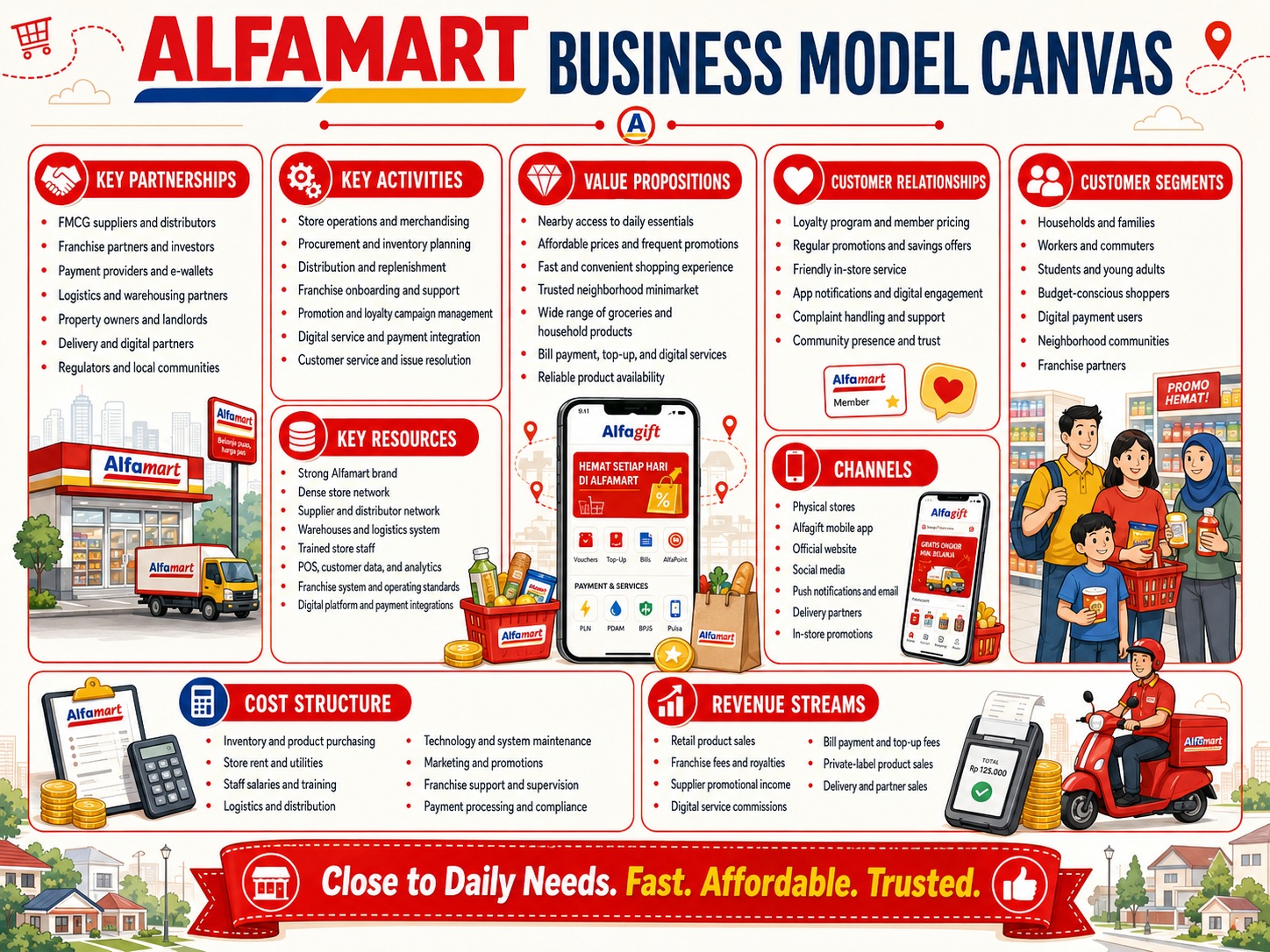
Before reviewing each block, the table below gives a quick view of how Alfamart’s business model works.
| BMC Block | Alfamart Application |
| Customer Segments | Households, workers, students, commuters, digital users, franchisees, and neighborhood shoppers. |
| Value Propositions | Nearby access, affordable daily essentials, fast service, trusted format, payments, and promotions. |
| Channels | Physical stores, franchise outlets, Alfagift, website, social media, delivery partners, and payment channels. |
| Customer Relationships | Loyalty rewards, member pricing, app offers, community presence, store service, and customer support. |
| Revenue Streams | Retail sales, franchise fees, royalties, private-label products, service commissions, and supplier promotions. |
| Key Resources | Store network, brand, suppliers, warehouses, staff, franchise system, POS data, and digital platforms. |
| Key Activities | Procurement, replenishment, store operations, merchandising, promotions, franchise support, and digital service management. |
| Key Partnerships | FMCG suppliers, franchisees, landlords, payment providers, logistics firms, delivery platforms, and local communities. |
| Cost Structure | Inventory, rent, payroll, utilities, logistics, technology, marketing, training, and franchise supervision. |
The model is built on scale, repeat visits, supplier power, and operating discipline.
Customer segments describe who Alfamart serves and why they choose the brand. The company targets people who need nearby access to daily products and practical services.
Alfamart’s customer base is broad because daily needs cut across income levels, age groups, and locations. Households buy groceries and cleaning products, while workers purchase drinks, bread, coffee, and ready-to-eat snacks.
Students often buy low-ticket items after school. Digital users visit for top-ups, bill payments, e-wallet transactions, and promotional offers.
Franchisees form another important segment. They are business partners rather than end consumers, but they help Alfamart expand coverage and strengthen local relevance.
| Customer Segment | What They Need | How Alfamart Serves Them |
| Households | Groceries and household essentials. | Provides nearby access to basic goods. |
| Workers and commuters | Fast purchases during busy routines. | Places outlets near offices, roads, and transit routes. |
| Students | Affordable snacks, drinks, and small items. | Offers low-ticket products and frequent promotions. |
| Digital users | Top-ups, payments, and e-wallet access. | Supports payment partners and financial services. |
| Franchisees | A proven retail format. | Provides brand, systems, training, and operational support. |
The Alfamart Business Model Canvas shows that Alfamart serves both shoppers and business partners at the same time.
Value propositions explain why customers choose Alfamart over other retail options. At its core, Alfamart offers nearby access to daily products, predictable service, and useful transactions.
Convenience is the main value driver. Customers can walk or ride a short distance, buy what they need, and leave quickly.
Affordability strengthens the offer. Promotions, bundled deals, member pricing, and private-label products help households manage daily spending.
Reliability also matters. Customers expect common products to be available, prices to be clear, store layouts to feel familiar, and payment systems to work.
| Value Proposition | Customer Benefit | Business Impact |
| Nearby daily essentials | Reduces travel effort. | Increases visit frequency. |
| Affordable pricing | Helps manage household budgets. | Builds traffic and repeat purchases. |
| Fast store experience | Saves time for small errands. | Supports high transaction volume. |
| Digital services | Enables payments, top-ups, and app offers. | Adds service revenue and engagement. |
| Trusted format | Provides familiar products and prices. | Strengthens repeat buying behavior. |
| Promotions and loyalty | Creates savings and rewards. | Improves retention and basket size. |
The Alfamart Business Model Canvas highlights a clear value logic: close, useful, affordable, trusted, and fast.
Channels explain how Alfamart reaches customers and stays visible in their daily routines. The company uses physical stores, franchise outlets, digital platforms, social media, delivery partners, and payment networks.
Physical stores remain the strongest channel. They create street-level visibility, capture customer traffic, and encourage impulse purchases.
Franchise outlets expand this reach with local capital and operators. Digital channels add engagement before, during, and after store visits.
Alfagift supports membership, promotions, product checking, and selected ordering activities. Social media promotes campaigns, new products, limited offers, and seasonal promotions.
| Channel | Example | Strategic Role |
| Physical stores | Neighborhood and commercial-area outlets. | Captures daily demand directly. |
| Franchise outlets | Stores operated by business partners. | Expands coverage through local operators. |
| Alfagift and website | App offers, product checking, and membership. | Builds digital engagement and customer data. |
| Social media | Instagram, TikTok, Facebook, and WhatsApp. | Keeps promotions visible. |
| Delivery partners | On-demand retail delivery platforms. | Serves customers beyond walk-in traffic. |
| Payment channels | E-wallets and transaction partners. | Makes payments and services easier. |
Strong channels help Alfamart compete across offline habits and digital routines.
Customer relationships explain how Alfamart keeps customers coming back. The model depends on convenience, familiarity, savings, trust, and repeated practical use.
Most relationships are habit-based, not deeply personalized. Customers return because the outlet is nearby, the product range is familiar, prices are clear, and promotions are frequent.
Digital engagement deepens the relationship. Alfagift, member pricing, rewards, targeted promotions, and service notifications give customers more reasons to interact beyond physical visits.
Community familiarity also helps. A neighborhood store can become part of a customer’s daily route when service remains consistent.
| Relationship Driver | How It Works | Example |
| Loyalty and membership | Rewards repeat behavior. | Members check app offers before shopping. |
| Promotion-led engagement | Discounts create purchase motivation. | Families buy promoted cooking oil or snacks. |
| Convenience relationship | Nearby stores reduce effort. | Workers stop after office hours. |
| Community familiarity | Local staff and routine visits build comfort. | Regular shoppers recognize their nearest outlet. |
| Customer support | Issues are handled through service channels. | Users report product or transaction problems. |
This relationship model is practical. Customers return when Alfamart remains easy, relevant, and good value.
Revenue streams show how Alfamart makes money. The company earns most of its income from retail sales, supported by franchise income, service commissions, supplier promotions, and private-label products.
Daily product sales form the core of the model. Groceries, beverages, snacks, toiletries, household items, and personal care products create frequent transactions.
Private-label products can improve margin because they reduce dependence on branded suppliers. Service transactions add revenue without requiring significant shelf space.
Mobile top-ups, electricity tokens, e-wallet services, bill payments, and other digital transactions can generate commissions while increasing store visits.
| Revenue Stream | Description | Why It Matters |
| Retail sales | Sales of FMCG and household goods. | Forms the main revenue base. |
| Private-label products | Alfamart-branded alternatives. | Improves margin and price competitiveness. |
| Service commissions | Top-ups, payments, and digital transactions. | Adds income beyond inventory. |
| Franchise fees and royalties | Income from franchise partners. | Supports expansion and recurring revenue. |
| Supplier promotions | Brand-funded displays and campaigns. | Monetizes shelf visibility. |
| Delivery orders | Sales through digital and delivery channels. | Captures demand beyond store visits. |
This revenue model depends on transaction frequency, store density, assortment discipline, and service breadth.
Key resources are the assets Alfamart needs to operate and grow. The most important resources include its store network, brand, suppliers, warehouses, technology, trained workforce, data, and franchise system.
The store network is critical because proximity drives convenience retail. Each outlet acts as a customer access point, sales channel, service counter, and local brand billboard.
Supplier relationships protect product availability, price support, and promotional funding. Logistics capability ensures that goods move efficiently from warehouses to stores.
Digital infrastructure also matters. POS data, inventory systems, loyalty platforms, payment integrations, and analytics support better decisions in pricing, replenishment, and promotion planning.
| Key Resource | Role in the Model | Strategic Value |
| Store network | Provides customer access. | Drives reach and visit frequency. |
| Brand trust | Builds familiarity. | Supports repeat purchases. |
| Supplier network | Secures products and promotions. | Protects availability and margin. |
| Logistics capability | Moves goods efficiently. | Reduces stockouts and waste. |
| Trained workforce | Runs stores and serves customers. | Maintains speed and service quality. |
| Digital platforms | Supports data, loyalty, and payments. | Improves engagement and control. |
| Franchise system | Standardizes partner operations. | Enables scalable expansion. |
Together, these resources make Alfamart a repeatable and scalable retail operating model.
Key activities are the tasks Alfamart must perform well every day. These include procurement, assortment planning, replenishment, store operations, logistics, staff training, promotion execution, digital service management, and franchise support.
Execution consistency is critical. Customers expect clean stores, stocked shelves, clear prices, fast checkout, working payment systems, and helpful staff.
Merchandising also shapes performance. Alfamart must select products that match local demand, manage fast-moving items, rotate promotions, and prevent stockouts during peak periods.
Franchise support is equally important. Partner-operated stores must comply with brand standards, pricing rules, inventory procedures, service expectations, and reporting requirements.
| Key Activity | What It Involves | Why It Matters |
| Procurement | Buying from FMCG suppliers. | Protects price, stock, and margin. |
| Store operations | Checkout, shelving, cleaning, and service routines. | Maintains convenience and trust. |
| Merchandising | Product selection, displays, and promotions. | Improves basket size and conversion. |
| Logistics | Warehousing and replenishment. | Keeps shelves available. |
| Franchise support | Training, monitoring, and guidance. | Protects brand consistency. |
| Digital service management | Payments, top-ups, app offers, and systems. | Adds utility and service revenue. |
Retail advantage depends on disciplined daily execution, not only strategic planning.
Key partnerships help Alfamart expand, operate efficiently, and increase the usefulness of each store. The company depends on FMCG suppliers, franchisees, landlords, payment providers, logistics partners, delivery platforms, technology vendors, and local communities.
Supplier partnerships are central to the model. FMCG brands need Alfamart’s shelf visibility, while Alfamart needs stable supply, competitive terms, promotional support, and category collaboration.
Payment and digital partners strengthen each outlet’s role as a transaction point. These relationships make Alfamart useful even when customers visit mainly to pay bills or top up credit.
Landlords and franchisees influence expansion quality. Good locations and disciplined operators help protect store productivity.
| Partner Type | Example | Contribution |
| FMCG suppliers | Food, beverage, household, and personal care brands. | Provide core products and promotions. |
| Franchisees | Local operators and investors. | Expand store footprint. |
| Landlords | Property owners and developers. | Provide strategic locations. |
| Payment providers | E-wallets, banks, and bill networks. | Enable digital transactions. |
| Logistics partners | Warehouse and distribution providers. | Support replenishment. |
| Delivery platforms | On-demand shopping partners. | Extend reach beyond stores. |
| Local communities | Schools, neighborhoods, and organizations. | Support local trust and presence. |
Strong partnerships turn each outlet into a retail, service, and customer access node.
Cost structure explains Alfamart’s major expenses. Convenience retail carries large recurring costs because it depends on inventory, locations, staff, utilities, technology, logistics, and marketing.
Inventory is a major cost and working-capital requirement. The company must buy goods before selling them, manage expiry risk, secure supplier terms, and maintain availability without overstocking.
Fixed costs also shape profitability. Rent, electricity, store maintenance, security, equipment, payroll, and system support can pressure margins when store traffic is weak.
Promotion spending requires careful control. Discounts can attract traffic, but excessive promotions can reduce margin if they do not increase basket size or repeat visits.
| Cost Category | Example | Management Challenge |
| Inventory | FMCG, fresh items, snacks, drinks, and household goods. | Balance availability with working capital. |
| Rent and utilities | Store leases, electricity, water, and maintenance. | Protect outlet-level profit. |
| Labour | Cashiers, store teams, supervisors, and support staff. | Maintain service while controlling cost. |
| Logistics | Warehousing, transport, and replenishment. | Reduce stockouts and distribution cost. |
| Technology | POS, apps, payments, cybersecurity, and analytics. | Ensure reliability and value. |
| Marketing | Promotions, campaigns, displays, and loyalty offers. | Drive traffic without eroding margin. |
| Franchise support | Training, audits, manuals, and supervision. | Keep partner stores consistent. |
Growth is valuable only when store productivity, margin control, and cost discipline remain healthy.
Alfamart offers practical lessons for entrepreneurs, franchise owners, retailers, and business strategists.
The first lesson is that proximity can be a powerful competitive weapon. Customers often choose the store that reduces effort, especially for urgent and routine needs.
Another lesson is that small baskets require high frequency. A minimarket may generate limited value from one visit, but repeated purchases across many outlets can build a strong revenue engine.
Distribution is also part of the product. Alfamart’s value is not only what it sells, but where it sells, how quickly customers can buy, and how consistently products are available.
Franchising requires control. Expansion can move faster through business partners, but training, audits, supply rules, service standards, and brand discipline must remain strong.
Digital services increase relevance. When stores support payments, top-ups, loyalty, and app promotions, they become more useful in customers’ daily routines.
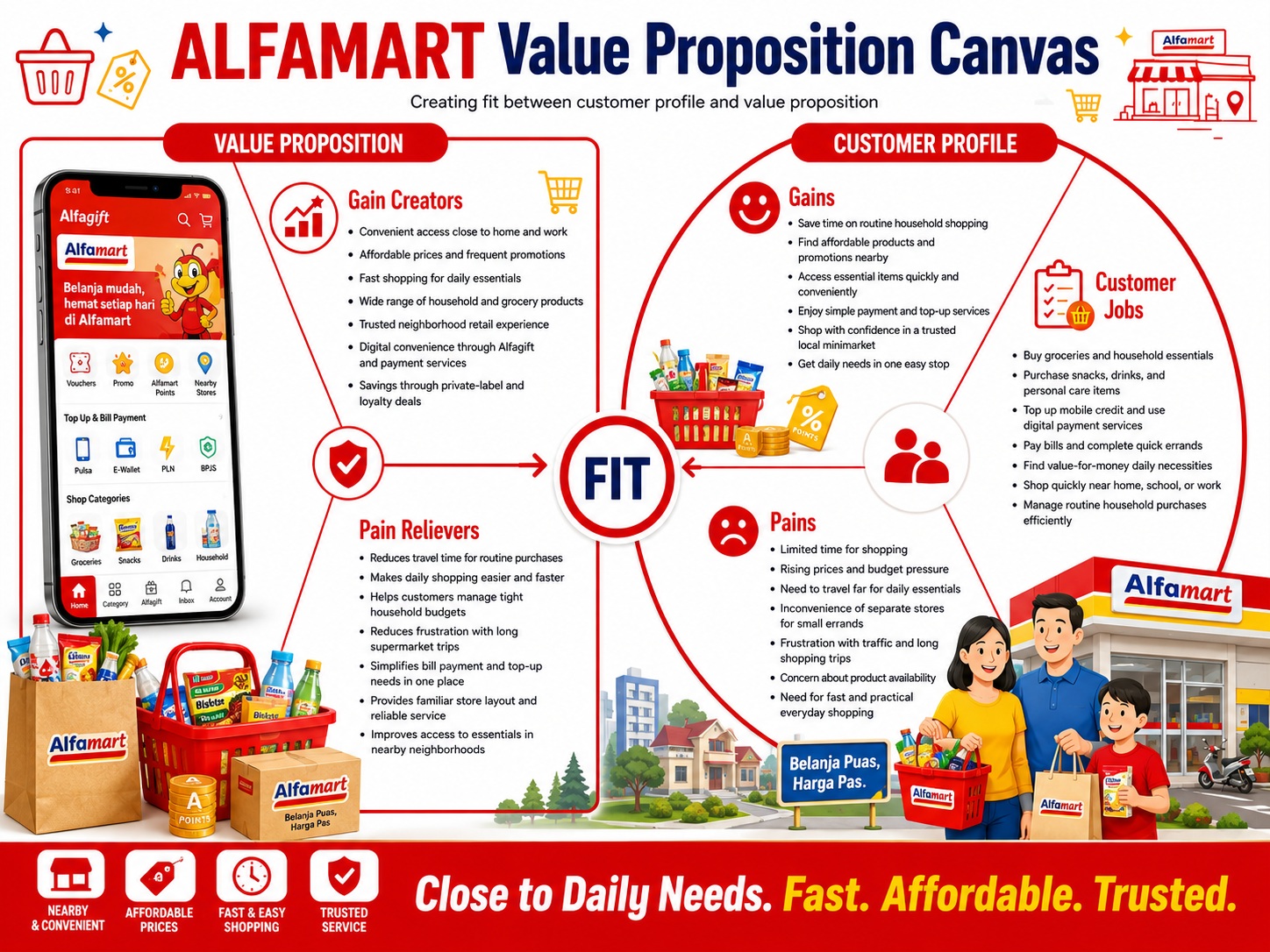
The Value Proposition Canvas helps explain the fit between Alfamart’s offer and customer needs. It shows why customers choose Alfamart not only because it sells groceries, but because it solves practical, financial, and time-related needs in daily life.
The customer profile explains what Alfamart customers want to achieve, what problems they face, and what benefits they expect. Alfamart customers are often busy, price-sensitive, convenience-driven, and focused on recurring household needs.
For customer jobs, Alfamart helps customers buy daily essentials, complete quick errands, pay bills, top up mobile credit, find promotions, and access basic services near home, school, work, or travel routes.
For customer pains, customers face traffic, limited time, rising prices, long supermarket trips, stockouts, transport constraints, and a lack of nearby service points. Alfamart reduces these pains through neighborhood locations, fast checkout, familiar layouts, regular promotions, and digital transaction services.
For customer gains, customers want convenience, savings, product availability, payment flexibility, predictable service, trusted brands, and quick access to small-basket purchases. Alfamart creates these gains through store density, essential product assortment, loyalty offers, private-label options, e-wallet services, and app promotions.
The value proposition explains how Alfamart responds to those customer jobs, pains, and gains. Its core offer is simple: nearby daily retail that is affordable, fast, reliable, and useful beyond product shopping.
Alfamart’s products and services include groceries, snacks, beverages, toiletries, household goods, private-label products, bill payments, mobile top-ups, electricity tokens, e-wallet services, app promotions, and franchise stores.
Pain relievers include accessible locations, fast checkout, regular discounts, familiar products, digital payment options, bill payment counters, and consistent store standards. These benefits reduce customer effort when handling small but frequent daily needs.
Gain creators include loyalty rewards, member pricing, supplier campaigns, private-label savings, app-based offers, trusted product selection, and daily neighborhood presence. These benefits make Alfamart more valuable than a basic shop because customers get convenience, savings, and service access in one place.
| Customer Profile | Details | Matching Value Proposition | How Alfamart Creates Fit |
| Customer Jobs | Customers want to buy daily essentials, complete quick errands, pay bills, top up mobile credit, and find daily promotions. | Products and Services | Groceries, snacks, household goods, toiletries, top-ups, bill payments, e-wallet services, Alfagift offers, and private-label products. |
| Customer Pains | Customers face traffic, limited time, rising prices, long shopping trips, stockouts, and a lack of nearby service points. | Pain Relievers | Nearby stores, fast checkout, regular promotions, familiar layouts, consistent availability, digital payments, and service counters. |
| Customer Gains | Customers want convenience, savings, trusted products, flexible payment, consistent service, and quick access to routine needs. | Gain Creators | Loyalty rewards, member prices, supplier campaigns, private-label savings, app-based offers, trusted brands, and dense neighborhood presence. |
The table shows that Alfamart fits the customer profile because it answers three needs at the same time: convenience, affordability, and everyday reliability. Customers are not only buying groceries, but a faster way to manage recurring household tasks.
This fit explains why Alfamart can remain relevant despite intense competition. The brand must continue matching changing customer jobs, pains, and gains. If customers shift toward delivery, e-wallet usage, healthier products, or cheaper private-label options, Alfamart must adapt without losing its core promise as a convenient nearby retailer.
Alfamart’s competitive advantage comes from a system of reinforcing strengths. No single factor is enough to protect the brand.
The Alfamart Business Model Canvas is powerful because it shows a system, not just a store. Alfamart competes through access, reliability, affordability, services, and execution.
Alfamart still faces real business risks. These issues do not make the model weak, but they show where management discipline is required.
These risks show that scale must be managed carefully. Long-term performance depends on store productivity, cost control, digital relevance, and customer trust.
The Alfamart Business Model Canvas shows how Indonesia’s minimarket giant built a scalable convenience retail model. Its success is based on proximity, affordability, product availability, franchise expansion, supplier relationships, digital services, and operational discipline.
Alfamart works because it serves recurring daily needs. Customers need groceries, snacks, household goods, payments, top-ups, and quick errands near where they live or work.
For business owners, the lesson is clear. A strong retail model is not only about selling products.
Real value comes from making purchases easy, frequent, trusted, and efficient. That is the strategic power behind Alfamart.
This article is for informational and educational purposes only. It is based on publicly available information and independent business analysis. It does not represent official information from Alfamart, PT Sumber Alfaria Trijaya Tbk, or any related company. Readers should conduct their own research before making business, investment, or strategic decisions.
Explore the CARPUT Business Model Canvas, nine BMC blocks, Value Proposition Canvas, competitor comparison, competitive… Read More
Explore the Boost Business Model Canvas, nine BMC blocks, Value Proposition Canvas, competitor comparison, advantages,… Read More
Explore the Domino's Pizza Business Model Canvas, nine BMC blocks, Value Proposition Canvas, Pizza Hut… Read More
Explore the Mie Gacoan Business Model Canvas, including its customer segments, value propositions, revenue streams,… Read More
Restaurant Business Model Canvas: A Practical Guide to Designing, Evaluating, and Improving Restaurant Business Models… Read More
Learn how the Food and Beverage Business Model Canvas helps restaurants, cafés, beverage brands, and… Read More