Nippon Sushi Business Model Canvas: How a Malaysian Japanese Restaurant Brand Creates and Captures Value
Article No: BMC #032
Meta Description: Explore the Nippon Sushi Business Model Canvas, including its nine BMC blocks, Value Proposition Canvas, revenue streams, competitors, and strategies.
2026 Update: This article has been extensively revised from its original 2024 publication. The updated version includes deeper analysis of the nine Business Model Canvas blocks, an expanded Value Proposition Canvas, a comparison with Sushi King and Empire Sushi, competitive advantages, business risks, potential failure scenarios, and strategic recommendations. The discussion also incorporates current restaurant industry considerations, including cost pressures, digital ordering, customer retention, and operational scalability.
1. Introduction
Japanese cuisine has established a strong presence in Malaysia’s food and beverage industry. Sushi, sashimi, ramen, tempura, and other Japanese-inspired dishes have become increasingly familiar choices for consumers seeking variety, convenience, and enjoyable dining experiences.
However, running a successful Japanese restaurant requires more than preparing attractive meals. Operators must manage ingredient quality, food safety, customer expectations, restaurant locations, labour productivity, and operating costs.
Nippon Sushi offers an interesting example of how a Malaysian entrepreneur entered an established international food category and developed a local restaurant brand.
Founded in 2017 by Siti Noraini, Nippon Sushi focuses on providing Japanese cuisine through a casual restaurant dining experience. Its business concept combines menu variety, ingredient quality, customer service, and comfortable dining environments.
The Nippon Sushi Business Model Canvas examines how these elements interact to create customer value and support the restaurant’s commercial operations.
Beyond describing how the business works, this analysis explores its competitive positioning, revenue opportunities, operational challenges, and potential for sustainable growth.
2. Company Background: The Story Behind Nippon Sushi
Nippon Sushi was established by Malaysian entrepreneur Siti Noraini in 2017.
According to the earlier Gerbang Bisnes company profile, Noraini previously worked in the corporate sector before transitioning into the food and beverage industry.
Her entrepreneurial journey included gaining experience through a franchise business, which helped develop her understanding of restaurant operations and management.
This experience provided a foundation for developing a Japanese restaurant concept that could appeal to Malaysian consumers.
Unlike Japanese fine-dining establishments primarily targeting premium customers, Nippon Sushi adopted a broader dining proposition centred on quality Japanese dishes, menu variety, and a comfortable restaurant environment.
Its development highlights an important aspect of food entrepreneurship: businesses can enter an established market by identifying opportunities to serve customers differently.
Rather than creating an entirely new food category, Nippon Sushi sought to compete through its interpretation of the Japanese dining experience.
Nippon Sushi at a Glance
| Company Information |
Details |
| Business Name |
Nippon Sushi |
| Founder |
Siti Noraini |
| Established |
2017 |
| Country of Origin |
Malaysia |
| Industry |
Food and Beverage |
| Business Category |
Japanese Restaurant |
| Core Products |
Sushi, sashimi, ramen, tempura, and Japanese dishes |
| Primary Business Model |
Restaurant-based food and beverage sales |
| Target Market |
Malaysian consumers seeking Japanese dining experiences |
The company’s entrepreneurial background demonstrates how industry experience, customer understanding, and disciplined restaurant management can contribute to business development.
Nevertheless, long-term competitiveness depends on how effectively those capabilities translate into consistent customer experiences and profitable operations.
3. What Is Nippon Sushi’s Business Model?
Nippon Sushi primarily operates a restaurant-based business model in which customers purchase prepared Japanese meals and beverages.
Its core value creation process involves sourcing ingredients, preparing dishes, delivering restaurant services, and generating income through customer transactions.
Unlike businesses that sell products through extensive automated distribution networks, restaurants rely heavily on physical facilities, employees, and daily operational execution.
Three commercial drivers are particularly important:
- Customer Demand: Attracting consumers who value Japanese cuisine, menu variety, and enjoyable dining experiences.
- Operational Delivery: Converting ingredients, labour, equipment, and restaurant facilities into consistent meals and services.
- Revenue and Profitability: Generating sufficient transaction revenue to cover food costs, labour, rent, utilities, and other operating expenses.
The Nippon Sushi Business Model Canvas illustrates how these drivers must remain aligned.
Higher customer traffic can increase revenue, but profitability depends on the relationship between transaction values, direct costs, and fixed operating expenses.
Consequently, successful growth requires both customer satisfaction and sound restaurant economics.
4. What Is the Business Model Canvas?
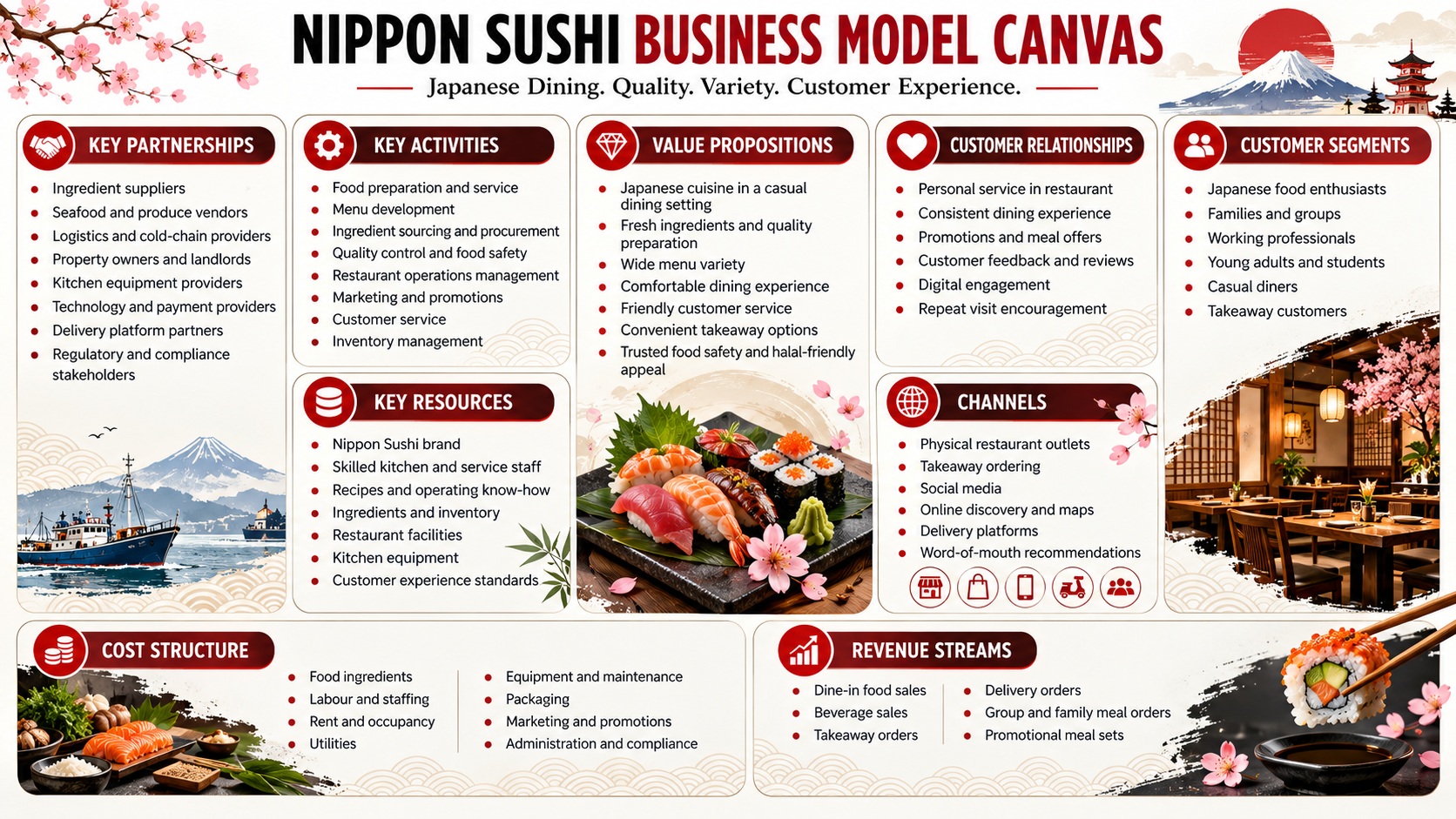
The Business Model Canvas (BMC) is a strategic management framework developed by Alexander Osterwalder and Yves Pigneur to explain how an organisation creates, delivers, and captures value.
It consists of nine interconnected building blocks that describe a company’s customers, offerings, operations, partnerships, revenues, and costs.
For Nippon Sushi, the framework helps explain how the restaurant converts demand for Japanese cuisine into a commercially sustainable dining business.
The Nine Business Model Canvas Blocks
| BMC Block |
Key Question |
| Customer Segments |
Who are Nippon Sushi’s customers? |
| Value Propositions |
Why do customers choose Nippon Sushi? |
| Channels |
How does the restaurant reach and serve customers? |
| Customer Relationships |
How does it attract and retain diners? |
| Revenue Streams |
How does the business generate income? |
| Key Resources |
What resources are required to operate? |
| Key Activities |
What activities support value delivery? |
| Key Partnerships |
Which external partners support operations? |
| Cost Structure |
What are the main operating expenses? |
Understanding these components together provides a more comprehensive assessment than examining sales, products, or restaurant locations independently.
5. Nippon Sushi Business Model Canvas Overview
Before examining the individual building blocks, it is useful to summarise how Nippon Sushi’s business model operates.
The following overview identifies the principal components that support its restaurant operations.
Nippon Sushi BMC Summary
| BMC Block |
Business Model Overview |
| Customer Segments |
Japanese food enthusiasts, families, professionals, casual diners, and visitors |
| Value Propositions |
Japanese cuisine, ingredient freshness, menu variety, comfortable dining, and attentive service |
| Channels |
Physical restaurants, takeaway, online discovery, and applicable delivery services |
| Customer Relationships |
Personal service, consistent dining experiences, promotions, and customer feedback |
| Revenue Streams |
Food and beverage sales, takeaway, delivery, and potential group orders |
| Key Resources |
Brand, skilled employees, recipes, ingredients, restaurant facilities, and kitchen equipment |
| Key Activities |
Food preparation, restaurant management, procurement, quality control, and marketing |
| Key Partnerships |
Ingredient suppliers, logistics providers, landlords, equipment providers, and service partners |
| Cost Structure |
Ingredients, labour, rent, utilities, equipment, marketing, and administrative expenses |
The Nippon Sushi Business Model Canvas reveals a business that relies on combining customer-facing value with operational capabilities.
Its competitive position depends on attracting suitable customer segments and delivering consistent dining experiences.
Behind that proposition, procurement, staffing, kitchen management, and cost control determine whether each outlet can operate profitably.
The following analysis examines each block and its strategic significance.
6. Detailed Analysis of Nippon Sushi’s Business Model Canvas
6.1 Customer Segments
Customer segments identify the groups of consumers that a business intends to serve.
Nippon Sushi appeals to individuals and groups who enjoy Japanese cuisine and prefer a casual restaurant setting.
Although customers share an interest in Japanese food, their purchasing motivations, spending patterns, and dining occasions may differ substantially.
Nippon Sushi Customer Segments
| Customer Segment |
Description |
Customer Needs |
| Japanese Food Enthusiasts |
Consumers who regularly enjoy Japanese cuisine |
Authentic flavours, menu variety, and food quality |
| Families and Friends |
Groups dining together for meals or celebrations |
Comfortable seating and diverse menu choices |
| Working Professionals |
Employees seeking lunch or dinner near workplaces |
Convenient locations, reasonable waiting times, and predictable prices |
| Young Adults and Students |
Consumers exploring Japanese food and casual dining |
Affordable combinations and appealing dining experiences |
| Visitors and Tourists |
Customers looking for Japanese dining options while travelling |
Accessibility, reliable quality, and recognisable menu items |
Analysis of Customer Segments
Different customer groups create different revenue opportunities.
Families and larger groups may generate higher transaction values, while working professionals can provide more frequent weekday visits.
Young consumers may respond positively to meal promotions, social media visibility, and accessible price points.
Tourists, meanwhile, may place greater importance on restaurant location and online reviews.
This diversity can reduce dependence on a single customer category, but it also creates challenges for menu design and marketing.
Strategic Implications
The Nippon Sushi Business Model Canvas suggests that customer segmentation should be assessed at individual outlet level.
A restaurant located near office buildings may benefit from quick lunch combinations, whereas a suburban location may attract more families during weekends.
Management should therefore examine customer frequency, average spending, preferred dishes, and profitability across different segments.
A clearer understanding of these patterns can improve staffing, menu planning, promotional effectiveness, and restaurant capacity utilisation.
Ultimately, prioritising valuable customer segments is more effective than attempting to appeal equally to every consumer.
6.2 Value Propositions
Value propositions explain why customers choose one business instead of competing alternatives.
Nippon Sushi’s core proposition centres on delivering Japanese cuisine within an enjoyable and accessible restaurant environment.
Customers evaluate not only the food itself but also ingredient quality, menu selection, service reliability, comfort, and perceived value.
Nippon Sushi Value Propositions
| Value Proposition |
Description |
Customer Benefit |
| Japanese Cuisine |
Selection of sushi and other Japanese dishes |
Access to familiar Japanese flavours |
| Fresh Ingredients |
Emphasis on ingredient quality and proper preparation |
Better confidence in food quality |
| Menu Variety |
Different dishes and meal options |
Suitable choices for diverse preferences |
| Comfortable Dining |
Casual restaurant environment |
Enjoyable meals with family and friends |
| Customer Service |
Attentive and responsive service |
More satisfying dining experiences |
| Food Suitability and Trust |
Clear product information and applicable food safety and halal assurance |
Greater purchasing confidence |
Analysis of Value Propositions
Customers rarely choose restaurants based on one attribute alone.
A diner may initially visit Nippon Sushi because of its menu but return because the food quality, service, and dining environment consistently meet expectations.
Menu variety is particularly valuable when customers dine in groups.
However, an extensive menu can increase preparation complexity, ingredient requirements, and inventory waste.
A strong value proposition must therefore consider both attractiveness to customers and feasibility for the business.
Strategic Implications
The Nippon Sushi Business Model Canvas highlights the importance of differentiating through a complete dining experience.
Competing primarily through lower prices may weaken margins and attract customers who switch easily when competitors offer discounts.
A stronger strategy would reinforce consistent food quality, customer convenience, menu relevance, and service reliability.
Importantly, management should identify which benefits customers genuinely value and are willing to pay for.
The most sustainable proposition combines meaningful customer benefits with capabilities that the restaurant can deliver efficiently and consistently.
6.3 Channels
Channels describe how businesses communicate with customers and deliver their products or services.
Physical restaurant locations are central to Nippon Sushi because they enable customers to experience the food, service, and dining environment directly.
Digital channels can complement physical outlets by improving restaurant discovery and offering additional ordering convenience.
Nippon Sushi Channels
| Channel |
Description |
Strategic Importance |
| Physical Restaurants |
Dine-in locations serving prepared meals |
Core customer experience and revenue |
| Takeaway |
Orders collected for off-premises consumption |
Extends convenience |
| Website and Online Listings |
Restaurant and menu information where available |
Supports customer discovery |
| Social Media |
Content, promotions, and customer communication |
Builds awareness and engagement |
| Delivery Platforms |
Third-party ordering where available |
Expands customer reach |
Analysis of Channels
Each channel has different economics.
Dine-in customers may purchase additional beverages and side dishes, although they require seating capacity and service staff.
Takeaway orders reduce dining-space requirements but introduce packaging expenses.
Delivery channels can generate incremental sales while creating platform commission and order fulfilment costs.
Therefore, increasing the number of orders does not necessarily generate proportionate profit growth.
The contribution margin of each channel should guide investment decisions.
Strategic Implications
The Nippon Sushi Business Model Canvas demonstrates the importance of managing physical and digital channels as complementary components.
Restaurants provide the complete brand experience, while online visibility helps attract new customers.
Takeaway and delivery can expand sales beyond the restaurant’s seating capacity.
However, management should avoid excessive dependence on discount-driven delivery transactions that generate limited margins.
An effective channel strategy should maximise profitable customer access while maintaining consistent product quality and service standards.
6.4 Customer Relationships
Customer relationships describe how a business attracts, serves, and retains its customers.
For Nippon Sushi, repeat purchases are particularly important because restaurant customers may return regularly when their experiences are satisfactory.
Food quality, service consistency, complaint resolution, and customer engagement all influence retention.
Nippon Sushi Customer Relationships
| Relationship Approach |
Description |
Strategic Benefit |
| Personal Customer Service |
Direct interaction with restaurant employees |
Builds satisfaction and trust |
| Consistent Dining Experience |
Reliable food and service standards |
Encourages repeat visits |
| Promotions and Special Offers |
Meal deals and occasional promotional campaigns |
Stimulates demand |
| Customer Feedback |
Reviews, complaints, and suggestions |
Identifies improvements |
| Digital Engagement |
Customer communication through online platforms |
Maintains brand awareness |
Analysis of Customer Relationships
Repeat customers can contribute substantially to restaurant economics.
A diner returning several times per month may generate more lifetime revenue than multiple first-time visitors attracted through advertising.
However, retention depends on consistent delivery.
Poor service, long waiting times, or inconsistent food preparation can undermine customer confidence.
Promotions may increase transaction frequency, but excessive discounting can reduce profitability without creating genuine loyalty.
Strategic Implications
The Nippon Sushi Business Model Canvas indicates that customer retention should become a measurable operational objective.
Management could track repeat visits, customer satisfaction, complaint frequency, average spending, and online review trends.
A well-designed loyalty programme may strengthen relationships, provided its rewards do not eliminate transaction margins.
More importantly, the restaurant should consistently deliver compelling reasons for customers to return.
Over time, reliable service and positive dining experiences can reduce dependence on paid customer acquisition and strengthen revenue predictability.
6.5 Revenue Streams
Revenue streams represent the different ways a company generates income.
Nippon Sushi primarily earns revenue through food and beverage sales at its restaurant locations.
Additional opportunities may arise from takeaway, delivery, group dining, and larger customer orders, depending on outlet capabilities.
Nippon Sushi Revenue Streams
| Revenue Stream |
Description |
Revenue Potential |
| Dine-in Food Sales |
Sushi, sashimi, ramen, and other Japanese meals |
Primary revenue source |
| Beverage Sales |
Drinks purchased with meals |
Increases transaction value |
| Takeaway Orders |
Meals purchased for consumption elsewhere |
Expands sales occasions |
| Delivery Orders |
Orders placed through applicable delivery channels |
Reaches convenience-focused customers |
| Group and Event Orders |
Larger purchases for gatherings or functions |
Potential higher-value transactions |
Analysis of Revenue Streams
Revenue depends on several interconnected variables, including customer traffic, average transaction value, menu composition, and available service capacity.
For example, a restaurant may increase sales by introducing promotional meal sets.
However, if discounting significantly reduces product margins, the additional transactions may contribute relatively little profit.
Beverages and complementary menu items can increase average spending when their margins are attractive.
Kitchen efficiency and table turnover also influence the amount of revenue generated from existing facilities.
Strategic Implications
The Nippon Sushi Business Model Canvas shows why revenue quality matters as much as revenue growth.
Management should evaluate sales by channel, menu category, transaction size, and outlet.
Important performance measures include average customer spending, contribution margin, food-cost percentage, and revenue per available seat.
A commercially healthy restaurant should generate sufficient contribution from each transaction to cover operating expenses and support profitability.
Consequently, revenue diversification should prioritise attractive margins rather than transaction volume alone.
6.6 Key Resources
Key resources are the assets and capabilities necessary to deliver customer value.
Nippon Sushi depends on physical facilities, employees, ingredients, preparation knowledge, and brand reputation.
These resources determine the restaurant’s ability to produce meals consistently and maintain operational reliability.
Nippon Sushi Key Resources
| Key Resource |
Description |
Strategic Importance |
| Brand Reputation |
Customer recognition and accumulated experiences |
Supports differentiation and repeat visits |
| Skilled Employees |
Kitchen, service, and management personnel |
Determines food and service quality |
| Ingredients |
Seafood, rice, vegetables, sauces, and other materials |
Supports menu production |
| Restaurant Facilities |
Kitchens, dining spaces, storage, and equipment |
Enables daily operations |
| Recipes and Operating Procedures |
Preparation methods and service standards |
Supports consistency and scalability |
Analysis of Key Resources
Not all resources create equal strategic value.
Kitchen equipment can generally be purchased, but trained employees and accumulated operational knowledge are harder to replace.
Similarly, restaurant locations influence customer accessibility, while brand reputation reflects experiences built over time.
Dependence on a small number of skilled employees can create operational vulnerabilities.
Without documented procedures, service quality may decline when experienced personnel leave.
Strategic Implications
The Nippon Sushi Business Model Canvas highlights the importance of building organisational capabilities rather than relying solely on physical assets.
Standardised recipes, employee development, inventory systems, and service procedures can improve consistency across locations.
These resources become particularly important when expanding a restaurant network.
Management should also ensure that investments are proportionate to expected demand.
Expensive equipment or excessive inventory can weaken returns if restaurant capacity is underutilised.
A sustainable resource strategy balances customer experience, operating efficiency, and long-term scalability.
6.7 Key Activities
Key activities describe the essential operations that a business must perform to deliver its value proposition.
Nippon Sushi must coordinate food preparation, procurement, service delivery, restaurant management, quality control, and marketing.
These activities directly influence customer satisfaction and profitability.
Nippon Sushi Key Activities
| Key Activity |
Description |
Strategic Importance |
| Food Preparation |
Preparing sushi and other Japanese dishes |
Delivers the core product |
| Ingredient Procurement |
Sourcing suitable food materials |
Maintains availability and quality |
| Quality and Food Safety Control |
Managing hygiene, preparation, and storage standards |
Protects customer trust |
| Restaurant Management |
Coordinating staffing, orders, inventory, and facilities |
Supports efficiency |
| Marketing and Menu Development |
Attracting customers and refining offerings |
Maintains market relevance |
Analysis of Key Activities
Restaurant activities are highly interconnected.
Procurement decisions affect ingredient availability, preparation quality, and food costs.
Kitchen efficiency influences waiting times and the number of orders that can be completed during busy periods.
Service quality shapes customer satisfaction and the likelihood of repeat visits.
Poor inventory forecasting may result in shortages of popular dishes or excessive food waste.
Likewise, insufficient staffing during peak periods can reduce service quality and customer throughput.
Strategic Implications
The Nippon Sushi Business Model Canvas demonstrates that operational excellence should be treated as a competitive capability.
Management should establish standard operating procedures, performance indicators, and quality controls.
Measures such as food preparation time, order accuracy, inventory waste, labour productivity, and customer complaints can reveal opportunities for improvement.
As the business expands, these activities should become increasingly standardised without removing the flexibility needed to accommodate local customer preferences.
The objective is to reproduce reliable dining experiences while controlling operational complexity.
6.8 Key Partnerships
Key partnerships involve external organisations that help a company operate effectively.
Nippon Sushi depends on suppliers, logistics providers, landlords, equipment specialists, and other service partners.
These relationships support ingredient availability, restaurant infrastructure, and operational continuity.
Nippon Sushi Key Partnerships
| Key Partner |
Description |
Strategic Importance |
| Ingredient Suppliers |
Suppliers of seafood, rice, vegetables, and other materials |
Supports food quality and availability |
| Logistics Providers |
Transportation and cold-chain services |
Protects ingredient integrity |
| Property Owners |
Landlords and commercial property operators |
Provides restaurant premises |
| Equipment Providers |
Kitchen equipment and maintenance services |
Supports operational reliability |
| Technology and Service Providers |
Ordering, payment, and applicable delivery services |
Enables transactions and distribution |
Analysis of Key Partnerships
Supplier performance has a direct impact on restaurant quality.
Fresh ingredients require reliable delivery, appropriate storage conditions, and consistent sourcing standards.
A disruption in seafood supply could prevent certain menu items from being served.
Meanwhile, unfavourable tenancy agreements may increase fixed costs and reduce outlet profitability.
Partner selection should therefore consider quality, reliability, flexibility, and total operating cost rather than purchase price alone.
Strategic Implications
The Nippon Sushi Business Model Canvas illustrates how strategic partnerships can reduce operational uncertainty.
Management should establish supplier evaluation criteria covering quality, delivery performance, traceability, pricing, and applicable certification requirements.
Alternative sourcing arrangements may improve resilience when supply disruptions occur.
Longer-term purchasing relationships can also create opportunities for better procurement terms as sales volumes increase.
However, cost savings should not compromise food safety or product quality.
Effective partnership management strengthens both operating efficiency and the customer proposition.
6.9 Cost Structure
Cost structure describes the major expenses required to operate a business.
Restaurants generally combine variable costs, such as food ingredients, with relatively fixed expenses, including rent and certain staffing commitments.
Nippon Sushi must control these expenses while maintaining the quality and service standards expected by customers.
Nippon Sushi Cost Structure
| Cost Category |
Description |
Cost Characteristic |
| Food Ingredients |
Seafood, rice, sauces, vegetables, and beverages |
Predominantly variable |
| Employee Expenses |
Kitchen, service, and management personnel |
Fixed and variable components |
| Rent and Occupancy |
Restaurant premises and related charges |
Largely fixed |
| Utilities and Maintenance |
Electricity, water, refrigeration, and equipment repairs |
Mixed |
| Marketing and Administration |
Promotions, technology, packaging, and compliance |
Fixed and variable components |
Analysis of Cost Structure
Restaurant profitability can be sensitive to relatively small changes in operating costs.
Seafood prices may fluctuate due to supply conditions, transport expenses, and currency movements.
Rental and staffing commitments are often less flexible in the short term.
Strategic Implications
The Nippon Sushi Business Model Canvas demonstrates the need for disciplined cost control.
Management should monitor food-cost ratios, inventory waste, labour productivity, rental expenses, and outlet-level operating margins.
Menu engineering can help identify products that are popular but insufficiently profitable.
Procurement improvements and more accurate demand forecasting can also reduce unnecessary expenses.
The objective should not be indiscriminate cost reduction.
Instead, management must preserve the quality and service attributes that encourage customer purchases while eliminating avoidable operational inefficiencies.
7. How the Nine Business Model Canvas Blocks Work Together
The nine blocks form an interconnected commercial system.
Customer segments determine whose needs the restaurant intends to satisfy.
Value propositions describe the dining benefits offered to those customers.
Channels connect the business with consumers, while customer relationships encourage repeat purchases.
Revenue streams convert transactions into income.
Key resources, activities, and partnerships enable the restaurant to deliver meals and services.
Finally, the cost structure determines whether the resulting revenue can support sustainable operations.
A weakness in one component can affect the others.
For example, adding more menu items may improve customer choice but also increase ingredient inventory and preparation complexity.
Similarly, opening another outlet may increase revenue while placing additional pressure on staffing, procurement, and management systems.
Sustainable restaurant performance therefore requires an integrated approach rather than independent optimisation of individual activities.
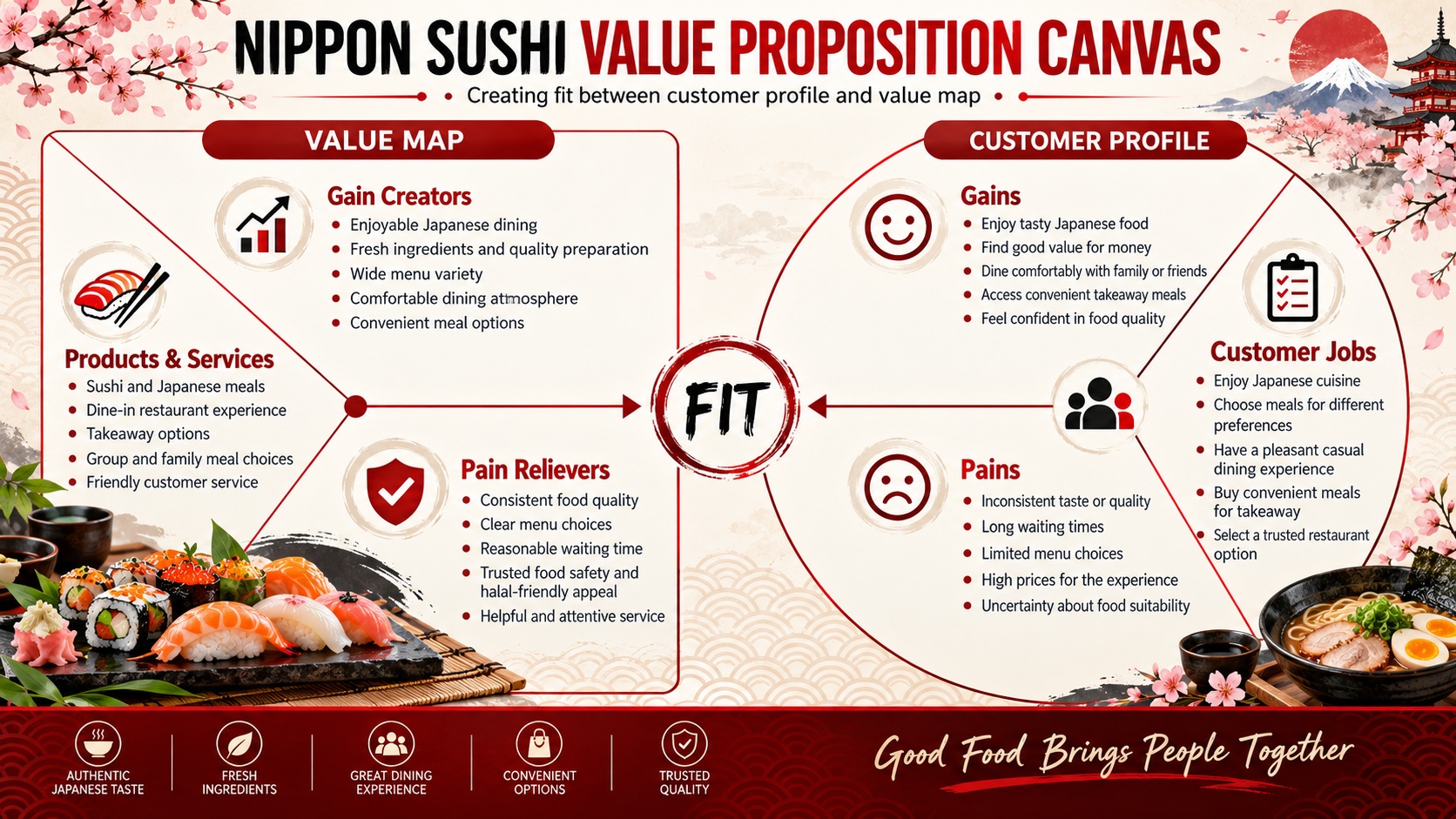
8. Nippon Sushi Value Proposition Canvas
The Value Proposition Canvas (VPC) complements the Business Model Canvas by examining how a business addresses customer needs.
It consists of two main components:
- Customer Profile: Customer jobs, pains, and gains.
- Value Map: Products and services, pain relievers, and gain creators.
For Nippon Sushi, the framework helps explain why customers may select its Japanese dining experience instead of alternative restaurants.
8.1 Customer Profile
The customer profile identifies the activities customers want to accomplish, the frustrations they wish to avoid, and the outcomes they expect.
Nippon Sushi Customer Profile
| Customer Component |
Description |
| Customer Jobs |
Enjoy Japanese food, dine with family or friends, purchase convenient meals, and explore different dishes |
| Customer Pains |
High prices, inconsistent quality, long waiting times, limited options, and concerns about food suitability |
| Customer Gains |
Quality meals, good value, menu variety, comfortable dining, convenient ordering, and confidence in food preparation |
Customer Profile Analysis
Restaurant customers evaluate multiple dimensions of value simultaneously.
Food enthusiasts may prioritise authenticity and ingredient quality.
Families may prefer menu variety and comfortable seating.
Working professionals may value convenient locations and efficient service.
These differences make customer segmentation important when designing the restaurant experience.
The business should avoid assuming that all Japanese food customers share identical expectations.
8.2 Value Map
The value map describes how Nippon Sushi’s offerings can address the needs identified in the customer profile.
Nippon Sushi Value Map
| Value Map Component |
Description |
| Products and Services |
Sushi, sashimi, ramen, other Japanese dishes, beverages, dine-in service, and takeaway |
| Pain Relievers |
Consistent preparation, menu information, service efficiency, quality control, and applicable food assurance |
| Gain Creators |
Menu variety, enjoyable restaurant experiences, convenient meals, and dependable customer service |
Value Map Analysis
The restaurant creates customer value by combining tangible products with service-related benefits.
Freshly prepared food addresses quality expectations.
Menu variety helps groups accommodate different preferences.
Consistent service reduces uncertainty and encourages repeat visits.
However, offering additional features does not always improve profitability.
Every customer benefit should be assessed against the operational resources and costs required to deliver it.
8.3 Customer-Value Proposition Fit
Value proposition fit occurs when the restaurant’s offerings effectively address customer jobs, pains, and desired gains.
Nippon Sushi Customer-Value Fit
| Customer Need |
Customer Profile |
Value Map Response |
| Japanese Cuisine |
Desire to enjoy Japanese food |
Sushi and complementary Japanese dishes |
| Family Dining |
Need for suitable group meals |
Menu variety and restaurant seating |
| Consistent Quality |
Concern about inconsistent preparation |
Standardised food preparation and quality controls |
| Convenient Meals |
Limited time for dining |
Takeaway and efficient ordering |
| Food Suitability |
Concern about ingredients and assurance |
Transparent information and verified compliance |
| Good Value |
Expectation of satisfying meals at suitable prices |
Relevant portions, quality, and service |
Strategic Interpretation
The Nippon Sushi Business Model Canvas becomes more valuable when customer expectations are explicitly connected with operating decisions.
For example, customers who prioritise convenience require efficient ordering and meal preparation.
Families seeking variety need appropriate menu combinations without excessive waiting times.
Customers concerned about food suitability require clear and reliable information.
The central challenge is balancing customer satisfaction with the cost of delivering these benefits.
A strong value proposition should be meaningful to customers, operationally achievable, and financially sustainable.
9. Competitive Comparison: Nippon Sushi vs Sushi King vs Empire Sushi
Malaysia’s Japanese food market includes several restaurant and retail formats.
Nippon Sushi competes with established Japanese dining brands as well as convenience-oriented sushi businesses.
Two relevant comparisons are Sushi King and Empire Sushi.
Sushi King operates a recognised Japanese restaurant chain associated with conveyor-belt sushi dining.
Empire Sushi is primarily known for its grab-and-go sushi concept, alongside selected dine-in formats.
Nippon Sushi’s business model is more closely associated with casual Japanese restaurant dining and broader menu offerings.
9.1 Business Model Comparison
The following comparison focuses only on BMC blocks that meaningfully differentiate the three businesses.
| Relevant BMC Block |
Nippon Sushi |
Sushi King |
Empire Sushi |
| Customer Segments |
Families, professionals, and casual Japanese food enthusiasts |
Mass-market Japanese restaurant customers and shoppers |
Convenience-focused sushi buyers and selected dine-in customers |
| Value Propositions |
Japanese menu variety and casual dining experience |
Recognisable conveyor-belt sushi experience |
Convenient, accessible sushi purchases |
| Channels |
Restaurants, takeaway, and applicable digital channels |
Restaurant network and takeaway |
Grab-and-go outlets and selected restaurants |
| Customer Relationships |
Personal service and repeat dining experiences |
Brand familiarity, promotions, and loyalty |
Convenience and repeat purchases |
| Revenue Streams |
Restaurant food and beverage sales |
Dine-in meals, beverages, and takeaway |
Individual sushi products, meal sets, and dine-in sales |
| Key Resources |
Kitchen teams, recipes, brand, and locations |
Brand network, restaurant systems, and operating capabilities |
Retail locations, production systems, and distribution |
| Cost Structure |
Ingredients, labour, rent, and restaurant operations |
Restaurant labour, occupancy, ingredients, and equipment |
Product preparation, ingredients, retail occupancy, and distribution |
The comparison represents an analytical interpretation of the brands’ operating formats, not audited company performance.
9.2 Competitive Positioning Analysis
Each company emphasises a different aspect of Japanese dining.
Nippon Sushi can compete through its overall restaurant experience, including menu variety, customer service, and comfortable group dining.
Sushi King benefits from a recognisable restaurant format, established brand presence, and operational familiarity among Malaysian consumers.
Empire Sushi offers a convenience-oriented proposition suited to customers who want ready-to-purchase sushi without a conventional dining experience.
These distinctions influence cost structures and customer expectations.
Restaurant-based businesses must justify higher service and occupancy costs through the value customers receive.
Convenience-focused formats, meanwhile, depend heavily on product accessibility, throughput, and efficient preparation.
9.3 Strategic Lessons from the Comparison
Nippon Sushi should avoid competing purely on outlet numbers or promotional prices.
Larger chains may possess advantages in purchasing scale, brand recognition, and location coverage.
Instead, the restaurant can strengthen its competitive position through consistent food quality, customer familiarity, local market understanding, and a distinctive dining experience.
The most defensible strategy is one that customers value and that management can execute profitably.
10. Nippon Sushi’s Competitive Advantages
The restaurant possesses or could further develop several competitive advantages.
Five factors are particularly relevant to its market positioning.
- Local Market Understanding: A Malaysian-developed restaurant brand can adapt menu offerings, marketing messages, and dining experiences to domestic customer preferences.
- Broad Japanese Menu Appeal: A varied menu supports different dietary preferences and dining occasions, helping attract individuals, families, and groups.
- Casual Dining Experience: Comfortable restaurant environments provide social and experiential benefits beyond purchasing prepared food.
- Food Quality and Customer Trust: Reliable ingredients, consistent preparation, food safety, and verified assurance can strengthen consumer confidence and repeat purchases.
- Potential Operational Flexibility: A locally managed business may respond more quickly to regional customer preferences and changing demand, provided its management systems support effective decisions.
These advantages are not automatically sustainable.
Competitors can imitate menu offerings, promotions, and restaurant design.
Long-term differentiation depends on consistently delivering benefits that customers recognise and value.
11. Risks and Challenges Facing Nippon Sushi
The Japanese restaurant industry presents attractive demand opportunities, but operating conditions remain challenging.
Five major risks could influence Nippon Sushi’s business performance.
- Intense Market Competition: Established restaurant chains and independent operators compete for similar customer segments. Frequent promotions may increase customer acquisition costs and weaken pricing power.
- Ingredient Cost Volatility: Seafood prices, imported ingredients, transportation costs, and currency fluctuations can increase food expenses and reduce gross margins.
- Food Safety and Quality Risks: Inconsistent ingredient handling, preparation practices, or hygiene standards could damage customer confidence and create compliance or reputational consequences.
- High Fixed Operating Costs: Rental commitments, staffing, equipment, and utilities create expenses that continue even when restaurant traffic declines.
- Expansion and Execution Challenges: Additional outlets require management capacity, trained employees, suitable locations, and consistent procedures. Poor expansion decisions may weaken profitability and service quality.
Managing these risks requires coordination between restaurant operations, procurement, human resources, marketing, and financial management.
12. Strategic Recommendations for Nippon Sushi
The analysis identifies opportunities to strengthen Nippon Sushi’s competitiveness, operating efficiency, and long-term profitability.
Rather than focusing exclusively on expansion, management should prioritise initiatives that improve customer retention, food quality consistency, and outlet-level financial performance.
The following recommendations are analytical proposals rather than confirmed company initiatives.
12.1 Strengthen Brand Positioning
Nippon Sushi should communicate a clear and recognisable value proposition.
Positioning the brand around quality Japanese cuisine, accessible dining, and consistent customer experiences could strengthen differentiation.
Marketing messages should explain why customers should choose the restaurant instead of relying primarily on promotional discounts.
A clearer identity can improve customer recognition and support more effective marketing expenditure.
12.2 Improve Menu Engineering
Menu performance should be assessed using sales popularity, contribution margins, ingredient requirements, and preparation complexity.
Profitable, frequently ordered dishes can receive greater promotional attention.
Products with low demand or weak margins should be reviewed to determine whether they justify their operational costs.
This approach can improve profitability while preserving menu variety.
12.3 Develop Stronger Customer Retention
Repeat purchases can improve revenue predictability and reduce customer acquisition costs.
Nippon Sushi could strengthen customer relationships through targeted promotions, feedback programmes, and commercially sustainable loyalty initiatives.
Customer behaviour data can help identify preferred menu items, dining frequency, and purchase patterns.
The objective is to encourage customers to return because of consistent value rather than continuous discounts.
12.4 Standardise Restaurant Operations
Consistent operating procedures are essential for maintaining quality across locations.
Management should establish clear standards for food preparation, ingredient storage, service delivery, hygiene, and inventory management.
Employee training and operational reviews can reduce variation between outlets.
Better standardisation also supports food safety, service efficiency, and scalable growth.
12.5 Apply Disciplined Outlet Expansion
Expansion decisions should be based on location-specific demand forecasts and financial analysis.
Important considerations include expected customer traffic, average transaction value, rental commitments, staffing requirements, and capital expenditure.
Each proposed outlet should demonstrate a realistic path to profitability.
Growing the restaurant network without sufficient operating discipline may increase complexity faster than financial returns.
12.6 Strengthen Procurement and Cost Management
Ingredient procurement deserves particular attention because food quality and food costs directly influence profitability.
Management should monitor supplier reliability, price movements, inventory waste, and ingredient yields.
Where appropriate, centralised purchasing and alternative sourcing arrangements may improve cost efficiency and resilience.
However, lower procurement costs should not come at the expense of product quality or food safety.
13. Key Business Lessons from Nippon Sushi
The Nippon Sushi Business Model Canvas offers useful insights for entrepreneurs operating in competitive food and beverage markets.
Customer value extends beyond the product. Good food is essential, but customers also evaluate convenience, service quality, dining comfort, and overall experience.
Established markets still offer entrepreneurial opportunities. Businesses do not necessarily need to invent new products. They can create value by serving existing customer needs more effectively.
Revenue growth does not guarantee profitability. Restaurant operators must understand contribution margins, fixed costs, and individual outlet performance.
Operational consistency supports scalability. Clear processes, employee capabilities, and quality controls become increasingly important as businesses grow.
Competitive differentiation requires continuous execution. An attractive menu can draw customers initially, but sustained success depends on delivering reliable value over repeated transactions.
These principles are relevant to restaurants, cafés, bakeries, food chains, and other consumer-facing businesses.
14. Conclusion
Nippon Sushi demonstrates how a Malaysian entrepreneur can participate in an established international food category by developing a restaurant proposition suited to local dining preferences.
Its business model combines Japanese cuisine, menu variety, customer service, and dining experiences with the operational capabilities required to prepare and deliver meals consistently.
The nine Business Model Canvas blocks reveal that restaurant success depends on coordinating customer demand, value delivery, procurement, staffing, partnerships, revenue generation, and cost management.
Meanwhile, the Value Proposition Canvas highlights the importance of understanding what customers genuinely value.
Food quality, convenience, menu selection, dining comfort, and confidence in food preparation all contribute to purchasing decisions.
Competition from Sushi King, Empire Sushi, and other Japanese dining providers creates pressure to maintain differentiation.
At the same time, ingredient costs, labour expenses, and restaurant operating requirements reinforce the need for disciplined financial management.
The Nippon Sushi Business Model Canvas ultimately illustrates that a successful restaurant is not defined solely by the popularity of its food.
Long-term performance depends on building a complete business system capable of creating customer value consistently and capturing sufficient financial returns.
For entrepreneurs, the central lesson is that developing an attractive product is only the beginning. Sustainable business success requires customer understanding, operational excellence, financial discipline, and the ability to adapt as market conditions change.
Disclaimer
This article is published by Gerbang Bisnes for educational, informational, and business analysis purposes only.
It is an independent analysis and does not represent official information, statements, financial disclosures, or endorsements from Nippon Sushi, its owners, or its management.
The analysis is based on publicly available information, general industry knowledge, and reasonable business-model interpretations. Certain operational practices, financial illustrations, and strategic recommendations are hypothetical and have not been independently verified with the company.
This article does not constitute investment, financial, legal, or professional business advice. Readers should conduct their own research and seek qualified professional guidance before making investment or commercial decisions.
All company names, trademarks, logos, brand identities, and copyrighted materials mentioned belong to their respective owners. Their use is solely for identification, reference, commentary, and educational purposes. No affiliation or endorsement is implied.
References
Nippon Sushi: Official Website — Company and restaurant information.
Sushi King: Official Website — Restaurant concept and brand information.
Empire Sushi: Official Website — Brand and dining concept information.
JAKIM: Malaysia Halal Portal — Official reference for checking applicable halal certification status.