Quipper Business Model Canvas
Explore the Quipper Business Model Canvas, nine BMC blocks, Value Proposition Canvas, Ruangguru and Pahamify comparison, competitive advantages, risks, and strategic recommendations.
Updated in 2026, this Indomaret Business Model Canvas article covers all BMC blocks, VPC, latest developments, competitive advantages, risks, recommendations, and strategic analysis in depth.
BMC Article No: BMC #033
This article was updated in 2026 to make the analysis more comprehensive. The revised version includes a broader Business Model Canvas breakdown, a Value Proposition Canvas section, latest developments around Indomaret, deeper strategic analysis, and more detailed recommendations.
Indomaret is one of the most visible retail brands in Indonesia. Its stores are located near homes, offices, schools, transit points, and secondary towns, which makes the brand part of everyday consumption rather than occasional shopping. That physical proximity is one reason the business remains relevant across income groups and regions.
The company’s model is stronger than a simple convenience-store format. It combines dense store coverage, fast-moving consumer goods, private-label products, payment services, digital ordering, and a large logistics backbone. Public reporting and corporate information also point to a business with more than 20,000 stores, a broad national footprint, and an established digital arm through Klik Indomaret.
This Indomaret Business Model Canvas matters because retail competition is changing. Consumers now expect speed, low prices, nearby access, digital convenience, and consistent product availability at the same time. Indomaret stays relevant because it turns those expectations into an operating system that can be repeated across thousands of neighborhoods.
In this article, we will break down how Indomaret creates value, reaches customers, earns revenue, manages costs, and protects its position in Indonesia’s convenience retail market.
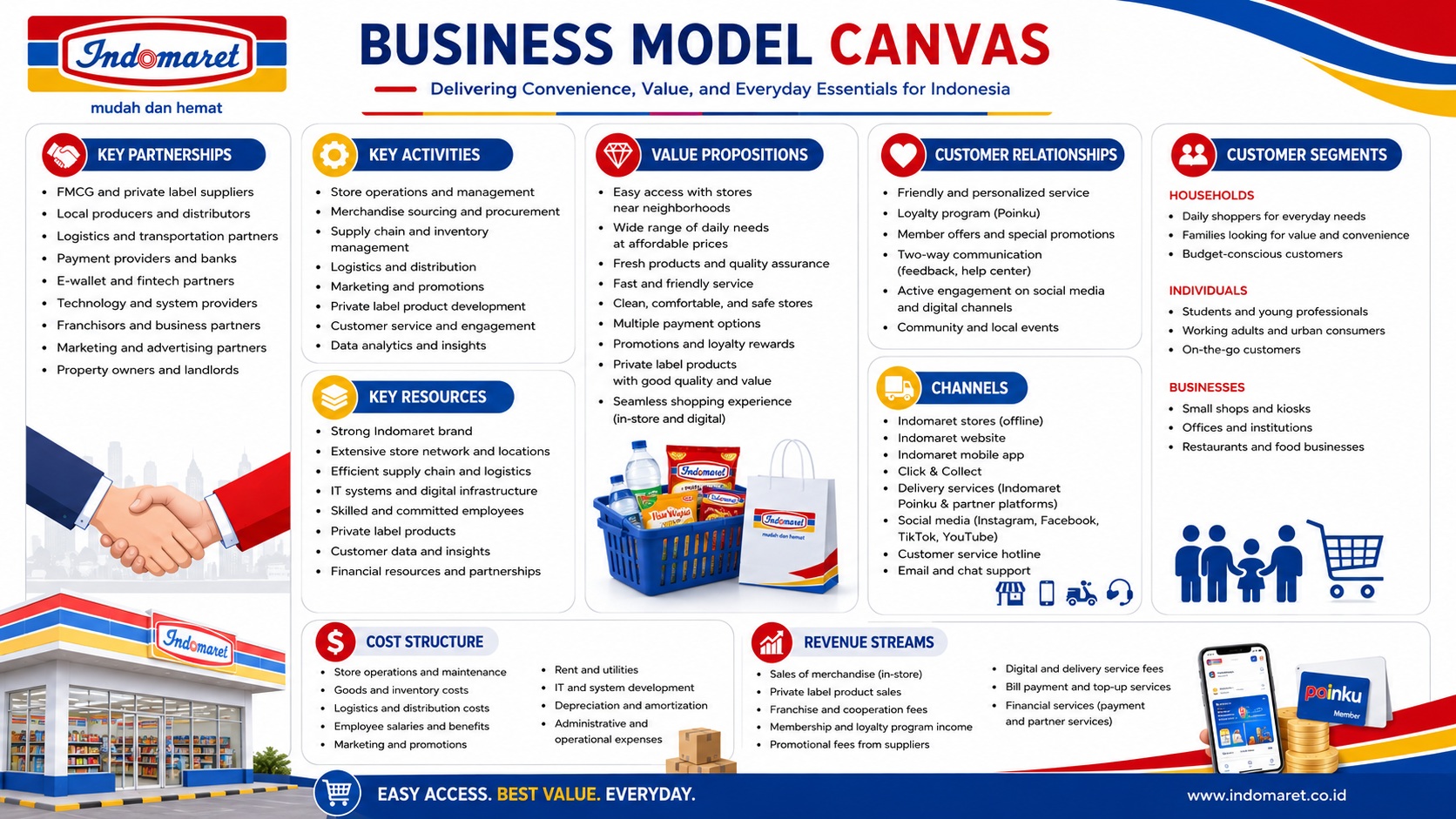
Indomaret’s business model is built around neighborhood convenience retail supported by scale, logistics, service variety, and repeat consumer habits. The company sells daily necessities such as packaged food, beverages, household products, personal care items, and impulse purchases through a large network of minimarkets.
It also earns value from services beyond product sales. Bill payments, digital top-ups, payment-related services, private-label products, and online ordering through Klik Indomaret broaden the model. This creates a structure where stores drive daily traffic, while services and digital access increase customer utility and transaction frequency.
A major strength of the model is repetition. Indomaret does not depend on a few large-ticket purchases. Instead, it wins through many small transactions made frequently by millions of customers who value speed, accessibility, and familiarity.
However, the model is not risk-free. Margin pressure, intense competition, rising operating costs, and growing digital expectations all require tight execution. The Indomaret Business Model Canvas shows a company that uses proximity, scale, and system discipline to stay relevant in a highly competitive market.
Business Model Canvas, or BMC, is a practical tool used to explain how a company works. It helps readers understand how a business creates value, delivers that value to customers, and captures revenue from the market.
Instead of looking only at products, BMC looks at the full operating system behind them. It connects customers, value propositions, channels, relationships, revenue, resources, activities, partners, and costs in one view.
This makes BMC useful for analysing companies like Indomaret because the business is not only about selling snacks or household goods. The model depends on store density, supply chain control, pricing, service utility, digital access, and habit-based repeat purchases. The Indomaret Business Model Canvas helps explain how those parts work together.
Before going deeper, the nine BMC blocks answer these questions:
| BMC Block | Main Question |
|---|---|
| Customer Segments | Who does the business serve? |
| Value Propositions | What value does the business offer? |
| Channels | How does the business reach customers? |
| Customer Relationships | How does the business keep customers coming back? |
| Revenue Streams | How does the business make money? |
| Key Resources | What assets does the business need? |
| Key Activities | What must the business do well? |
| Key Partnerships | Who helps the business operate? |
| Cost Structure | What are the major costs? |
Indomaret is a major Indonesian minimarket chain operated by PT Indomarco Prismatama. The business started in 1988 and later expanded into one of the country’s largest convenience retail networks. Today, the brand is widely associated with easy access, fast daily shopping, and neighborhood-level convenience across Indonesia.
Its scale matters because the business is not driven by one destination store. It is driven by reach. A wide outlet network allows Indomaret to stay close to residential demand, commuter traffic, and small-basket purchases that happen many times each week.
That reach is now supported by digital layers such as Klik Indomaret, delivery partnerships, loyalty tools, and service transactions. As a result, Indomaret is no longer only a physical retail chain. It is becoming a broader convenience platform built around daily consumption and practical services.
Indomaret is strategically interesting because it turns ordinary daily purchases into a scalable business engine. Many companies can sell packaged food, drinks, or household items. Indomaret connects product access, location convenience, service transactions, promotions, and local familiarity into one repeatable format.
The store acts as the center of the model. Once customers rely on the outlet for snacks, groceries, top-ups, bills, and urgent purchases, the relationship becomes habitual. That is strategically powerful because habit can protect volume even when product differentiation is low.
Another important factor is execution. A minimarket model looks simple from the outside, but real strength comes from site selection, replenishment, pricing discipline, supplier coordination, and traffic conversion. From a strategy perspective, the Indomaret Business Model Canvas shows how a company can turn operational discipline into a durable retail advantage.
Indomaret’s business model is changing in three important ways.
First, digital convenience is becoming more important. Klik Indomaret, delivery integrations, and digital payment behavior are expanding the role of the brand beyond in-store shopping.
Second, format evolution is becoming more relevant. Concepts such as Indomaret Fresh, Indomaret Point, foodservice, and ready-to-consume offerings can increase basket size and improve store differentiation.
Third, competition is intensifying. Minimarket rivalry, e-commerce convenience, and local retail alternatives continue to pressure pricing, service speed, and customer retention.
These changes make the Indomaret Business Model Canvas more important. The company still depends on physical stores, but future growth will rely more on better data use, stronger omnichannel integration, and sharper control of store economics.
Before going into each block in detail, the table below shows how the business works as one connected system.
| BMC Block | Indomaret Application |
|---|---|
| Customer Segments | Mass-market households, students, office workers, commuters, and small communities needing quick daily purchases. |
| Value Propositions | Nearby access, affordable prices, fast shopping, product variety, essential services, and trusted convenience. |
| Channels | Physical stores, Klik Indomaret, mobile app, delivery platforms, promotions, and neighborhood presence. |
| Customer Relationships | Habit-based repeat purchases, loyalty programs, promotions, service consistency, and local convenience. |
| Revenue Streams | Retail sales, private label, service fees, promotional income, and digital commerce transactions. |
| Key Resources | Store network, brand trust, logistics, supplier base, technology systems, and operational know-how. |
| Key Activities | Merchandising, replenishment, store operations, promotions, service delivery, and digital integration. |
| Key Partnerships | Suppliers, franchisees, delivery partners, payment partners, landlords, and technology providers. |
| Cost Structure | Store operations, labor, logistics, distribution, inventory, technology, promotion, and expansion costs. |
The Indomaret Business Model Canvas shows a business that depends less on one hero product and more on disciplined execution across many small daily transactions.
Customer segments explain who the business serves. Indomaret mainly targets mass-market consumers who value speed, convenience, and affordability in daily shopping. That includes urban families, working adults, students, commuters, and residents in smaller towns where modern retail options may be limited.
Its customer base is broad, but the common need is simple. People want easy access to snacks, drinks, groceries, household items, personal care products, and payment services without making a long trip. This is why location matters as much as assortment.
| Customer Segment | Main Need | How Indomaret Serves Them |
|---|---|---|
| Households | Daily essentials near home | Convenient neighborhood stores |
| Workers and commuters | Fast purchases on the go | Quick in-and-out shopping |
| Students and young adults | Snacks, drinks, top-ups | Affordable impulse and convenience products |
| Smaller communities | Access to modern retail | Broad network beyond major city centers |
The Indomaret Business Model Canvas is strong here because the company serves high-frequency demand, not narrow niche demand. That gives Indomaret a broader and more resilient base than a retailer that depends on one narrow demographic or one occasional use case. As long as daily convenience remains important in Indonesia, this customer structure can continue to support repeat traffic, steady transaction flow, and long-term relevance across many locations.
The value proposition explains why customers choose Indomaret instead of a traditional kiosk, wet market, supermarket, or competing minimarket. The answer is not only convenience. It is convenience delivered with consistency.
Indomaret offers nearby access, predictable pricing, reliable product availability, a wide range of daily necessities, and useful add-on services such as bill payments and mobile top-ups. That combination saves time for customers and reduces friction in everyday life.
The company also creates value through trust. Customers know what the store looks like, what products are likely available, how the promotions work, and what experience to expect. In retail, that predictability reduces decision effort and supports repeat visits.
| Value Proposition | Customer Benefit | Business Impact |
|---|---|---|
| Nearby convenience | Less travel and faster shopping | Drives frequent visits |
| Affordable everyday pricing | Better budget control | Supports volume sales |
| Broad essential assortment | One-stop daily needs | Increases basket size |
| Extra services | More reasons to visit | Adds traffic and utility |
The Indomaret Business Model Canvas works because it solves ordinary problems very well and very often. That may sound simple, but it is strategically powerful because daily retail value is won through repetition, not novelty. When customers repeatedly experience speed, access, and reliability, Indomaret becomes a default option rather than just one more store in the market.
Channels describe how the business reaches customers and delivers value. For Indomaret, the store itself is the most important channel. Store density creates visibility, accessibility, and habit.
Digital channels now extend that reach. Klik Indomaret and related online ordering tools help customers shop without visiting the store physically. Delivery platform partnerships add another layer by serving time-sensitive or convenience-led purchases.
Promotions, in-store displays, membership mechanics, and local neighborhood presence also function as channels. They influence demand directly at the point of purchase, where many buying decisions are still made.
| Channel | Examples | Strategic Role |
|---|---|---|
| Physical stores | Neighborhood minimarkets in residential, commuter, and local commercial areas | Core sales and convenience channel |
| Klik Indomaret | Online ordering platform and digital browsing | Digital reach and order capture |
| Delivery partners | Last-mile delivery through external platforms | Extends convenience for urgent or remote purchases |
| Promotions and displays | In-store campaigns, price offers, and point-of-sale visibility | Demand activation at store level |
| Local presence | High-visibility neighborhood footprint | Daily brand visibility and habit formation |
The channel mix is effective because it starts with physical proximity and then adds digital convenience around it. This is important because Indomaret does not need to replace the store to stay relevant. Instead, it can use digital tools to increase the usefulness of the physical network, extend access to more buying situations, and reinforce customer habit across both offline and online touchpoints.
Customer relationships in this business are not built through deep personalization. They are built through routine, trust, and repetition. A customer returns because the store is near, the shelves are familiar, the service is fast, and the promotions feel relevant.
Indomaret strengthens these relationships through loyalty tools, discount campaigns, service consistency, and a familiar branded environment across locations. The relationship is functional, but that does not make it weak. In high-frequency retail, habit can be more valuable than emotional storytelling.
Another important point is reliability. When customers believe they can find daily essentials quickly, the store becomes part of their weekly rhythm. That makes switching less attractive unless a rival offers a clearly better combination of location, pricing, and availability.
| Relationship Driver | How It Works | Example |
|---|---|---|
| Shopping habit | Frequent nearby visits build routine dependence | A household stops by several times a week for small-basket purchases |
| Promotional engagement | Discounts and bundle offers encourage repeat visits | A customer returns for weekly promo items or seasonal offers |
| Service convenience | Bill payments and top-ups increase practical usage beyond product buying | A shopper pays bills and buys groceries in one visit |
| Store familiarity | Standardised layout and service reduce effort | A customer can shop quickly in different branches with the same expectation |
| Brand trust | Consistent availability and fair pricing support confidence | Customers rely on the store for urgent daily essentials |
The Indomaret Business Model Canvas benefits from this kind of relationship because repeat traffic supports revenue predictability and store-level productivity. In convenience retail, strong relationships do not need to be emotional or highly personalised to be valuable. What matters more is consistent usefulness, and Indomaret performs well when customers see the brand as a dependable part of their daily routine.
Revenue streams show how the company makes money. The main stream comes from retail sales of fast-moving consumer goods, beverages, snacks, household items, personal care products, and other daily necessities. That is the core engine.
However, the model is more diversified than basic shelf sales. Service fees from bill payments, digital top-ups, ticketing, and related transactions can add non-merchandise income. Private-label products can also improve margins compared with third-party branded items.
Promotional income and supplier-related commercial arrangements may contribute additional value as well, especially in a large-scale retail environment where shelf access and campaign visibility matter.
| Revenue Stream | Description | Why It Matters |
|---|---|---|
| Retail product sales | Sales of packaged food, beverages, groceries, household goods, and personal care items | Forms the main revenue base of the business |
| Service fees | Bill payments, digital top-ups, ticketing, and other transactions | Adds utility-based income and more store traffic |
| Private label | Sales of Indomaret-owned or controlled product lines | Supports better margins and differentiation |
| Promotional and partner income | Commercial arrangements linked to campaigns, placement, and partner activities | Monetises traffic and shelf presence |
| Digital orders | Orders placed through Klik Indomaret and related digital channels | Extends sales beyond physical store visits |
This revenue model is attractive because it mixes volume, frequency, and supporting income sources. That balance matters because it reduces dependence on a single margin lever or one product category. A business built on many small, repeated transactions becomes more durable when it also earns from services, private label, and digital activity around the core store visit.
Key resources are the assets that make the model work. Indomaret’s most important resource is its large store network. That footprint creates convenience, visibility, and competitive defensibility. A rival cannot easily replicate dense presence in many neighborhoods without major capital and time.
Its second major resource is logistics. Distribution centers, supply chain coordination, and replenishment systems are critical because a convenience format only works when products are available at the right time in the right place. Empty shelves damage trust quickly.
Brand recognition is another major resource. Customers already understand the format, which reduces acquisition cost and supports repeat demand. Technology platforms, supplier relationships, and retail operating know-how also matter because they help manage scale efficiently.
| Key Resource | Role in the Business Model | Strategic Value |
|---|---|---|
| Store network | Provides neighborhood-level access and transaction reach | Creates convenience, visibility, and market defensibility |
| Logistics and distribution | Moves products efficiently across regions and stores | Protects availability and supports scale |
| Brand recognition | Builds customer familiarity and trust | Encourages repeat visits and lowers acquisition friction |
| Technology systems | Supports inventory, payments, digital orders, and promotions | Improves control, efficiency, and omnichannel capability |
| Supplier relationships | Secures product range and pricing support | Strengthens assortment quality and commercial stability |
| Retail operating know-how | Enables store execution, merchandising, and service consistency | Helps the model scale with discipline |
The Indomaret Business Model Canvas depends on resource coordination, not just resource ownership. Stores without logistics, data, and process discipline would not create the same advantage. This is what turns Indomaret’s scale into something more defensible than simple expansion. The resources matter individually, but the stronger strategic value comes from how tightly they work together across the network.
Key activities are the actions the company must perform well every day. For Indomaret, store operations and replenishment are at the center. The company needs products to move smoothly from suppliers to distribution facilities and then into stores with minimal disruption.
Merchandising is also important. Product mix, shelf placement, seasonal offers, and local demand adjustment affect both sales volume and margins. Pricing and promotion management matter because minimarket competition is intense and consumers notice small differences on everyday items.
Digital integration has become another important activity. Online ordering, payment integration, data systems, and delivery coordination expand the model beyond the store while improving customer convenience.
| Key Activity | What It Involves | Why It Matters |
|---|---|---|
| Store operations | Running outlets, staffing, checkout, display upkeep, and daily execution | Keeps daily transactions efficient |
| Inventory and replenishment | Forecasting demand, distributing stock, and restocking stores | Prevents stockouts and lost sales |
| Merchandising and promotion | Managing product mix, pricing, layout, and campaigns | Increases basket size and traffic |
| Service delivery | Supporting bill payments, top-ups, and other practical transactions | Broadens customer utility |
| Digital integration | Connecting apps, payments, ordering tools, and delivery workflows | Extends convenience beyond stores |
Strong execution in these activities is what turns scale into profit. A large store network can create visibility, but only disciplined daily execution creates sustainable financial performance. Indomaret’s advantage therefore depends not only on where it operates, but also on how consistently it manages the thousands of small decisions that shape customer experience and store productivity.
Key partnerships allow Indomaret to scale faster and operate more efficiently. Suppliers are central because the company needs reliable access to thousands of products at competitive prices. Payment and financial partners support transaction services, while delivery platforms help expand convenience beyond the store visit.
Franchise relationships are also strategically important where relevant because they can accelerate expansion while sharing part of the investment burden. Landlords and property owners matter too, since location quality directly affects traffic and store economics.
Technology vendors and service partners help support digital commerce, promotions, and systems integration. In a large retail network, partnerships are not peripheral. They are part of the operating backbone.
| Partner Type | Examples | Contribution to the Business Model |
|---|---|---|
| Suppliers | FMCG brands, household goods providers, and beverage companies | Maintain assortment depth and product availability |
| Franchisees | Local operators under the Indomaret brand | Support expansion and capital efficiency |
| Payment partners | Banks, payment processors, and bill-payment service providers | Enable transaction services and digital utility |
| Delivery partners | Last-mile and app-based fulfilment partners | Extend convenience beyond store visits |
| Landlords and property owners | Retail site owners and commercial location partners | Provide strategic store locations |
| Technology providers | Systems, software, and platform partners | Support digital retail, promotions, and integration |
This partnership structure is valuable when it improves speed, reach, availability, and customer utility rather than simply reducing cost. In a large convenience retail system, partnerships are strategic when they help the business serve customers better at scale. That is why supplier depth, payment integration, delivery support, and location access all have a direct effect on the strength of the model.
Cost structure shows the major expenses needed to run the business. For Indomaret, store operating costs are significant. Rent, utilities, staffing, maintenance, and store fit-out expenses can become substantial across a very large network.
Logistics and distribution are another major cost block. Warehousing, transportation, replenishment systems, and inventory handling are essential to support convenience retail at scale. Technology spending is also increasing because digital ordering, data systems, and integrated payment services now matter more.
Marketing and promotion costs remain important because consumer traffic in this segment is highly sensitive to pricing, offers, and local competition. Expansion spending also matters, especially when the company continues opening new outlets or refreshing formats.
| Cost Area | Examples | Business Impact |
|---|---|---|
| Store operations | Rent, utilities, staffing, maintenance, and fit-out expenses | High fixed cost across the network |
| Logistics and warehousing | Distribution centers, transport, storage, and replenishment systems | Necessary for availability and scale |
| Labor | Store staff, supervisors, and operational support teams | Important for service and execution |
| Technology | POS systems, inventory tools, payment systems, and digital platforms | Needed for digital retail and operational control |
| Promotion | Discounts, campaigns, in-store activation, and traffic-building offers | Required to sustain traffic |
| Expansion and refresh | New store openings, remodeling, and format development | Supports growth but adds capital pressure |
The challenge is to keep costs disciplined while preserving convenience and availability. That balance is central to the economics of the business. If Indomaret cuts too deeply, service quality and stock reliability may weaken. If it spends too freely, margins come under pressure. Long-term success depends on managing both efficiency and customer usefulness at the same time.
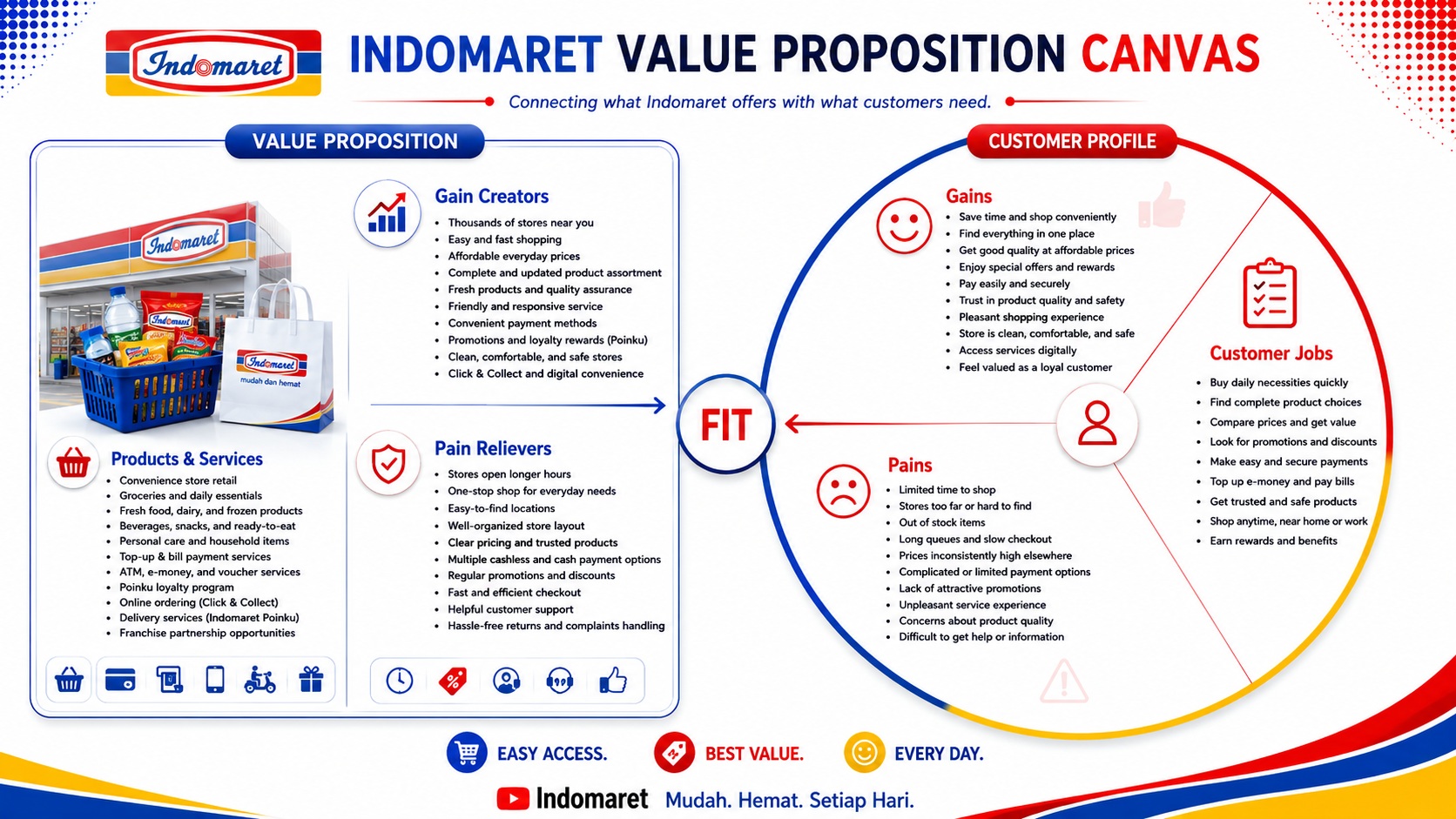
The Value Proposition Canvas adds another layer to the Indomaret Business Model Canvas by showing how the company’s offer connects with what customers actually need in daily life. While BMC explains the full operating system, VPC focuses more directly on customer jobs, pains, gains, and the specific elements of the offer that respond to them.
For Indomaret, this section matters because the company does not compete through one breakthrough product. It competes by reducing friction in routine shopping. Customers want quick access to essentials, fair prices, reliable stock, useful services, and a nearby store they can trust.
That means the fit is driven less by aspiration and more by repeated usefulness. When Indomaret saves time, reduces uncertainty, and supports small but frequent purchases, it creates practical value that becomes stronger through repetition.
The customer profile explains what Indomaret customers are trying to get done, what frustrations they want to avoid, and what benefits they hope to gain. This matters because Indomaret’s appeal is not based on exclusivity or novelty. Its appeal comes from being useful, accessible, and dependable in everyday situations.
Many customers want a nearby store that helps them buy essentials quickly, pick up snacks and drinks, top up digital balances, pay bills, and solve small urgent needs without long travel. They also want fair pricing, reliable availability, and a shopping process that feels easy rather than tiring.
There is also a small emotional layer in this profile. Customers want convenience and speed, but they also want confidence, familiarity, and less uncertainty in routine shopping. That emotional comfort helps explain why repeat visits matter so much.
Customer Profile Analysis
| Customer Profile Analysis | Details |
|---|---|
| Customer Jobs | Customers want to buy daily essentials quickly, top up digital balances, pay bills, pick up snacks and drinks, and handle urgent household needs near home or work. |
| Pains | They face traffic, limited time, uncertain stock in smaller shops, inconsistent pricing, slow checkout, crowded stores, and the inconvenience of visiting multiple places for simple needs. |
| Gains | They want speed, convenience, predictable pricing, nearby access, useful promotions, and confidence that key items will usually be available. |
The value map explains how the company responds to that customer profile. It shows what Indomaret offers, how those offers reduce customer pain, and how they create additional benefits beyond the basic transaction.
In simple terms, this section answers one question: why do customers choose Indomaret instead of another nearby retail option? The answer is not only snacks, drinks, groceries, or payment services. It is the full convenience experience created by location, accessibility, assortment, routine usefulness, and practical service support.
Indomaret reduces customer pain by making daily shopping easier. Store locations are close to demand, layouts are familiar, service is standardised, and practical transactions can be completed in one stop. These elements reduce frustration for customers who do not want long travel, uncertain stock, or multiple errands for simple needs.
Indomaret also creates gains by improving daily convenience, speed, reliability, and accessibility. A customer can buy food, household goods, personal care items, top up a balance, or pay a bill through the same retail system.
This is why Indomaret’s value proposition is powerful. It is not built around one special product. It is built around a repeatable convenience format that makes daily needs easier to manage. The more often customers use the format successfully, the stronger the perceived value becomes.
Value Map Analysis
| Value Map Element | Analysis |
|---|---|
| Products and Services | Packaged food, beverages, groceries, personal care items, household products, bill payments, digital top-ups, and Klik Indomaret ordering support. |
| Pain Relievers | Dense store locations, familiar layouts, standardised service, broad essential assortment, practical service transactions, and faster routine shopping. |
| Gain Creators | Neighborhood convenience, trusted retail format, repeatable service quality, practical promotions, better daily access, and a smoother link between physical stores and digital support. |
The fit happens when Indomaret’s offer clearly matches what customers are trying to achieve. Customers want shopping that is simple, reliable, affordable, nearby, and useful beyond product buying alone. Indomaret creates that fit by combining store density, product breadth, service utility, and digital support in one accessible system.
That fit becomes visible when a customer buys snacks, picks up household goods, tops up a mobile balance, pays a bill, and then returns later for another small-basket purchase at a familiar nearby location. Each activity solves a specific job, but the stronger value appears when convenience, accessibility, and routine usefulness work together.
| Customer Profile | Details | Matching Value Proposition | How Indomaret Creates Fit |
|---|---|---|---|
| Customer Jobs | Customers want to buy daily essentials quickly, top up digital balances, pay bills, pick up snacks and drinks, and handle urgent household needs near home or work. | Products and Services | Packaged food, beverages, groceries, personal care items, household products, bill payments, digital top-ups, and Klik Indomaret ordering support help customers complete these daily jobs. |
| Pains | Customers face traffic, limited time, uncertain stock in smaller shops, inconsistent pricing, slow checkout, and the inconvenience of visiting multiple places for simple needs. | Pain Relievers | Dense store locations, familiar layouts, standardised service, broad essential assortment, and practical service transactions reduce these frustrations. |
| Gains | Customers want speed, convenience, predictable pricing, useful promotions, nearby access, and confidence that key items will usually be available. | Gain Creators | Neighborhood convenience, trusted retail format, repeatable service quality, practical promotions, and a smoother link between physical stores and digital support create these gains. |
Fit also happens when Indomaret removes small daily frictions that customers may not even think about consciously. Travel time, uncertainty, and routine hassle become less visible when people can rely on a nearby store for both products and practical services.
At the same time, Indomaret creates gains through convenience, accessibility, dependable assortment, and everyday utility. That makes customers feel that Indomaret is not only a place to buy goods, but also a practical part of how they manage daily life.
That fit becomes stronger because the interaction is repeated often. Each visit may be small, but the cumulative value is high. This is why the Indomaret Business Model Canvas works so well. The company builds strength through consistency, frequency, and low-friction usefulness rather than through dramatic one-time purchases.
Indomaret has several competitive advantages that reinforce each other and make the business model harder to challenge over time. These strengths come not from one isolated advantage, but from a combination of scale, accessibility, operational discipline, and customer habit that work together across the network:
The Indomaret Business Model Canvas is powerful because these strengths work as one system rather than as isolated advantages. Their value becomes even greater when they reinforce one another across location, service, supply chain, and customer habit at the same time.
The company also faces meaningful risks and challenges that could affect growth, margins, and long-term competitive strength. These issues do not weaken the business model on their own, but they do require close attention and consistent management discipline:
This model remains resilient, but it needs constant operational discipline because convenience retail offers little room for execution mistakes. The risks are manageable, yet they become more serious when small weaknesses appear across many stores at the same time. That is why long-term resilience depends on close control of cost, availability, service quality, and local store economics.
Indomaret should keep strengthening the parts of the model that increase customer frequency, margin quality, and digital convenience.
First, it should use store data more aggressively to localise assortment, promotions, and replenishment by neighborhood. A dense network creates an advantage only when each outlet reflects local demand.
Second, digital and physical retail should be integrated more tightly. Customers should move easily between store visits, app ordering, delivery, loyalty, and payment services without friction.
Third, the company should continue expanding higher-margin categories such as private label, ready-to-eat products, and service-led transactions where customer demand supports them.
Fourth, format innovation deserves attention. Concepts such as fresh, foodservice, coffee, or community-oriented store formats can raise basket size and differentiate the brand.
The Indomaret Business Model Canvas suggests a clear strategic priority: protect convenience leadership while improving unit economics through better data, better mix, and better omnichannel execution.
Indomaret’s business model is strong because it is built around daily behavior. The company does not need customers to make rare, emotional, or high-ticket decisions. It wins by being nearby, useful, predictable, and fast.
Its real advantage is not just the number of stores. The stronger advantage is the system behind those stores: logistics, supplier relationships, store discipline, digital support, and repeat customer habits. When those elements work together, small baskets purchased frequently become a powerful business engine.
The Indomaret Business Model Canvas shows a retail model that is practical, scalable, and deeply rooted in everyday consumer life in Indonesia. This 2026 update makes the article more comprehensive by adding the Value Proposition Canvas, the latest developments shaping the business, expanded block-by-block analysis, and clearer strategic recommendations. Future growth will depend on how well the company balances expansion, digital convenience, cost control, and local relevance.
This article is for educational and business analysis purposes only. It is based on publicly available information, general market observation, and strategic interpretation. It is not financial advice, investment advice, legal advice, or an official statement from Indomaret or any related company. Readers should conduct their own research before making business, investment, or strategic decisions.
Explore the Quipper Business Model Canvas, nine BMC blocks, Value Proposition Canvas, Ruangguru and Pahamify… Read More
Explore the CARPUT Business Model Canvas, nine BMC blocks, Value Proposition Canvas, competitor comparison, competitive… Read More
Explore the Boost Business Model Canvas, nine BMC blocks, Value Proposition Canvas, competitor comparison, advantages,… Read More
Explore the Domino's Pizza Business Model Canvas, nine BMC blocks, Value Proposition Canvas, Pizza Hut… Read More
Explore the Mie Gacoan Business Model Canvas, including its customer segments, value propositions, revenue streams,… Read More
Restaurant Business Model Canvas: A Practical Guide to Designing, Evaluating, and Improving Restaurant Business Models… Read More