Rembayung Business Model Canvas
Explore the Rembayung Business Model Canvas, covering all nine BMC blocks, Value Proposition Canvas, De.Wan 1958 and Restoran Rebung comparison, competitive advantages, risks and strategic recommendations.
Explore the Rembayung Business Model Canvas, covering all nine BMC blocks, Value Proposition Canvas, De.Wan 1958 and Restoran Rebung comparison, competitive advantages, risks and strategic recommendations.
BMC Article No: BMC #080
New Article for 2026: This is a new Business Model Canvas analysis of Rembayung, Khairul Aming’s first restaurant venture in Kuala Lumpur. The analysis examines how the restaurant combines traditional Malay cuisine, creator-led brand equity, experiential dining, digital demand generation and reservation-based operations.
This article also provides deeper analysis of every BMC block, an integrated Value Proposition Canvas, comparison with De.Wan 1958 by Chef Wan and Restoran Rebung Chef Ismail, competitive advantages, risks and challenges, and strategic recommendations.
Rembayung represents a significant transition in Khairul Aming’s entrepreneurial journey from digital content and packaged food into physical hospitality. Located in Kampung Baru, Kuala Lumpur, the restaurant opened in January 2026 after an investment reported at approximately RM4 million.
Rather than building another contemporary café, the concept centres on traditional Malay kampung food presented within a professionally designed urban dining environment. Dishes such as masak lemak cili api, sambal tumis petai, kerabu and other familiar Malaysian favourites support this positioning.
The Rembayung Business Model Canvas is particularly interesting because customer acquisition began long before the restaurant opened. Khairul Aming already possessed a large digital audience, strong food-related credibility and proven consumer-product experience through Sambal Nyet.
Consequently, the restaurant does not depend solely on physical location or conventional restaurant advertising. Digital attention creates demand, while the physical restaurant converts that attention into food sales, customer experiences and deeper brand relationships.
Understanding this interaction provides useful lessons for entrepreneurs moving from personal branding into operationally intensive businesses.
Rembayung operates primarily as a dine-in Malay restaurant built around traditional cuisine, cultural familiarity and a distinctive physical experience.
Customers purchase individual dishes, beverages, desserts and complementary items, producing transaction-based restaurant revenue. Unlike a buffet model, the menu allows groups to order dishes for sharing, reflecting the communal nature of traditional Malaysian dining.
At the centre of the Rembayung Business Model Canvas is the conversion of brand attention into restaurant demand.
Khairul Aming’s existing audience dramatically reduces the challenge of creating initial awareness. Demand around the launch was sufficiently high that reservation traffic overwhelmed the booking system, while the restaurant welcomed around 450 customers through approximately 120 reservations on its opening day.
Three economic mechanisms support the model.
First, authentic Malay dishes provide the core product.
Second, the physical environment turns a meal into a cultural and social experience.
Third, Khairul Aming’s digital reach continuously generates awareness, conversation and customer interest.
Rembayung therefore combines restaurant economics with creator-led demand generation. Long-term success, however, will depend increasingly on repeat patronage rather than launch publicity alone.
Business Model Canvas, commonly known as BMC, is a strategic framework for understanding how an organisation creates, delivers and captures value.
Nine interconnected blocks explain the business model.
For a restaurant such as Rembayung, the framework is especially useful because customer experience depends on many elements working simultaneously. Food quality alone is insufficient if reservations, service, sourcing, staffing or capacity management fail.
The Rembayung Business Model Canvas therefore shows how culinary products, brand reputation, employees, suppliers, digital channels and physical infrastructure combine into one commercial system.
| BMC Block | Main Question |
|---|---|
| Customer Segments | Who does Rembayung serve? |
| Value Propositions | What value does Rembayung provide? |
| Channels | How does Rembayung reach customers? |
| Customer Relationships | How does Rembayung build loyalty and engagement? |
| Revenue Streams | How does Rembayung generate revenue? |
| Key Resources | Which resources make the concept possible? |
| Key Activities | What must Rembayung execute consistently? |
| Key Partnerships | Which partners support the restaurant? |
| Cost Structure | What are its major operating costs? |
Examining each block independently provides clarity, although the greater strategic insight comes from understanding the relationships between them.
Rembayung is the first restaurant launched by Malaysian content creator and entrepreneur Khairul Aming, whose food-related digital presence and Sambal Nyet business established significant consumer recognition before the restaurant venture.
Development reportedly involved approximately RM4 million and an 8,000-square-foot site in Kampung Baru. The restaurant was designed as a two-storey semi-glasshouse environment combining modern facilities with a kampung-inspired atmosphere.
Food remains firmly anchored in Malay culinary traditions.
Menu examples include daging salai masak lemak cili api, ayam kampung sambal berlada, udang sambal tumis petai, tempoyak daun kayu, ulam with sambal belacan, traditional desserts and local beverages.
Accessibility is another part of the concept. Khairul Aming specifically highlighted the absence of VIP rooms, describing an environment where customers share the same dining experience regardless of status. Children’s meal options were also introduced.
Strategically, Rembayung represents more than a restaurant launch. It demonstrates how digital trust can be transferred into an offline hospitality brand.
Few independent restaurant launches begin with Rembayung’s level of audience awareness.
Khairul Aming spent years building trust through approachable cooking content before entering the restaurant sector. That creates an unusual customer-acquisition advantage because potential diners already understand the founder’s association with food, consistency and Malaysian culinary culture.
The Rembayung Business Model Canvas consequently demonstrates the commercial value of creator equity.
Another strategic feature is scarcity.
Restaurant seating is inherently limited, while online reach can expose the brand to millions of potential customers. At launch, tens of thousands reportedly attempted to secure reservations despite physical capacity being only a fraction of that demand.
Location adds another layer of differentiation.
Kampung Baru provides a culturally relevant setting close to central Kuala Lumpur, allowing Rembayung to connect heritage cuisine with a major urban and tourism market.
Yet popularity creates its own risks. Expectations become unusually high, availability can frustrate customers, and any operational problem can spread rapidly online.
Rembayung must therefore convert publicity into a durable restaurant capability.
Several developments since the January 2026 launch provide early indications of Rembayung’s business dynamics.
Reservation demand initially exceeded technical and physical capacity. When booking slots opened, heavy traffic disrupted the reservation website, illustrating both exceptional demand and the operational challenge of translating online audiences into fixed restaurant capacity.
The Rembayung Business Model Canvas must therefore account for demand management as a core capability rather than simply a marketing issue.
Cultural participation has also become part of the customer experience. Khairul Aming encouraged diners to wear traditional clothing during weekends as a voluntary initiative to celebrate Malaysian attire, extending Rembayung from food consumption into cultural expression.
Customer expectations remain another priority. Khairul Aming publicly addressed extraordinary booking demand and emphasised the practical limitations of restaurant capacity shortly after opening.
These developments suggest that Rembayung’s immediate challenge is not creating awareness. Instead, management must balance demand, accessibility, consistency and customer expectations while preserving the cultural authenticity that created interest initially.
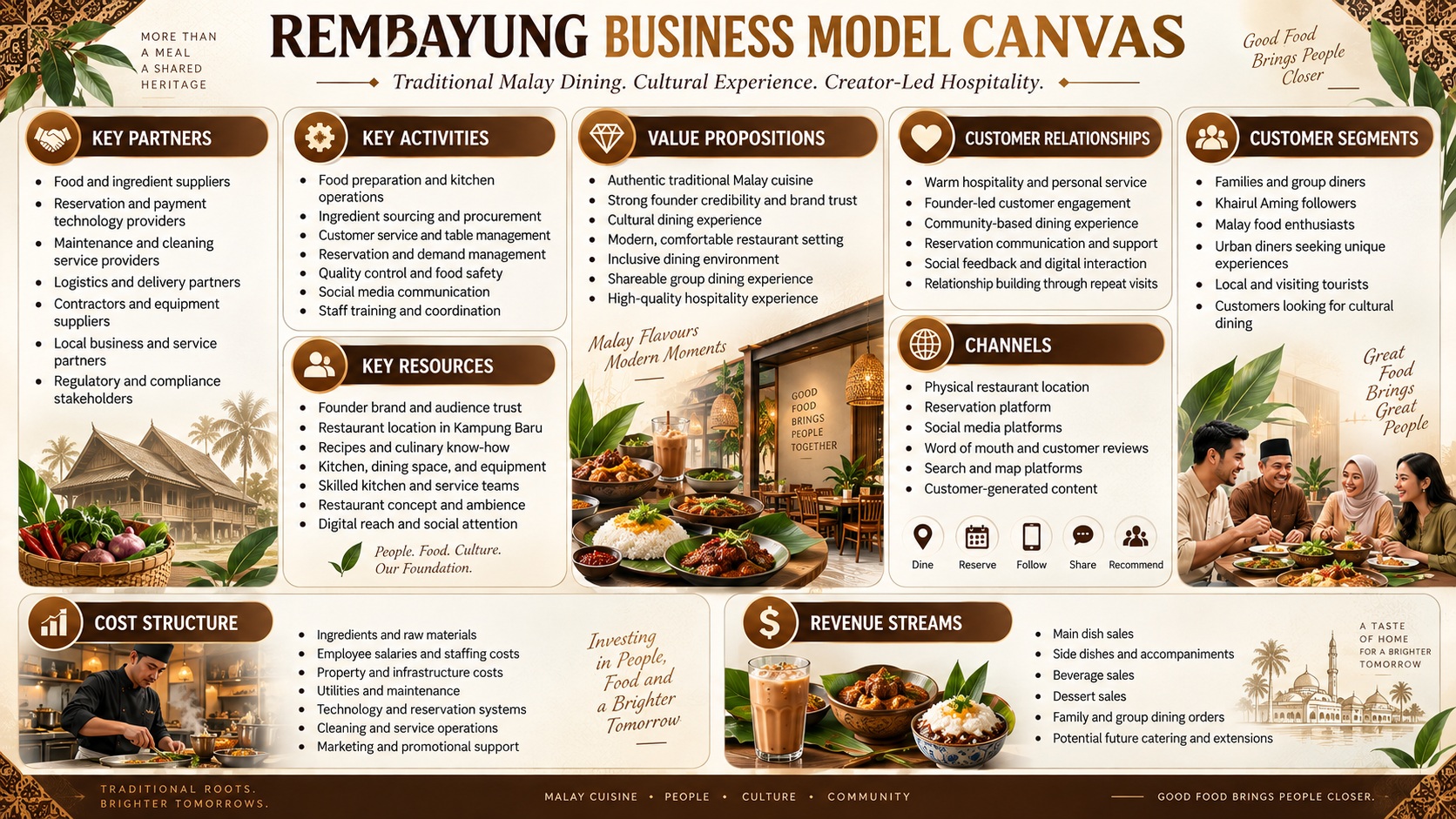
Before examining each component individually, the business can be summarised as a creator-powered restaurant that monetises strong consumer trust through traditional Malay food and a culturally distinctive dining environment.
| BMC Block | Rembayung Application |
|---|---|
| Customer Segments | Families, Malay-food enthusiasts, Khairul Aming followers, urban diners and tourists |
| Value Propositions | Authentic kampung dishes, trusted founder brand, cultural experience and quality environment |
| Channels | Restaurant, reservation platform, social media, word of mouth and digital content |
| Customer Relationships | Founder engagement, hospitality, community identity, reservations and social interaction |
| Revenue Streams | Food, beverages, desserts and potential future complementary offerings |
| Key Resources | Brand equity, recipes, location, kitchen, employees, digital audience and restaurant concept |
| Key Activities | Cooking, sourcing, service, reservation management, quality control and content communication |
| Key Partnerships | Food suppliers, technology providers, contractors, logistics providers and service vendors |
| Cost Structure | Ingredients, employees, rent/property costs, utilities, maintenance, technology and depreciation |
The model contains an important flywheel: digital credibility stimulates demand, customer visits generate experiences, those experiences create online conversation, and increased conversation reinforces brand awareness.
Detailed analysis reveals that Rembayung’s strongest advantage does not come from a single menu item.
The Rembayung Business Model Canvas combines founder credibility, Malay culinary identity, an attractive physical environment, high digital visibility and disciplined restaurant execution.
Each element influences the others.
Marketing can create bookings, but kitchen operations determine whether first-time guests recommend the restaurant. Premium facilities can improve experience, yet they increase fixed costs. High demand enhances scarcity, although excessive difficulty securing reservations could eventually discourage customers.
Founder visibility generates substantial attention, while dependence on one individual introduces concentration risk.
Sustainable performance therefore requires Rembayung to institutionalise the strengths initially associated with Khairul Aming.
Recipes need standardisation, employees require development, procurement must remain dependable and service standards must survive periods of peak demand.
The following nine blocks explain how those capabilities fit together.
Rembayung serves overlapping customer groups rather than a single demographic.
Khairul Aming followers represent an important early segment because existing familiarity significantly increases trial intention. Families and groups form another natural audience because Malay dishes are often ordered communally.
Traditional-food enthusiasts seek familiar recipes and regional flavours, while urban diners may value the combination of heritage cuisine and contemporary restaurant design.
Visitors to Kuala Lumpur create additional potential because Malay cuisine can function as part of a broader cultural experience.
| Segment | Details | Why It Matters |
|---|---|---|
| Families and groups | Customers sharing multiple traditional dishes | Supports larger table spending |
| Khairul Aming followers | Existing digital community attracted by the founder | Lowers customer-acquisition barriers |
| Malay-food enthusiasts | Diners seeking traditional kampung flavours | Reinforces core positioning |
| Urban consumers | Customers seeking distinctive dining experiences | Expands beyond heritage-food loyalists |
| Domestic and foreign visitors | Travellers exploring Malaysian cuisine | Creates tourism-related demand |
The customer mix creates valuable diversification.
Followers may drive initial traffic, but sustainable economics require broader appeal. Families can generate larger transactions, tourists expand market reach, and food enthusiasts can support repeat visits.
Overdependence on founder fandom would create vulnerability once launch novelty declines.
Rembayung should therefore aim to become a restaurant customers recommend for the food and experience even when Khairul Aming is not part of the purchasing decision.
Rembayung’s central proposition is accessible Malay heritage cuisine delivered within a polished contemporary environment.
Customers are not simply purchasing calories. They receive familiar food, cultural nostalgia, social interaction and participation in a highly visible Malaysian brand story.
Founder credibility adds reassurance because Khairul Aming built much of his public profile through cooking content before entering the restaurant business.
The physical concept strengthens the experience by translating an online personality into a tangible place customers can visit.
| Value Proposition | Details | Why It Matters |
|---|---|---|
| Traditional Malay cuisine | Familiar kampung-style dishes and flavours | Establishes culinary identity |
| Founder credibility | Strong association with Khairul Aming | Accelerates trust and trial |
| Cultural experience | Food, atmosphere and Malaysian traditions | Differentiates beyond functional dining |
| Contemporary hospitality | Modern facilities surrounding heritage cuisine | Broadens appeal |
| Inclusive dining | Shared environment without VIP-room separation | Supports community positioning |
Strong value propositions reinforce one another.
Authentic dishes create credibility, while the environment elevates them beyond ordinary everyday dining. Digital familiarity encourages trial, yet hospitality determines whether customers return.
The Rembayung Business Model Canvas ultimately depends on authenticity being operational rather than merely promotional.
If recipes become inconsistent or the experience appears excessively commercialised, customers may perceive a gap between brand storytelling and reality.
Maintaining cultural character while improving operational efficiency should therefore remain central to management decisions.
Rembayung combines physical and digital channels unusually effectively for a restaurant.
The restaurant itself is the primary fulfilment channel because most customer value is delivered through dining, service and ambience.
Social media performs a different function. Khairul Aming’s content ecosystem can generate awareness rapidly without relying exclusively on traditional paid media.
Reservations connect digital demand with physical capacity, while online maps, reviews and user-generated content support discovery.
| Channel | Details | Why It Matters |
|---|---|---|
| Physical restaurant | Main dining and hospitality environment | Delivers the core experience |
| Reservation platform | Manages table access and customer flow | Aligns demand with capacity |
| Social media | Founder and restaurant communication | Generates large organic reach |
| User-generated content | Reviews, photos and customer posts | Extends digital word of mouth |
| Search and map platforms | Location, navigation and discovery | Captures intent-driven customers |
Channel economics are attractive because founder reach reduces dependence on paid customer acquisition.
Nevertheless, exceptional online demand can expose capacity constraints. Reservation technology becomes particularly important when thousands of potential customers compete for a limited number of tables.
Rembayung should therefore treat its booking infrastructure as part of customer experience.
Clear availability, waiting-list functions, cancellation management and fair reservation rules can convert scarcity from frustration into controlled demand.
Rembayung’s customer relationships combine hospitality with creator-community engagement.
Khairul Aming communicates directly with audiences through social media, giving customers a stronger sense of connection with the founder than most restaurant chains can achieve.
Inside the restaurant, employee interactions become equally important.
Warm service should reflect the communal qualities associated with kampung hospitality rather than functioning merely as transaction processing.
Reservation communications also shape relationships before customers arrive.
| Relationship Type | Details | Why It Matters |
|---|---|---|
| Founder-led engagement | Direct communication through social platforms | Builds emotional connection |
| Personal hospitality | Human interaction during dining | Influences satisfaction and loyalty |
| Community identity | Shared interest in Malaysian food and culture | Deepens brand attachment |
| Reservation communication | Booking confirmations and customer information | Reduces uncertainty |
| Social feedback | Reviews, comments and digital discussions | Provides rapid customer insight |
Creator engagement offers Rembayung a relationship advantage, although it cannot replace service quality.
Customers attracted by Khairul Aming may arrive with unusually high expectations. Small failures can therefore receive disproportionate online attention.
Consistent employee behaviour becomes essential.
Training teams to resolve problems, communicate delays and understand the brand story can transform operational encounters into relationship-building moments.
Eventually, customer loyalty should attach to Rembayung itself rather than depending entirely on continuous founder involvement.
Restaurant sales provide Rembayung’s primary revenue stream.
Customers purchase seafood, meat dishes, vegetables, rice, traditional desserts and beverages across multiple price points. Published menu information shows a broad range from low-priced accompaniments to higher-priced seafood dishes, enabling different combinations and table values.
The Rembayung Business Model Canvas currently appears more concentrated than Khairul Aming’s digital and packaged-product businesses because physical seating limits transaction volume.
| Revenue Stream | Details | Why It Matters |
|---|---|---|
| Main dishes | Seafood, poultry, meat and traditional dishes | Drives core food revenue |
| Side dishes | Vegetables, ulam, rice and accompaniments | Increases table value |
| Beverages | Traditional and contemporary drinks | Supports attractive margins |
| Desserts and kuih | Malay desserts and snacks | Expands average customer spending |
| Future extensions | Catering, merchandise or packaged offerings | Could diversify revenue |
Revenue optimisation should prioritise average table contribution rather than simply increasing menu prices.
Beverages, desserts and complementary dishes can expand transaction values while retaining accessible entry points.
Capacity remains the structural ceiling.
Once tables and operating hours are highly utilised, growth requires higher productivity, additional dayparts, off-premise channels or new locations.
Expansion should occur carefully because excessive commercialisation could weaken the exclusivity and cultural character that support present demand.
Rembayung combines tangible and intangible resources.
Physical assets include the restaurant, kitchen, dining areas, equipment and interior environment. Human resources encompass cooks, service staff, supervisors and management.
Intangible assets may be even more strategically significant.
Khairul Aming’s reputation provides immediate awareness, while accumulated audience trust makes new-product adoption easier.
Recipes and operational knowledge convert that attention into a repeatable dining experience.
| Key Resource | Details | Why It Matters |
|---|---|---|
| Khairul Aming brand | Founder reputation and digital audience | Creates awareness and trust |
| Restaurant location | Kampung Baru position near central Kuala Lumpur | Supports cultural and urban relevance |
| Culinary know-how | Recipes, preparation methods and quality standards | Protects food consistency |
| Employees | Kitchen, service and management teams | Deliver customer experience |
| Physical infrastructure | Kitchen, equipment and dining environment | Enables operational capacity |
Resource concentration creates both strength and risk.
The founder brand is difficult for competitors to replicate, yet heavy dependence on one personality can constrain institutional development.
Similarly, the purpose-built location contributes strongly to experience but represents significant committed capital.
Management should therefore transform founder knowledge, recipes and service expectations into organisational systems.
Standard operating procedures, recipe controls, training programmes and leadership development can make the business less dependent on individual employees or constant founder supervision.
Restaurant performance depends on repetitive operational excellence.
Food preparation is the most visible activity, yet procurement, food safety, reservation management, scheduling and service coordination are equally important.
Demand forecasting becomes especially significant because fresh ingredients create spoilage risk while unexpected shortages can damage customer experience.
Digital communication represents another important activity because high public visibility requires accurate updates and rapid management of customer expectations.
| Key Activity | Details | Why It Matters |
|---|---|---|
| Food preparation | Produce consistent traditional dishes | Delivers the core promise |
| Procurement | Secure fresh and reliable ingredients | Protects quality and availability |
| Service operations | Manage tables and customer interactions | Shapes overall satisfaction |
| Reservation management | Match customer demand with capacity | Controls congestion |
| Quality assurance | Monitor food, hygiene and service standards | Protects reputation |
Operational complexity increases as volume grows.
A viral restaurant can attract customers faster than employees and processes mature, creating service bottlenecks even when food demand remains strong.
Rembayung should therefore optimise throughput without turning the dining experience into an industrial process.
Kitchen workflows, menu engineering, seating schedules and employee deployment can improve productivity while preserving hospitality.
Exceptional marketing may fill seats once; disciplined operations determine whether those seats remain valuable over time.
No restaurant produces its customer experience independently.
Rembayung relies on food suppliers for seafood, meat, vegetables, spices and other ingredients. Technology providers support reservations, payments and operational systems.
Maintenance contractors, cleaning services and equipment suppliers help preserve the physical environment.
Logistics partners may also influence ingredient availability and responsiveness.
| Key Partner | Details | Why It Matters |
|---|---|---|
| Food suppliers | Supply fresh and specialised ingredients | Protect menu availability |
| Technology providers | Reservations, payments and operating systems | Support customer and operational efficiency |
| Equipment suppliers | Kitchen and restaurant equipment | Maintain production capability |
| Service contractors | Cleaning, maintenance and specialist services | Protect facility standards |
| Logistics providers | Transport ingredients and supplies | Supports supply continuity |
Supplier quality directly influences the value proposition.
Traditional dishes can be particularly sensitive to ingredient freshness and consistency, making procurement relationships strategically important rather than purely transactional.
Diversification should also be considered for critical ingredients.
Depending on one supplier may simplify operations, but shortages, quality failures or price changes could interrupt menu availability.
Long-term partnerships should therefore combine reliable specifications, competitive economics, traceability and contingency arrangements.
Rembayung operates with a comparatively substantial fixed-cost base for an independent restaurant.
The reported RM4 million development investment demonstrates the importance of physical infrastructure within the concept.
Ongoing costs include employees, ingredients, utilities, maintenance, technology, cleaning and depreciation.
Food costs remain variable, while payroll and facility expenses continue even when demand fluctuates.
| Cost Category | Details | Why It Matters |
|---|---|---|
| Ingredients | Meat, seafood, vegetables and cooking materials | Directly affects gross margin |
| Employees | Kitchen, service and management personnel | Essential for hospitality |
| Property and infrastructure | Facility, depreciation and related commitments | Creates significant fixed costs |
| Utilities | Electricity, water, gas and cooling | Supports daily operations |
| Maintenance and technology | Equipment, booking and operational systems | Maintains reliability |
Strong demand makes high fixed investment easier to absorb because facility utilisation can remain high.
Problems arise if customer traffic weakens while cost commitments remain unchanged.
Margin discipline therefore requires more than controlling ingredient prices.
Menu engineering, labour scheduling, food-waste reduction, table utilisation and procurement efficiency should all be measured.
Rembayung must preserve the quality customers expect while developing a cost structure capable of remaining profitable beyond its launch period.
The Rembayung Business Model Canvas becomes most useful when viewed as one interconnected restaurant system.
Customer segments create demand from families, followers, food enthusiasts, urban consumers and visitors.
Value propositions convert that interest through traditional Malay cuisine, cultural familiarity and founder credibility.
Channels then connect audiences with the restaurant through social media, reservations and the physical venue.
Customer relationships strengthen the model through hospitality, community participation and digital engagement.
Revenue emerges mainly from food and beverage purchases.
Those earnings finance ingredients, staff, facilities and operating technology.
Key resources such as brand equity, recipes, employees and location support the activities required to prepare food and serve customers consistently.
Partnerships ensure ingredients, systems and external services remain available.
Cost discipline ultimately determines whether high demand translates into sustainable profitability.
Misalignment in any block can damage the whole model.
Powerful marketing cannot compensate permanently for inconsistent food. Excellent cuisine cannot create profitable growth if capacity is poorly managed. Cultural authenticity cannot protect the brand if service disappoints.
Rembayung therefore needs every block to reinforce the others.
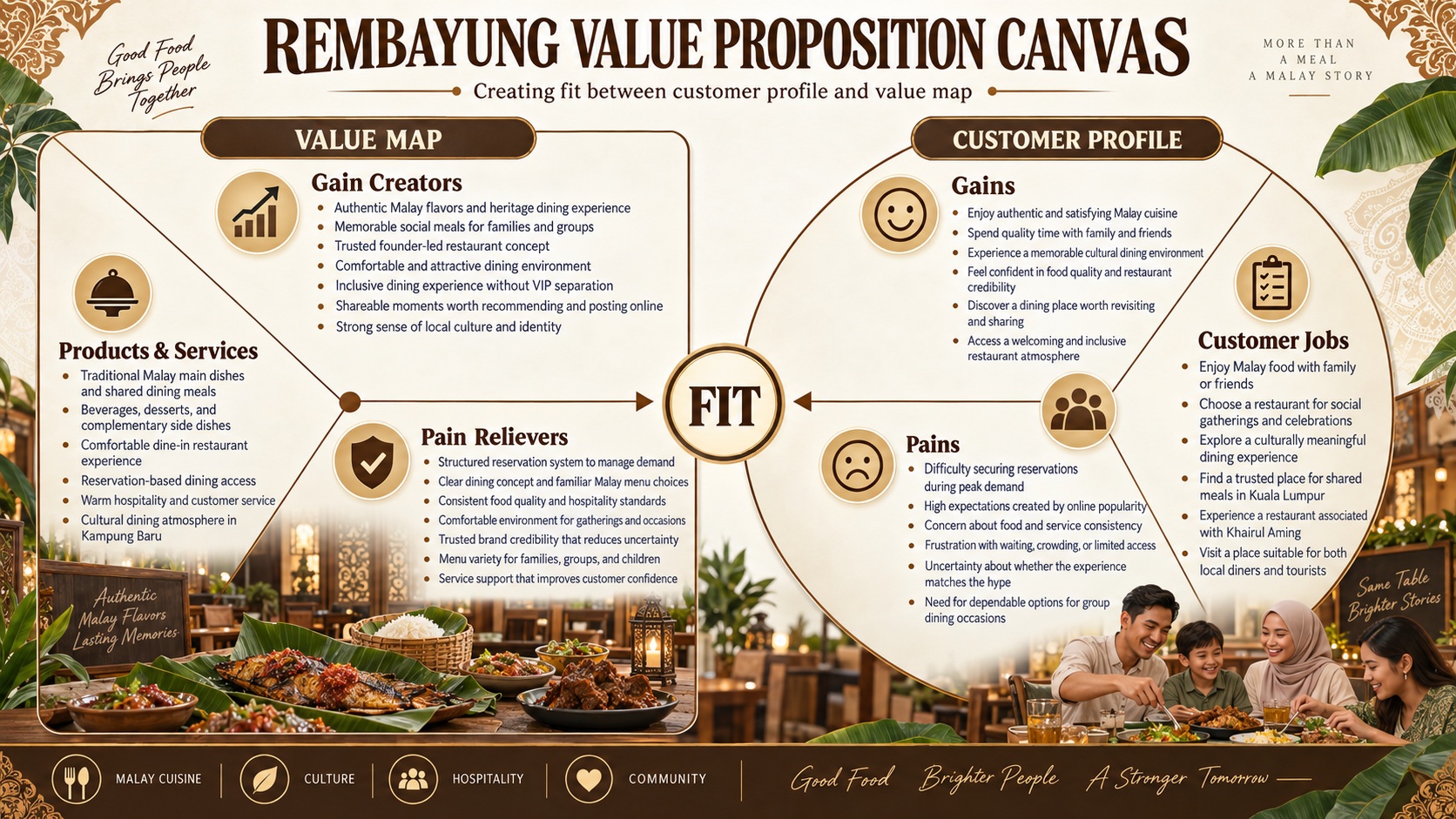
The Value Proposition Canvas provides a more detailed view of the fit between customer expectations and Rembayung’s restaurant offering.
While the Rembayung Business Model Canvas explains the complete commercial system, VPC focuses on what customers are attempting to accomplish, the problems they experience and the gains they seek.
For this analysis, the primary customer profile is a group or family choosing a distinctive Malay dining destination.
Dining decisions involve more than hunger.
Customers may want culturally familiar food, a comfortable place for gatherings, confidence in quality and an experience worth sharing with others.
Popularity can simultaneously create customer pains including reservation difficulty, waiting, congestion and expectations created by social-media hype.
| Customer Profile | Details |
|---|---|
| Customer Jobs | Enjoy Malay food, gather with family or friends, celebrate occasions and experience Malaysian cuisine |
| Customer Pains | Difficult reservations, inconsistent quality, long waits, parking concerns and expectations created by hype |
| Customer Gains | Authentic flavours, pleasant environment, trusted quality, memorable service and culturally meaningful experiences |
Customer satisfaction depends on narrowing the gap between anticipation and actual delivery.
A famous founder may increase willingness to try the restaurant, but customers still judge food quality, service, convenience and value independently.
Managing expectations should therefore be considered part of the customer proposition.
Rembayung responds with a combination of Malay dishes, hospitality, cultural storytelling and a purpose-built dining environment.
Digital reservation tools provide structure around demand, while the founder’s communication creates familiarity before the visit.
| Value Map | Details |
|---|---|
| Products and Services | Malay dishes, beverages, desserts, dining environment, reservations and hospitality |
| Pain Relievers | Structured booking, menu variety, children’s options, service processes and clear customer communication |
| Gain Creators | Founder trust, heritage flavours, attractive ambience, social experience and cultural identity |
Value creation becomes strongest when these elements operate together.
Food satisfies functional needs, ambience supports social occasions and cultural identity creates emotional relevance.
Founder credibility lowers uncertainty for first-time visitors.
Rembayung should nevertheless ensure that the restaurant itself becomes the strongest gain creator over time.
Value fit occurs when the dining experience successfully connects customer requirements with Rembayung’s operating model.
| Customer Profile | Details | Matching Value Map | How Rembayung Creates Fit |
|---|---|---|---|
| Customer Jobs | Enjoy Malay cuisine and social dining | Products and Services | Diverse dishes and shared dining support group meals |
| Customer Pains | Difficulty finding dependable traditional dining | Pain Relievers | Brand trust, reservations and quality controls reduce uncertainty |
| Customer Gains | Memorable cultural experience | Gain Creators | Cuisine, ambience and founder story create emotional value |
Strong fit depends on execution.
Guests who secure difficult reservations may enter with expectations considerably higher than those visiting an ordinary restaurant.
Food consistency and service quality must therefore justify scarcity.
When the complete experience matches expectations, satisfied customers become advocates and create additional digital word of mouth.
The Rembayung Business Model Canvas shares important characteristics with De.Wan 1958 by Chef Wan and Restoran Rebung Chef Ismail.
All three businesses connect recognised personalities with Malaysian cuisine, but their models differ significantly.
De.Wan 1958 positions Malay food within polished contemporary restaurant environments and operates across multiple locations. Its official positioning emphasises showcasing Malaysian cuisine through Chef Wan’s recipes.
Restoran Rebung focuses strongly on traditional Malay heritage through a buffet format, offering extensive “lauk pauk kampung” selections in Kuala Lumpur.
Rembayung combines creator-era digital reach with an à-la-carte heritage restaurant and a high-demand reservation model.
| Relevant BMC Block | Rembayung | De.Wan 1958 | Restoran Rebung |
|---|---|---|---|
| Customer Segments | Followers, families, urban diners, tourists | Premium casual diners, families, events, tourists | Families, groups, traditional-food diners, tourists |
| Value Proposition | Kampung cuisine plus creator-led cultural experience | Elevated Malay cuisine associated with Chef Wan | Wide variety of traditional Malay dishes |
| Channels | Restaurant, reservations, creator social media | Multiple restaurant locations and digital channels | Restaurant, buffet sessions and digital discovery |
| Customer Relationships | Strong founder-community engagement | Chef-led brand and professional hospitality | Familiar heritage dining and repeat patronage |
| Revenue Streams | À-la-carte food and beverages | Restaurant dining, events and related hospitality | Buffet dining and restaurant services |
| Key Resources | Khairul Aming brand, digital reach, location, culinary concept | Chef Wan brand, recipes, established restaurant group | Chef Ismail brand, buffet expertise, heritage positioning |
| Key Activities | Dining operations, reservations, content engagement | Restaurant operations, brand management, events | High-volume buffet preparation and service |
The most important difference lies in customer acquisition.
De.Wan 1958 benefits from Chef Wan’s longstanding culinary authority, while Rebung has accumulated restaurant heritage and familiarity.
Rembayung enters the market with unusually strong social-media distribution.
Its long-term challenge is transforming that digital advantage into the operating maturity its more established competitors have accumulated over time.
Rembayung possesses several structural advantages that can support long-term differentiation.
These advantages reinforce one another.
Brand reach creates demand, demand strengthens social proof, customer experiences generate content, and online conversation can attract further customers.
The challenge is ensuring operational capability grows as quickly as brand expectations.
Strong demand does not remove fundamental restaurant risks.
The largest risk is gradual deterioration rather than sudden failure.
Falling reservation demand, weaker social conversation, employee inconsistency and margin pressure could reinforce one another.
Management should consequently track repeat customers, food quality, table utilisation, average spending and customer satisfaction alongside social-media engagement.
Rembayung should protect the cultural authenticity and founder credibility that created early demand while systematically developing capabilities that can operate independently of launch hype.
Management should progressively give Rembayung its own identity, storytelling and customer community.
Khairul Aming can remain a powerful founder, but food quality, employees, recipes and customer experiences should increasingly become reasons to visit independently.
Building standalone equity would improve long-term scalability and reduce founder concentration.
Reservation difficulty should be managed strategically instead of allowing customer frustration to accumulate.
Waiting lists, cancellation releases, transparent booking cycles and limits on reservation abuse can improve perceived fairness.
Demand data can also identify preferred dining times and help optimise seating.
Early customers may visit because of curiosity.
Future revenue requires reasons to return.
Seasonal dishes, rotating regional recipes, family occasions and selected cultural programmes could create repeat demand without changing the core identity.
Customer retention should eventually matter as much as social reach.
Recipes, cooking procedures, ingredient specifications and service expectations should be documented thoroughly.
Training should produce consistent results regardless of which employee prepares a dish or serves a table.
Operational audits and customer feedback can identify quality variation before it damages the brand.
Physical seats impose a natural revenue ceiling.
Selected packaged products, catering, corporate dining or carefully designed takeaway offerings could create incremental revenue without immediately requiring another large restaurant.
Any extension should reinforce Malay culinary positioning rather than dilute it.
Critical ingredients should have quality specifications and backup suppliers.
Procurement teams can monitor price volatility, seasonality and availability while maintaining the flavour profiles customers expect.
Closer supplier relationships may also support traceability and storytelling around Malaysian ingredients.
A second location may appear attractive when reservations remain difficult.
Premature expansion, however, could reproduce weaknesses faster than strengths.
Management should first demonstrate stable margins, consistent food quality, capable restaurant leadership and repeatable training systems.
Replication should follow operating maturity rather than publicity.
The Rembayung Business Model Canvas illustrates how digital trust can be converted into a physical hospitality business.
Khairul Aming entered the restaurant sector with advantages most new operators do not possess: significant audience reach, food-related credibility, entrepreneurial recognition and the ability to generate demand directly through content.
Rembayung then adds traditional Malay cuisine, a culturally relevant location and a distinctive dining environment.
Those advantages explain strong initial attention, but they do not automatically guarantee sustainable restaurant economics.
Hospitality businesses ultimately depend on repetition.
Every service period requires ingredients to arrive, recipes to remain consistent, employees to perform, reservations to flow and customers to feel that the experience justifies their expectations.
Rembayung’s next stage should therefore focus on institutionalisation.
Founder equity can continue attracting customers, while stronger procedures, leadership development, supply resilience, customer-retention initiatives and disciplined cost management turn popularity into durable competitive capability.
If those elements mature successfully, Rembayung could evolve beyond being known as Khairul Aming’s first restaurant.
It could become a scalable Malaysian hospitality brand capable of bringing traditional Malay flavours, cultural identity and contemporary service to a broader market.
This article is provided solely for educational, informational and business-analysis purposes.
Information has been developed from publicly available sources, industry observations and strategic interpretation available at the time of writing.
Nothing in this article constitutes financial, investment, legal, accounting, business, food-service or other professional advice.
The analysis should not be interpreted as official information, endorsement or representation by Rembayung, Khairul Aming, De.Wan 1958, Chef Wan Group of Restaurants, Restoran Rebung Chef Ismail or any other organisation mentioned.
Business models, menu offerings, prices, operating arrangements, ownership structures and market conditions may change over time.
Readers should conduct independent research and obtain suitable professional advice before making business, investment or strategic decisions.
All company names, logos, trademarks, copyrights, product names and other intellectual-property rights belong to their respective owners.
Explore the Rembayung Business Model Canvas, covering all nine BMC blocks, Value Proposition Canvas, De.Wan 1958 and Restoran Rebung comparison, competitive advantages, risks and strategic recommendations.
Explore the Kinokuniya Business Model Canvas, covering all nine BMC blocks, Value Proposition Canvas, Barnes… Read More
Explore the Agoda Business Model Canvas, covering all nine BMC blocks, Value Proposition Canvas, Booking.com… Read More
Explore the FedEx Business Model Canvas, nine BMC blocks, Value Proposition Canvas, UPS and DHL… Read More
Explore the Quipper Business Model Canvas, nine BMC blocks, Value Proposition Canvas, Ruangguru and Pahamify… Read More
Explore the CARPUT Business Model Canvas, nine BMC blocks, Value Proposition Canvas, competitor comparison, competitive… Read More
Explore the Boost Business Model Canvas, nine BMC blocks, Value Proposition Canvas, competitor comparison, advantages,… Read More