Kinokuniya Business Model Canvas
Explore the Kinokuniya Business Model Canvas, covering all nine BMC blocks, Value Proposition Canvas, Barnes & Noble and Waterstones comparison, competitive advantages, risks and strategic recommendations.
Explore the Kinokuniya Business Model Canvas, covering all nine BMC blocks, Value Proposition Canvas, Barnes & Noble and Waterstones comparison, competitive advantages, risks and strategic recommendations.
BMC Article No: BMC #079
New Article 2026: This is a new business model analysis examining how Kinokuniya creates, delivers and captures value through physical bookstores, multilingual publishing access, specialist book categories, knowledgeable service, membership, e-commerce and international sourcing.
The analysis covers all nine Business Model Canvas blocks, a Value Proposition Canvas, comparison with Barnes & Noble and Waterstones, competitive advantages, risks and challenges, and strategic recommendations.
Few traditional retailers illustrate the continuing strategic relevance of physical bookstores as effectively as Kinokuniya.
Founded in Tokyo in 1927, Books Kinokuniya expanded beyond Japan with its first overseas bookstore in San Francisco in 1969. The company now operates more than 80 stores and 35 sales-office locations worldwide, including operations across Asia, Australia, the Middle East and the United States.
Rather than competing entirely through price or convenience, Kinokuniya differentiates itself through assortment depth, international titles, specialist categories and a distinctive bookstore environment.
Malaysia provides a strong example. Its Kuala Lumpur City Centre store offers more than 300,000 titles across English, Japanese, Chinese and Malay, alongside categories ranging from literature and children’s books to manga, art, design and social sciences.
The Kinokuniya Business Model Canvas therefore represents more than conventional book retailing. Its economic logic combines inventory curation, international publishing relationships, premium retail experience, specialist knowledge, customer loyalty and increasingly integrated physical and digital channels.
Understanding how these elements reinforce one another explains why Kinokuniya can remain differentiated even in a market where consumers can purchase books from general e-commerce platforms.
Kinokuniya operates primarily as a specialist bookselling and cultural-retail business.
Its core activity involves sourcing books, magazines and selected complementary products, curating those products for different markets and selling them through physical bookstores and digital channels.
Unlike general e-commerce marketplaces, Kinokuniya creates additional value through selection and discovery.
Customers may enter a store knowing exactly which title they want, but many also visit to browse genres, discover newly released books, explore Japanese publications or obtain recommendations from knowledgeable staff.
At the centre of the Kinokuniya Business Model Canvas is therefore an inventory-led retail model strengthened by curation.
Three economic engines support this structure.
First, book and merchandise sales generate transactional revenue.
Second, destination stores create an environment where customers spend time browsing and discovering products beyond their original purchase intention.
Third, digital commerce extends Kinokuniya’s catalogue and customer reach beyond physical-store visits.
Membership adds another layer by encouraging repeat purchasing. In Malaysia, Kinokuniya Privilege Card members receive regular discounts and can accumulate points for rewards, while the programme functions across physical stores and the Malaysian Webstore.
Kinokuniya consequently competes through assortment quality, accessibility and customer experience rather than through book sales alone.
A Business Model Canvas, commonly called BMC, is a strategic framework for understanding how an organisation creates value, delivers that value to customers and captures economic returns.
Nine interconnected blocks form the framework.
For Kinokuniya, BMC is especially useful because bookstore economics depend on much more than simply buying and reselling books.
The Kinokuniya Business Model Canvas demonstrates how customer segments, product assortment, supplier relationships, stores, digital channels, employees, inventory management and loyalty programmes interact.
| BMC Block | Main Question |
|---|---|
| Customer Segments | Who does Kinokuniya serve? |
| Value Propositions | What distinctive value does Kinokuniya provide? |
| Channels | How does Kinokuniya reach customers? |
| Customer Relationships | How does Kinokuniya encourage loyalty and repeat purchases? |
| Revenue Streams | How does Kinokuniya generate income? |
| Key Resources | Which assets make the model possible? |
| Key Activities | What must Kinokuniya perform consistently? |
| Key Partnerships | Which external relationships support the business? |
| Cost Structure | What are the major costs of operating the model? |
Examining these blocks separately provides useful insight.
Greater strategic value, however, comes from understanding how assortment, customer experience and operational capabilities reinforce one another.
Books Kinokuniya began in Shinjuku, Tokyo, in 1927.
International expansion became an important part of the company’s development after it opened its first overseas bookstore in San Francisco in 1969.
Kinokuniya’s global footprint has subsequently grown to more than 80 stores and 35 sales offices.
Product breadth has become one of its defining characteristics.
Within Malaysia, Kinokuniya carries English, Japanese, Chinese and Malay titles alongside children’s books, graphic novels, manga, art and design publications, social-science titles and lifestyle categories.
Physical experience also remains strategically important.
The KLCC bookstore is designed as a spacious browsing environment and includes knowledgeable staff, cultural exhibitions and supporting amenities that encourage customers to spend time in the store.
Digital commerce complements this retail footprint. Kinokuniya Malaysia launched its Webstore in September 2014, allowing customers to purchase publications and selected non-book products outside the physical store.
Kinokuniya should consequently be viewed as a specialist omnichannel bookseller rather than merely a physical bookstore chain.
Kinokuniya demonstrates how a specialist retailer can remain relevant despite powerful e-commerce competition.
General marketplaces may offer enormous product catalogues, aggressive pricing and rapid fulfilment.
Kinokuniya instead creates differentiation through expertise, discovery, international selection and physical experience.
The Kinokuniya Business Model Canvas is strategically interesting because these capabilities are mutually reinforcing.
Extensive assortment attracts serious readers.
Strong international sourcing improves access to specialised titles.
Knowledgeable employees help customers navigate complex categories.
Attractive stores encourage browsing and discovery.
Membership provides incentives for repeat purchases.
Digital channels then allow the relationship to continue after customers leave the store.
That combination creates a different competitive position from a seller attempting to win primarily through discounts.
However, specialist positioning also creates economic tension.
Large inventories consume working capital, premium retail locations create significant occupancy costs and imported publications may introduce currency and logistics exposure.
Kinokuniya must therefore maintain enough differentiation to justify the operating complexity associated with its broad assortment and experience-led model.
Bookselling is increasingly becoming an omnichannel activity.
Customers may discover a title through social media, search for availability online, examine it physically in a store and eventually purchase through either channel.
Kinokuniya’s Webstore places the company within this changing customer journey rather than restricting the relationship to physical retail.
Membership is becoming more digitally integrated as well.
Malaysia’s Kinokuniya Privilege Card system supports an electronic member card, online registration, accumulated points and e-voucher or gift redemption.
Specialist categories are simultaneously becoming more important.
Manga, Japanese publications, graphic novels, art books and other enthusiast categories create discovery opportunities that are difficult to reproduce through undifferentiated retail shelves.
Physical bookstores are also evolving from transactional locations toward cultural and discovery destinations.
Kinokuniya’s use of exhibitions, specialist sections and browsing environments illustrates this transition.
Future competitiveness will therefore depend increasingly on connecting inventory, customer knowledge, membership and digital discovery rather than treating stores and e-commerce as separate businesses.
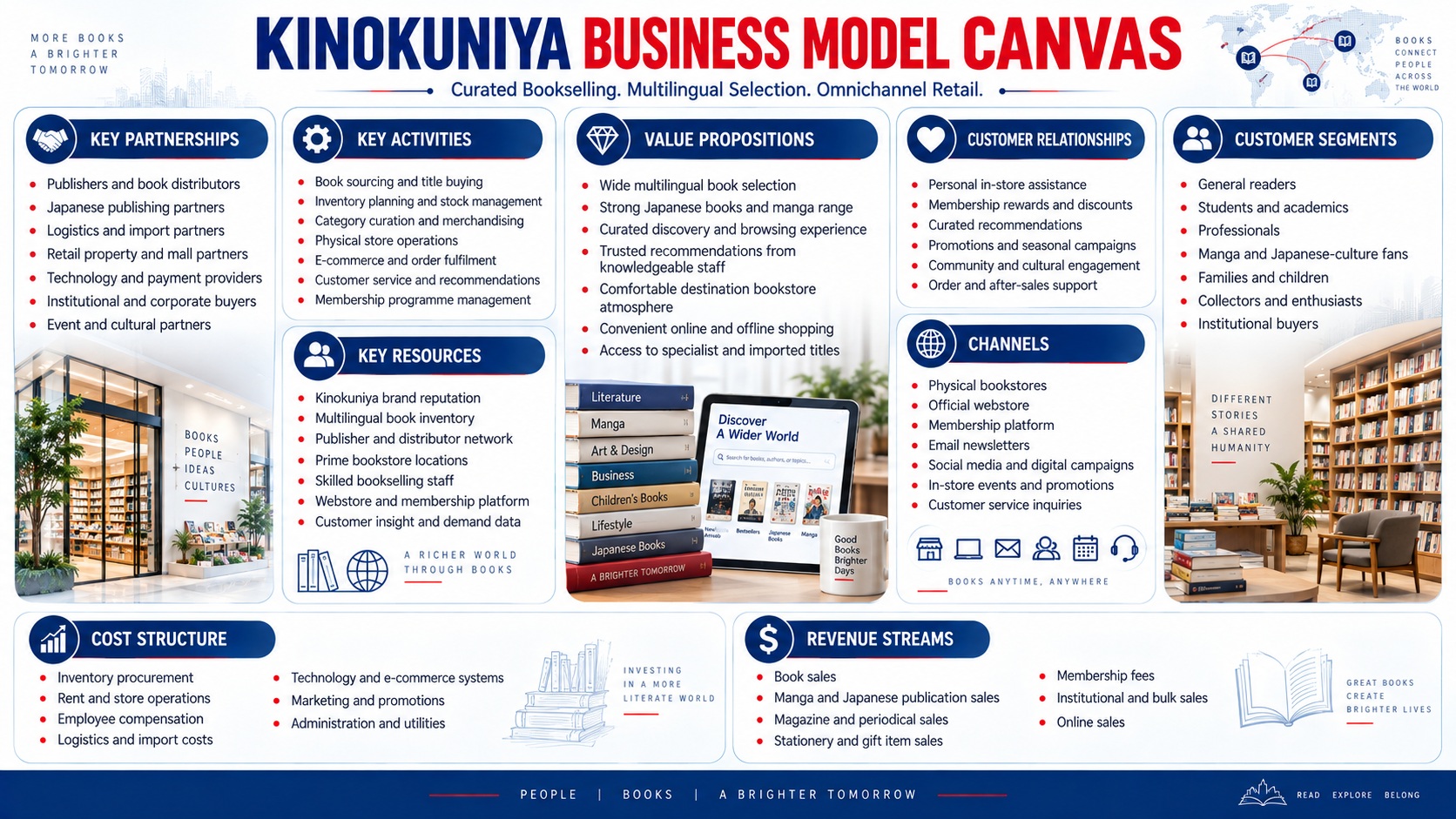
Before examining each component individually, the Kinokuniya Business Model Canvas can be summarised as a specialist retail system that converts publishing access, inventory curation and customer discovery into book and merchandise sales.
| BMC Block | Kinokuniya Application |
|---|---|
| Customer Segments | General readers, enthusiasts, students, professionals, families, collectors and institutional buyers |
| Value Propositions | Wide multilingual selection, Japanese content, specialist categories, trusted curation and bookstore experience |
| Channels | Physical bookstores, Webstore, membership communication and digital marketing |
| Customer Relationships | Knowledgeable service, membership, recommendations, promotions and cultural engagement |
| Revenue Streams | Books, magazines, stationery, gifts, selected merchandise and membership-related income |
| Key Resources | Brand, inventory, supplier network, retail locations, staff expertise, customer relationships and digital systems |
| Key Activities | Sourcing, buying, merchandising, inventory management, retail operations and e-commerce |
| Key Partnerships | Publishers, distributors, logistics providers, property partners and technology/payment providers |
| Cost Structure | Inventory, employees, rent, logistics, technology, store operations and marketing |
A Kinokuniya BMC diagram should emphasise the relationship between assortment, discovery and purchasing.
Publishers and distributors supply diverse titles.
Buying teams curate those titles for particular markets.
Stores and online channels present them to customers.
Staff expertise, merchandising and membership encourage discovery and repeat purchasing.
Revenue then supports continued investment in inventory, people, locations and digital infrastructure.
The detailed Kinokuniya Business Model Canvas shows that the company’s competitive position does not depend on one isolated strength.
Assortment without effective merchandising could create excessive inventory.
Premium stores without compelling products could become expensive showrooms.
Digital commerce without differentiation would place Kinokuniya into direct competition with larger online marketplaces.
Membership without attractive merchandise would create little loyalty.
Successful execution therefore requires alignment across the entire system.
Strong publisher access supports distinctive inventory.
Distinctive inventory increases the value of store visits.
Knowledgeable service improves product discovery.
Better discovery increases conversion and basket size.
Membership encourages repeat purchasing.
E-commerce captures demand beyond physical-store visits.
The following nine blocks explain these relationships in greater depth.
Kinokuniya serves customers whose requirements range from mainstream reading to highly specialised interests.
General readers purchase fiction, non-fiction, children’s titles and popular releases.
Students and professionals require educational, business, technical and reference materials.
Japanese-language readers and manga enthusiasts represent an important specialist segment because Kinokuniya’s heritage and sourcing capabilities provide differentiated access to Japanese publishing.
Families form another segment through children’s books, educational products and gift-oriented purchases.
Collectors and enthusiasts may seek art books, graphic novels, magazines, limited publications or titles that are difficult to locate through conventional bookstores.
| Segment | Details | Why It Matters |
|---|---|---|
| General readers | Fiction and mainstream non-fiction buyers | Creates broad transaction volume |
| Students and professionals | Educational and specialist information seekers | Supports higher-intent purchasing |
| Japanese-content enthusiasts | Japanese books, manga and magazines | Creates meaningful differentiation |
| Families | Children’s books and educational products | Supports recurring purchases |
| Institutions and organisations | Bulk, specialist and professional requirements | Broadens demand beyond consumers |
Segment diversity reduces dependence on any single reader category.
However, each audience expects different assortment depth.
Kinokuniya must therefore optimise inventory locally rather than assuming that identical product mixes will succeed everywhere.
Kinokuniya’s primary value proposition is access to a carefully selected range of books and related products that customers may struggle to discover elsewhere.
International and multilingual inventory is particularly important.
Japanese publications provide differentiation, while English, Chinese, Malay and other selections allow stores to serve diverse local markets.
Physical discovery creates another advantage.
Customers can browse shelves, compare books visually, examine design and production quality and receive assistance from knowledgeable booksellers.
Within the Kinokuniya Business Model Canvas, value therefore comes from combining product access with discovery rather than treating books as interchangeable commodities.
| Value Proposition | Details | Why It Matters |
|---|---|---|
| Extensive selection | Broad range of mainstream and specialist titles | Increases customer choice |
| Multilingual assortment | English, Japanese, Chinese, Malay and other titles | Serves diverse reader communities |
| Japanese specialisation | Manga, magazines, art and Japanese publications | Creates distinctive positioning |
| Curated discovery | Merchandising and knowledgeable recommendations | Reduces search effort |
| Bookstore experience | Comfortable environment designed for browsing | Differentiates physical retail |
Customers could often buy mainstream books elsewhere.
Kinokuniya becomes strategically stronger when it provides titles, expertise or discovery experiences that are not easily replicated by general retailers.
Its proposition should consequently remain centred on being worth visiting, not merely being another place to transact.
Kinokuniya delivers value through a combination of physical and digital channels.
Stores remain central because books are unusually suitable for browsing.
Customers can inspect covers, typography, illustrations and physical quality before purchasing.
Prime retail locations simultaneously provide visibility and spontaneous foot traffic.
Digital commerce expands this reach.
Kinokuniya Malaysia’s Webstore has operated since 2014 and allows customers to purchase publications and selected merchandise without visiting the physical location.
Membership communication, newsletters and promotions provide additional channels for maintaining contact with existing customers.
| Channel | Details | Why It Matters |
|---|---|---|
| Physical bookstores | Browsing, discovery and direct purchasing | Provides experiential differentiation |
| Webstore | Online search and ordering | Expands geographic and temporal reach |
| Membership platform | Account, points and rewards access | Connects repeat customers |
| Email newsletters | Promotions and activity updates | Supports retention |
| Digital/social channels | Product discovery and campaign communication | Reaches customers before store visits |
Physical and online channels should increasingly operate as one system.
Inventory visibility, recommendations, membership recognition and purchasing history can potentially create a more convenient journey when integrated effectively.
Omnichannel capability therefore represents both a distribution tool and a potential competitive advantage.
Bookselling can create unusually personal customer relationships because purchasing decisions are often linked to interests, education, hobbies and identity.
Kinokuniya reinforces these relationships through service, membership and discovery.
Knowledgeable employees are especially valuable when customers need recommendations or assistance locating specialist materials.
The Kinokuniya Privilege Card adds an economic retention mechanism. Current Malaysian membership provides regular book discounts, accumulated points, selected promotional benefits and advance information about activities.
| Relationship Type | Details | Why It Matters |
|---|---|---|
| Personal assistance | Staff help locate and recommend products | Builds trust and expertise |
| Membership | Discounts, points and member benefits | Encourages repeat purchasing |
| Product discovery | Displays, recommendations and curated sections | Deepens engagement |
| Promotions | Member and seasonal offers | Stimulates recurring visits |
| Cultural engagement | Exhibitions and bookstore activities | Strengthens community relevance |
Price incentives alone rarely create durable loyalty.
Kinokuniya’s stronger opportunity lies in combining economic rewards with intellectual and emotional attachment to books.
Customers who regard a store as a trusted destination for discovery are less likely to evaluate every transaction purely on price.
The relationship model should therefore make customers feel recognised as readers rather than simply processed as purchasers.
Book sales remain the principal economic engine.
Mainstream fiction, non-fiction, children’s titles, professional books, imported publications and specialist categories collectively provide transaction revenue.
Magazines and related publications broaden purchase frequency.
Stationery, gifts and selected non-book merchandise increase opportunities for complementary purchases.
Membership fees provide a smaller but strategically useful revenue source while supporting retention and customer identification.
The Kinokuniya Business Model Canvas can also benefit from institutional and specialist purchasing relationships, reflecting the company’s long history of serving academic and institutional markets internationally.
| Revenue Stream | Details | Why It Matters |
|---|---|---|
| Book sales | Mainstream, specialist and imported titles | Core commercial revenue |
| Japanese publications | Manga, magazines and Japanese-language products | Supports differentiated demand |
| Stationery and gifts | Complementary non-book merchandise | Increases basket diversification |
| Membership | Paid membership programme in relevant markets | Supports recurring relationships |
| Institutional sales | Organisational and specialist requirements | Diversifies customer base |
Revenue quality depends strongly on inventory productivity.
Selling more categories is valuable only when gross margin and stock turnover justify the capital invested.
Kinokuniya must therefore balance catalogue breadth against the financial discipline required in inventory-intensive retail.
Kinokuniya’s most important resources extend well beyond physical books.
Its brand represents decades of bookselling expertise and provides credibility among readers seeking specialist publications.
International publisher and distributor relationships provide access to an unusually broad catalogue.
Retail locations create physical visibility and support the browsing experience.
Knowledgeable employees represent another strategic resource because human recommendation remains difficult for general marketplaces to replicate fully.
Within the Kinokuniya Business Model Canvas, inventory itself is simultaneously an asset and a financial commitment.
| Key Resource | Details | Why It Matters |
|---|---|---|
| Brand | Established international bookselling reputation | Builds customer trust |
| Supplier network | Publisher and distributor relationships | Enables assortment breadth |
| Inventory | Multilingual and specialist titles | Provides immediate customer choice |
| Retail locations | Destination bookstore environments | Supports discovery and traffic |
| Staff expertise | Bookselling and category knowledge | Improves customer experience |
Digital infrastructure is becoming increasingly important alongside these traditional resources.
Product information, membership records, inventory visibility, online purchasing and customer analytics can improve how efficiently physical resources are used.
Kinokuniya’s strongest resource configuration therefore combines human expertise and physical assortment with better digital intelligence.
Kinokuniya must continuously perform sophisticated retail activities behind what appears to customers as a simple bookstore experience.
Buying and sourcing determine which titles enter the assortment.
Inventory planning determines how much stock should be held.
Merchandising makes thousands of titles understandable and discoverable.
Store operations ensure that products are correctly displayed and available.
E-commerce adds catalogue management, digital ordering, fulfilment and customer-service requirements.
| Key Activity | Details | Why It Matters |
|---|---|---|
| Product sourcing | Acquire books from publishers and distributors | Creates assortment |
| Inventory management | Balance availability and stock productivity | Protects working capital |
| Merchandising | Organise and promote products effectively | Improves discovery |
| Store operations | Maintain service and retail environment | Protects customer experience |
| E-commerce operations | Manage online catalogue, orders and fulfilment | Supports omnichannel growth |
Assortment decisions are particularly important.
Every additional title creates potential customer value but also consumes shelf space and working capital.
Successful bookselling therefore depends on knowing where breadth generates differentiation and where excessive inventory creates inefficiency.
Better demand forecasting and customer analytics can strengthen this decision-making without sacrificing Kinokuniya’s discovery-oriented character.
Kinokuniya depends heavily on relationships throughout the publishing and retail ecosystem.
Publishers provide titles, release information and commercial terms.
Distributors and wholesalers help aggregate supply across large numbers of publishers.
International logistics providers support imported products and cross-border supply chains.
Landlords and shopping-centre operators influence store accessibility, visibility and occupancy economics.
Technology, payment and fulfilment partners increasingly support digital commerce.
| Key Partner | Details | Why It Matters |
|---|---|---|
| Publishers | Supply books and publishing information | Determines product availability |
| Distributors and wholesalers | Aggregate titles across publishers | Simplifies procurement |
| Logistics providers | Transport domestic and imported products | Supports reliable inventory flow |
| Property partners | Provide strategic retail locations | Drives visibility and traffic |
| Technology/payment providers | Support digital transactions and systems | Enables omnichannel operations |
Publisher relationships have particular strategic significance.
Exclusive access may not always be possible, but strong buying relationships can improve availability, launch execution and specialist assortment.
International supply expertise also provides advantages when sourcing titles that general local retailers may find more difficult to obtain.
Partnership quality therefore directly affects Kinokuniya’s value proposition.
Kinokuniya operates an inventory-intensive and location-dependent retail model.
Product purchasing represents a major use of working capital because thousands of titles must be acquired before customer demand is fully known.
Retail occupancy is another important cost.
Large bookstores in premium commercial locations require sufficient sales productivity to justify rent and associated operating expenses.
Employee costs matter because knowledgeable booksellers and operational teams support the service proposition.
| Cost Category | Details | Why It Matters |
|---|---|---|
| Inventory | Purchase and holding of books and merchandise | Largest operational commitment |
| Occupancy | Rent, utilities and store facilities | Shapes physical-store economics |
| Employees | Booksellers, management and support teams | Sustains service quality |
| Logistics | Domestic and international transportation | Critical for imported inventory |
| Technology and e-commerce | Platforms, systems and fulfilment support | Enables digital operations |
Imported books can introduce additional volatility through freight costs and foreign-exchange movements.
Unsold inventory creates another risk because slow-moving stock occupies capital and shelf space.
Cost optimisation must therefore avoid damaging the characteristics that make Kinokuniya distinctive.
Reducing assortment or staff expertise excessively could lower expenses while simultaneously weakening the reasons customers choose the retailer.
The Kinokuniya Business Model Canvas becomes most useful when its nine components are treated as one connected retail system.
Customer segments determine which titles should be sourced.
Value propositions shape the required assortment and service level.
Channels connect those offerings with physical and digital customers.
Customer relationships encourage repeat purchasing through expertise, membership and discovery.
Revenue streams convert these interactions into book, merchandise and membership income.
Those revenues fund key activities such as buying, inventory management, merchandising and fulfilment.
Resources such as the brand, staff knowledge, locations and supplier network make those activities possible.
Partnerships provide access to publishers, logistics, property and technology.
Cost structure ultimately determines whether the system creates sustainable economic returns.
Alignment is essential.
Expanding inventory may increase customer choice but weaken working-capital efficiency.
Reducing inventory may improve financial metrics but diminish differentiation.
Premium locations may attract customers but create high fixed costs.
Online growth can expand reach but also increase direct price comparison.
Kinokuniya succeeds when each block strengthens the others rather than when any individual component is optimised independently.
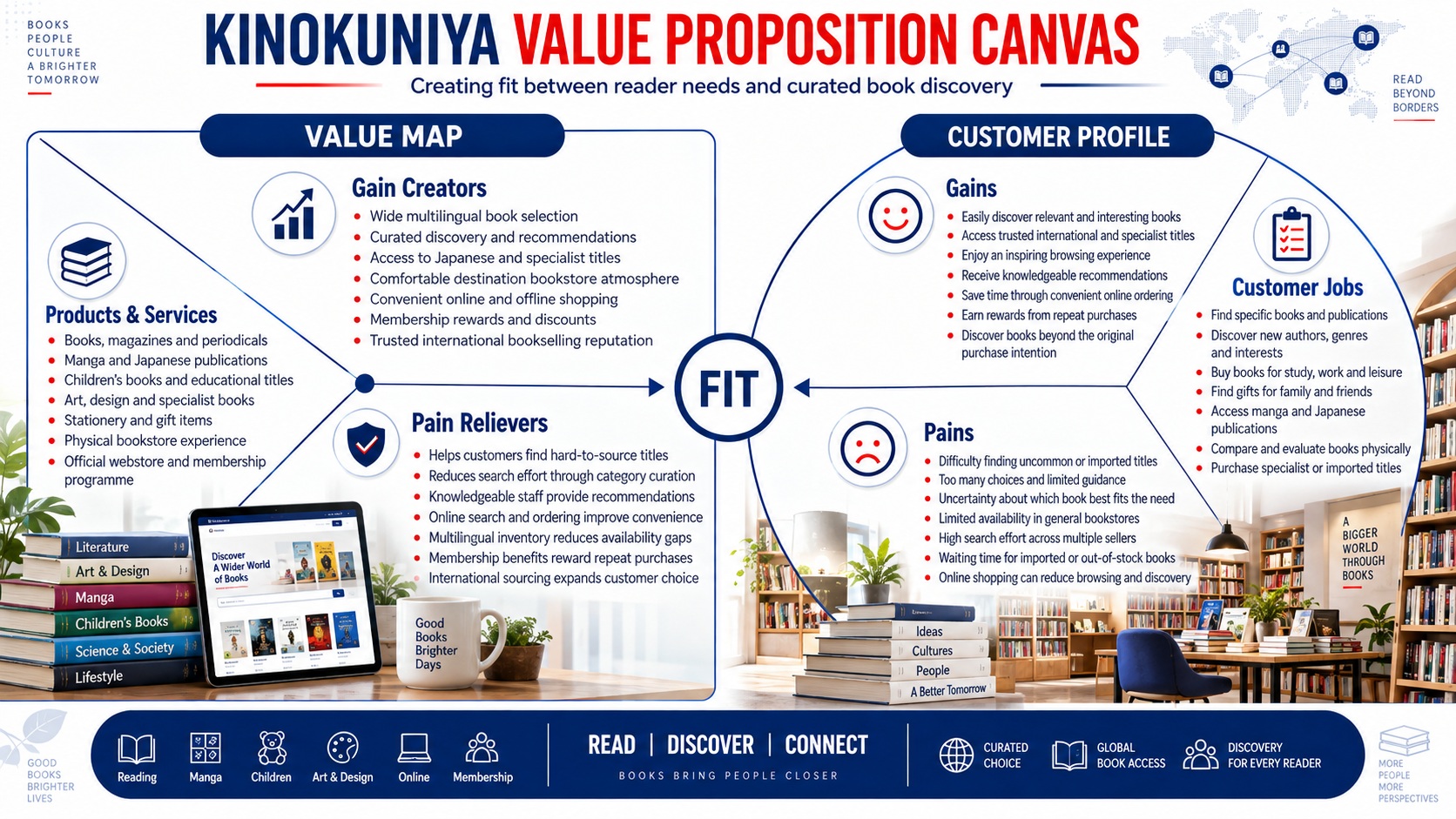
The Value Proposition Canvas provides a closer view of how Kinokuniya matches its products and services with customer requirements.
While BMC explains the overall organisation, the Kinokuniya Business Model Canvas becomes easier to understand by examining why individual readers choose the retailer.
The profile below focuses primarily on active readers and book buyers.
Their needs extend beyond obtaining a book.
Many customers want to discover new titles, browse specialist categories, locate imported publications, evaluate books physically and receive informed recommendations.
| Customer Profile | Details |
|---|---|
| Customer Jobs | Find specific books, discover new titles, browse interests, buy gifts, access specialist publications and obtain reliable recommendations |
| Customer Pains | Limited local availability, difficult searches, uncertain online quality, expensive imports, overwhelming choices and unavailable specialist editions |
| Customer Gains | Wide selection, trustworthy discovery, specialist access, enjoyable browsing, knowledgeable help and convenient online ordering |
Customers particularly value Kinokuniya when obtaining the right book would otherwise involve significant search effort.
The strategic objective should therefore be reducing discovery friction while maintaining the pleasure associated with exploration.
Kinokuniya responds through a combination of assortment, specialist sourcing, physical retail and digital access.
| Value Map | Details |
|---|---|
| Products and Services | Books, magazines, manga, art titles, children’s books, stationery, gifts, stores, Webstore and membership |
| Pain Relievers | Broad inventory, specialist sections, staff assistance, search facilities and international sourcing |
| Gain Creators | Curated discovery, multilingual choice, Japanese expertise, comfortable browsing and member rewards |
Kinokuniya’s strongest value does not come from offering every possible product.
Greater differentiation comes from making valuable products discoverable.
Store design, category organisation, knowledgeable employees and digital search should consequently operate as complementary discovery mechanisms.
| Customer Profile | Details | Matching Value Map | How Kinokuniya Creates Fit |
|---|---|---|---|
| Customer Jobs | Find and discover books | Products and Services | Broad specialist inventory provides multiple discovery paths |
| Customer Pains | Difficulty locating uncommon titles | Pain Relievers | International sourcing, categorisation and staff support reduce search friction |
| Customer Gains | Enjoyable discovery and trusted choice | Gain Creators | Curated stores, expertise and multilingual selection improve the buying experience |
Value fit becomes strongest when customers can find both what they intended to purchase and something worthwhile they did not initially expect to discover.
That combination differentiates specialist bookselling from purely transactional e-commerce.
The Kinokuniya Business Model Canvas shares important characteristics with Barnes & Noble and Waterstones because all three combine physical bookselling with digital commerce.
Their competitive emphasis, however, differs.
Barnes & Noble operates a major US bookstore network and combines books with categories including toys, games and other entertainment products. Its current membership architecture includes both a paid Premium programme and free Rewards programme.
Waterstones operates more than 300 locations across the UK, Ireland and parts of Europe and emphasises knowledgeable booksellers, locally relevant ranges and physical bookstore experience.
Kinokuniya is particularly differentiated by its Japanese heritage, multilingual catalogue and specialist imported content.
| Relevant BMC Block | Kinokuniya | Barnes & Noble | Waterstones |
|---|---|---|---|
| Customer Segments | International readers, multilingual customers, enthusiasts and specialist buyers | US mass-market readers, families and entertainment buyers | UK and European readers with strong local-bookshop orientation |
| Value Proposition | Multilingual selection, Japanese expertise and curated destination retail | Broad books-and-entertainment selection with large store network | Knowledgeable bookselling, local curation and strong bookstore experience |
| Channels | International stores, Webstores and membership | Stores, BN.com and membership ecosystem | 300+ stores and multiple online properties |
| Customer Relationships | Specialist service, discovery and paid membership | Premium and Rewards membership plus store engagement | Bookseller expertise, local merchandising and customer engagement |
| Key Resources | International sourcing, Japanese content, specialist inventory and brand | Large US store network, online platform and broad catalogue | Store estate, booksellers, local curation and multiple book retail brands |
Kinokuniya should not attempt to become indistinguishable from either competitor.
Its most defensible strategic territory is the combination of international breadth, Asian publishing access, specialist categories and destination-style bookstore discovery.
Kinokuniya possesses several advantages that support differentiation from general retailers and online marketplaces.
These strengths become most valuable when combined.
Assortment attracts customers, expertise helps them discover relevant products and the retail environment encourages longer engagement.
Kinokuniya also faces structural pressures that can weaken bookstore economics if not managed carefully.
The greatest threat would be gradual loss of differentiation.
When customers perceive Kinokuniya as offering essentially the same titles and experience available elsewhere, they have greater incentive to choose whichever seller is cheaper or faster.
Protecting uniqueness is therefore commercially essential.
Kinokuniya should modernise the economics of specialist bookselling without eliminating the characteristics that make the business distinctive.
Inventory visibility should connect physical and online purchasing more closely.
Customers could check store availability, reserve titles, collect purchases, receive personalised recommendations and access membership benefits consistently across channels.
Convenience would improve without forcing Kinokuniya into pure price competition.
Investment should concentrate on categories where expertise matters.
Manga, Japanese publications, art and design, children’s books, professional subjects, collectors’ editions and multilingual content can create stronger reasons to choose Kinokuniya.
Depth should become a strategic moat rather than merely a large inventory.
Physical stores should provide experiences that websites cannot fully reproduce.
Author events, curated collections, exhibitions, themed displays, reading communities and specialist recommendations can convert store visits into cultural experiences.
Higher engagement can strengthen both traffic and customer loyalty.
Membership should evolve beyond discounts.
Purchase history and declared interests could support relevant recommendations, new-release alerts, category-specific communications and curated offers.
Better personalisation would make the programme more valuable while reducing dependence on blanket discounting.
Data should help distinguish strategically valuable slow-moving titles from unproductive inventory.
Demand forecasting, local category performance and online search behaviour could improve purchasing decisions.
The objective should not be simply to reduce inventory but to maintain assortment breadth more intelligently.
Universities, schools, corporations, libraries and specialist organisations can provide demand less dependent on shopping-centre foot traffic.
Curated procurement, professional collections and bulk-order services could strengthen this segment.
Institutional capability would also leverage Kinokuniya’s international sourcing network.
International reach should provide sourcing advantages while individual markets retain locally relevant assortments.
A customer in Kuala Lumpur should encounter a different mix from one in Tokyo, Sydney or New York.
Global procurement combined with local merchandising can deliver both scale and relevance.
Overall, the Kinokuniya Business Model Canvas explains how a traditional bookseller can remain strategically relevant in an increasingly digital retail environment.
Its underlying commercial mechanism is straightforward.
Kinokuniya sources books and related products, organises those products into meaningful selections, makes them discoverable through stores and online channels and generates revenue when customers purchase them.
The sophistication lies in execution.
International sourcing supports assortment.
Specialist inventory creates differentiation.
Knowledgeable employees improve discovery.
Destination stores create experiential value.
Membership encourages repeat purchases.
Digital commerce extends accessibility beyond physical locations.
Kinokuniya’s future competitiveness will depend less on having the largest possible catalogue and more on making its catalogue unusually valuable to particular customer groups.
Generic books can be bought almost anywhere.
Specialist books, international publications, trusted recommendations and memorable discovery experiences are considerably more defensible.
Kinokuniya should therefore continue evolving from a bookstore that holds extensive inventory into an integrated discovery platform for readers.
If physical experience, specialist sourcing, membership data and digital convenience are combined effectively, the company can preserve the cultural strengths of traditional bookselling while improving the economics required for modern retail competition.
This article is provided solely for educational, informational and business-analysis purposes.
The analysis is based on publicly available company information, industry observations and strategic interpretation available at the time of writing.
Nothing contained in this article constitutes financial, investment, legal, accounting, business or other professional advice.
The content should not be interpreted as an official statement, endorsement or representation by Kinokuniya Company Ltd., Barnes & Noble, Waterstones or any other organisation mentioned.
Business models, products, store networks, prices, memberships, market conditions and corporate strategies may change over time.
Readers should conduct independent research and obtain appropriate professional advice before making investment, commercial or strategic decisions.
All logos, trademarks, copyrights, company names, product names and other intellectual-property rights belong to their respective owners.
Explore the Kinokuniya Business Model Canvas, covering all nine BMC blocks, Value Proposition Canvas, Barnes & Noble and Waterstones comparison, competitive advantages, risks and strategic recommendations.
Explore the Agoda Business Model Canvas, covering all nine BMC blocks, Value Proposition Canvas, Booking.com… Read More
Explore the FedEx Business Model Canvas, nine BMC blocks, Value Proposition Canvas, UPS and DHL… Read More
Explore the Quipper Business Model Canvas, nine BMC blocks, Value Proposition Canvas, Ruangguru and Pahamify… Read More
Explore the CARPUT Business Model Canvas, nine BMC blocks, Value Proposition Canvas, competitor comparison, competitive… Read More
Explore the Boost Business Model Canvas, nine BMC blocks, Value Proposition Canvas, competitor comparison, advantages,… Read More
Explore the Domino's Pizza Business Model Canvas, nine BMC blocks, Value Proposition Canvas, Pizza Hut… Read More