TV3 Business Model Canvas: How Malaysia’s Leading Free-to-Air Channel Creates Value Through Content, Audiences, Advertising, and Digital Distribution
BMC Article No: BMC #081
New Article in 2026: This is a new Business Model Canvas analysis of TV3. It examines how the Malaysian television channel creates, delivers, and captures value through free-to-air broadcasting, local content, news, entertainment, advertising, branded content, audience scale, and integration with Media Prima’s wider media ecosystem.
The article also includes deeper analysis of all nine BMC blocks, a Value Proposition Canvas, comparison with Astro Ria and TV1, competitive advantages, risks and challenges, strategic recommendations, and an assessment of how TV3’s traditional broadcasting strengths can remain relevant as Malaysian audiences increasingly consume video across multiple screens.
Introduction
Launched in 1984, TV3 became Malaysia’s first private television station and has developed into one of the country’s most recognisable mass-media brands. Today, it operates within Media Prima Television Networks alongside TV9, 8TV, DIDIKTV KPM and the Tonton streaming platform.
The TV3 Business Model Canvas is particularly interesting because viewers generally consume the television channel without paying TV3 directly. Audience attention instead creates commercial value that can be monetised through advertisers, sponsors, branded-content partners and the wider Media Prima ecosystem.
Unlike a subscription television service, TV3 must attract large audiences before it can effectively monetise them.
Its programming therefore performs two roles simultaneously.
Content must provide news, entertainment and culturally relevant programmes that encourage Malaysians to watch. At the same time, strong audiences create advertising inventory and sponsorship opportunities for businesses seeking nationwide reach.
Digital distribution adds another dimension. TV3 programmes can move beyond scheduled television into Tonton, social platforms, short-form formats and other Media Prima properties.
Understanding these relationships helps explain why TV3 is no longer simply a television broadcaster. It increasingly operates as the flagship of a broader content, audience and advertising ecosystem.
What Is TV3’s Business Model?
Commercially, TV3 operates primarily as an advertising-supported free-to-air television channel.
Most viewers do not pay a direct subscription fee to watch normal TV3 broadcasts. Removing that consumer payment barrier helps the channel maximise reach, which is particularly valuable to advertisers seeking access to large Malaysian audiences.
At the centre of the TV3 Business Model Canvas is therefore an attention-based model.
Three economic components support it.
First, TV3 acquires, produces and schedules programmes capable of attracting viewers.
Second, those audiences generate commercially valuable attention around dramas, news, reality programmes, lifestyle shows, religious programmes, major entertainment properties and other programming.
Third, advertisers and commercial partners pay to access those audiences through television advertising, sponsorship, product integration, branded content and wider cross-platform campaigns.
Media Prima strengthens this structure by connecting television with production, digital publishing, streaming and integrated advertising capabilities. Its television network comprises TV3 and several other channels, while Primeworks Studios supports content creation and Tonton extends selected content into streaming.
Consequently, TV3’s economic model is increasingly better understood as free television + premium local content + mass audience + advertising + cross-platform distribution.
What Is Business Model Canvas?
Developed as a strategic-management framework, the Business Model Canvas explains how an organisation creates value, delivers that value and captures economic returns.
Nine interconnected components form the framework.
For TV3, BMC is useful because the people receiving the principal service and the customers generating commercial revenue are often different groups.
Viewers receive programming largely free of direct charge, while advertisers and commercial partners pay for access to those viewers.
The TV3 Business Model Canvas shows how these relationships connect.
| BMC Block |
Main Question |
| Customer Segments |
Who does TV3 serve? |
| Value Propositions |
What value does TV3 provide? |
| Channels |
How does TV3 distribute content and reach customers? |
| Customer Relationships |
How does TV3 retain audiences and advertisers? |
| Revenue Streams |
How does TV3 generate commercial value? |
| Key Resources |
Which assets make TV3 competitive? |
| Key Activities |
What must TV3 continuously perform? |
| Key Partnerships |
Which external partners support the model? |
| Cost Structure |
What are TV3’s major operating costs? |
Examining each block separately clarifies the model, but TV3’s strategic strength ultimately depends on how effectively those nine components reinforce one another.
Quick Overview of TV3
Beginning broadcasts on 1 June 1984, TV3 was Malaysia’s first privately owned television station. Four decades later, the channel remains part of Media Prima, Malaysia’s largest integrated media group.
Programming has expanded considerably from conventional scheduled television.
News and current affairs remain important through properties associated with Buletin TV3, while entertainment includes dramas, reality programmes, lifestyle formats, religious content, special events and major entertainment franchises.
Local programming represents an especially important strategic asset because it reflects Malaysian language, culture, celebrities, social issues and viewing habits that international streaming platforms cannot reproduce as naturally.
Media Prima reported that its television networks captured 57% of Malaysia’s Total 4+ TV audience in FY2025. Within the Malay audience segment, TV3 recorded a 47.3% share and was described by the group as the country’s No. 1 channel.
Digital distribution increasingly complements broadcast television.
Tonton can provide early-access episodes, streaming availability and additional digital experiences around programmes associated with TV3. Social platforms extend individual programmes into clips, conversations and short-form content.
TV3 therefore combines the reach of traditional broadcasting with an increasingly multiplatform content strategy.
Why TV3 Is Strategically Interesting
Few Malaysian businesses illustrate the economics of attention as clearly as television broadcasting.
Viewers receive entertainment, news and information. Advertisers receive access to those viewers. Producers and talent gain distribution. Commercial partners gain opportunities to associate brands with popular programmes.
These stakeholders create an interconnected ecosystem.
The TV3 Business Model Canvas demonstrates that audience scale alone is not sufficient. TV3 must generate the right type of audience, at the right time, around programming advertisers consider commercially valuable.
A highly engaged programme can create multiple forms of value.
Traditional commercial spots may be sold around it. Sponsors can associate their brands with the programme. Products may be integrated into content. Clips can circulate on social media. Episodes can attract digital viewing. Events or extensions can deepen audience engagement.
That means successful content can become intellectual property rather than simply filling broadcast hours.
Media Prima demonstrated this principle with TV3’s “Itu” drama franchise, including Perempuan Itu, Lelaki Itu and Keluarga Itu. The group described the franchise as a significant cross-platform content property.
TV3 is therefore strategically interesting because its strongest programmes can potentially generate value across television, streaming, digital advertising, sponsorship, social media and future content extensions.
Latest Developments: What Is Changing Around TV3?
Several developments are reshaping TV3’s business environment.
Audience behaviour is becoming increasingly cross-platform. Television remains important, but viewers now move between scheduled broadcasting, streaming, social media and mobile video.
Media Prima has responded by connecting television more closely with Tonton and other digital formats. Tonton has used early-access models where selected drama episodes become available before their TV3 broadcast, creating interaction between streaming and linear television rather than treating them as completely separate channels.
The TV3 Business Model Canvas is also becoming more digitally oriented through short-form and vertical content.
Media Prima reported that TV3 experimented with micro-dramas such as Benci Jadi Cinta and branded vertical drama Keluarga Antara Insan. The former exceeded 4.6 million views on Drama Sangat digital platforms, while the Samsung collaboration exceeded 3.1 million views.
Advertising formats are also evolving beyond conventional commercial breaks.
Programme sponsorship, branded content, integrated campaigns and live experiences allow brands to become part of the content environment.
Consequently, TV3’s strategic challenge is not simply protecting television ratings. It must convert established broadcast strength into a multiplatform audience franchise.
TV3 Business Model Canvas Summary
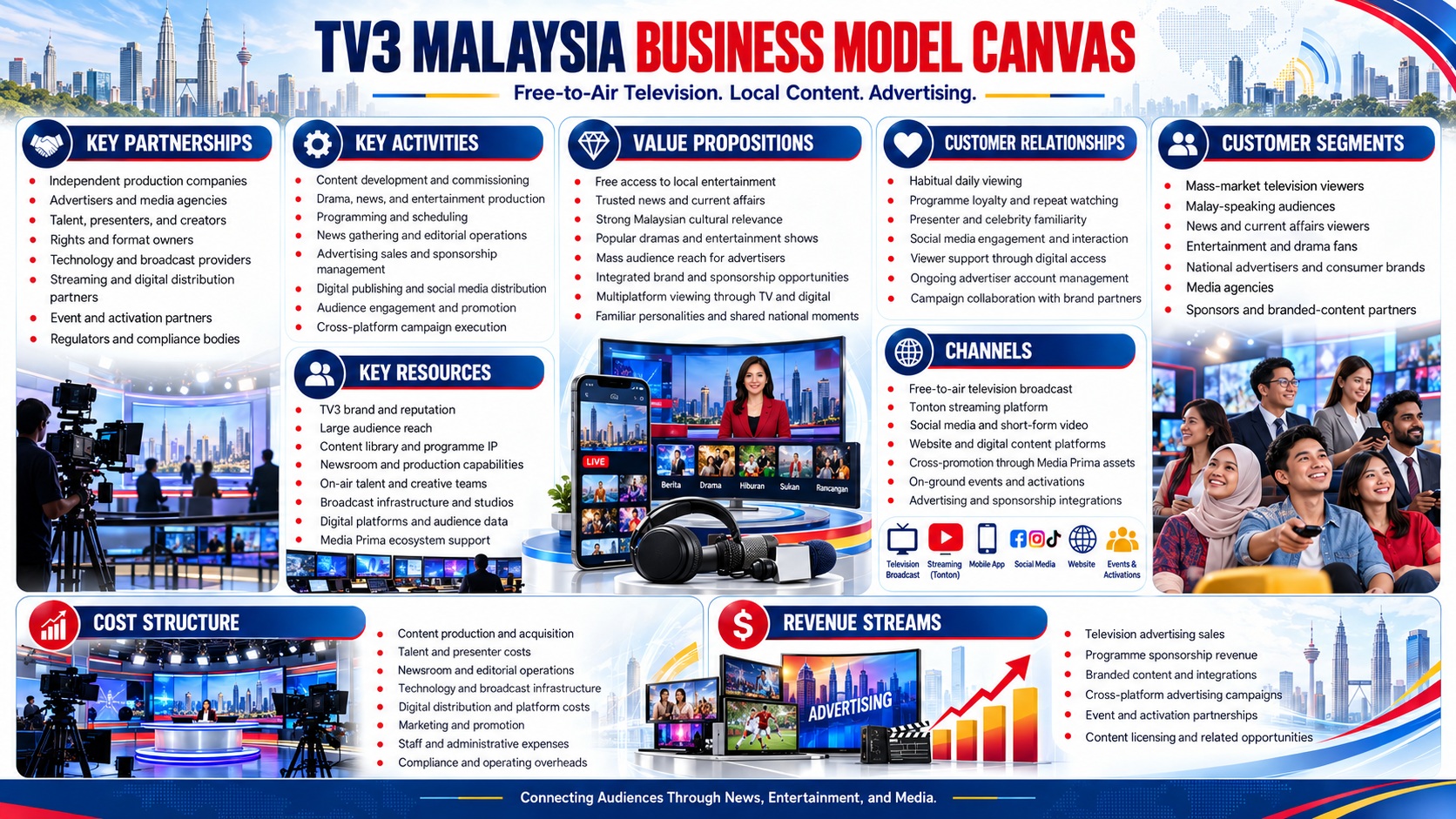
Before examining the components individually, the TV3 Business Model Canvas can be summarised as a media model that transforms locally relevant programming and audience attention into advertising, sponsorship and broader commercial opportunities.
| BMC Block |
TV3 Application |
| Customer Segments |
Mass viewers, Malay-speaking audiences, advertisers, agencies, sponsors and commercial partners |
| Value Propositions |
Free local entertainment, trusted news, cultural relevance, mass reach and advertising visibility |
| Channels |
Free-to-air TV, Tonton, digital video, social platforms and on-ground activities |
| Customer Relationships |
Habitual viewing, programme loyalty, personalities, social engagement and advertiser relationships |
| Revenue Streams |
Advertising, sponsorship, branded content and related commercial opportunities |
| Key Resources |
Brand, audience reach, content IP, talent, production capability, broadcast infrastructure and Media Prima ecosystem |
| Key Activities |
Content creation, acquisition, scheduling, news production, broadcasting, advertising and digital distribution |
| Key Partnerships |
Producers, advertisers, agencies, talent, rights owners, technology providers and regulators |
| Cost Structure |
Content, production, talent, employees, broadcasting infrastructure, marketing and digital operations |
TV3 BMC Diagram
A TV3 BMC diagram should highlight the interaction between content, audiences and advertisers.
Compelling programming attracts viewers. Larger audiences make advertising inventory more valuable. Commercial revenue funds further content creation, production, technology and distribution.
Digital platforms then extend the same content beyond scheduled broadcasting.
BMC Analysis of TV3
Examined in detail, the TV3 Business Model Canvas reveals a reinforcing system built around local content, reach, brand familiarity and advertising monetisation.
No individual block works independently.
Better programming can attract more viewers, but premium content raises production costs.
Higher ratings increase advertising attractiveness, although excessive advertising can reduce the viewing experience.
Digital distribution creates additional reach, yet it also places TV3 directly against YouTube, TikTok, Netflix, Viu, Astro, social-video creators and many other sources of entertainment.
Established television habits provide an advantage, but younger consumers increasingly expect on-demand availability and personalised recommendations.
TV3 therefore needs to protect the benefits of mass broadcasting while becoming increasingly flexible in how programmes are created, packaged, distributed and monetised.
The following sections analyse every BMC block in greater depth.
1. Customer Segments
Multiple stakeholder groups participate in TV3’s model.
Mass-market television viewers provide the fundamental audience base. Malay-speaking viewers are particularly important because TV3 has historically built strong positioning around Malay-language entertainment, news and cultural programming.
Advertisers form the principal commercial customer segment.
Large consumer brands can use TV3 for nationwide awareness, while government organisations, Malaysian companies and other marketers can purchase television and integrated media campaigns.
Advertising agencies act as important intermediaries by planning budgets and selecting media channels on behalf of clients.
Sponsors and branded-content partners form another segment. Rather than buying conventional advertising alone, these organisations can integrate brands into programmes, competitions, events or specially created content.
TV3 Customer Segments
| Segment |
Details |
Why It Matters |
| Mass-market viewers |
Malaysians consuming entertainment, news and information |
Generates audience scale |
| Malay-speaking audiences |
Core audience for many flagship programmes |
Strengthens TV3’s positioning |
| Advertisers |
Brands purchasing media exposure |
Provides commercial revenue |
| Agencies |
Plan and manage advertising campaigns |
Influence major media budgets |
| Sponsors and partners |
Participate in branded programmes and integrations |
Expands monetisation beyond spot advertising |
TV3 must balance audience interests with advertiser requirements.
Viewers ultimately create the attention advertisers purchase. Weak content reduces audience value, while excessive commercialisation can make programmes less attractive.
Long-term performance therefore depends on keeping viewers engaged while giving advertisers credible reach and meaningful brand outcomes.
2. Value Propositions
Different customers receive different benefits from the same media platform.
Viewers obtain free access to locally relevant entertainment, news, current affairs, lifestyle programming, major events and familiar Malaysian personalities.
Advertisers receive mass-market reach and association with established programmes.
Commercial partners can move beyond ordinary advertisements into sponsorships, branded segments and integrated campaigns.
Media Prima’s wider ecosystem further extends this proposition because television campaigns can potentially connect with streaming, digital publishing, radio, content production and on-ground activations.
The TV3 Business Model Canvas becomes stronger when these benefits reinforce one another.
TV3 Value Propositions
| Value Proposition |
Details |
Why It Matters |
| Free entertainment |
Broad programming without direct viewer subscription |
Maximises audience accessibility |
| Local relevance |
Malaysian stories, culture, personalities and language |
Differentiates TV3 from global platforms |
| News and information |
Established news and current-affairs programming |
Strengthens habitual viewing and credibility |
| Mass advertising reach |
Access to large television audiences |
Creates value for advertisers |
| Integrated brand opportunities |
Sponsorship, branded content and multiplatform campaigns |
Broadens commercial monetisation |
The central strategic asset is local relevance at mass scale.
International streaming platforms can offer enormous content libraries, while social media provides virtually unlimited short-form entertainment. Neither automatically possesses TV3’s combination of Malaysian cultural familiarity, linear reach and established local programming brands.
Sustainable differentiation therefore requires TV3 to make local relevance sufficiently valuable that audiences actively choose its programmes rather than merely encounter them.
3. Channels
Distribution has expanded beyond the television screen.
Free-to-air broadcasting remains TV3’s primary mass-reach channel and gives viewers access without requiring a conventional pay-TV subscription.
Tonton extends selected programming into streaming and allows audiences to consume video beyond a fixed broadcast schedule.
Social platforms provide another layer of distribution through clips, highlights, promotional material and audience conversations.
Media Prima can also use its broader digital and media portfolio to cross-promote programmes and commercial campaigns.
Events and physical activations provide an additional channel connecting audiences, advertisers, talent and programme brands.
TV3 Channels
| Channel |
Details |
Why It Matters |
| Free-to-air television |
Core scheduled broadcasting |
Delivers nationwide mass reach |
| Tonton |
Streaming and on-demand distribution |
Extends viewing beyond linear TV |
| Social media |
Clips, promotion and audience interaction |
Reaches mobile-first audiences |
| Media Prima ecosystem |
Cross-promotion through wider media assets |
Expands campaign reach |
| On-ground activations |
Events linked to programmes and brands |
Deepens audience engagement |
TV3 increasingly requires an omnichannel content strategy.
A strong television programme should not exist only during its scheduled broadcast slot. Individual scenes can become social clips, episodes can generate streaming demand, personalities can extend engagement online, and advertisers can participate across multiple touchpoints.
Distribution consequently becomes part of content design rather than simply the final stage after production.
4. Customer Relationships
Audience relationships are built mainly through repeated viewing behaviour and emotional familiarity.
Popular dramas encourage viewers to return for subsequent episodes. News programmes can become part of daily routines, while entertainment shows build recurring audiences around personalities, competitions and major moments.
Presenters, actors and celebrities further humanise the TV3 brand.
Social platforms add interactive relationships that traditional television could not provide. Audiences can comment, share clips and participate in conversations around programmes.
Advertiser relationships operate differently.
Media sales teams, agencies and integrated campaign capabilities help commercial customers plan television exposure, sponsorships and branded-content opportunities.
TV3 Customer Relationships
| Relationship Type |
Details |
Why It Matters |
| Habitual viewing |
Regular news and scheduled programmes |
Creates recurring audiences |
| Programme loyalty |
Viewers follow dramas and entertainment franchises |
Improves retention |
| Talent relationships |
Presenters and celebrities build familiarity |
Humanises the channel |
| Digital engagement |
Social interaction around programmes |
Extends relationships beyond television |
| Commercial account relationships |
Sales and campaign support for advertisers |
Supports repeat advertising spending |
Audience loyalty can no longer depend entirely on fixed schedules.
On-demand services have conditioned consumers to expect greater convenience and choice.
TV3 should therefore convert programme loyalty into broader franchise relationships where viewers can engage with favourite content before, during and after television transmission.
Strong customer relationships ultimately depend on both emotional connection and accessibility.
5. Revenue Streams
Advertising represents the principal commercial engine behind private free-to-air television.
Brands purchase television spots because TV3 offers access to large Malaysian audiences. Premium programmes and high-viewership periods can make specific advertising inventory particularly attractive.
Sponsorship creates another source of commercial value.
Brands may sponsor programmes, segments, contests or special events.
Branded content can integrate commercial messages more directly into entertainment or information formats when appropriately disclosed and structured.
The TV3 Business Model Canvas can also benefit indirectly from Media Prima’s wider digital and content ecosystem, although group-level revenues should not be confused with TV3 standalone revenue.
TV3 Revenue Streams
| Revenue Stream |
Details |
Why It Matters |
| Television advertising |
Commercial spots around programming |
Core monetisation mechanism |
| Programme sponsorship |
Brands associate with specific programmes |
Creates premium partnerships |
| Branded content |
Commercially supported content and integrations |
Expands advertiser solutions |
| Cross-platform campaigns |
TV combined with digital or other Media Prima assets |
Increases campaign value |
| Content-related opportunities |
IP extensions and selected licensing opportunities |
Supports diversification potential |
The principal economic vulnerability is advertising dependence.
Marketers can redirect budgets toward Google, Meta, TikTok, YouTube, connected TV, influencers and retail-media platforms.
TV3 therefore needs to demonstrate not merely reach but measurable effectiveness and distinctive cultural impact.
Future monetisation should increasingly package audiences across television, streaming, digital video and branded experiences.
6. Key Resources
TV3’s most important assets extend beyond physical broadcasting infrastructure.
Its brand has accumulated more than four decades of recognition within Malaysian households.
Audience reach represents another major resource because scale attracts advertisers seeking broad national visibility.
Content intellectual property is increasingly important. Successful dramas, entertainment formats, news properties and recurring programme franchises can remain valuable beyond their original transmission.
Talent—including actors, presenters, journalists, production teams and creative professionals—supports audience attachment and content quality.
Media Prima’s wider capabilities provide additional resources through production, streaming, digital publishing and commercial integration.
TV3 Key Resources
| Key Resource |
Details |
Why It Matters |
| TV3 brand |
Decades of national recognition |
Creates familiarity and trust |
| Audience reach |
Large Malaysian viewer base |
Attracts advertising demand |
| Content IP |
Dramas, news and entertainment franchises |
Creates reusable media assets |
| Talent |
Presenters, actors, journalists and creators |
Drives content quality and affinity |
| Media Prima ecosystem |
Production, streaming and integrated media capabilities |
Extends scale and distribution |
Resources become more valuable when combined.
Brand strength attracts talent. Talent supports content. Strong content attracts audiences. Audiences attract advertisers. Advertising finances further content development.
Maintaining that reinforcing cycle is critical because digital competitors may possess stronger technology or global libraries but cannot quickly replicate decades of local brand equity and Malaysian content relationships.
7. Key Activities
Content management sits at the centre of TV3 operations.
Programme development and acquisition determine what audiences can watch.
Production teams must create dramas, news, current affairs, entertainment programmes and other formats capable of sustaining attention.
Scheduling remains important because traditional broadcasting requires TV3 to place programmes into time slots that maximise audience fit.
News gathering demands continuous editorial, reporting and production capabilities.
Advertising sales convert audience attention into commercial value, while digital teams repurpose and distribute programmes for online environments.
TV3 Key Activities
| Key Activity |
Details |
Why It Matters |
| Content development |
Create and commission local programmes |
Drives audience demand |
| News production |
Gather, verify and broadcast news |
Supports credibility and daily relevance |
| Programming and scheduling |
Optimise programmes across time slots |
Maximises audience performance |
| Advertising sales |
Sell media, sponsorship and brand solutions |
Converts reach into revenue |
| Digital distribution |
Extend programmes into streaming and social formats |
Captures changing viewing behaviour |
Creative activity must increasingly start with multiple platforms in mind.
A drama developed only for a conventional one-hour television slot may not fully exploit its potential.
Scenes can become short-form videos, characters can extend into digital content, advertisers can support multiplatform storytelling and successful programmes can evolve into repeatable franchises.
TV3’s operational model should therefore move gradually from broadcast production toward content-IP management.
8. Key Partnerships
Television requires an extensive external ecosystem.
Independent production companies can provide dramas, entertainment programmes and specialist production capabilities.
Advertisers and media agencies are commercially important because their spending supports the free-to-air model.
Actors, presenters, musicians, influencers and other creative talent contribute both content and audience attraction.
Rights owners supply licensed programmes, formats, music and other intellectual property.
Technology and distribution partners support broadcasting, streaming and digital delivery.
Regulatory relationships are also important because Malaysian broadcasting operates within licensing, content and communications requirements.
TV3 Key Partnerships
| Key Partner |
Details |
Why It Matters |
| Production companies |
Produce commissioned or collaborative content |
Expands creative capacity |
| Advertisers and agencies |
Purchase commercial exposure |
Generate monetisation |
| Talent and creators |
Participate in programmes and promotions |
Attract audiences |
| Rights and format owners |
Supply licensed content and programme formats |
Diversifies programming |
| Technology and distribution partners |
Support broadcast and digital delivery |
Maintains reach and reliability |
Strong partnerships allow TV3 to access capabilities without building everything internally.
Dependency also creates risk.
Premium talent can work with competing broadcasters or digital platforms. Advertisers can shift budgets elsewhere, while attractive content rights may become more expensive.
Partnership strategy therefore requires TV3 to maintain enough scale and audience value that creative and commercial partners continue seeing the channel as an attractive platform.
9. Cost Structure
Running a major television channel involves significant fixed and variable costs.
Content production is among the most important expenditures because competitive programmes require writers, directors, crews, sets, post-production, equipment and numerous other resources.
Talent costs can rise when popular actors, presenters or personalities become important to audience performance.
News operations require journalists, editors, studios, production teams and field-reporting capabilities.
Broadcast infrastructure, technology and digital distribution create additional operating expenses.
Marketing is necessary to ensure programmes gain sufficient awareness within an increasingly fragmented media environment.
TV3 Cost Structure
| Cost Category |
Details |
Why It Matters |
| Content production |
Drama, entertainment and factual programming |
Determines programme competitiveness |
| Talent |
Actors, presenters and creative professionals |
Influences audience appeal |
| News operations |
Journalism, studios and reporting |
Supports daily programming |
| Technology and distribution |
Broadcasting, digital and streaming systems |
Enables multiplatform delivery |
| Marketing and employees |
Promotion, sales, creative and support teams |
Sustains audience and commercial operations |
Television economics require careful portfolio management.
Not every programme can receive blockbuster-level investment.
TV3 therefore needs a balanced schedule where premium flagship properties generate attention while lower-cost formats efficiently fill other viewing periods.
Digital reuse can improve economics by extracting more audience value from content already produced.
How the Nine BMC Blocks Work Together
Viewed as one system, the TV3 Business Model Canvas demonstrates a relatively clear economic flywheel.
Customer segments provide the starting point.
Viewers want relevant entertainment, news and information. Advertisers want access to those viewers.
Value propositions keep both groups participating.
Free local programming attracts audiences, while mass reach and cultural relevance attract commercial spending.
Channels distribute programmes through television, streaming, social media and related Media Prima properties.
Customer relationships encourage repeat viewing through daily news, programme franchises, familiar talent and digital interaction.
Revenue emerges mainly from advertising, sponsorship and related brand partnerships.
Those revenues support content production, journalism, talent, technology and distribution.
Key resources—particularly brand equity, audience scale, content IP and Media Prima’s wider ecosystem—make these activities more effective.
Partnerships expand creative capability and commercial reach.
Costs ultimately determine whether the model generates sustainable economic returns.
Misalignment can weaken the flywheel.
Poor programming lowers audiences. Falling audiences reduce advertiser appeal. Reduced revenue restricts content investment, which can further weaken audience performance.
TV3 therefore needs all nine blocks to reinforce one another.
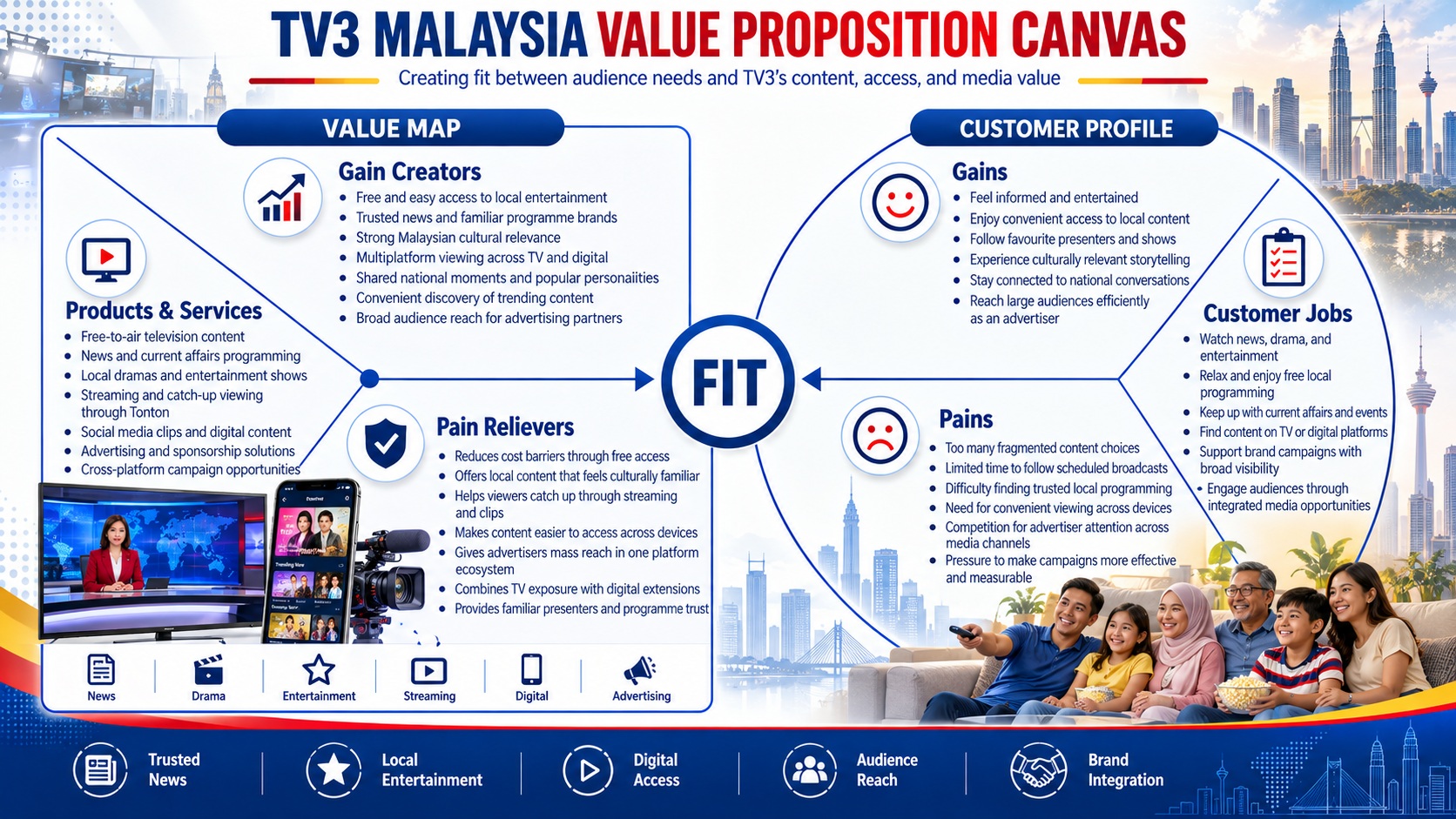
TV3 Value Proposition Canvas
The Value Proposition Canvas provides a more focused view of the needs TV3 addresses for its audiences.
While BMC explains the entire business system, VPC examines the relationship between audience expectations and the programmes, channels and experiences offered.
The TV3 Business Model Canvas becomes easier to understand when TV3’s consumer proposition is separated from its advertiser proposition.
The analysis below focuses primarily on television and digital viewers.
Customer Profile
Modern viewers have considerably more choices than television audiences of earlier decades.
Consumers can watch free television, pay-TV, Netflix, Disney+, YouTube, TikTok, Viu, social creators and numerous other entertainment sources.
Their fundamental requirement is therefore not merely “something to watch.”
They want relevant content available with minimal effort.
Customer Profile of TV3
| Customer Profile |
Details |
| Customer Jobs |
Watch entertainment, follow news, relax, discover local stories, follow favourite celebrities and participate in national cultural moments |
| Customer Pains |
Fixed schedules, repetitive content, excessive advertising, limited personalisation and competition for attention |
| Customer Gains |
Free access, strong local relevance, familiar personalities, popular dramas, timely news and convenient digital viewing |
TV3 must reduce the disadvantages traditionally associated with linear broadcasting without losing its mass-market strengths.
Scheduled television can create shared national moments, yet audiences increasingly expect programmes on demand.
The goal should therefore be complementarity rather than forcing viewers to choose between linear and digital consumption.
Value Map
TV3 responds through a portfolio of broadcast programmes, digital extensions and established content brands.
Local drama creates emotional relevance.
News delivers immediacy and recurring utility.
Entertainment programmes provide shared cultural experiences.
Tonton and digital channels reduce some limitations of fixed television schedules.
Value Map of TV3
| Value Map |
Details |
| Products and Services |
Free-to-air television, dramas, news, current affairs, entertainment programmes, lifestyle content, special events and digital distribution |
| Pain Relievers |
Free access, Tonton availability, programme clips, familiar local formats and multiple viewing touchpoints |
| Gain Creators |
Malaysian storytelling, popular talent, shared national moments, trusted programme brands and cross-platform experiences |
TV3 creates its strongest gains where global platforms are structurally less differentiated.
Netflix can provide international premium drama. YouTube can provide almost unlimited video. TikTok can provide constant algorithmic entertainment.
TV3’s opportunity lies in Malaysian relevance, mass cultural recognition and programmes capable of becoming shared national conversations.
How TV3 Creates Fit
| Customer Profile |
Details |
Matching Value Map |
How TV3 Creates Fit |
| Customer Jobs |
Watch useful and entertaining local content |
Products and Services |
News, drama and entertainment address everyday viewing needs |
| Customer Pains |
Fixed schedules and fragmented attention |
Pain Relievers |
Streaming and digital clips increase accessibility |
| Customer Gains |
Local relevance and shared experiences |
Gain Creators |
Malaysian stories, talent and major programmes create cultural connection |
Value fit improves when TV3 makes its strongest programmes available in the formats viewers prefer.
Weak fit emerges when audiences perceive television content as slower, less convenient or less relevant than digital alternatives.
The long-term opportunity is therefore to preserve TV3’s local identity while eliminating unnecessary distinctions between “television content” and “digital content.”
TV3 vs Astro Ria vs TV1 Business Models
The TV3 Business Model Canvas shares several characteristics with Astro Ria and RTM’s TV1 because all three compete for Malaysian television attention.
Their economics, however, differ substantially.
TV3 is a commercial free-to-air channel supported principally through advertising and related commercial activities.
Astro Ria operates within Astro’s broader subscription and advertising ecosystem. Astro reported 5.2 million TV households and a 71% share of TV viewership in FY2026 across its overall television ecosystem, while subscriptions remain a major source of group revenue.
TV1 operates as RTM’s national channel, with programming spanning news, current affairs, family entertainment, documentaries, religious content and sports.
BMC Block Comparison
| Relevant BMC Block |
TV3 |
Astro Ria |
TV1 |
| Customer Segments |
Mass viewers, advertisers and sponsors |
Subscribers, entertainment viewers, advertisers |
Malaysian public and national audiences |
| Value Proposition |
Free commercial entertainment, news and local relevance |
Premium Malay entertainment within Astro ecosystem |
Public-service news, information and family programming |
| Channels |
Free TV, Tonton and digital platforms |
Pay-TV, Astro GO and connected ecosystem |
Free TV and RTMKlik |
| Revenue Streams |
Mainly advertising, sponsorship and branded content |
Subscription plus advertising within wider Astro model |
Primarily public broadcasting model with permitted commercial activities |
| Key Resources |
TV3 brand, reach, content IP and Media Prima ecosystem |
Content, subscriber relationships and Astro infrastructure |
National broadcaster infrastructure and public-service mandate |
The most important difference lies in the economic relationship with viewers.
TV3 maximises free reach, Astro combines paid customer relationships with advertising, while TV1 serves a broader public-service role.
Competitive Advantages
Several structural strengths continue to support TV3’s competitive position.
- Established national brand: More than four decades of broadcasting have created strong recognition, familiarity and habitual audience relationships that newer digital entrants cannot immediately reproduce.
- Strong Malay audience position: Media Prima reported a 47.3% Malay audience share for TV3 in FY2025, giving the channel significant reach within a commercially important Malaysian audience segment.
- Local content capability: Malaysian dramas, news, personalities and entertainment formats give TV3 cultural relevance that many international streaming platforms must work harder to develop.
- Media Prima ecosystem: Television can connect with Tonton, Primeworks Studios, digital publishing and wider integrated-media capabilities rather than operating as an isolated channel.
- Cross-platform content potential: Successful TV properties can generate television ratings, digital views, social discussion, sponsorship, branded content and future programme extensions from the same underlying intellectual property.
These advantages reinforce one another.
Brand familiarity attracts viewers. Audience scale attracts advertisers. Commercial revenue supports content creation. Successful programmes strengthen the brand again.
The strategic priority is to extend this flywheel into digital media rather than protecting television as a separate legacy business.
Risks and Challenges
Despite its established market position, TV3 operates within a rapidly changing media environment.
- Audience fragmentation: Netflix, YouTube, TikTok, Astro, Viu, social creators and numerous other platforms compete for the same limited consumer attention.
- Advertising migration: Digital advertising platforms provide targeting, attribution and measurable performance tools that can attract budgets historically allocated to television.
- Changing viewing behaviour: Younger and mobile-first audiences increasingly expect personalised, short-form and on-demand content rather than fixed programme schedules.
- Content-cost pressure: High-quality dramas, talent and premium productions can become expensive, creating financial risk when audience performance does not justify expenditure.
- Dependence on sustained relevance: A strong historical brand does not guarantee future loyalty if programmes fail to reflect changing cultural interests, formats and consumption habits.
The largest threat may not be an abrupt collapse of traditional television.
Gradual erosion could be more significant.
If younger viewers watch less TV3, advertisers may redirect budgets. Lower commercial returns could restrict content investment, creating another reason for audiences to migrate.
Preventing that cycle requires TV3 to treat digital transformation as part of its core business model rather than merely another distribution project.
Strategic Recommendations
TV3 should preserve the reach and brand equity of free-to-air broadcasting while progressively redesigning its model around content IP, digital distribution and measurable advertising solutions.
Traditional television remains valuable, but its strongest assets should generate returns across more than one screen.
1. Build Flagship Programmes as Content Franchises
TV3 should design successful programmes for longer economic lives.
A popular drama can generate streaming episodes, social clips, cast interviews, short-form extensions, behind-the-scenes content, branded partnerships and potential sequels.
Reality programmes can create digital voting, live interaction and event opportunities.
Thinking in franchises would allow TV3 to monetise intellectual property rather than continuously treating every programme as an isolated broadcast product.
2. Design Content for TV and Digital Simultaneously
Production workflows should increasingly consider television, Tonton and social media from the beginning.
A sixty-minute programme may still be produced for broadcast, but its strongest moments can be deliberately structured into shorter digital assets.
Vertical video, short-form stories and platform-specific extensions should complement flagship programmes.
This approach can improve reach among audiences who rarely watch conventional television without abandoning existing viewers.
3. Strengthen Tonton Integration Around TV3
TV3 and Tonton should create a deliberate audience journey rather than function as parallel destinations.
Early access, extended endings, catch-up viewing, bonus scenes and digital exclusives can encourage audiences to move between platforms.
Media Prima already demonstrated the potential of early-access viewing through dramas released on Tonton before their television transmission.
Stronger integration would convert TV3 audience loyalty into owned digital relationships.
4. Develop More Measurable Advertising Solutions
Advertising buyers increasingly expect evidence of business outcomes.
TV3 should combine television reach with digital viewing, audience insights and cross-platform campaign measurement wherever appropriate.
A brand campaign could include television spots, programme integration, social clips, Tonton exposure and relevant Media Prima digital assets.
Such packages would make TV3 harder to compare purely on television cost-per-rating metrics and position it as a broader audience solution.
5. Protect News as a Strategic Differentiator
Entertainment is highly competitive, but credible local news creates recurring utility.
TV3 should continue strengthening journalism across television, mobile video, livestreaming and short-form explainers.
Media Prima’s integration of television and newspaper journalistic capabilities provides opportunities to share reporting resources across multiple platforms.
News can therefore function as both a public-value asset and an important daily audience-retention mechanism.
6. Use Data to Improve Content Decisions
Broadcast ratings should remain important, but decision-making can incorporate broader audience signals.
Streaming completion rates, digital video views, social engagement, search behaviour and audience retention can reveal which characters, stories and formats generate genuine interest.
Those insights can support commissioning, scheduling, marketing and sequel decisions.
Data should complement editorial judgement rather than replace it.
7. Make Local Relevance the Core Differentiator
TV3 should avoid competing directly with global platforms on catalogue size.
Netflix will offer more international series. YouTube will provide more video. TikTok will generate more short-form content.
TV3 can instead concentrate on what these competitors cannot easily duplicate: Malaysian stories, national conversations, local celebrities, Bahasa Malaysia programming and culturally specific entertainment.
Deep local relevance provides a clearer strategic position than attempting to become a smaller version of global platforms.
Conclusion
Overall, the TV3 Business Model Canvas explains how Malaysia’s first private television station has developed into a broader content and audience business.
Its basic economic mechanism remains straightforward.
TV3 creates or acquires programming, distributes that content freely to large audiences and converts viewer attention into advertising, sponsorship and other commercial opportunities.
The underlying system is becoming considerably more complex.
Television now interacts with streaming.
Long-form programmes generate short-form digital content.
Advertising increasingly becomes integrated brand storytelling.
Successful programmes become reusable intellectual property rather than one-time broadcasts.
Media Prima’s broader ecosystem creates additional opportunities for TV3 because content can connect with Tonton, production capabilities, news resources, digital media and integrated advertising solutions.
Future competitiveness will therefore depend less on defending traditional television against digital platforms and more on extending TV3’s strongest assets into every relevant format.
Brand recognition, local storytelling, mass reach, familiar talent and cultural relevance remain meaningful advantages.
If those strengths are combined with stronger digital distribution, content-franchise development, advertiser measurement and audience data, TV3 can evolve from a leading television channel into a more resilient Malaysian multiplatform content brand.
Disclaimer
This article is provided solely for educational, informational and business-analysis purposes.
The analysis is based on publicly available information, company disclosures, industry observations and strategic interpretation available at the time of writing.
Nothing contained in this article constitutes financial, investment, legal, regulatory, marketing, advertising, media, technology or other professional advice.
The analysis should not be interpreted as official information, an official statement, endorsement or representation by TV3, Sistem Televisyen Malaysia Berhad, Media Prima Berhad, Astro Malaysia Holdings Berhad, Radio Televisyen Malaysia or any other organisation mentioned.
Business models, financial performance, programmes, audience measurements, technologies, regulations and market conditions can change over time.
Readers should conduct their own research and obtain suitable professional advice before making investment, business or strategic decisions.
All company names, programme names, trademarks, logos, copyrights and other intellectual-property rights belong to their respective owners.
Meta Description
Explore the TV3 Business Model Canvas, including all nine BMC blocks, Value Proposition Canvas, Astro Ria and TV1 comparison, competitive advantages, risks and strategic recommendations for Malaysia’s leading free-to-air television brand.