Mamasab Bakery Business Model Canvas: How Mamasab Builds a Bakery Business Through Agents, Distribution Networks and Brand Loyalty
BMC Article No: BMC #031
Updated in 2026: This article has been comprehensively updated to reflect Mamasab Bakery’s development as part of Mamasab International, including its agent-based selling model, manufacturing capabilities, mini-branch distribution network, product diversification and digital sales opportunities.
The 2026 update also introduces deeper analysis of all nine Business Model Canvas blocks, expanded strategic interpretations, a Value Proposition Canvas, comparison with Secret Recipe and Baker’s Cottage, competitive advantages, risks and challenges, potential business failure scenarios, and recommendations for sustainable growth.
Introduction
Malaysia’s bakery and dessert industry is highly competitive. Traditional bakeries, café chains, independent cake makers, home-based entrepreneurs and online dessert sellers compete for customers across different price points, occasions and distribution channels.
Among these businesses, Mamasab has developed a distinctive approach to selling cakes, desserts and related products.
Founded by Siti Sabrina Sobri, Mamasab began as a home-based cake business in Klang in 2015 before expanding into a broader food and consumer-products enterprise.
Unlike conventional bakery chains that rely heavily on company-operated retail outlets, Mamasab has built a distribution model involving independent agents, dropship sellers, mini-branches and supporting production facilities.
The Mamasab Bakery Business Model Canvas is particularly interesting because the company combines food manufacturing with community-driven distribution and entrepreneurship.
Customers purchase cakes, desserts and other products, while independent sellers help introduce those products to local markets through personal networks and digital channels.
This creates a business model in which the company must deliver value to both consumers and its sales network.
However, the approach also introduces challenges involving product consistency, agent productivity, fulfilment, food safety, inventory management and brand control.
Understanding how these activities fit together provides useful insights into how a bakery brand can grow beyond the limitations of a conventional retail-store model.
What Is Mamasab Bakery’s Business Model?
Mamasab operates primarily through a combination of food production, branded consumer products and a decentralised sales and distribution network.
Its bakery business focuses on cakes, desserts, cookies and related food products, while the wider Mamasab International business has expanded into additional product categories.
The central idea behind the Mamasab Bakery Business Model Canvas is that product manufacturing and customer acquisition do not necessarily need to occur within the same organisation or physical location.
Instead, different participants contribute to the business system.
Three commercial engines support this approach.
First, manufacturing operations produce branded food products that can be distributed across multiple locations.
Second, an independent agent and reseller network helps generate demand, promote products, acquire customers and facilitate transactions.
Third, distribution facilities, mini-branches and digital communication channels connect available products with customers.
For example, an agent may promote a chocolate cake through WhatsApp, receive customer orders and coordinate delivery or collection through an available fulfilment arrangement.
The company benefits from expanded market reach without necessarily establishing a conventional bakery storefront for every local customer community.
Meanwhile, agents gain an opportunity to generate income by marketing and selling established products.
This creates a hybrid business model combining elements of direct-to-consumer retail, wholesale distribution, relationship selling and social commerce.
Its economic sustainability ultimately depends on maintaining sufficient product demand, effective distribution and attractive unit economics for both Mamasab and participating sellers.
What Is Business Model Canvas?
The Business Model Canvas (BMC) is a strategic management framework used to understand how an organisation creates value, delivers value and generates revenue.
It consists of nine interconnected components covering customers, operations, resources, partnerships and financial performance.
For Mamasab, the framework is especially useful because the business involves more than producing and selling cakes.
Manufacturing, entrepreneurship, distribution logistics, customer relationships and brand development must work together.
| BMC Block |
Main Question |
| Customer Segments |
Who does Mamasab serve? |
| Value Propositions |
What benefits do customers and agents receive? |
| Channels |
How do products reach customers? |
| Customer Relationships |
How does Mamasab encourage trust and repeat purchases? |
| Revenue Streams |
How does the business generate income? |
| Key Resources |
Which assets support its business model? |
| Key Activities |
What must Mamasab continuously perform? |
| Key Partnerships |
Which partners strengthen operations and distribution? |
| Cost Structure |
What are the main expenses involved? |
Analysing these blocks separately provides useful insights, but their relationships are equally important.
An extensive distribution network creates little economic value without products customers want to buy. Similarly, strong customer demand may not produce sustainable profits if manufacturing and fulfilment costs become excessive.
Quick Overview of Mamasab Bakery
Mamasab’s origins can be traced to 2015, when its founder began producing and selling cakes from home.
The business subsequently expanded through a distribution approach that placed considerable emphasis on agents, independent entrepreneurship and local market participation.
Mamasab International Sdn Bhd, formerly associated with the Sabrina Bakery name, operates a broader portfolio than bakery products alone.
Its corporate website describes manufacturing facilities, mini-branches and operations extending across Malaysia and Singapore.
As of the information publicly presented in 2026, the corporate website describes six main factories and approximately 200 mini-branches. These figures should be understood as company-published information rather than independently audited operational statistics.
The Mamasab Bakery Business Model Canvas therefore needs to be viewed within this larger corporate and distribution ecosystem.
Bakery products provide a recognisable consumer offering, while the broader business gains commercial flexibility through multiple product categories and sales channels.
This distinction matters because the strategy is not identical to that of a conventional bakery chain.
Rather than measuring growth solely through retail outlets, the business must also consider its active sales network, product availability, customer retention, distribution efficiency and contribution margin.
Why Mamasab Bakery Is Strategically Interesting
Mamasab demonstrates how a food business can use a distributed network to reach customers without relying exclusively on traditional retail expansion.
A conventional bakery typically needs to attract customers to its physical outlets or official ordering channels.
Mamasab’s model allows independent sellers to participate in market development.
These individuals can introduce products to neighbourhood groups, colleagues, families, online communities and local customers.
The Mamasab Bakery Business Model Canvas illustrates how relationship-based selling can function as an alternative customer-acquisition strategy.
Its network also provides a potential feedback mechanism.
Agents may observe changes in customer preferences, identify popular products and communicate local demand patterns.
However, a large network does not automatically guarantee commercial success.
The number of registered sellers may differ substantially from the number of active, productive agents.
Successful scaling therefore requires more than recruitment.
It demands sustainable consumer demand, competitive products, reliable fulfilment, appropriate seller incentives and disciplined operational management.
The strategic lesson is that network expansion creates value only when the underlying economics remain attractive.
Latest Developments: What Is Changing Around Mamasab Bakery?
Several developments are relevant to assessing Mamasab’s business model in 2026.
First, the wider organisation has established a larger operational footprint than its original home-bakery model.
Its corporate materials describe multiple production facilities and an extensive mini-branch network, reflecting the importance of manufacturing and local distribution.
Second, digital commerce continues to reshape how consumers discover and purchase food products.
Social media, messaging applications and online ordering create opportunities for agents to serve customers without operating traditional shops.
Third, the bakery industry faces increasing pressure to maintain product quality, freshness and consistent customer experiences.
Consumers can compare offerings from established bakery chains, home-based sellers and online dessert brands.
Fourth, rising operating costs can influence the profitability of food manufacturers and distributors.
Ingredients, labour, utilities, packaging, transport and temperature-controlled logistics may all affect margins.
Finally, data-driven management is becoming increasingly important.
For Mamasab, tracking active agents, repeat purchases, sales by product, stock availability and fulfilment performance could provide better insight into sustainable growth.
These developments suggest that future competitiveness will depend on operational discipline as much as distribution scale.
Mamasab Bakery Business Model Canvas Summary
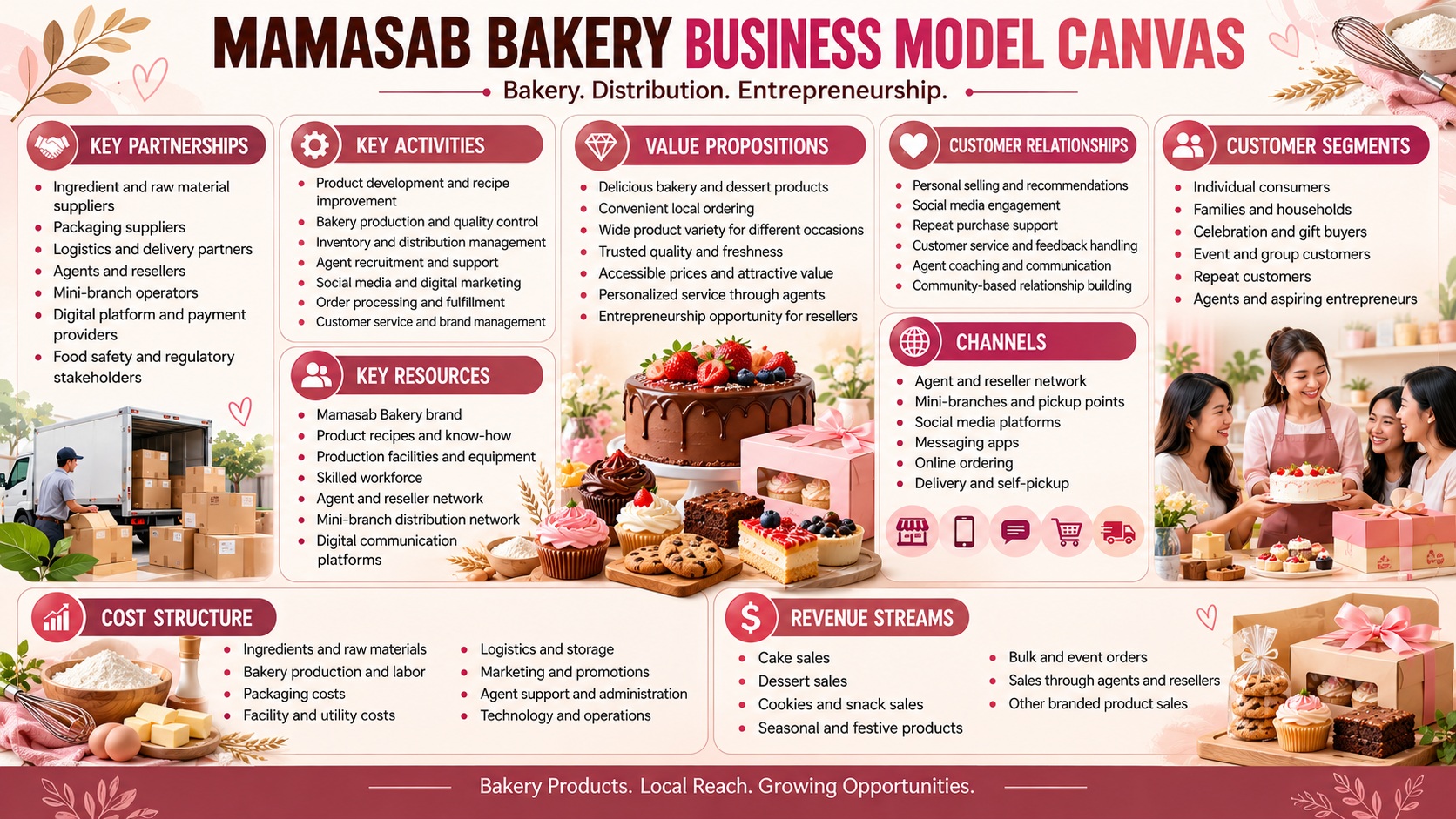
The Mamasab Bakery Business Model Canvas can be summarised as a food manufacturing and distribution business supported by independent agents, local fulfilment arrangements and customer relationships.
| BMC Block |
Mamasab Bakery Application |
| Customer Segments |
Individual consumers, families, gift buyers, event customers, agents and resellers |
| Value Propositions |
Accessible branded cakes and desserts, product variety, convenient ordering and entrepreneurship opportunities |
| Channels |
Agent network, mini-branches, social media, messaging platforms, online ordering and delivery |
| Customer Relationships |
Personalised selling, social engagement, repeat purchases, agent support and customer service |
| Revenue Streams |
Product sales through consumer-facing and distribution channels |
| Key Resources |
Brand, recipes, production facilities, workforce, distribution infrastructure and sales network |
| Key Activities |
Manufacturing, product development, quality control, marketing, distribution and network management |
| Key Partnerships |
Agents, resellers, ingredient suppliers, packaging vendors, logistics providers and technology partners |
| Cost Structure |
Ingredients, labour, production, facilities, packaging, logistics, marketing and network support |
Mamasab Bakery BMC Diagram
A complete BMC diagram should show how Mamasab’s production capabilities connect with its distribution network and end customers.
At the centre of the system is the value proposition of accessible branded bakery and dessert products.
Manufacturing converts ingredients and recipes into finished products. The distribution network creates market access, while agents and digital channels support customer acquisition.
Sales revenue then funds production, infrastructure, operations and business development.
The most important strategic relationship is between product demand, distribution productivity and operational efficiency.
BMC Analysis of Mamasab Bakery
The detailed Mamasab Bakery Business Model Canvas reveals that the company’s competitive position depends on coordinating several different capabilities.
The manufacturing function must maintain product quality and availability.
Sales channels need to create demand and communicate accurately with customers.
Distribution operations must preserve product condition, manage inventory and fulfil orders reliably.
Agent support must encourage sustainable sales activity rather than simply increasing registrations.
These activities are economically connected.
A successful product launch can increase demand across the network, but insufficient production capacity may generate shortages.
Additional agents can expand market coverage, yet geographical overlap may reduce sales opportunities for individual sellers.
Similarly, introducing more products may attract customers while increasing operational complexity and inventory risks.
The following sections examine how these trade-offs influence the nine BMC blocks.
1. Customer Segments
Mamasab serves multiple customer groups with different purchasing motivations.
Individual consumers may purchase cakes and desserts for personal consumption, family gatherings or everyday treats.
Celebration customers purchase products for birthdays, special occasions and gifts.
Meanwhile, agents and resellers form an additional strategic group because their activities influence the company’s ability to reach consumers.
The Mamasab Bakery Business Model Canvas therefore includes both end customers and distribution participants.
Mamasab Bakery Customer Segments
| Customer Segment |
Details |
Why It Matters |
| Individual consumers |
Customers purchasing cakes and desserts |
Supports recurring product demand |
| Families and households |
Buyers purchasing food for sharing and gatherings |
Encourages multiple-item purchases |
| Celebration and gift buyers |
Birthdays, festive occasions and special events |
Creates occasion-based sales |
| Corporate and group customers |
Offices, teams and organisations purchasing in volume |
Offers larger-order potential |
| Agents and resellers |
Independent sellers promoting and distributing products |
Expands customer reach |
The most important distinction is between end consumers and agents.
Consumers determine whether the products create genuine market demand, while agents influence how effectively the business captures that demand.
Both groups require different value propositions.
Customers generally prioritise taste, price, quality and convenience. Agents may place greater importance on selling opportunities, fulfilment reliability, training and the attractiveness of available products.
A sustainable strategy must therefore evaluate more than total sales.
Customer retention, average order value, active-agent productivity and geographic demand should also be measured.
The central challenge is avoiding an imbalance in which the organisation focuses excessively on recruiting agents while giving insufficient attention to repeat consumer purchases.
2. Value Propositions
Mamasab offers a combination of food products, purchasing convenience and participation opportunities for independent sellers.
For consumers, the value proposition centres on accessible bakery products, product selection and the ability to purchase through local representatives or other available channels.
For agents, the business provides access to established products and a sales system that can reduce some of the barriers associated with starting an independent food business.
The Mamasab Bakery Business Model Canvas becomes more distinctive when both propositions are evaluated together.
Mamasab Bakery Value Propositions
| Value Proposition |
Details |
Why It Matters |
| Branded bakery products |
Cakes, desserts and related food offerings |
Builds customer recognition |
| Product accessibility |
Local sales representatives and distribution points |
Reduces purchasing friction |
| Product variety |
Multiple flavours and product categories |
Supports different occasions and preferences |
| Relationship-based buying |
Customers can purchase through familiar agents |
Encourages trust and repeat purchases |
| Entrepreneurship opportunities |
Agents can market established products |
Expands participation in the sales network |
Mamasab’s offering is not based solely on the physical cake or dessert.
Convenience and availability contribute substantially to perceived customer value.
A customer who can obtain a suitable cake through a trusted local seller may choose that option over travelling to a distant bakery.
Nevertheless, the products must remain competitive on their own merits.
Convenient ordering cannot permanently compensate for inconsistent taste, poor freshness or weak value for money.
The agent proposition introduces another requirement: sellers must be able to generate worthwhile returns from their efforts.
Long-term differentiation therefore requires attractive products, dependable supply and a commercially viable distribution network.
3. Channels
Mamasab uses a combination of physical and digital channels to reach its customers.
Instead of relying exclusively on conventional retail traffic, the business can generate orders through independent sales representatives, online communication and local fulfilment points.
This approach potentially expands market coverage while limiting the need for equivalent company-operated retail footprints.
Mamasab Bakery Channels
| Channel |
Details |
Why It Matters |
| Agent and reseller network |
Independent sellers promote products and receive orders |
Provides distributed market coverage |
| Mini-branches and distribution points |
Local product availability and fulfilment |
Supports geographic accessibility |
| Social media |
Product promotion and customer engagement |
Generates awareness and enquiries |
| Messaging applications |
Customer communication and order coordination |
Enables personalised selling |
| Online ordering |
Digital catalogues and purchasing interfaces |
Improves ordering convenience |
| Delivery and collection |
Products reach customers through available fulfilment options |
Completes the customer journey |
The distribution model offers an opportunity to serve customers across different locations without depending entirely on foot traffic.
However, additional channels can also create complexity.
A customer may receive different product information, pricing, availability updates or service quality depending on the seller involved.
This inconsistency can undermine brand trust.
Mamasab therefore needs coordinated product catalogues, accurate stock information, consistent ordering processes and clear service standards.
The most valuable channel is not necessarily the one generating the highest gross sales.
Management should evaluate contribution margins, fulfilment costs, customer acquisition efficiency and repeat purchases across each channel.
4. Customer Relationships
Mamasab’s relationship model combines consumer loyalty with personal interaction through its sales network.
Agents can maintain direct contact with customers, share promotions and recommend products suited to particular occasions.
Digital communication allows these interactions to continue after the first purchase.
Meanwhile, the company’s relationship with its agents influences product representation and sales productivity.
Mamasab Bakery Customer Relationships
| Relationship Type |
Details |
Why It Matters |
| Personal selling |
Agents interact directly with customers |
Builds familiarity and trust |
| Repeat purchasing |
Existing customers buy products for new occasions |
Improves customer lifetime value |
| Social engagement |
Promotions, product updates and customer content |
Maintains brand visibility |
| Agent coaching |
Training and guidance for independent sellers |
Supports network effectiveness |
| Customer service |
Order enquiries, feedback and issue resolution |
Protects satisfaction |
| Community participation |
Connections among customers and sellers |
Supports recommendations and referrals |
Relationship-based selling can be particularly effective in local markets where customers value familiar sellers and convenient communication.
Nevertheless, personal relationships create a degree of dependency.
If an agent becomes inactive, switches brands or provides poor service, customer access and satisfaction may deteriorate.
A stronger model would combine agent relationships with company-level customer intelligence, supported by appropriate privacy safeguards.
For example, a structured loyalty programme could recognise repeat purchases without removing agents from the customer journey.
The strategic priority should be building loyalty to both the seller and the Mamasab brand.
That combination would provide greater resilience than relying exclusively on individual sales relationships.
5. Revenue Streams
Revenue is generated principally through selling branded products to customers via the business’s available sales and distribution arrangements.
The precise accounting treatment may depend on whether the company sells directly to consumers or supplies products through agents and resellers.
Public information does not establish the current revenue contribution of each individual channel.
Consequently, the Mamasab Bakery Business Model Canvas should distinguish identifiable revenue mechanisms from potential future opportunities.
Mamasab Bakery Revenue Streams
| Revenue Stream |
Details |
Strategic Significance |
| Cake sales |
Revenue from branded cake products |
Core consumer demand |
| Desserts and cookies |
Sales across additional bakery categories |
Supports product variety |
| Reseller channel sales |
Products supplied or sold through distribution arrangements |
Expands geographic reach |
| Seasonal product sales |
Purchases linked to festive and celebration periods |
Creates demand peaks |
| Group and bulk orders |
Larger purchases for gatherings or organisations |
May improve order economics |
| Other branded products |
Additional categories within the wider Mamasab business |
Provides potential diversification |
Revenue growth depends on more than increasing sales volume.
A company selling through intermediaries must account for the economics of the entire distribution chain.
Agent earnings, promotional discounts, packaging, transport, production costs and product wastage can all influence profitability.
For instance, a high-volume product may generate relatively weak contribution margins if production is costly or fulfilment is inefficient.
Management should therefore monitor gross margin by product, contribution margin by channel and the economic performance of repeat customers.
Increasing revenue without improving these underlying economics could create a larger but less profitable business.
6. Key Resources
Mamasab’s most important resources include its brand identity, product portfolio, manufacturing capabilities and distribution network.
Unlike a traditional bakery whose primary assets may be kitchen equipment and physical storefronts, a network-led operation requires supporting infrastructure across several functions.
The Mamasab Bakery Business Model Canvas highlights how intangible resources and physical assets must work together.
Mamasab Bakery Key Resources
| Key Resource |
Details |
Why It Matters |
| Brand reputation |
Consumer recognition and perceived reliability |
Influences purchasing decisions |
| Recipes and product development |
Product formulations and preparation knowledge |
Supports differentiation |
| Manufacturing facilities |
Production equipment and operational capacity |
Enables supply |
| Skilled workforce |
Production, quality, logistics and management personnel |
Maintains execution quality |
| Agent and reseller network |
Independent market-facing sellers |
Extends sales reach |
| Distribution infrastructure |
Facilities, stock management and fulfilment capability |
Supports product availability |
| Digital systems |
Ordering, communication and business reporting |
Improves coordination |
The agent network is particularly important because it provides market access that competitors cannot necessarily recreate immediately.
However, the network’s value depends on participation and productivity rather than registration numbers alone.
Manufacturing capacity represents another strategic resource.
Greater production capability can support growth, but underutilised facilities may increase fixed costs.
Similarly, brand reputation can improve customer acquisition efficiency but remains vulnerable to product and service failures.
Long-term competitiveness requires Mamasab to invest in assets that improve both customer value and operational efficiency.
7. Key Activities
Mamasab must coordinate activities extending from product development to customer fulfilment.
Food production remains central, but commercial success also requires marketing, distribution, agent management and continuous operational improvement.
Mamasab Bakery Key Activities
| Key Activity |
Details |
Why It Matters |
| Product development |
Designing and refining bakery products |
Maintains customer appeal |
| Food manufacturing |
Producing cakes and related products |
Generates saleable inventory |
| Quality and food-safety management |
Controlling production standards and handling |
Protects consumers and reputation |
| Sales and marketing |
Promoting products and generating demand |
Supports revenue |
| Agent development |
Recruitment, training and performance support |
Strengthens channel effectiveness |
| Inventory and distribution |
Planning stock and coordinating fulfilment |
Improves availability |
| Business analytics |
Reviewing sales, costs and performance |
Supports better decisions |
The most significant operational challenge involves synchronising demand generation with production and distribution.
Strong promotional campaigns may generate large order volumes, particularly during festive seasons.
If production capacity or inventory visibility is insufficient, order fulfilment may deteriorate.
Conversely, excessive production can create waste, particularly for perishable goods.
Effective demand forecasting is therefore essential.
Information from agent orders, historical purchasing patterns and seasonal trends could help guide manufacturing schedules.
A more disciplined operating model would allow Mamasab to reduce unnecessary stock while maintaining reliable product availability.
The objective is to convert sales-network reach into profitable and consistently fulfilled customer demand.
8. Key Partnerships
External partnerships play an important role in supporting Mamasab’s operations.
The business depends on relationships across raw materials, packaging, distribution, technology and market access.
Independent agents are particularly important because they influence both customer acquisition and product availability.
Mamasab Bakery Key Partnerships
| Key Partner |
Details |
Why It Matters |
| Agents and resellers |
Independent product sellers |
Supports sales distribution |
| Ingredient suppliers |
Sources of baking materials and food inputs |
Maintains production continuity |
| Packaging suppliers |
Food packaging, labelling and presentation materials |
Protects products and brand image |
| Logistics providers |
Transportation and delivery support |
Enables fulfilment |
| Technology providers |
Ordering, communication and management systems |
Improves coordination |
| Commercial partners |
Potential corporate buyers and distribution collaborators |
Creates market opportunities |
Partnership quality directly influences customer experience.
For example, a reliable packaging supplier helps preserve product presentation during delivery.
Likewise, effective logistics support reduces the likelihood of damaged or delayed orders.
Agent relationships require particular attention because independent participants may have different operating standards and commercial priorities.
Clear product information, pricing policies, training and service expectations can reduce inconsistency.
Supplier diversification is another important consideration.
Excessive dependency on a small number of ingredient or packaging vendors could create operational vulnerability.
Ultimately, partnership management should prioritise reliability, commercial sustainability and customer experience rather than simply maximising the number of participating businesses.
9. Cost Structure
Mamasab’s cost structure combines food manufacturing expenses with distribution, marketing and organisational support.
Product costs are influenced by ingredients, packaging, labour and production efficiency.
Meanwhile, the wider network creates additional requirements for logistics, technology, customer service and agent development.
Mamasab Bakery Cost Structure
| Cost Category |
Details |
Strategic Implication |
| Ingredients |
Flour, dairy, chocolate, sugar and other materials |
Influences product margins |
| Manufacturing labour |
Production and operational workforce |
Affects unit production costs |
| Facilities and utilities |
Factory operations, maintenance and energy |
Creates fixed and variable expenses |
| Packaging |
Containers, labels and protective materials |
Affects product presentation and cost |
| Logistics and storage |
Transport, distribution and inventory handling |
Determines fulfilment efficiency |
| Marketing and network support |
Campaigns, training and sales administration |
Supports demand generation |
| Technology and administration |
Systems, personnel and organisational functions |
Enables operational coordination |
Cost management becomes increasingly important as production and distribution networks expand.
Large facilities may provide economies of scale when operating near efficient utilisation levels.
However, fixed manufacturing expenses can become burdensome if demand falls below expectations.
Food businesses also face wastage risks arising from overproduction, spoilage and unsold inventory.
Distribution further complicates the economics.
Products requiring careful handling or temperature control may be more expensive to serve across distant locations.
The most useful financial metric is therefore not total revenue alone.
Contribution margin after production, distribution and channel-related expenses offers a better view of economic performance.
Sustainable growth requires Mamasab to manage costs across the entire value chain while preserving product quality.
Mamasab Bakery Value Proposition Canvas
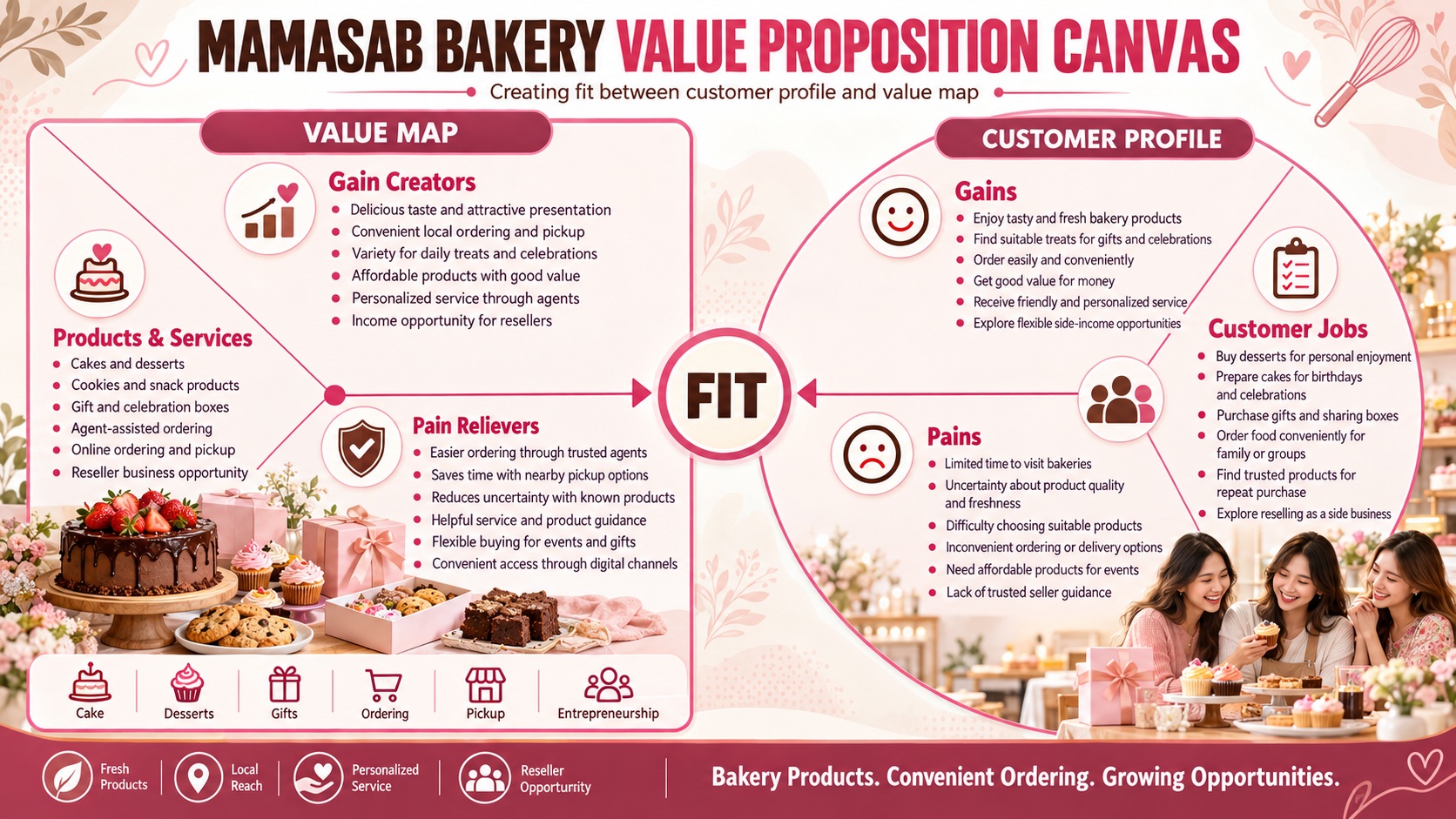
The Value Proposition Canvas (VPC) examines how a business’s products and services address customer needs.
While the BMC evaluates the overall commercial system, VPC focuses on how well the company’s offering matches the jobs, pains and gains of its target customers.
For the Mamasab Bakery Business Model Canvas, the primary consumer segment consists of individuals and households purchasing cakes and desserts.
A separate VPC could also be developed for agents because their commercial motivations differ from those of consumers.
Customer Profile
The customer profile identifies what customers want to accomplish, the problems they encounter and the benefits they expect.
| Customer Profile |
Details |
| Customer Jobs |
Purchase cakes and desserts, celebrate occasions, share food with family, give gifts and satisfy cravings |
| Customer Pains |
Inconvenient store locations, limited availability, unsuitable prices, delivery problems, uncertain freshness and inconsistent quality |
| Customer Gains |
Good taste, accessible prices, convenient ordering, dependable fulfilment, attractive presentation and product variety |
Customers are not simply purchasing ingredients assembled into a dessert.
They may be buying convenience, enjoyment, celebration or the ability to share something appealing with others.
For example, a birthday customer values a cake that looks attractive, arrives on time and meets expectations.
A repeat household buyer may prioritise affordability, taste and easy access.
These differences should influence product design and channel strategy.
Value Map
The value map explains how the business attempts to satisfy those customer requirements.
| Value Map Component |
Mamasab Bakery Application |
| Products and Services |
Cakes, desserts, cookies and related branded food offerings |
| Pain Relievers |
Agent-assisted ordering, local distribution, product variety and convenient purchasing channels |
| Gain Creators |
Recognisable products, accessible selection, sharing occasions, promotional offers and personalised recommendations |
The most important consideration is the alignment between the company’s offering and actual customer expectations.
If customers prioritise convenience, ordering and fulfilment processes must remain reliable.
When taste and freshness drive repeat purchases, manufacturing quality becomes more important than promotional frequency.
For occasion-based customers, packaging and delivery accuracy can strongly influence satisfaction.
Value Proposition Fit
A strong value proposition exists when customers consistently receive the benefits they expect.
Mamasab’s distribution network creates an opportunity to make bakery products more accessible through familiar local sellers.
However, accessibility must be supported by quality and reliability.
Poor product condition, inconsistent information or failed deliveries can weaken the perceived value of convenience.
The company should therefore measure repeat purchases, complaints, product satisfaction and fulfilment accuracy.
These indicators provide evidence of whether its value proposition remains competitive.
For agents, value proposition fit requires a separate assessment of earning opportunities, selling effort, product availability and operational support.
Mamasab Bakery vs Secret Recipe vs Baker’s Cottage Business Models
Mamasab competes within a market that includes established bakery and dessert brands offering overlapping products but operating through different commercial structures.
Two useful comparisons are Secret Recipe and Baker’s Cottage.
Secret Recipe is well known for its cakes, cafés and restaurant-style customer experience.
Baker’s Cottage competes through bakery products, physical retail distribution and convenient food offerings.
Mamasab differs through its emphasis on distributed selling and agent-supported market access.
Rather than comparing every BMC block, the most useful comparison focuses on the elements that explain these strategic differences.
BMC Block Comparison
| Relevant BMC Block |
Mamasab Bakery |
Secret Recipe |
Baker’s Cottage |
| Customer Segments |
Dessert customers, families, celebration buyers and agents |
Café customers, cake buyers, families and diners |
Bakery shoppers, households and convenience-oriented consumers |
| Value Proposition |
Branded desserts, convenient local ordering and seller participation |
Cakes, meals, café experience and established brand familiarity |
Accessible bakery products and convenient food purchases |
| Channels |
Agents, mini-branches, digital selling and distribution points |
Café and retail outlets, takeaway and delivery |
Physical bakery outlets, takeaway and available ordering channels |
| Customer Relationships |
Personal selling, repeat customers and agent support |
In-store experience, service and brand loyalty |
Retail convenience, everyday purchasing and repeat visits |
| Key Resources |
Manufacturing facilities, brand and agent network |
Brand, recipes, outlets, operations and service infrastructure |
Production capabilities, outlet network and supply chain |
| Cost Structure |
Manufacturing, agent-channel economics, distribution and network support |
Retail occupancy, labour, food production and restaurant operations |
Production, physical retail operations, distribution and labour |
The main strategic distinction concerns the route to market.
Secret Recipe creates substantial customer value through its café and restaurant environment.
Baker’s Cottage places significant emphasis on physical retail accessibility and convenient bakery purchases.
Mamasab can serve local markets through individuals who promote and facilitate sales without requiring every customer interaction to occur in a conventional bakery outlet.
This difference may provide advantages in geographic reach and community-based customer acquisition.
However, physical retail competitors can exercise more direct control over their in-store experience.
Mamasab’s long-term competitive position therefore depends on converting network reach into consistent product quality, strong customer loyalty and efficient fulfilment.
Competitive Advantages
Mamasab possesses several potential competitive advantages arising from its operating model.
- Agent-driven market reach: Independent sellers can introduce products across local communities, increasing distribution coverage without requiring an equivalent number of conventional retail outlets.
- Established brand identity: Recognition of the Mamasab name may help agents introduce products and encourage customers to consider new offerings.
- Manufacturing capabilities: Production infrastructure provides greater potential control over product development, manufacturing processes and supply availability.
- Relationship-based customer acquisition: Personal recommendations and community interactions may support trust, referrals and repeat purchases.
- Distribution and product flexibility: A combination of agents, mini-branches and multiple product categories creates opportunities to reach different customer groups and purchasing occasions.
These advantages become more valuable when supported by consistent execution.
An extensive network can improve accessibility, but it must generate productive and profitable sales.
Similarly, manufacturing capacity can support growth only when demand is sufficient to justify operating expenses.
The strongest competitive advantage may emerge from combining reliable products with a productive distribution network.
Competitors can introduce similar cakes or desserts relatively quickly.
Replicating a trusted brand, coordinated manufacturing operations and an effective local selling network may be more difficult.
Risks and Challenges
Despite its growth opportunities, Mamasab faces several risks inherent in the bakery and distribution business.
- Agent productivity and retention: A large number of registered agents does not guarantee consistent sales, while inactive sellers or high turnover can weaken distribution effectiveness.
- Product quality and food safety: Manufacturing inconsistencies, improper handling, spoilage or delivery failures could damage customer confidence and brand reputation.
- Cost and margin pressure: Rising ingredient prices, wages, energy expenses and logistics costs can reduce profitability even when revenue grows.
- Channel inconsistency and competition: Different sellers may create inconsistent customer experiences, while competing agents, bakeries and dessert brands can place pressure on prices.
- Inventory and operational complexity: Product variety, seasonal demand, multiple distribution locations and perishable stock can increase wastage and reduce operating efficiency.
The most significant strategic risk is that network expansion outpaces underlying consumer demand and operational capability.
Under such circumstances, the business could experience higher support costs, lower agent productivity and inventory inefficiencies.
This situation might not immediately appear problematic if headline sales continue increasing.
However, weakening contribution margins and declining repeat purchases could indicate deterioration in the underlying model.
Sustainable expansion requires careful monitoring of both commercial demand and operational performance.
How Could Mamasab Bakery’s Business Model Fail?
Business models rarely fail because of a single isolated weakness.
More commonly, several interconnected problems emerge and reinforce one another.
For Mamasab, a plausible failure scenario would begin with slowing consumer demand.
If fewer customers make repeat purchases, agents may find products increasingly difficult to sell.
Lower productivity could then reduce agent participation or encourage sellers to promote competing products.
As channel performance weakens, production facilities and distribution infrastructure may become underutilised.
Fixed costs would become more difficult to absorb, potentially reducing profitability.
Management might respond with aggressive promotions or increased agent recruitment, but these actions would not necessarily solve the underlying problem of weak customer demand.
The situation could become more serious if discounting reduces margins while operational costs remain high.
A second potential failure mechanism involves quality control.
Product or fulfilment problems could undermine brand reputation across an interconnected network.
Negative customer experiences may spread rapidly through the same social channels used for marketing.
The principal lesson is that network scale cannot compensate indefinitely for weak product economics or declining consumer trust.
Mamasab must preserve the fundamental relationship between product value, customer demand, seller productivity and operational efficiency.
Strategic Recommendations
Mamasab has an opportunity to strengthen its position by improving the productivity, profitability and resilience of its existing business model.
Future growth should not be evaluated solely through the number of agents, products, branches or factories.
Instead, strategic priorities should focus on customer loyalty, operating efficiency, sustainable distribution economics and differentiated products.
The following recommendations are strategic proposals based on the business-model analysis rather than statements of the company’s announced plans.
1. Prioritise Active Agent Productivity Over Network Size
Mamasab should place greater emphasis on active and productive sellers rather than total agent registrations.
Useful indicators include active-agent ratios, average sales per active agent, repeat-order contribution and seller retention.
For example, improving monthly sales among existing agents may deliver greater financial returns than recruiting large numbers of new participants who subsequently become inactive.
Training, product knowledge and sales-support tools should target measurable commercial improvements.
2. Strengthen Direct Customer Loyalty
A distributed sales model benefits from personal relationships, but the company should also develop stronger brand-level customer loyalty.
A structured loyalty programme could recognise repeat purchases and encourage customers to explore additional products.
Customer feedback, collected with suitable privacy safeguards, could reveal purchasing preferences and product-quality concerns.
Such information would help Mamasab strengthen customer retention while continuing to support agent participation.
3. Improve Demand Forecasting and Inventory Management
Bakery products create inventory risks because freshness and shelf life influence saleability.
Mamasab should use historical sales, seasonal demand patterns and distribution-level information to improve production planning.
Better forecasting could reduce overproduction and stock shortages.
For example, festive demand forecasts could combine prior sales patterns with confirmed agent orders.
Performance should be measured through product availability, wastage rates, inventory turnover and fulfilment accuracy.
4. Protect Product Quality Across the Distribution Network
Consistent quality is essential for a distributed bakery business.
The company should standardise handling requirements, delivery processes, product information and complaint resolution procedures.
Particular attention should be given to products that require temperature control or careful transportation.
Agent education should cover food handling and customer communication, not only sales techniques.
These measures would help ensure that consumers receive a consistent experience regardless of purchasing channel.
5. Develop Data-Driven Product Portfolio Management
A broad product catalogue can attract different customer groups but may also increase manufacturing and inventory complexity.
Mamasab should evaluate products according to sales volume, contribution margin, repeat-purchase frequency and operational requirements.
High-performing core products deserve strong availability and marketing support.
Lower-performing items should be reviewed for improvement, repositioning or discontinuation.
New products could be tested through selected agent groups before wider distribution.
This approach would reduce the risk of introducing unnecessary complexity.
6. Expand Digital Commerce Without Undermining Agents
Digital ordering offers an opportunity to improve the customer experience and simplify sales administration.
A more integrated system could provide updated product catalogues, stock visibility, ordering functions and fulfilment information.
Rather than competing with agents, the system could attribute orders to participating sellers or facilitate local fulfilment.
For example, a customer could place an order digitally while selecting a preferred local agent or collection point.
The objective should be to reduce transaction friction while preserving the strengths of relationship-based selling.
7. Establish Stronger Unit Economics and Performance Reporting
Management should monitor profitability across products, channels and geographic markets.
Revenue growth alone is not sufficient to determine whether expansion creates economic value.
Important measurements include contribution margin, production cost per unit, distribution cost per order, agent productivity and product wastage.
Factory utilisation should also be evaluated against demand and operating expenses.
These indicators would help identify which parts of the business deserve additional investment and which require corrective action.
A disciplined financial management approach would support more sustainable expansion.
Conclusion
The Mamasab Bakery Business Model Canvas demonstrates how a home-based bakery concept can develop into a broader manufacturing and distribution business built around branded products, independent sellers and local market access.
Its underlying economic model is relatively straightforward.
The company develops and manufactures products, uses its distribution infrastructure and sales network to reach customers, and generates revenue through product sales.
However, the operational requirements behind this model are considerably more complex.
Manufacturing facilities must maintain product quality and availability.
Distribution arrangements need to preserve freshness and deliver products efficiently.
Agents must continuously generate demand and provide satisfactory customer experiences.
Meanwhile, the company must manage operating costs, protect its brand and ensure that products remain attractive in a competitive food market.
Mamasab’s model is strategically different from bakery businesses that depend primarily on physical retail outlets or café experiences.
Its independent selling network creates opportunities for market penetration and community-based customer acquisition.
Nevertheless, the model’s long-term performance cannot be judged solely by the size of that network.
The productivity of active sellers, repeat purchases by end consumers and the profitability of each distribution channel are more meaningful indicators of sustainable success.
Another important consideration is manufacturing efficiency.
Greater production capacity may support economies of scale, but only when product demand is sufficient to utilise the facilities effectively.
If growth is pursued without proper inventory planning, quality control and cost management, operational complexity could erode the benefits of expansion.
Digital commerce and data analytics offer additional opportunities to strengthen the model.
Better ordering systems, customer insights, forecasting and agent performance reporting could improve coordination across the value chain.
However, technology should support the existing competitive strengths rather than eliminate the personal relationships that make the distribution model distinctive.
Ultimately, Mamasab’s future competitiveness will depend on its ability to combine product quality, customer loyalty, effective distribution and disciplined financial management.
Disclaimer
This article is provided solely for educational, informational and business-analysis purposes. It is based on publicly available information, general industry observations and independent strategic interpretation.
The content is not official information, a statement, endorsement or representation issued by Mamasab International Sdn Bhd, Mamasab Bakery, Secret Recipe, Baker’s Cottage or any other company mentioned.
Nothing in this article constitutes financial, investment, legal or professional advice. It should not be considered an investment recommendation or relied upon as the sole basis for business or financial decisions.
Business strategies, products, operating arrangements, financial results and market conditions may change over time. Readers should conduct their own research and seek appropriate professional advice where necessary.
All trademarks, logos, copyrights, company names, product names and related intellectual-property rights belong to their respective owners. Any reference to these names or materials is used for identification, commentary, educational and analytical purposes only.
Meta Description
Explore the Mamasab Bakery Business Model Canvas, nine BMC blocks, Value Proposition Canvas, competitor comparison, risks and recommendations. Updated 2026.