CARPUT Business Model Canvas
Explore the CARPUT Business Model Canvas, nine BMC blocks, Value Proposition Canvas, competitor comparison, competitive advantages, risks and strategic recommendations.
BMC Analysis of Indofood: A Business Model Canvas (BMC) analysis of Indofood using the interconnected 9 blocks. Indomie, a leading instant noodle brand, is the brainchild of PT Indofood CBP Sukses Makmur Tbk, a subsidiary of Indofood, one of the largest food companies in Indonesia.
BMC Article No: BMC #034
Updated in 2026: This article has been rewritten with a stronger business story, clearer Business Model Canvas structure, dedicated latest developments section, and a sharper strategic view of how Indomie supports Indofood’s consumer branded products business.
Indomie is more than an instant noodle brand. Across many markets, it has become a pantry staple, student meal, comfort food, export product, and cultural icon. That is why the Indofood business model canvas is worth studying. It shows how one packet of noodles can become a global business system.
Its advantage does not come from taste alone. Real strength comes from affordability, distribution, production scale, local flavour adaptation, brand memory, and repeat consumption. A customer may buy one packet for a quick meal. Families may buy multipacks for household stock. Overseas consumers may buy it as a familiar taste of Indonesia.
This article breaks down the Indofood business model canvas through Indomie. We will examine how Indofood creates value, reaches customers, generates revenue, manages cost, and protects its leadership in the instant noodle market.
Indofood’s business model through Indomie is built around high-volume consumer packaged food. The company produces affordable instant noodles at scale, distributes them through traditional stores, modern retail, e-commerce channels, and international markets, then reinforces demand through branding and product innovation.
Scale is the main strength. Indomie benefits from large production capacity, deep distribution, strong brand equity, and frequent repeat purchases.
Cost pressure is the main challenge. Wheat, palm oil, packaging, energy, logistics, and exchange rates can affect margins. Since instant noodles are price-sensitive, Indofood must balance affordability with profitability.
The Indofood business model canvas therefore shows a business that is simple at product level, but complex at operating level.
Business Model Canvas, or BMC, is a simple tool used to understand how a business works. It divides a company into nine key building blocks.
| BMC Block | Main Question |
|---|---|
| Customer Segments | Who does the business serve? |
| Value Propositions | What value does the business offer? |
| Channels | How does the business reach customers? |
| Customer Relationships | How does the business build loyalty? |
| Revenue Streams | How does the business make money? |
| Key Resources | What assets does the business need? |
| Key Activities | What must the business do well? |
| Key Partnerships | Who helps the business operate? |
| Cost Structure | What are the major costs? |
For Indomie, BMC is useful because the business is not only about selling noodles. It also involves manufacturing, flavour development, supplier management, distribution reach, brand trust, retailer relationships, export capability, and local market adaptation.
Indomie is an instant noodle brand produced by PT Indofood CBP Sukses Makmur Tbk, part of the Indofood group. The brand was launched in Indonesia in 1972 with a chicken flavour. Later, in 1982, Indomie introduced Mi Goreng, a dry noodle variant inspired by Indonesian fried noodles.
Mi Goreng became one of the brand’s defining moments. Rather than offering another basic soup noodle, it translated a familiar Indonesian dish into a convenient packaged format. That move gave Indomie a stronger identity.
Today, Indomie is available in more than 100 countries. This global footprint strengthens recognition and reduces reliance on one domestic market. Products travel well because they are affordable, shelf-stable, flexible, and easy to cook.
Strategically, Indomie supports Indofood CBP’s consumer branded products business. It contributes scale, repeat purchases, retail visibility, and global reach. The Indofood business model canvas explains why Indomie is not only a noodle product, but also a scalable consumer food platform.
Indomie is interesting because it turns a low-cost food item into a high-frequency consumer product. Many businesses chase premium pricing. By contrast, Indomie wins through repetition, habit, and availability.
A premium restaurant may earn more from one visit. Indomie can earn from millions of small purchases across homes, convenience stores, supermarkets, dormitories, offices, food stalls, and online platforms.
Everyday products work differently. Customers do not need a major reason to buy. Hunger, convenience, budget, nostalgia, and taste are enough.
Emotional familiarity also strengthens the brand. For many customers, Indomie connects with childhood, student life, late-night meals, family kitchens, travel, and quick comfort food. That gives the brand a stronger position than a purely functional instant noodle.
Indomie remains one of Indofood CBP’s flagship brands. Its current story is not only about growth, but also resilience, cost control, distribution strength, and brand relevance.
One major development is global brand recognition. In 2024, Indomie was recognized as the most chosen instant noodle brand in the world in Kantar’s Brand Footprint ranking for the instant noodle category. Brand choice matters because customers often face many similar noodle options.
Indomie has also strengthened its position as a leading FMCG brand in Southeast Asia and Indonesia. This matters because the brand is not only widely known. Purchase frequency is often more valuable than awareness alone.
Broad availability remains a key advantage. Indofood CBP continues to support Indomie through traditional outlets, modern retail, and wider distribution channels. In Indonesia, warungs, minimarkets, supermarkets, and wholesalers all play different roles in consumer access.
International reach adds another growth layer. Indomie is present in more than 100 countries, supported by overseas production and distribution networks. These channels serve diaspora customers and local consumers looking for affordable, quick, filling meals.
Cost and margin pressure still matter. Input costs, currency movement, logistics, and consumer purchasing power can affect profitability. Indofood must therefore keep Indomie affordable while protecting quality, supply reliability, and brand relevance.
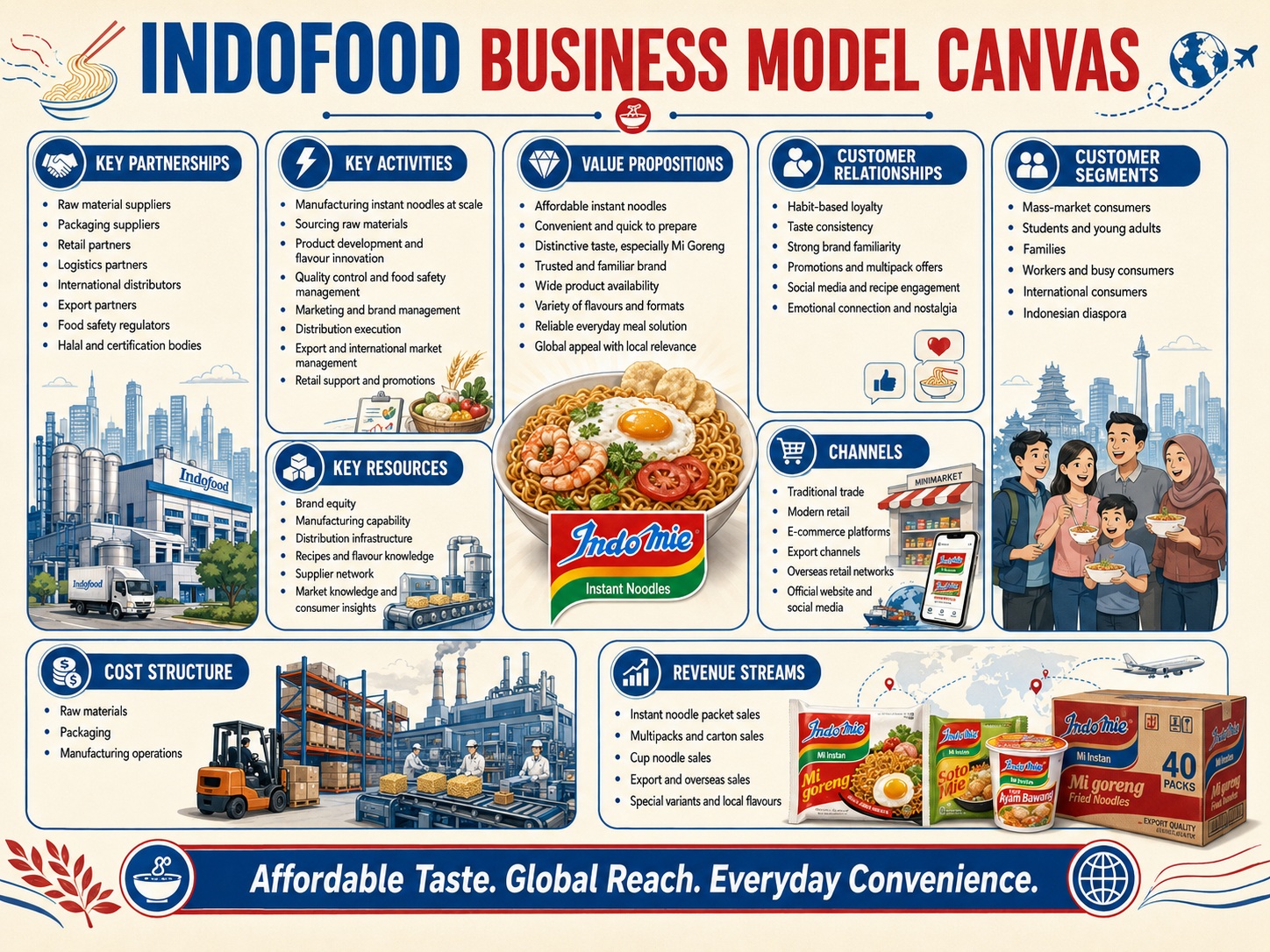
Before reviewing each block, the summary below gives a quick view of how Indomie supports the overall Indofood business model canvas. It shows who the brand serves, what value it offers, how it reaches customers, how revenue is created, and what resources keep the model running.
| BMC Block | Indomie / Indofood Application |
| Customer Segments | Mass-market consumers, students, families, workers, retailers, international customers, and food-service users. |
| Value Propositions | Affordable, tasty, convenient, widely available instant noodles with strong brand familiarity. |
| Channels | Warungs, minimarkets, supermarkets, wholesalers, distributors, e-commerce platforms, export channels, and overseas retail networks. |
| Customer Relationships | Habit-based loyalty, emotional brand connection, social media engagement, promotions, and flavour familiarity. |
| Revenue Streams | Sales of instant noodle packets, multipacks, cup noodles, exports, local market sales, and related noodle product variants. |
| Key Resources | Brand equity, factories, recipes, distribution network, supplier access, packaging capability, and market data. |
| Key Activities | Manufacturing, sourcing, flavour development, quality control, marketing, distribution, export management, and retailer support. |
| Key Partnerships | Raw material suppliers, packaging suppliers, distributors, retailers, logistics partners, overseas partners, and regulatory bodies. |
| Cost Structure | Wheat flour, palm oil, seasoning ingredients, packaging, labour, energy, logistics, marketing, compliance, and production overheads. |
Indofood BMC diagram:
Customer segments describe who the business serves. Indomie serves a broad market because instant noodles are consumed across income groups, age groups, and countries.
The brand targets the mass market, but its appeal is not generic. Students buy it because it is cheap and fast. Families use it as backup food. Workers choose it for convenience. Overseas consumers may buy it for affordability, curiosity, or nostalgia.
This wide base gives Indofood an important advantage. Indomie does not depend on one narrow segment or one usage occasion. It can be consumed as a meal, snack, emergency food, travel food, dormitory food, or comfort food.
| Customer Segment | What They Need | How Indomie Serves Them |
| Mass-market consumers | Affordable and convenient meals. | Low-priced instant noodles that are easy to find and prepare. |
| Students and young adults | Cheap food that can be prepared quickly. | Budget-friendly meals that require minimal cooking skill. |
| Families | Backup meals, snacks, and quick household food. | Multipacks and familiar flavours for routine grocery buying. |
| Workers and busy consumers | Fast meals during tight schedules. | Quick preparation and easy storage at home or work. |
| International consumers | Affordable noodles and familiar Asian flavours. | Exported and locally distributed products in overseas markets. |
| Indonesian diaspora | A taste connected to home and memory. | Mi Goreng and other familiar products with Indonesian flavour identity. |
The value proposition explains why customers choose Indomie. At the simplest level, it offers affordable, tasty, and convenient instant noodles.
Indomie’s proposition is built around practical everyday needs. The product is affordable enough for repeat purchase, convenient enough for busy consumers, and tasty enough to create emotional attachment.
Its strongest feature is the combination of low price and high familiarity. Many brands can offer cheap noodles. Fewer brands can combine price, taste memory, broad availability, and customer trust. This makes Indomie difficult to replace.
| Value Proposition | Customer Benefit | Business Impact |
| Affordability | Customers can buy a filling meal at a low price. | Supports mass adoption and frequent repeat purchases. |
| Convenience | Customers can prepare the product quickly and store it easily. | Makes Indomie relevant for busy consumers, students, and families. |
| Distinctive taste | Customers get a familiar flavour, especially through Mi Goreng. | Creates differentiation in a crowded noodle category. |
| Product variety | Customers can choose different flavours, formats, and local variants. | Keeps the brand fresh and reduces boredom. |
| Brand trust | Customers know what taste and quality to expect. | Strengthens loyalty and lowers purchase hesitation. |
Channels explain how Indomie reaches customers. This is one of the strongest parts of the Indofood business model canvas.
Indomie uses a multi-layered channel system. Products are available in traditional shops, minimarkets, supermarkets, wholesalers, online platforms, and overseas retail networks. Customers can therefore buy them during planned grocery trips or impulse shopping.
Distribution depth is a strong competitive barrier. In fast-moving consumer goods, availability can be as important as product quality. Competitors may copy flavour or packaging, but matching Indofood’s retail penetration, logistics reach, and international channel relationships is harder.
| Channel | Examples | Strategic Role |
| Traditional trade | Warungs, small shops, wholesalers, and neighbourhood retailers. | Reaches consumers in daily shopping locations. |
| Modern retail | Minimarkets, supermarkets, hypermarkets, and convenience stores. | Provides shelf visibility and promotional access. |
| E-commerce | Online marketplaces and grocery delivery platforms. | Supports bulk buying and digitally active consumers. |
| Export channels | Export partners, distributors, and overseas retailers. | Extends Indomie beyond Indonesia. |
| Overseas local networks | Local production, distributors, ethnic stores, and supermarkets. | Helps Indomie adapt to local retail structures. |
Customer relationships describe how the brand keeps people coming back. Indomie’s relationship with customers is built on habit, memory, and accessibility.
The brand does not rely on deep one-to-one relationships. Its model is based on repeat familiarity. Customers see it often, buy it often, cook it easily, and know what taste to expect.
Relationship strength comes from frequency rather than exclusivity. Indomie is part of everyday routines, not occasional luxury consumption. Buyers do not need a complex decision process because the brand is already familiar and trusted.
| Relationship Driver | How It Works | Example |
| Habit-based loyalty | Customers buy repeatedly because the product fits daily routines. | A student keeps Indomie as a late-night meal. |
| Taste consistency | The brand delivers familiar flavour across repeat purchases. | Customers expect the same Mi Goreng taste each time. |
| Mental availability | Customers know the brand before entering the store. | Indomie becomes a default instant noodle choice. |
| Promotions and campaigns | Discounts, multipacks, displays, and digital campaigns keep visibility high. | Retail promotions can encourage bulk purchases. |
| Community and culture | Customers create recipes and share content. | Social media recipes strengthen engagement. |
Revenue streams show how the business makes money. Indomie generates revenue mainly through product sales across domestic and international markets.
Its model is based on high-volume sales. Indofood earns from individual packets, multipacks, carton sales, cup noodles, local variants, and international sales. Each purchase may be small, but frequency and scale make the business powerful.
This model works because Indomie is a repeat-purchase product. Customers may buy it weekly, monthly, or in bulk for household stock. Multiple formats and geographic reach further expand the revenue base.
| Revenue Stream | Description | Why It Matters |
| Instant noodle packets | Sales of core products such as Mi Goreng and soup variants. | Forms the main volume engine. |
| Multipacks and carton sales | Bulk purchases by families, retailers, wholesalers, and online buyers. | Increases basket size and distribution efficiency. |
| Cup noodles and convenient formats | Products for faster preparation and portability. | Expands office, travel, and convenience occasions. |
| Export and overseas sales | Sales through international distributors and retailers. | Reduces dependence on one market. |
| Special variants and local flavours | Premium, seasonal, or market-specific products. | Supports variety and potential margin improvement. |
Key resources are the assets required to deliver the business model. For Indomie, the most important resource is brand equity.
Its resources include the brand, factories, recipes, supplier relationships, distribution infrastructure, and market knowledge. These assets work together to support affordable pricing, product consistency, and large-scale availability.
The most valuable resource is the system behind the brand. Brand equity creates demand. Manufacturing capacity fulfils it. Distribution infrastructure makes products available. Supplier access protects continuity.
| Key Resource | Role in the Business Model | Strategic Value |
| Brand equity | Recognition, trust, and emotional familiarity. | Helps Indomie stand out on crowded shelves. |
| Manufacturing capability | Factories, quality systems, packaging lines, and operating discipline. | Enables large-scale and cost-efficient production. |
| Distribution infrastructure | Access to traditional trade, modern retail, e-commerce, and export markets. | Makes Indomie easy to find. |
| Recipes and flavour knowledge | Product formulas, seasoning profiles, and local flavour development. | Protects taste consistency while supporting innovation. |
| Supplier access | Wheat flour, palm oil, spices, packaging, and logistics capacity. | Supports supply continuity and cost management. |
| Market knowledge | Consumer data, retail feedback, and regional demand insights. | Guides product, pricing, and distribution decisions. |
Key activities are the things Indofood must do well to keep Indomie competitive. These activities turn the brand promise into a consistent customer experience.
Indofood must manage manufacturing, sourcing, product development, quality control, marketing, distribution, and compliance. None of these functions is optional. Each one supports affordability, availability, safety, and consistency.
Operational discipline is the core activity behind Indomie. The product looks simple, but delivering it at large scale requires strong execution across factories, suppliers, retailers, and markets.
| Key Activity | What It Involves | Why It Matters |
| Manufacturing | Producing noodles at scale while maintaining quality and safety. | Protects reliability and cost efficiency. |
| Sourcing | Securing raw materials at the right quality, price, and volume. | Helps manage cost and supply continuity. |
| Product development | Creating flavours, local variants, formats, and campaign-linked products. | Keeps the brand relevant. |
| Marketing and brand management | Advertising, promotions, digital content, and positioning. | Maintains visibility in a competitive category. |
| Distribution execution | Moving products from factories to retailers and households. | Protects availability. |
| Quality and compliance management | Food safety, labelling, halal requirements, and regulation. | Supports trust and market access. |
Key partnerships help Indofood operate, distribute, and expand Indomie. They also reduce execution risk across a large food supply chain.
Indomie depends on a broad partner network. Suppliers provide raw materials and packaging. Retailers provide access to customers. Logistics partners move products across markets. International partners support overseas expansion.
Regulators and certification bodies also matter. Food safety, halal certification, labelling, import rules, and market-specific requirements are critical for a global food brand.
| Partner Type | Examples | Contribution to the Business Model |
| Raw material suppliers | Wheat flour, palm oil, seasoning ingredients, spices, and other inputs. | Support production continuity and cost management. |
| Packaging suppliers | Packaging films, cartons, cup packaging, and printed materials. | Protect shelf life and brand presentation. |
| Retail partners | Warungs, minimarkets, supermarkets, wholesalers, and grocery platforms. | Provide consumer access and shelf visibility. |
| Logistics partners | Domestic and international transport providers. | Move products efficiently across markets. |
| International partners | Export partners, local distributors, and market-entry partners. | Support overseas growth and adaptation. |
| Regulatory and certification bodies | Food safety regulators, halal bodies, and import authorities. | Enable compliance, trust, and market access. |
Cost structure explains where the money goes. Indomie operates in a high-volume, price-sensitive category, so cost discipline is critical.
The main costs include raw materials, packaging, manufacturing, labour, energy, logistics, marketing, and compliance. Because the product is affordable, Indofood must manage these costs carefully while protecting quality and availability.
Cost control is central to the Indofood business model canvas. Indomie cannot simply raise prices whenever input costs increase. Many customers are price-sensitive, so Indofood needs scale efficiency, supplier discipline, production productivity, and smart pricing.
| Cost Category | Examples | Management Challenge |
| Raw materials | Wheat flour, palm oil, seasoning ingredients, and spices. | Commodity price increases can pressure margins. |
| Packaging | Sachets, films, cartons, printed materials, and cup packaging. | Packaging must protect shelf life while staying cost efficient. |
| Manufacturing | Labour, energy, maintenance, depreciation, quality control, and overheads. | Scale must be matched with efficiency and quality. |
| Logistics and distribution | Transport, warehousing, retailer delivery, and export logistics. | Wide reach creates complexity. |
| Marketing | Advertising, promotions, sponsorships, social media, and in-store visibility. | Brand leadership requires continuous visibility. |
| Compliance | Food safety, testing, certification, labelling, and approvals. | Global presence increases regulatory complexity. |
Indomie teaches useful lessons for entrepreneurs and business strategists.
Frequent needs create repeat revenue. A simple product can build a large business when the customer need happens often. Indomie benefits because hunger, convenience, and affordability are recurring needs.
Distribution can beat advertising. A brand that is always available has a practical advantage over a brand that is only visible in campaigns. Indomie’s presence across warungs, supermarkets, minimarkets, online platforms, wholesalers, and overseas retailers makes purchase easier.
Consistency builds trust. Customers return when the product delivers the expected experience. Mi Goreng has a familiar taste that lowers purchase hesitation.
Local adaptation supports global growth. Indomie carries Indonesian flavour identity, but it can also offer market-specific variants and formats.
Affordability requires discipline. Low price must be supported by scale, procurement, production efficiency, and channel management.
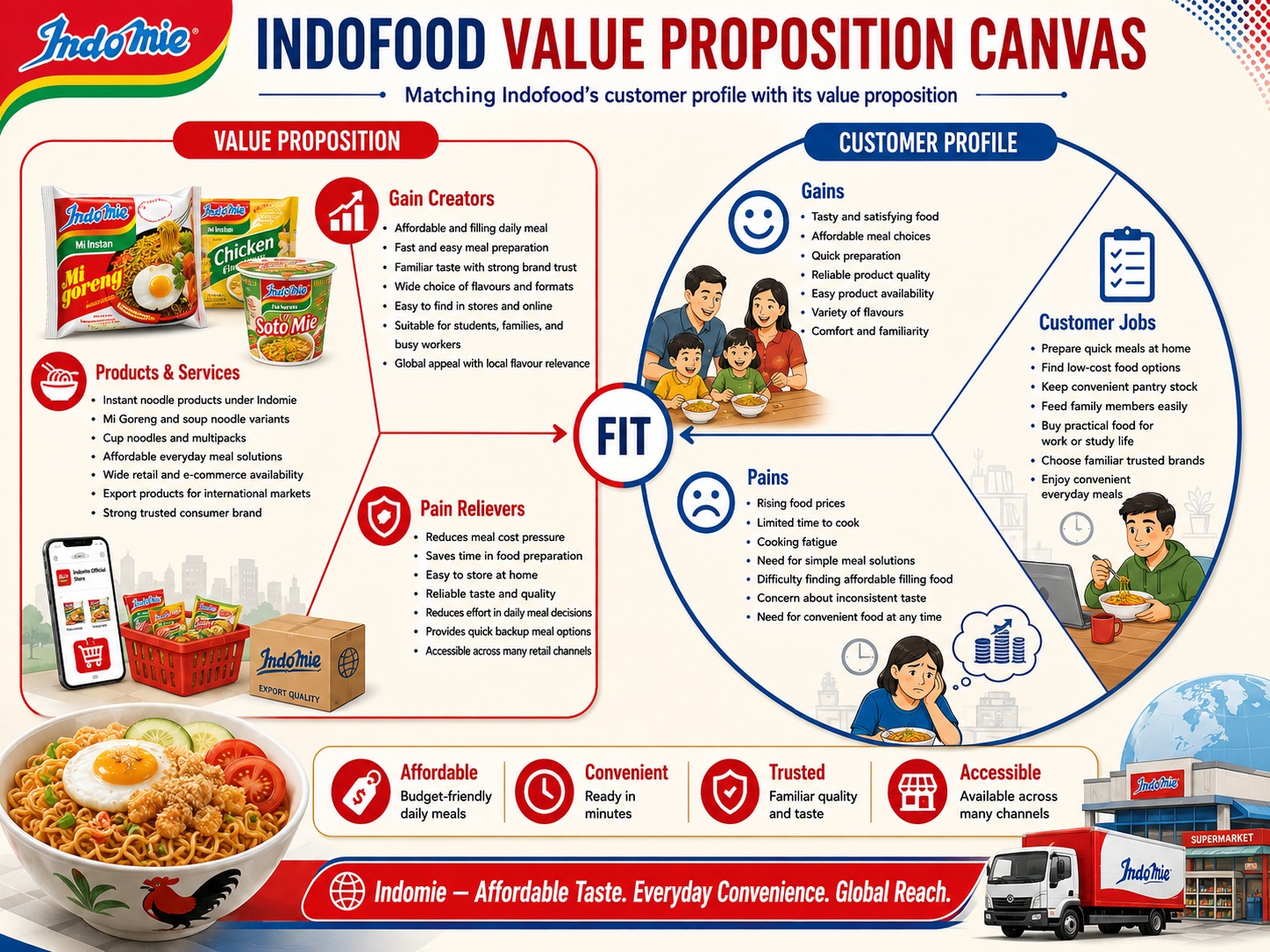
The Value Proposition Canvas explains the fit between Indomie’s offer and customer needs. Customers choose Indomie not only because it is cheap, but also because it solves practical meal problems, reduces daily inconvenience, and delivers familiar taste satisfaction.
The customer profile explains what Indomie customers want to achieve, what problems they face, and what benefits they expect. It is broad because Indomie serves students, families, workers, budget-conscious consumers, overseas customers, and Indonesian diaspora communities.
For customer jobs, Indomie helps people get food quickly. A student can cook it after class. Workers can prepare it after a long day. Families can keep it at home as backup food.
For customer pains, Indomie reduces common food-related problems. Rising food prices make affordable meals more important. Busy routines make long cooking less attractive. Cooking fatigue makes simple preparation valuable.
For customer gains, Indomie creates more than functional value. Customers want taste, convenience, low price, availability, variety, reliable quality, and emotional comfort.
The value proposition explains how Indomie responds to those jobs, pains, and gains. Its core offer is simple: affordable instant noodles that are fast to prepare, easy to store, widely available, and familiar in taste.
Indomie’s products include instant noodle packets, Mi Goreng variants, soup noodle variants, cup noodles, multipacks, and country-specific flavours. These products serve different moments, from quick home meals to office snacks, student meals, emergency food, and overseas demand.
Pain relievers are clear. The product reduces cooking time, lowers meal cost, simplifies food preparation, and gives customers predictable taste.
Gain creators strengthen the emotional side of the brand. Flavour variety, brand familiarity, broad availability, nostalgia, recipe possibilities, and global accessibility make Indomie more than a functional food item.
| Customer Profile | Details | Matching Value Proposition | How Indomie Creates Fit |
| Customer Jobs | Customers want quick meals, affordable food, familiar taste, easy preparation, and products that can be stored at home. | Products and Services | Instant noodle packets, Mi Goreng variants, soup noodle variants, cup noodle formats, multipacks, and country-specific flavours. |
| Customer Pains | Customers face limited time, rising food costs, cooking fatigue, inconsistent food quality, and the inconvenience of preparing full meals. | Pain Relievers | Indomie reduces cooking time, lowers meal cost, provides easy storage, simplifies food preparation, and gives customers predictable taste. |
| Customer Gains | Customers want tasty food, convenience, low price, easy availability, flavour variety, reliable quality, and emotional comfort. | Gain Creators | Indomie creates gains through flavour variety, brand familiarity, broad availability, nostalgic value, creative recipe possibilities, and global accessibility. |
Indomie fits the customer profile because it responds to three practical needs at the same time: speed, affordability, and familiarity. Customers are not only buying noodles. They are buying a simple meal solution that reduces decision pressure, preparation time, and taste uncertainty.
This fit explains why Indomie remains relevant. The stronger the match between customer needs and Indomie’s value proposition, the more likely customers are to keep buying it as part of everyday life.
Indomie’s competitive advantage comes from several layers working together. The brand is strengthened by recognition, production scale, distribution depth, distinctive flavour, repeat purchase habit, and international reach.
This system makes the Indofood business model canvas powerful. Indomie is not protected by one factor, but by the interaction between product, brand, factories, supply chain, retailer access, international reach, and customer habit.
Indomie still faces real business risks. These risks do not weaken the model automatically, but they show why Indofood must keep improving the business model, protecting affordability, and adapting to market changes.
Overall, these risks show that Indomie’s strength must be continuously managed. Long-term success depends on how well Indofood manages cost pressure, consumer expectations, competition, regulation, and changing taste preferences.
The Indofood business model canvas shows how Indomie became one of the world’s most recognized instant noodle brands. Its success is built on affordability, convenience, scale, distribution, brand trust, and repeat consumption.
Indomie works because it solves a simple problem very well. People need food that is quick, tasty, affordable, and easy to find. Indofood turns that need into a large operating system supported by factories, suppliers, retailers, distributors, marketing, and international expansion.
For business owners, the lesson is clear. A strong business model does not always need a complicated product. Sometimes the real strategy is making a simple product available everywhere, priced correctly, delivered consistently, and loved repeatedly.
This article is for informational and educational purposes only. Publicly available information and independent business analysis form the basis of this discussion. It does not represent official information from Indofood, Indofood CBP, or Indomie. Readers should conduct their own research before making business, investment, or strategic decisions.
Explore the CARPUT Business Model Canvas, nine BMC blocks, Value Proposition Canvas, competitor comparison, competitive… Read More
Explore the Boost Business Model Canvas, nine BMC blocks, Value Proposition Canvas, competitor comparison, advantages,… Read More
Explore the Domino's Pizza Business Model Canvas, nine BMC blocks, Value Proposition Canvas, Pizza Hut… Read More
Explore the Mie Gacoan Business Model Canvas, including its customer segments, value propositions, revenue streams,… Read More
Restaurant Business Model Canvas: A Practical Guide to Designing, Evaluating, and Improving Restaurant Business Models… Read More
Learn how the Food and Beverage Business Model Canvas helps restaurants, cafés, beverage brands, and… Read More