



Share This Article


Tealive Business Model Canvas: How Malaysia’s Lifestyle Tea Brand Built a Scalable Beverage Business
BMC Article No: BMC #021
Updated in 2026: This article has been rewritten with a stronger business story, clearer Business Model Canvas structure, latest developments, Value Proposition Canvas analysis, competitive advantages, risks, and strategic lessons from Tealive’s growth journey.
Introduction
Tealive is more than a bubble tea chain. It is a Malaysian lifestyle beverage brand built around convenience, youth culture, product variety, store expansion, digital ordering, and franchise-led growth. That is why the Tealive Business Model Canvas is interesting. It shows how a drink brand can grow from a local market reset into a regional beverage platform.
The strength of Tealive does not come from tea alone. Its real advantage comes from the combination of brand visibility, menu innovation, accessible pricing, store density, delivery availability, loyalty engagement, and local taste adaptation. A student may buy Tealive after class. A worker may order it during a lunch break. A family may stop at a mall outlet. A commuter may buy it from a drive-through location.
This makes Tealive different from a traditional café. It does not rely only on people sitting inside a store for a long time. It competes in fast-moving beverage occasions. Customers buy it for refreshment, social sharing, indulgence, convenience, and small daily rewards.
In this article, we will break down the Tealive Business Model Canvas and examine how Tealive creates value, reaches customers, generates revenue, manages cost, and protects its position in the competitive beverage market.
What Is Tealive’s Business Model?
Tealive’s business model is built around a scalable lifestyle beverage chain. The company sells ready-to-drink tea, milk tea, fruit tea, coffee, smoothies, chocolate drinks, snacks, and related products through physical outlets, franchise partners, delivery platforms, digital channels, and international market partnerships.
Its main strength is accessibility. Tealive is designed to be easy to find, easy to order, easy to customize, and easy to consume on the go. The brand does not need customers to plan a long dining experience. It only needs to be present when customers want a quick drink, a sweet treat, or a social beverage moment.
Its main challenge is market intensity. The bubble tea and lifestyle beverage category is crowded. Tealive competes with global tea brands, coffee chains, dessert drink players, convenience stores, and newer Chinese beverage brands. Customers have many choices, and switching costs are low.
The Tealive Business Model Canvas therefore shows a business that looks simple at the counter, but requires strong operating discipline behind the scenes. Product innovation, supply chain control, staff training, store execution, location strategy, digital engagement, and franchise governance must work together.
What Is Business Model Canvas?
Business Model Canvas, or BMC, is a simple tool used to understand how a business works. It helps readers see the logic behind how a company creates value, delivers that value to customers, and turns it into revenue. Instead of looking only at products or sales, BMC breaks the business into practical operating parts. It divides a company into nine key building blocks:
| BMC Block | Main Question |
|---|---|
| Customer Segments | Who does the business serve? |
| Value Propositions | What value does the business offer? |
| Channels | How does the business reach customers? |
| Customer Relationships | How does the business build loyalty? |
| Revenue Streams | How does the business make money? |
| Key Resources | What assets does the business need? |
| Key Activities | What must the business do well? |
| Key Partnerships | Who helps the business operate? |
| Cost Structure | What are the major costs? |
For Tealive, the BMC is useful because the business is not only about selling bubble tea. It involves menu development, raw material sourcing, store network planning, franchise management, brand campaigns, digital loyalty, delivery partnerships, staff training, and international expansion.
Quick Overview of Tealive and Loob Holding
Tealive is a Malaysian tea-based beverage brand owned by Loob Holding Sdn Bhd. The brand was launched in February 2017 after Loob Holding moved away from the Chatime franchise business and created its own homegrown beverage brand.
The founder, Bryan Loo, had already built experience in Malaysia’s bubble tea market before Tealive was launched. This gave the company an important early advantage. It understood local customers, store operations, mall locations, supplier requirements, pricing, and beverage trends.
Tealive grew quickly because it entered the market with a ready understanding of what Malaysian consumers wanted: customizable drinks, pearls and toppings, attractive store presentation, trendy product launches, and convenient access. The brand later expanded beyond Malaysia into several international markets.
Today, Tealive is positioned as a Southeast Asian lifestyle tea brand. Its menu extends beyond classic milk tea into hand-crafted teas, brown sugar beverages, coffee, chocolate, smoothies, fruit drinks, sparkling drinks, snacks, and localized variants. This wider menu helps Tealive serve more occasions than a pure bubble tea brand.
The Tealive Business Model Canvas helps explain why the brand is strategically important. Tealive is not only a drinks counter. It is a repeat-purchase beverage system supported by outlets, recipes, suppliers, technology, franchise partners, customer data, and brand memory.
Why Tealive Is Strategically Interesting
Tealive is interesting because it turns a small-ticket beverage into a scalable consumer habit. Each transaction may be relatively small, but the model works when many customers buy often across many outlets and channels.
A fine-dining restaurant may earn more from one customer visit. Tealive earns through frequency, convenience, and reach. It can sell to students, office workers, mall visitors, delivery users, commuters, families, tourists, and young consumers who want affordable indulgence.
The brand also benefits from social visibility. Drinks are easy to photograph, share, and discuss. New flavours, limited editions, toppings, packaging, collaborations, and promotional campaigns give customers reasons to notice the brand repeatedly.
Tealive’s strategic appeal also comes from its franchise and partnership potential. A beverage chain can scale faster when its operating model, recipes, training, store format, supply chain, and brand identity are standardized. This allows the company to expand across different towns, formats, and countries.
From a strategy perspective, the Tealive Business Model Canvas shows how a beverage brand can use product variety, store network, digital ordering, and brand relevance to compete in a crowded market.
Latest Developments: What Is Changing Around Tealive?
Tealive’s current story is not only about expansion. It is also about profitability, competitive pressure, international growth, and operating discipline.
One major development is scale. Loob Holding describes Tealive as a leading regional lifestyle tea brand in Southeast Asia, with more than 900 outlets across three continents. The brand is present in Malaysia and several international markets, including Vietnam, Myanmar, Brunei, the Philippines, Cambodia, Mauritius, Canada, Singapore, UAE, India, and Thailand.
Another development is international expansion through master franchise partnerships. In Thailand, Loob Holding announced plans to open 80 Tealive outlets over 10 years with Restaurants Development Co. Ltd as master franchisee. This is important because Thailand is already a strong beverage and café market. Success there requires local partner strength, location access, operating capability, and consumer adaptation.
Tealive has also expanded its menu beyond traditional bubble tea. Loob Holding states that Tealive offers more than 30 beverage types, while other company materials mention more than 45 drink options with a wide range of toppings. This menu breadth matters because customers may not want milk tea every time. Fruit tea, coffee, chocolate, smoothies, and sparkling drinks help Tealive serve different moods and occasions.
At the same time, the business faces financial and competitive pressure. Reports in 2026 indicated that Loob’s FY2025 revenue declined from FY2024, while earnings and profit margins weakened. The same reports highlighted intense competition in the beverage segment, including the entry of aggressive Chinese brands into Malaysia.
This latest context changes the way we read the Tealive Business Model Canvas. The brand has scale, recognition, and regional ambition. However, growth alone is not enough. Tealive must protect margins, defend traffic, improve store productivity, manage costs, and keep the brand relevant in a category where customers can switch easily.
Tealive Business Model Canvas Summary
Before going into each block in detail, the summary below gives a quick view of how Tealive’s business model works. It shows who the brand serves, what value it offers, how it reaches customers, how revenue is generated, and what resources and activities keep the model running.
| BMC Block | Tealive Application |
| Customer Segments | Young consumers, students, working adults, families, mall visitors, delivery users, franchise markets, and international beverage customers. |
| Value Propositions | Customizable lifestyle beverages, convenient access, affordable indulgence, wide menu variety, attractive brand experience, and local taste relevance. |
| Channels | Physical outlets, malls, high-street stores, drive-through formats, delivery platforms, mobile app, social media, franchise outlets, and international partners. |
| Customer Relationships | Loyalty rewards, digital engagement, promotions, social media campaigns, product launches, store experience, and habit-based repeat buying. |
| Revenue Streams | Beverage sales, snacks, delivery orders, franchise-related income, merchandise, limited-time products, and international outlet expansion. |
| Key Resources | Brand equity, recipes, supply chain, outlet network, trained staff, franchise system, digital platforms, customer data, and operating know-how. |
| Key Activities | Beverage preparation, menu innovation, store operations, sourcing, training, marketing, franchise management, digital engagement, and quality control. |
| Key Partnerships | Ingredient suppliers, packaging suppliers, franchisees, landlords, delivery platforms, technology providers, logistics partners, and market-entry partners. |
| Cost Structure | Ingredients, labour, rental, utilities, equipment, packaging, logistics, marketing, technology, franchise support, training, and compliance costs. |
Tealive BMC Diagram:
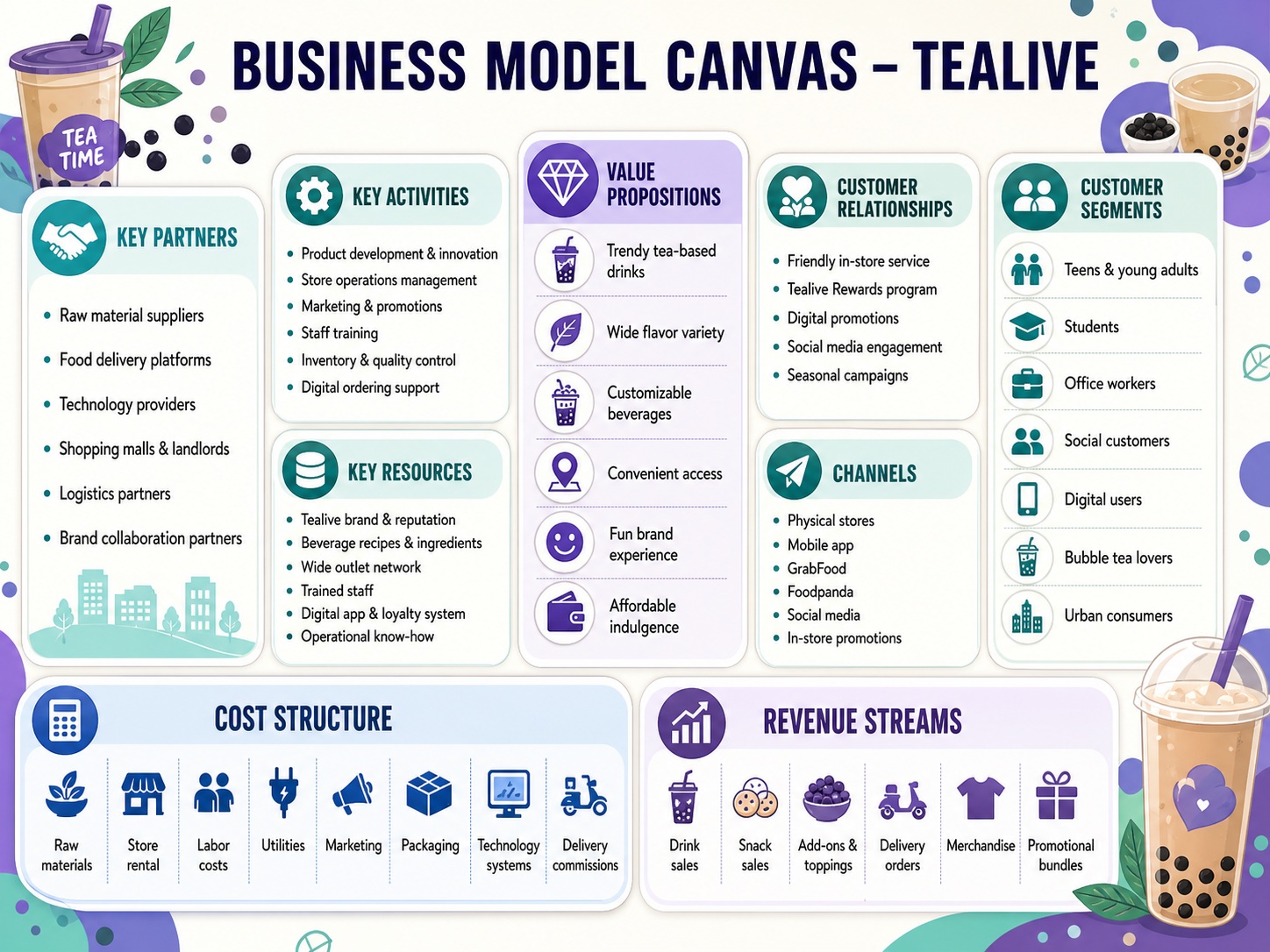
1. Customer Segments
Customer segments describe who the business serves. Tealive serves a broad consumer base, but its strongest appeal is among younger, urban, mobile, and digitally connected customers.
Tealive’s customers are not all buying for the same reason. Teenagers and young adults may buy the brand because it feels trendy and social. Students may buy it as an affordable treat after class. Office workers may buy it during breaks. Families may visit outlets in malls. Delivery users may order it for convenience. International customers may try it as a Malaysian lifestyle tea brand.
This broad customer base gives Tealive more room to grow. The brand is not limited to one narrow segment or one consumption occasion. A customer can buy Tealive as a dessert drink, afternoon refreshment, social beverage, study companion, delivery order, or impulse purchase.
Tealive Customer Segments:
| Customer Segment | What They Need | How Tealive Serves Them |
| Teenagers and young adults | Trendy, customizable drinks that feel social and fun. | Offers colourful beverages, toppings, limited-time flavours, and social media-friendly products. |
| Students | Affordable treats and quick drinks near campuses or transit areas. | Provides accessible pricing, convenient store formats, and drinks that can be consumed on the go. |
| Working adults | Refreshment during work breaks, lunch hours, and commuting. | Uses malls, commercial areas, delivery platforms, and quick-service formats to improve convenience. |
| Families | Casual drinks and snacks during shopping or leisure trips. | Serves a wide menu that can appeal to both adults and younger customers. |
| Delivery users | Easy ordering without visiting outlets. | Works through food delivery platforms and digital channels to serve home and office demand. |
| International consumers | New beverage options with Southeast Asian identity. | Expands through franchise partners and adapts the menu to local market preferences. |
The Tealive Business Model Canvas shows that the brand does not depend on one customer group. Its market is wide, frequent, and occasion-based.
2. Value Propositions
The value proposition explains why customers choose Tealive. At the simplest level, Tealive offers customizable lifestyle beverages that are accessible, enjoyable, and easy to buy.
Tealive’s value proposition is built around small indulgence. Customers may not need a bubble tea every day, but they often want a drink that feels more exciting than plain water and more affordable than a full café meal. Tealive fills that space between daily refreshment and affordable treat.
The strongest part of Tealive’s value proposition is variety. Customers can choose tea, milk tea, fruit tea, coffee, chocolate, smoothies, toppings, sugar levels, ice levels, and seasonal products. This customization gives customers a sense of control and keeps the brand from feeling repetitive.
| Value Proposition | Customer Benefit | Business Impact |
| Customizable beverages | Customers can adjust toppings, sweetness, ice, and drink type. | Increases relevance across different preferences and repeat visits. |
| Affordable indulgence | Customers can enjoy a treat without paying restaurant-level prices. | Supports frequent purchases and broad market appeal. |
| Wide menu variety | Customers can choose milk tea, fruit tea, coffee, chocolate, smoothies, and snacks. | Reduces boredom and increases cross-selling opportunities. |
| Convenient access | Customers can buy through outlets, delivery platforms, and digital channels. | Expands demand beyond walk-in traffic. |
| Lifestyle brand experience | Customers get a modern, youthful, and recognizable beverage experience. | Strengthens brand recall and social visibility. |
| Local taste adaptation | Customers get flavours and campaigns that fit market preferences. | Helps the brand compete against global and local beverage players. |
Tealive’s value proposition is not only the drink. It is the full experience of choice, convenience, affordability, and brand familiarity.
3. Channels
Channels explain how Tealive reaches customers. This is one of the most important parts of the Tealive Business Model Canvas.
Tealive uses a multi-channel model. The brand sells through physical stores, malls, street locations, petrol stations, drive-through formats, delivery platforms, mobile ordering, social media campaigns, and international franchise outlets. This channel mix allows Tealive to serve both planned and impulse purchases.
Location matters because beverages are often convenience-driven. Customers may choose the brand that is nearest, fastest, or easiest to order. That is why outlet density, delivery availability, and digital visibility are strategically important.
| Channel | Examples | Strategic Role |
| Physical outlets | Mall kiosks, shop lots, high-street stores, and transit-oriented outlets. | Creates brand visibility and captures walk-in customers. |
| Drive-through and convenience formats | Outlets near petrol stations or high-mobility locations. | Serves commuters and customers who want faster access. |
| Delivery platforms | Food delivery apps and marketplace ordering channels. | Extends reach to homes, offices, and group orders. |
| Mobile and loyalty channels | App-based promotions, rewards, and digital ordering. | Builds repeat engagement and captures customer data. |
| Social media | Product launches, campaigns, influencer content, and promotions. | Creates awareness and keeps the brand relevant among younger customers. |
| International franchise outlets | Local partners in overseas markets. | Expands Tealive beyond Malaysia while using partner market knowledge. |
Strong channels make Tealive more accessible. In a category with many substitutes, convenience can become a major reason for purchase.
4. Customer Relationships
Customer relationships describe how Tealive keeps people coming back. Tealive’s customer relationship model is built on habit, novelty, rewards, and social engagement.
The brand does not depend only on one-to-one personal relationships. Its relationship model is more transactional but frequent. Customers return because the brand is familiar, the menu changes regularly, rewards create incentives, and promotions make the purchase feel timely.
Tealive also uses digital engagement to stay visible. Social media campaigns, new drink launches, collaborations, and app-based promotions keep the brand in the customer’s attention space. This matters because the beverage category is crowded and customers can quickly shift to another brand.
| Relationship Driver | How It Works | Example |
| Loyalty rewards | Customers earn points, discounts, or benefits from repeat purchases. | A frequent customer uses rewards to justify another purchase. |
| Product novelty | New flavours and limited-time offers create reasons to revisit. | Seasonal drinks or brand collaborations drive trial. |
| Store experience | Friendly service, visible preparation, and recognizable store design support trust. | Customers feel comfortable buying from a familiar outlet. |
| Social media engagement | Campaigns, contests, and product content keep the brand visible. | A new drink launch spreads through Instagram or TikTok-style content. |
| Convenience relationship | Customers return because the brand is easy to find and easy to order. | A worker orders Tealive from a delivery app during a break. |
Tealive’s relationship with customers is not built on luxury exclusivity. It is built on repeat relevance. The brand needs to remain visible, convenient, and interesting enough for customers to return.
5. Revenue Streams
Revenue streams show how the business makes money. Tealive generates revenue mainly through beverage sales, supported by snacks, delivery, franchise expansion, and related products.
The core revenue engine is drink sales. Each transaction may include one beverage, multiple beverages, toppings, snacks, or limited-edition products. This creates opportunities to increase average order value through customization and add-ons.
Delivery platforms also expand revenue opportunities. A customer who may not visit an outlet can still order Tealive from home or office. Group delivery orders can increase basket size, although platform commissions and delivery economics must be managed carefully.
| Revenue Stream | Description | Why It Matters |
| Beverage sales | Sales of milk tea, fruit tea, hand-crafted tea, coffee, chocolate, smoothies, and specialty drinks. | Forms the main revenue base of the business. |
| Toppings and customization | Pearls, jellies, pudding, foam, sugar adjustments, and drink upgrades. | Increases basket size and supports customer personalization. |
| Snacks and side products | Light food, snacks, and selected add-on products. | Expands consumption occasions and increases order value. |
| Delivery orders | Sales through food delivery platforms and digital ordering channels. | Captures demand outside physical walk-in traffic. |
| Franchise-related income | Franchise fees, royalties, supply arrangements, and market-entry partnerships where applicable. | Supports faster expansion and capital-light growth in selected markets. |
| Merchandise and campaigns | Tumblers, limited products, collaborations, and promotional items. | Builds brand visibility and creates occasional incremental revenue. |
The Tealive Business Model Canvas shows a revenue model based on high transaction volume, product add-ons, repeat purchase, and network expansion.
6. Key Resources
Key resources are the assets required to deliver the business model. For Tealive, the most important resources are brand equity, recipes, outlet network, supply chain, operating system, and franchise capability.
The brand is a major resource because customers must recognize and trust the name before choosing it in a crowded beverage market. Tealive’s purple brand identity, menu familiarity, and store visibility help it stand out.
However, brand alone is not enough. Tealive also needs recipes, ingredients, trained staff, preparation systems, supply chain reliability, digital platforms, and franchise governance. These resources allow the company to deliver a consistent customer experience across many outlets.
| Key Resource | Role in the Business Model | Strategic Value |
| Brand equity | Recognition, trust, and lifestyle positioning. | Helps Tealive compete in a crowded beverage category. |
| Recipes and menu IP | Beverage formulas, toppings, preparation standards, and product concepts. | Protects product consistency and supports innovation. |
| Outlet network | Physical stores across malls, streets, petrol stations, and other locations. | Provides reach, visibility, and customer convenience. |
| Supply chain | Ingredients, packaging, equipment, logistics, and inventory systems. | Supports consistent quality and operational continuity. |
| Trained workforce | Baristas, store managers, trainers, operations teams, and franchise support teams. | Maintains service speed, drink consistency, and customer experience. |
| Digital platforms | Loyalty systems, ordering tools, customer data, and campaign channels. | Improves retention, personalization, and promotional effectiveness. |
| Franchise system | Store format, training manuals, partner selection, support model, and quality control. | Enables expansion across markets with controlled execution. |
Together, these resources make Tealive more than a drinks brand. They make it a repeatable beverage operating model.
7. Key Activities
Key activities are the things Tealive must do well to stay competitive. These include product development, store operations, sourcing, beverage preparation, marketing, staff training, franchise management, digital engagement, and quality control.
The most important activity is execution consistency. Customers expect their favourite drink to taste the same across outlets. If quality varies too much, the brand loses trust. This is why training, recipes, equipment, preparation steps, and store audits matter.
Product development is also critical. Beverage trends move quickly. Brown sugar, cheese foam, fruit tea, matcha, coffee, chocolate, and seasonal flavours can rise and fade. Tealive must keep launching products that feel fresh without confusing the core brand.
| Key Activity | What It Involves | Why It Matters |
| Beverage preparation | Making drinks according to recipe, speed, hygiene, and quality standards. | Protects customer satisfaction and repeat purchase. |
| Menu innovation | Developing new drinks, toppings, seasonal flavours, and collaborations. | Keeps the brand fresh and relevant. |
| Store operations | Managing staffing, inventory, queue flow, cleaning, cash handling, and service quality. | Ensures outlets can handle daily demand efficiently. |
| Sourcing and supply management | Securing tea, milk, sugar, pearls, packaging, equipment, and logistics. | Protects margin, quality, and product availability. |
| Marketing and promotions | Campaigns, product launches, social content, partnerships, and discounts. | Drives awareness, traffic, and customer engagement. |
| Training and quality control | Staff training, store audits, SOPs, and service monitoring. | Maintains consistency across a large outlet network. |
| Franchise management | Partner selection, onboarding, support, compliance, and performance tracking. | Enables expansion without losing brand control. |
The Tealive Business Model Canvas shows that operational discipline is the hidden engine behind a simple cup of tea.
8. Key Partnerships
Key partnerships help Tealive operate, expand, and serve customers more efficiently. These partnerships include suppliers, landlords, delivery platforms, franchisees, technology providers, logistics partners, and international market partners.
Tealive cannot scale through internal effort alone. Reliable suppliers are needed for ingredients and packaging. Landlords provide access to outlet locations. Delivery platforms support digital demand. Franchisees and master franchisees help drive international expansion. Technology partners also enable payments, loyalty, ordering, and customer data capabilities.
Partnership quality matters because a beverage chain is highly execution-dependent. Poor ingredients affect taste. Weak locations reduce traffic. Unreliable delivery affects customer experience. Weak franchise partners can damage the brand in new markets.
| Partner Type | Examples | Contribution to the Business Model |
| Ingredient suppliers | Tea, milk, sugar, pearls, fruit bases, chocolate, coffee, and toppings. | Support product quality, menu variety, and supply continuity. |
| Packaging suppliers | Cups, straws, lids, seals, bags, and branded packaging materials. | Protect drink presentation, convenience, and brand visibility. |
| Landlords and property partners | Mall operators, shop lot owners, petrol station partners, and commercial property owners. | Provide customer access and strategic locations. |
| Delivery platforms | Food delivery apps and online ordering marketplaces. | Extend reach beyond walk-in customers. |
| Technology partners | Payment systems, loyalty platforms, POS systems, analytics tools, and app providers. | Enable digital ordering, customer tracking, and operational control. |
| Franchise and master franchise partners | Local and international partners in expansion markets. | Provide capital, local knowledge, execution capability, and faster market entry. |
| Regulatory and certification bodies | Food safety authorities, halal certification bodies, and local market regulators. | Support compliance, trust, and legal market access. |
These partnerships reduce friction. They allow Tealive to focus on brand building, product innovation, store experience, and scalable expansion.
9. Cost Structure
Cost structure explains where the money goes. Tealive operates in a competitive beverage category, so cost discipline is critical.
The main costs include ingredients, packaging, labour, rental, utilities, equipment, delivery commissions, marketing, technology, training, logistics, and franchise support. Some costs rise as the outlet network grows. Others increase when competition forces more promotions and campaigns.
Tealive must manage a difficult balance. Customers expect affordable drinks, frequent promotions, attractive products, and convenient access. At the same time, the company must protect margins against rising input costs, labour pressure, rental costs, and intense competition.
| Cost Category | Examples | Management Challenge |
| Ingredients | Tea, milk, sugar, pearls, fruit bases, coffee, chocolate, and toppings. | Quality must be maintained while managing input cost volatility. |
| Packaging | Cups, seals, lids, straws, bags, and printed materials. | Packaging must support convenience, branding, and cost efficiency. |
| Labour | Baristas, store managers, supervisors, trainers, and support staff. | Service quality depends on training, staffing, and retention. |
| Rental and utilities | Mall rent, shop lot rent, electricity, water, maintenance, and service charges. | Good locations can drive sales but increase fixed costs. |
| Equipment and maintenance | Tea brewers, sealing machines, refrigeration, POS equipment, and kitchen tools. | Equipment reliability affects speed, quality, and outlet uptime. |
| Marketing and promotions | Advertising, digital campaigns, discounts, collaborations, and in-store displays. | Brand visibility requires continuous spending in a crowded market. |
| Technology | Loyalty apps, payment systems, delivery integration, POS, and analytics. | Digital capability must improve sales or efficiency to justify cost. |
| Logistics and distribution | Ingredient movement, warehousing, outlet replenishment, and overseas supply coordination. | Wider expansion increases supply chain complexity. |
The Tealive Business Model Canvas makes one point clear: growth must be supported by margin control. More outlets are valuable only when store productivity, cost discipline, and customer demand remain healthy.
Strategic Lessons from Tealive’s Business Model
Tealive offers several useful lessons for entrepreneurs, franchise owners, and business strategists.
The first lesson is that local insight can beat copycat positioning. Tealive did not grow only because bubble tea was popular. It grew because the company understood Malaysian consumer behaviour, mall culture, price sensitivity, digital ordering, and flavour preferences.
The second lesson is that small-ticket products need frequency. A beverage brand cannot depend on one-time trial. It must create repeat reasons to buy. Tealive does this through menu variety, promotions, rewards, new launches, and convenient locations.
The third lesson is that distribution is part of the product. A drink is more valuable when it is easy to get. Store density, delivery availability, drive-through access, and app-based ordering all make Tealive more convenient.
The fourth lesson is that franchising requires discipline. Fast expansion can strengthen a brand, but only if quality, training, supply chain, and service standards are controlled. A weak franchise system can create inconsistent experiences and damage trust.
The fifth lesson is that category growth attracts competition. Bubble tea and lifestyle beverages are attractive markets because they offer repeat purchases and strong youth appeal. This attracts new entrants. Tealive must therefore keep improving its product, operations, pricing, and customer engagement.
Value Proposition Canvas View of Tealive
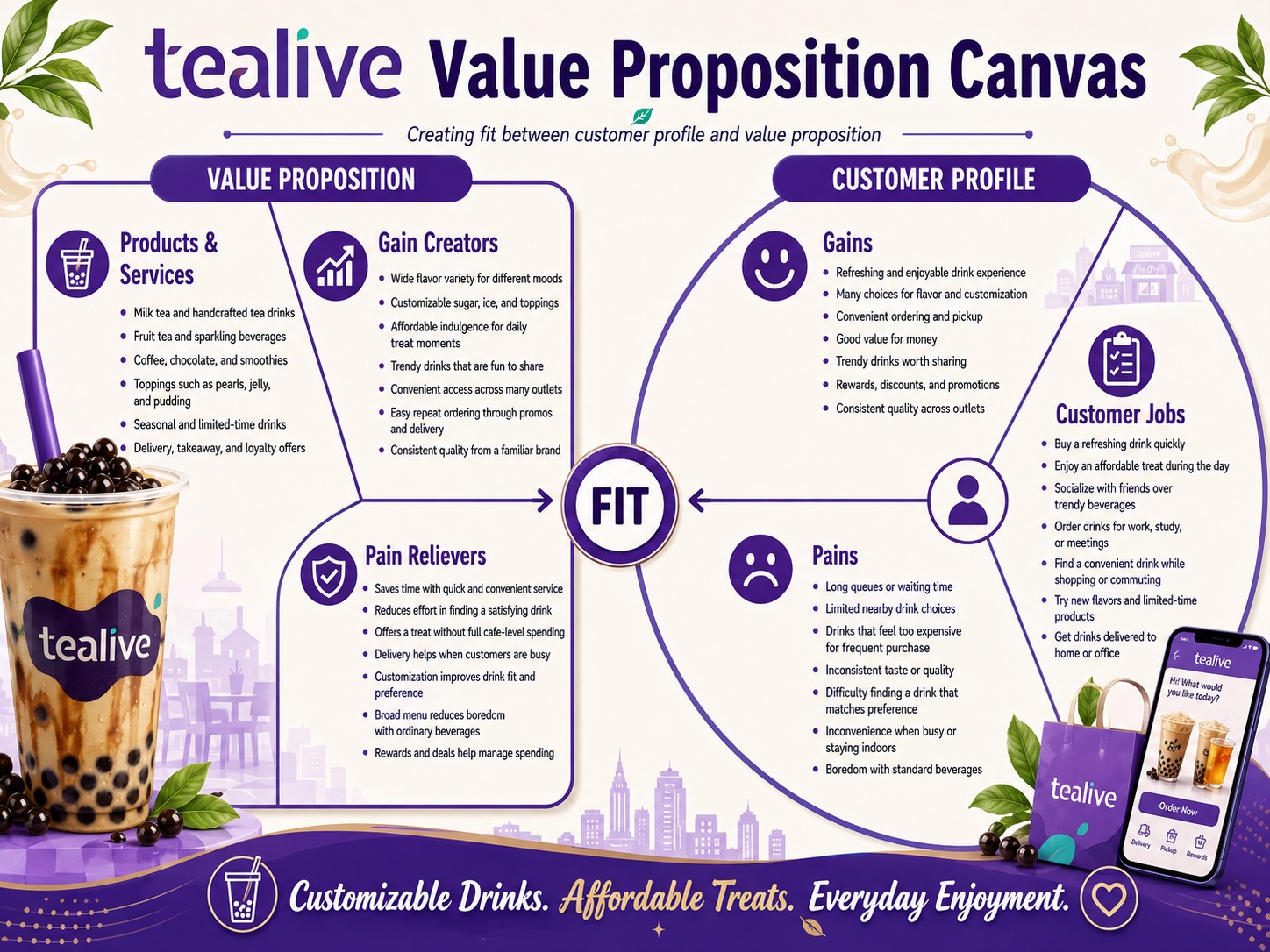
The Value Proposition Canvas helps explain the fit between Tealive’s offer and customer needs. It shows why customers choose Tealive not only because it sells bubble tea, but because it solves practical, emotional, and social needs.
Customer Profile
The customer profile explains what Tealive customers are trying to achieve, what problems they face, and what benefits they want. Tealive customers are often young, urban, busy, digitally active, and influenced by taste trends.
For customer jobs, Tealive helps customers get a refreshing drink, enjoy an affordable treat, socialize with friends, try new flavours, and order beverages conveniently. These jobs may look simple, but they occur frequently.
For customer pains, customers face limited time, boredom with ordinary drinks, inconsistent beverage quality, long queues, lack of nearby options, and price sensitivity. Tealive reduces these pains by offering multiple locations, delivery access, customizable drinks, and familiar product standards.
For customer gains, customers want taste variety, convenience, attractive presentation, customization, rewards, social value, and a small sense of indulgence. Tealive creates these gains through menu innovation, toppings, loyalty programs, colourful products, and easy ordering channels.
Value Proposition
The value proposition explains how Tealive responds to those customer jobs, pains, and gains. Its core offer is simple: customizable lifestyle beverages that are convenient, affordable, and enjoyable.
Tealive’s products and services include milk tea, fruit tea, hand-crafted tea, coffee, chocolate drinks, smoothies, sparkling drinks, snacks, toppings, delivery ordering, loyalty rewards, and seasonal products.
Pain relievers include convenience, product consistency, quick ordering, delivery access, familiar outlets, and customizable drink settings. These benefits reduce friction in the customer’s beverage decision.
Gain creators include new flavours, brand collaborations, toppings, rewards, social media visibility, attractive packaging, and lifestyle positioning. These benefits make the purchase feel more interesting than a basic drink.
Customer Profile and Value Proposition Fit
| Customer Profile | Details | Matching Value Proposition | How Tealive Creates Fit |
| Customer Jobs | Customers want refreshing drinks, affordable treats, social beverages, quick ordering, and new flavours. | Products and Services | Milk tea, fruit tea, coffee, chocolate drinks, smoothies, toppings, snacks, delivery ordering, and loyalty rewards. |
| Customer Pains | Customers face limited time, drink boredom, inconsistent quality, long queues, price sensitivity, and lack of convenient access. | Pain Relievers | Tealive provides outlet reach, delivery access, standardized recipes, app-based rewards, customizable drinks, and familiar service routines. |
| Customer Gains | Customers want taste variety, convenience, social value, attractive presentation, rewards, and small indulgence. | Gain Creators | Tealive creates gains through menu innovation, toppings, collaborations, promotions, loyalty points, and a recognizable lifestyle brand identity. |
The table shows that Tealive fits the customer profile because it responds to three needs at the same time: refreshment, convenience, and affordable enjoyment. Customers are not only buying tea. They are buying a quick mood lift, a social drink, and a customizable experience.
This fit explains why Tealive can remain relevant despite competition. The brand must continue to match changing customer jobs, pains, and gains. If customer tastes shift toward coffee, fruit drinks, healthier options, or premium tea, Tealive needs to adapt without losing its core identity.
Competitive Advantage of Tealive
Tealive’s competitive advantage comes from several layers working together. It is not protected by one factor alone. The brand is strengthened by recognition, outlet reach, menu variety, operating experience, digital engagement, and franchise capability.
1. Brand Recognition
Brand recognition gives Tealive an advantage in a crowded market. Customers are more likely to choose a brand they already know, especially when buying quickly. Its purple identity, strong outlet presence, and repeated campaigns make the brand easy to remember.
2. Store Network
Store network is one of Tealive’s most important assets. Beverage purchases are often convenience-driven. Presence in malls, commercial areas, transport points, neighbourhood locations, and delivery platforms increases the chance of being chosen.
3. Menu Breadth
Menu breadth helps Tealive serve more customers and occasions. A pure milk tea brand may lose customers who want fruit drinks, coffee, chocolate, smoothies, or snacks. This broader menu gives the company flexibility to respond to changing demand.
4. Local Market Understanding
Local market understanding gives Tealive an edge. The company understands Malaysian taste preferences, pricing expectations, shopping behaviour, and youth-driven beverage trends. This helps it create campaigns and products that feel familiar rather than imported.
5. Digital and Delivery Capability
Digital and delivery channels strengthen customer access. Loyalty systems, delivery platforms, digital promotions, and online campaigns help Tealive stay visible beyond physical outlets. Such capability matters because many customers now discover and buy beverages through mobile channels.
6. Franchise and Expansion System
Tealive’s ability to expand through partners is another advantage. A repeatable store format, standardized recipes, training systems, and master franchise arrangements allow the brand to enter new markets faster than a fully company-owned model.
7. Strategic Implication
The Tealive Business Model Canvas is powerful because it shows a system, not just a product. Tealive competes through brand, locations, menu innovation, operating consistency, digital reach, and partner-led expansion. The stronger these elements work together, the harder it becomes for smaller competitors to match the full model.
Risks and Challenges
Tealive still faces real business risks. These risks do not mean the model is weak. They show where management discipline is required.
1. Intense Competition
The beverage market is highly competitive. Tealive competes with bubble tea chains, coffee brands, dessert drink operators, convenience stores, kiosks, and international entrants. Chinese beverage brands have also increased competitive pressure in Malaysia and Southeast Asia.
To manage this risk, Tealive must keep its brand relevant, improve store productivity, refresh its menu, and avoid competing only on discounts.
2. Low Switching Cost
Customers can easily switch from one beverage brand to another. There is no contract, high commitment, or strong barrier that prevents switching. If another brand offers a better promotion, better location, or trendier product, customers may move quickly.
Tealive must respond by strengthening loyalty, product consistency, convenience, and emotional familiarity.
3. Margin Pressure
Ingredients, rental, labour, utilities, packaging, logistics, and marketing costs can pressure margins. Delivery commissions and promotional campaigns can also reduce profitability if not managed carefully.
This is especially important because the category is price-sensitive. Tealive cannot simply raise prices without risking customer resistance.
4. Outlet Productivity Risk
A large outlet network creates scale, but it also creates fixed-cost exposure. Weak locations, low traffic, poor staffing, or nearby cannibalization can reduce outlet profitability.
Tealive must carefully manage site selection, store format, franchise performance, and local demand analysis.
5. Product Trend Risk
Beverage trends change quickly. A flavour that attracts customers today may become ordinary tomorrow. Bubble tea itself can face trend fatigue if customers shift toward coffee, healthier drinks, functional beverages, or cheaper alternatives.
Tealive can manage this risk through product innovation, menu diversification, customer data, and stronger category sensing.
6. Franchise Governance Risk
Expansion through franchisees and master franchisees can accelerate growth, but it also increases control complexity. Poor partner execution can affect service quality, brand consistency, compliance, and customer experience.
Tealive needs strong training, audits, supply control, operating manuals, and partner governance.
7. Health and Sugar Perception
Sweet beverages can face scrutiny from health-conscious consumers. Customers may become more aware of sugar intake, calories, processed ingredients, and lifestyle choices.
A practical response would include lower-sugar options, clearer customization, better communication, and selected better-for-you products.
Strategic Implication
These risks do not weaken the Tealive Business Model Canvas automatically. They show that scale must be managed carefully. Tealive has brand reach and market visibility, but long-term success depends on how well it defends relevance, margin, quality, and customer frequency.
Conclusion
The Tealive Business Model Canvas shows how a Malaysian beverage brand built a scalable lifestyle tea business. Its success is not based on bubble tea alone. It is built on product variety, accessible locations, brand familiarity, delivery reach, loyalty engagement, franchise expansion, and local market understanding.
Tealive works because it solves a simple consumer need very well. People want drinks that are tasty, customizable, convenient, affordable, and enjoyable. The brand turns that need into a repeatable business system supported by outlets, suppliers, staff, partners, digital channels, marketing, and international expansion.
For business owners, the lesson is clear. A strong beverage business is not only about the drink recipe. It is about making the product easy to buy, easy to repeat, easy to share, and easy to scale.
That is the real power behind Tealive.
Disclaimer:
This article is for informational and educational purposes only. It is based on publicly available information and independent business analysis. It does not represent official information from Tealive, Loob Holding Sdn Bhd, or any related company. Readers should conduct their own research before making business, investment, or strategic decisions.

