



Share This Article


FamilyMart Business Model Canvas: How Japan’s Konbini Model Became a Food-Led Convenience Retail Strategy in Malaysia
BMC Article No: BMC #024
Updated in 2026: This article has been rewritten with a stronger business story, clearer Business Model Canvas structure, latest developments, Value Proposition Canvas analysis, competitive advantages, risks, and strategic lessons from FamilyMart’s growth journey in Malaysia.
Introduction
FamilyMart is more than a convenience store. It is a Japanese-style retail concept built around ready-to-eat food, daily essentials, desserts, beverages, quick meals, store experience, and repeat customer habits.
That is why the FamilyMart Business Model Canvas is interesting. It shows how a convenience store can grow beyond basic grocery missions and become part of a customer’s daily food routine.
The strength of FamilyMart does not come from store presence alone. Its real advantage comes from the combination of Japanese brand identity, food innovation, fresh product availability, store cleanliness, supply chain discipline, strategic locations, and small-ticket repeat purchases.
A student may buy oden after class. An office worker may pick up lunch. A commuter may grab coffee. A family may stop for sofuto and snacks. A busy customer may buy groceries and a quick meal in one visit.
This makes FamilyMart different from a traditional mini market. It competes in fast-moving convenience, foodservice, snacking, dessert, coffee, and impulse retail occasions.
In this article, we will break down how FamilyMart creates value, reaches customers, generates revenue, manages cost, and protects its position in Malaysia’s competitive convenience retail market.
What Is FamilyMart’s Business Model?
FamilyMart’s business model is built around food-led convenience retail. The company sells ready-to-eat meals, hot food, desserts, coffee, beverages, snacks, imported products, daily essentials, private-label items, and selected services through physical stores and compact retail formats.
Its main strength is differentiated convenience. Many convenience stores sell drinks, packaged snacks, bread, instant noodles, and daily necessities. FamilyMart adds stronger customer pull through Japanese-inspired food, oden, onigiri, bento-style meals, sofuto, coffee, seasonal desserts, and a cleaner store environment.
The business also benefits from local operating capability. In Malaysia, FamilyMart is operated by Maxincome Resources Sdn Bhd, a subsidiary of QL Resources Berhad. This matters because QL has experience in food production, consumer food distribution, and retail operations.
Its main challenge is execution complexity. Fresh food retail requires temperature control, product forecasting, hygiene standards, staff training, inventory discipline, and wastage control.
The FamilyMart Business Model Canvas therefore shows a business that looks simple at store level but requires strong operations behind the scenes. Location, menu, stock, logistics, store layout, supplier coordination, and customer service must work together every day.
What Is Business Model Canvas?
Business Model Canvas, or BMC, is a practical tool used to understand how a business works. It helps readers see how a company creates value, delivers that value to customers, and turns it into revenue. The tool is useful because it turns a business into a simple visual structure, making it easier to compare strategy, operations, customers, and financial logic in one view.
Instead of looking only at products or sales, BMC breaks the business into nine operating blocks. These blocks show the logic behind the company’s strategy. They also help readers understand whether the business has a strong fit between customer needs, value proposition, delivery channels, revenue model, resources, activities, partners, and cost structure.
| BMC Block | Main Question |
|---|---|
| Customer Segments | Who does the business serve? |
| Value Propositions | What value does the business offer? |
| Channels | How does the business reach customers? |
| Customer Relationships | How does the business build loyalty? |
| Revenue Streams | How does the business make money? |
| Key Resources | What assets does the business need? |
| Key Activities | What must the business do well? |
| Key Partnerships | Who helps the business operate? |
| Cost Structure | What are the major costs? |
For FamilyMart, BMC is useful because the business is not only about operating stores. It involves fresh food production, cold chain logistics, store network planning, supplier management, staff training, digital visibility, and product innovation.
Quick Overview of FamilyMart and QL Resources
FamilyMart is a Japanese convenience store chain that started in Japan and expanded across international markets. The brand is known for ready-to-eat meals, snacks, beverages, grocery items, and convenience services.
In Malaysia, FamilyMart opened its first store in November 2016. The business later expanded beyond Klang Valley into other states such as Negeri Sembilan, Melaka, Johor, Pahang, Perak, and Penang.
FamilyMart Malaysia is operated by Maxincome Resources Sdn Bhd, which sits under QL Resources Berhad. This gives the brand an important local operating base because QL already has food, distribution, and consumer market experience.
The Malaysian concept became popular because it brought the “konbini” idea into a local setting. Customers could buy oden, onigiri, bento-style meals, sofuto, coffee, desserts, snacks, and essential items in one store.
Today, FamilyMart is positioned as a food-led convenience retailer. Its appeal comes from combining Japanese convenience culture with Malaysian demand for fast meals, affordable treats, clean stores, and accessible locations.
The FamilyMart Business Model Canvas helps explain why the brand is strategically important. FamilyMart is not just a shop. It is a repeat-purchase retail system supported by stores, recipes, supply chain, staff, equipment, technology, and brand memory.
Why FamilyMart Is Strategically Interesting
FamilyMart is interesting because it turns convenience retail into a food and lifestyle habit. Each transaction may be small, but the model works when many customers buy often across many outlets.
A traditional mini market may depend heavily on emergency purchases, household items, prepaid services, drinks, and packaged snacks. FamilyMart creates additional demand by making the store a destination for food, coffee, desserts, and product discovery.
The brand benefits from multiple consumption occasions. Customers may visit in the morning for coffee, during lunch for a quick meal, after work for snacks, or during weekends for dessert.
Social visibility also supports the model. Sofuto, oden, Japanese snacks, seasonal products, and limited-time items are easy to notice, photograph, discuss, and share.
From a strategy perspective, FamilyMart shows how a retailer can compete through product experience, not just store access. The business does not only ask, “Where should we open?” It also asks, “Why should customers return?”
This is the strategic value of the model. FamilyMart converts convenience into frequency, and frequency into revenue.
Latest Developments: What Is Changing Around FamilyMart?
FamilyMart’s current story in Malaysia is not only about expansion. It is also about store productivity, competition, margin control, product freshness, and operating discipline.
One major development is network growth. QL Resources has continued to expand FamilyMart through standard stores, FamilyMart Mini vending formats, and FamiCafé touchpoints. Public reports in 2025 also indicated a target of 600 outlets nationwide by the financial year ending March 2027.
Another development is format diversification. FamilyMart Mini allows the brand to reach smaller sites where a full outlet may not be practical. FamiCafé gives the company another way to participate in the coffee and beverage occasion.
Competition is also rising. FamilyMart competes with 7-Eleven, KK Super Mart, 99 Speedmart, myNEWS, CU, emart24, petrol station stores, supermarkets, cafés, bakeries, quick-service restaurants, and food delivery platforms.
At the same time, cost pressure remains high. Rent, labour, utilities, equipment, logistics, food wastage, and promotional spending can reduce store-level profitability.
This latest context changes how we read the FamilyMart Business Model Canvas. Scale creates visibility, but long-term success depends on outlet productivity, customer frequency, product margin, and operational consistency.
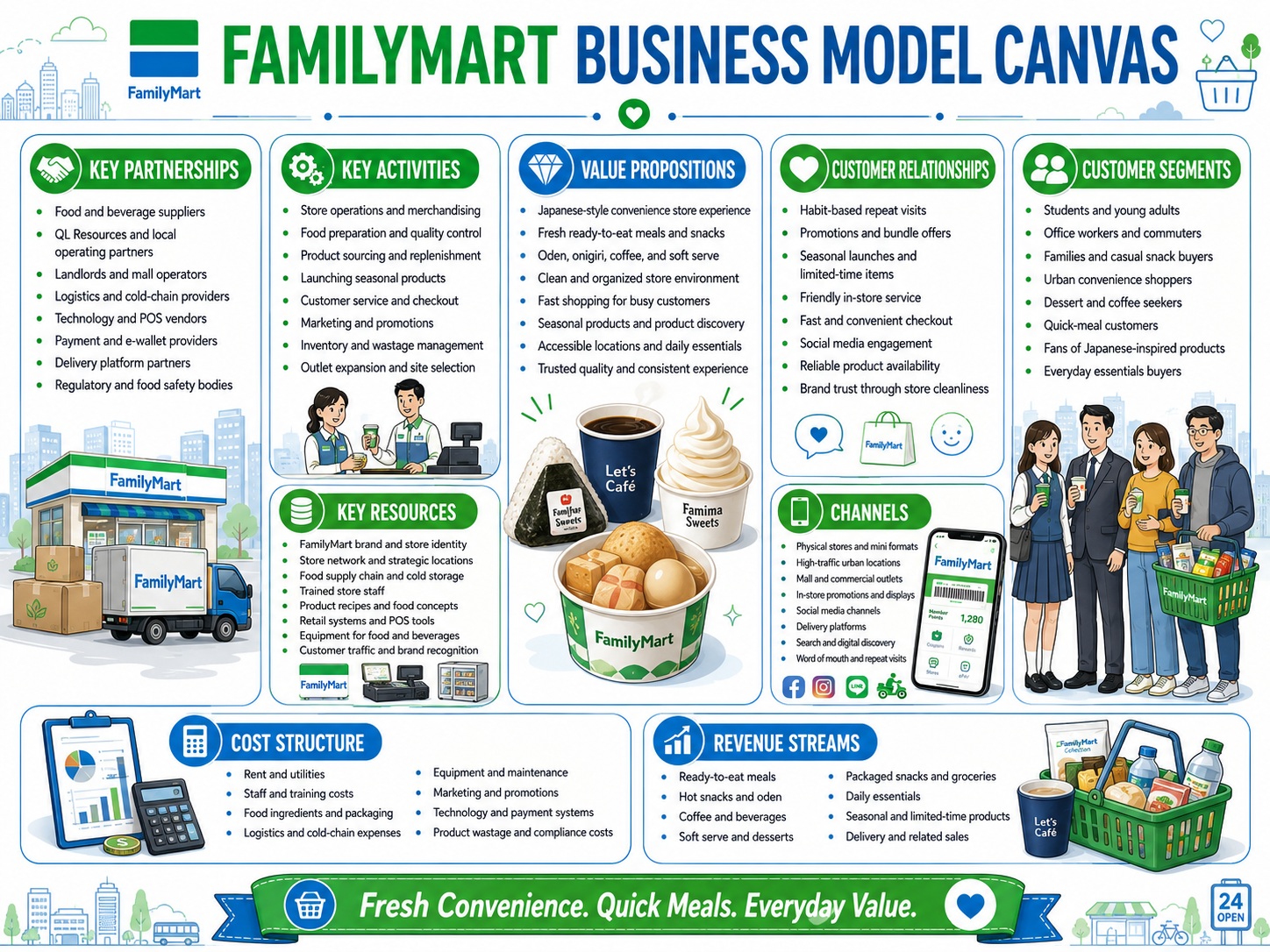
FamilyMart Business Model Canvas Summary
Before going into each block in detail, the summary below gives a quick view of how FamilyMart’s business model works.
| BMC Block | FamilyMart Application |
|---|---|
| Customer Segments | Urban consumers, students, office workers, commuters, families, snack buyers, meal seekers, dessert lovers, and convenience shoppers. |
| Value Propositions | Japanese-style convenience, fresh food, oden, quick meals, coffee, sofuto, desserts, clean stores, and daily essentials. |
| Channels | Physical stores, malls, shop lots, commercial areas, compact formats, FamilyMart Mini, FamiCafé, social media, and delivery platforms. |
| Customer Relationships | Habit-based visits, product novelty, promotions, seasonal launches, store experience, social media engagement, and repeat convenience. |
| Revenue Streams | Ready-to-eat food, hot food, beverages, coffee, desserts, packaged goods, daily essentials, private-label products, and compact formats. |
| Key Resources | Brand, store network, QL operating support, recipes, food supply chain, trained staff, equipment, technology, and retail systems. |
| Key Activities | Food preparation, store operations, menu planning, sourcing, replenishment, quality control, marketing, training, and expansion planning. |
| Key Partnerships | FamilyMart Co. Ltd, QL Resources, suppliers, landlords, logistics providers, payment partners, technology providers, and delivery platforms. |
| Cost Structure | Food cost, rent, labour, utilities, logistics, equipment, packaging, wastage, marketing, technology, training, and franchise-related costs. |
The summary shows one key point. FamilyMart is not only a retail store network. It is a food-led convenience operating model.
1. Customer Segments
Customer segments describe who the business serves. FamilyMart serves a broad customer base, but its strongest appeal is among urban, mobile, food-oriented, and convenience-driven consumers.
FamilyMart’s customers are not all buying for the same reason. Students may want affordable snacks and oden. Office workers may need lunch, coffee, or a fast after-work purchase. Commuters may value speed and accessibility. Families may visit for desserts, drinks, and small grocery items.
Another important group is the discovery shopper. This customer does not always enter with a fixed shopping list. Seasonal items, Japanese-inspired products, imported snacks, and limited-time desserts create reasons to browse.
The brand also serves customers who want convenience without feeling that they are buying from an ordinary mini market. Store cleanliness, product presentation, and food variety create a slightly more premium perception.
| Customer Segment | What They Need | How FamilyMart Serves Them |
|---|---|---|
| Students | Affordable snacks and quick meals. | Offers oden, drinks, sofuto, and ready-to-eat food. |
| Office workers | Fast lunch, coffee, and after-work convenience. | Provides meals, beverages, and accessible outlets. |
| Families | Desserts, snacks, and simple food options. | Offers sofuto, packaged snacks, and daily essentials. |
| Commuters | Speed and nearby access. | Uses strategic outlet locations and compact formats. |
| Discovery shoppers | New products and small treats. | Launches seasonal and Japanese-inspired items. |
The FamilyMart Business Model Canvas shows that the brand is built around many small but frequent customer missions.
2. Value Propositions
The value proposition explains why customers choose FamilyMart. At the simplest level, FamilyMart offers Japanese-style convenience that feels fast, clean, practical, and enjoyable.
Its strongest value is ready-to-eat food. Customers can buy oden, onigiri, meals, sandwiches, hot snacks, coffee, sofuto, desserts, and beverages without waiting for a restaurant experience.
Product discovery is another important value. FamilyMart gives customers something new to try through seasonal launches, Japanese-inspired products, limited-time desserts, imported snacks, and rotating promotions.
Convenience remains the foundation. Stores are designed for quick decisions, clear product access, and fast checkout. This matters for students, office workers, commuters, and busy households.
| Value Proposition | Customer Benefit | Business Impact |
|---|---|---|
| Japanese-style convenience | Customers get a different retail experience. | Strengthens brand differentiation. |
| Ready-to-eat food | Customers save time on meals. | Drives repeat visits and basket value. |
| Desserts and sofuto | Customers enjoy small treats. | Creates impulse purchases. |
| Clean store experience | Customers feel more confident buying food. | Builds trust and frequency. |
| Seasonal products | Customers have reasons to return. | Supports traffic and social visibility. |
FamilyMart’s value proposition is not only convenience. It is convenience with freshness, novelty, food appeal, and brand trust.
3. Channels
Channels explain how FamilyMart reaches customers. The most important channel is the physical store network.
FamilyMart operates in malls, shop lots, commercial areas, dense residential zones, office catchments, and selected travel-related locations. These outlets support both planned and impulse purchases.
Location matters because convenience retail is often decided in seconds. Customers may choose the option that is nearest, fastest, cleanest, or easiest to access.
The company also uses compact formats. FamilyMart Mini extends the brand into smaller spaces, while FamiCafé allows the business to participate more directly in coffee and beverage occasions.
Digital channels support visibility. Social media, online campaigns, delivery platforms, search discovery, and product announcements help customers notice new items and find nearby outlets.
| Channel | Examples | Strategic Role |
|---|---|---|
| Physical stores | Malls, shop lots, commercial areas, and residential catchments. | Capture walk-in and impulse traffic. |
| Compact formats | FamilyMart Mini and vending-style touchpoints. | Reach spaces that cannot support full outlets. |
| Beverage formats | FamiCafé touchpoints. | Compete in coffee and drink occasions. |
| Delivery platforms | Food delivery apps and online ordering. | Serve home and office demand. |
| Social media | Product launches and promotional content. | Build awareness and repeat interest. |
Strong channels make FamilyMart more present in the customer’s daily routine.
4. Customer Relationships
Customer relationships describe how FamilyMart keeps people coming back. The relationship model is built on habit, novelty, convenience, trust, and product availability.
The brand does not depend only on personal service. Its relationship with customers is frequent and practical. Customers return because the store solves simple daily needs quickly.
Habit is the strongest relationship driver. Coffee, lunch, snacks, dessert, and small essentials create recurring reasons to visit.
Product novelty keeps the relationship fresh. Seasonal desserts, Japanese-inspired snacks, limited-time drinks, and promotional bundles make customers curious about what is new.
Store experience also matters. Clean shelves, reliable food availability, helpful staff, fast checkout, and visible product preparation help customers trust the brand.
| Relationship Driver | How It Works | Example |
|---|---|---|
| Convenience habit | Customers return for quick daily needs. | A worker buys coffee before work. |
| Product novelty | New products create reasons to revisit. | A seasonal sofuto flavour drives trial. |
| Store trust | Clean and organized stores reduce purchase anxiety. | Customers feel confident buying ready meals. |
| Promotions | Bundles and campaigns make purchases timely. | A snack-and-drink deal increases basket size. |
| Digital visibility | Social content keeps the brand top of mind. | Customers notice a new dessert online. |
FamilyMart’s relationship with customers is not built on luxury exclusivity. It is built on repeat relevance.
5. Revenue Streams
Revenue streams show how the business makes money. FamilyMart generates revenue mainly through food, beverages, packaged goods, desserts, daily essentials, private-label items, and compact retail formats.
The core revenue engine is store sales. Each transaction may include a ready meal, drink, snack, dessert, or household item. Small add-ons can increase basket size.
Foodservice creates stronger differentiation than basic retail. Oden, hot snacks, coffee, sofuto, and fresh meals give customers more reasons to visit than packaged goods alone.
Delivery and compact formats also expand revenue opportunities. A customer who does not visit a full outlet may still buy through a delivery app, vending point, or smaller retail touchpoint.
| Revenue Stream | Description | Why It Matters |
|---|---|---|
| Ready-to-eat food | Oden, onigiri, meals, sandwiches, and hot snacks. | Forms a strong differentiation engine. |
| Beverages and coffee | Coffee, tea, bottled drinks, and chilled beverages. | Supports daily purchase frequency. |
| Desserts and sofuto | Ice cream, cakes, sweets, and seasonal treats. | Drives impulse and family purchases. |
| Packaged goods | Snacks, instant food, imported products, and groceries. | Adds basket value. |
| Daily essentials | Household and personal care basics. | Supports convenience missions. |
| Compact formats | FamilyMart Mini and vending-style formats. | Extends reach beyond full stores. |
The FamilyMart Business Model Canvas shows a revenue model based on frequency, basket expansion, food-led margins, and outlet productivity.
6. Key Resources
Key resources are the assets required to deliver the business model. For FamilyMart, the most important resources are brand equity, store network, food supply chain, recipes, trained staff, retail systems, equipment, and QL’s operating support.
Brand is a major resource because customers must trust the store before buying ready-to-eat food. The Japanese identity makes FamilyMart easier to recognize and harder to confuse with ordinary mini markets.
Food supply chain capability is equally important. Fresh meals, chilled items, frozen products, desserts, beverages, and hot food require reliable logistics, temperature control, supplier discipline, and quality assurance.
Store network is another key asset. Good locations create visibility, traffic, and convenience. Weak locations can weaken performance even when the brand is strong.
| Key Resource | Role in the Business Model | Strategic Value |
|---|---|---|
| Brand equity | Recognition, trust, and Japanese retail identity. | Helps FamilyMart stand out. |
| Store network | Physical access across strategic locations. | Drives convenience and frequency. |
| Supply chain | Food sourcing, logistics, and replenishment. | Protects availability and freshness. |
| Recipes and product standards | Food concepts and preparation methods. | Supports consistency and innovation. |
| Staff and operating systems | Store execution, service, stock, and hygiene. | Maintains customer experience. |
| QL operating support | Local food and retail capability. | Strengthens execution in Malaysia. |
Together, these resources make FamilyMart a repeatable retail operating system.
7. Key Activities
Key activities are the things FamilyMart must do well to stay competitive. These include food preparation, store operations, product planning, sourcing, replenishment, quality control, marketing, training, and expansion planning.
The most important activity is store execution. Customers expect food availability, clean stores, quick checkout, accurate pricing, friendly service, and consistent freshness.
Product planning is also critical. FamilyMart must keep popular items available while launching new products that create excitement. This balance prevents both boredom and confusion.
Supply chain management supports the full model. Fresh food retail requires forecasting, cold chain control, supplier coordination, replenishment discipline, and wastage management.
| Key Activity | What It Involves | Why It Matters |
|---|---|---|
| Food preparation | Preparing hot food, meals, and desserts safely. | Protects trust and repeat purchase. |
| Store operations | Staffing, checkout, cleaning, stock, and service. | Keeps outlets reliable. |
| Product innovation | Seasonal products, desserts, and new food items. | Creates repeat interest. |
| Supply management | Forecasting, logistics, and replenishment. | Protects freshness and availability. |
| Marketing | Product launches, promotions, and digital content. | Drives awareness and traffic. |
| Quality control | Hygiene, temperature, audits, and standards. | Reduces operational risk. |
The FamilyMart Business Model Canvas makes one point clear: operational discipline is the hidden engine behind convenience.
8. Key Partnerships
Key partnerships help FamilyMart operate, expand, and serve customers more efficiently. These partnerships include FamilyMart Co. Ltd, QL Resources, food suppliers, packaged goods suppliers, landlords, logistics providers, technology providers, payment partners, and delivery platforms.
FamilyMart Co. Ltd provides the brand, concept, retail identity, and convenience store know-how. QL Resources supports local execution through food capability, distribution experience, and market knowledge.
Supplier quality matters because food-led retail is execution-dependent. Weak ingredients affect taste. Late deliveries reduce availability. Poor packaging can damage presentation and customer trust.
Landlords also shape performance. Mall operators, shop lot owners, petrol station partners, and commercial property owners influence traffic, rent, store visibility, and expansion speed.
| Partner Type | Examples | Contribution to the Business Model |
|---|---|---|
| Brand and franchising partner | FamilyMart Co. Ltd. | Provides concept, standards, and brand identity. |
| Local operating platform | QL Resources and Maxincome Resources. | Supports food, distribution, and execution. |
| Food suppliers | Ingredients, meals, desserts, and beverages. | Enable product variety and freshness. |
| Landlords | Malls, shop lots, and commercial sites. | Provide customer access. |
| Logistics partners | Distribution and cold chain support. | Maintain availability and quality. |
| Technology and payment partners | POS, payments, inventory, and delivery integration. | Improve efficiency and convenience. |
Partnership quality directly affects the customer experience at store level.
9. Cost Structure
Cost structure explains where the money goes. FamilyMart operates in a cost-heavy retail category because each outlet requires rent, labour, utilities, stock, equipment, logistics, technology, and maintenance.
Foodservice adds another cost layer. Ready meals, hot snacks, desserts, chilled products, and coffee require ingredients, preparation equipment, refrigeration, food safety processes, and wastage control.
FamilyMart must manage a difficult balance. Customers expect convenience, attractive prices, clean stores, fresh products, and regular promotions. At the same time, the company must protect margins against rental pressure, wage costs, utility bills, and food wastage.
| Cost Category | Examples | Management Challenge |
|---|---|---|
| Food and ingredients | Meals, oden items, desserts, coffee, and snacks. | Maintain quality while controlling input costs. |
| Rental and utilities | Mall rent, shop lot rent, electricity, and water. | Good locations can raise fixed costs. |
| Labour | Store staff, supervisors, trainers, and support teams. | Service quality depends on staffing discipline. |
| Equipment | Refrigeration, warmers, coffee machines, POS, and kitchen tools. | Reliability affects food quality and uptime. |
| Logistics | Warehousing, replenishment, and cold chain movement. | Wider networks increase complexity. |
| Marketing and technology | Campaigns, digital tools, payments, and delivery integration. | Spending must support traffic or efficiency. |
| Wastage | Unsold fresh food and expired products. | Poor forecasting can reduce margin. |
The model only works when store productivity, stock accuracy, and cost discipline stay healthy.
Strategic Lessons from FamilyMart’s Business Model
FamilyMart offers several useful lessons for entrepreneurs, retailers, and business strategists.
The first lesson is that convenience must have a reason to repeat. Location brings customers once, but food variety, trust, novelty, and availability bring them back.
The second lesson is that small-ticket products need frequency. Oden, coffee, snacks, and desserts may not create large single transactions, but they can create recurring daily and weekly purchases.
The third lesson is that experience can differentiate a common category. Many stores sell snacks and drinks. FamilyMart makes the buying occasion feel cleaner, more curated, and more enjoyable.
The fourth lesson is that food-led retail requires discipline. Freshness, temperature, hygiene, staffing, forecasting, and wastage control are not optional. They are core to the economics.
The fifth lesson is that scale must be productive. More outlets improve visibility, but every location must justify rent, labour, stock, equipment, and logistics.
The sixth lesson is that local operating strength matters. A Japanese concept becomes more competitive when adapted to Malaysian habits, pricing expectations, supply conditions, and daily food occasions.
Value Proposition Canvas View of FamilyMart
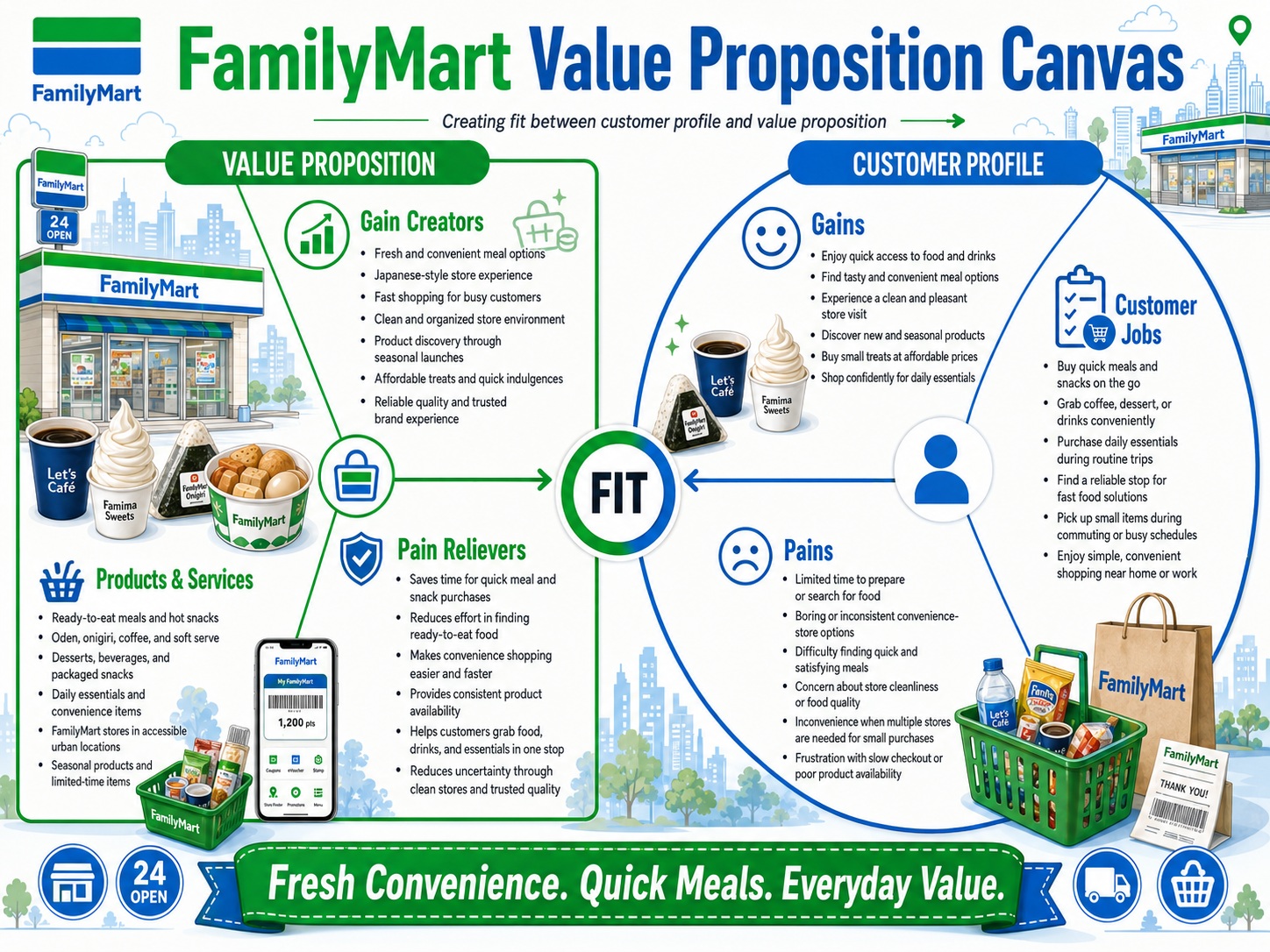
The Value Proposition Canvas helps explain the fit between FamilyMart’s offer and customer needs. It shows why customers choose FamilyMart not only because it sells convenience products, but because it solves practical and emotional needs.
Customer Profile
The customer profile explains what FamilyMart customers are trying to achieve, what problems they face, and what benefits they want. Many customers are busy, urban, mobile, time-sensitive, and open to small affordable treats.
For customer jobs, FamilyMart helps customers buy quick meals, snacks, coffee, desserts, drinks, and basic essentials. These jobs occur frequently and often require speed.
For customer pains, customers face limited time, boring food choices, inconsistent quality, long queues, poor availability, and inconvenient locations. FamilyMart reduces these pains through ready-to-eat food, nearby outlets, clean stores, and quick checkout.
For customer gains, customers want freshness, variety, novelty, convenience, attractive presentation, and small moments of enjoyment. FamilyMart creates these gains through Japanese-inspired food, sofuto, oden, seasonal products, and store experience.
Value Proposition
FamilyMart’s products and services include oden, ready meals, onigiri, sandwiches, coffee, sofuto, desserts, snacks, beverages, daily essentials, FamilyMart Mini, FamiCafé, and delivery access.
Pain relievers include time savings, easy food access, standardized products, clean store environments, familiar layouts, and convenient locations. These benefits reduce friction in daily purchase decisions.
Gain creators include Japanese-style retail experience, seasonal product excitement, dessert appeal, product discovery, branded food counters, and repeat-purchase routines.
Customer Profile and Value Proposition Fit
| Customer Profile | Details | Matching Value Proposition | How FamilyMart Creates Fit |
|---|---|---|---|
| Customer Jobs | Customers want quick meals, drinks, snacks, desserts, coffee, and essentials. | Products and Services | Oden, meals, coffee, sofuto, snacks, beverages, and daily essentials. |
| Customer Pains | Customers face limited time, boring options, queues, poor availability, and inconsistent quality. | Pain Relievers | Nearby stores, ready food, clean layouts, fast checkout, and reliable product standards. |
| Customer Gains | Customers want freshness, variety, novelty, comfort, and small indulgence. | Gain Creators | Japanese-style products, seasonal items, desserts, and discovery-led retail experience. |
This fit explains why FamilyMart can remain relevant despite intense competition. Customers are not only buying convenience. They are buying fast access, small enjoyment, and a trusted food experience.
Competitive Advantage of FamilyMart
FamilyMart’s competitive advantage comes from several layers working together. It is not protected by one factor alone.
- Japanese convenience store identity: FamilyMart brings a clear “konbini” position that differentiates it from traditional mini markets.
- Food-led retail model: Oden, meals, coffee, desserts, and sofuto give customers stronger reasons to visit.
- Store experience: Clean layouts, curated products, visible food counters, and organized shelves create a more premium perception.
- Product discovery: Seasonal items, Japanese-inspired products, and limited-time launches encourage browsing and trial.
- QL Resources backing: Local food, distribution, and retail support strengthen execution in Malaysia.
- Multiple formats: Full stores, FamilyMart Mini, FamiCafé, and delivery access help the brand serve different locations and occasions.
- Repeat-purchase habit: Small meals, drinks, and snacks create frequent reasons to return.
Strategic Implication
The FamilyMart Business Model Canvas is powerful because it shows a system, not just a store. FamilyMart competes through brand identity, food variety, location access, operating consistency, product novelty, and supply chain strength.
Risks and Challenges
FamilyMart still faces real business risks. These risks do not mean the model is weak. They show where management discipline is required.
- Intense competition: FamilyMart competes with convenience stores, mini markets, cafés, bakeries, supermarkets, petrol station stores, QSR brands, and delivery platforms.
- Low switching cost: Customers can easily choose a nearby competitor if FamilyMart is too far, too expensive, or out of stock.
- Margin pressure: Rent, labour, utilities, food cost, packaging, logistics, and marketing can reduce profitability.
- Food wastage: Fresh food creates differentiation but increases the risk of unsold or expired inventory.
- Outlet productivity risk: A larger network creates visibility, but weak locations can reduce profitability.
- Quality consistency: Foodservice depends on hygiene, temperature, preparation standards, training, and staff discipline.
- Expansion complexity: More stores require stronger systems, forecasting, logistics, audits, and management control.
- Customer trend risk: Demand can shift toward healthier meals, cheaper alternatives, coffee chains, or delivery-first food options.
Strategic Implication
These risks do not weaken the model automatically. They show that growth must be supported by margin control, freshness management, outlet discipline, and customer relevance.
Conclusion
The FamilyMart Business Model Canvas shows how a Japanese convenience store concept became a food-led retail model in Malaysia. Its success is not based only on selling daily essentials.
Instead, the model is built on ready-to-eat food, oden, coffee, desserts, sofuto, product discovery, clean stores, accessible locations, and repeat customer routines.
FamilyMart’s strength comes from combining global brand identity with local operating capability. QL Resources gives the Malaysian business an important platform for food production, supply chain support, distribution, and retail execution.
However, the model is not easy to run. Fresh food, premium locations, trained staff, equipment, logistics, wastage control, and product quality create constant pressure.
For entrepreneurs, the key lesson is clear. Modern convenience retail is no longer only about being nearby. The winning model must be nearby, useful, enjoyable, consistent, and operationally disciplined.
Disclaimer
This article is prepared for educational, business analysis, and knowledge-sharing purposes only. All brands, trademarks, logos, and company names mentioned belong to their respective owners. This article is not officially represented, sponsored, endorsed, or affiliated with FamilyMart, QL Resources, or any related entity. The information presented is based on public sources, general observation, and the author’s analysis of the business model.

