Quipper Business Model Canvas
Explore the Quipper Business Model Canvas, nine BMC blocks, Value Proposition Canvas, Ruangguru and Pahamify comparison, competitive advantages, risks, and strategic recommendations.
This article analyzes Shopee's business model using the Business Model Canvas (BMC). BMC is used to develop, analyze, and update business models.
BMC Article No: BMC #016
Updated in 2026: This article has been rewritten with a stronger business story, clearer Business Model Canvas structure, Value Proposition Canvas analysis, competitive advantages, risks, and strategic lessons from Shopee’s marketplace growth journey.
Shopee is more than an online shopping app. It is a digital marketplace built around convenience, price discovery, seller access, payment options, logistics integration, advertising, and campaign-led shopping behaviour. That is why the Shopee Business Model Canvas is interesting. It shows how an e-commerce platform can grow by connecting millions of buyers and sellers inside one digital environment.
The strength of Shopee does not come from product ownership alone. Its real advantage comes from the combination of marketplace traffic, mobile-first shopping, seller tools, vouchers, live commerce, delivery coordination, digital payments, and large-scale promotional events. A customer may buy skincare during a flash sale. Small sellers may use Shopee to reach customers nationwide. Official brands may use Shopee Mall to build trust and drive direct store sales.
This makes Shopee different from a traditional retailer. It does not need to own every product, operate every warehouse, or run every store. Instead, it builds the platform where buyers search, sellers list, advertisers promote, payment providers process, and logistics partners deliver.
In this article, we will break down the Shopee Business Model Canvas and examine how Shopee creates value, reaches customers, generates revenue, manages cost, and protects its position in the competitive e-commerce market.
Shopee’s business model is built around a multi-sided e-commerce marketplace. The company connects buyers, sellers, brands, logistics providers, payment providers, and advertisers through its website, mobile app, seller tools, payment features, and fulfilment ecosystem.
Its main strength is accessibility. Shopee is designed to make online shopping easy to start, easy to compare, easy to pay for, and easy to track. Buyers can browse many product categories, compare prices, use vouchers, read reviews, and complete purchases without visiting a physical store.
Sellers also benefit from this accessibility. A small business can open a store on Shopee without building its own e-commerce website, payment gateway, traffic engine, or delivery infrastructure from scratch. This lowers the barrier for online selling and increases the number of sellers on the platform.
Its main challenge is market intensity. E-commerce has low switching costs. Customers can compare Shopee with Lazada, TikTok Shop, brand websites, physical stores, and other digital marketplaces. Sellers can also list products on several platforms at the same time. This means Shopee must compete continuously on price, traffic, trust, seller tools, customer experience, logistics quality, and promotional effectiveness.
The Shopee Business Model Canvas therefore shows a business that looks simple on the app, but requires strong operating discipline behind the scenes. Technology, trust, payment, delivery, seller governance, campaign execution, customer support, and data analytics must work together.
Business Model Canvas, or BMC, is a simple tool used to understand how a business works. It helps readers see the logic behind how a company creates value, delivers that value to customers, and turns it into revenue. Instead of looking only at products or sales, BMC breaks the business into practical operating parts.
It divides a company into nine key building blocks:
| BMC Block | Main Question |
|---|---|
| Customer Segments | Who does the business serve? |
| Value Propositions | What value does the business offer? |
| Channels | How does the business reach customers? |
| Customer Relationships | How does the business build loyalty? |
| Revenue Streams | How does the business make money? |
| Key Resources | What assets does the business need? |
| Key Activities | What must the business do well? |
| Key Partnerships | Who helps the business operate? |
| Cost Structure | What are the major costs? |
For Shopee, the BMC is useful because the business is not only about selling products online. It involves marketplace design, seller acquisition, product search, payment processing, logistics coordination, advertising monetization, data analytics, campaign management, buyer protection, and trust-building.
Shopee was launched in 2015 and became one of the most recognized e-commerce platforms in Southeast Asia and Taiwan. The platform grew during a period when consumers were becoming more comfortable with mobile shopping, online payment, digital promotions, and home delivery.
Its early positioning was strongly mobile-first. This mattered because many Southeast Asian consumers accessed the internet mainly through smartphones. Shopee made online shopping feel familiar through app notifications, vouchers, chat functions, seller ratings, reviews, flash sales, and simple checkout flows.
The platform now serves many product categories, including fashion, beauty, electronics, home and living, groceries, toys, automotive products, personal care, and lifestyle goods. This broad category mix helps Shopee serve different purchase occasions, from planned shopping to impulse buying.
Shopee’s marketplace also includes official stores, small sellers, cross-border merchants, local brands, livestream sellers, and campaign participants. This gives the platform a wide product base and creates strong comparison behaviour among customers.
The Shopee Business Model Canvas helps explain why the platform is strategically important. Shopee is not only an e-commerce storefront. It is a repeat-transaction marketplace supported by technology, sellers, payments, logistics, customer data, promotions, and platform trust.
Shopee is interesting because it turns online shopping into a high-frequency digital habit. A customer may start with one discounted item, return for free shipping, browse during a campaign, follow a seller, watch a livestream, collect vouchers, and reorder household items later.
Traditional shops earn from foot traffic in one location. Shopee earns from digital traffic across many locations, product categories, and seller groups. Its marketplace becomes more useful when more buyers attract more sellers, and more sellers attract more buyers.
The brand also benefits from campaign memory. Dates such as 9.9, 10.10, 11.11, and 12.12 create shopping rituals. These campaigns help Shopee train customers to return at specific times, compare deals, and complete purchases with urgency.
Another strategic point is monetization depth. Shopee can earn from transaction commissions, seller fees, advertising placements, logistics-related services, payment-related services, and value-added seller tools. This gives the business more revenue options than a simple online catalogue.
From a strategy perspective, the Shopee Business Model Canvas shows how an e-commerce platform can use traffic, data, trust, payments, logistics, and seller participation to compete in a crowded digital commerce market.
Shopee’s current story is not only about online shopping growth. It is also about profitability, advertising revenue, live commerce, logistics efficiency, competitive pressure, and seller quality.
One major development is the shift from pure growth to efficiency. E-commerce platforms across Southeast Asia have faced pressure to improve margins, reduce excessive subsidies, and prove that transaction volume can convert into sustainable profit. For Shopee, this means promotions and free shipping must be balanced against revenue quality and operating cost.
Another development is the rise of social commerce. TikTok Shop and livestream selling have changed customer discovery behaviour. Many customers no longer search only through marketplace categories. They discover products through short videos, influencers, livestreams, and creator-led selling. Shopee has responded by strengthening features such as Shopee Live and campaign-based engagement.
Advertising is also becoming more important. Sellers and brands need visibility inside a crowded marketplace. Sponsored search, display placements, campaign participation, and official-store promotions can become meaningful revenue streams for Shopee while helping sellers compete for attention.
At the same time, buyers are becoming more demanding. They expect low prices, authentic products, fast delivery, easy returns, reliable reviews, secure payments, and responsive customer service. This raises the operating standard for Shopee and increases the importance of platform trust.
This latest context changes the way we read the Shopee Business Model Canvas. The platform has strong reach and brand recognition, but long-term success depends on how well it balances buyer value, seller quality, monetization, delivery experience, and cost discipline.
Before going into each block in detail, the summary below gives a quick view of how Shopee’s business model works. It shows who the platform serves, what value it offers, how it reaches customers, how revenue is generated, and what resources and activities keep the model running.
| BMC Block | Shopee Application |
|---|---|
| Customer Segments | Retail buyers, price-sensitive shoppers, SMEs, official brands, cross-border sellers, advertisers, and digital payment users. |
| Value Propositions | Wide product selection, competitive prices, vouchers, convenient shopping, seller market access, secure payment, reviews, and delivery integration. |
| Channels | Mobile app, website, seller stores, Shopee Mall, social media, push notifications, digital ads, livestreams, affiliates, and logistics touchpoints. |
| Customer Relationships | Loyalty rewards, vouchers, Shopee Coins, customer support, seller chat, reviews, recommendations, buyer protection, and campaign engagement. |
| Revenue Streams | Sales commissions, seller service fees, advertising fees, logistics-related income, payment-related services, campaign participation, and value-added seller tools. |
| Key Resources | Technology platform, customer data, seller network, brand equity, logistics integration, payment ecosystem, workforce, and marketplace algorithms. |
| Key Activities | Platform management, seller onboarding, marketing campaigns, logistics coordination, payment enablement, fraud control, customer support, and data analytics. |
| Key Partnerships | Sellers, brands, logistics companies, payment providers, banks, influencers, affiliates, technology providers, and marketing partners. |
| Cost Structure | Technology, marketing, vouchers, free shipping subsidies, logistics support, staff, customer service, payment processing, compliance, and platform security. |
Shopee BMC Diagram:
Customer segments describe who the business serves. Shopee serves a broad marketplace base, but its most important segments are buyers, sellers, brands, and advertisers.
Shopee’s buyers are not all shopping for the same reason. Some customers want the cheapest price. Others want product variety, official stores, free shipping, fast delivery, or convenient reordering. Students may buy fashion accessories. Parents may buy household products. Office workers may order phone accessories. Small business owners may buy packaging materials.
Shopee also serves sellers. Small and medium businesses use the platform to access digital customers without building their own online infrastructure. Larger brands use Shopee Mall and official stores to protect brand trust and reach marketplace shoppers.
This broad customer base gives Shopee room to grow. The platform is not limited to one product category, one buyer type, or one selling model.
| Customer Segment | What They Need | How Shopee Serves Them |
|---|---|---|
| Retail buyers | Convenient online shopping for daily and lifestyle products. | Offers wide product categories, app-based shopping, payment options, and delivery tracking. |
| Price-sensitive shoppers | Discounts, vouchers, free shipping, and campaign deals. | Uses flash sales, coins, vouchers, free shipping campaigns, and mega-sale events. |
| Small and medium sellers | Affordable access to online customers. | Provides seller stores, seller tools, payment support, campaign access, and logistics options. |
| Official brands | Trusted online storefronts and brand control. | Provides Shopee Mall, official store formats, campaign placements, and advertising tools. |
| Cross-border sellers | Access to Southeast Asian and Taiwanese customers. | Enables marketplace listing, cross-border fulfilment support, and customer reach. |
| Advertisers and merchants | Visibility inside a crowded marketplace. | Offers search ads, display ads, campaign packages, and promoted product placements. |
The Shopee Business Model Canvas shows that the platform does not depend on one customer group. Its model works because buyers, sellers, brands, and advertisers strengthen one another.
The value proposition explains why customers choose Shopee. At the simplest level, Shopee offers convenient online shopping with wide selection, competitive prices, and integrated fulfilment support.
Shopee’s value proposition is built around reducing shopping friction. Customers can search for products, compare sellers, read reviews, apply vouchers, pay online, and track orders inside one platform. This makes shopping easier than visiting many physical stores or browsing many separate websites.
The strongest part of Shopee’s value proposition is marketplace abundance. Customers can find many products from many sellers at different price points. This creates choice, comparison, and deal discovery.
For sellers, Shopee offers market access. A seller can reach customers faster by joining a platform that already has traffic, payment tools, campaign events, and logistics arrangements.
| Value Proposition | Customer Benefit | Business Impact |
|---|---|---|
| Wide product selection | Customers can choose from many categories, sellers, and price points. | Increases browsing time, purchase frequency, and marketplace relevance. |
| Competitive pricing | Buyers can access discounts, seller promotions, vouchers, and flash sales. | Strengthens traffic and encourages campaign participation. |
| Convenient shopping | Product search, checkout, payment, tracking, and returns happen in one platform. | Reduces friction and improves conversion. |
| Buyer trust signals | Reviews, ratings, Shopee Mall, buyer protection, and seller chat reduce uncertainty. | Builds confidence and supports repeat purchasing. |
| Seller market access | Sellers can reach customers without building their own e-commerce system. | Expands supply and strengthens marketplace depth. |
| Campaign-led shopping | Mega campaigns create urgency and repeat visits. | Drives traffic spikes, order volume, and seller advertising demand. |
Shopee’s value proposition is not only cheap products. It is the full experience of discovery, comparison, convenience, trust, and deal excitement.
Channels explain how Shopee reaches customers. This is one of the most important parts of the Shopee Business Model Canvas.
Shopee uses a multi-channel digital model. The mobile app is the main channel because customers can browse, receive notifications, collect vouchers, chat with sellers, pay, and track orders easily. Website access supports desktop shopping, search visibility, and broader browsing.
Social media also plays a major role. Shopee uses platforms such as Facebook, Instagram, TikTok, YouTube, affiliates, and influencer content to promote campaigns and product discovery. Livestreaming adds another layer because customers can watch sellers demonstrate products and buy during live sessions.
Logistics touchpoints also function as channels. Delivery notifications, parcel tracking, pick-up points, and return processes shape how customers experience Shopee after checkout.
| Channel | Examples | Strategic Role |
|---|---|---|
| Mobile app | Product browsing, checkout, vouchers, Shopee Live, seller chat, and order tracking. | Creates daily engagement and supports high-frequency shopping behaviour. |
| Website | Desktop browsing, search traffic, product pages, and seller stores. | Supports wider access and search-based discovery. |
| Social media | Facebook, Instagram, TikTok, YouTube, influencer content, and campaign posts. | Builds awareness and drives traffic during promotions. |
| Digital advertising | Search ads, retargeting, display ads, app notifications, and email marketing. | Pulls users back into the platform and improves campaign conversion. |
| Seller stores and Shopee Mall | Individual seller shops, official brand stores, and curated product pages. | Creates trust, product depth, and brand-led shopping paths. |
| Logistics touchpoints | Delivery tracking, courier updates, pick-up, returns, and customer notifications. | Completes the online-to-offline customer experience. |
Strong channels make Shopee more accessible. In e-commerce, visibility and convenience often determine which platform gets the transaction.
Customer relationships describe how Shopee keeps people coming back. Shopee’s relationship model is built on habit, rewards, trust, personalization, and campaign engagement.
The platform does not depend only on personal service. Its relationship model is mostly digital and behaviour-based. Customers return because they receive vouchers, collect coins, discover deals, get recommendations, follow sellers, join campaigns, and trust the transaction process.
Shopee also uses buyer-seller interaction. Chat functions allow customers to ask questions before buying. Reviews and ratings help customers evaluate products. Buyer protection reduces fear when purchasing from unfamiliar sellers.
Seller relationships are equally important. Shopee must keep sellers active by offering dashboards, campaign tools, advertising products, performance metrics, education content, and customer access.
| Relationship Driver | How It Works | Example |
|---|---|---|
| Loyalty rewards | Customers earn coins, vouchers, or campaign benefits from platform usage. | A buyer returns because coins and free shipping vouchers lower the final price. |
| Personalized recommendations | Shopee suggests products based on browsing, search, and purchase behaviour. | A customer who buys skincare sees related beauty products and promotions. |
| Buyer protection | Payment, dispute, review, and refund processes reduce perceived risk. | A buyer feels safer ordering from a seller with strong ratings and platform safeguards. |
| Seller chat and reviews | Customers can ask sellers questions and read feedback before purchase. | A customer checks size, delivery timing, and product quality before ordering. |
| Campaign engagement | Mega sales, flash deals, live sessions, and vouchers create return triggers. | A shopper waits for 11.11 or 12.12 to buy planned items. |
| Seller support | Sellers receive tools, dashboards, tutorials, and promotional options. | A small merchant improves sales by joining campaigns and using ads. |
Shopee’s relationship with customers is not built on exclusivity. It is built on repeat relevance. The platform needs to remain useful, trusted, affordable, and visible.
Revenue streams show how the business makes money. Shopee generates revenue through marketplace transactions, seller services, advertising, logistics-related income, payment-related services, and campaign participation.
The core revenue engine is marketplace activity. Every successful transaction can create commission or service fee opportunities, depending on seller type, product category, market rules, and platform policies.
Advertising has become increasingly important because sellers need visibility. A marketplace with many sellers creates competition for attention. Search ads, promoted listings, display placements, and campaign packages allow Shopee to monetize seller demand for traffic.
Logistics and payment-related services also support the revenue model. These services help Shopee control the customer experience while creating additional monetization opportunities.
| Revenue Stream | Description | Why It Matters |
|---|---|---|
| Sales commissions | Fees from successful marketplace transactions. | Forms a direct link between platform volume and revenue. |
| Seller service fees | Charges for selected marketplace services and seller participation. | Helps monetize platform access and operating support. |
| Advertising fees | Paid search, promoted listings, display placements, and campaign visibility. | Converts seller competition into platform revenue. |
| Logistics-related income | Shipping arrangements, fulfilment-related services, and delivery-linked charges. | Supports the delivery experience and adds monetization depth. |
| Payment-related services | Payment processing, wallet-related activity, and financial service adjacencies where applicable. | Strengthens platform stickiness and transaction control. |
| Campaign participation | Seller-funded discounts, promotional packages, and mega-sale participation. | Drives traffic while sharing campaign economics with merchants. |
The Shopee Business Model Canvas shows a revenue model based on transaction volume, seller monetization, advertising demand, and ecosystem services.
Key resources are the assets required to deliver the business model. For Shopee, the most important resources are the technology platform, seller base, buyer traffic, customer data, brand equity, logistics integration, payment infrastructure, and workforce capability.
The platform is a major resource because Shopee must handle search, recommendations, checkout, payments, seller tools, fraud controls, customer support, campaign traffic, and order tracking at scale.
However, technology alone is not enough. Shopee also needs sellers, product variety, customer trust, logistics partners, campaign expertise, data analytics, and operating teams. These resources allow the company to deliver a consistent marketplace experience across different countries and product categories.
| Key Resource | Role in the Business Model | Strategic Value |
|---|---|---|
| Technology platform | App, website, search, checkout, seller tools, payment flow, and order systems. | Enables high-volume marketplace activity. |
| Seller network | Local merchants, SMEs, official stores, brands, and cross-border sellers. | Provides product variety and marketplace depth. |
| Customer data | Search behaviour, purchase history, ratings, browsing patterns, and campaign response. | Improves recommendations, targeting, fraud detection, and seller insights. |
| Brand equity | Customer awareness, trust, campaign memory, and platform familiarity. | Reduces acquisition friction and supports repeat usage. |
| Logistics integration | Delivery partners, tracking systems, return processes, and fulfilment coordination. | Strengthens customer experience after checkout. |
| Payment ecosystem | Payment options, wallet features, fraud controls, and transaction infrastructure. | Improves checkout completion and platform trust. |
| Workforce capability | Engineers, product managers, data teams, marketers, operations staff, support agents, and compliance teams. | Keeps the marketplace operating and improving. |
Together, these resources make Shopee more than an online catalogue. They make it a scalable commerce operating system.
Key activities are the things Shopee must do well to stay competitive. These include platform development, seller management, campaign execution, logistics coordination, payment enablement, customer support, fraud control, data analytics, and marketplace governance.
The most important activity is marketplace orchestration. Shopee must ensure buyers can find products, sellers can list effectively, payments can be completed, deliveries can be tracked, and disputes can be handled. Any weakness in this chain can affect trust.
Campaign management is also critical. Shopee’s mega-sale identity requires planning, seller participation, voucher allocation, traffic management, advertising packages, app engagement, and operational readiness. A campaign that attracts traffic but causes poor fulfilment can damage customer experience.
Seller quality is another important activity. Shopee must balance seller growth with product authenticity, service standards, delivery performance, and customer satisfaction.
| Key Activity | What It Involves | Why It Matters |
|---|---|---|
| Platform development | Improving app performance, website functions, search, checkout, and seller tools. | Protects usability and conversion. |
| Seller onboarding and management | Recruiting sellers, training merchants, monitoring performance, and enforcing standards. | Ensures product supply and marketplace quality. |
| Marketing and campaign execution | Running mega sales, vouchers, flash deals, livestreams, ads, and partnerships. | Drives traffic, awareness, and repeat purchase. |
| Logistics coordination | Supporting delivery, tracking, returns, and fulfilment integration. | Shapes customer satisfaction after purchase. |
| Payment enablement | Managing payment options, transaction flow, wallet features, and fraud controls. | Improves trust and checkout completion. |
| Customer support | Handling complaints, refunds, disputes, inquiries, and service issues. | Reduces friction and protects platform reputation. |
| Data analytics | Analyzing demand, pricing, seller performance, customer behaviour, and fraud signals. | Improves decision-making and personalization. |
The Shopee Business Model Canvas shows that operational discipline is the hidden engine behind a simple online purchase.
Key partnerships help Shopee operate, expand, and serve customers more efficiently. These partnerships include sellers, brands, logistics companies, payment providers, banks, marketing partners, technology providers, influencers, and affiliates.
Shopee cannot scale through internal effort alone. Sellers provide product supply. Logistics companies move parcels. Payment partners support checkout. Official brands improve trust. Influencers and affiliates drive product discovery. Technology partners help support infrastructure, cybersecurity, analytics, and system reliability.
Partnership quality matters because e-commerce is highly execution-dependent. Poor delivery affects customer trust. Weak seller quality creates complaints. Limited payment options reduce checkout conversion. Low brand participation weakens customer confidence in authenticity.
| Partner Type | Examples | Contribution to the Business Model |
|---|---|---|
| Sellers and suppliers | SMEs, local merchants, official stores, brands, and cross-border sellers. | Provide product supply, category depth, and price competition. |
| Logistics partners | Courier companies, fulfilment providers, last-mile partners, and return handlers. | Support delivery, tracking, and post-purchase experience. |
| Payment partners | Banks, card networks, online banking providers, e-wallets, and payment gateways. | Enable secure and convenient checkout. |
| Brand partners | Official stores, Shopee Mall merchants, and campaign brands. | Increase trust, authenticity, and premium product availability. |
| Marketing partners | Influencers, affiliates, media agencies, livestream creators, and digital platforms. | Drive awareness, product discovery, and campaign traffic. |
| Technology partners | Cloud providers, analytics tools, cybersecurity providers, and infrastructure vendors. | Support platform reliability, data capability, and operational scale. |
| Regulatory and compliance stakeholders | Consumer protection bodies, payment regulators, tax authorities, and trade agencies. | Support legal operation, trust, and market access. |
These partnerships reduce friction. They allow Shopee to focus on platform growth, marketplace trust, campaign execution, data capability, and ecosystem monetization.
Cost structure explains where the money goes. Shopee operates in a competitive e-commerce category, so cost discipline is critical.
The main costs include technology, marketing, vouchers, free shipping subsidies, logistics support, staff, customer service, payment processing, compliance, cybersecurity, and seller support. Some costs rise when transaction volume grows. Others increase when competition forces more promotions and customer acquisition spending.
Shopee must manage a difficult balance. Customers expect low prices, free shipping, fast delivery, easy returns, and frequent deals. At the same time, the company must protect margins, reduce inefficient subsidies, improve advertising monetization, and manage platform quality.
| Cost Category | Examples | Management Challenge |
|---|---|---|
| Technology | App development, website maintenance, servers, cloud systems, data tools, and cybersecurity. | Platform reliability must improve while technology costs remain controlled. |
| Marketing and promotions | Advertising, mega campaigns, vouchers, free shipping, influencer campaigns, and retargeting. | Traffic growth must justify customer acquisition and subsidy costs. |
| Logistics support | Delivery subsidies, returns handling, tracking integration, and fulfilment coordination. | Customer satisfaction depends on delivery quality, but logistics costs can pressure margins. |
| Labour and operations | Engineers, marketers, operations teams, finance, compliance, seller support, and customer service. | Scale requires talent, process discipline, and productivity. |
| Customer support | Dispute handling, refunds, complaints, live chat, and service recovery. | High transaction volume can increase support burden. |
| Payment processing | Transaction fees, fraud controls, wallet operations, and financial service compliance. | Secure checkout must be maintained without excessive cost. |
| Trust and compliance | Anti-fraud systems, counterfeit monitoring, consumer protection, data protection, and regulatory controls. | Marketplace growth increases governance complexity. |
The Shopee Business Model Canvas makes one point clear: growth must be supported by monetization and cost discipline. More orders are valuable only when customer acquisition, fulfilment, support, and seller quality remain economically manageable.
Shopee offers several useful lessons for entrepreneurs, marketplace builders, digital sellers, and business strategists.
The first lesson is that convenience can become a major competitive advantage. Shopee does not only sell products. It simplifies discovery, comparison, payment, delivery, and returns. Each step reduces friction for the buyer.
The second lesson is that marketplace businesses must serve both sides. Buyers need choice, price, trust, and convenience. Sellers need traffic, tools, payment support, campaign access, and performance data. A platform weakens when one side feels neglected.
The third lesson is that campaigns can shape customer behaviour. Shopee’s mega-sale calendar trains customers to return regularly. This creates traffic spikes, seller participation, advertising demand, and stronger brand memory.
The fourth lesson is that data is part of the business model. Search behaviour, purchase history, seller performance, review patterns, and campaign response help Shopee improve recommendations, pricing, ads, fraud detection, and marketplace governance.
The fifth lesson is that scale does not automatically create profit. E-commerce platforms can grow transaction volume quickly, but subsidies, logistics, marketing, support, and competition can pressure margins. Long-term strength depends on efficient growth.
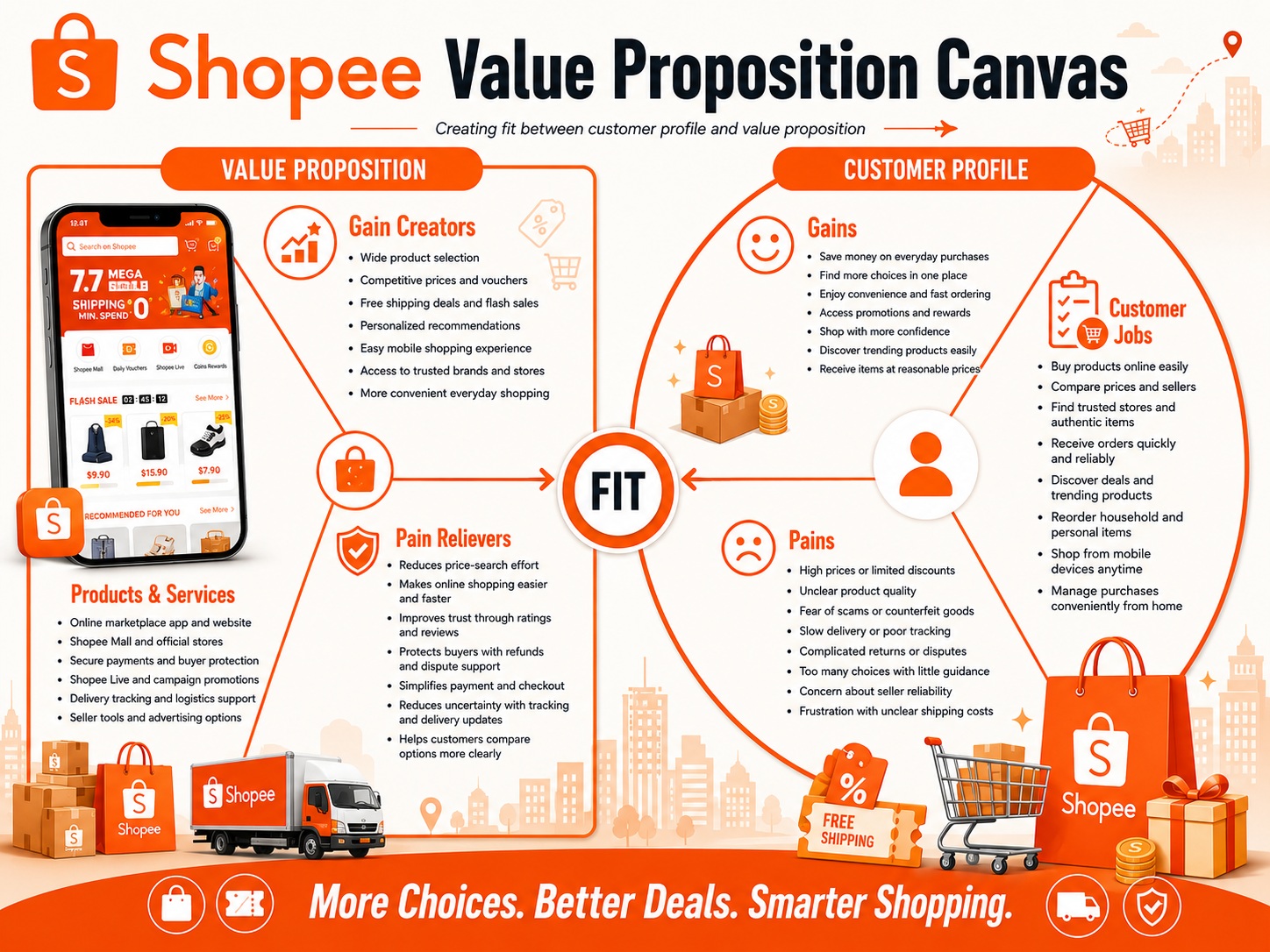
The Value Proposition Canvas helps explain the fit between Shopee’s offer and customer needs. It shows why customers choose Shopee not only because it sells many products, but because it solves practical, financial, and trust-related problems in online shopping.
The customer profile explains what Shopee customers are trying to achieve, what problems they face, and what benefits they want. Shopee customers are often mobile-first, price-aware, convenience-driven, and comfortable comparing options online.
For customer jobs, Shopee helps customers buy products easily, compare prices, discover deals, purchase from many sellers, reorder frequently used items, and receive parcels without visiting physical stores. These jobs happen across many categories, which increases platform relevance.
For customer pains, customers face limited time, high prices, delivery uncertainty, fear of scams, counterfeit risk, confusing product information, poor seller response, and inconvenient returns. Shopee reduces these pains through reviews, ratings, Shopee Mall, seller chat, buyer protection, tracking, and dispute handling.
For customer gains, customers want discounts, product variety, free shipping, fast checkout, trusted sellers, easy payment, reliable delivery, and a sense of getting a good deal. Shopee creates these gains through vouchers, campaigns, coins, recommendations, secure payments, and wide seller participation.
The value proposition explains how Shopee responds to those customer jobs, pains, and gains. Its core offer is simple: a convenient digital marketplace with broad product choice, competitive prices, integrated payment, and delivery support.
Shopee’s products and services include marketplace listings, official stores, seller chat, reviews, Shopee Mall, vouchers, flash sales, Shopee Live, payment options, order tracking, returns, seller tools, and advertising products.
Pain relievers include buyer protection, verified stores, customer reviews, delivery tracking, dispute processes, easy payment, and seller ratings. These benefits reduce uncertainty in online shopping.
Gain creators include mega campaigns, free shipping vouchers, Shopee Coins, personalized recommendations, livestream deals, wide product variety, and easy checkout. These benefits make the shopping experience feel more rewarding.
| Customer Profile | Details | Matching Value Proposition | How Shopee Creates Fit |
|---|---|---|---|
| Customer Jobs | Customers want to buy products, compare prices, discover deals, reorder items, and receive deliveries conveniently. | Products and Services | Marketplace listings, seller stores, official brands, vouchers, payment options, order tracking, and delivery support. |
| Customer Pains | Customers face price uncertainty, scam concerns, counterfeit risk, delivery delays, confusing options, and return friction. | Pain Relievers | Reviews, ratings, Shopee Mall, buyer protection, seller chat, tracking, refunds, and dispute handling. |
| Customer Gains | Customers want discounts, convenience, variety, free shipping, secure payment, and deal excitement. | Gain Creators | Mega campaigns, flash sales, Shopee Coins, free shipping vouchers, personalized recommendations, and livestream offers. |
The table shows that Shopee fits the customer profile because it responds to three needs at the same time: convenience, price value, and transaction trust. Customers are not only buying products. They are buying confidence, comparison power, and a simpler shopping process.
This fit explains why Shopee can remain relevant despite competition. The platform must continue to match changing customer jobs, pains, and gains. If customers shift toward livestream discovery, faster delivery, official stores, or stronger authenticity guarantees, Shopee needs to adapt without losing its core marketplace advantage.
Shopee VPC Diagram:
Shopee’s competitive advantage comes from several strengths that work together. These strengths make the platform difficult to copy as a full ecosystem.
Shopee still faces several risks. These risks do not make the model weak, but they show where Shopee must manage execution carefully.
The Shopee Business Model Canvas shows how a digital marketplace built a scalable e-commerce business. Its success is not based on low prices alone. It is built on product variety, mobile access, seller participation, campaign memory, payment convenience, logistics integration, advertising monetization, and customer trust.
Shopee works because it solves a practical consumer need very well. People want shopping that is easy, affordable, searchable, secure, and convenient. Sellers want traffic, tools, payment support, delivery options, and campaign access. Shopee connects both sides inside one marketplace system.
For business owners, the lesson is clear. Strong digital businesses are not only about having an online store. They are about making the full buying journey easy to start, easy to trust, easy to complete, and easy to repeat.
This article is for informational and educational purposes only. It is based on publicly available information and independent business analysis. It does not represent official information from Shopee, Sea Limited, or any related company. Readers should conduct their own research before making business, investment, or strategic decisions.
Explore the Quipper Business Model Canvas, nine BMC blocks, Value Proposition Canvas, Ruangguru and Pahamify… Read More
Explore the CARPUT Business Model Canvas, nine BMC blocks, Value Proposition Canvas, competitor comparison, competitive… Read More
Explore the Boost Business Model Canvas, nine BMC blocks, Value Proposition Canvas, competitor comparison, advantages,… Read More
Explore the Domino's Pizza Business Model Canvas, nine BMC blocks, Value Proposition Canvas, Pizza Hut… Read More
Explore the Mie Gacoan Business Model Canvas, including its customer segments, value propositions, revenue streams,… Read More
Restaurant Business Model Canvas: A Practical Guide to Designing, Evaluating, and Improving Restaurant Business Models… Read More