CARPUT Business Model Canvas
Explore the CARPUT Business Model Canvas, nine BMC blocks, Value Proposition Canvas, competitor comparison, competitive advantages, risks and strategic recommendations.
Explore the Mydin Business Model Canvas and learn how Mydin creates value through affordability, halal trust, wholesale strength, local supplier support, and community retail relevance.
BMC Article No: BMC #052
Updated in 2026: This article has been rewritten with stronger business depth, clearer strategic interpretation, Value Proposition Canvas analysis, latest retail context, competitive advantages, risks, and practical lessons from Mydin’s growth journey.
Mydin is more than a Malaysian hypermarket chain. It is a homegrown retail institution built around affordability, halal confidence, wholesale discipline, local supplier support, and community relevance.
The Mydin Business Model Canvas is interesting because it shows how a retailer can serve both household consumers and bulk buyers without losing its core identity. A family may visit Mydin for monthly groceries. Small traders may buy stock for resale. Schools, mosques, NGOs, or government-linked programmes may use Mydin for essential goods distribution.
Value retail is difficult to execute. Low prices attract customers, but thin margins punish weak operations. Large stores create visibility, but they also increase labour, rent, utilities, inventory, and logistics costs. This means Mydin’s real advantage is not only its shelf price. Its advantage comes from procurement scale, halal trust, store network, supplier relationships, and the ability to stay relevant to Malaysian communities.
This article breaks down the model and explains how Mydin creates value, reaches customers, earns revenue, manages cost, and protects its position in Malaysia’s competitive retail market.
Mydin’s business model is built around wholesale-to-retail value. The company sells groceries, household essentials, apparel, textiles, festive goods, halal products, school items, and bulk supplies through multiple store formats.
Its main strength is practical access. Customers visit Mydin because they want products that are affordable, familiar, trusted, and available in one place. The brand does not need to behave like a premium lifestyle retailer. It wins when it helps customers stretch their budget and complete routine shopping with confidence.
Competition remains intense. Mydin competes with supermarkets, hypermarkets, mini markets, convenience chains, wet markets, e-commerce platforms, discount stores, and specialty retailers. Switching costs are low because shoppers can compare price, proximity, promotions, and stock availability quickly.
The canvas therefore shows a business that appears simple at the checkout counter but requires heavy operating discipline behind the scenes. Procurement, inventory, logistics, supplier negotiation, halal assurance, staffing, store execution, and community engagement must work together.
Business Model Canvas, or BMC, is a practical tool used to understand how a company works. It explains how a business creates value, delivers that value to customers, and turns the model into revenue.
Instead of looking only at products or sales, BMC breaks a business into nine connected blocks.
| BMC Block | Main Question |
|---|---|
| Customer Segments | Who does the business serve? |
| Value Propositions | What value does the business offer? |
| Channels | How does the business reach customers? |
| Customer Relationships | How does the business build loyalty? |
| Revenue Streams | How does the business make money? |
| Key Resources | What assets does the business need? |
| Key Activities | What must the business do well? |
| Key Partnerships | Who helps the business operate? |
| Cost Structure | What are the major costs? |
For Mydin, BMC is useful because the business is not only about selling cheap goods. It involves halal positioning, wholesale economics, physical store reach, digital convenience, crisis supply, SME inclusion, and disciplined cost control.
Mydin Mohamed Holdings Berhad was established in 1957 by Tuan Mydin Mohamed bin Ghulam Hussein. The business began as a small wooden shop in Kota Bharu, Kelantan, before expanding into a national retail and wholesale group.
Today, the company is widely positioned as one of Malaysia’s largest halal homegrown wholesale and retail chains. Its formats include hypermarkets, emporiums, supermarkets, bazaars, marts, convenience outlets, and related retail concepts. Public reports in 2025 placed Mydin at about 69 to 70 stores, with annual sales estimated between RM2.5 billion and RM3 billion.
Leadership has also shaped the brand. Datuk Wira Dr. Ameer Ali Mydin made the company visible not only as a retailer but also as a public voice on cost of living, local business, halal trade, and consumer welfare.
The Mydin Business Model Canvas helps explain why the company remains relevant. Mydin is not just a store network. It is a value retail system built on trust, volume, sourcing discipline, community access, and Malaysian identity.
Mydin is strategically interesting because it competes in essential retail. Demand is recurring, but profit margins can be narrow and operational pressure is constant.
A luxury retailer can use brand aspiration to defend margins. Mydin must rely on price trust, stock reliability, customer convenience, and cost discipline. That makes the business more operationally demanding than it may appear from the outside.
Retail economics also make the model interesting. A small margin can still create a large business when transaction volume, basket size, product turnover, and supplier terms are managed well. Poor forecasting, slow-moving stock, high utilities, theft, wastage, or weak store productivity can quickly erode value.
Mydin’s community role adds another layer. The company is linked with halal confidence, local SME support, festive campaigns, and social initiatives. These factors create emotional trust that pure price competitors may struggle to copy.
From a strategy perspective, the Mydin Business Model Canvas shows how a value retailer can combine affordability, faith-based trust, operating scale, and public relevance.
Mydin’s story is no longer only about store expansion. It is also about digital adoption, inflation pressure, local supplier development, consumer affordability, and modern retail competition.
One development is scale. Publicly available profiles and media reports show Mydin operating around 69 to 70 stores in recent years, while continuing to open new outlets in selected locations. This scale gives Mydin purchasing power, but it also creates higher execution complexity.
Another development is local supplier support. Bernama reported in 2023 that Mydin purchased about RM230 million worth of products annually from MSMEs, with food and beverages forming most of that value. This matters because Mydin’s model supports both consumer affordability and domestic supplier participation.
Digital retail is also becoming more important. Customers now expect online ordering, clear promotions, digital payments, rewards, delivery options, and better product visibility. Mydin has digital channels, but the next competitive battle will likely be convenience, not only price.
The model must therefore be read through two lenses. Traditional retail strength is the first lens. Future readiness is the second lens, where digital experience, data, energy cost, logistics productivity, and customer personalization become more important.
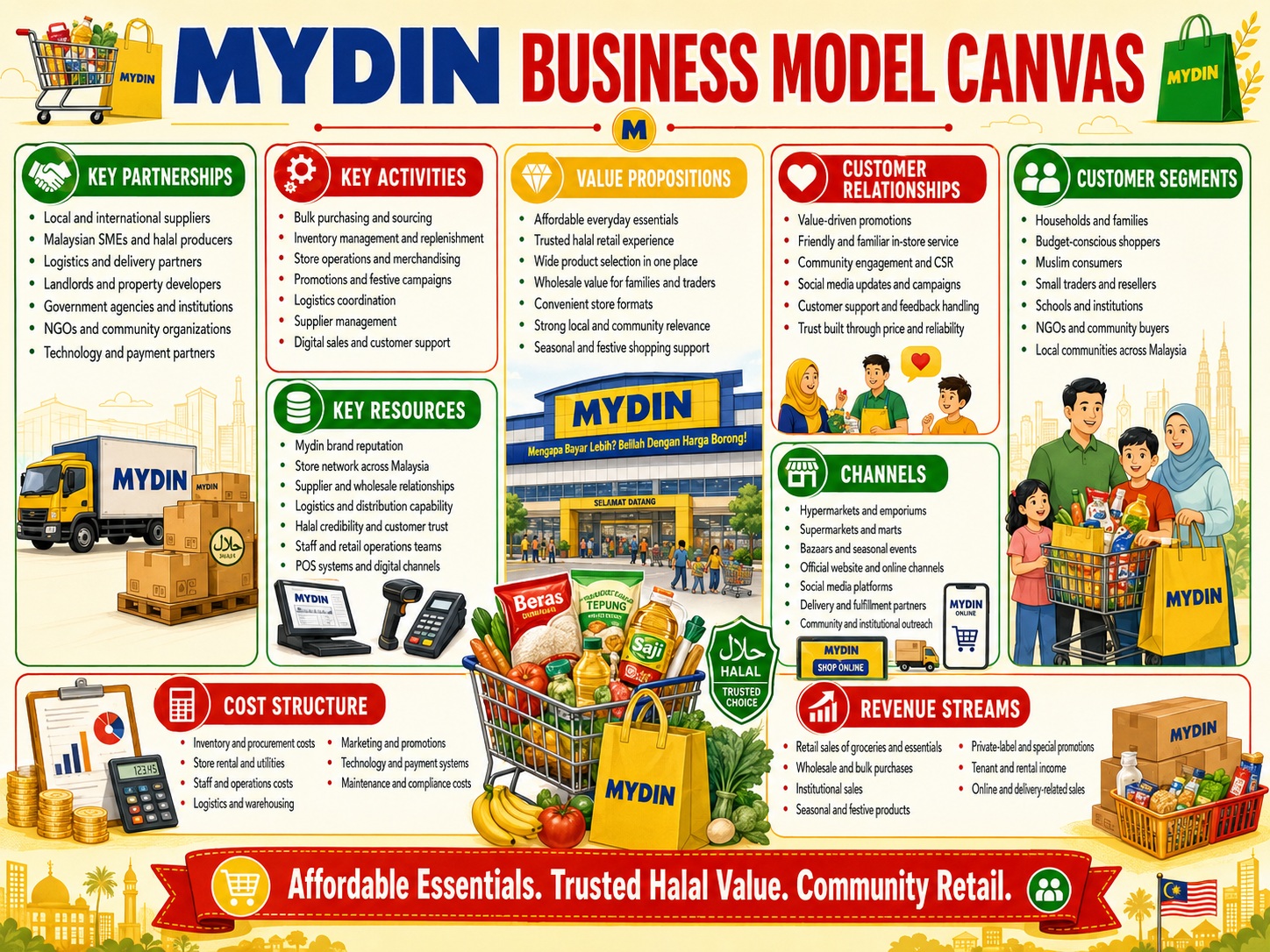
Before reviewing each block, the summary below gives a quick view of how Mydin’s business model works. It shows who the company serves, what value it offers, how it reaches customers, and what resources keep the model running.
| BMC Block | Mydin Application |
| Customer Segments | Households, budget-conscious shoppers, Muslim consumers, small traders, institutions, NGOs, schools, and community buyers. |
| Value Propositions | Affordable essentials, halal confidence, broad product range, wholesale-to-retail pricing, local identity, and bulk buying access. |
| Channels | Hypermarkets, emporiums, supermarkets, bazaars, marts, online platforms, delivery partners, social media, and community programmes. |
| Customer Relationships | Price trust, familiar service, religious alignment, CSR, festive campaigns, local engagement, and practical customer support. |
| Revenue Streams | Retail sales, wholesale and bulk purchases, private-label products, institutional sales, rental income, seasonal products, and online orders. |
| Key Resources | Brand equity, halal credibility, store network, logistics assets, supplier relationships, staff, technology, and procurement capability. |
| Key Activities | Bulk purchasing, inventory control, store operations, merchandising, logistics, supplier management, promotions, and digital improvement. |
| Key Partnerships | Suppliers, MSMEs, landlords, logistics providers, government agencies, NGOs, religious bodies, fintech firms, and technology partners. |
| Cost Structure | Inventory, labour, rent, utilities, logistics, marketing, technology, maintenance, compliance, and shrinkage control. |
The Mydin Business Model Canvas highlights a business built around volume, trust, availability, and operational discipline.
Customer segments describe who the business serves. Mydin serves a broad customer base, but its strongest appeal is among practical buyers who care about price, halal confidence, and reliable access to essential goods.
Different customers use Mydin for different shopping missions. Low- and middle-income households may visit for monthly groceries. Small traders may buy products for resale. Institutions may procure food packs, school supplies, or event materials. Muslim consumers may choose Mydin because halal trust reduces purchase anxiety.
| Customer Segment | What They Need | How Mydin Serves Them |
| Households | Affordable groceries and daily essentials. | Offers broad product range, promotions, and family-sized options. |
| Budget shoppers | Lower prices and visible savings. | Uses wholesale-to-retail positioning and campaign pricing. |
| Small traders | Bulk stock and predictable supply. | Provides wholesale-style access and large product quantities. |
| Institutions | Practical procurement for programmes. | Supports bulk buying for schools, NGOs, mosques, and agencies. |
| Muslim consumers | Halal confidence and religious alignment. | Builds trust through halal-oriented sourcing and brand identity. |
| Local communities | Convenient access to necessities. | Operates varied store formats and community-linked campaigns. |
The strategic point is clear. Mydin does not depend on one narrow segment. Its customers are connected by practical need, repeat demand, and value sensitivity.
The value proposition explains why customers choose Mydin. At the simplest level, Mydin offers affordable access to trusted essential goods.
However, the deeper value is not price alone. Mydin reduces several customer worries at once. Shoppers worry about rising prices, halal certainty, product availability, bulk needs, and whether a retailer understands local community life. Mydin answers these concerns through value pricing, halal positioning, wide assortment, and Malaysian familiarity.
| Value Proposition | Customer Benefit | Business Impact |
| Affordable essentials | Customers can manage household budgets better. | Supports frequent visits and repeat purchase. |
| Halal confidence | Shoppers feel safer about product suitability. | Strengthens trust among Muslim consumers. |
| Wide product range | Buyers can complete many needs in one trip. | Increases basket size and store relevance. |
| Bulk purchasing | Traders and institutions can buy efficiently. | Expands demand beyond household shoppers. |
| Local identity | Customers feel familiar with the brand. | Builds emotional trust and recognition. |
| SME inclusion | Local products gain shelf access. | Strengthens supplier diversity and national relevance. |
The Mydin Business Model Canvas shows a value proposition that blends economic value, religious trust, convenience, and social meaning.
Channels explain how Mydin reaches customers and delivers its value proposition. This is one of the most important parts of the model because retail demand is strongly shaped by access.
Mydin uses a multi-format channel strategy. Large hypermarkets support major shopping trips. Emporiums and bazaars serve more specific community and product needs. Smaller formats improve convenience. Digital channels help customers discover promotions, order selected goods, and engage with the brand without depending only on physical visits.
| Channel | Example | Strategic Role |
| Hypermarkets | Large-format stores. | Support full-basket grocery and household shopping. |
| Emporiums and bazaars | Community and category-led formats. | Serve local demand and festive buying. |
| Supermarkets and marts | Smaller neighbourhood formats. | Improve convenience and accessibility. |
| Online channels | Website, social media, digital promotions. | Extend reach and improve product visibility. |
| Delivery partners | Third-party delivery and ordering support. | Capture customers who prefer convenience. |
| Community programmes | CSR, festive, school, and welfare activities. | Deepen trust and local relevance. |
Location still matters, but channel strategy is changing. Future growth will depend on how well Mydin connects physical stores, online ordering, delivery, loyalty, and local promotions.
Customer relationships describe how Mydin builds loyalty and repeat purchase. Mydin’s relationship model is built on trust, familiarity, values, and practical usefulness.
The brand does not rely mainly on premium service or lifestyle exclusivity. Its relationship with customers is closer to a trusted community retailer. People return when they believe prices are fair, halal sourcing is reliable, stores are familiar, and the company remains connected to local needs.
| Relationship Driver | How It Works | Example |
| Price trust | Customers believe Mydin helps them save. | Promotions on essentials encourage repeat visits. |
| Halal alignment | Religious confidence reduces purchase doubt. | Muslim families shop with stronger assurance. |
| Community engagement | CSR and festive campaigns build goodwill. | Aid packs and social programmes improve public trust. |
| Familiar store experience | Customers know what to expect. | Repeat shoppers navigate categories more easily. |
| Social media updates | Promotions and campaigns stay visible. | Customers notice deals before visiting. |
| Ground-level feedback | Store teams hear customer concerns directly. | Product availability and service issues can be addressed. |
Mydin’s opportunity is to convert trust into stronger digital retention. A simple loyalty system, targeted savings, and group-buying offers could improve frequency without weakening its value identity.
Revenue streams show how Mydin makes money. The core engine is high-volume retail sales, supported by wholesale, institutional buying, seasonal demand, and rental income.
In value retail, each individual margin may be small. The model works when volume, basket size, supplier terms, stock turnover, and operating discipline are strong. A customer buying groceries may generate one type of revenue. Small traders buying cartons may generate another. Tenant rental inside a store creates an additional income stream.
| Revenue Stream | Description | Why It Matters |
| Retail sales | Groceries, household goods, apparel, and daily essentials. | Forms the main income base. |
| Wholesale and bulk sales | Larger purchases by traders and institutions. | Stabilises demand beyond walk-in shoppers. |
| Private-label products | Own-brand or controlled-margin items. | Can improve margin and customer value. |
| Tenant rental income | Kiosks, food courts, and vendor spaces. | Adds income from store footfall. |
| Online orders | Digital purchases and delivery-linked sales. | Expands reach beyond physical visits. |
| Seasonal products | Raya, school, festive, and campaign goods. | Captures high-demand buying periods. |
The Mydin Business Model Canvas shows a revenue model based on recurring need, volume economics, and practical shopping occasions.
Key resources are the assets required to deliver the business model. For Mydin, the most important resources are brand trust, halal credibility, store network, logistics capability, supplier relationships, staff, and retail technology.
Brand trust is especially important because value retail can be crowded. Many competitors can offer discounts. Fewer can combine affordability with halal confidence, national familiarity, bulk buying, and community reputation.
| Key Resource | Role in the Model | Strategic Value |
| Brand equity | Creates recognition and confidence. | Helps Mydin stay top-of-mind for value shopping. |
| Halal credibility | Supports religious assurance. | Differentiates the brand in Muslim-majority markets. |
| Store network | Provides physical access. | Converts brand trust into real shopping convenience. |
| Supplier base | Supports product range and price negotiation. | Improves availability and cost control. |
| Logistics assets | Move stock across outlets. | Protects replenishment and operating continuity. |
| Workforce | Runs stores, service, and fulfilment. | Determines daily execution quality. |
| Retail systems | Track inventory, sales, and procurement. | Improves decisions and reduces leakage. |
Together, these resources make Mydin more than a shopfront. They create a repeatable operating system for value retail.
Key activities are the things Mydin must do well every day. Retail success depends on repeated execution across thousands of products, many suppliers, and different store formats.
The most important activity is procurement discipline. Mydin must source at the right price, negotiate effectively, manage suppliers, and maintain product availability. Inventory control then determines whether the promise appears on the shelf. Poor replenishment weakens trust even when prices are attractive.
| Key Activity | What It Involves | Why It Matters |
| Bulk purchasing | Negotiating high-volume supply. | Protects affordability and margin. |
| Inventory control | Tracking stock, replenishment, and movement. | Reduces stockouts, waste, and slow stock. |
| Store operations | Managing checkout, shelves, staff, and cleanliness. | Shapes the customer experience. |
| Supplier management | Coordinating pricing, quality, and delivery. | Keeps products available and competitive. |
| Promotions planning | Designing campaigns around demand cycles. | Drives traffic and price perception. |
| Logistics coordination | Moving goods to the right outlet on time. | Supports availability across formats. |
| Digital improvement | Enhancing online, data, and payment tools. | Builds future relevance. |
The hidden engine of Mydin is operational consistency. Customers see shelves and prices, but the real work happens in sourcing, logistics, systems, and store discipline.
Key partnerships describe the external network that helps Mydin operate, expand, and remain relevant. Retail is a partnership-heavy business because product supply, store access, logistics, payment, and community programmes depend on external parties.
Supplier partnerships are central. Mydin needs manufacturers, distributors, wholesalers, local SMEs, and halal-certified producers to keep shelves filled. Property partners help secure locations. Government agencies, NGOs, zakat bodies, schools, and religious organisations support welfare and community distribution roles.
| Partner Type | Contribution | Strategic Importance |
| Product suppliers | Provide groceries, household goods, textiles, and essentials. | Support range, availability, and price competitiveness. |
| MSMEs and local brands | Supply Malaysian-made goods. | Reinforce local economy participation. |
| Logistics partners | Support transport and fulfilment. | Improve replenishment reliability. |
| Landlords and developers | Provide store locations. | Shape access and expansion economics. |
| Government agencies | Coordinate public and community programmes. | Strengthen institutional relevance. |
| NGOs and religious bodies | Support aid, zakat, and welfare distribution. | Build trust and social legitimacy. |
| Technology providers | Enable POS, payments, e-commerce, and analytics. | Improve efficiency and digital growth. |
Strong partnerships help Mydin reduce risk, extend reach, and strengthen its identity as a community-linked retailer.
Cost structure explains the major expenses required to operate the model. For Mydin, cost discipline is critical because value retail depends on low prices and controlled margins.
The largest cost area is inventory. Products must be purchased, transported, stored, displayed, and sold before they lose relevance or value. Large outlets also carry heavy utilities, rent, maintenance, labour, security, cleaning, refrigeration, and technology costs.
| Cost Driver | Explanation | Business Impact |
| Inventory procurement | Purchasing goods in large quantities. | Determines gross margin and price competitiveness. |
| Labour | Store teams, warehouse staff, managers, and support functions. | Affects service quality and operating cost. |
| Rent and property | Store leases, owned properties, and related charges. | Shapes outlet profitability. |
| Utilities | Electricity, refrigeration, water, and lighting. | Significant for large-format retail. |
| Logistics | Warehousing, fuel, transport, and delivery. | Influences stock availability and cost. |
| Technology | POS, inventory systems, cybersecurity, and e-commerce tools. | Supports efficiency and control. |
| Shrinkage and wastage | Theft, damage, expired goods, and handling loss. | Directly reduces profitability. |
The model shows why scale must be managed carefully. Bigger networks create buying power, but they also magnify cost leakage if controls are weak.
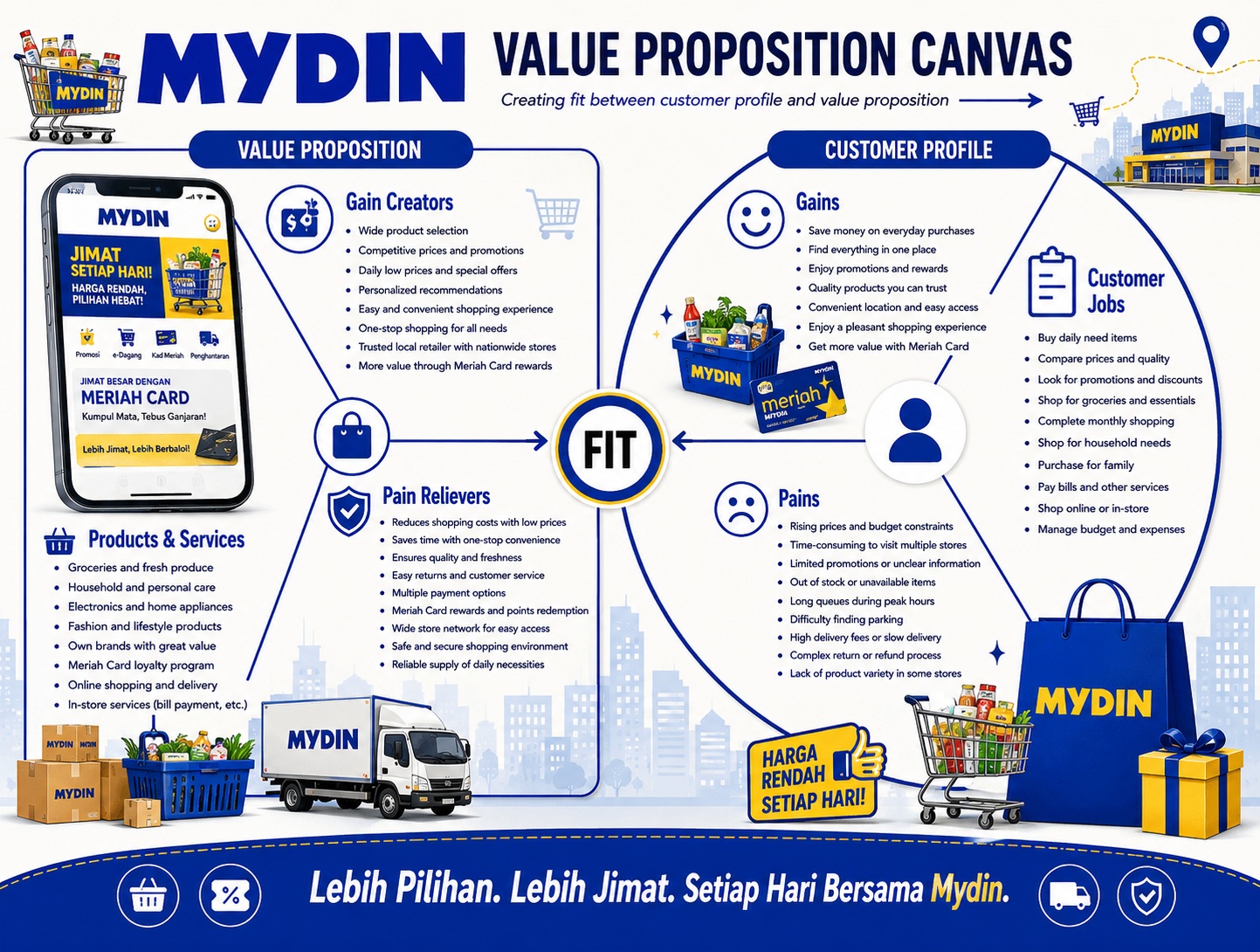
The Value Proposition Canvas explains how Mydin’s offer fits customer needs. It connects what customers are trying to do with the products, pain relievers, and gain creators provided by the company.
| Element | Mydin Customer View |
| Customer Jobs | Buy affordable essentials, manage household budgets, procure in bulk, prepare for festive needs, and find halal products. |
| Pains | Rising prices, halal uncertainty, limited time, stock shortages, inconvenient access, and weak digital visibility. |
| Gains | Savings, trust, one-stop convenience, cultural fit, product variety, and confidence during inflation or crisis periods. |
| Element | Mydin Value View |
| Products and Services | Groceries, household goods, apparel, halal products, bulk goods, festive items, and institutional supplies. |
| Pain Relievers | Wholesale-style pricing, halal sourcing, broad assortment, promotions, community distribution, and reliable supply. |
| Gain Creators | Malaysian identity, SME support, festive campaigns, CSR, family relevance, and practical store formats. |
Fit is strongest when Mydin helps customers save money without sacrificing trust. Future fit can improve through better digital ordering, clearer loyalty benefits, faster delivery, and more personalized value packs.
Mydin offers several useful lessons for business owners, retailers, and strategy students.
First, value retail is an operating model, not a slogan. A company can promise low prices, but it can only sustain them through procurement discipline, supplier terms, inventory control, and cost management.
Second, trust can be a commercial asset. Mydin’s halal positioning and local identity reduce customer uncertainty. This trust supports repeat visits and makes the brand meaningful beyond price comparison.
Third, broad customer coverage can strengthen resilience. Mydin serves households, traders, institutions, NGOs, and community buyers. This reduces dependence on one shopping mission.
Fourth, community relevance can defend a retail brand. CSR, festive campaigns, local SME support, and public visibility make Mydin feel connected to Malaysian life.
The Mydin Business Model Canvas shows that long-term retail strength comes from the combination of price, trust, access, and execution.
Mydin has several competitive advantages that support its position in Malaysian retail.
These advantages work best when they reinforce one another. Price brings customers in, but trust, availability, halal confidence, and community familiarity make them return.
Mydin also faces risks that require continuous management attention.
These risks do not weaken Mydin’s model automatically. They show where the company must keep improving: digital experience, energy efficiency, stock accuracy, margin control, and store productivity.
Mydin can strengthen its model by modernising convenience while protecting its affordability promise.
| Area | Recommendation |
| Channels | Improve mobile ordering, store pickup, delivery visibility, and location-based promotions. |
| Customer Relationships | Build a simple loyalty programme focused on essential savings, family baskets, and bulk buyers. |
| Key Activities | Use demand forecasting to reduce stockouts, wastage, and slow-moving inventory. |
| Revenue Streams | Expand private-label essentials, B2B procurement packs, and subscription-based household bundles. |
| Cost Structure | Apply energy monitoring, route optimisation, workforce scheduling, and shrinkage analytics. |
| Partnerships | Work with MSMEs, fintech firms, logistics providers, halal producers, and sustainability partners. |
The priority is not to become a premium retailer. Mydin should become a more convenient, data-informed, and efficient value retailer.
The Mydin Business Model Canvas shows how a Malaysian retailer built resilience through affordability, halal confidence, supplier strength, operational discipline, and community relevance.
This model works because it solves a practical problem. Customers need essential goods that are affordable, trusted, accessible, and suitable for family or institutional buying. The company turns that need into a retail system supported by procurement, logistics, stores, staff, suppliers, and brand trust.
Business owners can learn a clear lesson from Mydin. A strong retail model is not built only by opening more outlets or lowering prices. It is built by making the customer’s shopping mission easier, more reliable, and more repeatable.
That is the real business logic behind Mydin.
This article is for informational and educational purposes only. It is based on publicly available information and independent business analysis. The article does not represent official information from Mydin Mohamed Holdings Berhad, Mydin Mohamed Hypermarket, or any related company. Readers should conduct their own research before making business, investment, or strategic decisions.
Explore the CARPUT Business Model Canvas, nine BMC blocks, Value Proposition Canvas, competitor comparison, competitive… Read More
Explore the Boost Business Model Canvas, nine BMC blocks, Value Proposition Canvas, competitor comparison, advantages,… Read More
Explore the Domino's Pizza Business Model Canvas, nine BMC blocks, Value Proposition Canvas, Pizza Hut… Read More
Explore the Mie Gacoan Business Model Canvas, including its customer segments, value propositions, revenue streams,… Read More
Restaurant Business Model Canvas: A Practical Guide to Designing, Evaluating, and Improving Restaurant Business Models… Read More
Learn how the Food and Beverage Business Model Canvas helps restaurants, cafés, beverage brands, and… Read More