Quipper Business Model Canvas
Explore the Quipper Business Model Canvas, nine BMC blocks, Value Proposition Canvas, Ruangguru and Pahamify comparison, competitive advantages, risks, and strategic recommendations.
Loacker Business Model Canvas explained with detailed BMC analysis, Value Proposition Canvas, Ferrero comparison, competitive advantages, risks, and recommendations.
BMC Article No: BMC #066
Updated in 2026: This article has been refreshed with a more relevant confectionery comparison, deeper analysis for every BMC block, a fuller Value Proposition Canvas section, expanded risks and recommendations, and a more refined overall flow.
Loacker is no longer just a European wafer brand sitting in premium snack aisles. It is a confectionery business built around product quality, brand trust, controlled premium positioning, and disciplined international distribution.
The Loacker Business Model Canvas matters because Loacker does not compete only on sweetness or low price. Instead, it grows by serving several demand moments at once, from everyday snacking and self-treat purchases to gifting, sharing, and travel retail occasions.
That broader structure makes Loacker strategically interesting. Unlike a low-cost wafer player, Loacker uses quality, heritage, and packaging to create a more premium role in the category.
Loacker operates a branded confectionery and snack business model supported by product development, manufacturing, packaging, quality management, international distribution, and premium brand marketing. It sells wafers, chocolate specialties, pralines, snack bars, and gift-oriented products through retail, specialty channels, travel retail, and distributor-led international access.
At its core, the Loacker Business Model Canvas shows a company that earns through brand strength, premium pricing, channel breadth, and occasion-based product variety. Everyday wafer lines create familiarity and repeat purchase. Premium packs and specialty products improve margin mix, gifting relevance, and brand elevation.
This design matters because Loacker can spread demand across more than one buying situation. When one occasion softens, another can help support performance.
Business Model Canvas, or BMC, is a practical framework used to explain how a company creates value, delivers that value, and captures revenue. Rather than looking only at products, it maps the operating logic behind the business.
For Loacker, BMC is especially useful because success depends on more than recipe quality alone. Manufacturing discipline, ingredient sourcing, packaging quality, retail execution, and distributor coordination all affect results.
That is why the Loacker Business Model Canvas is a useful lens. It shows how premium positioning, product quality, and international route-to-market execution work together as one commercial system.
| BMC Block | Main Question |
|---|---|
| Customer Segments | Who does the business serve? |
| Value Propositions | What value does the business offer? |
| Channels | How does the business reach customers? |
| Customer Relationships | How does the business build loyalty? |
| Revenue Streams | How does the business make money? |
| Key Resources | What assets does the business need? |
| Key Activities | What must the business do well? |
| Key Partnerships | Who helps the business operate? |
| Cost Structure | What are the major costs? |
Loacker was founded in 1925 in Bolzano, South Tyrol, and celebrated its 100th anniversary in 2025. Over time, the company expanded from a local pastry business into an international wafer and chocolate specialist with global distribution. Company materials also highlight Loacker’s emphasis on quality systems, food safety, environmental management, and certifications that support trust in international markets.
Today, the brand is associated with premium wafers, chocolate specialties, natural ingredient cues, and a strong Alpine heritage story. Scale matters here in a different way than it does for giant multinationals. Loacker does not need the broadest portfolio to compete. It needs strong category meaning, consistent quality, and the ability to remain premium across markets.
Loacker is strategically interesting because it competes with a specialist premium logic rather than a mass-volume logic. A retailer is not only buying another wafer brand. It is buying a premium confectionery proposition that can work across self-consumption, gifting, sharing, and selected higher-quality retail environments.
That creates a stronger position than a narrow commodity-style snack model. Shelf appeal can improve because the brand feels more refined. Consumer relevance also becomes wider because Loacker participates in indulgence, gifting, everyday snacking, and travel retail moments at the same time.
Another advantage comes from focus. Management does not need to stretch the brand across too many unrelated categories in order to stay visible.
In 2026, the Loacker Business Model Canvas is shaped by four visible shifts. First, premium snack brands are under greater pressure to justify price through product quality, ingredient signaling, packaging, and brand story. Second, consumers remain price-aware, which means premium brands must work harder to stay worth the extra spend.
Third, gifting, sharing, and premium self-treat occasions are becoming more important because they help justify higher-value confectionery purchases. Fourth, international execution matters more because premium meaning can weaken quickly if route-to-market choices become too mass or inconsistent.
Together, these shifts make Loacker’s model more demanding operationally, but also more defensible if it protects quality, brand clarity, and disciplined market execution.
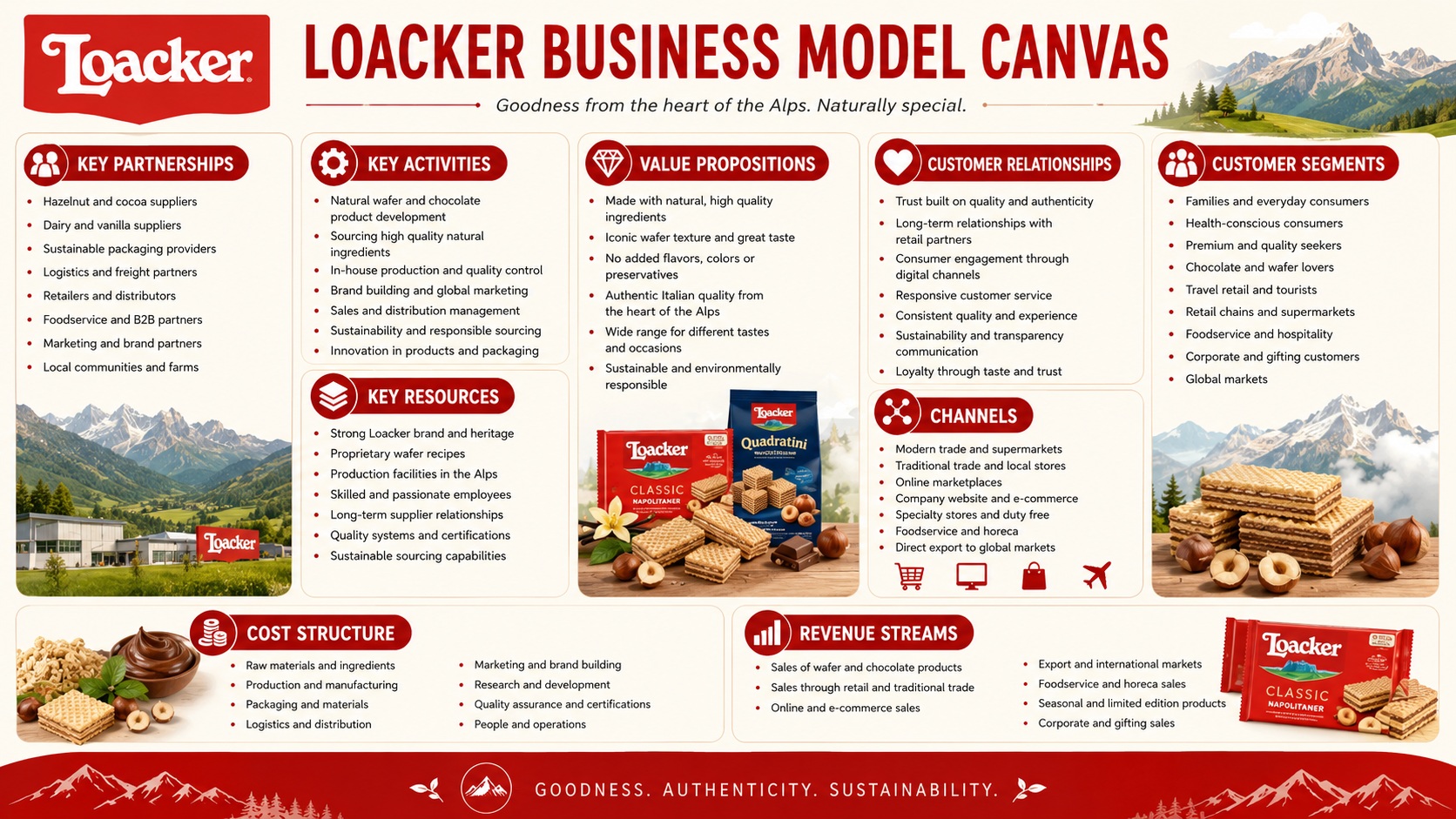
Before going into each block in detail, the summary below gives a quick view of how Loacker’s business works. It provides a compact snapshot of the full model before we move into deeper analysis, making it easier to see how the main building blocks connect. This summary also helps readers understand why Loacker is more than a wafer brand and how its premium confectionery model works as one commercial system.
| BMC Block | Loacker Application |
| Customer Segments | Families, premium snack buyers, gift buyers, travelers, retailers, distributors, and specialty channel partners. |
| Value Propositions | Premium wafers and chocolate specialties, trusted quality, broad flavor choice, strong packaging, and heritage-led brand meaning. |
| Channels | Modern retail, convenience, specialty retail, travel retail, e-commerce, and distributor-led international access. |
| Customer Relationships | Brand trust, packaging-led appeal, gifting relevance, repeat retail presence, and trade support for channel partners. |
| Revenue Streams | Wafer sales, premium specialty products, gifting formats, seasonal assortments, and international channel sales. |
| Key Resources | Brand equity, recipes, quality systems, manufacturing capability, ingredient sourcing, and distribution relationships. |
| Key Activities | Product development, manufacturing, quality control, branding, packaging, channel execution, and market expansion. |
| Key Partnerships | Suppliers, retailers, distributors, logistics providers, certification bodies, and international market partners. |
| Cost Structure | Ingredients, manufacturing, packaging, logistics, quality systems, marketing, labor, and trade support. |
The diagram below gives a visual summary of how the main blocks of Loacker’s business model connect in one view. It helps readers move from the written explanation into a simpler strategic snapshot before continuing to the detailed block-by-block analysis.
Customer segments explain who Loacker serves and why those buyers matter. Loacker targets a broad consumer base, but its real strength comes from serving several demand pools at the same time. It reaches buyers across age groups, spending levels, purchase occasions, and channel contexts, while also serving commercial customers that want dependable premium brands.
That mix matters because Loacker is present in both routine snacking and higher-value purchase moments. A family buying wafer packs for home consumption, a traveler picking up products in travel retail, and a shopper choosing a premium box for gifting all sit inside the same business model.
The company therefore benefits from broad occasion relevance rather than narrow audience dependence.
| Segment | Details | Why It Matters |
| Families and everyday consumers | Buy wafer and chocolate snacks for routine consumption at home or on the go | Creates repeat volume and brand familiarity across generations |
| Premium snack buyers | Prefer better taste, texture, packaging, and ingredient cues over low-price alternatives | Supports premium positioning and healthier margins |
| Gift and occasion buyers | Purchase boxed, seasonal, or premium packs for sharing and gifting | Expands the brand beyond impulse snacking into higher-value occasions |
| Trade and channel buyers | Include retailers, distributors, specialty stores, and travel retail partners | Strengthens shelf presence and recurring route-to-market access |
Loacker wins because it serves both end consumers and commercial buyers. One part of the model generates pull through brand demand, while another secures push through retail and distribution relationships. That is why the Loacker Business Model Canvas is strong here. It gives Loacker multiple customer layers, broader purchase occasions, and less dependence on one narrow consumption situation.
The value proposition explains why consumers and channel partners choose Loacker repeatedly. Loacker offers more than sweetness. It delivers product quality, premium packaging, heritage trust, and a snack experience that feels more elevated than lower-end alternatives.
That matters because confectionery purchases are often made quickly. Consumers usually do not spend much time comparing every option in detail. Familiarity, visible quality, trust, and format suitability often influence the decision more than technical product features.
Loacker strengthens its value by serving several indulgence moments at once, from everyday snacking and self-treat purchases to gifting and sharing.
| Value Proposition | Details | Why It Matters |
| Premium taste and texture | Crispy wafers, layered fillings, chocolate coatings, and distinctive flavor combinations | Differentiates Loacker from cheaper private-label snacks |
| Heritage and trust | A long brand history connected to South Tyrol and Italian confectionery craftsmanship | Supports credibility, repeat purchase, and emotional resonance |
| Ingredient quality cues | Natural ingredient messaging, certifications, and quality-system discipline | Helps justify higher prices and reduces purchase hesitation |
| Broad occasion fit | Products for everyday snacking, sharing, gifting, and travel retail | Allows the brand to earn across more than one buying occasion |
Customers do not choose Loacker only because one product tastes good. They often choose familiarity, trusted quality, attractive presentation, and reassurance that the purchase will feel worth it. The Loacker Business Model Canvas becomes stronger because the company spreads value across taste, packaging, heritage, and occasion fit. That gives Loacker a more resilient proposition than a business built around low-price volume alone.
Channels explain how Loacker reaches customers and converts demand into repeat sales. In premium confectionery, distribution is not just a support function. It is a positioning tool. Loacker depends on selective but broad enough channel coverage so its products are visible, available, and easy to buy in the settings where premium purchases happen.
The company uses modern retail, convenience, specialty retail, travel retail, digital commerce, and distributor-led access to capture both planned and impulse purchases. That is important because premium snack demand does not happen in only one place. A shopper may buy wafer multipacks in a supermarket, a giftable pack in a specialty setting, and another format in a travel retail environment.
This multi-channel system keeps the brand close to real purchase behavior.
| Channel | Details | Why It Matters |
| Modern retail | Supermarkets and hypermarkets with broad snack and confectionery assortment | Generates scale and supports routine household purchasing |
| Convenience and impulse channels | Smaller outlets where ready-to-eat products perform well | Captures quick purchase and on-the-go consumption |
| Specialty and gifting channels | Premium stores, seasonal displays, and selective high-quality retail settings | Strengthens elevated brand perception |
| Travel retail and distributors | Airports, tourist locations, and partner-led international market access | Improves premium visibility and global reach |
Distribution breadth gives Loacker more than physical reach. It also creates shelf visibility, premium context, impulse opportunity, and repeated exposure. The Loacker Business Model Canvas shows that strong channels do not only deliver units sold. They reinforce brand meaning, support pricing, and make it harder for lower-end rivals to compete on the same terms.
Customer relationships describe how Loacker keeps the brand relevant, visible, and repeatedly chosen. These relationships work at two levels. One level is consumer-facing through packaging, consistency, gifting relevance, and premium brand recognition. The other is trade-facing through retail execution, distributor support, and dependable availability.
That dual structure matters because premium confectionery brands are rarely sustained by image alone. A buyer may like the brand, but the purchase still depends on shelf presence, presentation, stock availability, and suitability for the occasion.
Loacker therefore builds loyalty through both emotional connection and execution discipline.
| Relationship Type | Details | Why It Matters |
| Brand trust | Consistency in taste, texture, and product quality over time | Encourages repeat purchase and intergenerational familiarity |
| Packaging-led connection | Refined presentation and recognizable visual identity | Supports premium perception at the point of sale |
| Seasonal and occasion relevance | Gift packs and premium assortments for holidays or sharing | Creates spikes in demand and emotional relevance |
| Retail relationship support | Strong execution with distributors and retail partners | Helps protect shelf space and promotional visibility |
Consumer loyalty in this category is rarely purely emotional or purely rational. Loacker must keep the brand desirable while making the product easy to notice and easy to buy. The Loacker Business Model Canvas is strong in this block because customer relationships are reinforced not only through product experience, but also through everyday market execution that keeps trial and repeat purchase active.
Revenue streams explain how Loacker captures value from the demand it creates. For a premium confectionery company, this is not simply about selling more units. It is also about balancing recurring volume with higher-value product formats such as gifting packs, seasonal assortments, and premium specialties.
That matters because not all revenue plays the same strategic role. Some products create familiarity and frequency. Others improve price realization, occasion value, and premium mix.
Loacker therefore benefits from both routine consumption and higher-value purchase moments.
| Revenue Stream | Details | Why It Matters |
| Core wafer sales | Flagship wafer products sold in regular consumer channels | Provide brand familiarity and recurring base revenue |
| Premium specialty products | Chocolate-coated, praline, or higher-end confectionery lines | Support better margins and brand elevation |
| Seasonal and gifting sales | Holiday packs, assortments, and shareable formats | Capture special-occasion demand and higher-value baskets |
| International channel sales | Revenue generated through export, distributors, and travel retail | Expands the business beyond the domestic market |
Loacker’s revenue strength comes from layering. Everyday products stabilize turnover. Premium formats improve the mix. Gift and travel retail formats create moments when the same brand can capture greater value from the same core equity. The Loacker Business Model Canvas becomes stronger because income is spread across repeat consumption and occasion-based premium spending rather than one narrow sales logic.
Key resources explain what Loacker must possess in order to deliver its premium promise consistently. In this business, resources go far beyond factories or ingredients. They include brand trust, heritage, recipe knowledge, manufacturing reliability, and the ability to maintain quality across markets.
That matters because premium brands depend on assets that reinforce one another. A strong brand without dependable execution will weaken over time. Efficient production without distinctive brand meaning will struggle to justify premium pricing.
Loacker’s resources therefore work as an interdependent system rather than as isolated assets.
| Key Resource | Details | Why It Matters |
| Brand equity | A long-standing premium identity associated with wafers and indulgence | Supports recognition, trust, and price resilience |
| Manufacturing and quality systems | Production capability backed by food safety and management standards | Protects consistency and international credibility |
| Recipes and ingredient sourcing | Distinct product formulations and access to quality raw materials | Sustain taste differentiation and product integrity |
| Distribution relationships | Retail, distributor, and travel retail connections | Ensure market access across many regions |
A strong resource base gives Loacker control over quality perception, which is central to premium brand economics. The Loacker Business Model Canvas is robust here because the brand promise depends heavily on resource discipline. A competitor may imitate a product form, but it is far harder to replicate a century of trust combined with reliable premium execution.
Key activities explain what Loacker must do well to keep the business model working. In premium confectionery, this involves more than production. It includes managing quality, developing relevant products, supporting brand positioning, and ensuring the brand is executed well across channels and markets.
That matters because premium positioning can erode quickly if quality slips, innovation loses direction, or execution becomes inconsistent. Loacker therefore depends on disciplined operating routines as much as on good products.
Its business works best when product quality, brand building, and route-to-market execution reinforce each other.
| Key Activity | Details | Why It Matters |
| Manufacturing and quality control | Produce consistent products at the required taste and safety standards | Protects trust and repeat purchase |
| Product innovation | Refresh flavors, formats, and premium offerings | Keeps the range relevant without losing core identity |
| Brand building | Communicate heritage, quality, and indulgence positioning | Reinforces distinctiveness in crowded snack aisles |
| Distribution execution | Manage channel presence, stock availability, and market expansion | Converts brand interest into actual sales |
Loacker succeeds when it combines product credibility with professional commercial execution. The Loacker Business Model Canvas is strong here because the company does not rely on heritage alone. It translates that heritage into packaging, quality, and retail performance that consumers can experience directly.
Key partnerships explain which external parties help Loacker protect quality, expand reach, and operate at scale. For a premium food brand, partnerships are not just support mechanisms. They are part of how the customer experience is delivered, from ingredients and packaging to distribution and compliance.
That matters because a premium promise depends on consistency beyond the company’s own walls. Weak partners can damage quality, freshness, visibility, or market access.
Loacker therefore needs partnerships that support both operational reliability and brand integrity.
| Key Partnership | Details | Why It Matters |
| Ingredient suppliers | Provide cocoa, hazelnuts, dairy inputs, and other essential materials | Directly influence product quality and cost stability |
| Retail and distributor partners | Expand reach in domestic and international markets | Increase visibility and recurring sales opportunities |
| Logistics providers | Support timely and careful movement of products | Protect availability and product condition |
| Certification and compliance bodies | Support quality, safety, halal, kosher, and related requirements | Improve trust and widen market access |
Strong partnerships help Loacker scale internationally without losing the discipline expected from a premium food brand. The Loacker Business Model Canvas is stronger because its ecosystem is not just functional. It also supports the quality signals and premium consistency that the brand relies on.
Cost structure explains where Loacker spends money and what that spending reveals about the business model. For a premium confectionery player, cost is not only a matter of efficiency. It is also a reflection of what the company chooses to protect, including ingredients, packaging quality, brand communication, and disciplined production standards.
That matters because premium economics require selective cost control rather than simple cost cutting. The business must protect the visible elements that support differentiation while still managing margin pressure carefully.
Loacker’s cost logic therefore reflects premium discipline, not commodity logic.
| Cost Category | Details | Why It Matters |
| Ingredients and sourcing | High-quality raw materials used in wafers and chocolate specialties | Directly affect taste, consistency, and premium credibility |
| Manufacturing and labor | Production operations and workforce costs | Support scale, safety, and product reliability |
| Packaging and logistics | Presentation, transportation, and market delivery costs | Shape both premium image and channel execution |
| Marketing and trade support | Brand communication, retail activation, and promotional investment | Help the brand stay visible and competitive |
Loacker’s cost structure is not built for low-price domination. It is built to sustain premium quality and trusted execution over time. The Loacker Business Model Canvas is therefore sensitive to cost decisions that weaken visible quality. If the consumer-facing experience slips, the premium promise becomes harder to defend.
Before comparing Loacker with another confectionery player, it is useful to look at how Loacker creates fit between what customers want and what the company delivers. That is the purpose of Value Proposition Canvas, or VPC. While Business Model Canvas explains the overall structure of the company, VPC focuses more closely on the link between customer needs and the company’s actual offer.
This section matters because Loacker’s competitive position depends heavily on perceived fit. Buyers are not purchasing a necessity. They are choosing a branded indulgence. The closer the fit between customer expectations and product experience, the more the company can protect loyalty and pricing.
Customer profile explains what Loacker’s buyers are trying to get done, what frustrates them, and what they hope to gain. In this case, the customer is not simply buying sugar or a snack. The purchase often includes a desire for reassurance, presentable quality, and a product that feels worth the premium.
That matters because premium confectionery is judged not only by taste, but also by the confidence and emotional value attached to the purchase.
| Customer Profile | Details |
| Customer Jobs | Buy tasty snacks, serve guests, share treats, give small gifts, and choose trusted confectionery for family consumption |
| Pains | Fear of low-quality ingredients, disappointing taste, artificial feel, weak freshness, and unattractive packaging |
| Gains | Want great taste, premium feel, reliable quality, recognizable branding, and products suitable for both self-consumption and sharing |
The Loacker Business Model Canvas connects well with this profile because the brand competes on reassurance and quality, not just on impulse alone. It addresses not only hunger or craving, but also social and emotional needs linked to sharing, gifting, and making a good purchase choice.
Value map shows how Loacker responds to those customer expectations through its actual offer. The company does not simply present wafers and chocolate products. It also provides quality cues, packaging reassurance, and emotional signals tied to heritage and premium indulgence.
That matters because premium brands win when they remove hesitation while increasing the sense of reward.
| Value Map | Details |
| Products and Services | Wafers, chocolate specialties, pralines, snack bars, minis, seasonal packs, and gifting assortments |
| Pain Relievers | Consistent taste, strong quality cues, trusted heritage, certifications, and premium packaging that reduce uncertainty |
| Gain Creators | Indulgent flavor, better snack experience, shareable formats, gift suitability, and emotional appeal linked to heritage and origin |
That value map matters because it turns a basic snack purchase into a more rewarding and lower-risk buying decision. Loacker does not simply add features. It removes hesitation while increasing the sense of reward.
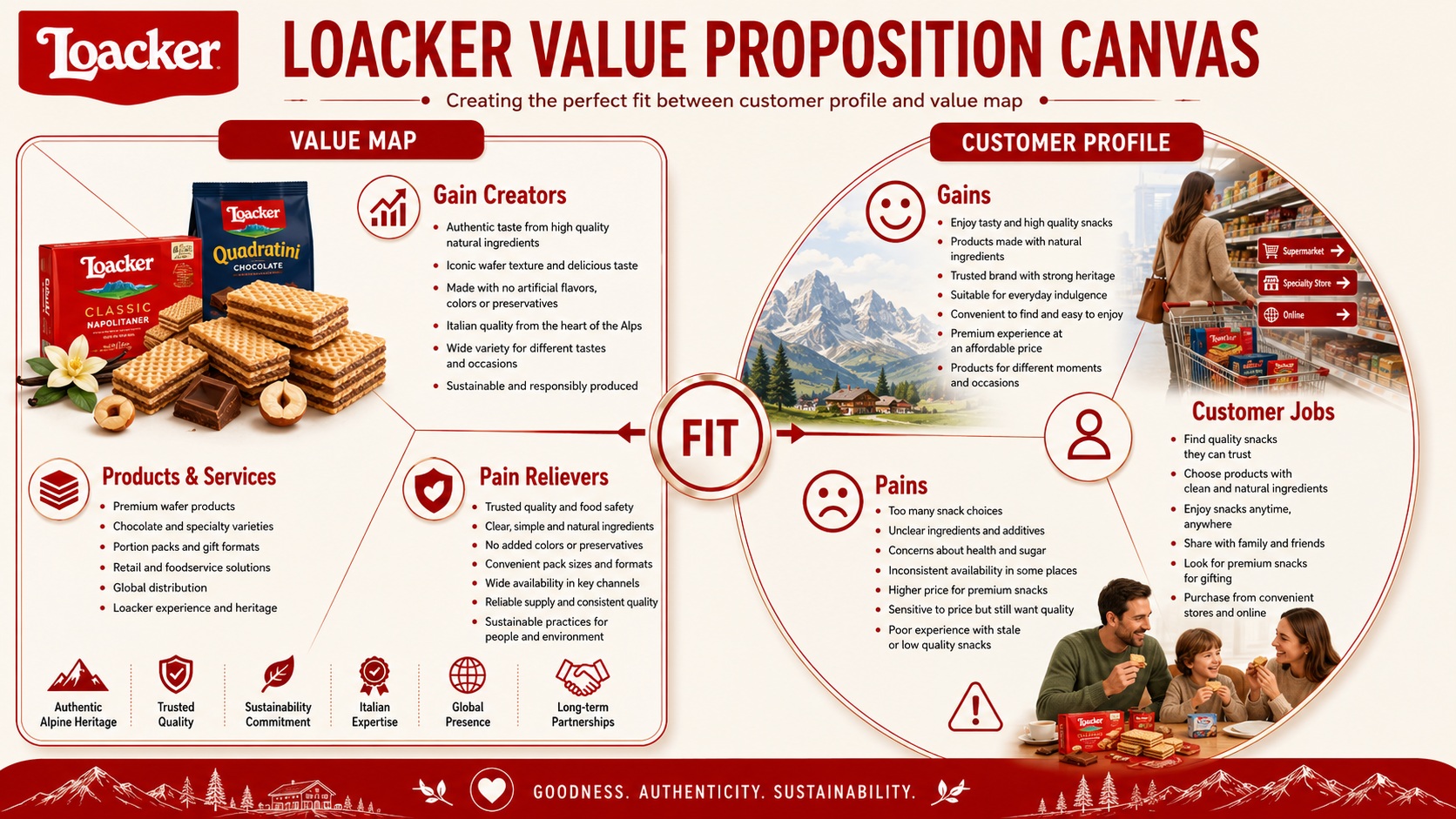
The table below shows how customer needs and Loacker’s value offer connect more directly. This format matches customer-side needs with company-side value creation in a clear and structured way.
| Customer Profile | Details | Matching Value Map | How Loacker Creates Fit |
| Customer Jobs | Customers want indulgent snacks and confectionery products that are tasty, easy to trust, suitable for sharing or gifting, and available across different budgets and occasions. | Products and Services | Loacker offers wafers, chocolate specialties, pralines, snack bars, minis, seasonal packs, and gifting assortments across multiple channels and purchase moments, making it easier for consumers to find a suitable option quickly. |
| Customer Pains | Customers face concerns about low product quality, artificial taste, weak freshness, limited premium options, and uncertainty about whether a product feels worth the price. | Pain Relievers | Loacker reduces those frictions through strong quality cues, trusted heritage, disciplined manufacturing standards, recognizable packaging, and certifications that make the purchase feel safer and more dependable. |
| Customer Gains | Customers value taste, trust, presentation, variety, and products that fit both indulgent and everyday needs. | Gain Creators | Loacker creates those gains through refined flavors, layered textures, premium packaging, broad format choice, and emotional appeal linked to heritage, gifting, and elevated snack experiences. |
The fit is strong because Loacker’s offer does not solve only one customer need. It helps customers make quick, low-friction choices across indulgence, gifting, trust, quality, and convenience. That is an important reason the Loacker Business Model Canvas remains resilient across both everyday snack moments and higher-value confectionery occasions.
The following is a VPC diagram of Loacker. It gives a visual view of how customer jobs, pains, and gains connect with Loacker’s products and services, pain relievers, and gain creators.
A more relevant comparison for Loacker is Ferrero rather than a soft drink or unrelated consumer brand. Both companies are Italian-rooted confectionery players with strong family-business heritage, strong recognition in international markets, and products that combine indulgence with emotional brand appeal. Ferrero is much larger, with more than 35 brands sold in over 170 countries, including Nutella, Kinder, Tic Tac, and Ferrero Rocher. Loacker is more focused, with a narrower portfolio centered on wafers and chocolate specialties.
That difference matters because the two businesses create power in different ways. Ferrero wins through portfolio scale, brand breadth, and category diversification across multiple confectionery segments. Loacker wins through sharper category focus, premium wafer identity, and a more concentrated brand meaning. Readers are likely to find this comparison more intuitive because both companies come from Italy, operate in sweet packaged foods, and rely on heritage as part of brand storytelling.
Ferrero’s scale gives it stronger bargaining power, broader shelf influence, and more opportunities to cross-subsidize brand investment across categories. Loacker cannot realistically match that breadth. Its strategic answer is clarity. By staying more focused, it can maintain stronger coherence around what the brand represents. In other words, Ferrero’s advantage is diversified confectionery leadership, while Loacker’s advantage is concentrated premium specialization.
This comparison also highlights a risk for Loacker. Focus creates distinctiveness, but it can also create category dependence. If wafer demand slows materially or if premium consumers shift toward other indulgence formats, Loacker has less diversification protection than Ferrero. At the same time, that same focus can be a strength because consumers may remember Loacker more specifically for wafers than they remember a diversified conglomerate for any one snack format.
The strategic lesson is clear. Loacker should not imitate Ferrero’s scale model. It should strengthen its own premium specialist model. The Loacker Business Model Canvas works best when the company competes through distinction, credibility, and category authority rather than through breadth alone.
The Loacker Business Model Canvas highlights several reinforcing advantages that make the company more defensible than many snack competitors. These strengths matter because Loacker does not have the same breadth or scale as the largest multinational confectionery groups. Its edge comes from sharper positioning and stronger coherence across the model rather than sheer portfolio power.
Taken together, these advantages show why Loacker can remain competitive without becoming a mass-market giant. The brand wins when focus, trust, and premium execution work together as a single system rather than as isolated strengths.
Loacker also faces important pressures that could weaken growth or margin if not managed carefully. These risks are important because premium confectionery brands have less room to hide operational or strategic mistakes. When customers pay more, they expect the premium promise to remain visible and consistent.
These challenges do not make the model weak, but they do make discipline essential. Loacker’s long-term performance will depend on how well management protects differentiation while absorbing cost pressure, channel complexity, and changing consumer expectations.
Loacker should continue protecting the premium meaning of the brand rather than chasing scale through excessive discounting. Wider distribution is useful, but it should still favor channels and presentations that reinforce quality.
Management should also keep investing in product formats that match current demand, including share packs, gifting lines, and premium snack options that feel contemporary without losing brand heritage. Digital storytelling around ingredients, craftsmanship, and origin can further strengthen trust.
Another priority is selective innovation. New flavors and adjacent premium products can create excitement, but they should remain consistent with what consumers already expect from Loacker. The Loacker Business Model Canvas will remain stronger when growth comes from disciplined extension rather than brand dilution.
A further recommendation is to sharpen occasion-based portfolio strategy. Not every product needs to serve the same mission. Some lines should clearly drive everyday frequency, while others should be positioned more deliberately for gifting, premium sharing, or travel retail. When each format has a clear commercial role, the overall portfolio becomes easier to manage and more effective in supporting both volume and margin.
Loacker should also deepen premium communication in channels where purchase decisions are fast. Shelf presentation, pack architecture, and concise digital content need to signal quality immediately. In premium confectionery, consumers often decide in seconds. Strong brand assets should therefore do more work at the point of purchase.
Another important move would be to expand carefully in ways that preserve scarcity and distinctiveness. Premium brands often weaken themselves when availability becomes too ordinary. Selective expansion across markets and formats is likely to create healthier long-term returns than rapid distribution growth that treats the brand like a mass commodity.
These recommendations point to the same broader principle. Loacker should grow by deepening its specialist premium model, not by imitating the scale logic of larger competitors. The Loacker Business Model Canvas becomes stronger when every decision, from product innovation to channel expansion, reinforces what the brand is already trusted for.
Loacker shows how a focused confectionery brand can build durable advantage without becoming the biggest player in the category. Its business model works because product quality, heritage, packaging, and channel choice reinforce one another.
Viewed through the Loacker Business Model Canvas, the company is best understood as a premium wafer and chocolate specialist that wins through clarity, not complexity. That focus gives Loacker a distinctive place in the market. It also explains why the brand can remain relevant across generations while still adapting to modern premium-snack expectations.
The deeper lesson is that premium strength does not always require portfolio breadth. In some cases, it comes from sharper positioning, stronger quality discipline, and more consistent symbolic meaning. Loacker appears to benefit from that logic. It occupies a space that is narrower than many multinational rivals, but often more precise in how consumers understand it.
Long-term success will depend on whether the company can continue balancing three demands at once: protect quality, stay relevant in modern channels, and expand without becoming generic. If Loacker maintains that balance, its focused premium model can remain highly competitive even in a market dominated by larger confectionery groups.
In that sense, Loacker offers a useful business lesson beyond confectionery. A company does not always need to be the broadest player in the market to build staying power. It can also win by becoming more credible, more focused, and more consistently understood than larger rivals. That is the central strategic insight behind the Loacker Business Model Canvas.
Loacker Business Model Canvas explained with detailed BMC analysis, Value Proposition Canvas, Ferrero comparison, competitive advantages, risks, and recommendations.
This article is provided for educational and business analysis purposes only. Its content is based on publicly available information, general market observations, and strategic interpretation. It does not constitute financial advice, investment advice, legal advice, or an official statement from Loacker. Readers should conduct their own research before making any business, investment, or strategic decisions.
All trademarks, logos, copyrights, brand names, and related materials mentioned or shown in this article belong to their respective owners.
Explore the Quipper Business Model Canvas, nine BMC blocks, Value Proposition Canvas, Ruangguru and Pahamify… Read More
Explore the CARPUT Business Model Canvas, nine BMC blocks, Value Proposition Canvas, competitor comparison, competitive… Read More
Explore the Boost Business Model Canvas, nine BMC blocks, Value Proposition Canvas, competitor comparison, advantages,… Read More
Explore the Domino's Pizza Business Model Canvas, nine BMC blocks, Value Proposition Canvas, Pizza Hut… Read More
Explore the Mie Gacoan Business Model Canvas, including its customer segments, value propositions, revenue streams,… Read More
Restaurant Business Model Canvas: A Practical Guide to Designing, Evaluating, and Improving Restaurant Business Models… Read More