CARPUT Business Model Canvas
Explore the CARPUT Business Model Canvas, nine BMC blocks, Value Proposition Canvas, competitor comparison, competitive advantages, risks and strategic recommendations.
Read this Apple Business Model Canvas analysis to understand how Apple creates value through premium devices, services, ecosystem loyalty, retail control, and recurring revenue.
BMC Article No: BMC #071
Apple is more than a company that sells iPhone, Mac, iPad, Apple Watch, and AirPods. It is a premium technology ecosystem built around hardware, software, services, retail experience, brand trust, privacy, and customer loyalty.
The Apple Business Model Canvas is interesting because Apple combines one-time product sales with recurring services revenue. A customer may buy an iPhone once every few years, but that same customer may keep paying for iCloud, Apple Music, Apple TV+, AppleCare, App Store purchases, and other services.
This makes Apple different from many hardware companies. Its strength does not come from devices alone. Real power comes from how those devices connect, share data, support services, and make customers less likely to switch.
In this article, we will break down how Apple creates value, reaches customers, earns revenue, manages costs, and protects its competitive position.
Apple’s business model is built around premium devices, integrated software, digital services, and ecosystem loyalty. The company designs and sells products such as iPhone, Mac, iPad, Apple Watch, AirPods, Apple TV, and accessories.
It also earns revenue from services such as the App Store, iCloud, Apple Music, Apple TV+, Apple Pay, advertising, AppleCare, and subscription bundles. This creates a model where hardware brings users into the ecosystem, while services increase long-term customer value.
A major strength is integration. Apple controls hardware design, operating systems, chips, retail experience, developer access, privacy positioning, and customer support. That control allows the company to deliver a consistent experience across devices.
However, the model is not risk-free. Premium pricing depends on strong brand trust and continuous product relevance. Services growth also brings regulatory attention, especially around App Store fees, platform control, payment rules, and competition.
The Apple Business Model Canvas shows a company that uses product excellence to attract users, services to deepen relationships, and ecosystem design to increase switching costs.
Business Model Canvas, or BMC, is a practical tool used to explain how a company works. It helps readers understand how a business creates value, delivers that value to customers, and captures revenue from the market.
Instead of looking only at products, BMC looks at the full business system behind those products. It connects customers, value propositions, channels, relationships, revenue, resources, activities, partners, and costs in one simple view.
This makes BMC useful for analysing companies like Apple because it shows how product design, ecosystem control, services revenue, retail channels, and customer loyalty work together. Rather than treating Apple as only a device company, BMC helps explain the wider strategy behind its growth.
Instead of looking only at products, BMC divides a company into nine operating blocks.
| BMC Block | Main Question |
|---|---|
| Customer Segments | Who does the business serve? |
| Value Propositions | What value does the business offer? |
| Channels | How does the business reach customers? |
| Customer Relationships | How does the business build loyalty? |
| Revenue Streams | How does the business make money? |
| Key Resources | What assets does the business need? |
| Key Activities | What must the business do well? |
| Key Partnerships | Who helps the business operate? |
| Cost Structure | What are the major costs? |
For Apple, BMC is useful because the company is not only selling devices. The Apple Business Model Canvas helps explain the link between product design, platform control, retail channels, services revenue, and long-term customer retention.
Apple Inc. is a global technology company headquartered in Cupertino, California. It is best known for the iPhone, Mac, iPad, Apple Watch, AirPods, iOS, macOS, App Store, iCloud, and its growing services portfolio.
The company was founded in 1976 by Steve Jobs, Steve Wozniak, and Ronald Wayne. Over time, Apple moved from personal computers into music players, smartphones, tablets, wearables, digital services, payments, and entertainment.
In fiscal 2025, Apple reported total net sales of about USD416.2 billion. iPhone remained the largest category at about USD209.6 billion, while Services reached about USD109.2 billion. Mac, iPad, and Wearables, Home and Accessories added further scale.
This revenue mix matters because Apple is no longer a simple product company. It is a platform business with a massive installed base, premium hardware economics, and high-margin services.
Apple is strategically interesting because it turns devices into an ecosystem. Many companies sell smartphones, laptops, watches, headphones, and subscriptions. Apple connects these products into one experience.
The iPhone acts as the centre of this model. Once customers use iPhone, they may add AirPods, Apple Watch, iCloud storage, App Store apps, Apple Pay, Mac, iPad, and AppleCare. Each additional product increases convenience and makes switching more difficult.
Brand trust also plays a major role. Apple sells at premium prices because customers associate the brand with design, privacy, security, reliability, status, and ease of use. That perception gives Apple pricing power that many competitors struggle to match.
From a strategy perspective, the Apple Business Model Canvas shows how a company can use integration, distribution control, customer data, services, and emotional loyalty to protect long-term value.
Apple’s business model is changing in three important ways.
First, Services is becoming more important. App Store, iCloud, advertising, AppleCare, Apple Music, Apple TV+, and payments create recurring revenue from the existing customer base.
Second, artificial intelligence is becoming a strategic battleground. Apple must show that its devices and operating systems can deliver useful AI features while maintaining privacy and device performance.
Third, regulation is increasing. Governments and courts are looking closely at App Store rules, payment restrictions, default services, competition, privacy, and platform control.
These changes make the Apple Business Model Canvas more important. Apple still depends heavily on iPhone, but its future growth depends on services, AI-enabled experiences, installed-base monetisation, and careful regulatory management.
Before going into each block in detail, the summary below gives a quick view of how Apple’s business model works. It shows who Apple serves, what value it offers, how it reaches customers, how revenue is generated, and what resources and activities keep the model running.
| BMC Block | Apple Application |
|---|---|
| Customer Segments | Premium consumers, professionals, students, creators, enterprises, developers, and digital service users. |
| Value Propositions | Premium devices, integrated ecosystem, privacy, design, performance, convenience, and reliable support. |
| Channels | Apple Stores, online store, telecom carriers, authorised resellers, App Store, service platforms, and enterprise channels. |
| Customer Relationships | Ecosystem loyalty, software updates, AppleCare, subscriptions, support, data continuity, and repeat upgrades. |
| Revenue Streams | iPhone, Mac, iPad, wearables, accessories, App Store, iCloud, subscriptions, AppleCare, advertising, and platform fees. |
| Key Resources | Brand equity, installed base, operating systems, Apple Silicon, retail network, patents, supply chain, and talent. |
| Key Activities | Product design, software development, chip development, supply chain management, services operation, retail, and marketing. |
| Key Partnerships | Manufacturers, component suppliers, telecom carriers, developers, content partners, payment networks, and resellers. |
| Cost Structure | Manufacturing, R&D, marketing, retail, cloud infrastructure, content, logistics, legal, support, and compliance costs. |
Apple BMC Diagram:
Customer segments describe who the business serves. Apple serves a broad global customer base, but its strongest appeal is among users who value quality, convenience, privacy, design, and ecosystem integration.
Apple’s customers are not all buying for the same reason. A professional may buy a Mac for creative work. A student may use an iPad for learning. A consumer may buy an iPhone for daily communication. An enterprise may deploy Apple devices because of security and manageability.
This broad base gives Apple many growth paths. The company can sell one customer multiple products over time, then add services, accessories, warranties, apps, and subscriptions.
| Customer Segment | What They Need | How Apple Serves Them |
|---|---|---|
| Premium consumers | Reliable, stylish, and easy-to-use devices for daily life. | Offers iPhone, AirPods, Apple Watch, iPad, accessories, and services. |
| Professionals and creators | High-performance tools for work, design, media, and productivity. | Provides Mac, iPad Pro, Apple Silicon, creative apps, and iCloud. |
| Students and education users | Portable devices for learning, notes, research, and creative work. | Supports iPad, MacBook, Apple Pencil, education pricing, and learning apps. |
| Enterprises | Secure and manageable devices for business users. | Offers iPhone, Mac, iPad, Apple Business Manager, security features, and support. |
| Developers | Access to a large user base and reliable app tools. | Provides App Store access, developer tools, APIs, and platform documentation. |
The Apple Business Model Canvas shows that Apple does not depend on one customer group. Its market is broad, global, and ecosystem-based. This gives Apple stronger resilience because growth can come from different segments at different times. A student may start with an iPad, later buy a Mac, then become an iPhone, iCloud, and Apple Watch user. That customer journey makes Apple’s customer base valuable over the long term.
The value proposition explains why customers choose Apple. At the simplest level, Apple offers premium technology products that are easy to use, secure, well-designed, and deeply connected.
Apple’s value proposition is built around integration. Customers do not only buy an iPhone, Mac, or iPad. They buy access to a system where devices, apps, services, payments, data, and support work together.
The strongest part of Apple’s value proposition is trust. Customers believe that Apple products will work reliably, protect their data, receive long-term updates, and retain strong resale value.
| Value Proposition | Customer Benefit | Business Impact |
|---|---|---|
| Integrated ecosystem | Devices, apps, and services work smoothly together. | Increases loyalty and makes switching harder. |
| Premium design | Customers get products that feel modern, simple, and high quality. | Supports premium pricing and strong brand perception. |
| Privacy and security | Users feel safer when using devices, apps, cloud storage, and payments. | Builds trust and differentiates Apple from many competitors. |
| Strong performance | Devices deliver speed, battery life, and reliable daily use. | Makes Apple products harder to compare on price alone. |
| Brand confidence | Customers trust product quality, support, and resale value. | Encourages repeat purchases and long-term retention. |
Apple’s value proposition is not only the device. It is the full experience of simplicity, privacy, design, performance, support, and ecosystem confidence. This is why customers often compare Apple less by technical specifications and more by overall usability. When the experience feels reliable across many products, Apple can defend premium pricing and strengthen emotional loyalty.
Channels explain how Apple reaches customers. This is one of the most important parts of the Apple Business Model Canvas because Apple uses both controlled and partner-led channels.
Apple sells through its own stores, online platforms, telecom carriers, authorised resellers, enterprise partners, education channels, and digital platforms. This channel mix allows Apple to serve direct buyers, contract buyers, business users, students, and digital service customers.
Control matters because Apple is a premium brand. Its products need the right presentation, explanation, setup support, and after-sales experience.
| Channel | Examples | Strategic Role |
|---|---|---|
| Apple Stores | Flagship stores, mall outlets, Genius Bar, and product demos. | Creates brand visibility and controls the premium experience. |
| Apple online channels | Apple website, Apple Store app, trade-in pages, and financing. | Enables direct sales, custom orders, and upgrade conversion. |
| Telecom carriers | Mobile plans, instalments, bundles, and upgrade offers. | Expands iPhone reach and reduces upfront purchase barriers. |
| Authorised resellers | Electronics retailers, enterprise resellers, and education partners. | Increases market coverage where Apple Stores are limited. |
| Digital platforms | App Store, iCloud, Apple Music, Apple TV app, and Apple Pay. | Maintains customer engagement after the device purchase. |
Strong channels make Apple more accessible. In a premium category, channel control also protects the brand experience and supports customer trust. Apple Stores help customers understand the product before purchase, while online channels and carriers make buying easier. Digital platforms then extend the relationship after purchase, which turns distribution into a long-term engagement system.
Customer relationships describe how Apple keeps people coming back. Apple’s relationship model is built on trust, convenience, support, ecosystem habit, and long-term product usage.
The company does not rely only on sales transactions. It builds a continuing relationship through software updates, iCloud storage, subscriptions, AppleCare, App Store purchases, device settings, and cross-device continuity.
Apple also benefits from customer data continuity. Photos, files, passwords, health data, apps, messages, payment settings, and subscriptions become part of the customer’s daily digital life.
| Relationship Driver | How It Works | Example |
|---|---|---|
| Ecosystem habit | Customers use several Apple devices and connected services. | An iPhone user adds AirPods, Apple Watch, iCloud, and Mac. |
| Long-term software support | Updates improve security, features, and product relevance. | Older devices continue receiving important updates. |
| Technical support | AppleCare, Genius Bar, online support, and service centres solve issues. | A customer repairs a device or gets setup help. |
| Subscription relationship | iCloud, Apple Music, Apple TV+, Arcade, Fitness+, and Apple One create recurring contact. | A user pays monthly for storage and entertainment. |
| Data continuity | Files, passwords, apps, photos, health data, and settings remain connected. | Switching becomes inconvenient because digital life is already inside Apple. |
Apple’s relationship with customers is not built on one purchase. It is built on repeated use, saved data, service dependency, and ecosystem comfort. The more a customer uses Apple products, the more valuable the relationship becomes. This creates a strong retention loop because leaving Apple means replacing not only a device, but also habits, files, apps, subscriptions, and support routines.
Revenue streams show how the business makes money. Apple generates revenue mainly through hardware sales, supported by services, accessories, platform fees, subscriptions, warranties, and upgrade cycles.
The core revenue engine is still the iPhone. However, Apple’s services revenue has become strategically important because it creates recurring income from the installed base.
Each device sale can lead to more spending. A customer may buy accessories, iCloud storage, AppleCare, App Store apps, Apple Music, Apple TV+, and future device upgrades.
| Revenue Stream | Description | Why It Matters |
|---|---|---|
| Hardware sales | Sales of iPhone, Mac, iPad, Apple Watch, AirPods, and Apple TV. | Forms the largest revenue base of the business. |
| Services | App Store, iCloud, Apple Music, Apple TV+, Arcade, Fitness+, and AppleCare. | Creates recurring revenue and improves margin quality. |
| Accessories | Cases, chargers, watch bands, keyboards, AirPods, and Apple Pencil. | Increases average customer spend. |
| Platform fees | App Store commissions, advertising, licensing, and payment-related income. | Monetises Apple’s installed base and platform control. |
| Upgrade cycles | New devices, trade-ins, instalments, and financing. | Encourages repeat hardware purchases over time. |
The Apple Business Model Canvas shows a revenue model based on premium hardware, recurring services, ecosystem add-ons, and long-term customer lifetime value. This structure is powerful because Apple can earn at several points in the customer journey. It earns when customers buy devices, upgrade products, subscribe to services, purchase apps, add accessories, and pay for support.
Key resources are the assets required to deliver the business model. For Apple, the most important resources are brand equity, operating systems, installed base, Apple Silicon, supply chain capability, retail network, and talent.
The brand is a major resource because customers must trust Apple before paying premium prices. Apple’s design reputation, privacy image, product quality, and resale value help protect that trust.
However, brand alone is not enough. Apple also needs software platforms, chips, supply chain scale, retail capability, patents, cloud infrastructure, and skilled teams.
| Key Resource | Role in the Business Model | Strategic Value |
|---|---|---|
| Brand equity | Recognition, trust, privacy image, and premium reputation. | Helps Apple charge premium prices and retain customers. |
| Installed base | Active iPhone, Mac, iPad, Watch, and Apple TV users. | Creates demand for services, apps, accessories, and upgrades. |
| Operating systems | iOS, macOS, iPadOS, watchOS, and visionOS. | Controls the user experience across devices. |
| Apple Silicon | Custom chips used across major product lines. | Improves performance, battery life, and differentiation. |
| Retail and support network | Apple Stores, service centres, online support, and AppleCare. | Strengthens sales, service, education, and loyalty. |
| Supply chain capability | Supplier relationships, manufacturing scale, logistics, and quality control. | Enables global product launches and reliable availability. |
Together, these resources make Apple more than a device company. They make it a repeatable premium technology operating model. The brand attracts demand, the installed base creates recurring monetisation, Apple Silicon improves differentiation, and the retail network strengthens trust. This combination is difficult to copy because competitors must match both product quality and ecosystem depth.
Key activities are the things Apple must do well to stay competitive. These include product design, software development, chip development, supply chain management, services operation, retail execution, marketing, and quality control.
The most important activity is integration. Customers expect Apple products to work smoothly across devices, apps, cloud services, payments, and support channels.
Product development is also critical. Smartphone, computing, wearable, AI, and services markets move quickly. Apple must keep improving products without weakening simplicity or trust.
| Key Activity | What It Involves | Why It Matters |
|---|---|---|
| Product design | Designing devices, accessories, packaging, and user experiences. | Protects Apple’s premium identity and usability. |
| Software development | Building operating systems, native apps, developer tools, and updates. | Keeps the ecosystem secure, useful, and consistent. |
| Chip development | Designing Apple Silicon for iPhone, Mac, iPad, and other devices. | Supports performance, battery life, and hardware differentiation. |
| Supply chain management | Securing components, managing production, and controlling quality. | Supports global availability and launch discipline. |
| Services operation | Running App Store, iCloud, subscriptions, payments, and customer accounts. | Builds recurring revenue and platform engagement. |
| Retail and support execution | Managing stores, setup, repairs, education, and customer care. | Converts product interest into loyalty. |
The Apple Business Model Canvas shows that operational discipline is the hidden engine behind Apple’s simple customer experience. Customers may see clean design and smooth software, but behind that experience are complex activities across engineering, supply chain, services, retail, and support. Apple’s strength comes from making these difficult activities feel simple to the end user.
Key partnerships help Apple operate, scale, and serve customers more efficiently. These partnerships include manufacturers, component suppliers, telecom carriers, developers, content partners, payment networks, logistics providers, and resellers.
Apple cannot scale through internal effort alone. Reliable suppliers are needed for components. Manufacturing partners help produce devices. Carriers expand iPhone reach. Developers make the ecosystem more useful.
Partnership quality matters because Apple’s brand depends on consistency. Poor components, weak manufacturing, unreliable apps, or poor service partners can damage the customer experience.
| Partner Type | Examples | Contribution to the Business Model |
|---|---|---|
| Manufacturing partners | Device assemblers and production partners. | Help Apple produce devices at global scale. |
| Component suppliers | Chip, display, camera, sensor, battery, memory, and material suppliers. | Support product quality and technical performance. |
| Telecom carriers | Mobile network operators and iPhone plan providers. | Expand iPhone distribution through plans and promotions. |
| Developers | App creators across iOS, iPadOS, macOS, watchOS, and visionOS. | Make Apple devices more useful and valuable. |
| Content partners | Music, video, gaming, sports, and media providers. | Strengthen Apple’s entertainment and subscription services. |
| Payment and enterprise partners | Banks, payment networks, business software providers, and resellers. | Support Apple Pay, business adoption, and service expansion. |
These partnerships reduce friction. They allow Apple to focus on product strategy, ecosystem control, customer experience, and premium brand management. At the same time, Apple depends on partner performance to protect quality and availability. This means partnership management is not a back-office activity. It is a strategic capability that supports scale, innovation, and customer trust.
Cost structure explains the major costs required to run the business model. Apple’s cost base reflects premium product development, global manufacturing, retail operations, services infrastructure, marketing, logistics, and compliance.
Manufacturing is a major cost because Apple sells hardware at massive scale. Research and development is also critical because the company must keep improving chips, software, AI, cameras, displays, health features, and future devices.
Retail and support costs are also important. Apple Stores, trained staff, repairs, customer education, and service operations help protect the premium customer experience.
| Cost Area | Examples | Business Impact |
|---|---|---|
| Manufacturing | Components, assembly, testing, packaging, and quality control. | Drives the cost base behind global device sales. |
| Research and development | Chips, software, AI, cameras, health features, and future products. | Protects innovation and long-term differentiation. |
| Marketing and launches | Advertising, events, campaigns, packaging, and product storytelling. | Supports premium positioning and product demand. |
| Retail operations | Stores, staff, repairs, training, inventory, and customer support. | Strengthens customer experience but adds fixed cost. |
| Services infrastructure | Cloud, content, payments, App Store operations, and compliance. | Supports recurring revenue and platform reliability. |
| Logistics and legal | Shipping, warranties, regulatory work, and environmental commitments. | Protects delivery quality, compliance, and brand trust. |
Apple’s cost structure supports its premium positioning. The company spends heavily because product quality, trust, support, and ecosystem reliability are central to its business model. These costs are strategic investments, not only operating expenses. When R&D, manufacturing, retail, services, and support are managed well, they help Apple protect margins, customer loyalty, and long-term brand strength.
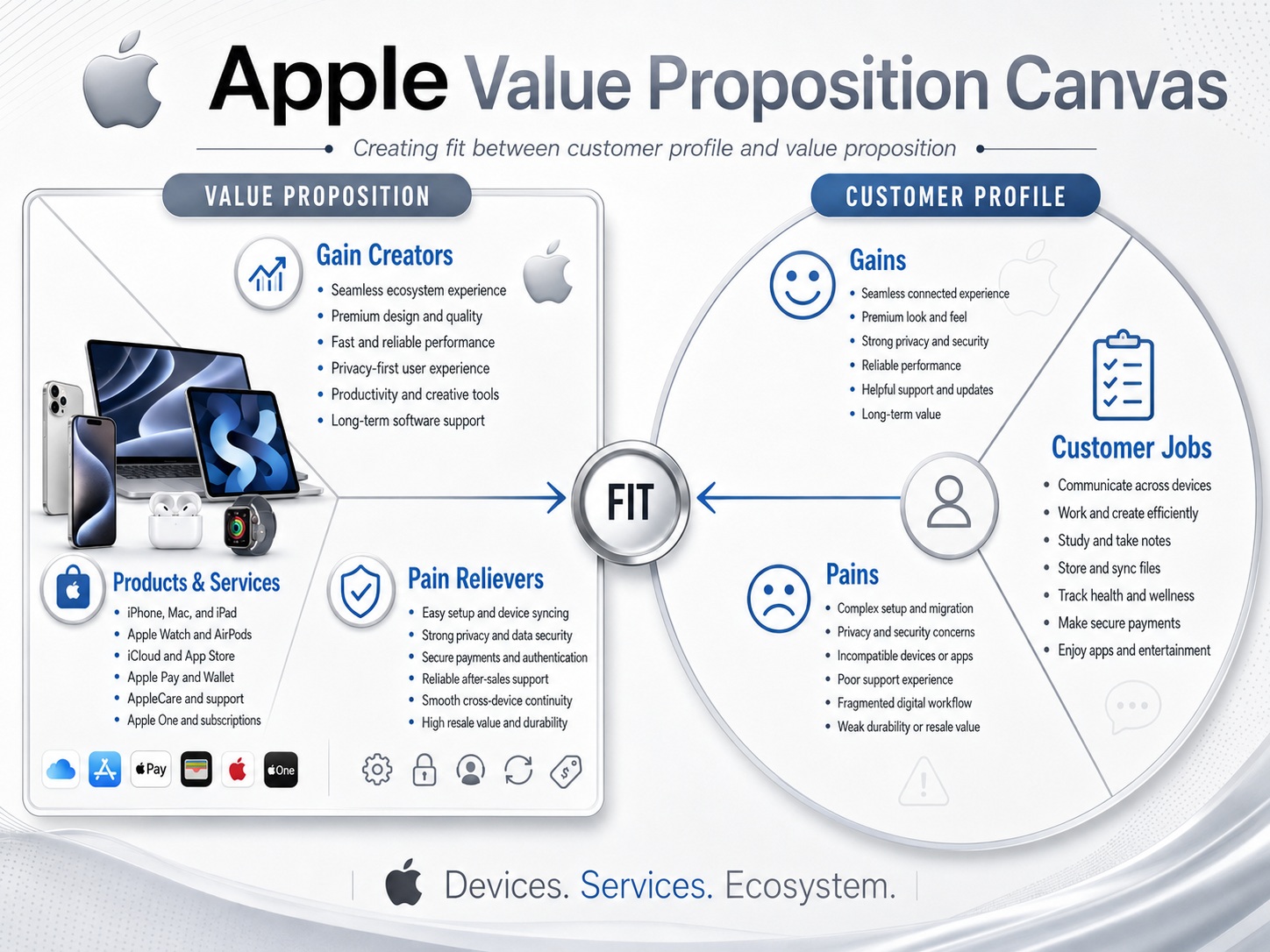
The Value Proposition Canvas is a tool used to analyse how well a company’s offer fits what customers need. It connects two sides: the customer profile and the value proposition. The customer profile explains what customers want to achieve, what problems they face, and what benefits they expect. The value proposition explains how the company’s products and services reduce those problems and create those benefits.
For Apple, the Value Proposition Canvas helps explain how Apple’s products fit customer needs. It shows the relationship between customer jobs, pains, and gains with Apple’s products, pain relievers, and gain creators.
For Apple, this fit is important because customers do not only want advanced devices. They want technology that reduces complexity, protects personal data, supports work and lifestyle needs, and connects smoothly across daily routines. Apple’s value proposition works when its products and services solve those practical needs better than fragmented alternatives.
The customer profile explains what Apple customers are trying to achieve, what problems they want to avoid, and what benefits they expect from the brand. This view is useful because Apple does not compete only through product features. It competes by solving daily technology frustrations in a simple and premium way.
Many Apple customers want devices that help them communicate, work, create, study, manage personal data, track health, make payments, and enjoy entertainment without unnecessary complexity. They also want products that feel secure, reliable, and connected across different parts of their digital life.
This means Apple’s customer profile is shaped by both practical and emotional needs. Customers want performance and convenience, but they also want confidence, privacy, status, and long-term product value.
| Customer Profile | Analysis |
|---|---|
| Customer Jobs | Customers want to communicate, work, create, study, manage health, pay, store data, and enjoy entertainment. |
| Pains | They face complex setup, security concerns, poor support, device incompatibility, low resale value, and fragmented services. |
| Gains | They want simple experiences, premium design, privacy, performance, convenience, and confidence. |
Apple Value Proposition explains how Apple responds to the customer profile above. It shows which products and services Apple offers, how those offers reduce customer problems, and how they create extra benefits for users.
In simple terms, this section answers one question: why do customers choose Apple instead of another technology brand? The answer is not only the iPhone, Mac, iPad, or Apple Watch. It is the complete experience that combines devices, software, services, support, privacy, and ecosystem continuity.
Apple reduces customer pains by making technology easier to use. Setup is simple, devices connect smoothly, software updates are frequent, and support is available through AppleCare, online help, and service centres. These elements reduce frustration for customers who do not want fragmented devices, weak support, or complicated digital tools.
Apple also creates gains by improving daily productivity, creativity, entertainment, health tracking, payments, and personal data management. A customer can start work on a Mac, continue on an iPad, answer calls through AirPods, track health on Apple Watch, and keep files synced through iCloud.
This is why Apple’s value proposition is powerful. It is not built around one product feature. It is built around a connected lifestyle that makes customers feel more productive, secure, and confident.
| Value Proposition Element | Analysis |
|---|---|
| Products and Services | iPhone, Mac, iPad, Apple Watch, AirPods, iCloud, App Store, AppleCare, and Apple One. |
| Pain Relievers | Easy setup, strong support, software updates, privacy controls, secure payments, and device integration. |
| Gain Creators | Status, productivity, creative tools, health features, recurring services, and cross-device continuity. |
The fit happens inside Apple’s ecosystem, where customer needs and Apple’s value proposition meet in daily use. Customers want technology that is simple, secure, reliable, and connected. Apple creates that fit by combining devices, software, services, support, privacy features, and account continuity into one integrated system.
This fit becomes visible when an iPhone user stores photos in iCloud, listens through AirPods, tracks health on Apple Watch, pays with Apple Pay, works on a Mac, and continues tasks on an iPad. Each product solves a specific customer job, but the stronger value appears where these products connect. That is where Apple turns individual devices into a complete digital experience.
| Customer Profile | Details | Matching Value Proposition | How Apple Creates Fit |
|---|---|---|---|
| Customer Jobs | Customers want to communicate, work, create, study, manage health, make payments, store data, and enjoy entertainment. | Products and Services | iPhone, Mac, iPad, Apple Watch, AirPods, iCloud, App Store, Apple Pay, AppleCare, and Apple One support these daily jobs. |
| Pains | Customers face complex setup, security concerns, poor support, device incompatibility, fragmented apps, and low resale value. | Pain Relievers | Easy setup, privacy controls, secure payments, software updates, AppleCare, service centres, and cross-device integration reduce these frustrations. |
| Gains | Customers want convenience, premium design, strong performance, privacy, productivity, status, and long-term value. | Gain Creators | Apple creates gains through ecosystem continuity, Apple Silicon performance, premium design, health features, creative tools, resale value, and recurring services. |
Fit also happens when Apple reduces customer pains. Complicated setup, weak support, fragmented apps, device incompatibility, and security concerns become less visible when customers stay within the Apple ecosystem.
At the same time, Apple creates gains through convenience, premium design, productivity, privacy, resale value, and status. This makes customers feel that Apple is not only selling technology, but also making their digital life easier to manage.
The Apple Business Model Canvas becomes stronger when viewed together with this fit. Apple wins when customers feel that its products reduce complexity, improve daily life, and make digital experiences easier to manage.
VPC Diagram:
Apple has several competitive advantages that support its long-term business model. These advantages are not separate strengths. They work together as one system, where brand trust attracts customers, ecosystem integration keeps them engaged, and services increase the value of each customer relationship over time.
These advantages reinforce each other. Apple’s brand attracts customers, the ecosystem keeps them engaged, and services increase the value of each relationship over time.
Apple also faces several risks that may affect future growth. These risks are important because Apple operates at global scale, depends on premium customer demand, and faces pressure from regulators, developers, suppliers, and fast-moving technology competitors:
These risks do not mean Apple’s model is weak. They show that a powerful ecosystem also attracts pressure from competitors, regulators, developers, and customers.
Apple should protect the iPhone as the ecosystem anchor while reducing overdependence on hardware replacement cycles. More value should come from services, device intelligence, health, financial services, privacy tools, and enterprise use cases.
The company should also accelerate practical AI integration. Customers do not need AI as a slogan. They need better search, writing, photos, personal assistance, productivity, health insights, and device automation.
A stronger services strategy should remain customer-friendly. Apple can grow recurring revenue, but aggressive fees or restrictive rules may create regulatory and developer backlash.
Supply chain diversification should continue. Wider manufacturing resilience can reduce exposure to geopolitical risk, tariffs, and single-country concentration.
Enterprise growth deserves more attention. Mac, iPhone, iPad, security features, device management, and privacy positioning can help Apple win more business customers.
The Apple Business Model Canvas suggests one clear priority: keep the ecosystem valuable without making customers, developers, or regulators feel trapped.
Apple’s business model is powerful because it connects premium hardware, software, services, retail, support, and brand trust into one system. The company does not only sell products. It builds an environment where customers keep using, upgrading, subscribing, and adding more Apple devices.
The iPhone remains the centre of this model, but Services is increasingly important. Mac, iPad, Apple Watch, AirPods, App Store, iCloud, AppleCare, Apple Pay, and subscription bundles all extend the relationship beyond a single purchase.
The canvas shows that Apple’s real advantage is not one product. Its advantage is the system around the product.
Future growth will depend on how well Apple manages AI, regulation, services, supply chain resilience, and customer trust. If those areas are handled well, Apple can remain one of the world’s strongest business ecosystems.
This article is for educational and business analysis purposes only. It is based on publicly available information, general market observation, and strategic interpretation. It is not financial advice, investment advice, legal advice, or an official statement from Apple Inc. Readers should conduct their own research before making business, investment, or strategic decisions.
Explore the CARPUT Business Model Canvas, nine BMC blocks, Value Proposition Canvas, competitor comparison, competitive… Read More
Explore the Boost Business Model Canvas, nine BMC blocks, Value Proposition Canvas, competitor comparison, advantages,… Read More
Explore the Domino's Pizza Business Model Canvas, nine BMC blocks, Value Proposition Canvas, Pizza Hut… Read More
Explore the Mie Gacoan Business Model Canvas, including its customer segments, value propositions, revenue streams,… Read More
Restaurant Business Model Canvas: A Practical Guide to Designing, Evaluating, and Improving Restaurant Business Models… Read More
Learn how the Food and Beverage Business Model Canvas helps restaurants, cafés, beverage brands, and… Read More