Mie Gacoan Business Model Canvas
Explore the Mie Gacoan Business Model Canvas, including its customer segments, value propositions, revenue streams, operations, competitive advantages, risks, and strategic recommendations.
Pizza Hut is one of the most established global pizza brands. The company was founded in 1958 in Wichita, Kansas, by two brothers with a simple dine-in pizza concept. Over time, the brand expanded rapidly through franchising and became a household name in many countries. Its early success relied on casual dining, family meals, and strong brand recognition.
BMC Article No: BMC #065
Updated in 2026: This article has been refreshed with Pizza Hut’s latest company scale, updated business performance and ownership context, a more relevant comparison with Domino’s, deeper analysis for every BMC block, an expanded Value Proposition Canvas, revised competitive advantages and risks, new strategic recommendations, and a more refined article structure.
Pizza Hut is more than a traditional pizza restaurant chain. It is a global foodservice brand built around franchise expansion, recognisable products, restaurant operations, digital ordering, delivery, takeaway, and family-oriented dining occasions.
The Pizza Hut Business Model Canvas matters because the company does not depend on one restaurant format or one purchasing channel. Instead, it serves customers through full-service restaurants, compact outlets, delivery-focused stores, takeaway counters, websites, mobile applications, and third-party platforms.
That broader structure makes Pizza Hut strategically interesting. Unlike a small independent pizza operator, the company can combine international brand recognition, standardised systems, local franchise knowledge, menu adaptation, and extensive market coverage.
Pizza Hut operates a branded restaurant and food-delivery business model supported primarily by franchising. It sells pizza, pasta, chicken, side dishes, desserts, and beverages through dine-in, takeaway, delivery, and digital ordering channels.
At its core, the Pizza Hut Business Model Canvas shows a company that earns through restaurant sales, franchise royalties, delivery transactions, menu combinations, promotional offers, and network expansion. Dine-in outlets support brand experience and family occasions, while delivery and takeaway provide convenience and transaction frequency.
This design matters because Pizza Hut can serve several meal occasions within one commercial system. When dine-in traffic is weaker, delivery, collection, or smaller-format outlets can help maintain customer access.
Business Model Canvas, or BMC, is a practical framework used to explain how a company creates value, delivers that value, and captures revenue. Rather than focusing only on products, the framework maps the operating logic behind the entire organisation.
For Pizza Hut, BMC is particularly useful because success depends on more than pizza quality. Restaurant locations, kitchen productivity, digital ordering, delivery speed, franchisee capability, promotions, menu design, and supply-chain coordination all influence performance.
That is why the Pizza Hut Business Model Canvas is a useful lens. It shows how brand familiarity, customer convenience, operational discipline, and franchise scale work together as one restaurant system.
| BMC Block | Main Question |
| Customer Segments | Who does the business serve? |
| Value Propositions | What value does the business offer? |
| Channels | How does the business reach customers? |
| Customer Relationships | How does the business build loyalty? |
| Revenue Streams | How does the business make money? |
| Key Resources | What assets does the business need? |
| Key Activities | What must the business do well? |
| Key Partnerships | Who helps the business operate? |
| Cost Structure | What are the major costs? |
Pizza Hut was founded in Wichita, Kansas, in 1958 by brothers Dan and Frank Carney. The company initially grew through its restaurant-based pizza concept before expanding internationally through franchising, delivery, takeaway, and multiple store formats.
Over time, Pizza Hut became one of the world’s largest pizza restaurant brands. By the first quarter of 2026, the division reported 19,944 restaurants worldwide and opened 346 gross new outlets across 27 countries during the quarter.
Scale matters because a large restaurant network creates stronger brand visibility, broader delivery coverage, greater purchasing leverage, and more opportunities to adapt formats to different markets.
Pizza Hut is strategically interesting because it combines the characteristics of a restaurant operator, delivery business, digital commerce platform, and global franchise network.
A customer does not interact only with the food. The complete experience includes menu discovery, promotional selection, ordering, payment, preparation, delivery or collection, food quality, and service recovery when something goes wrong.
That creates a more complex commercial position. Pizza Hut must manage restaurant experience and off-premise convenience simultaneously, while delivery-focused competitors can concentrate more narrowly on speed, digital conversion, and compact store economics.
Another advantage comes from format flexibility. Management and franchisees can use dine-in restaurants, delivery units, express outlets, or hybrid formats depending on local demand, property costs, and customer behaviour.
In 2026, the Pizza Hut Business Model Canvas is shaped by four visible shifts. First, delivery, takeaway, and digital ordering continue to influence how customers purchase pizza, reducing dependence on traditional restaurant visits.
Second, value remains important as customers compare Pizza Hut with Domino’s, local pizza chains, independent restaurants, and food-delivery alternatives. Clearer combinations, targeted promotions, and suitable portion sizes therefore affect conversion.
Third, outlet economics require closer attention. Larger dine-in locations may carry higher rental, labour, utility, and maintenance costs than compact delivery or takeaway formats.
Fourth, Pizza Hut entered a major ownership transition in June 2026. Yum! Brands agreed to sell the business outside mainland China to LongRange Capital, while Yum China agreed to acquire the mainland China operation. The two announced transactions were valued at approximately US$2.7 billion in total and remained subject to closing conditions.
Together, these changes make Pizza Hut’s model more demanding, but also create an opportunity to sharpen strategic focus, improve outlet productivity, and localise decisions more effectively.
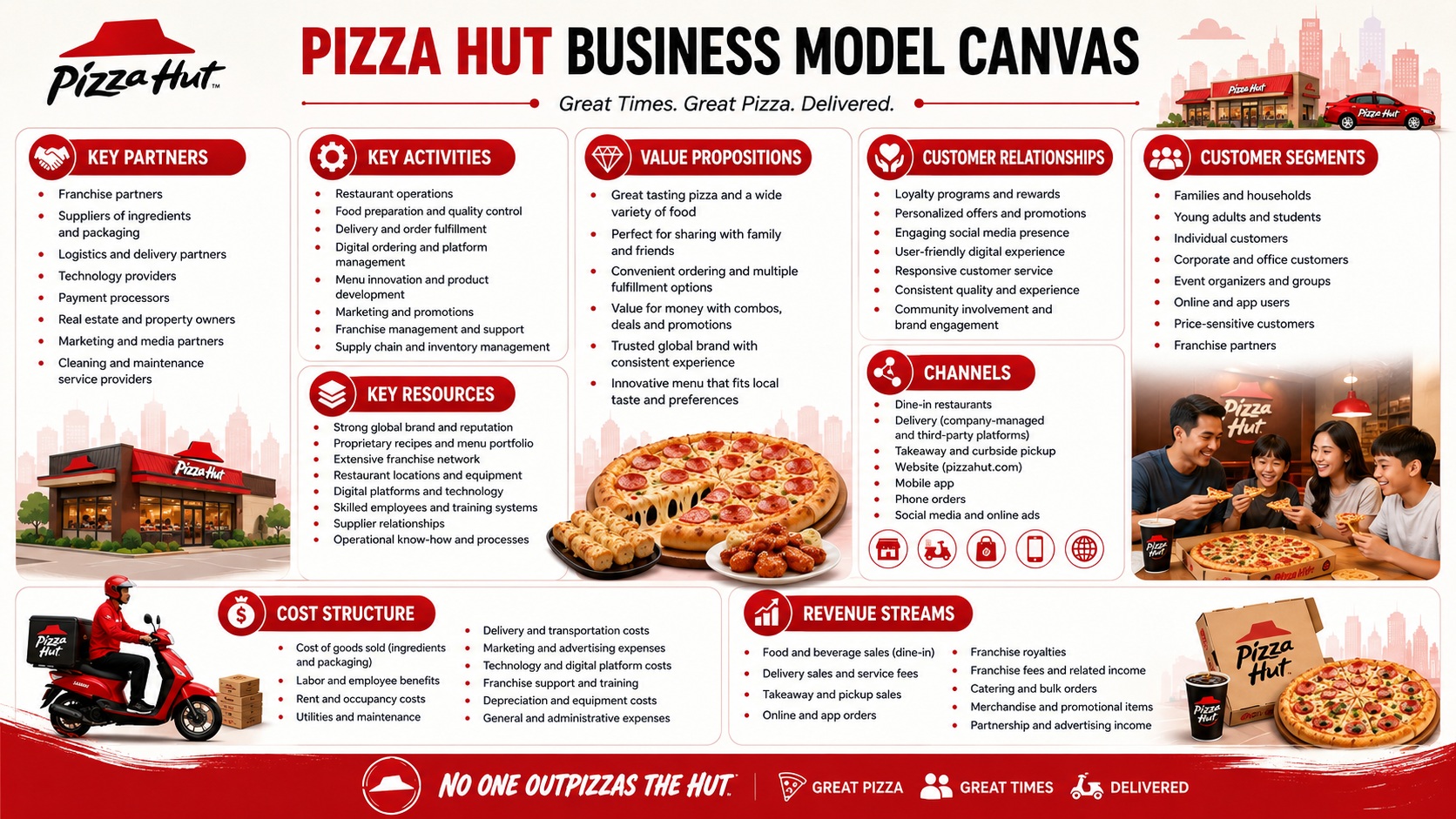
Before examining each block in detail, the summary below provides a quick view of how Pizza Hut’s business works. It offers a compact snapshot of the complete model before the deeper analysis, making it easier to see how the main building blocks connect.
This summary also helps readers understand why Pizza Hut is more than a dine-in pizza chain and how restaurants, delivery, digital platforms, franchising, and brand strength operate as one commercial system.
| BMC Block | Pizza Hut Application |
| Customer Segments | Families, individuals, students, young adults, office workers, groups, digital customers, and franchise partners |
| Value Propositions | Recognisable pizza, menu variety, convenient ordering, shareable meals, broad accessibility, and value combinations |
| Channels | Dine-in restaurants, delivery, takeaway, websites, mobile applications, telephone ordering, and delivery platforms |
| Customer Relationships | Brand campaigns, promotions, loyalty programmes, digital engagement, convenient reordering, and customer support |
| Revenue Streams | Pizza and food sales, dine-in transactions, delivery orders, takeaway purchases, franchise royalties, and related fees |
| Key Resources | Brand equity, recipes, franchise network, restaurant footprint, digital platforms, supply relationships, and operating systems |
| Key Activities | Restaurant operations, food preparation, delivery, digital ordering, menu development, marketing, and franchise management |
| Key Partnerships | Franchisees, food suppliers, logistics companies, technology vendors, delivery platforms, landlords, and payment providers |
| Cost Structure | Ingredients, labour, rent, utilities, delivery, packaging, technology, maintenance, marketing, and franchise support |
The diagram below gives a visual summary of how the main blocks of Pizza Hut’s business model connect in one view. It helps readers move from the written explanation into a simpler strategic snapshot before continuing to the detailed block-by-block analysis.
The BMC analysis of Pizza Hut examines how the nine building blocks work together to support the company’s global restaurant and franchise model. Each block represents a specific part of the business, but Pizza Hut’s performance depends on how well these elements are aligned across customer demand, menu design, restaurant operations, digital ordering, delivery, partnerships, and cost control.
This analysis is especially important because Pizza Hut operates through multiple formats and channels. A promotion that increases order volume may also affect kitchen capacity, delivery speed, labour requirements, ingredient usage, and franchisee profitability. Likewise, a new outlet can improve market coverage, but only when its size, location, format, and operating costs match local customer behaviour.
The following sections analyse each block of the Pizza Hut Business Model Canvas in greater detail. Together, they show how Pizza Hut creates value for customers, delivers that value through its restaurant and digital network, and captures revenue through food sales, delivery, franchising, and related commercial activities.
Customer segments explain who Pizza Hut serves and why those buyers matter. Pizza Hut targets a mass market, but its real strength comes from addressing several meal occasions, household types, age groups, and ordering preferences within the same restaurant system.
Families may use Pizza Hut for shared meals, celebrations, or convenient weekend dining. Students and young adults often respond to combinations, discounts, new flavours, and digital promotions. Office customers may order for lunch, meetings, or group events.
The company therefore benefits from broad meal relevance rather than dependence on one narrowly defined customer group.
| Segment | Details | Why It Matters |
| Families and households | Customers purchasing shareable meals for family dining, celebrations, weekends, and convenient at-home consumption | Supports larger orders, group combinations, side dishes, and repeat family occasions |
| Students and young adults | Price-conscious consumers attracted to promotions, digital ordering, new products, and informal social meals | Maintains relevance among younger buyers and generates demand through value-led campaigns |
| Individual and convenience buyers | Customers seeking personal meals, quick collection, delivery, or simple dining without meal preparation | Expands Pizza Hut beyond group occasions and supports transaction frequency |
| Corporate and group customers | Businesses, schools, event organisers, and other buyers placing larger orders for meetings or gatherings | Produces higher-value transactions and broadens demand beyond routine household purchases |
Pizza Hut succeeds because it serves both planned group meals and immediate convenience needs. One part of the model supports family and social occasions, while another captures individual, delivery, and takeaway demand. The Pizza Hut Business Model Canvas is strong here because it provides multiple customer layers, broader purchasing occasions, and less dependence on one restaurant format.
The value proposition explains why customers choose Pizza Hut repeatedly. Pizza Hut offers more than pizza. It delivers familiar products, menu variety, flexible ordering, group suitability, broad accessibility, and pricing options for different budgets.
That matters because restaurant decisions are often made quickly. Customers may compare taste, price, portion size, delivery time, promotions, and familiarity without conducting an extensive evaluation.
Pizza Hut strengthens its value by serving several meal occasions, from family dining and group sharing to personal delivery, takeaway, and casual weekday meals.
| Value Proposition | Details | Why It Matters |
| Recognisable products | Familiar pizzas, crust choices, toppings, pasta, chicken, sides, desserts, and beverages | Reduces customer uncertainty and supports repeat purchases based on predictable expectations |
| Shareable menu | Pizza and combination meals designed for families, friends, offices, and social gatherings | Increases suitability for group occasions and can raise average order value |
| Convenience | Dine-in, delivery, takeaway, website, application, and third-party ordering options | Allows customers to choose the channel that best fits their location, time, and meal occasion |
| Value combinations | Bundled meals, promotional packages, coupons, and different portion sizes | Simplifies purchasing decisions and improves perceived affordability for price-sensitive customers |
Customers do not choose Pizza Hut only because they want one particular pizza. Many choose the brand because it provides familiar quality, broad selection, straightforward group ordering, and multiple fulfilment options. The model becomes stronger because value is distributed across products, portions, channels, and meal occasions.
Channels explain how Pizza Hut reaches customers and converts meal demand into completed orders. In the restaurant industry, channel management is not merely a supporting activity. It directly affects customer convenience, delivery economics, food quality, and access to customer data.
Pizza Hut uses dine-in restaurants, takeaway counters, direct delivery, websites, applications, telephone orders, and third-party platforms. This mix matters because customers do not purchase pizza in one uniform way.
A family may visit a restaurant, an office may arrange delivery, while an individual may place a collection order through a mobile application.
| Channel | Details | Why It Matters |
| Dine-in restaurants | Physical locations offering table service, brand experience, family dining, and group meals | Builds visibility, supports social occasions, and differentiates Pizza Hut from delivery-only operators |
| Direct delivery | Orders prepared and delivered through Pizza Hut’s own fulfilment arrangements in applicable markets | Expands convenience while providing greater control over service standards and customer relationships |
| Takeaway and collection | Customers order in advance or directly at outlets and collect their meals | Reduces last-mile delivery costs and serves customers seeking speed and flexibility |
| Digital and third-party platforms | Websites, mobile applications, food-delivery marketplaces, and online payment channels | Improves ordering convenience, expands reach, and supports targeted promotions and demand analysis |
Channel breadth gives Pizza Hut more than sales access. It creates restaurant visibility, delivery coverage, digital convenience, and additional opportunities to engage customers. Strong channels do not only generate orders. They reinforce brand availability and make it harder for smaller competitors to match Pizza Hut across multiple fulfilment options.
Customer relationships describe how Pizza Hut keeps customers engaged, satisfied, and willing to purchase again. These relationships operate through brand communication, promotions, loyalty initiatives, digital interaction, and service delivery.
That combination matters because restaurant loyalty is rarely created by advertising alone. Customers may recognise the brand, but repeat purchasing still depends on price, food quality, delivery reliability, order accuracy, and convenience.
Pizza Hut therefore builds relationships through both emotional familiarity and consistent execution.
| Relationship Type | Details | Why It Matters |
| Brand engagement | Advertising, social media, product campaigns, seasonal promotions, and locally relevant communication | Maintains awareness and helps Pizza Hut remain visible in a crowded foodservice market |
| Promotional loyalty | Coupons, combinations, limited-time offers, digital promotions, and loyalty rewards | Encourages repeat orders, supports trial, and provides incentives for price-sensitive customers |
| Digital interaction | Mobile accounts, order histories, saved addresses, notifications, online feedback, and personalised offers | Reduces ordering friction and creates more relevant customer communication |
| Service and recovery | Customer support, complaint handling, order correction, refunds, and restaurant-level assistance | Protects trust when delivery, food quality, or order accuracy falls below expectations |
Customer loyalty is not purely emotional or transactional. Pizza Hut must keep the brand familiar while ensuring that each order is easy, accurate, and satisfactory. The model is strongest when promotions attract demand and reliable operations convert that demand into repeat purchasing.
Revenue streams explain how Pizza Hut converts restaurant demand, brand strength, and franchise scale into income. Most system revenue originates from food sales, but the economics vary according to channel, menu mix, promotion, delivery cost, and ownership structure.
Dine-in transactions may generate beverages, desserts, and additional side orders. Delivery offers convenience but introduces driver, packaging, platform, and last-mile expenses. Franchise royalties provide the brand owner with recurring income linked to network sales.
That combination creates several complementary revenue sources.
| Revenue Stream | Details | Why It Matters |
| Restaurant food sales | Revenue from pizza, pasta, chicken, side dishes, desserts, beverages, and other menu items | Provides the core transaction base and supports multiple pricing and menu combinations |
| Delivery and takeaway sales | Orders completed through direct channels, collection, telephone, applications, and delivery marketplaces | Captures off-premise demand and expands sales beyond restaurant seating capacity |
| Franchise royalties and fees | Payments from franchise operators for brand use, operating support, network participation, and related rights | Supports capital-efficient expansion and creates recurring income linked to franchisee performance |
| Promotional and menu mix | Revenue supported by bundles, premium products, limited-time offers, add-ons, and different portion sizes | Increases basket value and allows Pizza Hut to serve value, mainstream, and selected premium demand |
Not all sales contribute equally to profitability. Some channels improve reach, while others create higher delivery or commission costs. The Pizza Hut Business Model Canvas therefore depends on the quality of revenue, not merely order volume. Stronger menu mix, direct digital ordering, and disciplined promotions can improve returns without relying only on price increases.
Key resources describe the assets that make Pizza Hut’s model difficult to reproduce at comparable scale. The most important resources are not limited to recipes or restaurant buildings. Competitive strength comes from how the brand, franchise network, operating systems, technology, and supplier relationships work together.
A smaller pizza operator may create a comparable menu item, but it cannot quickly replicate Pizza Hut’s international awareness, restaurant coverage, purchasing scale, and accumulated operating experience.
Scale is therefore not simply the number of outlets. It is a system of repeatable market access.
| Resource | Details | Why It Matters |
| Global brand | Long-established Pizza Hut name, visual identity, product familiarity, and customer awareness | Reduces customer acquisition difficulty and supports trust across new and existing markets |
| Franchise network | Local operators providing investment, market knowledge, employees, and restaurant management | Enables expansion while distributing capital requirements and operational responsibility |
| Restaurant and fulfilment network | Dine-in outlets, delivery units, takeaway locations, kitchens, equipment, and geographic coverage | Provides production capacity, customer access, delivery reach, and physical brand visibility |
| Technology and operating knowledge | Ordering platforms, restaurant procedures, menu systems, data, training, and quality standards | Improves consistency, supports digital commerce, and enables performance management across the network |
These resources create barriers that are difficult to replicate quickly. A competitor may copy a topping or promotion, but building similar recognition, franchise capability, delivery coverage, and restaurant systems is substantially harder.
Key activities explain what Pizza Hut must execute well for the model to remain effective. The business cannot rely on brand familiarity alone. It must coordinate food preparation, service, delivery, technology, marketing, procurement, and franchise governance.
Restaurant execution is particularly important because customer expectations are immediate. Poor order accuracy, slow delivery, inconsistent food temperature, or weak service can damage trust after a single transaction.
Menu development must also balance variety with operational simplicity.
| Activity | Details | Why It Matters |
| Restaurant operations | Food preparation, hygiene, service, staffing, inventory, payment processing, and outlet management | Determines food consistency, customer satisfaction, productivity, and restaurant profitability |
| Delivery and order fulfilment | Order receiving, kitchen sequencing, packaging, dispatch, collection, and last-mile coordination | Protects convenience and quality across an increasingly important customer channel |
| Menu and product development | Creating new pizzas, flavours, combinations, portions, and locally relevant menu items | Maintains customer interest while helping Pizza Hut respond to changing taste and value expectations |
| Marketing and franchise management | Campaigns, promotional planning, training, standards, performance review, and franchise support | Converts brand awareness into sales and protects consistency across independently operated restaurants |
Operational excellence matters because even a famous restaurant brand can lose customers when orders are late, inaccurate, or poorly prepared. The model works when marketing, kitchen capacity, delivery, value, and service reinforce one another.
Key partnerships explain which external organisations help Pizza Hut operate at scale. Franchisees are the most important partners because they invest in outlets, employ restaurant teams, understand local markets, and deliver the customer experience.
Food suppliers provide cheese, flour, meat, vegetables, sauces, beverages, and packaging. Technology and payment providers support digital ordering, transaction processing, analytics, and restaurant systems.
Delivery platforms offer additional customer access but can also introduce commissions and weaker control over customer data.
| Partner | Details | Why It Matters |
| Franchise operators | Local businesses that finance, develop, and manage Pizza Hut restaurants under agreed standards | Accelerates expansion and provides local operating expertise without requiring full corporate ownership |
| Food and packaging suppliers | Producers and distributors supplying ingredients, beverages, boxes, containers, and restaurant materials | Supports food consistency, availability, cost control, and compliance with quality requirements |
| Technology and payment partners | Providers supporting applications, websites, point-of-sale systems, payments, cybersecurity, and data tools | Enables efficient transactions, digital ordering, and coordinated restaurant management |
| Delivery and logistics partners | Third-party delivery platforms, fleet providers, warehouses, and distribution companies | Extends market coverage and supports the movement of food, packaging, and customer orders |
Partnership quality affects both growth and daily operating stability. Strong coordination can protect ingredient availability, delivery performance, outlet development, and digital reliability. External relationships are therefore central to how Pizza Hut translates brand strength into actual customer orders.
Cost structure explains the major expenses required to operate Pizza Hut’s restaurant and franchise system. Ingredients, labour, rent, utilities, delivery, packaging, technology, maintenance, and marketing all influence outlet economics.
Restaurant formats have different cost profiles. Large dine-in locations carry more seating, property, service, and maintenance costs, while delivery units may face higher packaging, commission, and last-mile expenditure.
Promotional intensity can also pressure margins when discounts increase transactions without generating sufficient contribution per order.
| Cost Category | Details | Why It Matters |
| Ingredients and packaging | Cheese, flour, meat, vegetables, sauces, beverages, pizza boxes, containers, and related inputs | Directly affects food margins and exposes outlets to commodity and packaging price changes |
| Labour and restaurant operations | Wages, training, utilities, cleaning, equipment, restaurant management, and daily operating expenses | Determines service capacity, kitchen productivity, and the economic sustainability of each outlet |
| Property and maintenance | Rental, renovation, restaurant furniture, kitchen equipment, repairs, and location-related commitments | Creates substantial fixed-cost exposure, particularly for larger dine-in restaurants |
| Marketing, delivery, and technology | Campaigns, promotions, applications, systems, delivery expenses, commissions, and digital infrastructure | Supports customer acquisition and convenience but can reduce margins when spending is poorly controlled |
Scale can distribute technology, marketing, procurement, and operating development costs across a large network. However, it does not remove the pressure created by rent, wages, food inflation, commissions, and underperforming restaurants. Pizza Hut must therefore manage growth and unit-level productivity simultaneously.
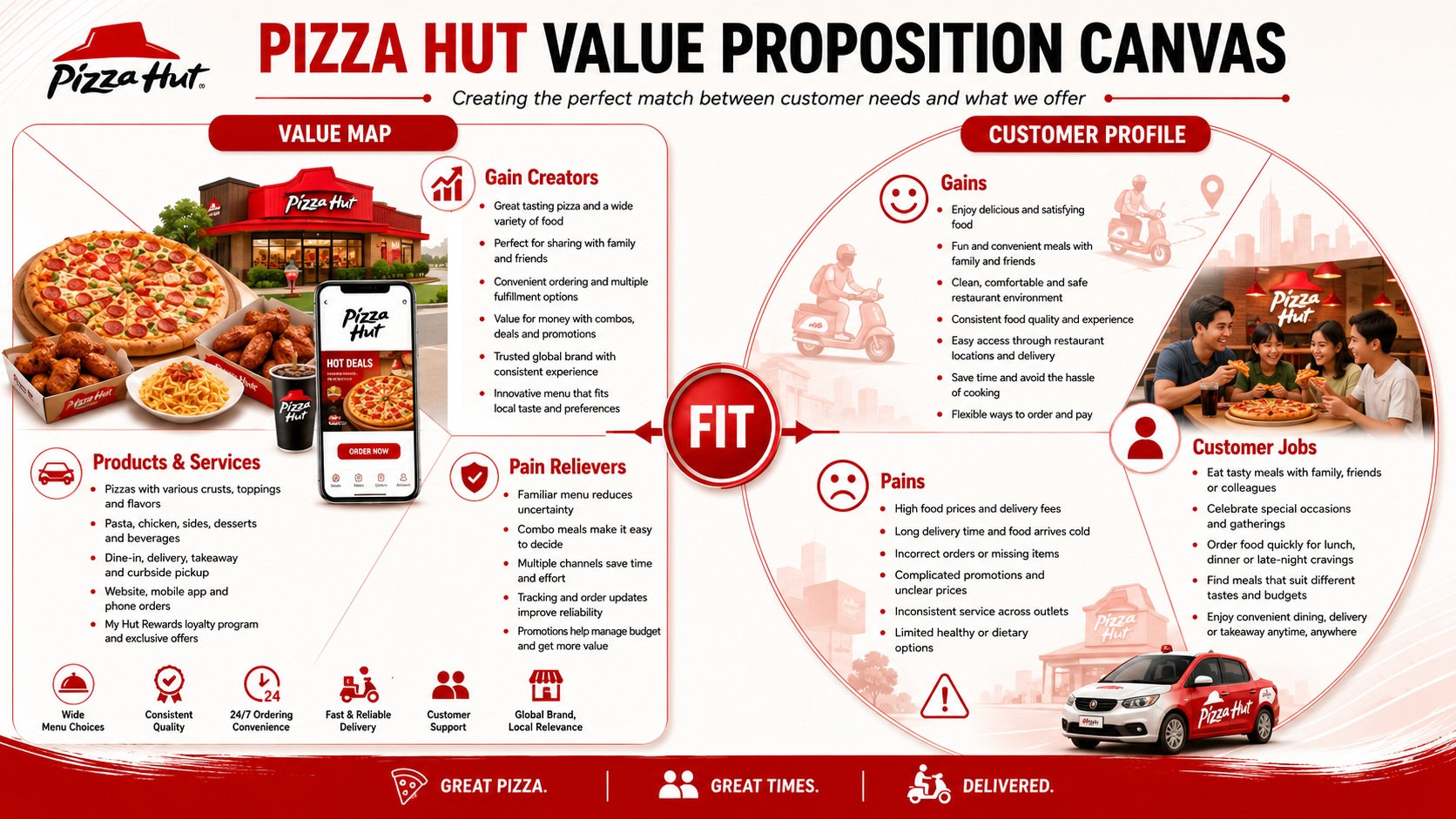
Before comparing Pizza Hut with Domino’s, it is useful to examine how Pizza Hut creates fit between what customers need and what the company delivers. That is the purpose of Value Proposition Canvas, or VPC.
While Business Model Canvas explains the overall structure of the company, VPC focuses more closely on the connection between customer requirements and Pizza Hut’s actual offer.
For Pizza Hut, this framework is especially relevant because the brand serves several meal occasions. It must balance taste, convenience, group suitability, affordability, delivery reliability, and menu variety.
In simple terms, VPC helps explain why the Pizza Hut Business Model Canvas works in practice. It shows how customer jobs, pains, and gains connect with Pizza Hut’s food, service, channels, promotions, and recognised brand.
The customer profile examines what Pizza Hut’s target customers are trying to accomplish, what frustrates them, and which outcomes they value most. Since the company serves a broad market, the profile reflects common customer needs across dine-in, takeaway, and delivery occasions.
| Customer Profile | Details |
| Customer Jobs | Find a convenient meal, feed individuals or groups, avoid cooking, organise food for family or social occasions, and select items that suit different tastes and budgets |
| Customer Pains | Rising meal prices, slow delivery, cold food, inaccurate orders, confusing promotions, inconsistent service, limited healthy choices, and difficulty satisfying several people |
| Customer Gains | Enjoyable taste, reliable quality, convenient ordering, shareable portions, menu variety, transparent value, predictable delivery, and access to a familiar restaurant brand |
This profile shows that Pizza Hut does not win only through pizza flavour. It also wins by reducing meal-planning effort, making group ordering easier, and offering several ways to receive the food.
The value map explains how Pizza Hut responds to customer jobs, pains, and gains. The company uses a menu-and-channel strategy rather than depending on one product or one restaurant experience.
That matters because customers may want different benefits on different occasions. Some seek a family meal, others need fast delivery, while many simply want a familiar choice that is easy to order.
| Value Map | Details |
| Products and Services | Pizza, pasta, chicken, side dishes, desserts, beverages, meal combinations, dine-in service, takeaway, delivery, websites, applications, and loyalty offers |
| Pain Relievers | Familiar products reduce uncertainty, group packages simplify selection, multiple channels reduce ordering effort, tracking improves visibility, and promotions address price sensitivity |
| Gain Creators | Shareable meals, crust and topping choices, convenient reordering, broad menu variety, recognisable taste, loyalty rewards, and products suitable for family and social occasions |
This value map shows why Pizza Hut retains broad commercial relevance. The company does not rely solely on one signature pizza. It creates value by linking a recognised menu with convenient access, group suitability, and different price options.
The table below shows how customer needs and Pizza Hut’s value offer connect more directly. This format matches customer-side requirements with company-side value creation in a clear and structured way.
| Customer Profile | Details | Matching Value Map | How Pizza Hut Creates Fit |
| Customer Jobs | Customers want convenient meals that can serve individuals, families, colleagues, or social groups without cooking | Products and Services | Pizza Hut provides shareable pizzas, supporting menu items, multiple portion sizes, and several ordering and fulfilment channels |
| Customer Pains | Buyers face price pressure, delivery uncertainty, menu-selection difficulty, and the risk of inconsistent food or service | Pain Relievers | Familiar recipes, bundles, digital ordering, order confirmation, promotions, and standardised operating procedures reduce those concerns |
| Customer Gains | Customers value taste, convenience, variety, reliable quality, simple group ordering, and reasonable value | Gain Creators | Pizza Hut creates those gains through recognised products, menu breadth, sharing formats, loyalty offers, and accessible restaurant and delivery channels |
The fit is strongest because Pizza Hut solves more than hunger. It reduces planning effort, supports shared meals, and offers customers flexibility in how they order and receive food.
The strongest fit occurs during family meals, informal gatherings, office lunches, celebrations, weekend dining, and situations where customers want food without preparing it themselves.
Pizza Hut performs well when buyers require familiar products, simple group ordering, and several menu options within one transaction. A pizza can be shared, customised, and combined with side dishes to accommodate different preferences.
This is where Pizza Hut’s broad operating model matters most. A specialist restaurant may deliver a more premium experience, while a delivery-only operator may optimise narrowly around speed. Pizza Hut can create fit across dine-in, delivery, takeaway, individual meals, and larger group occasions.
The following is the VPC diagram of Pizza Hut. It provides a visual view of how customer jobs, pains, and gains connect with Pizza Hut’s products and services, pain relievers, and gain creators.
The Pizza Hut Business Model Canvas differs from Domino’s mainly in restaurant-format heritage, menu breadth, dining experience, and the role of delivery within the operating system.
Domino’s was founded in the United States in 1960 and developed around delivery and takeaway convenience. The company later strengthened this position through digital ordering, operational consistency, compact store formats, and a highly franchised international network. By the end of its 2025 financial year, Domino’s reported more than 22,000 stores worldwide, making it a familiar and direct comparison for Pizza Hut.
Pizza Hut has traditionally operated across a broader mix of dine-in, takeaway, delivery, and express formats. Its menu also tends to extend further into pasta, chicken, side dishes, desserts, and complete restaurant meals.
Neither structure is automatically superior. Each is optimised around different strategic priorities.
| Dimension | Pizza Hut | Domino’s |
| Format logic | Mix of dine-in restaurants, delivery units, takeaway locations, express counters, and hybrid outlets | Predominantly delivery and takeaway-focused stores designed for efficient order fulfilment |
| Customer occasion | Family dining, group meals, celebrations, takeaway, delivery, and casual restaurant visits | Convenience-led delivery, collection, individual consumption, and informal group orders |
| Menu breadth | Broader restaurant menu including pizza, pasta, chicken, sides, desserts, and beverages | More focused menu structured around pizza and products that travel efficiently through delivery |
| Brand positioning | Familiar family pizza restaurant with value, variety, and multiple ways to dine | Technology-enabled pizza delivery and collection brand focused on convenience and fulfilment |
| Model strength | Broader occasion coverage, restaurant experience, international familiarity, and menu variety | Operational focus, compact outlet economics, digital ordering capability, and delivery efficiency |
Pizza Hut’s broader model allows the company to participate in more dining occasions and create a richer restaurant experience. Domino’s benefits from a more concentrated operating system designed largely around delivery and takeaway.
This comparison is useful because it shows that Pizza Hut should not simply copy Domino’s. A stronger approach is to retain its family, sharing, menu, and restaurant advantages while improving digital commerce, delivery consistency, outlet productivity, and franchisee economics.
The Pizza Hut Business Model Canvas highlights several reinforcing strengths that make the company more defensible than many smaller restaurant and delivery competitors. These capabilities work together across branding, restaurant access, customer familiarity, franchising, and menu design.
Together, these strengths make Pizza Hut harder to displace than a small single-format competitor. They also allow the company to participate in more than one meal occasion, customer segment, and ordering channel.
Pizza Hut also faces material execution risks arising from the scale, age, and complexity of its operating model. Since the company combines dine-in restaurants, delivery, franchising, digital channels, and broad menus, pressure in one area can affect both customer experience and restaurant profitability.
None of these risks means the model is inherently weak. Instead, they show that Pizza Hut must continuously balance restaurant experience, affordability, delivery convenience, franchisee returns, and operational simplicity.
Pizza Hut should strengthen the customer occasions that distinguish it from delivery-focused competitors. Family meals, sharing, celebrations, and casual group dining can provide a clearer position than competing primarily through discounts.
Management should also segment the restaurant portfolio more precisely. High-potential family restaurants, compact delivery units, takeaway outlets, and express formats should use different location, investment, menu, and performance criteria.
Another priority is menu discipline. Popular and profitable products should receive greater focus, while items that add inventory, preparation time, or waste without creating meaningful customer value should be simplified.
Direct digital ordering requires continued investment. Better applications, clearer offers, reliable delivery estimates, loyalty benefits, and convenient repeat ordering can reduce dependence on third-party marketplaces and improve access to customer data.
Finally, franchisee economics should remain central to every strategic decision. Pricing, commissions, labour models, promotional funding, kitchen productivity, and outlet investment must produce sustainable returns at restaurant level.
Overall, the Pizza Hut Business Model Canvas explains why Pizza Hut remains one of the world’s most recognisable pizza restaurant brands. Its strength comes from combining global familiarity, a large franchise network, menu breadth, restaurant presence, delivery access, and multiple dining occasions.
Pizza Hut is not simply selling pizza. It is managing a restaurant and fulfilment system that connects food preparation, franchise partners, physical outlets, digital ordering, delivery, promotions, and customer experience.
Future performance will depend on whether the company can balance value, restaurant productivity, franchisee profitability, digital convenience, and meaningful brand differentiation. Successful execution could allow Pizza Hut to compete effectively not only with Domino’s, but also with local restaurants, delivery-first concepts, and the wider foodservice market.
This article is provided for educational and business analysis purposes only. Its content is based on publicly available information, general market observations, and strategic interpretation. It does not constitute financial advice, investment advice, legal advice, franchise advice, or an official statement from Pizza Hut, Yum! Brands, LongRange Capital, Yum China Holdings, or Domino’s Pizza.
Readers should conduct independent research and obtain appropriate professional advice before making business, investment, or franchise decisions.
All trademarks, logos, copyrights, brand names, product names, and related materials mentioned or shown in this article belong to their respective owners.
Explore the Pizza Hut business model canvas, nine BMC blocks, Value Proposition Canvas, Domino’s comparison, advantages, risks, and strategic recommendations.
Explore the Mie Gacoan Business Model Canvas, including its customer segments, value propositions, revenue streams,… Read More
Restaurant Business Model Canvas: A Practical Guide to Designing, Evaluating, and Improving Restaurant Business Models… Read More
Learn how the Food and Beverage Business Model Canvas helps restaurants, cafés, beverage brands, and… Read More
Read this Apple Business Model Canvas analysis to understand how Apple creates value through premium… Read More
This Business Model Canvas AWS analysis explains how the company creates, delivers, and captures value… Read More
Hermes Business Model Canvas explained in depth, including customer segments, value proposition, channels, revenue, competitive… Read More