Quipper Business Model Canvas
Explore the Quipper Business Model Canvas, nine BMC blocks, Value Proposition Canvas, Ruangguru and Pahamify comparison, competitive advantages, risks, and strategic recommendations.
Explore the Mixue Business Model Canvas and learn how Mixue uses affordability, franchising, supply chain control, and mascot branding to scale globally. This BMC Mixue Analysis explains how Mixue built one of the largest beverage networks globally. Mixue was founded in 1997 in Zhengzhou, China. The founder focused on affordability as a core principle. Ice cream and tea were positioned as everyday products.
BMC Article No: BMC #067
Mixue is not only an ice cream and tea brand. It is a high-volume franchise system built around affordability, simple products, supply chain control, and aggressive outlet expansion.
The Mixue Business Model Canvas is interesting because Mixue does not depend mainly on premium pricing. Its strength comes from selling low-priced products at massive scale, while capturing value through ingredients, equipment, packaging, logistics, franchise support, and standardised operations.
This makes Mixue different from many beverage brands. Many competitors focus on lifestyle positioning, premium store design, and higher average selling prices. Mixue focuses on mass access, speed, repeat purchases, and cost discipline.
In this article, we will break down how Mixue creates value, reaches customers, earns revenue, manages costs, and protects its competitive position.
Mixue’s business model is built around affordable ice cream, tea drinks, fruit beverages, coffee products, and a large franchise network. The company serves mass-market consumers who want quick, low-priced, and familiar products.
A major strength is vertical control. Mixue manages key parts of the supply chain, including ingredients, production, warehousing, logistics, packaging, and franchise support. This structure helps the company keep prices low while maintaining consistency across a very large store network.
Franchisees operate most outlets. They invest in stores, manage daily operations, hire staff, and serve local customers. Mixue supports them with brand assets, recipes, supplies, training, operating standards, and procurement systems.
However, the model is not risk-free. Low prices create pressure on margins. Rapid expansion increases quality-control risk. Franchise performance can vary across locations, regions, and countries.
The Mixue Business Model Canvas shows a company that uses scale, supply chain power, and simple execution to make low-priced beverages profitable.
Business Model Canvas, or BMC, is a practical tool used to explain how a business works. It helps readers understand how a company creates value, delivers that value to customers, and earns revenue from the market.
Instead of looking only at products, BMC looks at the full business system behind those products. It connects customers, value propositions, channels, relationships, revenue, resources, activities, partners, and costs in one simple view.
This makes BMC useful for analysing Mixue because the brand is not only selling drinks and ice cream. It is also operating a franchise system, a supply chain engine, and a mass-market retail network.
| BMC Block | Main Question |
|---|---|
| Customer Segments | Who does the business serve? |
| Value Propositions | What value does the business offer? |
| Channels | How does the business reach customers? |
| Customer Relationships | How does the business build loyalty? |
| Revenue Streams | How does the business make money? |
| Key Resources | What assets does the business need? |
| Key Activities | What must the business do well? |
| Key Partnerships | Who helps the business operate? |
| Cost Structure | What are the major costs? |
For Mixue, BMC is useful because low prices alone do not explain the business. The Mixue Business Model Canvas helps explain how franchising, procurement, store density, mascot branding, and supply chain control work together.
Mixue started in Zhengzhou, China, in 1997. The brand became known for affordable soft-serve ice cream, milk tea, fruit tea, lemonade, and other low-priced drinks.
Its growth accelerated through franchising. Instead of building every store with its own capital, Mixue allowed local operators to open outlets under the brand. This helped the company expand faster and reach lower-tier cities, student areas, transit zones, and dense neighbourhoods.
The company’s model became more powerful as store numbers increased. More outlets created higher demand for ingredients, packaging, equipment, and logistics. That volume gave Mixue stronger purchasing power and better cost efficiency.
Today, Mixue is one of the most visible Chinese consumer brands in the beverage market. Its Snow King mascot, bright store design, and low price points make the brand easy to recognise across China and overseas markets.
Mixue is strategically interesting because it turns a low-price product category into a scalable franchise and supply chain business. Many beverage brands try to win through premium flavours, lifestyle spaces, and higher margins per cup. Mixue wins through reach, repetition, and cost control.
The customer-facing model looks simple. People buy affordable ice cream and drinks from small, visible outlets. Behind that simple experience is a disciplined operating system that standardises products, controls inputs, trains franchisees, and moves supplies across a large network.
Scale is the strategic engine. More stores create more purchasing volume. Greater purchasing volume lowers unit costs. Lower costs support lower prices. Those prices attract more customers and improve outlet traffic.
From a strategy perspective, the Mixue Business Model Canvas shows how a company can use affordability, franchising, and supply chain ownership to compete against both local drink stalls and premium beverage chains.
Mixue’s business model is changing in three important ways.
First, international expansion is becoming more important. Southeast Asia and other overseas markets give Mixue access to young consumers, hot climates, dense cities, and high demand for affordable cold drinks.
Second, public-market visibility has increased after its Hong Kong listing. This makes growth, margins, governance, and franchise quality more visible to investors.
Third, competition is intensifying. Beverage chains, coffee brands, convenience stores, local dessert shops, and food delivery platforms all compete for the same daily refreshment budget.
These changes make the canvas more important. Mixue still depends on low prices and store growth, but future performance will also depend on international execution, product relevance, franchise discipline, and margin protection.
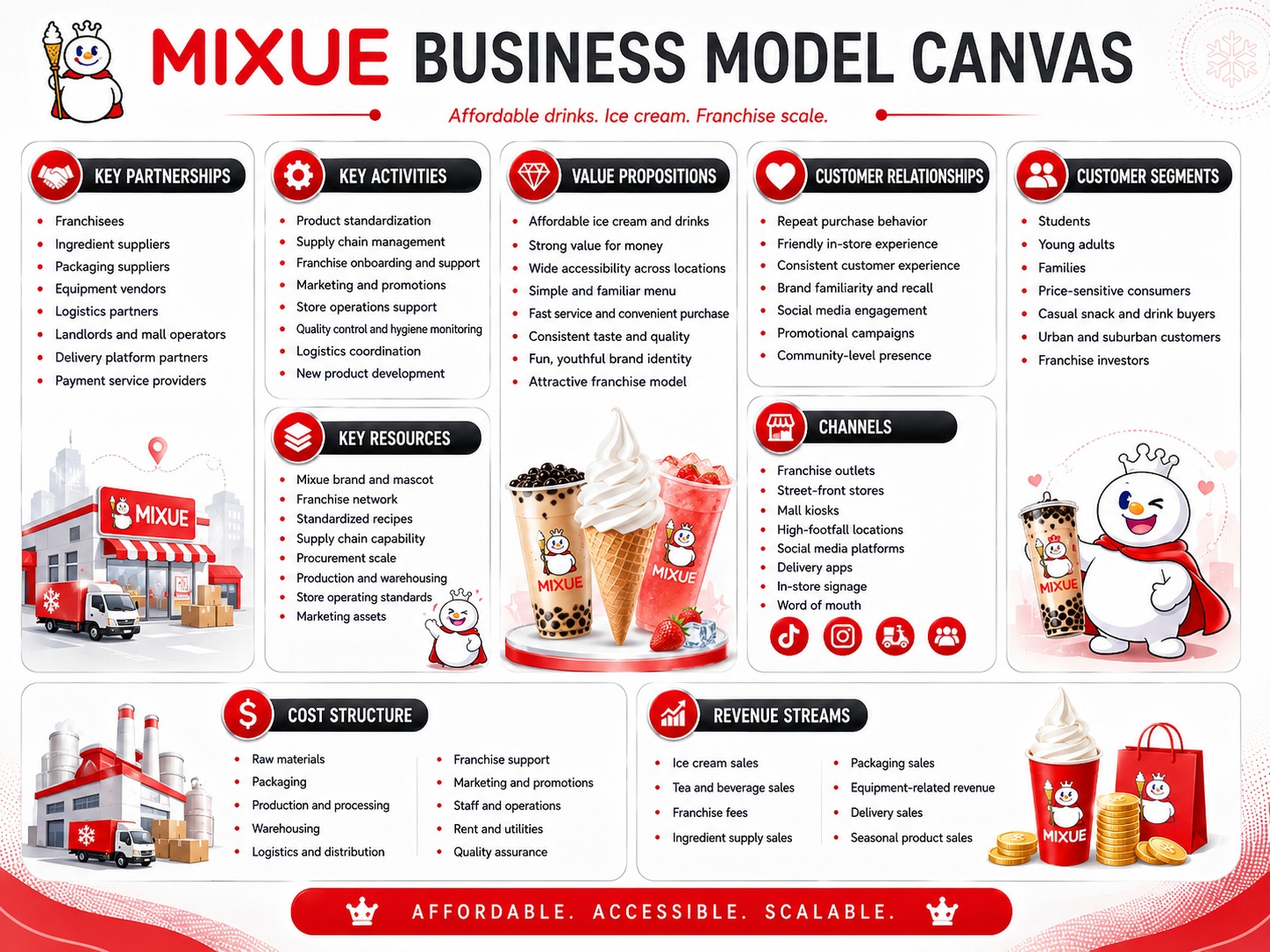
Before going into each block in detail, the summary below gives a quick view of how Mixue’s business model works. It shows who Mixue serves, what value it offers, how it reaches customers, how revenue is generated, and what resources and activities keep the system running.
| BMC Block | Mixue Application |
|---|---|
| Customer Segments | Price-sensitive consumers, students, young workers, families, daily snack buyers, and franchise operators. |
| Value Propositions | Affordable ice cream and drinks, consistent taste, fast service, simple menu, strong visibility, and familiar branding. |
| Channels | Street-level franchise outlets, high-footfall locations, social media, storefront branding, word-of-mouth, and delivery platforms. |
| Customer Relationships | Transactional service, habit-based repeat visits, mascot familiarity, consistent experience, and low-friction ordering. |
| Revenue Streams | Product sales, franchise-related fees, ingredient sales, packaging, equipment, logistics, and supply chain margin. |
| Key Resources | Brand, Snow King mascot, recipes, franchise system, production capacity, procurement scale, logistics, and operating standards. |
| Key Activities | Product standardisation, supply chain management, franchise onboarding, quality control, marketing, logistics, and store support. |
| Key Partnerships | Suppliers, franchisees, logistics providers, landlords, packaging partners, equipment vendors, and local service providers. |
| Cost Structure | Ingredients, production, warehousing, logistics, franchise support, marketing, technology systems, staff, rent, and compliance. |
Mixue BMC Diagram:
Customer segments describe who the business serves. Mixue serves a wide base of mass-market consumers who want affordable, fast, and predictable refreshment.
The strongest customer groups are students, young workers, families, and price-sensitive daily buyers. These customers may not spend much per visit, but they can buy frequently. This makes transaction volume more important than premium basket size.
Mixue also serves franchise operators as a second customer group. Franchisees need a recognisable brand, affordable setup, operational guidance, stable supplies, and a model that can attract daily traffic.
| Customer Segment | What They Need | How Mixue Serves Them |
|---|---|---|
| Students | Affordable treats near schools and colleges. | Offers low-priced ice cream, tea, and fruit drinks. |
| Young workers | Quick drinks during breaks or commutes. | Places outlets near offices, transit points, and dense streets. |
| Families | Budget-friendly snacks for children and groups. | Provides simple products at prices suitable for repeat buying. |
| Daily consumers | Familiar drinks without high spending. | Keeps menus simple, visible, and easy to understand. |
| Franchise operators | Brand support and supply reliability. | Provides recipes, materials, training, and operating standards. |
The Mixue Business Model Canvas shows that Mixue’s customer base is broad but not random. It is built around people who value affordability, convenience, and frequency.
The value proposition explains why customers choose Mixue. At the simplest level, Mixue offers cold drinks and ice cream at prices that feel accessible for everyday consumption.
Affordability is the anchor. Customers can buy a treat without treating it as a premium purchase. This price point makes Mixue attractive for students, families, workers, and casual buyers.
Consistency strengthens the offer. Customers expect similar taste, portion size, menu structure, and service flow across outlets. That predictability reduces purchase risk and supports repeat visits.
| Value Proposition | Customer Benefit | Business Impact |
|---|---|---|
| Low prices | Customers can buy more often. | Drives high transaction volume. |
| Simple menu | Ordering feels fast and easy. | Improves throughput and staff efficiency. |
| Consistent taste | Customers know what to expect. | Builds trust across locations. |
| Visible branding | Stores are easy to notice. | Increases walk-in traffic. |
| Friendly mascot | The brand feels familiar and memorable. | Strengthens recall without heavy advertising. |
Mixue’s value proposition is not built around luxury. It is built around price confidence, convenience, accessibility, and repeatability.
Channels explain how Mixue reaches customers. The main channel is the physical franchise outlet, usually located in visible, high-footfall areas.
Location is critical. Mixue outlets work best near schools, residential areas, transport hubs, shopping streets, food clusters, and office zones. These locations support impulse buying and repeat traffic.
Digital channels also matter, although they mainly support awareness and convenience. Social media helps the mascot travel faster. Delivery platforms can extend reach beyond walk-in customers in selected markets.
| Channel | Examples | Strategic Role |
|---|---|---|
| Franchise outlets | Street shops, mall kiosks, and neighbourhood stores. | Capture walk-in and impulse demand. |
| High-density locations | Schools, transit areas, offices, and food streets. | Increase daily customer traffic. |
| Storefront branding | Red signage, Snow King visuals, and menu boards. | Improves recognition at the point of purchase. |
| Social media | Short videos, customer posts, and mascot content. | Builds awareness and shareability. |
| Delivery platforms | Food delivery apps in selected markets. | Adds convenience and wider coverage. |
Strong channels make Mixue easy to find, easy to notice, and easy to buy from. Distribution is therefore not only about store count. It is about placing low-priced products where daily demand already exists.
Customer relationships describe how Mixue keeps people coming back. The model is mostly transactional, but it becomes powerful through habit.
Mixue does not need a complex relationship model for every market. Customers return because the product is affordable, the store is nearby, the menu is familiar, and the experience feels predictable.
Mascot branding adds emotional memory. Snow King makes the brand more recognisable and friendly, especially for younger customers. This softens the low-cost image and gives the brand personality.
| Relationship Driver | How It Works | Example |
|---|---|---|
| Habit-based buying | Low prices encourage frequent visits. | A student buys lemonade after class. |
| Fast transactions | Simple ordering reduces waiting time. | Customers choose familiar products quickly. |
| Brand familiarity | The mascot and store colours create recall. | Snow King makes the store easy to remember. |
| Consistent service | Standard recipes create predictable outcomes. | Customers expect the same taste at different outlets. |
| Franchise proximity | Dense store networks keep the brand close. | A customer sees Mixue during a daily commute. |
The Mixue Business Model Canvas shows that loyalty does not always require premium memberships or complex apps. For Mixue, loyalty comes from price, proximity, repetition, and familiarity.
Revenue streams show how the business makes money. Mixue earns from customer purchases at store level and from the franchise system that supports those stores.
Retail sales are important, but the deeper revenue logic sits upstream. Mixue can earn from ingredients, packaging, equipment, logistics, and franchise-related services supplied to franchisees.
This model is powerful because every new store increases demand for central supplies. More franchise outlets create more recurring demand for materials, which strengthens procurement scale and production utilisation.
| Revenue Stream | Description | Why It Matters |
|---|---|---|
| Product sales | Ice cream, tea, fruit drinks, coffee, and snacks. | Creates daily cash flow at outlet level. |
| Ingredient supply | Syrups, tea bases, dairy inputs, and toppings. | Captures margin through central procurement. |
| Packaging sales | Cups, lids, straws, bags, and branded materials. | Keeps presentation consistent across outlets. |
| Equipment supply | Store tools, preparation equipment, and machines. | Standardises operations for franchisees. |
| Franchise services | Joining fees, support, training, and related services. | Monetises network expansion and brand access. |
The Mixue Business Model Canvas shows that Mixue is not only a beverage retailer. It is a supply chain monetisation model supported by franchise growth.
Key resources are the assets required to deliver the business model. Mixue’s most important resources are its brand, franchise network, supply chain, product formulas, mascot, production capacity, and operating standards.
Brand visibility matters because low-priced products need high traffic. The red storefront, Snow King mascot, and clear menu boards make Mixue easy to recognise in crowded retail areas.
Supply chain capability is equally important. Low pricing only works when the company can control input costs, reduce waste, move goods efficiently, and maintain quality across many outlets.
| Key Resource | Role in the Business Model | Strategic Value |
|---|---|---|
| Brand and mascot | Create recognition and emotional familiarity. | Drives traffic without premium advertising spend. |
| Franchise network | Expands store coverage quickly. | Reduces capital burden on the central company. |
| Supply chain system | Supports production, procurement, and logistics. | Enables low prices and consistent quality. |
| Product formulas | Standardise taste across outlets. | Protects customer expectations. |
| Operating standards | Guide store setup, preparation, and service. | Reduces variation across franchisees. |
| Data and systems | Track orders, supplies, and outlet performance. | Improves control as the network expands. |
Together, these resources make Mixue more than a low-price drink shop. They create a repeatable operating model that can be copied across cities and markets.
Key activities are the things Mixue must do well to stay competitive. The most important activities are supply chain management, product standardisation, franchise support, logistics, marketing, and quality control.
Execution discipline is critical. Low prices leave limited room for mistakes, so each activity must support volume, speed, and cost efficiency.
Franchise onboarding also matters. New operators must understand product preparation, hygiene, store layout, service standards, stock management, and local marketing. Weak onboarding can damage the brand quickly.
| Key Activity | What It Involves | Why It Matters |
|---|---|---|
| Product standardisation | Recipes, portions, preparation steps, and menu control. | Keeps taste consistent across stores. |
| Supply chain management | Sourcing, production, warehousing, and replenishment. | Protects cost efficiency and availability. |
| Franchise onboarding | Training, setup guidance, and operating manuals. | Helps new outlets launch properly. |
| Quality control | Audits, inspections, hygiene checks, and feedback loops. | Reduces brand and safety risk. |
| Marketing execution | Mascot content, price communication, and local campaigns. | Maintains awareness and traffic. |
| Logistics coordination | Delivery of supplies to many outlets. | Prevents stockouts and service disruption. |
The Mixue Business Model Canvas shows that the brand’s simplicity is supported by complex behind-the-scenes execution. Customers see cheap drinks, but the operating model depends on disciplined supply, training, and control.
Key partnerships help Mixue operate at scale. These partnerships include franchisees, raw material suppliers, packaging manufacturers, logistics providers, landlords, equipment vendors, and local service partners.
Franchisees are the most visible partners because they run daily store operations. Their performance shapes customer experience, local reputation, store cleanliness, queue management, and sales conversion.
Supplier partnerships also carry strategic weight. Mixue needs stable input quality and reliable volume pricing to maintain its low-price position. Weak supply relationships could increase costs or reduce product consistency.
| Partner Type | Examples | Contribution to the Business Model |
|---|---|---|
| Franchisees | Local store operators and multi-unit owners. | Expand the network and manage outlet operations. |
| Ingredient suppliers | Tea, dairy, sugar, fruit inputs, and toppings. | Support product quality and cost control. |
| Packaging partners | Cups, lids, straws, labels, and bags. | Maintain brand consistency and outlet supply. |
| Logistics providers | Transport, warehousing, and last-mile delivery. | Keep stores supplied across regions. |
| Landlords | Mall owners, shoplot owners, and property managers. | Provide access to high-footfall locations. |
| Equipment vendors | Machines, tools, freezers, and preparation systems. | Enable standardised store operations. |
Partnership quality affects both growth and control. Mixue can expand faster through partners, but it must manage them carefully to protect consistency.
Cost structure explains the major costs required to run the business model. Mixue’s cost base reflects ingredients, production, packaging, logistics, warehousing, franchise support, marketing, technology, and compliance.
Ingredient costs are central because Mixue competes on low prices. Any increase in dairy, tea, sugar, fruit, packaging, energy, or transport costs can affect margins.
Logistics is another major cost area. A large store network needs reliable replenishment, regional warehouses, stock planning, and delivery coordination. Poor logistics can lead to stockouts, waste, and customer dissatisfaction.
| Cost Area | Examples | Business Impact |
|---|---|---|
| Ingredients | Tea, dairy, sugar, fruit inputs, syrups, and toppings. | Drives product cost and margin pressure. |
| Production | Processing, quality checks, labour, and utilities. | Supports consistency and volume scale. |
| Packaging | Cups, lids, straws, bags, and branded materials. | Reinforces brand visibility but adds variable cost. |
| Logistics | Warehousing, delivery, cold chain, and transport. | Keeps outlets supplied and operational. |
| Franchise support | Training, audits, manuals, and field support. | Protects outlet quality and consistency. |
| Marketing and systems | Mascot campaigns, digital tools, and data platforms. | Supports awareness and operational control. |
Mixue’s cost structure must stay lean because the brand promise depends on affordability. Efficiency is therefore not only a finance issue. It is the foundation of the value proposition.
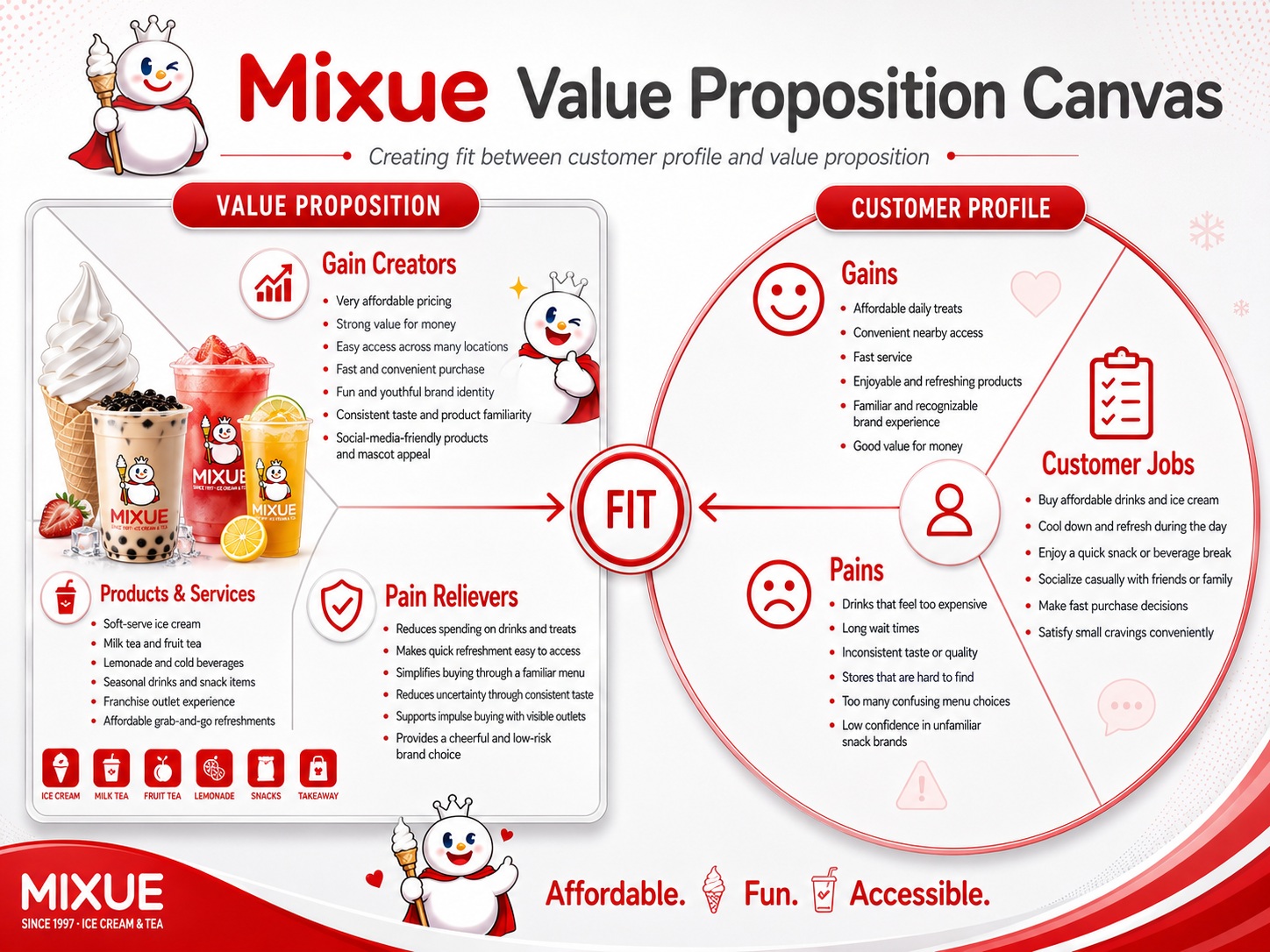
The Value Proposition Canvas helps explain how well Mixue’s offer fits what customers need. It connects two sides: the customer profile and the value proposition.
For Mixue, this fit is important because customers do not only want a drink. They want something affordable, quick, refreshing, familiar, and easy to buy during normal daily routines.
The strongest fit happens when Mixue removes price anxiety. Customers can buy more often because the product feels inexpensive enough for everyday consumption.
The customer profile explains what Mixue customers are trying to achieve, what problems they want to avoid, and what benefits they expect.
Many customers want affordable refreshment during school, work, shopping, commuting, or casual social time. They also want fast ordering, clear prices, simple options, and consistent taste.
This customer profile is practical. Buyers may enjoy the brand, but the core motivation is usually price, access, speed, and predictability.
| Customer Profile Element | Analysis |
|---|---|
| Customer Jobs | Buy affordable drinks and ice cream, cool down, socialise casually, and make quick purchase decisions. |
| Pains | High drink prices, inconsistent taste, long queues, confusing menus, and poor store access. |
| Gains | Low prices, predictable quality, fast service, familiar branding, and easy repeat buying. |
Mixue responds to the customer profile with low prices, simple products, fast preparation, dense store coverage, and familiar branding.
The offer works because it reduces barriers. Customers do not need to think too hard about price, product choice, or brand trust. They can choose a familiar item and complete the purchase quickly.
Mixue also creates emotional value through Snow King. The mascot makes a low-cost brand feel warmer, more recognisable, and easier to share on social media.
| Value Proposition Element | Analysis |
|---|---|
| Products and Services | Soft-serve ice cream, milk tea, fruit tea, lemonade, coffee, and selected seasonal drinks. |
| Pain Relievers | Low pricing, simple menus, standardised recipes, visible stores, and fast service routines. |
| Gain Creators | High perceived value, frequent affordability, brand familiarity, social shareability, and daily convenience. |
Fit happens where Mixue meets everyday demand with the right price, location, and product simplicity. Customers want quick refreshment without spending much, and Mixue answers that need through familiar drinks, visible outlets, and easy ordering.
This fit is strongest in high-traffic areas such as schools, transit points, office districts, shopping streets, and family neighbourhoods. Demand becomes even stronger in hot weather, after-school hours, lunch breaks, and casual social moments when customers want a small affordable treat.
| Customer Profile | Matching Value Proposition | How Mixue Creates Fit |
|---|---|---|
| Customers want affordable daily refreshment. | Low-priced ice cream and drinks. | Makes repeat buying financially comfortable. |
| Customers dislike slow and confusing purchases. | Simple menus and standardised preparation. | Reduces decision time and queue pressure. |
| Customers want familiar, low-risk choices. | Consistent taste and visible branding. | Builds confidence across outlets. |
The canvas becomes stronger when viewed together with this fit. Mixue wins when customers feel the brand is cheap, close, fast, and reliable.
Mixue has several competitive advantages that support its long-term business model. These strengths work together as one system, where store scale increases supply volume, supply volume lowers cost, and low cost supports everyday pricing.
Mixue also faces several risks that may affect future growth. These risks matter because the model depends on volume, consistency, franchise discipline, and cost control.
Mixue should protect affordability while improving the quality of franchise oversight. The brand should remain low priced, but stronger audits, mystery shopping, hygiene checks, and outlet scorecards can reduce inconsistency.
Product innovation should stay selective. New flavours can create excitement, but excessive menu expansion may slow service, complicate training, and weaken supply chain efficiency.
International expansion should be disciplined. Mixue should prioritise markets with hot climates, dense cities, young consumers, strong foot traffic, and clear franchise economics.
Digital capability deserves more attention. Better ordering data, outlet dashboards, inventory tracking, and franchise performance analytics can improve decision-making across the network.
Brand building should also mature. Snow King is already memorable, but Mixue can strengthen emotional connection through local campaigns, community content, and seasonal storytelling without moving away from affordability.
The canvas suggests one clear priority: keep the model simple at the customer level while making operations more disciplined behind the scenes.
Mixue’s business model is powerful because it combines low prices, high-volume demand, franchise expansion, supply chain control, and strong visual branding into one operating system.
The company does not compete like a premium tea brand. It competes like a scale machine designed for everyday consumption. Customers come for affordability and convenience, while the business captures value through network growth and upstream supply control.
The canvas shows that Mixue’s real advantage is not one drink, one store, or one mascot. Its advantage is the system that makes low-priced products profitable across thousands of outlets.
Future growth will depend on franchise quality, cost control, international execution, product relevance, and food safety discipline. If those areas are handled well, Mixue can remain one of the most important mass-market beverage brands in the world.
This article is for educational and business analysis purposes only. It is based on publicly available information, general market observation, and strategic interpretation. The content is not financial advice, investment advice, legal advice, or an official statement from Mixue Group. Readers should conduct their own research before making business, investment, or strategic decisions.
Explore the Quipper Business Model Canvas, nine BMC blocks, Value Proposition Canvas, Ruangguru and Pahamify… Read More
Explore the CARPUT Business Model Canvas, nine BMC blocks, Value Proposition Canvas, competitor comparison, competitive… Read More
Explore the Boost Business Model Canvas, nine BMC blocks, Value Proposition Canvas, competitor comparison, advantages,… Read More
Explore the Domino's Pizza Business Model Canvas, nine BMC blocks, Value Proposition Canvas, Pizza Hut… Read More
Explore the Mie Gacoan Business Model Canvas, including its customer segments, value propositions, revenue streams,… Read More
Restaurant Business Model Canvas: A Practical Guide to Designing, Evaluating, and Improving Restaurant Business Models… Read More