CARPUT Business Model Canvas
Explore the CARPUT Business Model Canvas, nine BMC blocks, Value Proposition Canvas, competitor comparison, competitive advantages, risks and strategic recommendations.
Canva Business Model Canvas analysis updated in 2026. Learn how Canva creates value through templates, subscriptions, AI, collaboration, enterprise tools, revenue streams, risks, and strategic recommendations.
BMC Article No: BMC #068
Updated in 2026: This article has been refreshed with Canva’s wider product scope, stronger AI positioning, clearer enterprise direction, updated copyright and governance analysis, and a more structured review of how Canva combines design, collaboration, brand control, and content production in one platform.
Canva started in 2013 as an online design tool and grew into one of the world’s most widely used visual communication platforms. Over time, it expanded beyond simple graphic design into a broader ecosystem that now serves individuals, students, teachers, entrepreneurs, creators, marketers, nonprofits, and large organisations.
Its offering now covers presentations, social media content, documents, videos, whiteboards, websites, print products, team collaboration, and AI-powered creative tools. That gives users a more complete way to create and manage visual communication in one place.
The Canva Business Model Canvas is useful because Canva is not just selling design software. It is building a digital creative platform where ideation, design, editing, collaboration, publishing, and brand management happen inside one environment. That makes the company strategically interesting, because its value comes not only from templates or subscriptions, but also from how well it reduces creative friction, supports repeat usage, and connects many content needs in one workflow.
Canva runs a platform-based SaaS business model focused on helping users create, edit, share, and publish visual content in one place. The company serves both individual users and organisations through a freemium structure that encourages broad adoption before converting users into paid plans.
Revenue does not come from one source alone. Canva can earn from Canva Pro subscriptions, team and enterprise plans, print services, selected premium assets, and AI-enhanced features tied to higher-value usage. This creates a model that balances accessibility, scale, convenience, and repeat engagement.
What makes the model stronger is workflow bundling. A user may start with a social media post, then create a presentation, build brand templates, make short videos, generate AI content, and collaborate with a team without leaving the platform. That raises usage depth and makes Canva more valuable over time. The Canva Business Model Canvas shows how the company turns fragmented design tasks into a more connected creative workflow.
Business Model Canvas, or BMC, is a practical tool used to explain how a business creates value, delivers that value, and captures revenue. Instead of looking only at products, it maps the full operating logic of the company.
BMC is useful for Canva because the company sits between user needs, content assets, creative tools, AI functionality, collaboration workflows, and subscription monetisation. That means its success depends on ease of use, product depth, trust, community adoption, brand consistency, and monetisation working together.
Instead of seeing Canva as only a design app, BMC shows the wider system behind its growth.
| BMC Block | Main Question |
|---|---|
| Customer Segments | Who does the business serve? |
| Value Propositions | What value does the business offer? |
| Channels | How does the business reach users? |
| Customer Relationships | How does the business build loyalty? |
| Revenue Streams | How does the business make money? |
| Key Resources | What assets does the business need? |
| Key Activities | What must the business do well? |
| Key Partnerships | Who helps the business operate? |
| Cost Structure | What are the major costs? |
The Canva Business Model Canvas helps explain how user needs, creative assets, platform design, AI capabilities, and subscription logic come together in one global platform. It also shows why Canva’s model is stronger when these elements reinforce one another, rather than operating as separate parts of the business. That wider view makes the platform easier to understand from both a customer and strategy perspective.
Canva was founded in Australia in 2013 and later expanded into a global platform used across education, business, marketing, media, and nonprofit work. On its official pages, Canva presents itself as a visual communication platform that helps users create everything from presentations and social posts to videos, whiteboards, documents, and websites.
That scale matters because design platforms become stronger when they combine broad use cases, strong user traffic, and frequent repeat usage. More templates improve relevance. More users improve sharing and collaboration. Better product breadth improves upgrade potential and organisational adoption.
The Canva Business Model Canvas is therefore about scale with usability. Growth comes not only from selling more subscriptions, but also from becoming the default platform for everyday visual communication, team content creation, and brand-managed design work.
Canva is strategically interesting because it solves several creative problems at once. Users often face complex software, slow design processes, high outsourcing costs, inconsistent branding, and difficulty creating professional-looking content quickly.
Instead of asking users to move between separate tools for design, presentations, collaboration, video, and asset management, Canva brings those functions into one interface. That lowers creative friction and improves output speed.
Another important point is user expansion. Content needs differ across students, teachers, creators, marketers, and enterprises. Canva’s model is stronger because it adapts to those use cases instead of remaining tied to one narrow creative segment.
Canva’s model is evolving in four important ways, and each one strengthens its position in a competitive digital productivity market.
First, product breadth is getting wider. The platform now goes beyond static graphic design into documents, whiteboards, websites, video editing, presentations, and workplace collaboration. This matters because broader product coverage gives users more reasons to stay inside Canva instead of switching between different tools.
Second, AI is becoming more central. Features under Canva AI and Magic Studio aim to speed up ideation, content drafting, editing, and design generation. These tools matter because speed is now a major competitive factor in digital content creation.
Third, enterprise relevance is increasing. Brand Kit, approval controls, team workflows, admin settings, and governance tools make Canva more useful for organisations that need consistency at scale. This shifts Canva from a solo-user tool toward a more embedded business platform.
Fourth, professional capability is expanding. Canva’s growing ecosystem, including assets tied to Affinity and AI-related acquisitions, signals a push to cover both beginner simplicity and more advanced creative needs. That balance matters because growth becomes more durable when the company can serve both mass users and more demanding teams.
The Canva Business Model Canvas is stronger in 2026 because the company is not just competing on templates. It is competing on workflow depth, AI productivity, team adoption, and brand-controlled content creation. That shift makes the model more defensible, because it depends less on one-off design usage and more on repeat integration into everyday work.
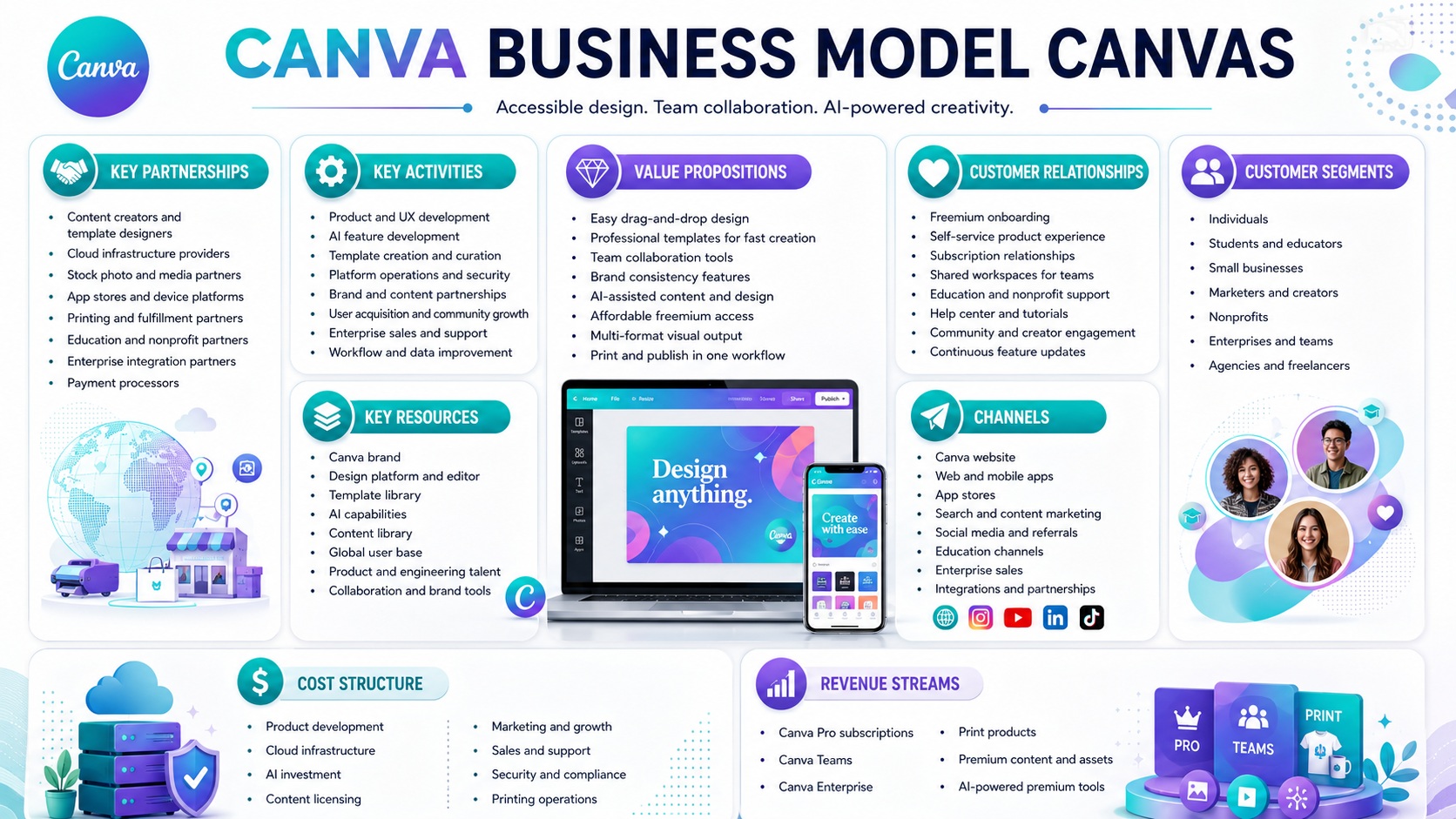
Before going into each block in detail, the summary below gives a quick view of how Canva’s business works. It provides a simple snapshot of the full model before we move into deeper analysis, making it easier to see how the main building blocks connect. This quick summary also helps readers understand the overall logic of the business before looking at each section one by one.
| BMC Block | Canva Application |
| Customer Segments | Individuals, students, teachers, creators, entrepreneurs, teams, nonprofits, and enterprises. |
| Value Propositions | Easy design, templates, collaboration, brand control, AI support, and multi-format content creation. |
| Channels | Website, mobile app, desktop app, SEO, social media, education access, and enterprise sales. |
| Customer Relationships | Self-service use, tutorials, community support, customer success, and team management tools. |
| Revenue Streams | Pro subscriptions, team plans, enterprise contracts, print services, premium assets, and AI-related paid use. |
| Key Resources | Platform, brand, user base, templates, content library, AI capability, and product ecosystem. |
| Key Activities | Product development, AI improvement, template expansion, support, marketing, security, and enterprise enablement. |
| Key Partnerships | Content providers, educators, nonprofits, app partners, print partners, and technology partners. |
| Cost Structure | Technology, people, infrastructure, AI computing, marketing, support, content, and compliance. |
The diagram below gives a visual summary of how the main blocks of Canva’s business model connect in one view. It helps readers move from the written analysis into a more practical visual format before continuing to the detailed block-by-block discussion.
Customer segments explain who Canva serves and why those users matter. Canva serves a broad creative and communication market, but its strongest position is among people and teams that need speed, ease, affordability, and professional-looking results without advanced design training.
These users are not all creating content for the same reason. A student may need class presentations. A creator may need thumbnails and social posts. A small business owner may care more about marketing materials and brand consistency. A large enterprise may focus on governance, approval control, and scalable team collaboration.
This mix gives Canva more than volume. It gives the company multiple demand pools across education, personal use, marketing, internal communication, and business operations. That makes the platform less dependent on one narrow type of user.
| Customer Segment | What They Need | How Canva Serves Them |
| Individuals | Fast, easy design for personal use | Templates, drag-and-drop editing, free access |
| Students and teachers | Clear, attractive educational content | Presentations, worksheets, classroom visuals, education access |
| Creators | High-volume content production | Social templates, video tools, thumbnails, AI support |
| Entrepreneurs and SMEs | Marketing content and brand consistency | Brand Kit, templates, print, social design tools |
| Teams | Shared workflows and collaborative design | Real-time collaboration, shared folders, approvals |
| Enterprises | Governance, scale, and controlled brand output | Admin controls, permissions, enterprise workflows |
The real strength of this block is diversity with overlap. One user can move across segments over time, from student to creator to business owner to team manager. The Canva Business Model Canvas shows that serving both individuals and organisations strengthens monetisation opportunities, increases platform stickiness, and creates a broader base for long-term growth.
The value proposition explains why users choose Canva over traditional design software or other content tools. Canva’s core promise is simple: make visual communication easier, faster, and more accessible in one digital environment.
That value is especially important in a world where content demand is rising across social media, presentations, internal communication, education, and marketing. Canva reduces that friction by combining templates, design tools, AI features, brand assets, and collaboration tools in one platform.
Its proposition is not only about making design easier. The wider value comes from reducing time, lowering cost, and helping non-designers produce stronger output.
| Value Proposition | Customer Benefit | Business Impact |
| Easy design experience | Reduces skill barriers | Expands addressable market |
| Ready-made templates | Saves time and effort | Increases usage frequency |
| Collaboration tools | Supports team content creation | Improves stickiness and team adoption |
| Brand control features | Keeps output more consistent | Supports enterprise relevance |
| AI-powered assistance | Speeds up ideation and production | Strengthens competitive position |
| Multi-format creation | Handles many content needs in one place | Raises workflow depth and retention |
This matters because content creation is often time-sensitive and skill-constrained. Users worry about design quality, speed, brand consistency, and resource limits. Canva becomes more valuable when it does not only help people make content, but also helps them work faster and with more confidence. That is where the Canva Business Model Canvas becomes especially strong.
Channels explain how Canva reaches users and turns interest into active usage or paid subscriptions. The company depends heavily on digital channels, especially its website and app ecosystem, but the full channel model is broader than one sign-up page.
Canva uses its website, mobile app, desktop app, search visibility, social media content, referrals, education access, partner ecosystems, and enterprise outreach to reach customers at different stages of the user journey. Some users arrive ready to create. Others are still searching for templates, ideas, or design solutions.
That matters because content decisions rarely happen in one step. Discovery, experimentation, creation, sharing, and upgrading often happen across many sessions.
| Channel | Examples | Strategic Role |
| Website | Main access and creation platform | Drives discovery, onboarding, and conversion |
| Mobile app | Fast design and editing on the go | Supports frequent and casual use |
| Desktop app | Longer design sessions | Improves workflow stability |
| SEO | Template and design-related search traffic | Captures high-intent discovery |
| Social media | Product inspiration and feature visibility | Builds awareness and engagement |
| Education access | School and academic adoption | Builds early user habits |
| Enterprise sales | Team and organisation onboarding | Expands higher-value contracts |
An app-and-web channel strategy is important because repeat users prefer speed, saved assets, and easier editing access. At the same time, search visibility remains important for first-time discovery and template-led growth. The Canva Business Model Canvas shows that strong channels do more than create awareness. They support onboarding, retention, upgrade potential, and cross-use across the full customer journey.
Customer relationships describe how Canva keeps users engaged after first use. In creative software, relationship quality is shaped less by brand messaging alone and more by whether the platform remains easy, reliable, and useful as user needs grow.
Canva builds these relationships through self-service tools, tutorials, templates, communities, onboarding prompts, collaborative features, and customer success support for enterprise users. That means the platform is trying to reduce friction not only before creation, but also during repeat use, team adoption, and higher-value workflows.
This is critical because weak support, confusing upgrades, or poor collaboration experiences can reduce retention quickly.
| Relationship Driver | How It Works | Example |
| Self-service tools | Users create and manage content directly | Drag-and-drop editor, account access |
| Learning support | Users improve usage over time | Tutorials, help centre, guides |
| Community inspiration | Users discover ideas and best practices | Template ecosystem and community content |
| Team collaboration | Users work together in shared spaces | Comments, shared folders, approvals |
| Customer success | Larger users receive structured support | Enterprise onboarding and admin guidance |
This block is more strategic than it first appears. A platform can attract users through free access, but it keeps them through repeated usefulness and low friction. Canva strengthens long-term retention when users see that the platform remains helpful as their work becomes more complex. That trust makes future upgrades easier and lowers dependence on constant acquisition spending.
Revenue streams explain how Canva turns usage into income. The company’s strongest monetisation engine comes from converting free users into paid users once their content needs, collaboration demands, or brand requirements become more advanced.
Canva uses individual subscriptions, team plans, enterprise contracts, print services, selected premium assets, and higher-value feature access to capture revenue from different usage levels. This works well because not all users need the same depth, and paid plans can grow with the user.
That matters because freemium alone creates reach, but sustainable growth needs conversion and expansion.
| Revenue Stream | How It Works | Strategic Value |
| Canva Pro | Individual subscription for premium tools | Converts frequent personal users |
| Canva Teams | Paid access for collaborative groups | Expands account value through teams |
| Canva Enterprise | Larger contracts with governance tools | Supports higher-value monetisation |
| Canva Print | Printing of created designs | Adds service-based revenue |
| Premium assets | Paid content and advanced elements | Increases monetisation depth |
| AI-related paid use | Higher-value creative productivity features | Aligns monetisation with advanced usage |
The real advantage of this block is expansion over time. A user may begin for free, upgrade to Pro, invite a team, and later bring Canva into a wider organisation. The Canva Business Model Canvas shows that revenue becomes stronger when product usage turns into workflow dependence, because that creates better conversion, retention, and account expansion.
Key resources explain what Canva must own, control, or maintain to keep the model working. For Canva, the most important resources are not physical. They are digital, brand-based, and ecosystem-driven.
These include the platform itself, the user base, the template library, the content asset ecosystem, the Canva brand, AI capabilities, product talent, usage data, and enterprise trust features. Each of these resources supports either scale, ease of use, or monetisation.
That matters because design platforms become harder to replace when users rely on their templates, stored assets, team workflows, and brand systems.
| Key Resource | Why It Matters | Strategic Effect |
| Platform technology | Powers creation, sharing, and collaboration | Enables scale and usability |
| Brand | Signals ease and accessibility | Builds trust and adoption |
| User base | Creates product reach and upgrade potential | Supports growth and monetisation |
| Template library | Gives users faster starting points | Increases usage frequency |
| Content assets | Expands creative possibilities | Improves product value |
| AI capability | Supports faster output and automation | Strengthens future competitiveness |
| Enterprise controls | Builds organisational trust | Expands B2B relevance |
The strength of this block is combination. A competitor may copy some features, but it is harder to copy Canva’s user habits, template depth, brand familiarity, and integrated workflow base all at once. The Canva Business Model Canvas shows that these resources become more powerful when used together rather than in isolation.
Key activities explain what Canva must do consistently well to keep delivering value. The company’s success depends on product development, template growth, AI improvement, platform reliability, content management, support, marketing, and enterprise enablement.
These activities matter because Canva’s market changes quickly. User expectations evolve with social platforms, workplace content needs, AI trends, and collaboration habits. That means Canva cannot rely on its early simplicity alone.
It must keep improving speed, relevance, trust, and workflow depth over time.
| Key Activity | What It Involves | Strategic Role |
| Product development | Building and refining features | Keeps Canva competitive and useful |
| Template expansion | Adding new starting points and formats | Supports broad use cases |
| AI improvement | Enhancing automation and generation tools | Improves speed and relevance |
| Platform operations | Maintaining performance and availability | Protects reliability and trust |
| Content management | Curating assets and templates | Supports quality and rights control |
| Marketing and growth | Driving awareness and conversion | Sustains user acquisition |
| Enterprise enablement | Supporting larger accounts | Expands higher-value usage |
The main challenge in this block is balance. Canva must add more advanced capabilities without making the platform feel heavy or confusing. The Canva Business Model Canvas is strongest when simplicity and depth continue to grow together.
Key partnerships explain which outside relationships help Canva extend its value. The company does not build everything alone. It depends on partners to expand content, improve integrations, support distribution, enable print fulfilment, and deepen trust across education and business use cases.
These partners include creators, stock-content platforms, app developers, technology providers, print partners, schools, nonprofits, and enterprise ecosystem relationships. Together, they help Canva scale faster and serve more specialised needs.
That matters because platform businesses become stronger when external partners add value without increasing internal complexity too much.
| Partner Type | Contribution | Strategic Benefit |
| Content creators | Supply templates and creative assets | Expands user choice and relevance |
| Technology partners | Support integrations and workflow connections | Improves platform utility |
| Education partners | Encourage adoption in schools | Builds early familiarity and loyalty |
| Nonprofit partners | Extend usage into mission-driven sectors | Strengthens reach and brand goodwill |
| Print partners | Fulfil physical product orders | Adds service capability |
| App ecosystem partners | Extend specialised features | Deepens workflow coverage |
| Enterprise-related partners | Support broader business adoption | Improves credibility and reach |
The real advantage of this block is leverage. Canva can widen its offer without building every asset or feature internally. The Canva Business Model Canvas shows that partnerships help the company improve scale, flexibility, and ecosystem value, while also creating some dependency risks around quality, licensing, and integration trust.
Cost structure explains the major expenses Canva must carry to operate at scale. Although Canva is a digital platform, its cost base is still significant because usability, speed, AI capability, and global reach all require sustained investment.
Major costs include product development, cloud infrastructure, AI computing, people, content licensing, support, marketing, security, compliance, and enterprise service capability. These costs rise as Canva adds more users, more features, and more business-critical workflows.
That matters because platform growth only becomes attractive when monetisation scales well relative to operating cost.
| Cost Category | What It Covers | Why It Matters |
| Product development | Engineering, design, testing | Sustains product relevance |
| Infrastructure | Hosting, storage, delivery, reliability | Supports global platform scale |
| AI computing | Generation and automation workloads | Enables advanced productivity features |
| People | Product, support, sales, operations | Keeps the business running and growing |
| Content and licensing | Assets, fonts, templates, rights | Supports creative breadth and trust |
| Marketing | Acquisition, campaigns, SEO | Drives discovery and conversion |
| Security and compliance | Protection and enterprise trust | Supports organisational adoption |
| Customer support | User and enterprise assistance | Protects retention and brand confidence |
The key issue in this block is efficiency. Canva needs paid conversion, higher-value subscriptions, and disciplined AI monetisation to grow faster than its costs. The Canva Business Model Canvas makes that trade-off clear, because strong user growth alone is not enough unless it leads to stronger account value and healthier economics.
Value Proposition Canvas, or VPC, is a practical tool used to explain how a company’s offer matches what customers actually need. It is built around two connected sides. One side focuses on the customer profile, including customer jobs, pains, and gains. The other side focuses on the value map, including products and services, pain relievers, and gain creators. When these two sides align well, the business creates a stronger reason for customers to choose, trust, and keep using the platform.
Canva is a useful case because content creation often involves time pressure, uneven design skill, brand consistency issues, and growing expectations around speed. That makes the link between customer needs and value delivery especially important. A good VPC section helps show not only what Canva offers, but why its offer fits the real problems and expectations of users across personal, educational, creative, and business contexts.
Before looking at where the fit happens, it helps to separate the two sides of the Value Proposition Canvas. One side explains the customer profile. The other explains the value map. When both sides align well, the business creates a stronger reason for customers to choose, trust, and return to the platform.
The customer profile explains what Canva users are trying to achieve. Most users want to create visual content quickly, maintain a professional look, and avoid the complexity of traditional design tools.
| Customer Profile | Details |
| Customer Jobs | Create social posts, presentations, videos, documents, educational materials, marketing assets, and internal communication content. |
| Pains | Complex software, high design costs, slow production, weak brand consistency, and difficulty creating high-quality visuals quickly. |
| Gains | Faster output, lower cost, professional-looking design, easier collaboration, stronger confidence, and more consistent branding. |
This profile matters because Canva users are often working under time, skill, and budget constraints. A teacher may need lesson materials quickly. A business owner may need promotional content today. A team may need consistent branded presentations across departments.
These needs are not limited to one type of user. A creator wants speed and variety. A marketer wants performance and consistency. A small business owner wants affordability. An enterprise team wants governance and efficiency. The Canva Business Model Canvas connects directly to these needs because Canva turns design from a specialist task into a repeatable and accessible workflow across many situations.
The value map explains how Canva responds to customer jobs, pains, and gains. Canva provides tools, assets, workflows, and AI features that reduce design friction and improve speed.
| Value Map Element | Details |
| Products & Services | Drag-and-drop editor, templates, Brand Kit, collaboration features, AI tools, videos, documents, websites, print, and enterprise controls. |
| Pain Relievers | Easy interface, pre-built templates, shared assets, approval workflows, automatic resizing, and AI-assisted editing. |
| Gain Creators | Faster production, stronger visual quality, lower creative cost, easier teamwork, more content variety, and better brand consistency. |
The strength of Canva’s value map is integration. Users can move from idea to design, editing, collaboration, and publishing inside one environment.
That matters because creative work often breaks down when teams must switch between too many disconnected tools. Canva reduces that problem by combining templates, assets, formatting, collaboration, and publishing support in one platform. This lowers tool-switching costs and raises switching costs when teams rely on Canva for brand assets, templates, approvals, and ongoing content workflows.
The fit happens when Canva matches everyday content needs with a simple, scalable, and increasingly intelligent creative workflow. Users want speed, ease, quality, and control. Canva responds with templates, AI, collaboration, brand tools, and multi-format creation.
| Customer Profile | Details | Matching Value Map | How Canva Creates Fit |
| Customer Jobs | Create many kinds of visual and communication content | Templates, editor, AI tools, multi-format creation | Reduces time from idea to usable output |
| Pains | Low design skill, slow production, high cost, inconsistent branding | Easy interface, Brand Kit, collaboration, automation | Makes creative work faster and more controlled |
| Gains | Better-looking content, speed, confidence, lower cost | Premium assets, AI support, team workflows, publishing options | Helps users produce stronger content at scale |
This company creates fit when the platform reduces content complexity. That fit becomes stronger when users return not only for one design task, but also for the next presentation, campaign, classroom asset, or team workflow.
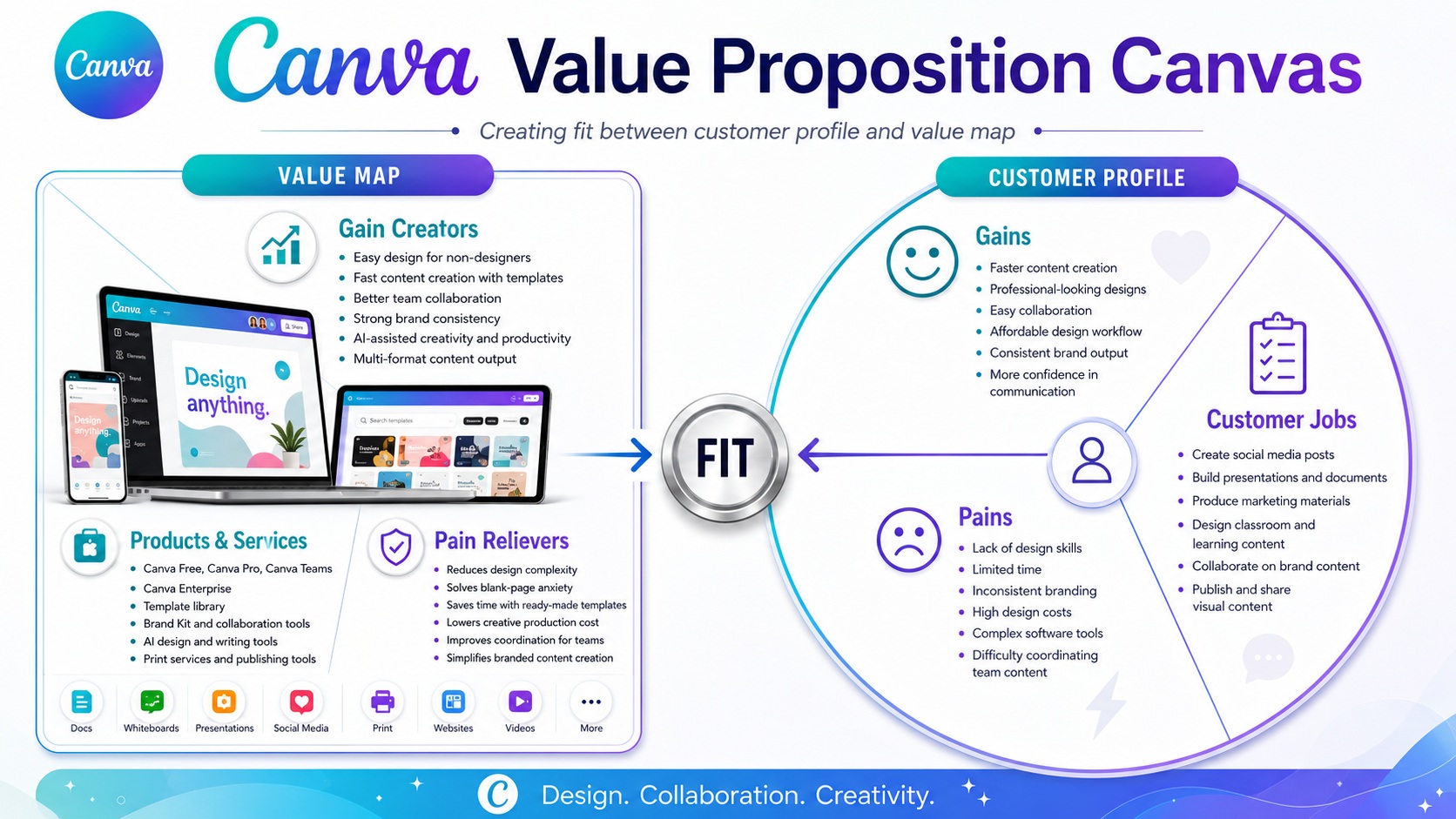
The diagram below gives a visual summary of how Canva’s customer profile and value map connect in one structured view. It helps readers see more clearly how customer jobs, pains, and gains are matched with Canva’s products, pain relievers, and gain creators before moving to the final strategic synthesis.
The Canva Business Model Canvas highlights several advantages that support long-term growth, and these strengths matter because they make the platform more scalable, more relevant to users, and more defensible in a competitive creative and productivity market:
The Canva Business Model Canvas also highlights several risks that could weaken the model if they are not managed carefully. These risks matter because Canva now operates across design, AI, collaboration, enterprise workflows, and content rights, which means execution discipline is becoming as important as user growth:
These risks do not make the model weak. They show that the next stage of growth depends on balance. Canva needs to expand AI, enterprise capability, and workflow breadth without losing simplicity, cost discipline, or trust.
Canva should continue strengthening enterprise-grade governance, approval controls, and measurable admin visibility so the platform becomes more credible for large organisations. Stronger governance can help Canva move from a convenient design tool to a more embedded content operating platform.
The company should also build clearer AI monetisation logic. Premium AI output, usage limits, brand-safe generation, and enterprise-ready controls can help align added value with added cost while protecting margins.
More work is needed on copyright clarity and commercial-use confidence. Stronger licensing signals, asset transparency, provenance tools, and clearer enterprise guidance can improve trust among business customers.
Canva should keep building industry-specific workflows for education, marketing teams, small businesses, nonprofits, and corporate communication functions. Focused solutions can improve relevance and reduce the need for users to adapt a general-purpose platform on their own.
At the same time, the company must protect simplicity. Advanced features should remain layered, so beginners still experience ease while more demanding users can access deeper capability.
Finally, Canva should improve retention through stronger workflow integration. The more the platform becomes central to brand assets, approvals, recurring templates, and team collaboration, the harder it becomes to replace.
Canva has built a strong global platform by making content creation, editing, collaboration, and publishing more convenient. It is not simply offering templates or design tools. It is organising fragmented creative work into one digital system.
The Canva Business Model Canvas shows that its real advantage comes from how the blocks work together. Customer reach, template depth, AI support, brand controls, workflow breadth, and team adoption all reinforce one another.
Future growth will depend on whether Canva can keep improving trust, monetisation, and workflow depth without damaging simplicity or user confidence. If it manages that balance well, it can remain one of the world’s most important visual communication platforms.
This article is for educational and strategic analysis purposes only. It is based on publicly available information, business model interpretation, and general market observation. It is not financial advice, investment advice, legal advice, or an official statement from Canva. Readers should conduct their own research before making business, investment, or strategic decisions.
Explore the CARPUT Business Model Canvas, nine BMC blocks, Value Proposition Canvas, competitor comparison, competitive… Read More
Explore the Boost Business Model Canvas, nine BMC blocks, Value Proposition Canvas, competitor comparison, advantages,… Read More
Explore the Domino's Pizza Business Model Canvas, nine BMC blocks, Value Proposition Canvas, Pizza Hut… Read More
Explore the Mie Gacoan Business Model Canvas, including its customer segments, value propositions, revenue streams,… Read More
Restaurant Business Model Canvas: A Practical Guide to Designing, Evaluating, and Improving Restaurant Business Models… Read More
Learn how the Food and Beverage Business Model Canvas helps restaurants, cafés, beverage brands, and… Read More