Indah Kiat Business Model Canvas: How Indonesia’s Paper Giant Creates Value Through Manufacturing Scale, Packaging, and Global Markets
BMC Article No: BMC #036
Updated in 2026: This article has been comprehensively rewritten to reflect the evolving pulp and paper industry, including rising demand for packaging materials, manufacturing efficiency, sustainability expectations, international trade pressures, and changing customer requirements.
The 2026 update also introduces deeper analysis of all nine Business Model Canvas blocks, expanded strategic insights, a Value Proposition Canvas, comparisons with two relevant industry competitors, five competitive advantages, five key risks and challenges, and strategic recommendations.
Introduction
Indonesia is one of Asia’s important pulp and paper manufacturing centres, supported by industrial capacity, access to fibre resources, and connections to international markets. Within this industry, PT Indah Kiat Pulp & Paper Tbk (Indah Kiat) has developed a substantial manufacturing business serving domestic and overseas customers.
Part of the wider Asia Pulp & Paper (APP) business network associated with Sinar Mas, Indah Kiat produces pulp, printing and writing paper, industrial paper, and packaging-related products.
Unlike consumer brands that compete primarily through marketing and retail visibility, Indah Kiat operates in a capital-intensive business where manufacturing efficiency, product specifications, supply reliability, and access to international buyers are essential.
The Indah Kiat Business Model Canvas illustrates how the company combines industrial production, distribution capabilities, customer relationships, and operational resources to create commercial value.
Its business model is particularly interesting because the company must balance economies of scale with changing market demand, environmental expectations, raw material availability, and manufacturing costs.
Understanding these relationships provides valuable lessons for businesses operating in manufacturing, industrial supply chains, packaging, and international trade.
What Is Indah Kiat’s Business Model?
Indah Kiat primarily operates a business-to-business (B2B) manufacturing model, producing pulp and paper-based products for industrial customers, converters, printers, distributors, and other commercial buyers.
The company creates value by transforming raw materials into products that customers use in packaging, printing, publishing, and industrial applications.
Its economic model depends on four interconnected capabilities: large-scale production, efficient procurement, consistent product quality, and access to domestic and international markets.
Rather than relying on consumer subscriptions or advertising revenue, the company generates income primarily through product sales.
Three commercial engines underpin the business.
First, manufacturing facilities convert fibre, pulp, chemicals, energy, and other inputs into saleable products.
Second, sales and distribution networks connect production capacity with industrial demand.
Third, operational efficiency and product differentiation determine how much economic value the company can capture after manufacturing and logistics costs.
The Indah Kiat Business Model Canvas therefore represents an industrial business where profitability depends not only on sales volume but also on production yields, capacity utilisation, product mix, and market conditions.
What Is Business Model Canvas?
The Business Model Canvas (BMC) is a strategic management framework used to explain how an organisation creates, delivers, and captures value.
Developed by Alexander Osterwalder and Yves Pigneur, the framework organises a business into nine interconnected building blocks.
For manufacturing companies such as Indah Kiat, it is especially useful because it connects customer demand with physical production capabilities, supply chains, distribution, and financial performance.
| BMC Block |
Main Question |
| Customer Segments |
Who purchases Indah Kiat’s products? |
| Value Propositions |
Why do customers choose its products? |
| Channels |
How are products sold and delivered? |
| Customer Relationships |
How does the company retain industrial buyers? |
| Revenue Streams |
How does the business generate income? |
| Key Resources |
What assets enable production and distribution? |
| Key Activities |
Which operations create customer value? |
| Key Partnerships |
Which external relationships support the business? |
| Cost Structure |
What are the major operating costs? |
These blocks must be evaluated collectively. Manufacturing capacity has limited value without sufficient customer demand, while sales growth may not improve profitability if production and distribution costs increase faster than revenue.
Quick Overview of Indah Kiat
Indah Kiat was established in 1976 and subsequently expanded into a major Indonesian pulp and paper manufacturer.
The company operates significant industrial facilities, including operations associated with Tangerang, Serang, and Perawang, serving different product categories and market requirements.
Its portfolio covers several important paper-industry segments, including printing and writing paper, industrial paper, packaging board, and pulp.
Indah Kiat’s position within the wider APP network provides connections to a broader paper manufacturing and commercial ecosystem.
However, it is important to distinguish the listed company’s activities from those of APP as a whole. Not every facility, product, sustainability initiative, or commercial relationship associated with APP necessarily belongs directly to Indah Kiat.
The company operates in an industry shaped by capital investment, global commodity prices, environmental scrutiny, and long-term changes in paper consumption.
Consequently, business performance must be evaluated through operational efficiency, market positioning, product mix, and resilience rather than production volume alone.
Why Indah Kiat Is Strategically Interesting
Indah Kiat demonstrates how manufacturing businesses can build competitive positions through scale, industrial capabilities, and integration with broader supply chains.
Its operations illustrate several important strategic principles.
Large production facilities can reduce average manufacturing costs when operated efficiently and at sufficient utilisation. Nevertheless, those same facilities create substantial fixed costs when demand weakens.
Serving multiple product categories can diversify market exposure. Printing paper, packaging board, and industrial paper face different demand drivers, allowing some degree of portfolio balance.
International sales expand market opportunities but also expose manufacturers to currency movements, trade policies, freight costs, and overseas competition.
The Indah Kiat Business Model Canvas also highlights a central industrial trade-off: the company must maintain competitive manufacturing costs while meeting increasingly demanding requirements for product quality, responsible sourcing, and environmental performance.
Long-term competitiveness therefore depends on more than expanding production capacity. Management must ensure that investment decisions translate into sustainable demand, attractive margins, and adequate returns on capital.
Latest Developments: What Is Changing Around Indah Kiat?
Several structural developments are influencing the paper manufacturing industry in 2026.
Packaging demand continues to be influenced by e-commerce, food and beverage distribution, consumer goods, and the substitution of certain plastic packaging applications with fibre-based alternatives.
At the same time, digitalisation has changed demand patterns for traditional printing and writing paper. Electronic documents, digital communications, and online publishing have reduced some conventional paper applications.
Environmental expectations are also becoming more demanding. Industrial buyers increasingly examine responsible fibre sourcing, traceability, emissions, water consumption, and supplier compliance.
Energy efficiency has become another competitive factor because pulp and paper manufacturing requires significant heat, electricity, and water.
International trade conditions introduce additional uncertainty through freight costs, tariffs, currency fluctuations, and changing import requirements.
For the Indah Kiat Business Model Canvas, these developments suggest that future competitiveness will depend increasingly on product portfolio optimisation, operational efficiency, customer diversification, and credible environmental performance.
The strategic question is no longer simply how much paper the company can manufacture, but which products it can produce profitably for changing markets.
Indah Kiat Business Model Canvas Summary
The following table summarises how Indah Kiat creates value through its industrial manufacturing capabilities and commercial network.
| BMC Block |
Indah Kiat Application |
| Customer Segments |
Packaging manufacturers, printers, industrial buyers, distributors, and export customers |
| Value Propositions |
Product consistency, industrial-scale supply, diverse paper grades, and manufacturing expertise |
| Channels |
Direct B2B sales, distributors, industrial supply networks, and export channels |
| Customer Relationships |
Commercial account management, repeat orders, technical coordination, and supply agreements |
| Revenue Streams |
Sales of pulp, printing and writing paper, industrial paper, and packaging products |
| Key Resources |
Manufacturing plants, machinery, workforce, technical expertise, raw materials, and capital |
| Key Activities |
Pulp and paper production, quality control, procurement, maintenance, and distribution |
| Key Partnerships |
Fibre and chemical suppliers, logistics providers, equipment vendors, distributors, and industry partners |
| Cost Structure |
Raw materials, energy, labour, maintenance, logistics, depreciation, and financing |
Indah Kiat BMC Diagram
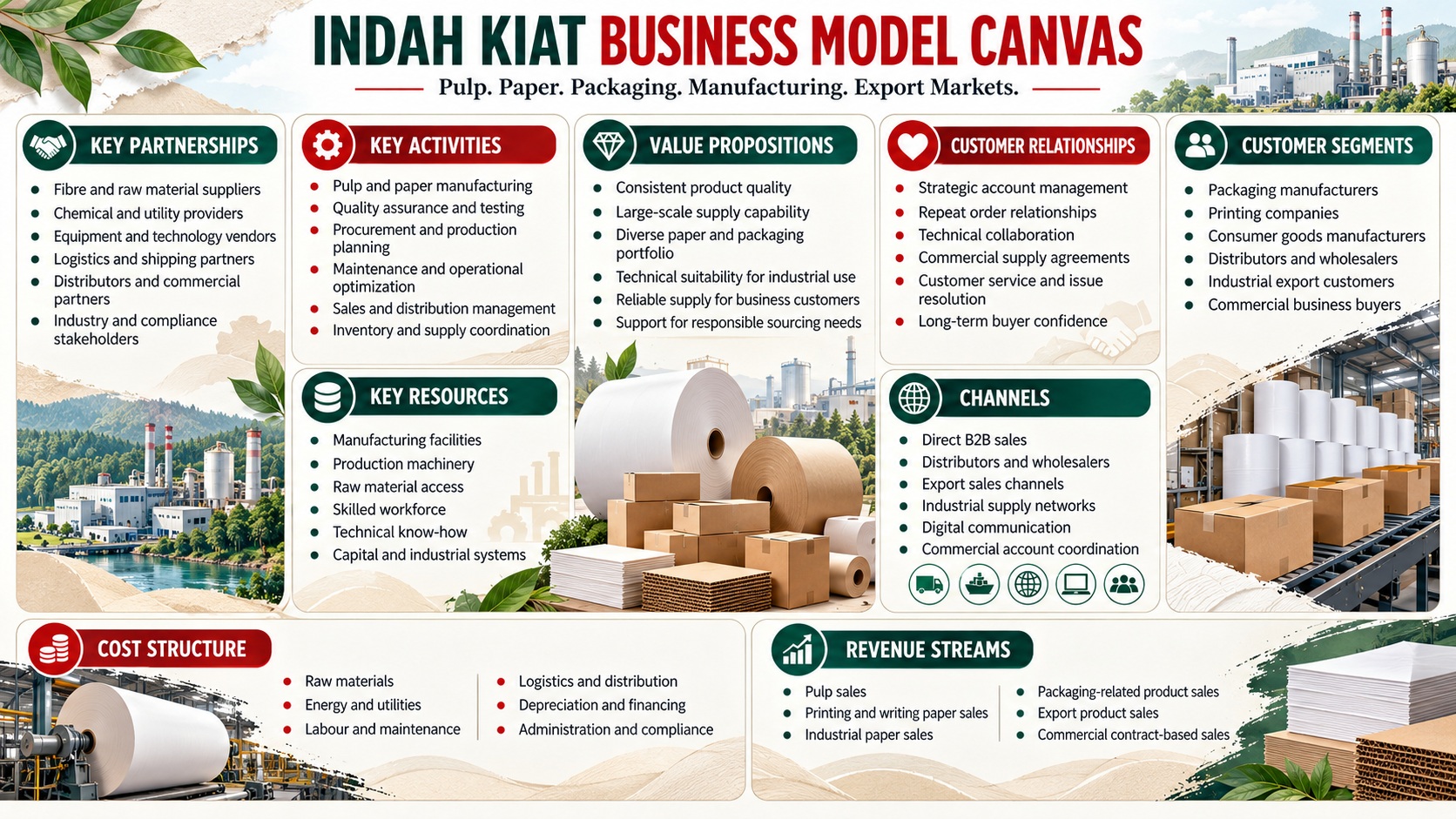
A complete Indah Kiat BMC diagram should display all nine blocks in one integrated view.
The most important relationship is between manufacturing resources, production activities, customer requirements, and revenue generation.
Raw materials and industrial equipment enable production. Manufacturing processes convert inputs into paper products. Sales channels deliver those products to commercial buyers, while revenue must cover operating costs, capital requirements, and reinvestment.
This relationship forms the economic foundation of the business.
BMC Analysis of Indah Kiat
The detailed Indah Kiat Business Model Canvas reveals a business built around the interaction between industrial assets, customer demand, supply-chain reliability, and cost competitiveness.
Unlike digital platforms, where additional customers may be served at relatively low marginal cost, industrial manufacturing requires physical materials, energy, equipment, and distribution for every unit produced.
Increasing sales can improve economies of scale, but only when production remains efficient and selling prices justify the additional operating costs.
Similarly, adding new product categories can diversify revenue while introducing new equipment, technical, and working-capital requirements.
The following analysis examines each BMC block and explains how its commercial and operational decisions affect the overall business model.
1. Customer Segments
Indah Kiat serves industrial and commercial customers requiring paper-based materials for manufacturing, printing, packaging, and distribution.
Its customer base is predominantly B2B, with purchasing decisions influenced by product specifications, pricing, supply continuity, and delivery performance.
Packaging manufacturers need paperboard and industrial paper for converting into finished packaging. Printing companies purchase suitable paper grades for publishing and commercial applications.
Distributors extend market access by supplying smaller businesses that may not purchase directly from large mills.
International customers provide additional opportunities but may impose different technical, regulatory, and sustainability requirements.
Indah Kiat Customer Segments
| Segment |
Details |
Why It Matters |
| Packaging manufacturers |
Producers of cartons, boxes, and packaging materials |
Supports industrial paper demand |
| Printing companies |
Commercial printers and publishers |
Creates demand for printing grades |
| Consumer goods manufacturers |
Businesses requiring packaging materials |
Connects production with end-market consumption |
| Distributors and wholesalers |
Bulk purchasers serving smaller customers |
Expands market coverage |
| International industrial buyers |
Overseas manufacturers and commercial importers |
Diversifies geographic demand |
Customer diversification helps reduce dependence on any single industry. Nevertheless, different segments have different profitability profiles.
Large buyers may provide predictable volumes but demand competitive pricing and favourable payment terms. Smaller specialised customers may offer better margins but require greater sales coordination and product flexibility.
Packaging demand can benefit from consumer goods distribution, while printing paper remains exposed to digital substitution.
The strategic opportunity is to balance stable, high-volume customers with attractive specialised markets.
Rather than pursuing volume indiscriminately, Indah Kiat should prioritise segments based on contribution margins, payment reliability, demand growth, and production compatibility. A well-managed customer portfolio can improve capacity utilisation while reducing exposure to cyclical demand and excessive buyer concentration.
2. Value Propositions
Industrial customers purchase paper products because they perform specific functions within manufacturing and distribution processes.
For these customers, quality means more than appearance. Paper strength, thickness, printability, moisture characteristics, and production consistency can directly affect downstream efficiency.
Indah Kiat’s value proposition centres on combining manufacturing scale with product diversity and supply capabilities.
The Indah Kiat Business Model Canvas shows that customers receive both physical products and operational benefits, particularly dependable supply and suitable technical specifications.
Indah Kiat Value Propositions
| Value Proposition |
Details |
Why It Matters |
| Product consistency |
Paper manufactured to defined specifications |
Reduces downstream production problems |
| Large-scale supply |
Industrial manufacturing capacity |
Supports substantial customer orders |
| Diverse product portfolio |
Pulp, printing paper, industrial paper, and packaging products |
Addresses multiple applications |
| Technical suitability |
Grades designed for different converting and printing requirements |
Improves customer production efficiency |
| Responsible sourcing capabilities |
Fibre sourcing and environmental management practices |
Supports customer procurement requirements |
The strongest value proposition is not necessarily the lowest selling price. Industrial buyers often consider total procurement and production costs.
A cheaper paper grade may become expensive if it causes machine stoppages, excessive waste, printing defects, or packaging failures.
Reliable specifications can therefore justify stronger customer relationships and, in suitable segments, price premiums.
Environmental performance also influences purchasing decisions, especially among multinational customers with formal supplier requirements.
Indah Kiat can strengthen differentiation by connecting product quality with measurable customer outcomes such as lower material waste, fewer rejected batches, improved converting efficiency, and dependable delivery.
Ultimately, its value proposition becomes more defensible when customers perceive the company as a contributor to operational performance rather than merely another commodity paper supplier.
3. Channels
Indah Kiat relies on commercial and industrial distribution channels to move large quantities of products from manufacturing facilities to customers.
Direct sales relationships are particularly relevant for major manufacturers requiring technical coordination, repeat orders, and volume planning.
Distributors and wholesalers extend coverage to smaller customers and fragmented markets.
Export channels provide access to international buyers, supported by freight forwarding, shipping arrangements, and trade documentation.
Indah Kiat Channels
| Channel |
Details |
Why It Matters |
| Direct B2B sales |
Commercial engagement with industrial customers |
Supports large-volume contracts |
| Distributors |
Intermediaries serving regional and smaller buyers |
Expands customer reach |
| Export sales |
International commercial and trading arrangements |
Accesses overseas markets |
| Industrial supply networks |
Established relationships across packaging and printing industries |
Supports repeat purchasing |
| Digital communication |
Product enquiries, documentation, and commercial coordination |
Improves customer accessibility |
Distribution strategy matters because paper products are relatively bulky, and transportation costs can materially affect profitability.
A commercially attractive overseas order may generate weaker margins once shipping, handling, insurance, and trade-related expenses are included.
Direct relationships provide greater customer visibility but require stronger account management capabilities.
Distributors can improve market coverage, although they may reduce control over end-customer relationships and pricing.
An effective channel strategy should therefore match customer size, geography, order frequency, and product characteristics.
Indah Kiat can improve channel economics through coordinated production planning, shipment consolidation, and stronger demand forecasting. Greater visibility into customer orders and delivery performance would also help reduce unnecessary inventory and working-capital requirements.
The objective is not simply broader distribution. It is profitable market access supported by reliable fulfilment.
4. Customer Relationships
Industrial paper purchasing is frequently relationship-driven because customers depend on consistent materials for ongoing operations.
Changing suppliers may require product testing, machinery adjustments, quality validation, and procurement approval.
These switching requirements create opportunities for long-term commercial relationships, although they do not eliminate competition.
Indah Kiat’s customer relationship model can be understood through repeat purchasing, technical coordination, commercial negotiation, and dependable fulfilment.
Indah Kiat Customer Relationships
| Relationship Type |
Details |
Why It Matters |
| Strategic account management |
Dedicated coordination with major buyers |
Supports customer retention |
| Repeat purchasing |
Recurring industrial orders |
Improves demand visibility |
| Technical collaboration |
Product specification and quality discussions |
Reduces application problems |
| Commercial agreements |
Negotiated pricing, volumes, and supply terms |
Supports planning |
| Customer service |
Order coordination and issue resolution |
Builds confidence |
Customer retention is particularly valuable in capital-intensive manufacturing.
Stable orders help management plan production runs, allocate machinery capacity, and manage raw material purchases.
However, strong customer relationships can create commercial dependence when a small number of buyers represent substantial sales volumes.
Large customers may use their purchasing power to negotiate discounts or longer payment periods.
The company must therefore distinguish between revenue growth and customer profitability.
A major customer purchasing substantial volumes may contribute less economic value than expected if pricing is weak, delivery requirements are costly, or payment cycles are extended.
Long-term relationships should be supported by measurable service performance, product consistency, and transparent commercial terms.
By combining customer profitability analysis with technical support and dependable supply, Indah Kiat can strengthen retention without sacrificing financial discipline.
5. Revenue Streams
Indah Kiat generates revenue primarily by selling manufactured pulp and paper products.
Unlike subscription-based businesses, its revenue is closely linked to production output, selling prices, product mix, and customer demand.
Different paper categories can have different market dynamics, manufacturing requirements, and margin characteristics.
Indah Kiat Revenue Streams
| Revenue Stream |
Details |
Why It Matters |
| Printing and writing paper |
Sales of paper for commercial and publishing applications |
Serves established paper markets |
| Industrial paper |
Paper products used in manufacturing and packaging |
Supports industrial demand |
| Packaging-related products |
Board and other paper-based packaging materials |
Provides exposure to packaging markets |
| Pulp products |
Sales of pulp where commercially applicable |
Monetises upstream production |
| Export product sales |
International sales across relevant product categories |
Expands geographic revenue opportunities |
Export sales represent a geographic sales channel rather than an entirely separate product category. The categories above may overlap and should not be interpreted as distinct financial reporting segments.
Revenue growth does not automatically translate into stronger profitability.
A manufacturer can increase output while experiencing margin pressure if raw material prices, energy costs, or freight expenses rise faster than selling prices.
Product mix is equally important. Specialised grades may generate stronger margins but require additional production complexity or investment.
Commodity-grade products can support high volumes while remaining highly sensitive to international market prices.
The Indah Kiat Business Model Canvas therefore demonstrates why revenue quality matters as much as revenue size.
Management should assess contribution margins by product, customer, and market rather than relying exclusively on total sales.
A stronger revenue model would combine reliable baseline demand with profitable growth in technically differentiated products. Such a balance could improve earnings resilience and reduce dependence on favourable commodity pricing cycles.
6. Key Resources
Manufacturing resources form the foundation of Indah Kiat’s business model.
The company requires substantial physical infrastructure, including production facilities, paper machines, utilities, processing equipment, storage systems, and supporting logistics capabilities.
Human expertise is equally important because industrial paper manufacturing involves complex chemical, mechanical, and operational processes.
Indah Kiat Key Resources
| Resource |
Details |
Why It Matters |
| Manufacturing facilities |
Mills and industrial production infrastructure |
Enables commercial-scale output |
| Production machinery |
Paper machines and processing equipment |
Determines productivity and product capabilities |
| Raw material access |
Fibre, pulp, recovered paper, and chemicals as applicable |
Supports production continuity |
| Skilled workforce |
Engineers, operators, maintenance, and quality personnel |
Maintains operational performance |
| Capital and technical knowledge |
Financing capacity, process expertise, and industrial systems |
Supports investment and efficiency |
Indah Kiat’s listed mills include facilities in Tangerang, Perawang, and Serang, with product capabilities varying by location.
The strategic value of these resources depends on how effectively they are utilised.
A modern production facility can offer substantial economies of scale, but underutilised equipment creates depreciation and maintenance expenses without generating sufficient revenue.
Raw material access is another critical factor. Disruptions in fibre availability, chemical supplies, or energy can affect production schedules and costs.
Technical expertise helps improve yields, reduce defects, and extend equipment life.
Financial resources also matter because manufacturing upgrades frequently require significant capital expenditure.
The company should therefore evaluate resources based on productivity, reliability, flexibility, and return on invested capital.
Sustainable competitive advantage emerges when industrial assets are combined with superior operational execution, rather than simply from owning large factories.
7. Key Activities
Indah Kiat’s key activities revolve around transforming raw materials into marketable pulp and paper products.
Manufacturing operations must coordinate production scheduling, material preparation, processing, quality inspection, equipment maintenance, and finished-goods handling.
Supply-chain management connects these activities with customer orders and delivery commitments.
Indah Kiat Key Activities
| Activity |
Details |
Why It Matters |
| Pulp and paper manufacturing |
Industrial conversion of raw materials |
Creates core products |
| Quality assurance |
Testing and monitoring product specifications |
Maintains customer acceptance |
| Procurement and planning |
Coordinating materials, inventory, and production |
Supports efficiency |
| Maintenance and optimisation |
Improving machinery reliability and productivity |
Reduces operational disruption |
| Sales and distribution |
Managing commercial orders and fulfilment |
Converts production into revenue |
Manufacturing efficiency is a critical profitability driver because even small improvements can create substantial value at industrial scale.
Higher production yields reduce raw material consumption per saleable tonne.
Preventive maintenance can reduce unplanned downtime, while improved scheduling helps minimise product changeover losses.
Quality control also has direct financial implications. Defective products create waste, rework, customer complaints, and potentially lost contracts.
Environmental management must be integrated into daily operations because water consumption, wastewater treatment, emissions, and energy use are material operational considerations.
Digital monitoring and predictive maintenance offer opportunities to improve reliability, although their value depends on implementation effectiveness.
Indah Kiat’s long-term performance will depend on how consistently these activities translate into lower unit costs and reliable customer outcomes.
Operational excellence should therefore be treated as a continuous management discipline rather than a one-time efficiency programme.
8. Key Partnerships
Industrial manufacturing depends on extensive relationships beyond a company’s own facilities.
Indah Kiat requires dependable suppliers, service providers, logistics partners, technology specialists, and commercial intermediaries.
Its wider corporate ecosystem may also provide opportunities for coordination, although individual arrangements should not be assumed without supporting disclosures.
Indah Kiat Key Partnerships
| Partner Category |
Details |
Why It Matters |
| Fibre and material suppliers |
Providers of production inputs |
Supports supply continuity |
| Chemical and utility providers |
Suppliers of industrial chemicals, energy, and services |
Enables manufacturing operations |
| Equipment and technology vendors |
Machinery, automation, and maintenance specialists |
Supports productivity |
| Logistics providers |
Freight, shipping, and transportation partners |
Enables domestic and export delivery |
| Distributors and commercial partners |
Businesses supporting product market access |
Expands sales coverage |
Partnership quality directly affects production reliability and cost competitiveness.
A disruption involving a critical chemical or equipment component can interrupt manufacturing even when customer demand remains strong.
Logistics partners influence delivery reliability, freight expenses, and access to overseas markets.
Technology providers can help improve automation, process monitoring, and energy efficiency.
Environmental assurance also requires engagement with relevant verification, certification, and regulatory systems. Certification bodies should nevertheless remain independent rather than be treated as ordinary commercial partners.
The Indah Kiat Business Model Canvas highlights how external relationships support the company’s internal manufacturing capabilities.
Strategically, the objective should be to develop a resilient supplier and partner ecosystem that reduces concentration risk while maintaining quality and cost efficiency.
Strong partnerships are most valuable when they improve operational continuity, provide technical capabilities, and help the company respond quickly to changing customer requirements.
9. Cost Structure
Indah Kiat operates in a capital-intensive industry where both fixed and variable costs materially influence profitability.
Manufacturing facilities require substantial investment, while day-to-day production consumes raw materials, energy, chemicals, labour, and maintenance resources.
Distribution expenses add another layer of cost, particularly for export markets.
Indah Kiat Cost Structure
| Cost Category |
Details |
Why It Matters |
| Raw materials |
Fibre, pulp, recovered paper, and chemicals |
Major variable production inputs |
| Energy and utilities |
Electricity, steam, fuel, and water management |
Influences unit manufacturing costs |
| Labour and maintenance |
Employees, repairs, and equipment servicing |
Maintains operational continuity |
| Logistics and distribution |
Freight, warehousing, and export handling |
Affects delivered product margins |
| Depreciation and financing |
Capital equipment depreciation and borrowing costs |
Reflects capital intensity |
The economics of paper manufacturing are particularly sensitive to capacity utilisation.
When production volume increases, fixed costs can be spread across more saleable output, potentially lowering average unit costs.
However, running equipment at higher utilisation does not guarantee profitability if market prices are weak.
Energy efficiency is another important consideration because manufacturing processes can require substantial heat and electricity.
Waste reduction, improved material yields, and predictive maintenance can provide recurring cost benefits.
Capital expenditure must also be carefully evaluated. New equipment may increase production capacity or improve efficiency, but it creates financial commitments that must be justified by future demand.
A disciplined cost strategy should therefore consider both operational expenses and the cost of capital.
The strongest financial outcomes are likely to come from balancing efficient production, profitable product selection, reliable equipment, and prudent investment decisions.
Indah Kiat Value Proposition Canvas
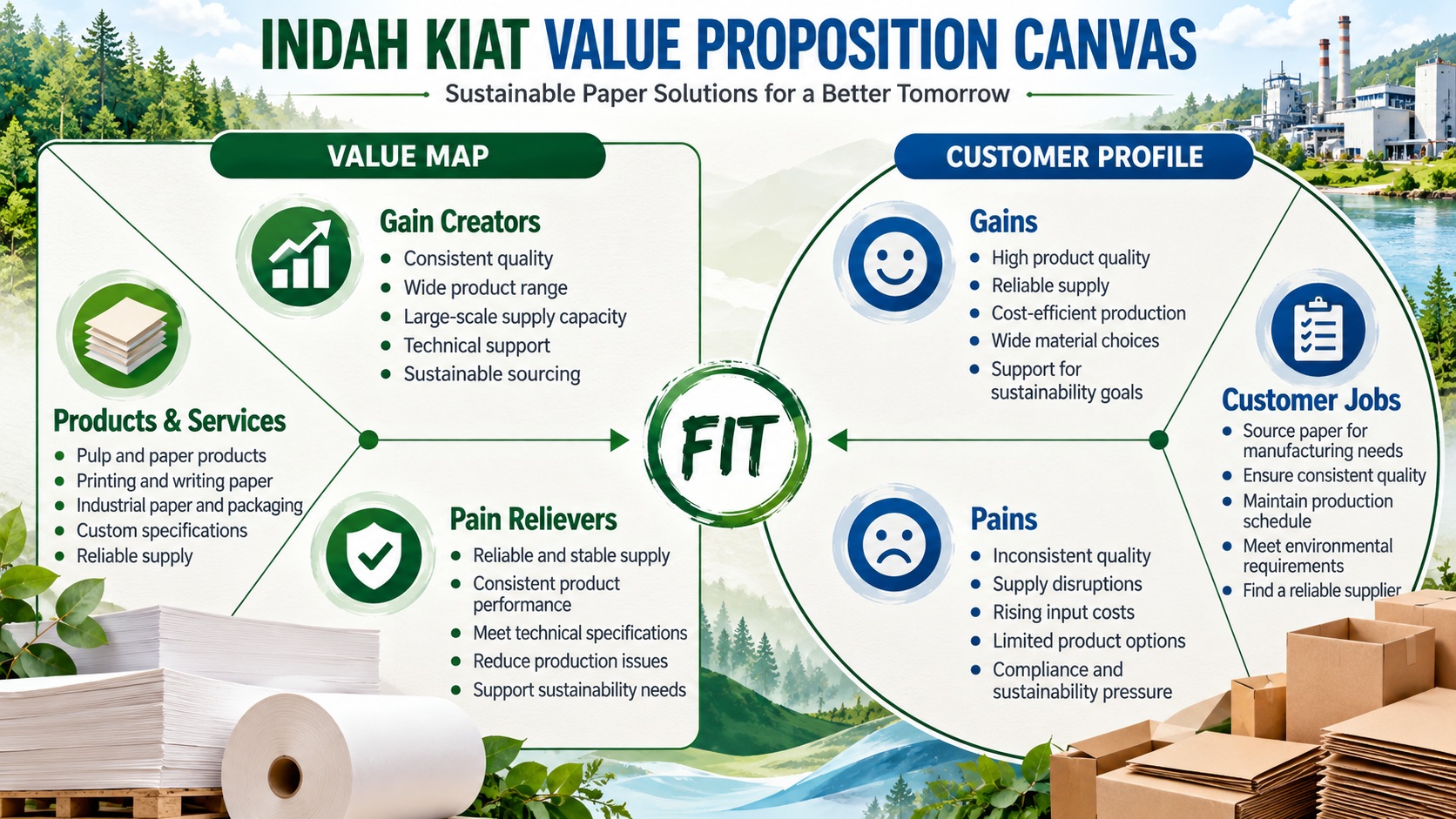
The Value Proposition Canvas (VPC) provides a closer examination of how Indah Kiat’s products and manufacturing capabilities address customer requirements.
While BMC explains the overall business model, VPC focuses on the relationship between what customers need and how the company delivers value.
For the Indah Kiat Business Model Canvas, the most relevant customer profile is an industrial packaging manufacturer purchasing paperboard or related materials for downstream production.
These customers do not simply purchase paper. They require materials that help maintain production efficiency, meet product specifications, and fulfil their own customers’ orders.
Customer Profile
The customer profile examines the functional requirements, difficulties, and desired outcomes of industrial packaging manufacturers.
| VPC Component |
Customer Perspective |
| Customer Jobs |
Purchase suitable paper materials for packaging production |
| Customer Jobs |
Maintain consistent production quality and delivery schedules |
| Customer Jobs |
Meet technical and environmental procurement requirements |
| Customer Pains |
Inconsistent material quality causing production waste |
| Customer Pains |
Supply disruptions affecting manufacturing schedules |
| Customer Pains |
Volatile prices increasing production costs |
| Customer Gains |
Reliable material availability |
| Customer Gains |
Improved converting efficiency and reduced defects |
| Customer Gains |
Competitive procurement costs and traceable sourcing |
Industrial customers are especially sensitive to material performance because paper quality affects machinery productivity and finished packaging quality.
Supply reliability can be as important as price. A delayed shipment may disrupt a packaging manufacturer’s production commitments and customer relationships.
Value Map
The value map explains how Indah Kiat’s product portfolio and industrial capabilities can address these requirements.
| VPC Component |
Indah Kiat Value Offering |
| Products and Services |
Industrial paper and packaging-related grades |
| Products and Services |
Large-scale manufacturing and commercial supply |
| Products and Services |
Product specification and technical coordination |
| Pain Relievers |
Consistent product specifications reduce processing problems |
| Pain Relievers |
Production scale supports substantial order requirements |
| Pain Relievers |
Supply coordination improves procurement predictability |
| Gain Creators |
Suitable materials support efficient packaging production |
| Gain Creators |
Diverse grades address different industrial applications |
| Gain Creators |
Manufacturing and sourcing capabilities support customer requirements |
Value Proposition Fit
The Indah Kiat Business Model Canvas becomes more meaningful when the relationship between customer expectations and manufacturing capabilities is considered.
Indah Kiat’s strongest potential fit comes from providing reliable materials at competitive total costs.
A packaging manufacturer may prefer a supplier offering consistent quality and dependable delivery even when another supplier quotes a slightly lower unit price.
However, this fit weakens when material defects, shipment delays, or pricing volatility disrupt customer operations.
The company can strengthen its value proposition by measuring customer outcomes such as material rejection rates, on-time delivery, product consistency, and technical complaint resolution.
Ultimately, the strongest customer relationships are created when Indah Kiat helps industrial buyers improve their own operational performance.
Indah Kiat vs FajarPaper vs Riau Andalan Pulp & Paper Business Models
Indah Kiat competes within a paper industry that includes both diversified manufacturers and businesses with more specialised product portfolios.
Two relevant companies for comparison are PT Fajar Surya Wisesa Tbk (FajarPaper) and PT Riau Andalan Pulp & Paper (RAPP).
FajarPaper is particularly relevant because of its industrial paper and packaging focus. RAPP provides a useful comparison in pulp and paper manufacturing, supported by the wider APRIL industrial ecosystem.
The comparison concentrates on the BMC blocks that most clearly distinguish their business models, rather than repeating all nine components.
BMC Block Comparison
| Relevant BMC Block |
Indah Kiat |
FajarPaper |
RAPP |
| Customer Segments |
Packaging manufacturers, printers, industrial buyers, and export customers |
Corrugated packaging producers and industrial paper buyers |
Pulp purchasers, paper buyers, and industrial customers |
| Value Proposition |
Broad paper portfolio, manufacturing scale, and product diversity |
Industrial packaging paper and containerboard expertise |
Large-scale pulp and paper production capabilities |
| Revenue Streams |
Pulp, printing paper, industrial paper, and packaging-related sales |
Primarily industrial paper and packaging material sales |
Pulp and paper product sales |
| Key Resources |
Multiple manufacturing facilities and diversified production capabilities |
Industrial paper mills, recovered-fibre processing, and manufacturing expertise |
Integrated pulp and paper production assets and associated supply capabilities |
| Key Activities |
Pulp and paper manufacturing, quality control, and distribution |
Industrial paper production and operational optimisation |
Pulp production, papermaking, and industrial supply-chain operations |
| Cost Structure |
Raw materials, energy, labour, maintenance, logistics, and capital costs |
Recovered fibre, energy, manufacturing, and logistics |
Fibre, chemicals, energy, manufacturing, and capital costs |
This is a qualitative comparison of business-model characteristics, not a ranking of financial performance or market share. RAPP’s wider group capabilities should not be interpreted as assets owned directly by RAPP.
The strategic differences are significant.
Indah Kiat’s diversified portfolio provides exposure to several paper-industry applications. FajarPaper’s more concentrated industrial paper positioning connects it closely to packaging demand and recovered-fibre economics.
RAPP’s pulp and paper operations offer a different combination of upstream manufacturing capabilities and product markets.
These differences influence raw material requirements, customer relationships, investment priorities, and sensitivity to market cycles.
For Indah Kiat, diversification creates opportunities but also increases operational complexity.
The company must determine which product categories generate the strongest returns and where its industrial capabilities provide a genuine competitive advantage.
Industry sources identify these manufacturers among Indonesia’s important pulp, paper, and packaging market participants.
Competitive Advantages
Indah Kiat possesses several structural strengths that can support its competitive position in Indonesia’s pulp and paper industry.
The Indah Kiat Business Model Canvas suggests that its advantages arise from the combination of manufacturing resources, product capabilities, market access, and operational experience.
- Large-scale manufacturing capabilities. Substantial industrial facilities enable high-volume production and potential economies of scale. Efficient utilisation can spread fixed manufacturing costs across greater output, strengthening cost competitiveness.
- Diversified product portfolio. Participation in pulp, printing paper, industrial paper, and packaging-related markets provides exposure to different demand drivers. This diversification can reduce reliance on any single product category, although it does not eliminate industry cyclicality.
- Established industrial expertise. Decades of manufacturing experience provide accumulated knowledge in production processes, machinery operations, quality control, and technical problem-solving. Such capabilities can be difficult for new entrants to replicate quickly.
- Domestic and international market access. Serving multiple geographic markets expands commercial opportunities and can support production planning. Export capabilities also provide flexibility when demand conditions vary across regions.
- Position within a broader industrial ecosystem. Association with APP provides access to a wider network of industry experience and potential commercial coordination. Actual benefits depend on the arrangements and resources available to the company.
These advantages are meaningful but not permanent.
Large manufacturing assets can become financial burdens when utilisation declines. Product diversity can create complexity, while international exposure introduces additional commercial risks.
Sustaining competitive advantage therefore requires continuous improvements in productivity, customer service, product differentiation, and capital allocation.
Risks and Challenges
Indah Kiat operates in an industry exposed to market cycles, environmental scrutiny, capital intensity, and international competition.
Five major challenges deserve particular attention.
- Raw material and energy cost volatility. Changes in fibre, recovered paper, chemical, fuel, and electricity costs can weaken margins. Manufacturers may struggle to pass these increases to customers when market competition is intense.
- Environmental and sustainability pressures. Fibre sourcing, deforestation concerns, biodiversity, emissions, wastewater, and traceability requirements create regulatory, operational, and reputational exposure. Weak performance can affect market access and customer confidence.
- Changing demand for traditional paper products. Digital communication and electronic documentation continue to influence printing and writing paper consumption. Packaging growth may offset some pressure, but the transition requires product and capacity adjustments.
- International trade and competitive pressure. Export sales expose the company to exchange-rate fluctuations, freight costs, trade restrictions, and competition from other manufacturers. Global oversupply can also place downward pressure on selling prices.
- Capital intensity and financial exposure. Manufacturing facilities require significant investment, maintenance, and working capital. Expansion undertaken without sufficient demand or attractive returns can increase debt burdens and reduce financial flexibility.
These risks are interconnected.
Higher energy costs can weaken profitability just as market prices decline. Environmental requirements may necessitate additional capital investment, while weaker demand can reduce the cash available to finance those improvements.
The central management challenge is maintaining resilience across the entire business model.
Strategic Recommendations
The analysis identifies several opportunities for Indah Kiat to strengthen its long-term competitiveness.
Rather than focusing exclusively on manufacturing expansion, the company should prioritise initiatives that improve profitability, capital efficiency, customer value, and resilience.
The following recommendations are strategic proposals derived from the BMC analysis, not confirmed company initiatives.
1. Prioritise Higher-Value Packaging Opportunities
Demand for fibre-based packaging creates opportunities to improve the product portfolio.
Indah Kiat should assess packaging segments where technical specifications, consistent quality, and supply reliability provide opportunities for differentiation.
For example, specialised paperboard grades used in consumer goods packaging may offer more defensible customer relationships than purely commodity-driven products.
Investment decisions should nevertheless consider customer demand, machinery suitability, and expected returns.
The objective is to improve product mix rather than simply increase production volume.
2. Accelerate Manufacturing Efficiency
Operational efficiency should remain a core strategic priority.
Digital monitoring, predictive maintenance, process automation, and advanced quality control can help reduce production losses.
For example, identifying machinery deterioration before equipment failure could reduce unplanned downtime and maintenance expenses.
Improved production planning can also reduce changeover losses and unnecessary inventory.
Management should measure these investments against tangible outcomes such as energy consumption per tonne, production yield, downtime, and manufacturing cost per saleable unit.
3. Strengthen Sustainability and Traceability
Environmental performance is increasingly connected to customer procurement decisions and international market access.
Indah Kiat should continue strengthening credible fibre traceability, responsible sourcing, emissions management, and water efficiency.
Greater transparency can help industrial customers evaluate supply-chain risks and demonstrate compliance with their own sustainability requirements.
However, environmental claims should be supported by verifiable evidence and clear reporting boundaries.
The commercial objective is to make responsible production a measurable part of the customer value proposition.
4. Improve Customer and Product Profitability Analysis
High sales volumes do not necessarily generate attractive financial returns.
The company should evaluate profitability across customer segments, product grades, and geographic markets.
For example, a large export contract may appear attractive until freight costs, payment terms, and production requirements are included.
Customer profitability analysis can help identify which relationships deserve greater commercial investment.
Such insights can guide pricing, product development, capacity allocation, and contract negotiations.
5. Develop More Resilient Supply Chains
Manufacturing continuity depends on reliable access to materials, utilities, logistics, and technical services.
Indah Kiat should assess concentration risks involving critical suppliers and transportation routes.
Alternative sourcing arrangements, appropriate inventory policies, and supplier performance monitoring can reduce operational disruption.
At the same time, excessive inventory should be avoided because it increases working-capital requirements.
A resilient supply chain balances continuity, cost efficiency, quality, and financial discipline.
6. Optimise Capital Allocation and Production Capacity
Capital expenditure should be guided by market demand and expected returns rather than expansion opportunities alone.
Before committing to new capacity, management should evaluate projected utilisation, customer commitments, operating costs, and downside scenarios.
Upgrading existing machinery may sometimes provide better returns than building additional production lines.
Investments that improve energy efficiency, production yield, or product flexibility can also strengthen competitiveness without proportionate capacity expansion.
Disciplined capital allocation is especially important in industries exposed to commodity pricing cycles.
7. Deepen Strategic Customer Relationships
Indah Kiat can differentiate itself by helping industrial customers improve their production outcomes.
Technical collaboration, joint product development, and stronger delivery coordination can increase customer loyalty.
For example, working with a packaging manufacturer to optimise paperboard specifications may reduce material waste and improve converting efficiency.
These relationships can shift competition away from price alone.
Over time, stronger customer integration may improve demand visibility, support more predictable production planning, and create opportunities for differentiated products.
Conclusion
The Indah Kiat Business Model Canvas demonstrates how a capital-intensive manufacturing company creates value through the combination of industrial resources, production expertise, customer relationships, and market access.
Unlike digital businesses that can expand through software and network effects, pulp and paper manufacturers depend on physical assets, raw materials, energy, skilled workers, and logistics infrastructure.
These requirements create substantial barriers to entry but also introduce considerable financial and operational risks.
Indah Kiat’s manufacturing capabilities and diversified product portfolio provide a foundation for serving different industrial markets. Its domestic and international commercial reach further expands opportunities for revenue generation.
However, production scale alone is insufficient to guarantee long-term profitability.
Manufacturing efficiency, product mix, customer profitability, and capital allocation ultimately determine whether large industrial assets generate attractive economic returns.
The transition toward packaging applications creates opportunities, while digitalisation continues to challenge certain traditional paper categories.
Environmental expectations are also reshaping competition. Customers increasingly evaluate not only price and product specifications but also supply-chain transparency, responsible sourcing, and environmental performance.
Indah Kiat must therefore balance three strategic priorities: maintaining cost competitiveness, delivering differentiated customer value, and improving operational resilience.
The nine BMC blocks show how these priorities are connected.
Customer demand influences production planning. Product specifications determine manufacturing requirements. Resources and partnerships enable operations, while distribution capabilities convert output into sales.
Revenue must then cover operating costs, financing commitments, and reinvestment.
A weakness in one block can undermine the performance of the entire model.
For business owners and entrepreneurs, Indah Kiat provides an important lesson: competitive advantage in manufacturing comes not simply from producing more, but from producing the right products efficiently, serving profitable customers, and allocating capital wisely.
Companies that successfully integrate these capabilities are better positioned to withstand industry cycles and adapt to changing market conditions.
Indah Kiat’s future competitiveness will depend on its ability to translate manufacturing scale into sustainable economic value while responding to evolving customer, environmental, and technological expectations.
Disclaimer
This article is intended solely for educational, informational, and business-analysis purposes.
The content is based on publicly available information, industry observations, and independent strategic interpretation. It is not official information, a statement, or an endorsement from PT Indah Kiat Pulp & Paper Tbk, Asia Pulp & Paper, Sinar Mas, FajarPaper, APRIL Group, RAPP, or any other company mentioned.
Nothing in this article constitutes investment, financial, legal, or professional advice. Readers should conduct independent research and consult qualified advisers before making investment or business decisions.
Company information, products, operations, financial performance, and market conditions may change over time.
All company names, trademarks, logos, copyrighted materials, and other intellectual-property rights belong to their respective owners. Any references are used solely for identification, commentary, and educational purposes.
Meta Description
Explore the Indah Kiat Business Model Canvas, nine BMC blocks, Value Proposition Canvas, competitor comparison, risks and strategies. Updated 2026.