FedEx Business Model Canvas
Explore the FedEx Business Model Canvas, nine BMC blocks, Value Proposition Canvas, UPS and DHL comparison, competitive advantages, risks, and strategic recommendations.
Explore the Facebook Business Model Canvas, including all nine BMC blocks, Value Proposition Canvas, TikTok and YouTube comparison, competitive advantages, risks, failure scenarios and strategic recommendations updated for 2026.
BMC Article No: BMC #007
Updated in 2026: This article has been comprehensively updated to reflect Facebook’s evolving role within Meta Platforms, changes in digital advertising, greater use of artificial intelligence, the growing importance of Reels and recommendation-driven discovery, increasing infrastructure investment, regulatory pressure, and stronger competition from TikTok and YouTube.
The 2026 update also includes deeper analysis for every BMC block, expanded closing analysis, a Value Proposition Canvas, comparison with two relevant competitors, competitive advantages, risks and challenges, strategic recommendations, and an assessment of how Facebook’s business model could potentially fail.
Facebook started as a social-networking platform designed primarily to connect people with friends, classmates and family members. Over time, it evolved into one of the largest digital platforms in the world and became the foundation of what is now Meta Platforms.
Today, Facebook is much more than a social network. The platform combines personal connections, communities, entertainment, video, Reels, Groups, Pages, Marketplace, creators, business messaging, product discovery and digital advertising.
The Facebook Business Model Canvas is particularly interesting because Facebook operates as a multi-sided platform. Most individual users do not pay directly to access the service. Instead, Facebook attracts and retains massive audiences, generates engagement, organises content through algorithms and monetises that attention primarily through advertising.
Businesses and advertisers pay for access to audiences, targeting capabilities, campaign optimisation and measurable marketing outcomes. Creators, communities and publishers contribute content that further increases engagement.
Facebook therefore creates value for one stakeholder group while capturing most of its revenue from another.
Understanding this interaction is essential to understanding how the platform has become such a powerful digital business.
Facebook operates primarily as an advertising-supported digital platform connecting individual users, businesses, creators, communities and advertisers.
Most consumer services are offered without requiring direct payment. Removing the subscription barrier allows Facebook to maximise participation, which strengthens network effects and increases advertising inventory.
At the centre of the Facebook Business Model Canvas is an advertising model in which marketers purchase placements to reach audiences based on objectives such as brand awareness, engagement, lead generation, application installs, website traffic and sales.
Meta has consistently reported that substantially all of its revenue comes from advertising across its Family of Apps.
Three economic engines support this model.
First, users, businesses and creators generate content, conversations and activity.
Second, recommendation algorithms and AI systems organise that content and determine what users are likely to see.
Third, advertisers pay to access the attention generated by those interactions.
The result is a powerful flywheel. More users attract more creators and businesses. More content improves engagement opportunities. Higher engagement creates additional advertising inventory. Increased advertising revenue funds further investment in technology, infrastructure and product development.
Facebook has therefore evolved from a simple social-networking website into a global attention, discovery, community and advertising platform.
Business Model Canvas, commonly known as BMC, is a strategic framework used to understand how an organisation creates value, delivers value and captures economic returns.
The framework consists of nine interconnected blocks.
For Facebook, BMC is particularly useful because its users and paying customers are often different groups. Individual users create much of the activity and engagement that makes Facebook commercially attractive, while advertisers provide most of the revenue.
The Facebook Business Model Canvas helps explain how these relationships fit together.
| BMC Block | Main Question |
|---|---|
| Customer Segments | Who does Facebook serve? |
| Value Propositions | What value does Facebook provide? |
| Channels | How does Facebook reach users and customers? |
| Customer Relationships | How does Facebook maintain engagement and loyalty? |
| Revenue Streams | How does Facebook generate revenue? |
| Key Resources | Which resources make the business model possible? |
| Key Activities | What activities must Facebook continuously perform? |
| Key Partnerships | Which external partners strengthen the ecosystem? |
| Cost Structure | What are Facebook’s major costs? |
Looking at these blocks individually is useful, but the real strategic value comes from understanding how they reinforce one another.
Facebook was launched in February 2004 and gradually became one of the dominant consumer internet platforms globally.
Its original value proposition focused heavily on connecting friends and family through personal profiles, status updates and the social graph.
Modern Facebook is considerably broader.
Users can participate in Groups, follow Pages, watch long-form and short-form video, use Marketplace, discover businesses, communicate through Messenger, engage with creators and consume content recommended by algorithms.
Facebook also operates as part of Meta’s wider ecosystem, which includes Instagram, Messenger, WhatsApp, Threads and Meta’s broader artificial intelligence and Reality Labs initiatives.
The platform’s position within this ecosystem strengthens its strategic reach.
Advertisers can reach customers across multiple Meta properties, while Meta can combine technological capabilities such as advertising infrastructure, AI models, recommendation engines and data-centre capacity across its applications.
Facebook therefore should not be evaluated purely as a standalone social network.
Its competitive position is increasingly tied to the wider capabilities of Meta Platforms.
Facebook is strategically interesting because it demonstrates how a multi-sided digital platform can build powerful economics without directly charging most users.
Individuals participate because the platform offers communication, entertainment, communities and discovery.
Businesses join because consumers are already present.
Creators and publishers participate because the platform offers potential reach.
Advertisers spend money because Facebook provides access to audiences at scale.
These different groups reinforce one another.
Larger audiences attract more businesses and creators. Additional content creates more reasons for users to return. Higher engagement increases advertising inventory and provides additional behavioural signals that can improve recommendations and advertising optimisation.
The Facebook Business Model Canvas therefore demonstrates the strategic importance of network effects.
However, network effects are not automatically permanent.
Users can shift attention to competing platforms. Creators can move their content elsewhere. Advertisers can redirect budgets rapidly if performance deteriorates.
Facebook must continuously maintain value across the entire ecosystem rather than relying solely on historical scale.
Several developments are reshaping Facebook’s business model in 2026.
Artificial intelligence has become increasingly important to content recommendation, advertising optimisation, moderation, creative tools and product development.
Facebook is also becoming more discovery-driven.
Historically, the News Feed relied primarily on content from friends, Pages and Groups that users had deliberately chosen to follow. Increasingly, recommendation systems surface content from creators and accounts outside the traditional social graph.
Reels is an important part of this transition.
Short-form video has become a major battleground as Facebook and Instagram compete with TikTok and YouTube Shorts for user attention.
Advertising technology is changing as well.
Meta is increasingly using AI to automate campaign creation, targeting, creative production, bidding and optimisation. This can make the advertising platform easier for smaller businesses to use while potentially improving campaign performance.
Infrastructure investment is another major development.
Advanced AI models require enormous computing capacity, increasing Meta’s capital expenditure and making data centres, chips and computing infrastructure more strategically important.
Regulatory exposure has simultaneously increased.
Privacy, youth safety, content governance, platform competition and algorithmic transparency are becoming increasingly important considerations.
The Facebook Business Model Canvas must therefore evolve while preserving the advertising economics that continue to fund Meta’s wider strategy.
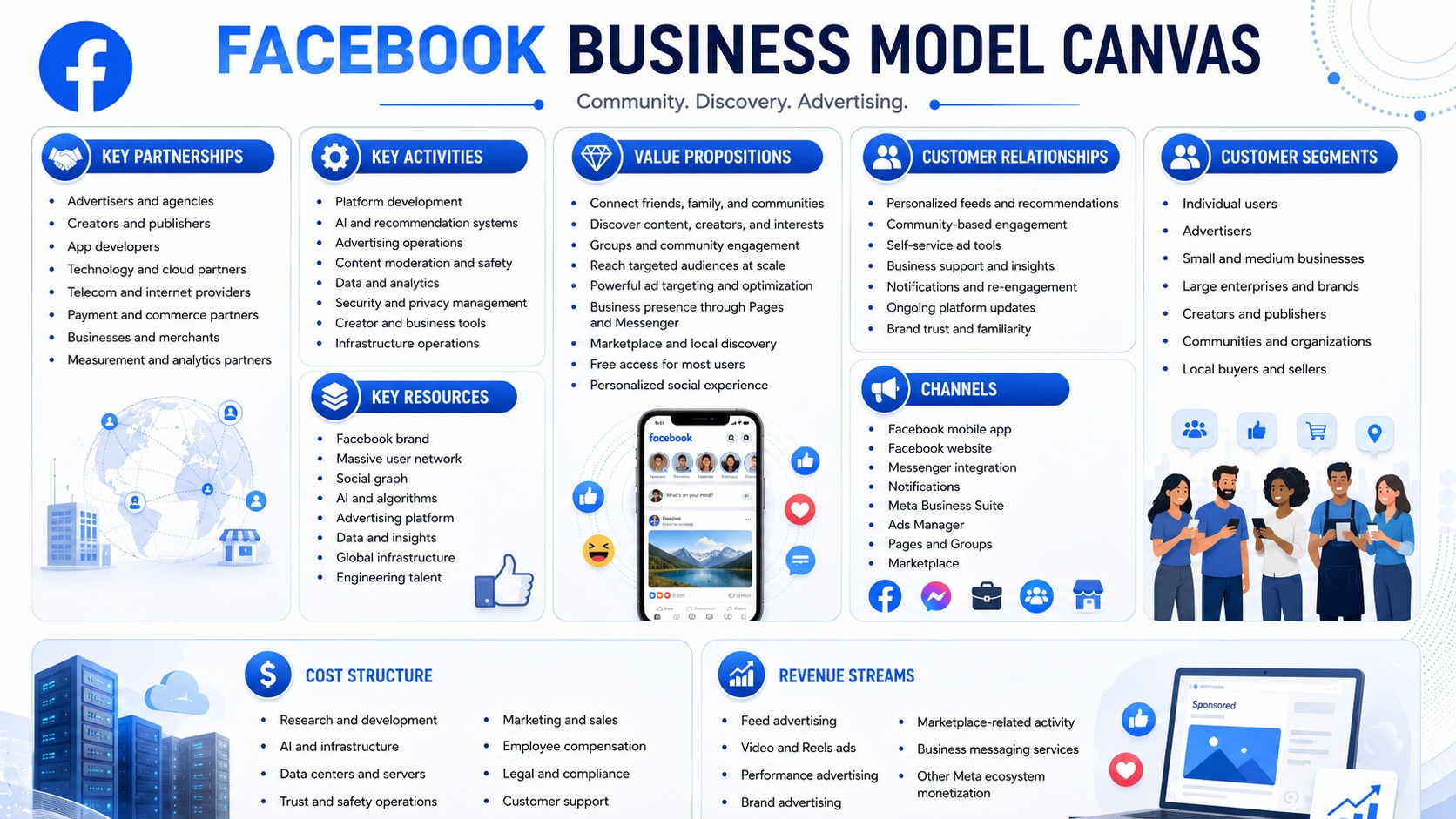
Before analysing each component in detail, the Facebook Business Model Canvas can be summarised as a digital platform that converts user participation, content and attention into monetisable advertising opportunities.
| BMC Block | Facebook Application |
|---|---|
| Customer Segments | Individual users, advertisers, SMEs, businesses, creators and communities |
| Value Propositions | Social connection, content discovery, communities, business reach and advertising performance |
| Channels | Facebook app, website, Messenger, notifications and Meta advertising tools |
| Customer Relationships | Network effects, personalisation, communities, self-service advertising and business support |
| Revenue Streams | Primarily digital advertising with selected complementary services |
| Key Resources | User network, social graph, AI, algorithms, infrastructure, brand and advertising technology |
| Key Activities | Product development, recommendation, advertising, trust and safety, security and infrastructure operations |
| Key Partnerships | Advertisers, agencies, creators, developers, technology partners and telecommunications providers |
| Cost Structure | R&D, infrastructure, AI computing, employees, trust and safety, sales and compliance |
A Facebook BMC diagram should present all nine blocks in one visual view.
The most important relationship to highlight is the interaction between users, content, AI, advertisers and revenue.
Users generate activity. Creators and communities add content. Algorithms organise that activity. Advertisers pay to access relevant audiences. Revenue is then reinvested into technology, AI, security and infrastructure.
The detailed Facebook Business Model Canvas shows that Facebook’s competitive position is created through a combination of audience scale, network effects, recommendation systems, advertising technology and infrastructure.
No individual BMC block works independently.
A stronger recommendation engine may increase engagement, but additional engagement creates more infrastructure requirements.
More advertising can increase revenue, yet excessive commercial content can reduce user satisfaction.
Stricter privacy requirements may protect users while limiting advertising signals.
Facebook must therefore continuously balance multiple objectives across the entire business model.
The following sections examine each BMC block in greater depth.
Facebook serves several customer groups simultaneously.
Individual users form the foundation of the platform. They use Facebook to communicate, discover information, participate in communities, consume entertainment, follow creators, attend events, interact with businesses and buy or sell products through Marketplace.
Advertisers represent the most important paying customer segment.
This group ranges from local SMEs spending relatively small amounts on digital advertising to multinational corporations running sophisticated global campaigns.
Creators and publishers provide content that increases engagement.
Community administrators manage Groups and specialised networks that create recurring interaction.
Businesses also use Pages, messaging, Marketplace and advertising tools to maintain customer relationships and support commercial activity.
| Segment | Details | Why It Matters |
|---|---|---|
| Individual users | People communicating, discovering and consuming content | Creates audience scale and network activity |
| Advertisers | Businesses purchasing targeted advertising | Generates the majority of commercial revenue |
| SMEs | Smaller businesses using Pages, messaging and advertising | Expands advertiser participation globally |
| Creators and publishers | Individuals and organisations producing content | Increases content supply and engagement |
| Communities and organisations | Groups, associations and interest communities | Strengthens specialised network effects |
Facebook must continuously balance the interests of both non-paying users and revenue-generating business customers.
Individual users create the audience, activity and network effects that make the platform attractive, while advertisers convert that engagement into revenue. Creators, communities and SMEs strengthen the ecosystem further by supplying content, commercial activity and specialised interactions.
This multi-sided structure is strategically powerful but also creates tension.
Excessive advertising can reduce user satisfaction, while weaker targeting or campaign performance can encourage advertisers to shift budgets elsewhere. Creators may also leave if distribution or monetisation opportunities become less attractive.
Facebook therefore cannot optimise one customer segment independently.
Long-term success depends on maintaining sufficient value for every participant so that users continue engaging, creators continue producing content, communities remain active and advertisers continue generating measurable commercial returns.
Facebook delivers different value propositions to different stakeholders.
For users, the platform provides social connection, entertainment, communication, community participation and content discovery.
Businesses receive access to digital audiences without needing to build their own large consumer platforms.
Advertisers gain scalable reach, audience targeting, automated optimisation and campaign measurement.
Creators receive distribution and access to communities of potential followers.
Groups enable people to organise themselves around shared interests, professions, hobbies, local communities or causes.
The Facebook Business Model Canvas becomes especially powerful when these different value propositions reinforce one another.
| Value Proposition | Details | Why It Matters |
|---|---|---|
| Social connectivity | Maintain relationships and interact with people | Supports recurring network participation |
| Content discovery | Algorithmic feeds, video, Reels and recommendations | Expands engagement beyond existing friends |
| Communities | Groups organise people around shared interests | Creates specialised and persistent engagement |
| Business access | Pages, messaging and Marketplace support commercial activity | Connects businesses with potential customers |
| Advertising performance | Targeting, optimisation and measurement tools | Converts audience attention into commercial value |
Facebook’s value proposition works because different stakeholder groups receive different benefits from the same underlying platform.
Users gain social connection, entertainment, communities and discovery, while businesses gain digital visibility and access to potential customers. Advertisers receive scalable reach, optimisation and measurable marketing performance.
The strategic challenge is maintaining alignment among these propositions.
Increasing advertising intensity may improve short-term monetisation but weaken the user experience. More aggressive recommendation systems may increase engagement while also creating concerns around relevance, safety or user control.
Facebook must therefore continuously refine the balance between commercial outcomes and user utility.
A sustainable value proposition requires Facebook to remain genuinely useful even without advertising. If users continue finding meaningful connections, relevant communities, useful discovery and worthwhile content, the platform preserves the attention that ultimately supports its advertising economics.
Facebook reaches its customers primarily through digital channels.
The Facebook mobile application is the main consumer interface, providing access to feeds, Groups, Marketplace, Reels, Pages and other services.
Desktop and mobile web access provide additional entry points.
Messenger enables direct communication between individuals and businesses.
Notifications serve as an important retention mechanism by bringing users back when there is new activity.
Businesses and advertisers use Meta’s advertising and business-management tools to create campaigns, analyse results and manage customer interactions.
| Channel | Details | Why It Matters |
|---|---|---|
| Facebook mobile app | Primary social, content and community interface | Provides persistent mobile access |
| Facebook website | Browser-based platform access | Supports desktop and alternative access |
| Messenger | Direct communication between users and businesses | Extends customer relationships into messaging |
| Notifications | Alerts about interactions and relevant activity | Encourages repeat engagement |
| Meta advertising tools | Campaign creation and optimisation interfaces | Connects marketers with advertising inventory |
Facebook’s control over its primary digital channels gives Meta significant influence over how users access content and how advertisers purchase media.
The mobile application, website, Messenger, notifications and Meta’s advertising tools create a largely direct relationship between the platform and its key customer groups.
However, Facebook does not control the entire technology stack.
Mobile operating systems, app stores, telecommunications networks and device manufacturers remain important intermediaries. Changes in privacy policies, tracking rules or application distribution can therefore affect Facebook’s ability to collect signals, measure advertising performance and maintain seamless user access.
Channel strategy consequently extends beyond simply maintaining an application.
Facebook must strengthen direct customer relationships while reducing dependency on external technology gatekeepers. Deeper integration across Meta’s applications can also create more resilient distribution by allowing users and businesses to move between Facebook, Instagram, Messenger and WhatsApp.
Facebook’s customer relationships are primarily digital, automated and network-driven.
Social connections encourage users to return because their friends, family members and communities already exist on the platform.
Groups strengthen relationships by creating specialised environments where users can participate regularly around shared interests.
Recommendation algorithms personalise content and increasingly introduce users to material from creators and Pages they do not already follow.
Advertisers interact differently.
Many use self-service advertising tools, automated campaign optimisation, analytics dashboards and varying levels of account support.
| Relationship Type | Details | Why It Matters |
|---|---|---|
| Network relationships | Connections with friends, family and acquaintances | Creates switching friction |
| Personalisation | Algorithmically selected content and recommendations | Improves relevance and engagement |
| Communities | Ongoing interaction through Facebook Groups | Builds deeper participation |
| Self-service advertising | Advertisers manage campaigns through digital tools | Enables enormous operating scale |
| Business support | Automated tools and account assistance | Helps retain commercial customers |
Facebook’s customer relationship model is highly scalable because most interactions are created automatically through social networks, algorithms and self-service tools.
Billions of users can receive personalised feeds, recommendations and notifications without direct human involvement. Advertisers similarly manage much of their campaign activity through automated interfaces.
Scale, however, creates an important weakness.
When users experience account problems, harmful content, scams or poor recommendations, automated systems may not always provide the level of support required. Advertisers can face similar frustration when campaigns are restricted or accounts are suspended without clear explanations.
Facebook therefore needs to combine automation with greater transparency, control and selective human support.
Strong customer relationships depend not only on personalisation but also on trust. Users and businesses are more likely to remain loyal when they understand how the platform works, can resolve important problems effectively and believe Facebook is protecting their interests.
Advertising remains the central revenue engine behind Facebook.
Businesses purchase advertising placements to achieve objectives such as awareness, engagement, leads, application installs, traffic and sales.
Advertising can appear across feeds, video environments, Reels and other placements within Meta’s ecosystem.
Campaign pricing generally depends on advertising demand, available inventory, auction dynamics and optimisation objectives.
Performance advertising is especially important because advertisers increasingly expect measurable returns.
The Facebook Business Model Canvas remains highly concentrated around advertising even as Meta expands into other commercial opportunities.
| Revenue Stream | Details | Why It Matters |
|---|---|---|
| Feed advertising | Sponsored placements within user feeds | Provides large-scale advertising inventory |
| Video and Reels advertising | Advertising around short and longer video formats | Monetises growing video consumption |
| Performance advertising | Campaigns optimised for leads, sales or actions | Supports measurable advertiser ROI |
| Brand advertising | Campaigns focused on reach and awareness | Attracts major corporate advertising budgets |
| Other Meta monetisation | Business services and wider ecosystem revenue | Provides gradual diversification potential |
Advertising concentration gives Facebook an extremely scalable revenue model because the same platform can serve millions of advertisers without requiring equivalent growth in physical distribution.
Strong demand can therefore generate substantial incremental revenue and operating leverage.
The downside is dependence on a relatively narrow commercial engine.
Economic downturns, privacy restrictions, weaker campaign performance or changes in advertiser behaviour could affect revenue across the platform simultaneously. Competition from TikTok, YouTube, Amazon and other advertising ecosystems also gives marketers alternative places to allocate budgets.
Facebook should therefore protect advertising effectiveness while gradually expanding complementary revenue sources.
Business messaging, creator services, AI-powered tools, subscriptions and commercial services could reduce concentration over time.
Advertising is likely to remain dominant, but broader monetisation would make the overall model more resilient and create additional ways to capture value from Facebook’s enormous ecosystem.
Facebook’s most important resources are largely intangible and technological.
Its enormous user network creates significant network effects.
The social graph represents decades of accumulated connections between people, Groups, communities and organisations.
AI systems and recommendation algorithms determine which content users see and which advertisements are displayed.
Advertising technology manages targeting, bidding, optimisation and measurement at massive scale.
Meta’s global infrastructure provides the computing capacity required to support billions of users and increasingly sophisticated AI systems.
| Key Resource | Details | Why It Matters |
|---|---|---|
| User network | Billions of people across Meta applications | Creates reach and network effects |
| Social graph | Connections between people and communities | Differentiates social interaction |
| AI and algorithms | Recommendation and advertising systems | Drives relevance and monetisation |
| Technology infrastructure | Data centres, computing and networks | Enables platform-scale operations |
| Advertising platform | Targeting, bidding and measurement technology | Converts attention into revenue |
Facebook’s strategic resources reinforce one another.
A large user network produces activity and behavioural signals, the social graph provides relationship context, AI systems organise content and advertising, while infrastructure allows those capabilities to operate at global scale.
These resources also create significant barriers to entry.
A new competitor can build a social application, but replicating decades of relationships, advertising technology, data infrastructure and global computing capacity is considerably more difficult.
Meta’s financial resources strengthen this advantage further by allowing continuous investment in AI and infrastructure.
Nevertheless, valuable resources can become liabilities if poorly governed.
Extensive data collection creates privacy obligations, massive infrastructure creates high fixed costs and sophisticated algorithms increase regulatory scrutiny.
Facebook’s competitive advantage therefore depends not only on possessing these resources but on deploying them responsibly, efficiently and in ways that continue producing measurable value for users and advertisers.
Facebook must perform a wide range of activities continuously.
Product development remains fundamental.
Engineering teams improve feeds, Groups, Marketplace, Reels, video, advertising tools and communication features.
AI development has become increasingly important because recommendation quality directly affects user engagement and advertising performance.
Advertising operations manage auctions, delivery, targeting, optimisation and measurement.
Trust and safety teams work to reduce harmful content, fraud, scams and other forms of platform abuse.
Infrastructure operations keep the platform available and responsive across global markets.
| Key Activity | Details | Why It Matters |
|---|---|---|
| Product development | Improve platform features and interfaces | Maintains user relevance |
| AI development | Build recommendation and advertising models | Strengthens engagement and monetisation |
| Advertising operations | Manage auctions, targeting and measurement | Produces commercial revenue |
| Trust and safety | Detect harmful activity and policy violations | Protects platform integrity |
| Infrastructure operations | Maintain global computing capacity | Ensures availability and performance |
Facebook’s key activities have evolved far beyond operating a traditional social network.
Product development, AI research, advertising optimisation, trust and safety, cybersecurity and global infrastructure management now function as interconnected operational capabilities.
The difficulty lies in balancing objectives that can sometimes conflict.
Recommendation systems may optimise engagement, yet excessive optimisation can contribute to low-quality or harmful content. Advertising systems need extensive signals to improve performance, but privacy expectations increasingly limit how information can be collected and used.
Facebook must therefore optimise for sustainable engagement rather than engagement alone.
Activities such as moderation, security and integrity should be treated as core commercial functions because they influence user retention and advertiser confidence.
Long-term performance depends on Facebook’s ability to innovate quickly while maintaining safety, reliability, trust and regulatory compliance across billions of interactions.
Facebook relies on a broad ecosystem of partners.
Advertisers and agencies are economically critical because their spending funds the platform’s commercial model.
Creators and publishers generate content that increases engagement.
Developers build integrations and services around Meta’s platforms.
Technology providers contribute hardware, software and infrastructure capabilities.
Telecommunications providers help connect users globally.
Operating-system and app-store providers also influence how users access Facebook on mobile devices.
| Key Partner | Details | Why It Matters |
|---|---|---|
| Advertisers and agencies | Purchase and manage advertising campaigns | Drive platform revenue |
| Creators and publishers | Produce content and audience engagement | Strengthen content supply |
| Developers | Build integrations and supporting applications | Extends ecosystem capabilities |
| Technology providers | Support hardware, software and infrastructure | Enables reliable operations |
| Telecommunications providers | Facilitate internet and mobile access | Connects users to the platform |
Facebook’s partnerships expand its reach, content supply and commercial capabilities beyond what Meta could efficiently provide on its own.
Advertisers finance the ecosystem, creators generate content, developers extend functionality and infrastructure partners support global distribution.
However, some relationships involve substantial strategic dependency.
Apple and Google influence mobile access through operating systems and app stores, while telecommunications providers determine connectivity in many markets. Creators and advertisers can also shift activity to competing platforms if Facebook no longer provides attractive economics.
Partnership management is therefore not merely an operational requirement.
It is part of Facebook’s competitive strategy.
Meta must ensure that creators can build audiences, advertisers can generate returns and technology partners have incentives to support integration.
Reducing overdependence on any single external platform while strengthening mutually beneficial ecosystem relationships can improve the resilience of Facebook’s overall business model.
Operating Facebook requires substantial ongoing expenditure.
Research and development is one of the largest cost categories because Meta invests heavily in software engineering, artificial intelligence, recommendation systems and future computing platforms.
Infrastructure spending includes data centres, servers, networking equipment, energy and depreciation.
Employee costs include engineers, product teams, advertising sales staff, trust and safety teams, compliance professionals and corporate support functions.
Content moderation, cybersecurity, legal matters and regulatory compliance also create significant operating costs.
| Cost Category | Details | Why It Matters |
|---|---|---|
| Research and development | AI, software and new technology development | Supports long-term competitiveness |
| Infrastructure | Data centres, servers and networking | Enables global platform operations |
| Employees | Engineers, sales, safety and corporate teams | Provides critical technical capability |
| Trust and safety | Moderation, security and platform integrity | Protects users and advertisers |
| Legal and compliance | Regulatory, litigation and governance costs | Increasingly affects economics and risk |
Facebook’s cost structure reflects the economics of operating one of the world’s largest digital platforms.
Although serving an additional user can have relatively low marginal distribution cost, the infrastructure required to support billions of users, advanced AI models, advertising systems and security operations is extremely capital intensive.
Rising expenditure does not necessarily indicate inefficiency.
Investments in AI, computing infrastructure and engineering can improve recommendations, advertising performance and operational productivity. Those investments may strengthen Facebook’s competitive position if they produce sustainable revenue growth or lower long-term operating costs.
The primary risk emerges when expenditure grows faster than economic returns.
Large infrastructure commitments create fixed costs that cannot be reduced immediately if demand weakens.
Facebook must therefore apply disciplined capital allocation, linking major investments to measurable improvements in engagement, monetisation, safety or productivity.
Maintaining this discipline will become increasingly important as Meta commits larger amounts of capital to AI and next-generation computing infrastructure.
The Facebook Business Model Canvas becomes most powerful when the nine components are viewed as one integrated system.
Customer segments provide the starting point.
Users create activity, creators generate content, communities strengthen participation and advertisers provide monetisation.
Value propositions keep those groups participating.
Social connection attracts users, recommendation improves discovery, communities create recurring interaction and advertising tools provide commercial value to businesses.
Channels distribute these experiences through mobile applications, websites, Messenger and Meta’s business interfaces.
Customer relationships increase retention through personalisation, network effects, Groups and automated advertising tools.
Revenue then emerges mainly through advertising.
Those revenues fund key activities including AI development, product engineering, infrastructure, moderation and security.
Key resources such as the social graph, computing capacity and advertising technology strengthen those activities.
Partnerships expand content supply, commercial reach and technological capability.
The cost structure determines whether all these activities can be maintained economically.
A healthy model creates mutual reinforcement.
Problems emerge when one element becomes misaligned.
Too much advertising can reduce engagement. Weak moderation can damage trust. Poor advertiser performance can reduce revenue. Excessive investment can weaken financial returns.
Facebook therefore succeeds when the entire BMC remains balanced rather than when any single block is maximised independently.
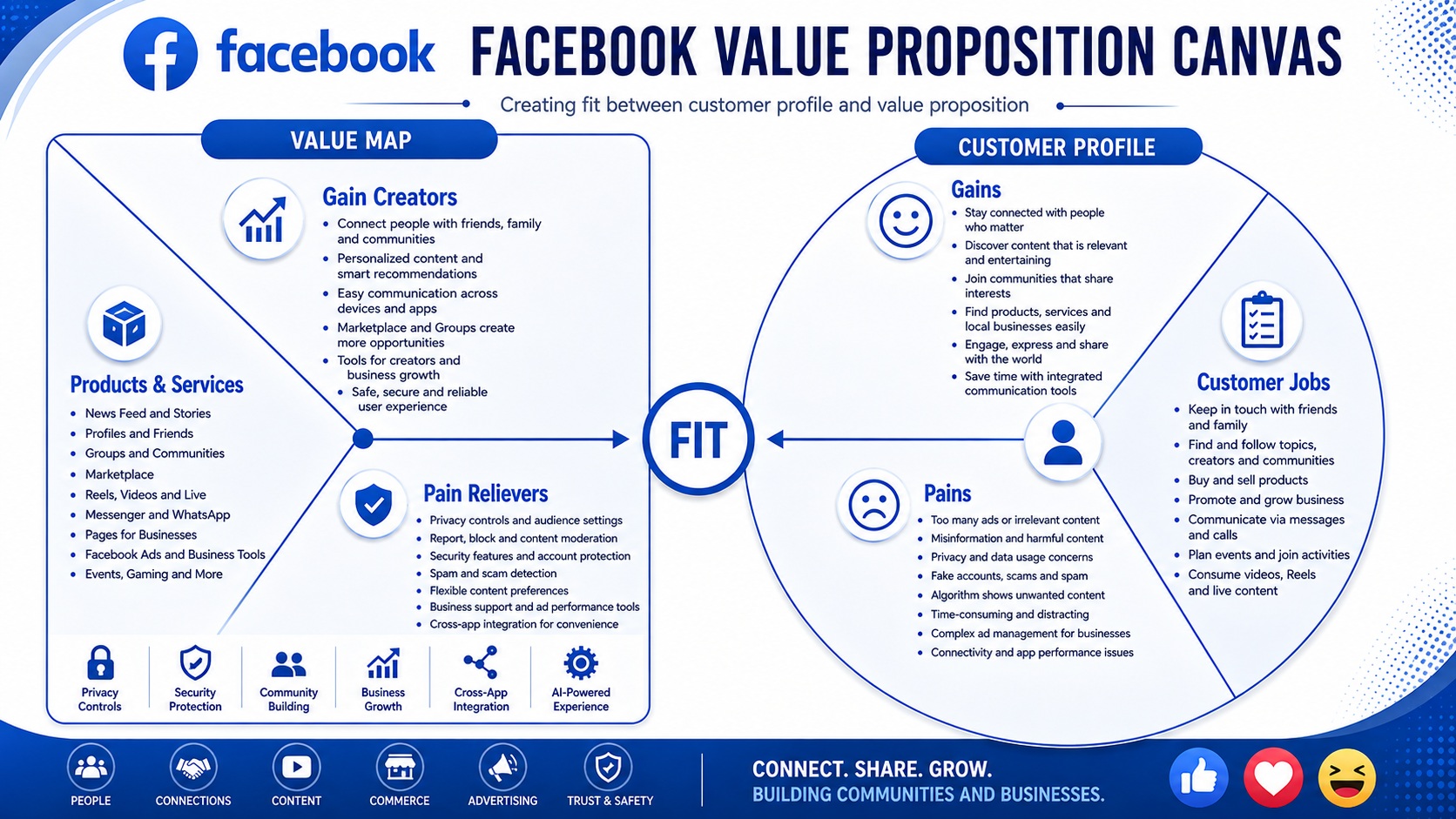
The Value Proposition Canvas provides a more detailed view of how Facebook addresses customer jobs, pains and gains.
While BMC explains the overall business system, VPC focuses more closely on the relationship between customer requirements and the platform’s products and services.
The Facebook Business Model Canvas becomes easier to understand when the primary consumer value proposition is examined separately.
The customer profile below focuses primarily on ordinary Facebook users.
Their needs extend beyond simply maintaining social connections.
Many users also want entertainment, information, local discovery, communities and convenient ways to interact with businesses.
| Customer Profile | Details |
|---|---|
| Customer Jobs | Stay connected, communicate, discover information, join communities, follow interests, watch content and discover products |
| Customer Pains | Irrelevant content, excessive advertising, scams, misinformation, privacy concerns, unwanted interactions and algorithmic overload |
| Customer Gains | Easy communication, meaningful communities, useful recommendations, entertainment, local discovery and convenient Marketplace access |
Facebook must reduce these pains without eliminating the diversity and scale that make the platform valuable.
Too little personalisation can make the experience irrelevant.
Excessive personalisation can make users feel that they have lost control.
The challenge is to create relevance while maintaining transparency and choice.
Facebook responds to user requirements with a combination of social-networking, communication, content discovery and commercial features.
| Value Map | Details |
|---|---|
| Products and Services | News Feed, Profiles, Pages, Groups, Marketplace, Reels, video, events, Messenger integrations and business tools |
| Pain Relievers | Privacy controls, moderation systems, reporting, account security, recommendation controls and spam detection |
| Gain Creators | Social connectivity, personalised discovery, large communities, creator content, local marketplaces and business access |
Facebook’s value increasingly comes from combining two different models.
The traditional social graph helps users stay connected with people and communities they already know.
Algorithmic discovery introduces them to creators, videos, Pages and content beyond those existing relationships.
This combination allows Facebook to serve both social interaction and entertainment-oriented discovery.
| Customer Profile | Details | Matching Value Map | How Facebook Creates Fit |
|---|---|---|---|
| Customer Jobs | Connect and communicate | Products and Services | Profiles, feeds, Groups and messaging enable interaction |
| Customer Pains | Irrelevant or harmful content | Pain Relievers | Moderation, controls and recommendation systems reduce unwanted experiences |
| Customer Gains | Relevant discovery and useful communities | Gain Creators | Algorithms, Groups, creators and Marketplace expand discovery |
Value fit improves when Facebook allows users to accomplish social and discovery tasks efficiently.
The fit deteriorates when users experience too many advertisements, harmful content, scams or recommendations that feel irrelevant.
Facebook must therefore continually improve recommendation quality and platform safety while preserving meaningful social interactions.
The Facebook Business Model Canvas shares several characteristics with TikTok and YouTube.
All three platforms compete for consumer attention, creators and advertising budgets.
Their underlying business models, however, are not identical.
Facebook originated around relationships and the social graph.
TikTok is more strongly built around algorithmic entertainment and interest discovery.
YouTube combines recommendation, search, long-form video, short-form video, creators and subscriptions.
These distinctions affect the BMC blocks that matter most.
| Relevant BMC Block | TikTok | YouTube | |
|---|---|---|---|
| Customer Segments | Social users, communities, businesses, advertisers and creators | Entertainment users, creators, advertisers and merchants | Viewers, creators, advertisers and subscribers |
| Value Proposition | Social connection plus community and discovery | Highly personalised entertainment discovery | Broad video library, search and creator content |
| Channels | Feed, Groups, Marketplace, Reels and Messenger | For You feed, LIVE, search and commerce | App, website, Shorts, connected TV and subscriptions |
| Revenue Streams | Primarily advertising | Advertising plus commerce-related monetisation | Advertising plus significant subscription revenue |
| Key Resources | Social graph, user network, AI and advertising technology | Recommendation engine, creator ecosystem and cultural relevance | Video catalogue, creators, search and Google infrastructure |
The most important strategic difference is that Facebook still possesses a relationship-based network effect.
TikTok does not require users to build strong social connections before receiving useful content.
YouTube is similarly valuable even if a viewer has no personal network.
Facebook should therefore avoid competing exclusively on entertainment discovery.
Its stronger strategic position comes from combining algorithmic recommendations with social relationships, communities, Groups, Marketplace and communication.
Facebook retains several competitive advantages that remain difficult for smaller platforms to reproduce.
These advantages reinforce one another.
Scale improves advertiser reach. Advertising revenue funds technology. Better technology can improve engagement. Stronger engagement attracts more advertisers.
The challenge is maintaining this reinforcing cycle as user behaviour and technology continue to change.
Despite its scale, Facebook faces significant strategic risks.
The most serious strategic threat is not necessarily a sudden loss of users.
A more damaging situation would involve gradual deterioration in engagement quality, creator activity, advertiser returns and trust simultaneously.
That combination could weaken several BMC blocks at once.
Facebook should protect the advertising model that already generates substantial economic value while reducing concentration risk and adapting to changes in digital behaviour.
The platform should avoid simply copying whichever competitor currently attracts attention.
Instead, strategy should emphasise areas where Facebook possesses distinctive structural advantages.
Facebook should invest more heavily in Groups, events, local communities, professional communities and relationship-based interaction.
These areas leverage the social graph more effectively than generic entertainment feeds.
Communities can create higher switching costs because users are not simply consuming content; they are participating in social structures that may be difficult to recreate elsewhere.
Facebook should continue improving recommendation systems without allowing discovery content to overwhelm relationship-based interaction.
Users should have clearer control over whether they want content from friends, Groups, creators or wider recommendations.
This would allow Facebook to compete with TikTok while preserving its social-network differentiation.
Advertising should remain the main revenue engine, but Facebook should continue developing complementary models.
Business messaging, creator services, subscriptions, premium tools, AI-powered business applications and commerce could gradually broaden monetisation.
Greater diversification would reduce dependence on advertising cycles and regulatory changes affecting ad targeting.
Meta should link AI spending to measurable business outcomes.
Examples include higher advertising conversion rates, better recommendations, lower moderation costs, improved customer support, stronger fraud detection and new revenue-generating services.
Large infrastructure investment should be evaluated against economic outcomes rather than technological capability alone.
Facebook should view platform integrity as part of its core value proposition.
Scams, harmful content, fake accounts and account compromise directly influence user retention and advertiser confidence.
Investment in trust and safety can therefore protect revenue rather than simply fulfil regulatory obligations.
Facebook remains particularly valuable for small and medium-sized businesses that may lack sophisticated marketing capabilities.
AI-assisted campaign creation, automated creative tools, clearer reporting and integrated messaging could make the advertising platform easier to use.
Improving SME success would strengthen one of Meta’s largest advertiser segments.
Facebook does not need to compete independently with every new platform.
Its strategic advantage may increasingly come from acting as one component within a broader Meta ecosystem.
Businesses could discover customers through Facebook, communicate through Messenger or WhatsApp, build visual engagement through Instagram and use Meta AI across these interactions.
Cross-platform integration creates capabilities that standalone competitors may find difficult to reproduce.
Overall, the Facebook Business Model Canvas explains how a simple social-networking service evolved into one of the world’s most sophisticated digital platforms.
Its core economic mechanism remains relatively straightforward.
Facebook attracts users and communities, generates content and engagement, organises that activity through algorithms and sells advertisers access to relevant audiences.
The complexity exists underneath that simple model.
AI systems determine recommendations and advertising performance.
Data centres provide the computing infrastructure required for billions of interactions.
Trust and safety systems protect platform integrity.
Advertising technology converts attention into revenue.
Creators and communities continuously supply content and engagement.
Facebook’s future success will depend less on whether it can introduce another isolated feature and more on whether all nine BMC blocks continue reinforcing one another.
Advertising revenue provides Meta with substantial financial capacity, but greater infrastructure costs, stronger competitors, changing consumer behaviour and increasing regulatory pressure mean that execution remains critical.
Facebook should therefore protect its strongest differentiators: relationships, communities, network effects, advertising technology and integration across Meta’s ecosystem.
If those strengths are combined effectively with AI-driven discovery, business messaging, short-form video and stronger platform trust, Facebook can remain strategically relevant even as the wider social-media market continues to evolve.
This article is provided solely for educational, informational and business-analysis purposes.
The content is based on publicly available company information, industry observations and strategic interpretation available at the time of writing.
Nothing in this article constitutes financial, investment, legal, regulatory, privacy, advertising, technology or professional advice.
The analysis should not be interpreted as an official statement, endorsement or representation by Meta Platforms, Inc., Facebook, ByteDance Ltd., TikTok, Alphabet Inc., Google, YouTube or any other company mentioned.
Business models, financial performance, technologies, regulations, products and market conditions may change over time.
Readers should conduct independent research and seek appropriate professional advice before making investment, business or strategic decisions.
All trademarks, logos, copyrights, company names, product names and other intellectual-property rights belong to their respective owners.
Explore the Facebook Business Model Canvas, including all nine BMC blocks, Value Proposition Canvas, TikTok and YouTube comparison, competitive advantages, risks, failure scenarios and strategic recommendations updated for 2026.
Explore the FedEx Business Model Canvas, nine BMC blocks, Value Proposition Canvas, UPS and DHL… Read More
Explore the Quipper Business Model Canvas, nine BMC blocks, Value Proposition Canvas, Ruangguru and Pahamify… Read More
Explore the CARPUT Business Model Canvas, nine BMC blocks, Value Proposition Canvas, competitor comparison, competitive… Read More
Explore the Boost Business Model Canvas, nine BMC blocks, Value Proposition Canvas, competitor comparison, advantages,… Read More
Explore the Domino's Pizza Business Model Canvas, nine BMC blocks, Value Proposition Canvas, Pizza Hut… Read More
Explore the Mie Gacoan Business Model Canvas, including its customer segments, value propositions, revenue streams,… Read More