



Share This Article


Cleanpro Business Model Canvas: How Cleanpro Builds a Self-Service Laundry, Franchise, and Equipment Business
BMC Article No: BMC #030
Updated in 2026: This article has been comprehensively revised to reflect Cleanpro’s broader business model beyond operating self-service laundromats. The update covers Cleanpro Express, Cleanpro Ibu Sayang, franchise development, commercial laundry equipment, technical services, cashless payments through Cleanpro Plus, and outlet management through Cleanpro Link.
The 2026 revision also includes deeper analysis of all nine Business Model Canvas blocks, expanded strategic explanations, a Value Proposition Canvas, comparison with LaundryBar and myDobi, competitive advantages, risks and challenges, potential business failure scenarios, and strategic recommendations.
Introduction
Laundry may appear to be a simple business. Customers bring their clothes, use a washing machine, transfer their laundry to a dryer, and pay for the service.
Behind this seemingly straightforward activity, however, lies a business model involving capital investment, equipment reliability, location economics, customer convenience, franchise relationships, technology, and recurring consumer demand.
Cleanpro has developed its position in Malaysia’s laundry industry by combining self-service laundry outlets with franchise solutions, commercial laundry equipment, consumables, and technical support.
Rather than relying entirely on traditional attended laundry operations, its model emphasises automated machines, standardised outlet configurations, and operational systems that reduce the need for continuous on-site staffing.
The Cleanpro Business Model Canvas is particularly interesting because the business serves two interconnected markets.
The first consists of consumers who need accessible and reliable washing and drying facilities. The second comprises entrepreneurs, franchisees, and commercial customers seeking equipment, business systems, and support to operate laundry businesses.
Cleanpro therefore creates value through both everyday laundry transactions and the infrastructure required to establish and maintain laundry operations.
This distinction matters strategically.
A consumer sees a convenient place to wash clothes. An outlet investor sees a business opportunity supported by established machinery, operating systems, technical expertise, and brand recognition.
Understanding both perspectives reveals why Cleanpro should be analysed as a laundry solutions ecosystem rather than merely a chain of laundromats.
Latest Developments: What Is Changing Around Cleanpro?
Malaysia’s self-service laundry industry is evolving as consumers increasingly expect convenient payments, reliable equipment, consistent washing performance, and accessible neighbourhood locations.
Digitalisation is becoming more important to outlet operations. Cleanpro Plus provides a web-based cashless payment experience using QR codes, while Cleanpro Link gives business owners access to machine usage and revenue information.
These capabilities can potentially improve operating visibility, customer convenience, and revenue management.
Cleanpro also offers two distinct franchise concepts. Cleanpro Express targets the premium self-service laundry segment, while Cleanpro Ibu Sayang focuses on a more affordable proposition.
Beyond franchising, the company provides commercial laundry equipment, detergent solutions, maintenance, and support for businesses establishing their own laundry operations.
The Cleanpro Business Model Canvas must therefore account for several developments in 2026:
Customers increasingly value convenience, speed, and digital payment options. Outlet owners require better financial visibility, technical support, and equipment uptime. Rising utilities, rental costs, and competition also increase the importance of site selection and operational efficiency.
These changes make business-model execution, rather than outlet expansion alone, critical to sustainable growth.
Cleanpro Business Model Canvas Summary
Before examining each BMC component in detail, the Cleanpro Business Model Canvas can be summarised as an integrated laundry business that connects consumers, outlet investors, commercial equipment, technology, and technical support.
| BMC Block | Cleanpro Application |
|---|---|
| Customer Segments | Laundry consumers, franchise investors, independent laundry operators, commercial customers |
| Value Propositions | Convenient laundry, reliable machinery, franchise systems, digital payments, technical support |
| Channels | Laundry outlets, website, franchise consultants, digital marketing, business sales |
| Customer Relationships | Self-service experience, loyalty rewards, franchise support, technical assistance |
| Revenue Streams | Laundry transaction fees at outlets, franchise-related sales, equipment, consumables, support services |
| Key Resources | Brand, laundry equipment, technical expertise, operating systems, technology, franchise network |
| Key Activities | Franchise development, equipment installation, maintenance, marketing, customer experience |
| Key Partnerships | Equipment manufacturers, franchisees, suppliers, technology providers, property stakeholders |
| Cost Structure | Machinery, outlet setup, utilities, maintenance, rental, logistics, marketing, technical support |
Revenue sources depend on the relevant legal entity and outlet ownership structure. This table describes the commercial ecosystem rather than a verified consolidated revenue breakdown.
Cleanpro BMC Diagram
A Cleanpro BMC diagram should illustrate the nine components as one integrated operating system.
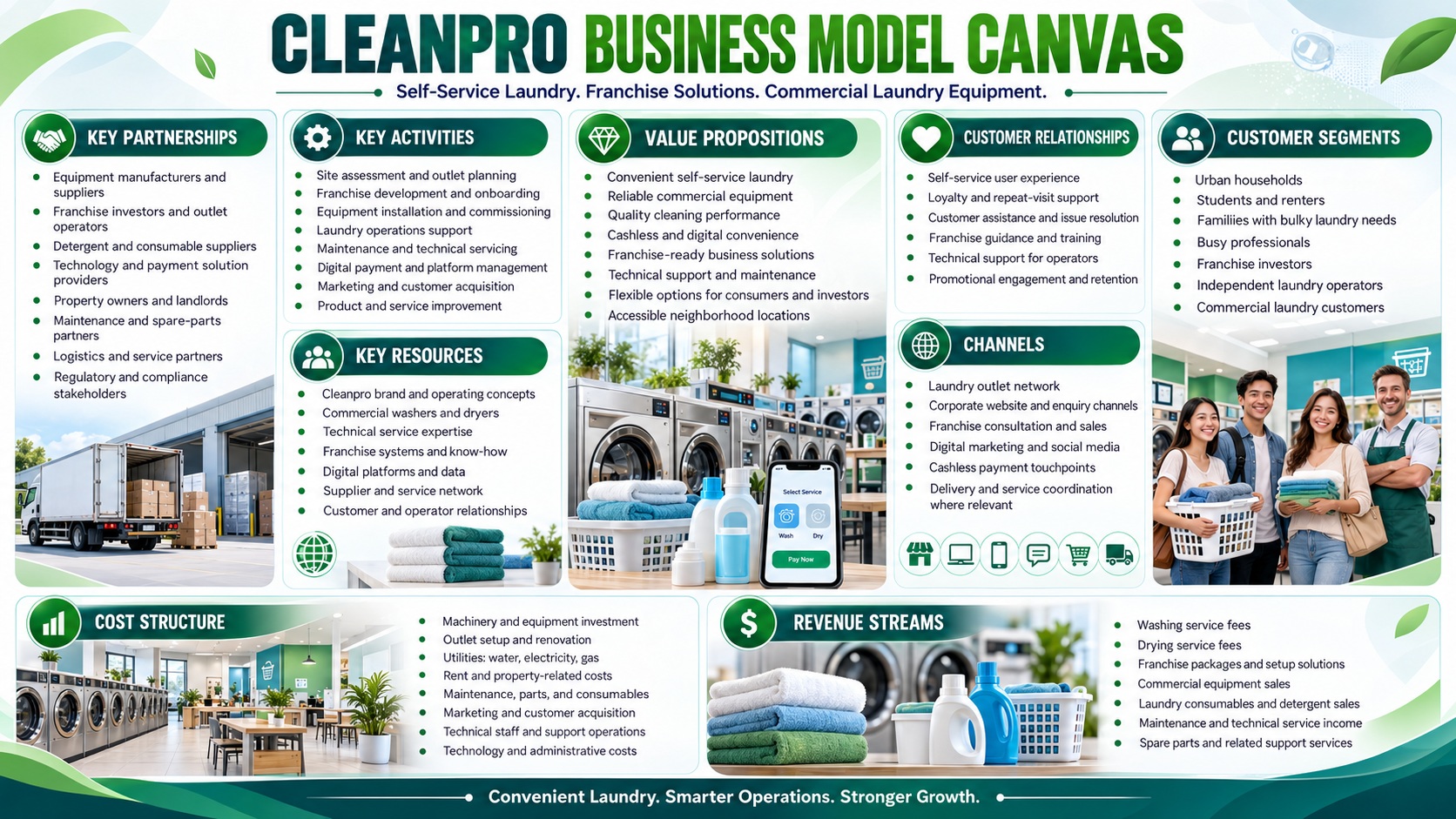
The central relationship connects laundry consumers, outlet operators, equipment, and the Cleanpro support ecosystem.
Consumers create demand for washing and drying services. Franchise investors provide capital to establish outlets, while machinery and supporting systems enable the service to be delivered.
Technology supports payments and operating visibility. Technical services maintain equipment availability, while consumables and maintenance sustain daily operations.
Revenue generated across these activities supports continued service delivery, equipment investment, technology development, and business expansion.
BMC Analysis of Cleanpro
The detailed Cleanpro Business Model Canvas demonstrates how a seemingly simple consumer service can support a more complex commercial ecosystem.
Laundry transactions produce recurring consumer demand, but outlet economics depend heavily on equipment utilisation, location quality, and maintenance performance.
Franchise development expands the physical network without necessarily requiring Cleanpro to finance every outlet directly. Commercial equipment and technical support create additional relationships with laundry operators.
These elements reinforce one another.
A larger installed equipment base can create greater demand for maintenance, spare parts, and consumables. Improved equipment performance strengthens the consumer experience and increases confidence among potential investors.
However, this model also creates interdependencies.
Poor outlet performance can weaken franchise demand. Frequent machinery breakdowns can undermine customer confidence, while excessive expansion in saturated areas can reduce utilisation across nearby outlets.
The following nine BMC blocks explain how Cleanpro creates, delivers, and captures value.
1. Customer Segments
Cleanpro serves several customer groups with different requirements, purchasing behaviours, and economic contributions.
Individual laundry users form the consumer-facing foundation. They include apartment residents, students, working professionals, and households seeking a practical alternative to washing and drying clothes at home.
Some customers may lack suitable washing facilities. Others may have machines at home but require larger-capacity equipment for blankets, curtains, or accumulated laundry.
Franchise investors represent a different market. These customers seek established business systems, dependable equipment, and professional support rather than simply laundry services.
Commercial operators form another segment by purchasing laundry machinery, consumables, or technical solutions.
Cleanpro Customer Segments
| Segment | Details | Why It Matters |
|---|---|---|
| Urban households | Residents seeking convenient washing and drying | Creates recurring local demand |
| Students and renters | Customers with limited laundry facilities | Supports location-specific usage |
| Families | Households needing larger-capacity machines | Increases potential transaction value |
| Franchise investors | Entrepreneurs establishing branded laundromats | Supports network expansion |
| Commercial operators | Businesses purchasing laundry equipment and services | Diversifies commercial opportunities |
Analysis
Cleanpro’s customer portfolio creates two distinct economic engines.
Consumer demand determines whether individual outlets attract sufficient machine usage. Investor and commercial demand influence equipment sales, franchise development, and related services.
These groups require different marketing approaches.
Consumers evaluate convenience, pricing, cleanliness, and accessibility. Investors consider capital expenditure, location feasibility, cash flow, machine reliability, and potential returns.
The strategic challenge is maintaining alignment between them.
Expanding the franchise network without sufficient consumer demand could create underperforming outlets, weakening investor confidence and long-term brand reputation.
Sustainable growth therefore requires Cleanpro to prioritise outlet viability and customer density rather than maximising outlet numbers alone.
2. Value Propositions
Cleanpro delivers different forms of value to laundry consumers, franchise investors, and commercial customers.
For consumers, its central proposition is convenient access to commercial washing and drying equipment without requiring personal ownership.
Modern machinery provides the capacity to handle different laundry loads, while selected offerings incorporate enhanced detergents and water-treatment technology.
Cashless payment through Cleanpro Plus reduces dependence on coins or tokens.
Franchise investors receive a more comprehensive proposition involving established branding, equipment packages, site assessment, training, marketing support, and technical assistance.
Commercial customers can obtain machinery and support without necessarily joining a franchise.
Cleanpro Value Propositions
| Value Proposition | Details | Why It Matters |
|---|---|---|
| Convenient self-service | Accessible washing and drying facilities | Saves customers time and effort |
| Reliable equipment | Commercial machines designed for repeated usage | Supports service consistency |
| Cleaning performance | Detergent formulations and selected LaundroBoost technology | Enhances perceived washing quality |
| Franchise solutions | Brand, setup, guidance, and support | Reduces startup complexity |
| Digital convenience | Cashless payment and outlet management systems | Improves user and operator experience |
Analysis
Convenience alone is insufficient for lasting differentiation because competing laundromats can provide similar basic services.
Cleanpro’s stronger opportunity lies in combining reliable equipment, consistent cleaning performance, convenient payment, and professional operator support.
These benefits reinforce one another.
Customers are more likely to return when machines work properly, clothes are cleaned effectively, and payment is uncomplicated.
Meanwhile, franchise investors gain confidence when technical systems reduce downtime and improve operating visibility.
The company must nevertheless substantiate its value proposition through actual outlet performance.
Superior machinery does not guarantee strong returns if location demand is weak, utility consumption is excessive, or customers perceive little difference from cheaper competitors.
Long-term differentiation depends on translating technical capabilities into measurable customer satisfaction and sustainable outlet economics.
3. Channels
Cleanpro uses physical, digital, and direct business channels to reach different customer groups.
Self-service outlets are the principal service-delivery channel for everyday laundry customers. Their locations and physical accessibility directly influence convenience and repeat visits.
The corporate website provides information about franchise opportunities, equipment, business solutions, and outlet locations.
Digital marketing supports brand awareness and customer acquisition, while consultation and sales activities connect the company with potential investors.
Cleanpro Plus adds a digital transaction interface to the physical laundry experience.
Cleanpro Channels
| Channel | Details | Why It Matters |
|---|---|---|
| Laundry outlets | Physical washing and drying locations | Delivers the core consumer service |
| Corporate website | Outlet information, franchise and business solutions | Supports discovery and enquiries |
| Franchise consultation | Investor engagement and feasibility discussions | Converts investment interest |
| Digital marketing | Online campaigns and promotional communication | Builds brand visibility |
| Cleanpro Plus | Web-based QR payment and loyalty access | Improves transaction convenience |
Analysis
Unlike purely digital businesses, Cleanpro must maintain an effective connection between online discovery and physical service delivery.
Customers may discover an outlet through a search engine or map, but satisfaction depends on actual machine availability, cleanliness, safety, and accessibility.
Investor acquisition operates differently.
Potential franchisees require detailed consultation, capital estimates, location analysis, and commercial reassurance before committing funds.
The Cleanpro Business Model Canvas therefore involves two customer journeys: a short consumer transaction journey and a longer business investment decision.
Digital channels can improve both journeys, but their functions differ.
Consumers benefit from accessible outlet information and convenient payments. Investors require credible operating information and transparent business assumptions.
Strengthening local search visibility, outlet-level information, and investor conversion processes can improve channel effectiveness without relying exclusively on more advertising expenditure.
4. Customer Relationships
Customer relationships in self-service laundry businesses differ from those in traditional labour-intensive service operations.
Most consumers interact directly with machines rather than employees. Consequently, machine functionality, operating instructions, cleanliness, and payment reliability become central parts of the customer relationship.
Cleanpro Plus introduces loyalty rewards, promotional vouchers, and digital customer engagement.
Franchisees require more extensive support throughout business setup and operations.
Their relationships may involve consultancy, training, marketing assistance, machinery support, and technical troubleshooting.
Cleanpro Customer Relationships
| Relationship Type | Details | Why It Matters |
|---|---|---|
| Self-service experience | Customers independently use laundry machines | Supports convenient operations |
| Digital loyalty | Cleanpro Plus rewards and vouchers | Encourages repeat usage |
| Customer assistance | Support for service or payment issues | Protects customer satisfaction |
| Franchise consultancy | Guidance during outlet development | Builds investor confidence |
| Technical support | Maintenance and troubleshooting assistance | Sustains operator relationships |
Analysis
Customer retention in laundromats is driven more by consistent execution than by frequent personal interaction.
An outlet that is clean, dependable, and convenient may build customer loyalty even with minimal on-site staffing.
Conversely, unresolved machine failures, unsuccessful payments, or poor cleanliness can quickly drive customers toward nearby alternatives.
Digital loyalty systems provide opportunities to strengthen repeat usage, but promotional discounts must be managed carefully.
Franchise relationships have even greater long-term implications.
Investors may remain associated with the brand for years, making service responsiveness, transparent communication, and equipment reliability important drivers of trust.
Cleanpro should therefore treat customer experience and franchisee satisfaction as related strategic priorities.
Strong consumer retention supports outlet profitability, while successful operators reinforce brand credibility and future network expansion.
5. Revenue Streams
Cleanpro’s commercial model involves several potential sources of revenue across consumer laundry operations, franchise development, equipment supply, and related services.
At outlet level, washing and drying usage generates transaction-based revenue.
For the wider Cleanpro business ecosystem, machinery packages and outlet setup can create substantial business-to-business commercial activity.
Equipment supply and consumables provide additional opportunities beyond branded franchise development.
Maintenance, parts, and technical support may also contribute commercially depending on service agreements and contractual arrangements.
Cleanpro Revenue Streams
| Revenue Stream | Details | Why It Matters |
|---|---|---|
| Washing and drying fees | Customer payments at laundry outlets | Generates recurring outlet-level sales |
| Franchise and setup packages | Equipment and related outlet-development offerings | Supports network development |
| Commercial machinery | Sales of washers, dryers, and related equipment | Serves broader business markets |
| Laundry consumables | Detergent and softener supply | Creates recurring purchasing demand |
| Technical services | Maintenance, parts, and support where chargeable | Supports equipment lifecycle economics |
Analysis
The distinction between outlet revenue and corporate revenue is essential.
A franchisee-operated laundromat may generate substantial washing and drying income without that entire transaction value becoming revenue for the franchisor.
Similarly, gross equipment sales must not be confused with net profit.
The Cleanpro Business Model Canvas illustrates the possibility of combining transaction-driven demand with business-to-business commercial activity.
This diversification can reduce reliance on any single customer group, although individual revenue categories have different margins, cash conversion cycles, and capital requirements.
Equipment sales may generate larger but less frequent transactions, while consumables can produce repeat purchasing.
Outlet revenues are recurring but highly dependent on machine utilisation.
The long-term opportunity is to strengthen recurring commercial relationships after installation rather than treating every franchise or equipment sale as a one-off transaction.
Actual revenue composition cannot be determined without verified financial disclosures.
6. Key Resources
Cleanpro’s business requires more than physical washing machines.
Its strategic resources include brand recognition, equipment access, technical expertise, installation capabilities, digital systems, and established operating knowledge.
Commercial laundry machines remain fundamental because service delivery depends directly on equipment availability and performance.
Location assessment capabilities are also important, particularly when supporting franchise investments.
Cleanpro Plus and Cleanpro Link add technology resources that support customer transactions and outlet visibility.
Cleanpro Key Resources
| Key Resource | Details | Why It Matters |
|---|---|---|
| Brand and franchise systems | Established concepts and operating knowledge | Supports market credibility |
| Laundry machinery | Commercial washers, dryers, and supporting systems | Enables core service delivery |
| Technical expertise | Installation, repairs, and equipment maintenance | Protects reliability |
| Digital platforms | Cleanpro Plus and Cleanpro Link | Supports payments and management |
| Supplier relationships | Access to machinery, parts, and consumables | Supports scalability |
Analysis
Not all resources contribute equally to competitive advantage.
Machines can be purchased by competitors, while outlets can be opened in similar neighbourhoods.
More difficult to reproduce is a combination of technical expertise, reliable supplier relationships, site-selection knowledge, and a functioning support network.
These resources become particularly valuable as the installed equipment base expands.
An experienced technical organisation can potentially identify recurring faults, standardise maintenance practices, and improve equipment deployment decisions.
Digital systems offer a further opportunity.
Usage information may help outlet owners identify peak periods, monitor machine performance, and understand transaction patterns.
However, operational data becomes strategically valuable only when it is accurate, secure, and converted into better decisions.
Cleanpro’s resource advantage therefore depends less on the quantity of machines deployed than on the operational capabilities supporting those machines throughout their economic life.
7. Key Activities
Cleanpro performs activities across franchise development, laundry equipment supply, technical support, and brand management.
Outlet planning is particularly important because local demand, competition, accessibility, and rental costs influence commercial viability.
Equipment installation involves coordination of machinery, plumbing, electrical systems, ventilation, and other supporting infrastructure.
Technical teams must maintain machine functionality and resolve operational problems.
Marketing activities attract consumers and prospective franchise investors, while technology services support payments and business monitoring.
Cleanpro Key Activities
| Key Activity | Details | Why It Matters |
|---|---|---|
| Site assessment | Evaluate locations and commercial feasibility | Reduces investment risk |
| Franchise development | Consultation, planning, setup, and training | Supports network expansion |
| Equipment installation | Configure and commission laundry systems | Enables operational readiness |
| Technical maintenance | Repair, troubleshoot, and support equipment | Reduces downtime |
| Marketing and technology | Promote outlets and maintain digital capabilities | Supports demand and efficiency |
Analysis
The most important activities are not necessarily those that generate immediate sales.
Equipment maintenance, site screening, and technical support may appear operational, yet they influence the long-term profitability of the entire business network.
Poor site selection can create persistent financial pressure regardless of equipment quality.
Similarly, inadequate maintenance increases downtime, reduces machine availability, and damages customer confidence.
The Cleanpro Business Model Canvas highlights the importance of maintaining performance after an outlet opens.
Franchise expansion creates initial commercial opportunities, but ongoing support determines whether the network remains healthy.
Technology can improve execution through better operating information, provided owners and support teams use it consistently.
Cleanpro should therefore measure not only new outlet development but also existing outlet performance, equipment availability, customer retention, and franchisee satisfaction.
These indicators offer a more complete view of business quality than expansion figures alone.
8. Key Partnerships
Cleanpro depends on a network of commercial and operational partners.
Laundry equipment manufacturers and suppliers provide the machinery required for consumer and business operations.
Its franchise model also relies on entrepreneurs who finance and operate outlets under established business concepts.
Other important relationships involve detergent suppliers, spare-part providers, payment technology partners, and property stakeholders.
The strength of these partnerships influences equipment availability, installation quality, operating costs, and customer experience.
Cleanpro Key Partnerships
| Key Partner | Details | Why It Matters |
|---|---|---|
| Equipment manufacturers | Suppliers including Dexter, LG, and Fagor across relevant offerings | Supports machinery quality |
| Franchise investors | Entrepreneurs developing branded outlets | Provides expansion capacity |
| Consumable suppliers | Detergents, softeners, and related materials | Supports daily operations |
| Technology providers | Payment and supporting digital infrastructure | Enables digital transactions |
| Property stakeholders | Landlords and location-related partners | Supports outlet accessibility |
Analysis
Partnerships allow Cleanpro to provide a broader solution than it could efficiently develop alone.
Established machinery manufacturers contribute engineering expertise and product availability, while local technical capabilities support installation and after-sales service.
Franchise investors extend the outlet network by contributing capital and entrepreneurial effort.
However, partnership dependence introduces operational vulnerabilities.
Equipment supply disruptions, parts shortages, unfavorable property terms, or inconsistent operator standards can affect outlet performance.
The strategic objective is therefore not simply to increase the number of partners.
Cleanpro should prioritise reliability, commercial alignment, service responsiveness, and long-term performance.
Strong supplier relationships can support better maintenance and equipment lifecycle management, while productive franchise relationships can improve brand consistency.
A resilient partnership ecosystem reduces execution risk and strengthens the credibility of Cleanpro’s overall business proposition.
9. Cost Structure
Cleanpro’s cost structure combines capital-intensive equipment requirements with recurring operating and support expenses.
At outlet level, major investments include washers, dryers, installation, renovation, utility infrastructure, and related equipment.
Recurring expenses include rent, electricity, water, gas where applicable, detergent, maintenance, payment processing, and cleaning.
For the wider business organisation, technical personnel, inventory, logistics, marketing, digital systems, and administrative support create additional costs.
Cleanpro Cost Structure
| Cost Category | Details | Why It Matters |
|---|---|---|
| Machinery investment | Commercial washers, dryers, and supporting equipment | Creates significant initial capital requirements |
| Outlet setup | Renovation, plumbing, electrical and supporting works | Determines startup expenditure |
| Utilities and rent | Electricity, water, gas, and premises costs | Affects recurring outlet margins |
| Maintenance and consumables | Repairs, parts, detergent, and softener | Influences operating efficiency |
| Corporate support | Technical teams, marketing, logistics, and technology | Sustains the business ecosystem |
Analysis
Self-service laundry operations can reduce direct staffing requirements, but they are not cost-free automated businesses.
Machinery, premises, utilities, repairs, and financing commitments can create substantial fixed and variable expenses.
The central economic challenge is generating sufficient machine usage to recover these costs.
High-capacity equipment may improve revenue potential, yet expensive machines deliver poor returns when utilisation remains low.
Similarly, a premium location may attract more customers but fail commercially if rental costs exceed the value of additional demand.
Cost discipline should therefore focus on lifecycle economics rather than equipment purchase prices alone.
Reliable machines may justify higher upfront investment if they reduce breakdowns, improve efficiency, and remain productive for longer.
Cleanpro’s long-term economics depend on balancing capital expenditure, outlet utilisation, utility efficiency, maintenance performance, and ongoing support costs.
A profitable model requires consistent operating returns, not merely an attractive initial revenue projection.
How the Nine BMC Blocks Work Together
The nine components become more meaningful when Cleanpro is viewed as an integrated commercial system.
Customer segments determine where demand originates. Consumers require laundry services, while investors and commercial operators require equipment, operating systems, and technical expertise.
Value propositions address those requirements through convenience, machinery reliability, franchise support, and digital capabilities.
Channels connect customers with outlets and prospective investors with business solutions.
Customer relationships encourage repeat laundry visits and sustain longer-term franchise partnerships.
Revenue opportunities arise through outlet transactions and relevant business-to-business activities.
Key resources, activities, and partnerships provide the machinery, operating capabilities, and commercial network necessary to deliver those services.
Finally, the cost structure determines whether the system generates attractive returns.
These components reinforce one another when managed effectively.
Better machine performance can improve customer satisfaction. Higher utilisation can strengthen outlet economics. Successful franchisees can support stronger brand credibility and future investor interest.
Problems can also spread across several blocks simultaneously.
Poor site selection reduces demand, weak revenue weakens operator finances, delayed maintenance damages service quality, and declining investor confidence constrains expansion.
The business therefore succeeds when outlet economics, customer value, and network support remain aligned.
Cleanpro Value Proposition Canvas
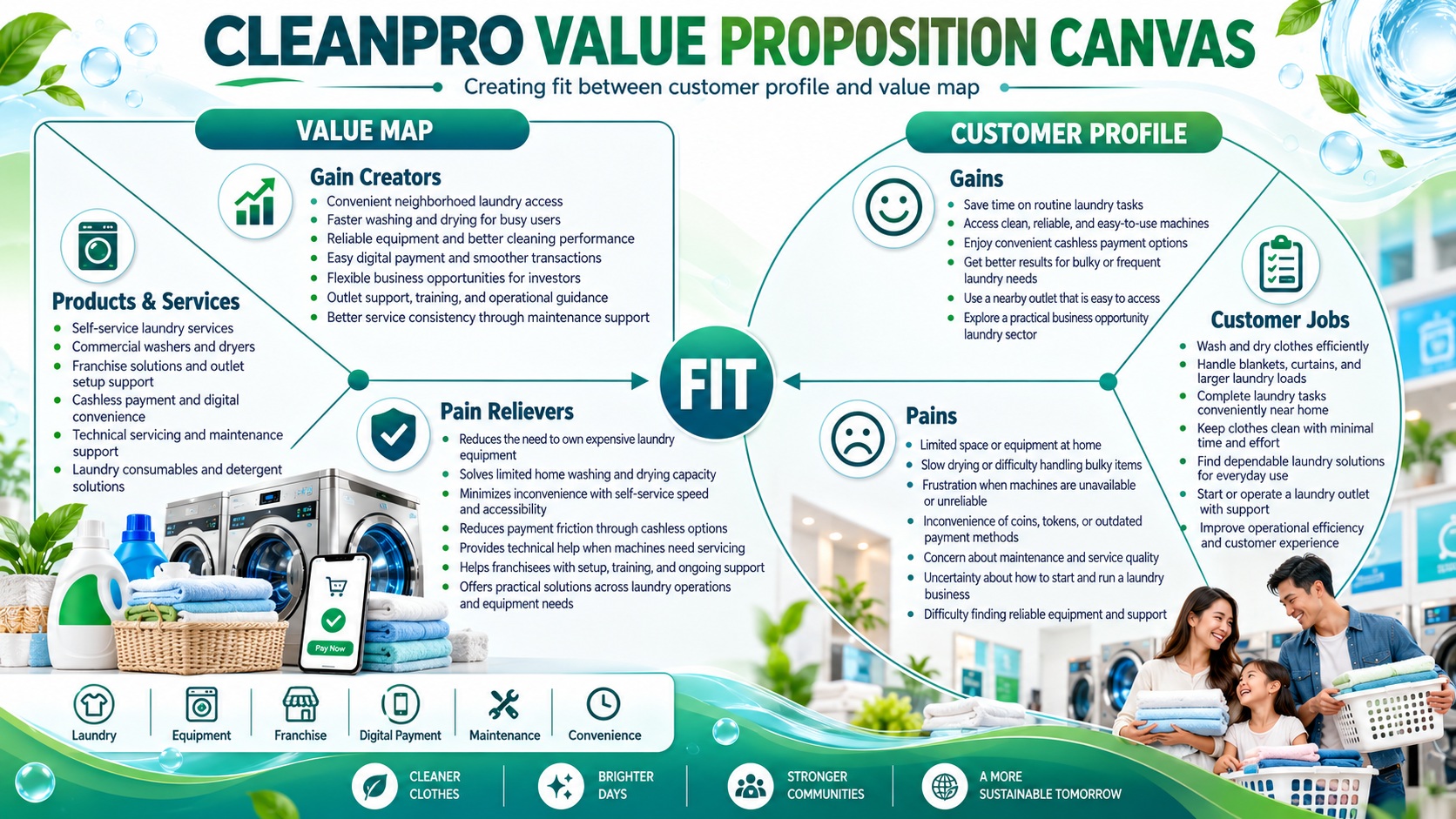
The Value Proposition Canvas (VPC) provides a more detailed understanding of how Cleanpro addresses customer needs and translates operational capabilities into practical benefits.
While the Business Model Canvas examines the overall commercial system, the VPC focuses on the relationship between customer jobs, pains, gains, and the solutions offered.
The Cleanpro Business Model Canvas becomes particularly useful when its consumer-facing value proposition is examined alongside the distinct requirements of franchise investors.
Customer Profile
The customer profile below focuses primarily on everyday self-service laundry users.
Customers are not simply purchasing access to washing machines. They are looking for clean clothes, convenient service, efficient drying, and a reliable solution that fits their daily routines.
Customer Profile of Cleanpro
| Customer Profile | Details |
|---|---|
| Customer Jobs | Wash clothes, dry laundry, handle bulky items, maintain hygiene, manage household laundry efficiently |
| Customer Pains | Limited space, slow home drying, machine breakdowns, inconvenient payments, expensive services, long waiting times |
| Customer Gains | Faster laundry completion, convenient locations, reliable machines, effective cleaning, affordable service, flexible usage |
Customer priorities vary across different segments.
Apartment residents may value access to larger machines, while students often prioritise affordability and convenience. Families may focus on washing capacity, drying efficiency, and reliable cleaning performance.
These differences influence how customers evaluate outlet value.
Price-sensitive users may select the cheapest convenient option, whereas customers handling large or delicate loads may place greater emphasis on equipment quality.
Cleanpro must therefore balance accessibility, perceived affordability, performance, and service consistency to maintain strong customer satisfaction.
Value Map
Cleanpro addresses customer requirements through its physical laundry infrastructure, machinery, cleaning solutions, and supporting digital services.
The company’s value map combines the basic function of washing and drying with additional benefits that improve service convenience and reliability.
Value Map of Cleanpro
| Value Map | Details |
|---|---|
| Products and Services | Self-service laundry facilities, commercial washers, dryers, selected cleaning technologies, Cleanpro Plus |
| Pain Relievers | Large-capacity machines, efficient wash-and-dry processes, cashless payments, technical maintenance support |
| Gain Creators | Convenient service, reliable washing performance, digital rewards, flexible laundry access, improved cleaning experience |
Value creation begins with the physical service.
Commercial machines allow customers to wash and dry clothing without purchasing or maintaining equivalent equipment at home.
Additional technologies may improve the experience by making payment simpler and cleaning more consistent.
Cleanpro Plus also enables loyalty rewards and promotional incentives.
Nevertheless, the effectiveness of these benefits depends on daily execution.
A digital payment system creates little value when machines are unavailable. Premium detergents cannot compensate for poor outlet cleanliness or inconvenient access.
A strong value proposition therefore requires every element of the service experience to work together.
How Cleanpro Creates Fit
The relationship between customer requirements and Cleanpro’s offerings can be illustrated through the following value-fit analysis.
| Customer Profile | Customer Need | Matching Value Map | How Cleanpro Creates Fit |
|---|---|---|---|
| Customer Jobs | Complete washing and drying efficiently | Products and Services | Commercial equipment enables convenient laundry completion |
| Customer Pains | Limited capacity, inconvenience, machine problems | Pain Relievers | Larger machines, cashless payment, and technical support reduce friction |
| Customer Gains | Reliability, speed, convenience, and value | Gain Creators | Equipment performance, selected cleaning technologies, and rewards improve the experience |
Value fit becomes stronger when customers can complete their laundry with minimal inconvenience.
The service must perform consistently across the entire customer journey, from finding an outlet and making payment to washing, drying, and leaving with clean clothes.
Convenience attracts customers, but reliable execution encourages repeat visits.
For franchisees, value fit requires an additional layer involving site feasibility, capital efficiency, technical support, and sustainable operating returns.
Cleanpro’s broader strategic challenge is satisfying both groups without compromising either consumer value or investor economics.
Cleanpro vs LaundryBar vs myDobi Business Models
The Malaysian self-service laundry market includes several established business operators offering different approaches to outlet ownership, equipment supply, and operational support.
Three relevant companies are Cleanpro, LaundryBar, and myDobi.
All three participate in the broader self-service laundry industry, but their commercial models are not identical.
Cleanpro combines branded franchise solutions with commercial equipment, technology, consumables, and technical support.
LaundryBar emphasises self-service laundry franchising, technology, machinery, and its wider outlet network.
myDobi differentiates its investor proposition through a licensing model rather than a conventional franchise arrangement, according to its own published information.
These distinctions affect the BMC blocks most relevant to competition.
BMC Block Comparison
| Relevant BMC Block | Cleanpro | LaundryBar | myDobi |
|---|---|---|---|
| Customer Segments | Laundry users, franchisees, commercial laundry operators | Laundry users and franchise investors | Laundry users, licensed outlet investors |
| Value Propositions | Laundry convenience, equipment reliability, franchise support, technical solutions | Self-service convenience, technology, franchise network | Outlet ownership under a licensing structure with business support |
| Channels | Branded outlets, corporate website, franchise consultancy, B2B equipment sales | Laundry outlets, website, franchise development channels | Licensed outlets, website, direct investor consultation |
| Customer Relationships | Cashless loyalty, technical support, franchise assistance | Customer service, payment technology, franchise support | Operator support, licensing relationships, site-selection assistance |
| Revenue Streams | Outlet-level laundry transactions, equipment and franchise-related sales, commercial solutions | Outlet-level transactions and franchise-related commercial activity | Outlet transactions and licensing-related business activities |
| Key Resources | Brand concepts, machinery, technical capabilities, Cleanpro Plus, Cleanpro Link | Brand network, machinery relationships, franchise systems, payment technology | Licensing system, operational experience, machinery network, location expertise |
This comparison reflects publicly described business models rather than independently audited financial structures.
The most important strategic distinction involves how each company supports business ownership and operational execution.
Cleanpro’s broader equipment and service portfolio allows it to engage both branded franchisees and independent commercial operators.
LaundryBar offers a competing branded franchise ecosystem supported by a substantial regional presence.
myDobi positions its licensing approach around outlet ownership and the absence of ongoing royalties or revenue-sharing charges under its published model.
For investors, these differences can affect contractual obligations, upfront investment, ongoing costs, operating freedom, and available support.
For consumers, however, ownership arrangements may be less visible.
Their decisions are usually influenced by location, cleanliness, price, machine availability, and service quality.
Cleanpro should therefore compete on two levels: delivering an attractive consumer laundry experience while providing a commercially credible and dependable business solution for investors.
Competitive Advantages
Cleanpro possesses several potential competitive strengths that support its positioning in Malaysia’s laundry industry.
The most important advantages extend beyond the availability of washing machines.
- Integrated laundry solutions: Cleanpro combines franchising, commercial machinery, consumables, technical support, and digital services. This broadens its customer relationships beyond individual laundry transactions.
- Established equipment partnerships: Access to recognised commercial machinery brands supports its reliability proposition and gives franchise investors established equipment options.
- Multiple franchise concepts: Cleanpro Express and Cleanpro Ibu Sayang allow the business to address different investment propositions and consumer expectations.
- Digital operating capabilities: Cleanpro Plus and Cleanpro Link support convenient transactions, loyalty programmes, and better outlet-level operating visibility.
- Technical and after-sales expertise: Installation, troubleshooting, maintenance, and machinery support can strengthen equipment uptime and long-term operator confidence.
These advantages can reinforce one another when properly managed.
Reliable equipment supports stronger customer experiences, while effective maintenance improves operating continuity.
Digital systems can provide greater convenience and useful performance information.
Established franchise concepts also reduce the need for investors to develop every operating process independently.
However, none of these strengths guarantees permanent competitive superiority.
Competitors can acquire similar machines, introduce cashless payments, and develop franchise support systems.
Cleanpro must continuously convert its capabilities into measurable improvements in outlet profitability, customer satisfaction, and business-owner confidence.
Its strongest advantage may ultimately come from executing the entire laundry operating system more consistently than competing providers.
Risks and Challenges
Despite the recurring nature of laundry demand, Cleanpro operates in a competitive and capital-intensive industry.
Several strategic risks could affect outlet performance and the attractiveness of its wider business model.
- Intense market competition: Competing laundromats may offer similar equipment, convenience, and promotional pricing, reducing differentiation and putting pressure on revenue.
- High capital expenditure: Machinery, renovation, installation, and outlet infrastructure require substantial upfront investment, increasing financial exposure when utilisation is weak.
- Rising operating costs: Electricity, water, gas, rental, maintenance, and consumable expenses may reduce margins if prices cannot be adjusted accordingly.
- Equipment reliability and technology dependence: Machine breakdowns, technical delays, payment failures, or digital-system interruptions can disrupt operations and weaken customer confidence.
- Franchise performance and reputation: Poor site selection, inconsistent outlet standards, or underperforming franchisees can damage the brand and reduce interest from prospective investors.
These risks are interconnected.
A poorly selected outlet may experience low machine utilisation, making it more difficult to cover fixed expenses.
Financial pressure could lead an operator to defer maintenance, reducing service reliability and further weakening customer demand.
Greater local competition can intensify the problem through price discounting.
The most serious risk is therefore not necessarily a single equipment breakdown or an isolated unprofitable outlet.
A more damaging situation would involve widespread deterioration in outlet economics, declining franchisee confidence, and inconsistent customer experiences across the network.
Preventing such outcomes requires strong site-selection discipline, operating standards, financial monitoring, and responsive technical support.
How Cleanpro’s Business Model Could Fail
Even a business serving recurring household needs can become financially unsustainable if its underlying economics deteriorate.
Cleanpro’s model depends on generating sufficient value for laundry customers and outlet investors while maintaining dependable equipment and support services.
One potential failure scenario involves excessive network expansion.
If new outlets open too close to existing locations without sufficient local demand, machine utilisation may decline across multiple operators.
A second scenario involves rising operating costs.
Electricity, water, rental, and maintenance expenses could grow faster than laundry revenue, weakening outlet profitability.
The third involves failures in technical support.
Repeated machine breakdowns, poor maintenance response, or unreliable digital payments could reduce consumer confidence and encourage customers to switch providers.
Franchise dissatisfaction represents another potential vulnerability.
If actual returns consistently fall below investment expectations, Cleanpro may face weaker investor interest and reputational pressure.
Finally, competition could gradually commoditise the service.
When customers perceive few meaningful differences between laundromats, convenient location and price become dominant purchasing factors.
The business would then face pressure to differentiate through execution, operating efficiency, and customer experience.
These are hypothetical risk scenarios rather than predictions of Cleanpro’s financial condition.
Strategic Recommendations
The Cleanpro Business Model Canvas indicates that sustainable growth should depend on more than increasing the number of outlets or selling additional machines.
Cleanpro should strengthen its position as an integrated laundry solutions provider while ensuring that existing outlets generate attractive and sustainable economic outcomes.
The following recommendations focus on improving franchise quality, recurring commercial value, operating efficiency, digital capabilities, and customer retention.
1. Prioritise Outlet Profitability Over Network Expansion
Cleanpro should establish disciplined outlet-performance criteria before approving additional locations.
Site evaluations should consider population density, customer accessibility, rental costs, local competition, expected machine utilisation, and household characteristics.
Existing outlets should also be monitored against comparable operating benchmarks.
A smaller network of consistently performing outlets may create stronger long-term brand credibility than rapid expansion accompanied by weak investor returns.
2. Strengthen Data-Driven Outlet Management
Cleanpro should continue developing the practical value of Cleanpro Link and related operating systems.
Useful performance measures include machine utilisation, revenue per machine, transaction frequency, downtime, and maintenance cost.
Operators could use these indicators to identify underperforming equipment, understand peak demand periods, and improve operating decisions.
Better information can improve profitability when translated into corrective action rather than being treated simply as reporting.
3. Develop Recurring Business-to-Business Revenue
Equipment installation should be viewed as the beginning of a longer commercial relationship.
Cleanpro could strengthen recurring revenue opportunities through structured maintenance plans, spare-parts programmes, consumable supply arrangements, and optional operating support.
Such services can provide continuity between major equipment purchases.
Recurring commercial relationships may also improve customer lifetime value and strengthen the company’s installed-base economics.
Any new offering should be designed around genuine operator needs and transparent service pricing.
4. Differentiate Through Reliability and Customer Experience
Cleanpro should emphasise service consistency rather than relying exclusively on machine specifications.
Customer expectations include functioning equipment, clean premises, straightforward payments, and predictable washing performance.
Clear operating instructions, effective fault reporting, and responsive support can reduce frustration.
Establishing measurable service standards across branded outlets would strengthen customer confidence and support repeat usage.
5. Improve Franchisee Economics and Transparency
Prospective franchise investors require realistic assessments of capital expenditure, ongoing costs, and potential operating returns.
Cleanpro should provide scenario-based financial models illustrating how changes in utilisation, utilities, rental costs, and financing affect profitability.
Assumptions should distinguish projected performance from guaranteed returns.
Ongoing performance reviews can also help identify support requirements before financial problems become severe.
Greater transparency can strengthen investor trust and improve long-term franchise relationships.
6. Expand Digital Loyalty Without Excessive Discounting
Cleanpro Plus provides an opportunity to encourage repeat transactions and better understand customer behaviour.
Rather than relying heavily on broad discounts, the business could explore targeted rewards based on visit frequency, customer preferences, and relevant promotions.
Examples include incentives during quieter periods and rewards designed for regular users.
Promotional effectiveness should be measured against incremental revenue and contribution margin.
A loyalty programme creates sustainable value when it changes customer behaviour profitably, not merely when it distributes vouchers.
7. Position Cleanpro as a Complete Laundry Business Partner
Cleanpro’s broader capabilities provide an opportunity to differentiate beyond the conventional franchise model.
The company could strengthen its market positioning around the complete laundry business lifecycle, from feasibility assessment and equipment planning to installation, operational technology, maintenance, and future upgrades.
This approach could appeal to both branded franchise investors and independent commercial operators.
By combining technical expertise with commercial insight, Cleanpro can compete on the quality of its business solutions rather than relying solely on franchise branding or equipment sales.
Conclusion
Overall, the Cleanpro Business Model Canvas demonstrates how a self-service laundry business can evolve into a broader commercial ecosystem that integrates consumer services, franchise development, equipment supply, digital technology, and technical support.
At the consumer level, Cleanpro provides convenient washing and drying services through commercial machines located in accessible neighbourhoods. Behind this straightforward offering, however, lies a business model requiring substantial capital investment, strategic location selection, continuous maintenance, and efficient operations.
Cleanpro’s key strength lies in its ability to deliver integrated laundry solutions. Its franchise concepts support network expansion, while equipment sales and technical services create additional commercial revenue opportunities.
Nevertheless, long-term success depends on more than the number of outlets. Machine utilisation, utility costs, equipment reliability, customer satisfaction, and franchisee profitability are critical factors influencing business sustainability.
Competition from LaundryBar, myDobi, and independent laundromats also requires Cleanpro to strengthen its differentiation through service quality, operational efficiency, and technology adoption.
To achieve sustainable growth, the company should prioritise outlet profitability, enhance data-driven management, and develop long-term commercial relationships with laundry operators.
Ultimately, Cleanpro illustrates that a successful self-service business involves much more than installing machines and waiting for customers. Sustainable success requires a clear strategy, consistent execution, and continuous improvement to transform everyday consumer needs into a competitive and profitable business model.
Disclaimer
This article is intended solely for educational, informational, and business-analysis purposes.
The content is based on publicly available information, company websites, industry observations, and independent strategic interpretation available at the time of writing.
This article is not official information, communication, endorsement, or representation from Cleanpro, Cleanpro Laundry Holdings Sdn Bhd, LaundryBar, myDobi, or any other company mentioned.
The analysis does not constitute investment, financial, legal, franchise, or professional business advice. Any references to business opportunities, profitability, investment returns, or commercial potential are illustrative and should not be interpreted as investment recommendations or guarantees of performance.
Readers should conduct their own due diligence and seek appropriate professional advice before making business or investment decisions.
All company names, brands, trademarks, logos, images, copyrights, product names, and other intellectual-property rights belong to their respective owners. Any reference to these properties is used solely for identification, educational discussion, and analytical purposes.
Business models, operating arrangements, technologies, commercial terms, and market conditions may change over time. Gerbang Bisnes does not guarantee the completeness, accuracy, or continuing validity of the information presented.
Meta Description
Explore the Cleanpro Business Model Canvas, including nine BMC blocks, Value Proposition Canvas, LaundryBar and myDobi comparison, risks, advantages, and 2026 recommendations.

