Agoda Business Model Canvas
Explore the Agoda Business Model Canvas, covering all nine BMC blocks, Value Proposition Canvas, Booking.com and Expedia comparison, competitive advantages, risks and strategic recommendations for 2026.
Explore the Agoda Business Model Canvas, covering all nine BMC blocks, Value Proposition Canvas, Booking.com and Expedia comparison, competitive advantages, risks and strategic recommendations for 2026.
BMC Article No: BMC #078
Updated in 2026: This article examines Agoda as a broader digital travel platform rather than merely a hotel-booking website. The analysis reflects its accommodation, flight, activities, transportation, package and supporting travel services, together with increasing investment in artificial intelligence, payment technology and travel-personalisation capabilities.
Recent developments also show Agoda strengthening technology partnerships, AI-assisted booking support and destination-marketing collaborations. The analysis includes all nine BMC blocks, a Value Proposition Canvas, comparison with Booking.com and Expedia, competitive advantages, risks and challenges, strategic recommendations and an assessment of the model as an integrated system.
Agoda began with a strong focus on online accommodation booking, particularly in Asia, but has progressively developed into a broader digital travel platform.
Travellers can now use its website and mobile application to search for hotels and homes, book flights, arrange airport transfers and ground transportation, discover activities, purchase travel-related products and combine selected travel components. Agoda says its platform provides access to millions of hotels and holiday properties across more than 200 countries and territories.
The Agoda Business Model Canvas is strategically interesting because the company sits between travellers and a large network of travel suppliers.
Consumers want attractive prices, selection, convenience and booking confidence. Hotels, property owners, airlines and other suppliers want demand, distribution and conversion. Agoda uses technology, marketing, data, payments and digital merchandising to connect these groups.
Economic value is captured when transactions occur rather than simply when consumers browse.
Consequently, Agoda must simultaneously build traveller demand, maintain competitive inventory, improve conversion rates and operate transaction infrastructure efficiently.
That combination makes its business fundamentally different from a traditional travel agency with physical branches.
Agoda operates primarily as an online travel intermediary connecting travellers with accommodation providers and an expanding range of travel suppliers.
At the centre of the Agoda Business Model Canvas is a two-sided marketplace structure.
Travellers use Agoda to search, compare and purchase travel products, while hotels, homeowners, airlines, activity operators and transportation providers obtain access to demand that would otherwise be expensive to acquire independently.
Booking Holdings categorises its wider online travel revenue into merchant, agency, and advertising and other revenue. Under a merchant arrangement, the platform facilitates customer payment and earns economics from the difference between amounts collected and amounts owed to suppliers, together with relevant transaction-related revenue. Agency arrangements generally generate commissions without the platform facilitating the traveller’s payment in the same way.
Agoda therefore creates an economic flywheel.
More travel inventory increases consumer choice. Greater choice can attract more travellers. Additional demand makes Agoda more useful to suppliers. Larger transaction volume generates data and commercial resources that can improve pricing, recommendations, marketing and technology.
Scale becomes especially valuable because much of this interaction occurs through software rather than physical travel-agent locations.
Business Model Canvas, commonly called BMC, is a strategic framework for understanding how an organisation creates, delivers and captures value.
Nine interconnected components are examined rather than looking only at products or revenue.
For Agoda, this framework is useful because customers and suppliers participate for different reasons. Travellers seek attractive travel options and convenience, whereas accommodation providers and other travel businesses seek distribution and bookings.
The Agoda Business Model Canvas therefore helps explain how demand generation, travel inventory, technology, transactions and supplier economics connect.
| BMC Block | Main Question |
|---|---|
| Customer Segments | Who does Agoda serve? |
| Value Propositions | What value does Agoda provide? |
| Channels | How does Agoda reach travellers and partners? |
| Customer Relationships | How does Agoda encourage conversion and retention? |
| Revenue Streams | How does Agoda capture economic value? |
| Key Resources | Which assets make the platform possible? |
| Key Activities | What must Agoda continuously perform? |
| Key Partnerships | Which external organisations strengthen the platform? |
| Cost Structure | What are Agoda’s major cost categories? |
Studying each component independently provides useful detail.
Greater strategic insight emerges when the relationships among the nine blocks are considered together.
Agoda was formally launched in Singapore in 2005 after founders Michael Kenny and Robert Rosenstein developed the concept of an Asia-focused online travel company.
Booking Holdings, then known as Priceline Group, acquired Agoda in 2007.
Its historical strength has been accommodation, especially across Asia-Pacific.
Modern Agoda is considerably broader.
Consumers can access hotels, private homes, flights, activities, transportation and other travel-related services through a digital interface. Agoda states that its site and application support 39 languages and that customer support operates around the clock.
Technology increasingly sits at the centre of the proposition.
Search algorithms help travellers navigate enormous inventories, recommendation systems improve discovery, payment infrastructure simplifies transactions, and machine learning can support pricing, merchandising, fraud management and conversion.
Parent company Booking Holdings describes Agoda as a leading online accommodation reservation service catering primarily to Asia-Pacific consumers while also offering flights, ground transportation and attractions.
Its competitive position therefore combines regional depth with global inventory and technology scale.
Agoda demonstrates how a digital intermediary can create substantial value without owning most of the hotels, aircraft or tourist attractions sold through its platform.
Supply is provided predominantly by external businesses.
Agoda instead controls important layers of the customer journey: discovery, comparison, merchandising, booking, selected payment flows, communication and post-booking support.
That asset-light marketplace structure allows geographical expansion without building physical accommodation inventory.
Another distinctive characteristic is its historical strength across Asia-Pacific.
The region contains highly fragmented accommodation markets, multiple languages, different currencies, varied payment preferences and a large spectrum of independent properties.
Handling this complexity digitally creates value for both travellers and suppliers.
Network effects are present but differ from social-media platforms.
Travellers do not necessarily join because other travellers are present. Instead, more supplier inventory improves selection, while greater traveller demand makes participation more attractive to suppliers.
Data generated from searches, prices, bookings and customer behaviour can subsequently improve matching and merchandising.
Agoda’s strategic challenge is converting this scale into sustainable preference rather than becoming interchangeable with other travel-search platforms.
Several developments are reshaping Agoda during 2026.
Artificial intelligence is becoming more visible across the booking journey. In January 2026, Agoda introduced an AI-powered Booking Form Bot designed to answer contextual questions at checkout, extending earlier AI capabilities used to answer property-related questions.
Travel diversification is another important direction.
Booking Holdings has identified expansion of flight and attraction-ticket offerings at Booking.com and Agoda as a strategic priority. Its 2025 filing reported substantial growth in flight gross bookings at group level.
Payment technology is also becoming strategically significant. Agoda announced an expanded relationship with Checkout.com in July 2026 involving payment acceptance optimisation and virtual-card issuing for supplier payments.
Partnerships with tourism authorities continue to grow beyond simple advertising campaigns.
For example, Agoda and the Singapore Tourism Board expanded their collaboration in August 2026 to cover destination marketing, data, technology, AI innovation and tourism-industry development.
These developments suggest Agoda is evolving from a transaction marketplace toward a more integrated travel-technology platform.
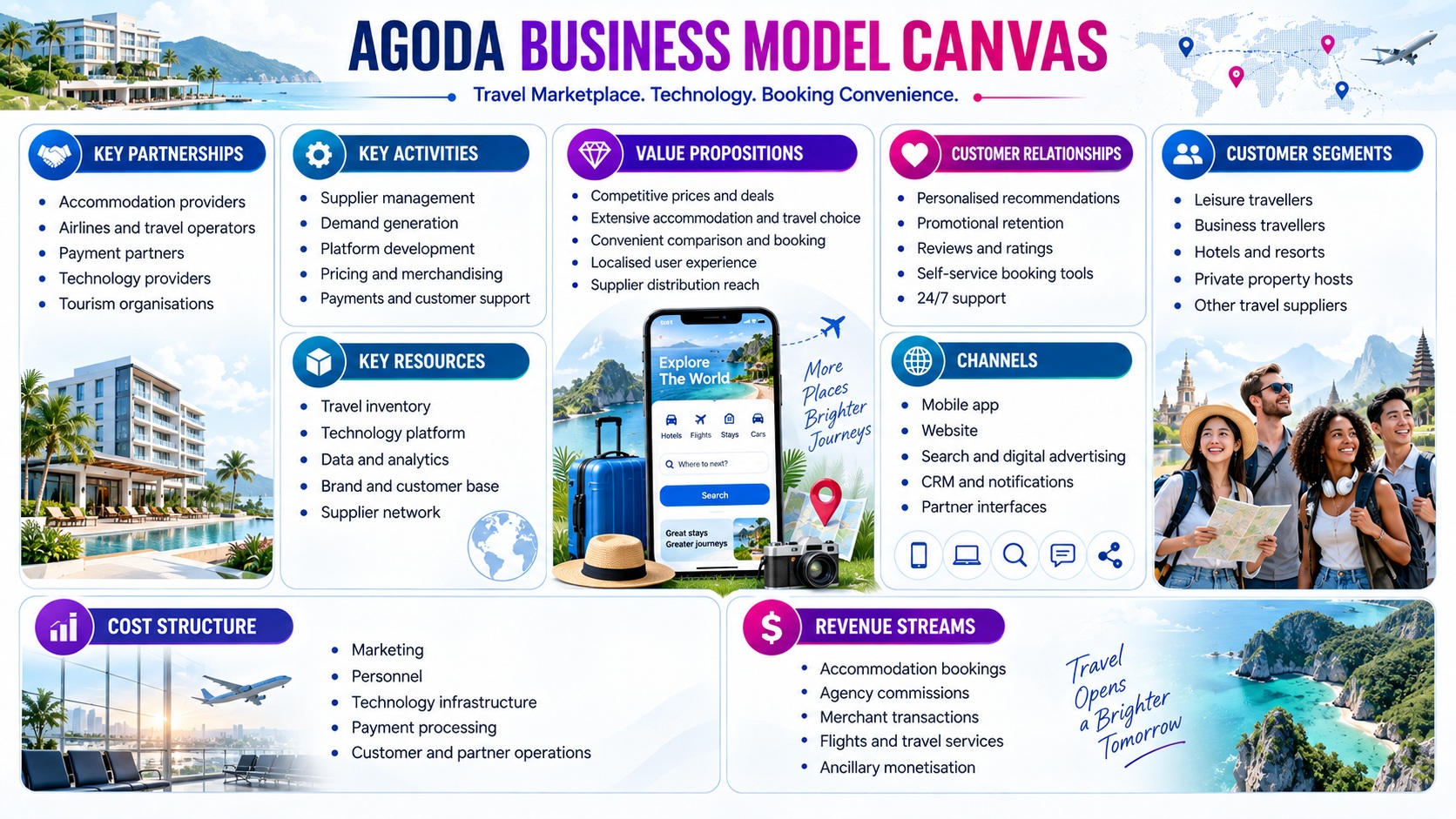
Before examining each component separately, the Agoda Business Model Canvas can be summarised as a digital travel marketplace that aggregates supply, attracts traveller demand and converts travel discovery into transactions.
| BMC Block | Agoda Application |
|---|---|
| Customer Segments | Leisure travellers, business travellers, accommodation partners and other travel suppliers |
| Value Propositions | Competitive prices, extensive choice, convenient comparison, localised booking and supplier distribution |
| Channels | Agoda website, mobile app, digital marketing, search engines, affiliates and partner channels |
| Customer Relationships | Personalisation, loyalty incentives, self-service booking, reviews and 24/7 support |
| Revenue Streams | Merchant economics, agency commissions and selected ancillary or advertising-related revenue |
| Key Resources | Travel inventory, brand, technology, data, partner network, payment capabilities and workforce |
| Key Activities | Supplier management, demand generation, pricing, platform development, payments and customer support |
| Key Partnerships | Hotels, homeowners, airlines, activity providers, payment firms, technology firms and tourism authorities |
| Cost Structure | Marketing, personnel, technology, transaction processing, customer support and partner operations |
An Agoda BMC diagram should show both sides of the marketplace.
Travellers create demand, while accommodation providers and other suppliers create inventory.
Technology sits between them.
Search, recommendation, pricing, payment and booking systems convert fragmented travel supply into easily purchasable digital products.
Revenue is captured when successful transactions occur and is partly reinvested into marketing, technology and supply development.
The detailed Agoda Business Model Canvas reveals that Agoda’s strategic strength does not come from any individual component.
Supply without demand has limited economic value.
Heavy marketing without competitive inventory makes acquisition inefficient.
Competitive prices without reliable payment and fulfilment processes can damage trust.
Advanced technology without sufficient customer traffic produces limited commercial returns.
Agoda therefore manages an interdependent optimisation system.
Demand-generation activity brings travellers to the platform. Supplier relationships provide availability and pricing. Technology improves matching and conversion. Payment infrastructure completes transactions. Customer support manages booking complexity when automated journeys fail.
Parent-level financial disclosures illustrate why transaction scale matters. Booking Holdings generated $186.1 billion of gross bookings and $26.9 billion of revenue during 2025, although those figures cover the entire group rather than Agoda individually.
The following nine sections examine how Agoda creates this system.
Agoda operates a multi-sided platform serving both travellers and travel suppliers.
Leisure travellers represent the largest visible consumer segment, ranging from budget-conscious backpackers to families and premium travellers.
Business travellers add demand for convenient booking, reliable accommodation and flexible travel arrangements.
Accommodation providers form the principal supply-side segment. Agoda works with hotels, resorts, hostels, serviced apartments, private homes and other property categories.
Airlines, activity operators and transportation providers expand the marketplace beyond rooms.
The Agoda Business Model Canvas becomes stronger when demand from these groups overlaps within one trip.
| Segment | Details | Why It Matters |
|---|---|---|
| Leisure travellers | Individuals and families booking personal trips | Generates core consumer transaction volume |
| Business travellers | Customers travelling for professional purposes | Adds recurring and higher-value demand |
| Hotels and resorts | Professional accommodation suppliers | Provides major inventory depth |
| Private property hosts | Apartments, villas and holiday-home suppliers | Expands alternative accommodation selection |
| Other travel suppliers | Airlines, transport and activity providers | Enables broader trip monetisation |
Agoda must create sufficient value on both sides.
Travellers will compare competing platforms if prices, inventory or booking conditions become unattractive. Suppliers can similarly distribute through Booking.com, Expedia, direct websites and other channels.
This creates continuous competitive pressure.
Strong performance therefore requires more than acquiring users. Agoda must improve traveller conversion while simultaneously delivering profitable incremental demand to suppliers.
Agoda’s value proposition begins with reducing the complexity of travel purchasing.
Customers gain access to extensive inventories that can be searched and compared through a single digital interface.
Price is particularly important.
Agoda positions itself around affordable travel and frequently uses discounts, promotions, member rates and other merchandising mechanisms to strengthen perceived value.
Convenience adds another layer through accommodation, flights, activities, airport transfers and selected bundled travel products.
Suppliers receive a different proposition: global digital distribution, customer acquisition, merchandising tools and access to Agoda’s traveller base.
The Agoda Business Model Canvas therefore contains separate but mutually reinforcing propositions.
| Value Proposition | Details | Why It Matters |
|---|---|---|
| Competitive travel pricing | Deals, promotions and differentiated rates | Encourages search-to-book conversion |
| Extensive selection | Large accommodation and travel inventory | Improves probability of matching customer needs |
| Convenient comparison | Search, filters, reviews and booking information | Reduces travel-planning friction |
| Localised experience | Languages, currencies and market adaptation | Strengthens relevance across Asian markets |
| Supplier distribution | Access to Agoda demand and booking technology | Encourages partners to provide inventory |
Sustainable differentiation depends on more than displaying many properties.
Travellers can compare prices across several OTAs within minutes.
Agoda therefore needs to combine price competitiveness with availability, trustworthy content, efficient checkout, relevant recommendations and reliable service.
Supplier economics matter equally.
Partners need incremental bookings that justify commissions, promotional discounts and inventory commitments.
The strongest proposition emerges when Agoda makes both buying travel and selling travel more efficient.
Agoda operates predominantly through digital distribution.
Its mobile application is especially important because travellers increasingly research, compare and book trips through smartphones.
The website provides another direct interface for destination research and transaction completion.
Paid search, organic search, metasearch platforms, digital advertising and affiliate relationships help capture travellers during high-intent planning moments.
Email, application notifications and promotional communications support re-engagement.
Supplier-facing systems form a separate channel because properties require tools to update rates, availability, content and promotions.
| Channel | Details | Why It Matters |
|---|---|---|
| Mobile application | Search, booking and trip management | Creates direct and recurring customer access |
| Website | Full browser-based travel marketplace | Captures search and desktop demand |
| Search and digital advertising | Paid and organic customer acquisition | Reaches travellers during planning |
| CRM channels | Email, notifications and targeted offers | Encourages repeat bookings |
| Partner interfaces | Supplier inventory and commercial-management tools | Keeps marketplace supply accurate |
Channel control has major economic implications.
Direct application traffic can reduce dependence on repeatedly purchasing customers through search engines or other intermediaries.
Conversely, users who begin every trip on Google or a metasearch service can make customer acquisition expensive.
The channel objective is therefore not merely generating traffic.
Agoda benefits when acquired customers gradually become direct users who open the application, respond to personalised offers or begin their next travel search within Agoda itself.
That behaviour improves lifetime economics and reduces dependence on external gatekeepers.
Agoda’s customer relationships are largely digital, automated and transaction-oriented.
Personalised recommendations can simplify discovery by surfacing destinations or properties likely to match previous behaviour.
Promotions, member pricing and loyalty-style benefits create financial reasons to return.
Traveller reviews provide social proof and reduce uncertainty when customers cannot physically inspect accommodation before purchase.
Self-service tools allow users to manage many booking-related tasks without direct staff involvement.
Human customer support nevertheless remains critical because travel disruptions, cancellations, payment problems and supplier disputes can be highly time-sensitive. Agoda states that support is available 24/7.
| Relationship Type | Details | Why It Matters |
|---|---|---|
| Personalisation | Recommendations based on travel context and behaviour | Improves relevance and conversion |
| Promotional retention | Member rates, deals and targeted offers | Encourages repeat usage |
| Reviews and ratings | Traveller-generated property feedback | Reduces purchase uncertainty |
| Self-service tools | Digital booking and reservation management | Supports scalable operations |
| Customer support | Assistance with booking and travel problems | Protects trust during service failures |
Automation gives Agoda substantial scale.
Yet travel purchases carry higher emotional and financial stakes than many ordinary e-commerce transactions.
A failed booking can affect an entire holiday.
Customer relationships therefore become most important when something goes wrong.
AI tools may improve response speed, but escalation to effective human resolution remains essential for complex cases.
Trust ultimately determines whether customers return after a disruption.
Travel transactions provide Agoda’s principal economic engine.
Booking Holdings explains that group revenue from online travel reservations is generated through merchant and agency models, supplemented by payment facilitation, advertising and other services. Agoda-specific revenue is not separately reported in the group’s public financial statements.
Merchant transactions allow a platform to facilitate customer payments and capture transaction economics between what consumers pay and what is owed to travel suppliers.
Agency arrangements generally produce commissions for facilitating reservations without the same payment structure.
Accommodation remains especially important, while flights and other travel categories expand transaction opportunities.
The Agoda Business Model Canvas therefore benefits from increasing customer spend across the broader trip.
| Revenue Stream | Details | Why It Matters |
|---|---|---|
| Accommodation transactions | Economics from hotel and home reservations | Remains the core commercial engine |
| Agency commissions | Commissions from qualifying travel reservations | Provides scalable intermediary revenue |
| Merchant transactions | Margin and related economics from facilitated payments | Expands control over transaction experience |
| Flight and travel services | Economics from flights, transport and attractions | Increases addressable travel spending |
| Ancillary monetisation | Selected advertising, payment or related services | Broadens monetisation opportunities |
Revenue diversification has strategic advantages.
A customer acquired for accommodation becomes more valuable if Agoda can also capture flights, activities and transport.
Cross-selling can consequently raise revenue per traveller without requiring an entirely new customer-acquisition event.
However, travel categories have different margins and operational complexity.
Growth should therefore be evaluated based on contribution economics rather than gross transaction volume alone.
Agoda’s most important assets are predominantly digital and relational rather than physical.
Travel inventory is foundational.
Without competitive accommodation availability, pricing and room types, the platform loses relevance regardless of marketing strength.
Technology provides another essential resource.
Search systems, recommendation engines, pricing infrastructure, mobile applications, fraud controls, payment technology and data analytics support millions of travel decisions.
Customer and transaction data can improve merchandising when governed appropriately.
Brand recognition reduces perceived risk and may increase direct traffic.
The Agoda Business Model Canvas is further strengthened by Booking Holdings ownership, which provides access to broader financial, technological and travel-industry capabilities.
| Key Resource | Details | Why It Matters |
|---|---|---|
| Travel inventory | Hotels, homes, flights and other travel products | Creates marketplace utility |
| Technology platform | Search, recommendation and booking systems | Enables global digital transactions |
| Data and analytics | Search, pricing and booking information | Improves matching and optimisation |
| Brand and customer base | Recognition and recurring traveller demand | Reduces customer-acquisition friction |
| Supplier network | Relationships across the travel ecosystem | Supports availability and geographic coverage |
These resources reinforce one another.
Larger inventory generates more customer interactions. Additional transactions create data. Better data can improve conversion and merchandising. Stronger conversion makes the platform more valuable to suppliers.
The critical resource is therefore not merely inventory or software in isolation.
Agoda’s deeper asset is the accumulated system connecting supply, demand, technology and transaction knowledge.
Competitors can replicate individual features more easily than the entire ecosystem.
Agoda must continuously manage both marketplace demand and supply.
Supplier acquisition and account management ensure properties and other travel businesses remain available on the platform.
Pricing and merchandising activities help determine how inventory is presented, discounted and promoted.
Marketing generates traffic from travellers who have many competing options.
Engineering teams maintain search, booking, mobile, payment, security and data infrastructure.
Artificial intelligence is becoming increasingly important in customer interaction. Agoda’s Booking Form Bot, for example, addresses questions near checkout where unresolved uncertainty can reduce conversion.
| Key Activity | Details | Why It Matters |
|---|---|---|
| Supplier management | Acquire and maintain travel inventory | Protects selection and availability |
| Demand generation | Search marketing, advertising and CRM | Produces booking traffic |
| Platform development | Improve applications, website and infrastructure | Maintains digital competitiveness |
| Pricing and merchandising | Promotions, ranking and personalised offers | Influences conversion |
| Payments and support | Process transactions and resolve booking issues | Protects transaction reliability |
Operational excellence matters because small percentage improvements can become economically meaningful at platform scale.
Higher checkout conversion increases revenue without proportional marketing growth.
Lower payment failure reduces lost bookings.
Better fraud detection protects margins.
Faster customer service limits dissatisfaction.
Agoda should therefore treat technological optimisation and operational execution as components of the same commercial system rather than separate support functions.
External partners are fundamental because Agoda does not manufacture most of the travel products it sells.
Hotels and other accommodation providers supply the platform’s core inventory.
Airlines broaden its ability to participate earlier in trip planning.
Ground-transportation and activity providers extend monetisation into the destination experience.
Payment companies enable secure cross-border transactions involving different currencies and financial systems.
Technology providers contribute infrastructure and specialist capabilities.
Tourism authorities represent another strategically important category.
Agoda’s expanded 2026 partnership with the Singapore Tourism Board includes marketing, data, technology and AI collaboration.
| Key Partner | Details | Why It Matters |
|---|---|---|
| Accommodation providers | Hotels, resorts and private homes | Supply core booking inventory |
| Airlines and travel operators | Flights, transport and activities | Expand trip coverage |
| Payment partners | Acceptance, processing and supplier payments | Enable reliable global transactions |
| Technology providers | Infrastructure and specialist digital capabilities | Strengthen platform performance |
| Tourism organisations | Destination marketing and industry collaboration | Generates demand and market insight |
Partnership quality directly influences customer experience.
Incorrect property information, failed supplier fulfilment or payment disruption can damage Agoda’s reputation even when an external partner caused the problem.
Marketplace governance therefore matters alongside partner acquisition.
Long-term advantage depends on creating relationships where suppliers receive worthwhile demand while Agoda receives competitive rates, availability and reliable fulfilment.
Agoda’s asset-light model avoids the capital expenditure required to own hotels or aircraft, but operating a global OTA still creates substantial costs.
Marketing can be particularly significant because travel platforms compete aggressively for high-intent customers through search engines, metasearch services and digital advertising.
Booking Holdings reported $8.2 billion of marketing expense for 2025 at group level, illustrating the scale of customer-acquisition investment across its portfolio rather than Agoda alone.
Personnel represents another substantial category because the business requires engineers, data scientists, commercial teams, customer-service staff and corporate functions.
Technology infrastructure supports search, booking and payment operations.
Transaction processing becomes more important as merchant payment flows expand.
| Cost Category | Details | Why It Matters |
|---|---|---|
| Marketing | Search, metasearch, advertising and promotions | Acquires traveller demand |
| Personnel | Engineering, commercial and support teams | Provides key operational capabilities |
| Technology | Cloud, software, cybersecurity and infrastructure | Keeps the marketplace reliable |
| Payment processing | Merchant transactions and financial operations | Enables global commerce |
| Customer and partner operations | Service, sales and supplier support | Maintains marketplace quality |
The economic objective is not simply reducing costs.
Marketing expenditure may be attractive when acquired customers generate sufficient lifetime contribution.
Technology spending can produce strong returns if it increases conversion or lowers service costs.
Payment investment can recover revenue otherwise lost through transaction failures.
Discipline should therefore focus on marginal returns from each major spending category.
The Agoda Business Model Canvas becomes most useful when the nine components are viewed as one commercial engine.
Customer segments provide demand and supply.
Value propositions encourage travellers to search and suppliers to list inventory.
Digital channels bring those participants onto the platform.
Customer relationships increase confidence, conversion and repeat usage.
Transactions generate revenue.
That income supports key activities such as marketing, product development, supplier management, payment operations and customer service.
Resources including technology, brand, inventory and data strengthen those activities.
External partnerships expand product breadth and geographic reach.
Cost structure determines whether growth converts into sustainable economic value.
A reinforcing cycle emerges when the system performs well.
More inventory improves selection. Better selection increases booking probability. Greater demand attracts suppliers. More transactions generate information. Improved information supports stronger recommendations and merchandising.
Misalignment can reverse the cycle.
Poor prices reduce conversion, excessive marketing raises acquisition costs, unreliable partners weaken trust and failed service drives travellers toward competing platforms.
The Value Proposition Canvas examines customer needs more narrowly than the BMC.
While the broader framework explains how the whole organisation works, VPC focuses on the fit between what travellers are trying to accomplish and what Agoda offers.
Applying the Agoda Business Model Canvas together with VPC therefore helps separate company-level economics from consumer-level value.
The customer profile below focuses primarily on leisure travellers.
Their fundamental objective is not to make a hotel reservation.
Instead, travellers want to organise a satisfactory trip within constraints involving budget, location, timing, convenience and uncertainty.
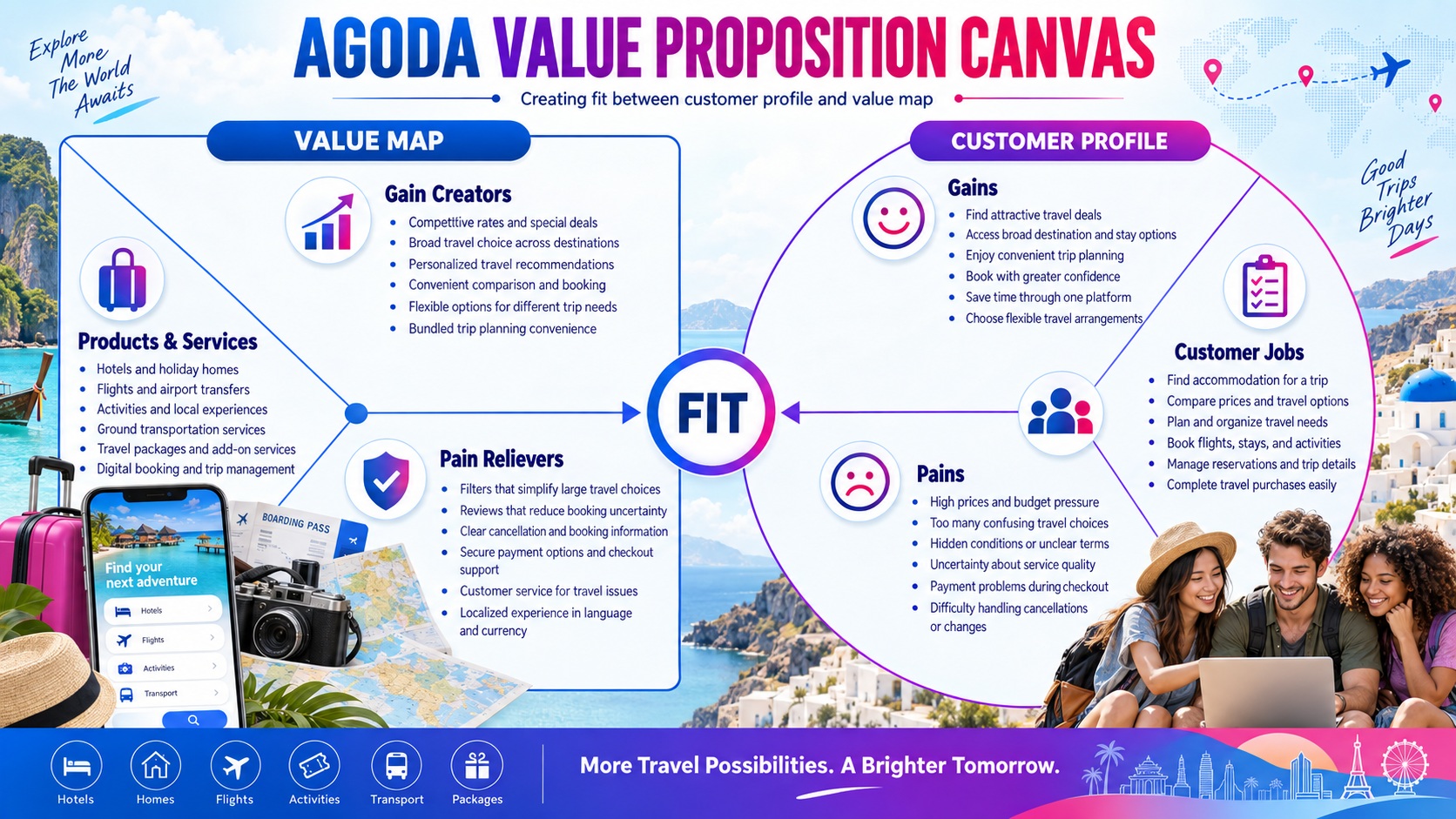
| Customer Profile | Details |
|---|---|
| Customer Jobs | Find accommodation, compare prices, plan trips, book travel and manage reservations |
| Customer Pains | High prices, confusing choices, hidden conditions, uncertain quality, payment failures and difficult cancellations |
| Customer Gains | Attractive deals, broad selection, trustworthy information, convenient booking and flexible travel choices |
Travel purchasing creates uncertainty because customers frequently buy services they will consume weeks or months later in unfamiliar locations.
Reducing uncertainty therefore has significant value.
Reviews, clear booking conditions, support, accurate information and reliable payments are not peripheral features.
They are central components of the customer proposition.
Agoda responds through a combination of marketplace inventory, search technology, pricing mechanisms and transaction services.
| Value Map | Details |
|---|---|
| Products and Services | Hotels, homes, flights, activities, transportation, packages and supporting travel services |
| Pain Relievers | Filters, reviews, cancellation information, secure payment options, booking support and customer service |
| Gain Creators | Competitive rates, promotions, broad inventory, recommendations, convenience and trip bundling |
The strength of Agoda’s value map comes from aggregation.
Travellers do not need to contact hundreds of hotels individually.
Search tools narrow large inventories into manageable alternatives.
Pricing and promotion mechanisms help customers identify perceived value.
Additional travel categories can reduce the number of separate services required to organise a trip.
Future differentiation will increasingly depend on how intelligently these capabilities work together.
| Customer Profile | Details | Matching Value Map | How Agoda Creates Fit |
|---|---|---|---|
| Customer Jobs | Find and book suitable travel | Products and Services | Aggregated travel inventory provides multiple booking options |
| Customer Pains | Uncertainty, complexity and price concerns | Pain Relievers | Reviews, filters, support and booking information reduce friction |
| Customer Gains | Convenience, savings and selection | Gain Creators | Promotions, recommendations and broad inventory improve perceived value |
Value fit improves when Agoda helps travellers move quickly from uncertainty to confident booking.
Poor fit appears when advertised pricing differs from checkout expectations, cancellation terms are unclear, a payment fails or the actual travel service does not match platform information.
Agoda’s increasing use of contextual AI at booking stages is strategically relevant because these moments frequently determine whether customer intent becomes completed revenue.
The Agoda Business Model Canvas shares many structural characteristics with Booking.com and Expedia because all three connect travellers with external travel suppliers.
Important differences nevertheless exist in geographic heritage, positioning, product emphasis and ecosystem structure.
Agoda historically developed particularly strong capabilities around Asia-Pacific accommodation.
Booking.com has enormous global accommodation distribution and forms another brand within Booking Holdings.
Expedia operates within Expedia Group’s broader portfolio of travel brands and has long positioned itself around comprehensive trip booking.
Only the BMC blocks where meaningful strategic differences exist are compared below.
| Relevant BMC Block | Agoda | Booking.com | Expedia |
|---|---|---|---|
| Customer Segments | Strong Asia-Pacific traveller orientation plus global travellers and suppliers | Broad global traveller and accommodation market | Global travellers, suppliers and package-oriented customers |
| Value Proposition | Competitive travel deals, localisation and strong Asian inventory | Extensive global accommodation choice and connected-trip convenience | Broad travel shopping and trip bundling |
| Channels | App, website, search, digital marketing and partner ecosystem | App, website, extensive performance marketing and direct traffic | App, website, marketing ecosystem and Expedia Group distribution |
| Revenue Streams | Accommodation-led merchant and agency economics plus expanding travel categories | Large accommodation-led merchant and agency economics | Merchant, agency and wider travel-platform monetisation |
| Key Resources | Asia-Pacific strength, supplier inventory, technology, data and Booking Holdings ownership | Global accommodation scale, brand, technology and Booking Holdings ecosystem | Brand portfolio, traveller base, technology and supplier relationships |
Agoda’s differentiation should not be based solely on inventory quantity.
Both major competitors possess substantial scale.
Regional relevance, localisation, pricing capability and deep supplier relationships across Asia provide a more defensible strategic position.
At the same time, Agoda can benefit from Booking Holdings’ wider capabilities without needing to duplicate every resource independently.
This combination of local market sophistication and global corporate scale is strategically significant.
Agoda possesses several advantages that strengthen its position in online travel.
These strengths interact rather than functioning independently.
Regional inventory makes marketing more effective, transactions create data, technology converts that data into better experiences and parent-company scale supports continued investment.
Despite substantial scale, Agoda faces several important strategic risks.
The greatest danger would be deterioration across several dimensions simultaneously.
If acquisition costs rise while supplier rates become less competitive and service quality declines, conversion can weaken rapidly.
Reduced transactions would then make Agoda less valuable to suppliers, potentially reinforcing the decline.
Agoda should strengthen the areas where its existing capabilities can produce structural advantage rather than competing primarily through promotional discounting.
Agoda should deepen its position as the preferred platform for travel within and into Asia.
That means strengthening accommodation coverage in secondary cities, transport connections, activities and destination content alongside major tourist centres.
Asia contains substantial travel diversity that global competitors cannot address effectively through a completely standardised approach.
Localised inventory, languages, payment methods and market-specific merchandising should remain major strategic priorities.
Agoda should increasingly measure customer value across the full journey rather than individual reservations.
A traveller booking a hotel represents potential demand for flights, airport transfers, local transport, attractions and other products.
Intelligent cross-selling can increase transaction value while lowering the effective acquisition cost of each additional service.
Execution must remain selective because irrelevant offers can create friction.
Artificial intelligence should focus on measurable customer problems rather than novelty.
Checkout questions, property comparison, cancellation interpretation, destination planning and service support are high-value use cases.
Agoda’s Booking Form Bot already demonstrates this direction.
Performance should be evaluated through conversion, resolution accuracy, support-cost reduction and customer satisfaction.
Greater direct traffic would strengthen long-term economics.
Agoda should make its application and membership proposition sufficiently valuable that travellers begin future searches directly rather than returning through paid search channels.
Personalised destination ideas, useful trip management, saved preferences and meaningful member benefits can help.
The objective is habitual usage, not merely additional promotional messages.
Payment reliability should be treated as a revenue-generation capability rather than a back-office function.
Cross-border travel creates currency, card-acceptance, fraud and supplier-settlement complexity.
Agoda’s 2026 work with Checkout.com illustrates the commercial importance of improving transaction acceptance and supplier payment reliability.
Higher successful payment rates translate directly into more completed bookings.
Inventory quality ultimately depends on supplier participation.
Agoda should provide accommodation partners with clearer demand insights, pricing recommendations, promotional controls and performance analytics.
Independent hotels may particularly value technology that helps them compete without sophisticated revenue-management teams.
Better partner economics can produce preferential inventory and rates that subsequently improve the traveller proposition.
Travel platforms often focus heavily on price, but reliability can become equally important.
Agoda should make cancellation terms, taxes, fees, room conditions and payment requirements exceptionally clear before checkout.
When disruptions occur, customers need rapid escalation and transparent resolution.
Combining strong automation with selective human intervention could turn customer service from a necessary expense into a retention advantage.
Overall, the Agoda Business Model Canvas shows how Agoda converts fragmented global travel supply into a searchable and transactable digital marketplace.
Its underlying mechanism is straightforward.
Travel suppliers provide inventory.
Agoda aggregates, prices, merchandises and distributes that inventory.
Travellers use its digital channels to discover and purchase suitable travel products.
Successful reservations create economic value through merchant and agency transaction models and related services.
Complexity exists beneath that apparently simple transaction.
Marketing must generate demand economically. Supplier relationships must preserve competitive inventory. Search and recommendation systems must convert enormous choice into relevant options. Payments must work across markets. Customer support must resolve problems involving services delivered by third parties.
Agoda’s long-term advantage will therefore depend less on simply listing more properties and more on orchestrating the entire travel marketplace better than competitors.
Deep Asia-Pacific capabilities, Booking Holdings support, growing travel-product breadth and continued investment in AI and payment technology provide strong foundations.
Sustainable growth will require those resources to produce measurable improvements in direct customer loyalty, supplier value, conversion, whole-trip monetisation and traveller trust.
This article is provided solely for educational, informational and business-analysis purposes.
Its contents are based on publicly available company information, industry observations and strategic interpretation available at the time of writing.
Nothing contained in this article constitutes financial, investment, legal, regulatory, accounting, travel, technology or professional advice.
The analysis is independent and should not be interpreted as an official statement, endorsement or representation by Agoda Company Pte. Ltd., Booking Holdings Inc., Booking.com, Expedia Group or any other organisation mentioned.
Business models, services, pricing, financial performance, partnerships, regulations and market conditions may change over time.
Readers should conduct independent research and obtain appropriate professional advice before making investment, commercial or strategic decisions.
All logos, trademarks, copyrights, company names, product names and other intellectual-property rights belong to their respective owners.
Explore the Agoda Business Model Canvas, covering all nine BMC blocks, Value Proposition Canvas, Booking.com and Expedia comparison, competitive advantages, risks and strategic recommendations for 2026.
Explore the FedEx Business Model Canvas, nine BMC blocks, Value Proposition Canvas, UPS and DHL… Read More
Explore the Quipper Business Model Canvas, nine BMC blocks, Value Proposition Canvas, Ruangguru and Pahamify… Read More
Explore the CARPUT Business Model Canvas, nine BMC blocks, Value Proposition Canvas, competitor comparison, competitive… Read More
Explore the Boost Business Model Canvas, nine BMC blocks, Value Proposition Canvas, competitor comparison, advantages,… Read More
Explore the Domino's Pizza Business Model Canvas, nine BMC blocks, Value Proposition Canvas, Pizza Hut… Read More
Explore the Mie Gacoan Business Model Canvas, including its customer segments, value propositions, revenue streams,… Read More