



Share This Article


Tupperware Business Model Canvas: Why an Iconic Brand Lost Its Edge
BMC Article No: BMC #046
Updated in 2026: This article has been refreshed with the 2024 bankruptcy filing context, post-bankruptcy business developments, deeper analysis for every BMC block, a new section on why the company filed bankruptcy linked directly to the business model, expanded risks and recommendations, and a more refined structure.
Introduction
Tupperware is one of the most recognisable household brands in modern consumer goods. For decades, it stood for food storage, durability, kitchen organisation, and a distinctive selling system built around consultants and home parties. That formula once turned ordinary containers into a social and commercial phenomenon.
The Tupperware Business Model Canvas is especially useful because the company’s story is not only about products. It is also about channels, customer relationships, cost structure, and the ability to adapt when consumer behaviour changes.
That makes Tupperware strategically important to study. It succeeded for years with a model that was once innovative, but later struggled when the same model became less relevant in a digital, retail-driven, and sustainability-conscious market.
What Is Tupperware’s Business Model?
Tupperware operates a branded housewares and kitchen solutions business model built around product design, brand trust, and a historically strong direct selling network. It has sold food storage, preparation, serving, and kitchen products through consultants, parties, online channels, and selected retail partnerships.
At its core, the Tupperware Business Model Canvas shows a company that originally created power through premium reusable products plus relationship-led selling. The product was practical, but the selling method was the real differentiator because it created community, demonstration, and emotional loyalty.
That design worked well in a pre-digital era. Once consumers shifted toward e-commerce, faster price comparison, modern retail convenience, and broader product choice, the same structure became harder to defend.
What Is Business Model Canvas?
Business Model Canvas, or BMC, is a strategic framework used to explain how a company creates value, delivers that value to customers, and captures revenue from its operations. Rather than looking only at products or sales, it provides a broader view of how the entire business works.
In the case of Tupperware, this framework is especially useful because the company’s long-term performance was shaped by the interaction of multiple business elements. Customer segments, value propositions, channels, customer relationships, revenue streams, resources, partnerships, and cost structure all influenced how the company grew, competed, and later struggled.
That is why the Tupperware Business Model Canvas is a useful tool for this analysis. It helps explain not only how the business created strength in the past, but also why the model became harder to sustain when market behaviour changed.
| BMC Block | Main Question |
|---|---|
| Customer Segments | Who does the business serve? |
| Value Propositions | What value does the business offer? |
| Channels | How does the business reach customers? |
| Customer Relationships | How does the business build loyalty? |
| Revenue Streams | How does the business make money? |
| Key Resources | What assets does the business need? |
| Key Activities | What must the business do well? |
| Key Partnerships | Who helps the business operate? |
| Cost Structure | What are the major costs? |
Latest Developments: What Is Changing Around Tupperware?
In 2026, the Tupperware Business Model Canvas is shaped by a very different reality from its historic peak. The company filed for Chapter 11 bankruptcy in September 2024, then moved through a court-approved lender-backed sale that aimed to keep the brand operating under new ownership and a narrower core-market focus.
Several shifts now matter. First, Tupperware can no longer rely on nostalgia alone. Second, digital commerce and retail accessibility matter more than traditional party selling. Third, consumers now care more about value, convenience, and sustainability at the same time. Fourth, the company needs a simpler and more focused operating model if it wants to rebuild profitability.
These changes do not erase the brand’s heritage. They do show that future relevance depends on whether Tupperware can convert brand recognition into a more modern commercial system.
Why Tupperware Is Strategically Interesting
Tupperware is strategically interesting because it once transformed a simple household item into a branded experience. The company did not merely sell containers. It sold freshness, trust, demonstration, social interaction, and an entrepreneurship pathway for consultants.
That combination made the business model distinctive for decades. A customer was not just buying plasticware. She was often buying from someone she knew, after seeing the product demonstrated in a social environment.
The strategic lesson is important. Tupperware’s historic strength came from a strong fit between product, channel, and customer behaviour. Its later weakness came when that fit broke down. This makes the Tupperware Business Model Canvas a useful case not only for understanding success, but also for understanding strategic drift.
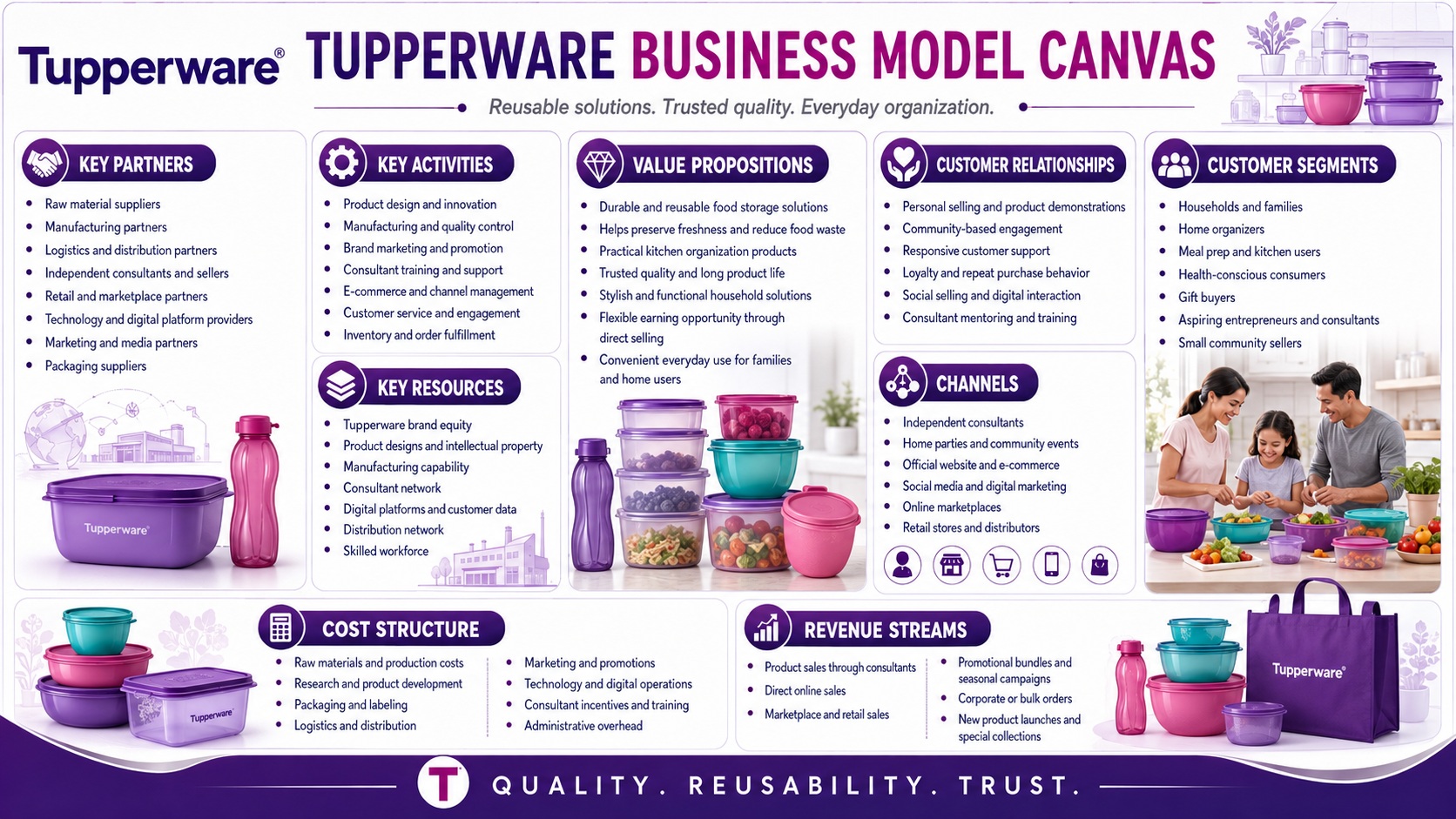
Tupperware Business Model Canvas Summary
Before going deeper into the wider discussion, the summary below gives a quick view of how Tupperware’s business works. It helps connect the full model in one snapshot before moving into the next sections of the article.
| BMC Block | Tupperware Application |
|---|---|
| Customer Segments | Families, home users, kitchen organisers, consultants, and practical value-seeking consumers. |
| Value Propositions | Reusable storage, product durability, food freshness, convenience, and trusted brand heritage. |
| Channels | Direct selling, social selling, online store, consultants, and selected retail channels. |
| Customer Relationships | Personal selling, demonstrations, repeat use, community trust, and consultant engagement. |
| Revenue Streams | Product sales through consultants, direct online sales, retail sales, and promotional bundles. |
| Key Resources | Brand reputation, product portfolio, consultant base, distribution capability, and product know-how. |
| Key Activities | Design, manufacturing, selling support, channel management, marketing, and fulfilment. |
| Key Partnerships | Suppliers, consultants, logistics providers, marketplaces, and retail partners. |
| Cost Structure | Raw materials, production, shipping, incentives, technology, and organisational expenses. |
Tupperware BMC Diagram:
The diagram below gives a visual summary of how the main blocks of Tupperware’s business model connect in one view. It helps readers move from the written explanation into a simpler strategic snapshot before continuing to the next sections of the article. Tupperware business model canvas:
BMC Analysis of Tupperware
The detailed BMC analysis below explains how each building block supports Tupperware’s overall business logic. Instead of looking at the brand only as a product company, this section shows how customer segments, value creation, channels, relationships, resources, and costs work together to shape performance.
This matters because Tupperware’s long-term rise and decline were not caused by one factor alone. The Tupperware Business Model Canvas becomes more insightful when each block is assessed not only on its standalone role, but also on how well it fits changing consumer behaviour, channel dynamics, and financial realities.
1. Customer Segments
Customer segments explain who Tupperware serves and why those buyers matter. Tupperware historically served households, home-focused buyers, and women seeking practical kitchen solutions, while also depending on consultants as both sellers and community connectors.
This block is important because Tupperware did not grow by targeting a broad mass market in the same way as many FMCG brands. Instead, it performed best when it focused on practical household users who appreciated product demonstration, personal recommendation, and repeat everyday use.
That mix was powerful because it combined product users with a motivated sales force. The model created both consumer demand and interpersonal distribution at the same time.
Tupperware Customer Segments:
| Segment | Details | Why It Matters |
| Households and families | Buyers seeking food storage, meal prep, and kitchen organisation | Creates steady everyday demand tied to repeat household use |
| Home organisers and practical users | Consumers who value neat storage, convenience, and durability | Supports premium positioning based on utility and product longevity |
| Consultants and social sellers | Independent sellers who market products through relationships and demonstrations | Expands reach without relying only on traditional retail infrastructure |
| Gift and occasion buyers | Customers purchasing functional household items for events or family use | Adds seasonal and event-driven sales opportunities |
The strength of this block was once its intimacy. Customers were not reached only through advertising, but through social trust and familiar domestic use cases. That gave Tupperware a sharper fit with family-oriented and relationship-driven buyers.
The weakness emerged when younger consumers moved toward online discovery, fast delivery, broader price comparison, and retail convenience. As that happened, the original segment focus became narrower in relative terms, while the consultant-led audience became harder to renew at scale. In strategic terms, Tupperware did not lose the household segment entirely, but it became less effective at capturing the next generation of household buyers.
2. Value Propositions
Value propositions explain why customers choose Tupperware. The brand became famous for durable reusable containers, freshness-preserving seals, stackable designs, and practical kitchen organisation. It also offered an income opportunity through direct selling.
This block mattered because Tupperware was never just selling storage products. It was selling reliability, order, cleanliness, and a sense of confidence in everyday kitchen use. In many markets, that practical value was reinforced by the brand’s reputation for quality and long-term usability.
That broader value once gave Tupperware more than a product advantage. It created functional value for users and economic value for consultants.
Tupperware Value Propositions:
| Value Proposition | Details | Why It Matters |
| Durability and reusability | Long-lasting containers designed for repeated household use | Supports trust and justifies premium pricing over low-cost alternatives |
| Freshness and storage convenience | Airtight sealing and practical storage formats | Solves everyday food preservation and organisation needs |
| Brand trust and heritage | Well-known household reputation built over decades | Lowers buyer uncertainty in a crowded market |
| Earning opportunity | Consultant-based selling model with income potential | Extends market reach and builds loyalty around the brand ecosystem |
The problem was not that Tupperware had no value. The problem was that the value proposition evolved too slowly relative to market expectations. Competitors added modern aesthetics, wider retail convenience, lower price points, and stronger sustainability narratives.
As a result, Tupperware’s core promise remained credible but became less differentiated. A value proposition that once felt premium and distinctive began to look less unique when consumers could find similar utility with easier access and more contemporary brand positioning. The block remained relevant, but its competitive sharpness weakened.
3. Channels
Channels explain how Tupperware reaches customers. Historically, the company relied on consultants and in-home parties, then gradually added online selling and selected retail distribution.
This block sits near the centre of Tupperware’s strategic story because the channel was once the company’s strongest advantage. The product gained appeal through live demonstration, conversation, and social proof rather than relying only on shelf visibility or mass advertising.
That original channel model was revolutionary for its time because it made selling experiential. Customers could see the products, ask questions, and buy in a trusted social setting.
Tupperware Channels:
| Channel | Details | Why It Matters |
| Consultants and home parties | Demonstration-led selling through personal networks | Created trust, product education, and emotional connection |
| Social selling | Consultant outreach through messaging and online communities | Helped extend direct selling into digital behaviour |
| Own online channels | Brand websites and direct e-commerce presence | Important for convenience, brand control, and modern consumer access |
| Selected retail outlets | Limited retail presence in some markets | Improves accessibility for buyers who prefer store-based purchasing |
This block later became one of Tupperware’s biggest weaknesses. The company remained too dependent on a channel system whose relevance declined, while competitors built stronger omnichannel models combining retail, marketplaces, and digital commerce.
The strategic issue was not that direct selling had no remaining value. The real issue was that Tupperware did not rebalance its channel mix fast enough. Once the route to market stopped matching how people preferred to discover and buy household products, the entire business model became harder to scale efficiently.
4. Customer Relationships
Customer relationships explain how Tupperware builds trust and repeat demand. The company historically relied on personal selling, demonstrations, consultant relationships, and household familiarity built over many years.
This block was especially valuable because Tupperware’s relationship model created emotional stickiness around a practical product category. The company benefited when buyers felt guided, reassured, and socially connected rather than simply sold to.
That structure produced loyalty because the relationship was often human rather than transactional. Buyers remembered the seller, the demonstration, and the usefulness of the product in daily life.
Tupperware Customer Relationships:
| Relationship Type | Details | Why It Matters |
| Personal selling | Direct interaction between consultants and customers | Builds trust and reduces purchase hesitation |
| Demonstration-based engagement | Showing product use in live or social settings | Makes functional benefits more visible and persuasive |
| Repeat household use | Frequent product interaction in daily routines | Encourages repurchase and word-of-mouth loyalty |
| Community connection | Social dimension around parties and consultant networks | Strengthens emotional attachment beyond product utility |
The relationship model weakened when social media, influencer culture, and digital communities replaced traditional party-based engagement. Tupperware did not build online relevance fast enough to replace declining consultant-led intimacy.
That shift mattered because relationship strength had long compensated for the premium price of the product. Once those relationships became less distinctive, the company had to compete more directly on convenience, style, and perceived value. In effect, the relationship engine lost some of its historical power to defend the brand.
5. Revenue Streams
Revenue streams explain how Tupperware makes money. The company earned primarily from product sales through consultants, then increasingly through online and retail channels where available.
This block reveals how dependent the company was on the health of its traditional selling engine. A model can look profitable for years when one revenue source is strong, but it becomes vulnerable when that source weakens before new streams are fully developed.
That structure worked when consultant-led selling remained vibrant and the brand could preserve premium pricing. Trouble emerged when consultant activity slowed, demand softened, and lower-cost competitors reduced pricing power.
Tupperware Revenue Streams:
| Revenue Stream | Details | Why It Matters |
| Consultant-led product sales | Core sales generated through direct selling networks | Historically the backbone of the company’s commercial model |
| Direct online sales | Orders made through company-owned digital channels | Important for modern convenience and higher consumer reach |
| Retail sales | Sales through selected physical retail partnerships | Helps capture customers who prefer store-based shopping |
| Bundles and promotions | Campaign-driven offers and grouped products | Supports volume movement and inventory turnover |
The Tupperware Business Model Canvas shows that revenue concentration was a problem here. When one main sales engine lost momentum, the company did not have enough channel diversification to stabilise topline performance quickly.
That makes this block central to understanding the later financial distress. Revenue pressure did not come only from weaker demand. It also came from a model that lacked enough alternative growth engines to absorb the decline of the legacy consultant channel. Once sales softened, the broader structure became much more fragile.
6. Key Resources
Key resources are the assets Tupperware needs to operate effectively. These include brand equity, product know-how, its consultant network, manufacturing capability, and customer familiarity built over decades.
This block is important because Tupperware historically possessed the kind of intangible assets many consumer brands want but never achieve. Recognition, trust, and product memory gave the company a strong platform that could support repeat purchase and premium positioning.
Those resources once created strong competitive insulation. The brand was widely recognised, and the products were associated with quality and practicality.
Tupperware Key Resources:
| Key Resource | Details | Why It Matters |
| Brand equity | Strong household recognition across many markets | Supports trust, memory, and premium perception |
| Product design know-how | Practical storage-focused product expertise | Enables functionality-led differentiation |
| Consultant network | Distributed sales force with community access | Creates market reach without full retail dependence |
| Manufacturing and supply capability | Ability to produce and distribute branded household goods | Supports consistency, quality, and scale |
The issue was not a lack of resources, but declining effectiveness. Brand equity alone could not offset channel weakness, consultant attrition, financial strain, and insufficient reinvestment in modern growth capabilities.
In other words, the resources remained valuable but were no longer being converted into advantage as efficiently as before. This is a key strategic lesson. Strong resources help only when the surrounding business model still knows how to deploy them in ways the market rewards.
7. Key Activities
Key activities explain what Tupperware must do well to make the model work. These activities include product design, manufacturing, demand generation, consultant support, fulfilment, and channel management.
This block matters because even a strong brand cannot sustain itself without the right operating rhythm. Tupperware needed its activities to remain tightly coordinated so that product innovation, selling support, and market access kept reinforcing each other.
In the best years, the company’s activity system aligned tightly with its selling model. Product demonstration, consultant activation, and repeated use reinforced one another.
Tupperware Key Activities:
| Key Activity | Details | Why It Matters |
| Product development | Designing useful kitchen and storage solutions | Keeps the brand relevant in everyday household tasks |
| Manufacturing and quality control | Producing durable and consistent products | Protects trust and supports long-term positioning |
| Consultant support and training | Enabling sellers to promote and demonstrate products | Critical for direct-selling productivity |
| Marketing and channel execution | Managing campaigns, digital presence, and distribution | Essential for attracting new customers and driving access |
The weakness appeared when these activities became misaligned with market reality. Tupperware needed more digital marketing, stronger e-commerce execution, and faster product renewal, but the legacy model absorbed too much attention.
That misalignment reduced the company’s ability to respond at speed. Instead of building a modern operating system around contemporary buying habits, too much of the organisation remained oriented around preserving an older formula. Over time, that slowed adaptation and weakened competitiveness across the wider model.
8. Key Partnerships
Key partnerships explain who helps Tupperware operate. The company has depended on suppliers, consultants, logistics partners, distributors, and, in some markets, retail partners.
This block deserves more attention because partnerships can either reinforce a legacy model or accelerate transformation. For Tupperware, the quality of its partner ecosystem directly affected how efficiently it could produce, distribute, and modernise its route to market.
Partnerships matter because Tupperware does not create value alone. Its products need materials, fulfilment, selling support, and route-to-market access.
Tupperware Key Partnerships:
| Partner Type | Details | Why It Matters |
| Suppliers | Providers of materials, packaging, and production inputs | Affect product quality, availability, and cost |
| Consultants | Independent sellers and community-based promoters | Extend reach and sustain relationship-led selling |
| Logistics partners | Shipping and fulfilment providers | Important for timely delivery and customer satisfaction |
| Retail and marketplace partners | External channels that broaden availability | Help modernise reach beyond the legacy party model |
This block was under-optimised. Tupperware could have strengthened retail, e-commerce, and platform partnerships much earlier. A broader partner ecosystem might have reduced overdependence on the declining traditional consultant channel.
From a BMC perspective, partnerships should have been used more aggressively as a transition lever. Stronger alliances with retail and digital platforms could have improved accessibility, broadened discovery, and reduced the burden placed on the legacy selling network. That missed opportunity became more visible as market conditions changed.
9. Cost Structure
Cost structure explains the major expenses required to run Tupperware’s model. These include manufacturing, materials, logistics, incentives, marketing, and organisational overhead.
This block is critical because cost structure often determines whether a legacy brand can survive a difficult transition period. When a company faces slower sales and needs to transform at the same time, it must manage costs tightly without starving future growth.
Cost discipline matters greatly in a business with pricing pressure and slowing sales. When revenue falls but cost rigidity remains high, the model becomes fragile quickly.
Tupperware Cost Structure:
| Cost Category | Details | Why It Matters |
| Raw materials and production | Resin, manufacturing, tooling, and quality control costs | Directly shape product cost and gross margin |
| Logistics and fulfilment | Shipping, warehousing, and distribution expenses | Affect service levels and total delivery economics |
| Consultant incentives and support | Commissions, promotions, and seller enablement costs | Necessary for the direct-selling model to function |
| Marketing, technology, and overhead | Brand support, digital tools, staff, and administration | Supports long-term competitiveness but can burden profitability |
This was a major pressure point. As revenue weakened, debt remained heavy, and channel productivity declined, the cost structure became harder to absorb. The company then had less room to invest in transformation while also protecting liquidity.
That is why this block links directly to the bankruptcy discussion later in the article. A weakening top line can sometimes be managed if the cost base is flexible and the balance sheet is healthy. In Tupperware’s case, cost pressure and financial strain reduced strategic options at exactly the moment the business needed more room to adapt.
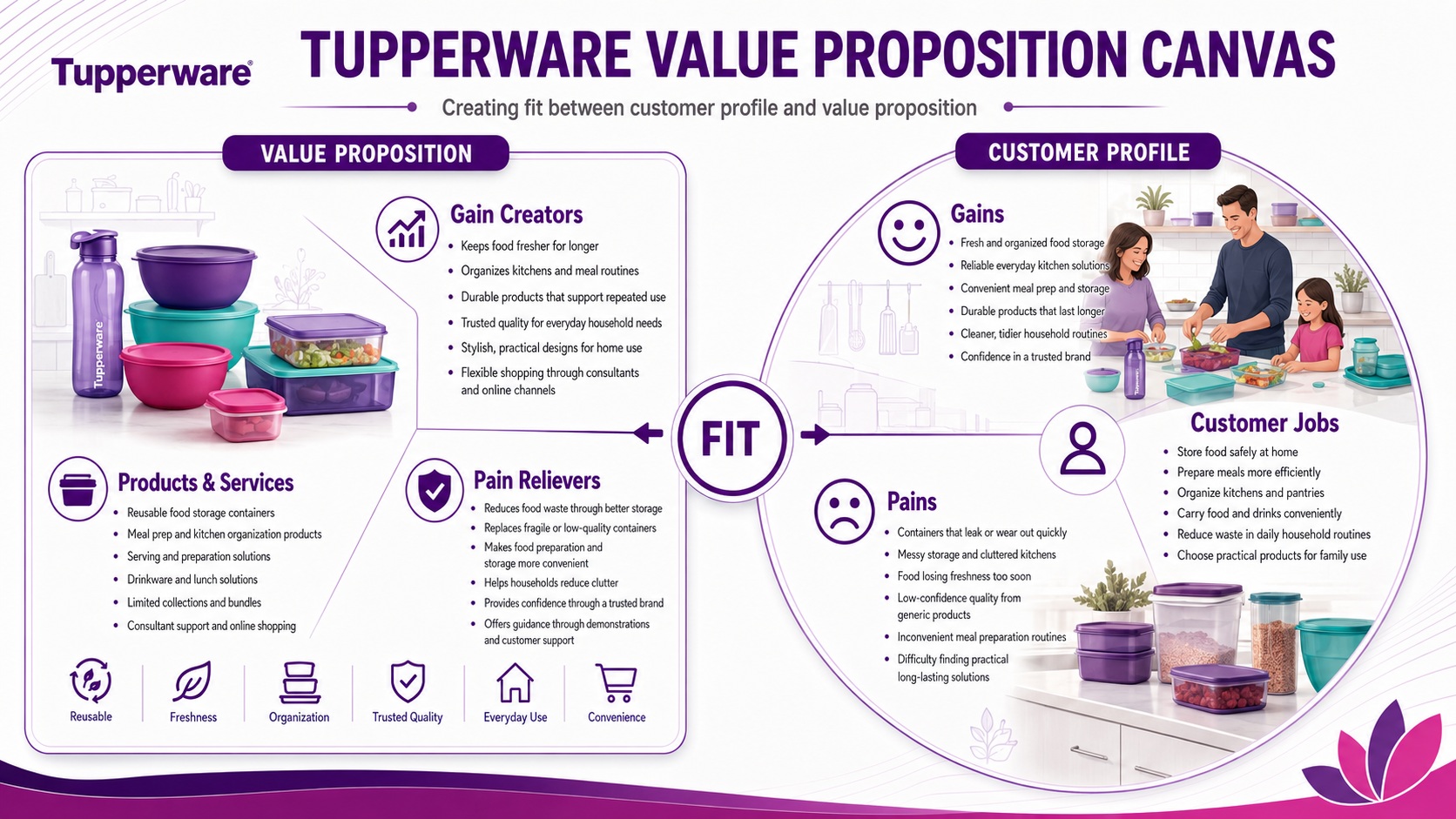
Tupperware Value Proposition Canvas
Before looking at why the company filed bankruptcy, it is useful to examine how Tupperware creates fit between what customers want and what the company delivers. That is the role of Value Proposition Canvas.
For Tupperware, this framework matters because the company historically won by matching household needs with product quality, convenience, and trusted demonstration. The challenge emerged when customer expectations shifted faster than the value offer evolved.
Customer Profile
The customer profile looks at what Tupperware buyers are trying to achieve, what frustrates them, and what outcomes they value most. In this case, customers want practical food storage, organised kitchens, reliable product quality, and convenient purchase access.
Customer Profile of Tupperware
| Customer Profile | Details |
|---|---|
| Customer Jobs | Store food safely, organise the kitchen, reduce waste, prepare meals efficiently, and buy durable household tools. |
| Customer Pains | Cheap products that break easily, cluttered storage, difficulty comparing options, limited channel access, and concern over value for money. |
| Customer Gains | Long-lasting containers, trusted quality, better organisation, preserved freshness, attractive design, and easier daily routines. |
This profile shows that Tupperware’s functional relevance remains real. The issue is that many competitors now address the same jobs with greater convenience, wider price options, or stronger modern branding.
Value Map
The value map explains how Tupperware responds to those customer jobs, pains, and gains. It does so through reusable products, practical designs, trusted quality, and a brand associated with organised living.
Value Map of Tupperware
| Value Map | Details |
|---|---|
| Products and Services | Food storage containers, kitchen tools, preparation solutions, serving products, water bottles, and organisation-focused items. |
| Pain Relievers | Durable quality reduces replacement frequency, seal performance supports freshness, and product design makes storage easier. |
| Gain Creators | Better kitchen order, trusted usability, reusable value over time, and products that make food preparation more manageable. |
The Tupperware Business Model Canvas works best when this value is matched with convenient access and relevant communication. Once access weakened and messaging felt dated, the fit became less compelling.
How Tupperware Creates Fit
The table below shows how customer needs and Tupperware’s value offer connect more directly.
| Customer Profile | Details | Matching Value Map | How Tupperware Creates Fit |
|---|---|---|---|
| Customer Jobs | Customers want practical and durable products for food storage, preparation, and organisation. | Products and Services | Tupperware offers reusable kitchen solutions designed to improve daily household routines. |
| Customer Pains | Customers dislike poor durability, clutter, weak product performance, and confusing low-quality alternatives. | Pain Relievers | Tupperware reduces those frictions through trusted quality, proven functionality, and recognisable product design. |
| Customer Gains | Customers value convenience, neat storage, confidence in product use, and long-term utility. | Gain Creators | The brand creates fit by combining usability, organisation, and reusability into an everyday household system. |
This fit used to be stronger because channel experience reinforced the value. When buying became less experiential and more convenience-driven, Tupperware needed to recreate that fit through digital and retail excellence.
Why Tupperware Filed for Bankruptcy
Tupperware filed for Chapter 11 bankruptcy in 2024 not because its products suddenly became useless, but because too many parts of the business model weakened at the same time. The core issue was a breakdown in BMC fit.
| Area of BMC Weakness | What Went Wrong | Why It Mattered |
|---|---|---|
| Channels | Overdependence on legacy direct selling and slow omnichannel adaptation | Reduced convenience and customer reach as shopping shifted online and retail-first |
| Customer Relationships | Traditional party-based engagement lost relevance with younger consumers | Weakened acquisition and loyalty in a digital attention economy |
| Value Propositions | Product quality remained strong, but innovation and sustainability signals lagged | Made the brand feel less current versus cheaper or more modern alternatives |
| Revenue Streams | Sales stayed too concentrated around a declining core engine | Limited resilience when consultant productivity and demand softened |
| Cost Structure | Debt burden, operating pressure, and transformation needs collided | Left too little room to reinvest while preserving liquidity |
The Tupperware Business Model Canvas therefore explains the bankruptcy clearly. This was not one isolated failure. It was a structural deterioration across channels, demand generation, financial flexibility, and speed of adaptation.
Competitive Advantages
The brand still has meaningful strengths, even after crisis and restructuring.
- Strong household recognition built over decades, which lowers awareness costs and gives the company a foundation to rebuild from.
- Clear product utility in food storage, kitchen organisation, and reusable household use, which means the core category remains relevant.
- Emotional brand heritage that many consumer goods brands cannot easily replicate.
- Demonstration-friendly products that still work well in social selling, live commerce, and content-led formats.
- Presence in several markets where the brand continues to retain familiarity and practical relevance.
These advantages are real, but they need a better operating model around them. Heritage alone is not enough unless it is translated into modern commercial execution.
Risks and Challenges
Tupperware also faces significant risks as it tries to rebuild.
- Legacy brand associations may help awareness but may also make the company feel old-fashioned to younger consumers.
- Low-cost competitors and private-label products continue to pressure pricing and margin.
- Sustainability scrutiny remains important because food storage categories face material and packaging questions.
- Channel rebuilding is difficult because direct selling, e-commerce, retail, and marketplace execution each require different capabilities.
- Financial discipline will remain critical if management wants to avoid repeating past overextension.
- Consultant relevance may continue to decline unless the model is redesigned for digital-first behaviour.
None of these risks make recovery impossible. They do show that the company must simplify, focus, and modernise with greater discipline than before.
Strategic Recommendations
Readers can take several important lessons from Tupperware’s experience. First, a strong brand should never be treated as a substitute for continuous adaptation. Companies need to refresh channels, customer engagement, and product relevance before market shifts become structural problems.
Second, business leaders should avoid overdependence on one legacy sales engine. A more balanced mix of e-commerce, retail, partnerships, and digital discovery can reduce concentration risk when customer behaviour changes.
Third, management teams should keep the value proposition current. Product quality and heritage remain important, but buyers also respond to convenience, accessibility, design relevance, and a message that fits present-day lifestyles.
Finally, firms should maintain tighter financial discipline during transformation. Businesses that carry high fixed pressure, strategic complexity, or delayed reinvestment often lose flexibility at the moment they most need it. The broader lesson is clear: review the full business model regularly, identify weakening blocks early, and adapt before decline becomes difficult to reverse.
Conclusion
Overall, the Tupperware Business Model Canvas shows a company that once built a brilliant fit between product usefulness, community selling, and household trust. That fit created a powerful competitive advantage for decades.
The same analysis also explains why the model later weakened. Tupperware struggled to adapt channels, refresh customer engagement, modernise its proposition quickly enough, and maintain financial flexibility while competition intensified.
The strategic lesson is clear. A great business model does not fail only when products decline. It can also fail when channels, customer relationships, cost structure, and adaptation speed stop fitting the market. That is why the Tupperware Business Model Canvas remains such a valuable case for business analysis.
Disclaimer
This article is provided for educational and business analysis purposes only. Its content is based on publicly available information, general market observations, and strategic interpretation. It does not constitute financial advice, investment advice, legal advice, or an official statement from Tupperware. Readers should conduct their own research before making any business, investment, or strategic decisions. All trademarks, logos, copyrights, brand names, and related materials mentioned or shown in this article belong to their respective owners.

