CARPUT Business Model Canvas
Explore the CARPUT Business Model Canvas, nine BMC blocks, Value Proposition Canvas, competitor comparison, competitive advantages, risks and strategic recommendations.
Secret Recipe Business Model Canvas explained with updated 2026 analysis, nine BMC blocks, competitive advantage, risks, recommendations, and a relevant comparison with OldTown White Coffee.
BMC Article No: BMC #047
Updated in 2026: This article has been refreshed with the latest official brand footprint, updated digital and membership touchpoints, a more relevant comparison section, deeper analysis for every BMC block, expanded risks and recommendations, and a more refined article structure aligned more closely with the Pepsi article format.
Secret Recipe Business Model Canvas matters because Secret Recipe is no longer just a cake shop. The company operates a café and casual dining model built around signature cakes, broad menu variety, affordable premium positioning, and a scalable outlet network across multiple Asian markets.
That combination makes the business strategically interesting. Unlike a pure bakery that depends mainly on celebration demand, Secret Recipe can generate revenue from dine-in meals, beverages, takeaway desserts, whole cakes, gifting occasions, and digital orders. This creates a more balanced commercial engine and gives the brand more than one reason to stay relevant.
The structure also makes Secret Recipe resilient in a competitive foodservice environment. A customer may first visit for a birthday cake, return for lunch with colleagues, and later order dessert for delivery. In other words, the model works because it converts one brand into multiple consumption occasions.
This article explores the nine building blocks of the Secret Recipe Business Model Canvas, then examines what makes the model defensible, what risks could weaken it, and what management should improve next.
Secret Recipe operates an affordable premium café and cake chain business model. It combines dine-in foodservice, dessert retail, celebration-led purchases, takeaway convenience, and franchise-supported expansion into one integrated system.
At its core, the Secret Recipe Business Model Canvas shows a company that earns by serving both everyday dining and emotional occasion-based demand. Cakes attract brand attention and reinforce differentiation. Meals and beverages increase visit frequency. Outlet presence improves accessibility. Franchise expansion extends market reach with lower direct capital requirements.
This design matters because it reduces reliance on one narrow source of demand. If full cake purchases slow, dine-in meals still matter. If mall traffic becomes more volatile, delivery and takeaway can provide support. The model therefore works not because one product dominates everything, but because several revenue occasions reinforce one another.
Business Model Canvas, or BMC, is a practical framework used to explain how a company creates value, delivers that value, and captures revenue. Rather than focusing only on products, it maps the operating logic that holds the business together.
For Secret Recipe, BMC is especially useful because success depends on more than menu appeal alone. Brand recognition, store placement, service execution, cake quality, franchise coordination, digital access, and cost management all influence performance.
That is why the Secret Recipe Business Model Canvas is a useful lens. It shows how customer demand, emotional brand value, operating consistency, and channel convenience work together as one business system.
| BMC Block | Main Question |
|---|---|
| Customer Segments | Who does the business serve? |
| Value Propositions | What value does the business offer? |
| Channels | How does the business reach customers? |
| Customer Relationships | How does the business build loyalty? |
| Revenue Streams | How does the business make money? |
| Key Resources | What assets does the business need? |
| Key Activities | What must the business do well? |
| Key Partnerships | Who helps the business operate? |
| Cost Structure | What are the major costs? |
Secret Recipe was founded in 1997 and has grown into one of the most recognizable lifestyle café and cake chains from Malaysia. The brand officially positions itself around gourmet cakes, café dining, modern ambience, and quality food at accessible prices. It also reports a footprint of more than 380 outlets across several Asian markets.
Scale matters here because foodservice brands with stronger network presence usually gain better visibility, wider awareness, and more repeat opportunities. A single outlet can be popular, but a network creates routine familiarity. Consumers begin to see the brand as a dependable default rather than as an occasional discovery.
This matters commercially because Secret Recipe competes in a crowded category. It needs enough brand familiarity and location presence to remain top of mind when customers think about casual dining, desserts, birthdays, and café meetups.
Secret Recipe is strategically interesting because it combines three demand engines in one model. First, it has signature cake equity that gives the brand distinct emotional relevance. Second, it has a broader café and meal business that drives recurring everyday traffic. Third, it uses store presence, takeaway, delivery, and gifting-related purchases to extend convenience.
That structure makes the brand more defensible than a concept built only around one product line. If celebration spending softens, the café offer still matters. If meal traffic becomes slower, whole cakes and gifting can still contribute meaningfully. Few mid-market café brands balance indulgence and practicality this consistently.
Another advantage is positioning. Secret Recipe feels polished enough to support a premium image, yet affordable enough to remain accessible to mainstream consumers. That balance widens the addressable market and supports repeat purchase across different income groups and occasions.
In 2026, the Secret Recipe Business Model Canvas is shaped by four visible shifts. First, digital convenience has become more important because customers increasingly expect easy ordering, promotions, and membership-linked engagement. Second, consumer value sensitivity remains important, which means brands must defend affordability without damaging quality perception.
Third, café competition is becoming more fragmented as bakery cafés, dessert specialists, quick-service players, and independent food brands all compete for overlapping occasions. Fourth, customer expectations around menu variety and experience quality continue to rise, especially for brands that occupy an affordable premium position.
Together, these shifts make Secret Recipe’s model more demanding operationally. At the same time, they also make the brand stronger when it can preserve consistency, maintain relevance, and deepen direct customer relationships.
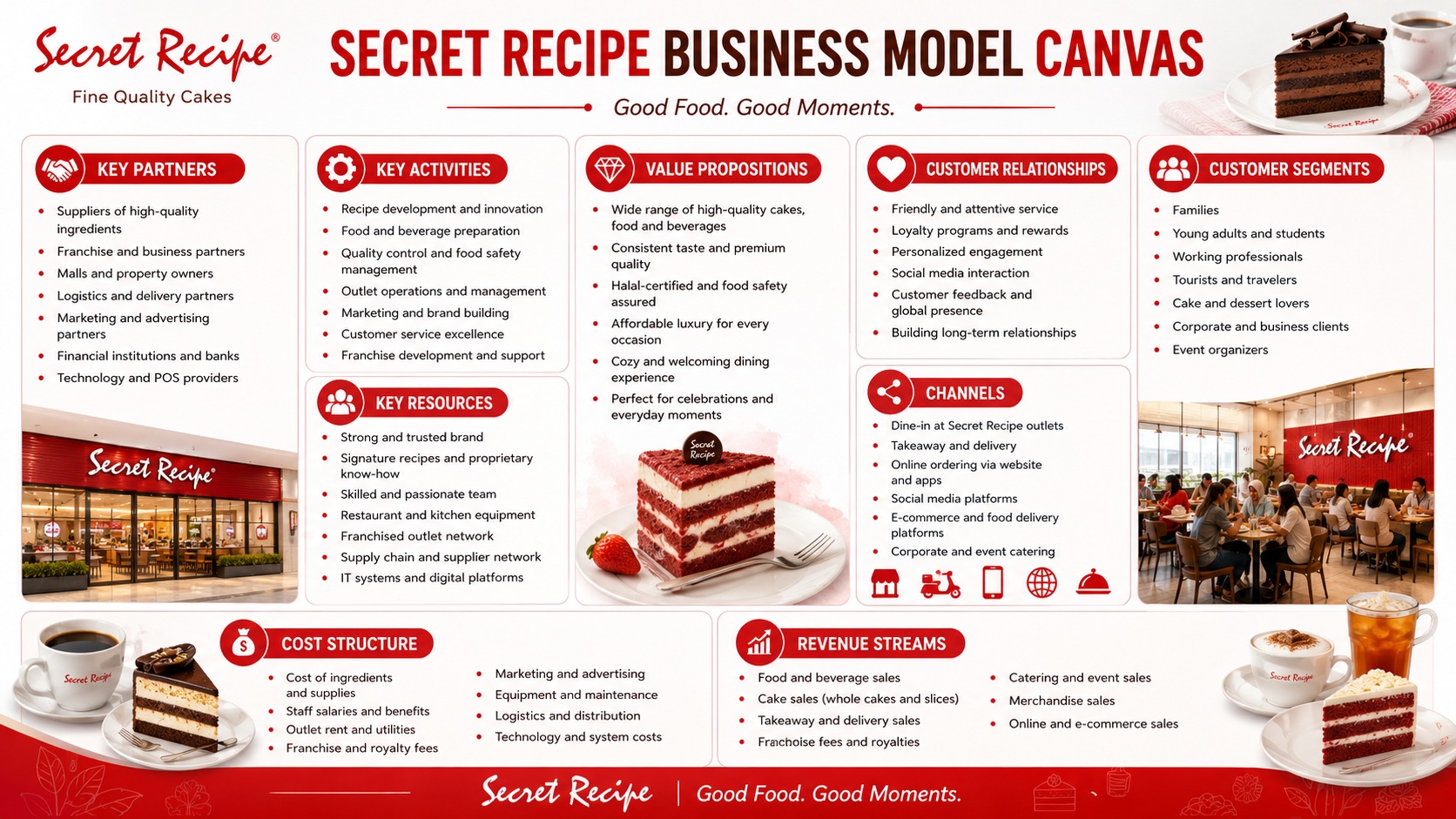
Before going into each block in detail, the summary below gives a quick view of how Secret Recipe’s business works. It provides a compact snapshot of the full model before we move into deeper analysis, making it easier to see how the main building blocks connect. This summary also helps readers understand why Secret Recipe is more than a cake chain and how its café, celebration, and convenience-driven demand work as one commercial system.
| BMC Block | Secret Recipe Application |
|---|---|
| Customer Segments | Families, casual diners, working professionals, students, celebration buyers, and corporate or group purchasers. |
| Value Propositions | Signature cakes, broad café menu, affordable premium experience, and convenient access through outlets and digital ordering. |
| Channels | Café outlets, takeaway, self-pickup, online ordering, digital promotions, and third-party delivery or gifting channels. |
| Customer Relationships | In-store service, membership offers, seasonal promotions, celebration relevance, and digital engagement. |
| Revenue Streams | Dine-in meals, beverages, cake sales, takeaway and delivery, and franchise-related income. |
| Key Resources | Brand equity, recipes and menu standards, outlet network, people, operating systems, and service know-how. |
| Key Activities | Product preparation, quality control, outlet operations, menu innovation, marketing, and franchise coordination. |
| Key Partnerships | Ingredient suppliers, franchisees, mall or property partners, packaging providers, and delivery platform partners. |
| Cost Structure | Ingredients, labour, rental, utilities, marketing, systems, and franchise or support operations. |
The diagram below gives a visual summary of how the main blocks of Secret Recipe’s business model connect in one view. It helps readers move from the written explanation into a simpler strategic snapshot before continuing to the detailed block-by-block analysis.
The Secret Recipe Business Model Canvas becomes clearer when each of the nine building blocks is examined in detail. While the summary table gives a high-level snapshot, the deeper analysis below explains how the model works commercially, where its strengths come from, and why the different blocks reinforce one another.
This section also shows that Secret Recipe’s business is not driven by one product alone. Its performance depends on how customer demand, brand positioning, outlet execution, convenience, and operating discipline come together as one integrated system.
Customer segments explain who Secret Recipe serves and why those buyers matter. The brand targets a broad middle-market audience, but its real strength comes from serving several demand pools at the same time. It reaches customers looking for routine café dining, dessert indulgence, social meetups, celebration purchases, and convenient takeaway solutions.
That matters because foodservice demand is not uniform. A family visiting on the weekend, an office worker having lunch in a mall, and a customer buying a birthday cake all represent different spending motivations. Secret Recipe performs well when it captures these different moments without losing a coherent brand identity.
The company therefore benefits from wide relevance rather than dependence on one narrow customer type.
| Segment | Details | Why It Matters |
|---|---|---|
| Families and casual diners | Customers visiting for meals, desserts, and shared occasions | Supports steady dine-in traffic across lunch, dinner, and weekends |
| Working professionals and students | Buyers seeking convenient café meals, beverages, and accessible meeting spots | Drives weekday frequency in urban and mall-based locations |
| Celebration buyers | Customers purchasing cakes for birthdays, events, and gifting occasions | Creates emotionally driven, higher-value transactions |
| Corporate and group buyers | Offices, organizers, and teams needing cakes, vouchers, or larger orders | Adds non-routine volume beyond normal walk-in traffic |
Secret Recipe wins because it serves both everyday consumption and event-based demand. One part of the model creates frequency, while another creates occasion value. That is why the Secret Recipe Business Model Canvas is strong in this block. It gives the company broader purchase occasions, more customer layers, and less dependence on one single type of visit.
The value proposition explains why customers choose Secret Recipe repeatedly over alternative cafés, bakeries, and casual dining brands. Secret Recipe offers more than cake. It delivers recognizable desserts, broad menu choice, modern café ambience, and a premium feel that remains affordable for mainstream consumers.
That matters because food choices are often made quickly. Customers do not always compare every menu line in detail. Familiarity, trust, atmosphere, portion suitability, and perceived value often influence the decision more than technical product differences.
Secret Recipe strengthens its offer by serving several need states at once, from indulgence and celebration to convenience and routine dining.
| Value Proposition | Details | Why It Matters |
|---|---|---|
| Signature cakes and desserts | Recognizable cakes with strong celebration and gifting appeal | Gives the brand a differentiated emotional reason to be chosen |
| Broad café menu | Meals, beverages, desserts, and periodic menu refreshes | Expands spending occasions beyond cake purchases |
| Affordable premium experience | Polished ambience and perceived quality at moderate prices | Attracts mainstream consumers without losing aspirational appeal |
| Convenient access | Mall presence, takeaway, online ordering, and gift-related purchases | Makes it easier for customers to buy across many situations |
Customers do not choose Secret Recipe only because a slice of cake looks appealing. They often choose familiarity, trusted quality, menu breadth, and a café environment suitable for different occasions. The Secret Recipe Business Model Canvas becomes stronger because the company spreads value across indulgence, dining, convenience, and emotional relevance. That gives Secret Recipe a more resilient proposition than a business built only around desserts.
Channels explain how Secret Recipe reaches customers and converts demand into repeat sales. In café businesses, channel design is not a support function. It is a major part of the commercial model. Secret Recipe depends on strong outlet visibility, convenient takeaway, and increasingly relevant digital access to stay close to customer demand.
The company uses physical stores, self-pickup, digital ordering touchpoints, and third-party delivery or gifting-related access to capture both planned and spontaneous purchases. That is important because consumption does not happen in one setting. A customer may dine in for lunch, collect a whole cake for an event, and later place a delivery order from home.
This channel system keeps the brand connected to daily life and occasional celebration at the same time.
| Channel | Details | Why It Matters |
|---|---|---|
| Café outlets | Physical stores in urban and mall locations | Creates visibility, dine-in experience, and impulse traffic |
| Takeaway and self-pickup | Customers buying cakes or meals without dining in | Improves convenience and speed of service |
| Online ordering and app touchpoints | Digital order flows, promotions, vouchers, and membership access | Supports repeat purchase and convenience-led demand |
| Third-party delivery and gifting | Delivery, e-vouchers, and related digital redemption options | Extends reach beyond physical visits |
Channel breadth gives Secret Recipe more than simple access. It also creates visibility, routine exposure, occasion readiness, and purchase flexibility. The Secret Recipe Business Model Canvas shows that strong channels do not only deliver transactions. They reinforce brand memory, improve convenience, and help defend share against fragmented café competition.
Customer relationships describe how Secret Recipe stays relevant, trusted, and repeatedly chosen. These relationships operate at two levels. One level is customer-facing through service quality, promotions, social engagement, and occasion relevance. The other is habit-facing, where consistency and convenience turn the brand into a repeat choice.
That dual structure matters because café loyalty is rarely driven by emotional appeal alone. A customer may like the brand, but repeat visits still depend on service speed, pricing fairness, product quality, and ease of ordering.
Secret Recipe therefore builds loyalty through both familiarity and dependable execution.
| Relationship Type | Details | Why It Matters |
|---|---|---|
| In-store service experience | Friendly service, speed, presentation, and ambience | Shapes perception during each visit |
| Membership and promotions | Rewards, special offers, vouchers, and seasonal campaigns | Encourages repeat buying and data-led engagement |
| Celebration relevance | Birthdays, gatherings, gifting, and festive moments | Builds emotional connection beyond functional dining |
| Social and digital interaction | Updates, campaigns, and customer touchpoints online | Keeps the brand visible between visits |
Customer loyalty in this category is rarely purely emotional or purely rational. Secret Recipe must keep the brand desirable while also making the purchase experience easy and reliable. The Secret Recipe Business Model Canvas is strong in this block because customer relationships are reinforced not only through image and occasion marketing, but also through everyday service consistency that supports repeat demand.
Revenue streams explain how Secret Recipe converts brand demand into cash flow. A major strength of the model is that revenue does not depend on one format, one meal period, or one purchase reason.
The company earns through dine-in food and beverages, whole cakes, sliced desserts, takeaway, delivery, and franchise-related income. That matters because café brands with only one strong product category often struggle when consumer traffic shifts or occasion demand becomes uneven.
Secret Recipe generates value by combining routine spend with special-occasion purchases.
| Revenue Stream | Details | Why It Matters |
|---|---|---|
| Dine-in food and beverages | Meals, drinks, and add-on dessert purchases | Generates recurring everyday revenue |
| Cake sales | Whole cakes, slices, seasonal products, and celebration orders | Delivers strong brand-linked spending and emotional value |
| Takeaway and delivery | Off-premise food and dessert purchases | Captures convenience-driven demand |
| Franchise-related income | Expansion and network-related commercial flows | Supports scale with lower direct capital intensity |
Customers may enter the brand through one product but often spend across several categories over time. Cakes create identity, meals and beverages improve visit frequency, and franchise economics support growth. That is why the Secret Recipe Business Model Canvas is more balanced than a model built only on occasional celebration purchases.
Key resources explain what Secret Recipe must control to make the model work consistently. In café chains, brand alone is not enough. Product standards, location quality, people capability, and operating systems are equally important.
That matters because recognition can attract trial, but only consistency protects loyalty. A customer who buys from the brand in one city expects similar quality, presentation, and service elsewhere.
Secret Recipe therefore depends on a combination of intangible and operational assets.
| Key Resource | Details | Why It Matters |
|---|---|---|
| Brand and reputation | Strong recognition in cakes and café dining | Lowers trust barriers and supports repeat visits |
| Recipes, menu know-how, and product standards | Core product knowledge and consistency controls | Protects taste expectations across outlets |
| Outlet network and locations | Presence in malls and urban traffic areas | Increases accessibility and top-of-mind visibility |
| People and operating systems | Kitchen teams, service staff, training, and execution routines | Converts the brand promise into actual experience |
These resources reinforce one another. Brand drives awareness, recipes protect product identity, locations create access, and people deliver the experience. The Secret Recipe Business Model Canvas depends heavily on this resource combination because any major weakness in consistency can dilute the value of the entire network.
Key activities explain what Secret Recipe must do well to sustain performance at scale. In foodservice, execution failure becomes visible very quickly. Slow service, inconsistent cakes, weak availability, or poor store experience can damage repeat demand even when brand awareness remains high.
The company therefore needs disciplined daily execution across product quality, operations, marketing, and network support. It must also refresh demand often enough to stay relevant in a crowded market.
Operational excellence is not optional here. It is central to commercial survival.
| Activity | Details | Why It Matters |
|---|---|---|
| Product preparation and quality control | Maintaining taste, freshness, and presentation | Protects trust and repeat purchase |
| Outlet operations and service delivery | Running efficient dine-in, takeaway, and front-line service | Sustains satisfaction and outlet productivity |
| Menu innovation and promotion | Refreshing offers, bundles, and seasonal campaigns | Keeps the brand relevant and commercially active |
| Franchise and supply coordination | Supporting network standards and ingredient flow | Preserves scale without damaging consistency |
A café chain cannot rely on branding if service is slow, food is inconsistent, or products are unavailable. The Secret Recipe Business Model Canvas works only when execution remains reliable across outlets, formats, and purchase occasions. This is one of the most operationally demanding parts of the model.
Key partnerships explain who helps Secret Recipe scale efficiently and serve customers consistently. Not every capability needs to be fully internal, but partner quality strongly affects the customer experience.
That matters because ingredient quality, location quality, delivery reliability, and franchise discipline all sit partly outside direct day-to-day control. A weak partner can quickly become a brand problem.
Secret Recipe therefore depends on partnerships not only for growth, but also for system stability.
| Partner Type | Details | Why It Matters |
|---|---|---|
| Ingredient and packaging suppliers | Providers of food inputs and operational materials | Support quality consistency and cost control |
| Franchise operators | Partners extending outlet reach | Accelerate expansion and local execution |
| Delivery and digital platform partners | Third-party fulfillment and promotional ecosystems | Expand convenience and customer access |
| Property and mall partners | Landlords and site partners in strategic locations | Influence traffic, visibility, and outlet economics |
Partnerships are not secondary in this business. They shape service reliability, growth speed, and unit profitability. The Secret Recipe Business Model Canvas becomes stronger when partners help the company scale without weakening consistency, which is one of the hardest things for a regional café chain to maintain.
Cost structure explains where Secret Recipe spends money to operate and grow. The business must balance quality, accessibility, and outlet economics at the same time. That makes cost discipline especially important.
The largest pressures come from ingredients, labour, rental, and operating support. Marketing, systems, and franchise coordination also matter because the brand must remain visible and well-managed as the network expands.
This cost profile is commercially important because Secret Recipe competes in an affordable premium position. It cannot drift too far upward on price, but it also cannot allow quality to fall in order to cut cost.
| Cost Area | Details | Why It Matters |
|---|---|---|
| Ingredients and food production | Raw materials, desserts, meal components, and packaging | Directly affect quality perception and gross margin |
| Labour and outlet operations | Kitchen, service, supervision, and support functions | Essential to customer experience and execution consistency |
| Rental and occupancy | Mall and urban location costs | Major fixed-cost driver in café economics |
| Marketing, systems, and franchise support | Promotions, digital tools, and network coordination | Needed to sustain growth and repeat demand |
The tension is clear. Secret Recipe must preserve quality and a premium feel without letting costs undermine affordability. That makes mix management, service productivity, assortment discipline, and outlet efficiency critical to long-term profitability.
Before comparing Secret Recipe with OldTown White Coffee, it is useful to look at how Secret Recipe creates fit between what customers want and what the company delivers. That is the purpose of Value Proposition Canvas, or VPC. While Business Model Canvas explains the overall structure of the company, VPC focuses more closely on the link between customer needs and the company’s actual offer.
For Secret Recipe, this framework is especially relevant because the business serves several dining and purchase occasions rather than just one transaction moment. It must match celebration demand, casual café dining, dessert indulgence, convenience, and affordable premium expectations across a broad but recognizable brand offer.
In simple terms, VPC helps explain why the Secret Recipe Business Model Canvas works so well in practice. It shows how Secret Recipe aligns customer jobs, pains, and gains with signature cakes, café meals, service experience, location accessibility, and digital convenience.
The customer profile looks at what Secret Recipe’s target customers are trying to achieve, what frustrates them, and what outcomes they value most. Because Secret Recipe serves a broad café market, the profile below reflects common patterns across celebration purchases, dine-in occasions, dessert buying, and convenient takeaway use.
| Customer Profile | Details |
|---|---|
| Customer Jobs | Buy cakes for birthdays and celebrations, enjoy café meals, meet friends or colleagues, choose a comfortable place to dine, and order desserts or takeaway food conveniently. |
| Customer Pains | Inconsistent cake quality, limited menu variety, inconvenient ordering, poor café ambience, weak service, and prices that feel too high for a casual premium experience. |
| Customer Gains | Reliable celebration solutions, enjoyable dine-in experience, menu variety, trusted quality, easy access, affordable indulgence, and a brand that feels suitable for both routine and special occasions. |
This profile shows that Secret Recipe does not win only through dessert appeal. It wins by reducing uncertainty, increasing convenience, and giving customers a dependable option that can work across both emotional and everyday purchase moments.
The value map explains how Secret Recipe responds to those customer jobs, pains, and gains. In this case, the company uses a multi-occasion café strategy rather than relying only on one product category. It creates fit by offering cakes, meals, beverages, café ambience, gifting relevance, and accessible ordering across one brand system.
That matters because customers do not always want the same thing. Some want a whole cake for an event, others want a lunch venue, and many simply want a familiar café option with desserts and beverages in one place. Secret Recipe’s value map works because it addresses those variations without moving too far away from its core identity.
| Value Map | Details |
|---|---|
| Products and Services | Signature cakes, cake slices, café meals, beverages, takeaway options, celebration purchases, digital ordering touchpoints, and accessible outlet locations. |
| Pain Relievers | Quality consistency reduces purchase uncertainty, broad menu variety reduces the need to switch brands, digital access reduces ordering friction, and affordable premium pricing improves value perception. |
| Gain Creators | Recognizable cakes, comfortable café experience, reliable occasion relevance, broad menu choice, trusted brand familiarity, and convenient access across dine-in and takeaway situations. |
This value map shows why Secret Recipe’s business model is commercially effective. The company does not depend on only one hero product. It creates value by serving different emotional and functional needs through one coordinated café and cake proposition.
The table below shows how customer needs and Secret Recipe’s value offer connect more directly. This format matches customer-side needs with company-side value creation in a clear and structured way.
| Customer Profile | Details | Matching Value Map | How Secret Recipe Creates Fit |
|---|---|---|---|
| Customer Jobs | Customers want reliable cakes for celebrations, enjoyable café meals, convenient takeaway choices, and a comfortable place for casual meetings or social occasions. | Products and Services | Secret Recipe offers signature cakes, café dining, takeaway options, and accessible outlet locations, allowing one brand to serve both routine and occasion-based needs. |
| Customer Pains | Customers face inconsistent quality, limited variety, inconvenient ordering, uninspiring café environments, and prices that may feel too high for the experience delivered. | Pain Relievers | Secret Recipe reduces these frictions through quality control, broad menu selection, digital ordering touchpoints, familiar ambience, and affordable premium positioning. |
| Customer Gains | Customers value trust, convenience, menu breadth, celebration relevance, and a sense of indulgence without needing to spend at a luxury level. | Gain Creators | Secret Recipe creates those gains through recognizable cakes, a modern café setting, repeat-friendly brand familiarity, convenient access, and products that feel suitable for both everyday and special occasions. |
The fit is strong because Secret Recipe does not solve only one problem. It helps customers choose a familiar brand for celebration, dining, dessert, and convenience-led occasions without much decision friction. That is an important reason the Secret Recipe Business Model Canvas remains resilient in a competitive café and casual dining market.
The strongest fit happens in everyday and occasion-based moments where customers want something dependable, convenient, and slightly special without becoming expensive or complicated. Secret Recipe performs well when customers need a birthday cake they can trust, a café meal in a comfortable setting, a dessert option for social gatherings, or a familiar takeaway choice from an accessible outlet.
This is where Secret Recipe’s multi-occasion logic matters most. A narrower bakery may solve only dessert demand. A standard casual dining outlet may solve only meal demand. Secret Recipe can create fit across several emotional and functional moments at once. That broader relevance helps explain why the Secret Recipe Business Model Canvas remains competitive even under cost pressure, fragmented café competition, and shifting consumer preferences.
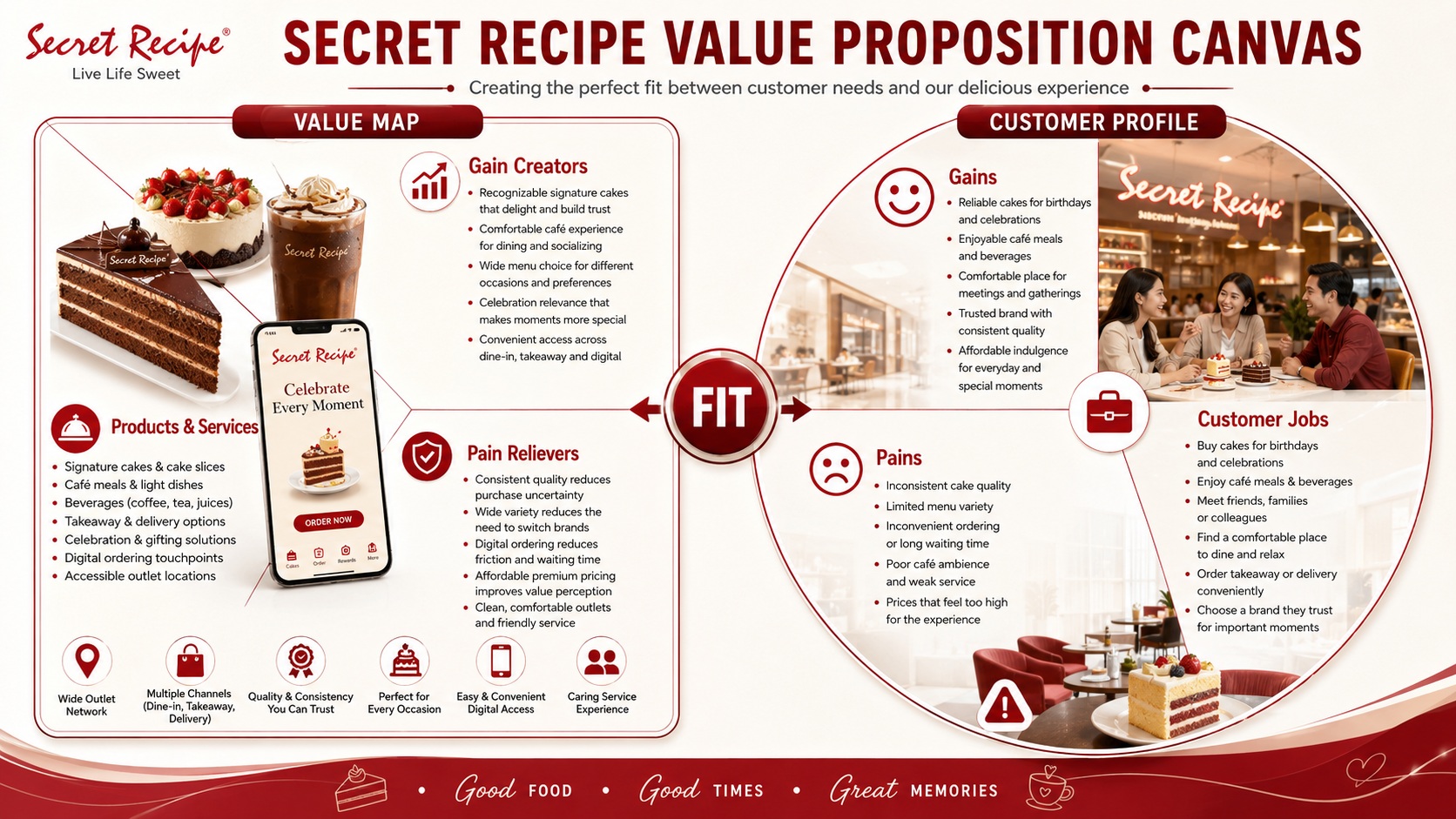
The following is VPC diagram of Secret Recipe. It gives a visual view of how customer jobs, pains, and gains connect with Secret Recipe’s products and services, pain relievers, and gain creators.
Secret Recipe value proposition canvas:
Both brands are useful to compare because they compete in broadly similar café and casual dining spaces, appeal to mainstream consumers, and expand through outlet-led networks. Even so, each brand is built on a different economic logic, which makes the contrast strategically meaningful.
| Dimension | Secret Recipe | OldTown White Coffee |
|---|---|---|
| Core demand anchor | Cakes, café meals, and celebration occasions | Coffee-led dining and heritage beverage identity |
| Brand role | Affordable premium lifestyle café | Familiar white coffee and kopitiam-inspired brand |
| Revenue logic | Mix of cakes, meals, beverages, takeaway, and occasion demand | Stronger dependence on beverage-led visits plus meals |
| Occasion strength | Celebrations, gifting, desserts, and social dining | Everyday coffee, routine meals, and casual meetups |
Secret Recipe is stronger when customers want indulgence, gifting, or a more polished café experience. OldTown is stronger when customers prioritize coffee familiarity and habitual everyday value. In short, one brand monetizes emotional dessert-led occasions more effectively, while the other is built more firmly around beverage habit and heritage familiarity.
Secret Recipe’s competitive advantages come from how well it combines emotional cake-led demand with everyday café relevance. The brand is not competing only on taste or only on price. It is competing through familiarity, accessibility, multi-occasion usage, and a premium feel that remains within reach of mainstream consumers.
The points below show why the business model is defensible and why Secret Recipe has stayed distinctive in a crowded foodservice market.
Despite its strong brand position, Secret Recipe still operates in a category where margins, customer expectations, and competitive pressure can shift quickly. The business must manage not only external market risks, but also operating risks that can weaken consistency, customer trust, and long-term profitability.
The following challenges are the most important ones shaping the future performance of Secret Recipe’s business model.
The next phase of Secret Recipe’s growth should focus on strengthening the parts of the model that improve repeat demand, protect margins, and preserve brand consistency. Strategic recommendations are therefore not only about expansion. They are also about making the current business more resilient in a market shaped by rising costs, fragmented competition, and changing customer expectations.
The following priorities would help Secret Recipe improve long-term performance while protecting the strengths that already define the brand.
Secret Recipe should strengthen direct digital engagement rather than depend too heavily on third-party platforms. A stronger owned membership and ordering ecosystem would improve retention, margin visibility, and customer data quality.
Menu innovation should also become more deliberate. Lighter desserts, clearer nutritional positioning, limited-time café offers, and better-for-you beverage options can widen relevance without weakening the brand’s indulgent core.
Operationally, outlet consistency deserves constant management attention. Training, service standards, product quality control, and store experience discipline should remain central, especially as the network scales.
Another recommendation is to deepen occasion-based marketing. Secret Recipe already has natural strength in birthdays, gifting, and festive moments. That advantage can be extended through bundles, corporate offers, premium seasonal launches, and stronger event-led campaigns.
Management should also keep balancing affordability with premium perception. That balance is one of the hardest qualities for competitors to copy and one of the biggest reasons the brand remains commercially distinctive.
The Secret Recipe Business Model Canvas shows a business built on more than cakes. Secret Recipe combines affordable premium positioning, emotional dessert equity, outlet visibility, menu breadth, and multi-occasion demand into a model that is accessible, scalable, and commercially resilient.
Its strength comes from linking celebration purchases with everyday café traffic. That gives the company broader revenue logic than many single-category food brands. The model also benefits from a recognizable identity that travels well across dine-in, takeaway, gifting, and digital touchpoints.
At the same time, long-term success will depend on disciplined execution. Cost control, service consistency, menu relevance, and stronger direct customer relationships will determine whether Secret Recipe continues to lead rather than simply remain visible.
Viewed strategically, the Secret Recipe Business Model Canvas remains a strong example of how a regional café brand can turn indulgence, convenience, and operating scale into a durable competitive advantage.
This article is provided for educational and business analysis purposes only. Its content is based on publicly available information, general market observations, and strategic interpretation. It does not constitute financial advice, investment advice, legal advice, or an official statement from Secret Recipe Cakes & Café Sdn. Bhd. Readers should conduct their own research before making any business, investment, or strategic decisions.
All trademarks, logos, copyrights, brand names, and related materials mentioned or shown in this article belong to their respective owners.
Explore the CARPUT Business Model Canvas, nine BMC blocks, Value Proposition Canvas, competitor comparison, competitive… Read More
Explore the Boost Business Model Canvas, nine BMC blocks, Value Proposition Canvas, competitor comparison, advantages,… Read More
Explore the Domino's Pizza Business Model Canvas, nine BMC blocks, Value Proposition Canvas, Pizza Hut… Read More
Explore the Mie Gacoan Business Model Canvas, including its customer segments, value propositions, revenue streams,… Read More
Restaurant Business Model Canvas: A Practical Guide to Designing, Evaluating, and Improving Restaurant Business Models… Read More
Learn how the Food and Beverage Business Model Canvas helps restaurants, cafés, beverage brands, and… Read More