FedEx Business Model Canvas
Explore the FedEx Business Model Canvas, nine BMC blocks, Value Proposition Canvas, UPS and DHL comparison, competitive advantages, risks, and strategic recommendations.
Pepsi business model canvas using the BMC framework. Explore PepsiCo’s customer segments, value proposition, revenue streams, competitive advantages, risks, and key differences from Coca-Cola in this updated 2026 article.
BMC Article No: BMC #045. Updated in 2026: This article has been refreshed with newer company scale, updated 2025 business performance context, sharper comparison with Coca-Cola, deeper analysis for every BMC block, expanded risks and recommendations, and a more refined article structure.
PepsiCo is no longer just a cola company. It is a global food and beverage operator built around scale, brand power, route-to-market reach, and portfolio diversification across carbonated drinks, sports drinks, water, juice, snacks, and convenient foods.
The Pepsi Business Model Canvas matters because PepsiCo does not rely on one product, one brand, or one consumption occasion. Instead, it grows by serving many moments of demand, from impulse beverage purchases to at-home snacking, sports hydration, and value-driven family consumption.
That broader structure makes Pepsi strategically interesting. Unlike a pure-play soft drink player, PepsiCo can use snacks and beverages together to strengthen shelf presence, distributor relevance, and revenue resilience.
PepsiCo operates a branded consumer goods business model supported by large-scale manufacturing, bottling, distribution, category management, and marketing. It sells through retail, foodservice, e-commerce, vending, and wholesale channels across many countries.
At its core, the Pepsi Business Model Canvas shows a company that earns through volume, pricing power, channel breadth, and portfolio balance. Beverages attract attention and refreshment occasions. Snacks increase frequency, margin mix, and cross-category strength.
This design matters because PepsiCo can spread risk across categories. When one segment faces pressure, another can help stabilise performance.
Business Model Canvas, or BMC, is a practical framework used to explain how a company creates value, delivers that value, and captures revenue. Rather than looking only at products, it maps the operating logic behind the business.
For PepsiCo, BMC is especially useful because success depends on more than branding alone. Manufacturing scale, retail execution, product innovation, promotional intensity, and supplier coordination all affect results.
That is why the Pepsi Business Model Canvas is a useful lens. It shows how customer reach, category breadth, and operating discipline work together as one commercial system.
| BMC Block | Main Question |
|---|---|
| Customer Segments | Who does the business serve? |
| Value Propositions | What value does the business offer? |
| Channels | How does the business reach customers? |
| Customer Relationships | How does the business build loyalty? |
| Revenue Streams | How does the business make money? |
| Key Resources | What assets does the business need? |
| Key Activities | What must the business do well? |
| Key Partnerships | Who helps the business operate? |
| Cost Structure | What are the major costs? |
PepsiCo traces its roots to Pepsi-Cola and later became a much broader company after combining with Frito-Lay in 1965. Since then, the group has expanded into categories such as sports drinks, juice, oats, convenient foods, and at-home beverage systems.
Today, PepsiCo describes itself as a global beverage and convenient food company whose products are consumed more than one billion times a day in over 200 countries and territories. Its 2025 net revenue was reported at nearly $94 billion, underlining how large and diversified the company has become.
Scale matters here because brand owners with broad category presence usually gain stronger shelf leverage, more marketing efficiency, and better bargaining power with retailers.
PepsiCo is strategically interesting because it competes with a portfolio logic rather than a single-brand logic. A retailer does not buy only Pepsi cola. It buys a system that may include Lay’s, Doritos, Cheetos, Gatorade, Mountain Dew, Quaker, and other brands serving different demand occasions.
That creates a stronger commercial position. Shelf access can improve because PepsiCo matters across multiple aisles. Consumer relevance also becomes wider because the company participates in refreshment, indulgence, convenience, hydration, and better-for-you categories at the same time.
Another advantage comes from execution flexibility. Management can push premiumisation, affordability packs, innovation, or promotional support depending on market conditions.
In 2026, the Pepsi Business Model Canvas is shaped by four visible shifts. First, the company is leaning harder into its combined food-and-drink model rather than treating beverages as the whole story. Second, affordability and value are becoming more important as consumers remain price-sensitive in many markets.
Third, health and wellness pressure continues to influence innovation, especially in zero sugar, portion control, hydration, and better-for-you categories. Fourth, execution quality in North America matters more because snacks and beverages there still influence both scale and investor expectations.
Together, these shifts make PepsiCo’s model more demanding operationally, but also more defensible if it balances brand strength with disciplined execution.
Before going into each block in detail, the summary below gives a quick view of how PepsiCo’s business works. It provides a compact snapshot of the full model before we move into deeper analysis, making it easier to see how the main building blocks connect. This summary also helps readers understand why PepsiCo is more than a beverage company and how its snack-and-drink portfolio works as one commercial system.
| BMC Block | PepsiCo Application |
|---|---|
| Customer Segments | Mass consumers, youth segments, families, health-aware buyers, retailers, foodservice operators, and wholesale channel partners. |
| Value Propositions | Strong brands, broad portfolio, convenience, reliable availability, and products for many taste, price, and usage occasions. |
| Channels | Modern trade, traditional trade, foodservice, vending, e-commerce, wholesale, and distributor-led market access. |
| Customer Relationships | Brand campaigns, promotions, merchandising, loyalty through familiarity, and trade support for retail partners. |
| Revenue Streams | Beverage sales, snack sales, away-from-home consumption, innovation-led product mix, and premium or value-based pack architecture. |
| Key Resources | Brand portfolio, manufacturing assets, distribution network, trade relationships, people, R&D capability, and marketing power. |
| Key Activities | Manufacturing, supply execution, brand building, innovation, merchandising, pricing, and channel management. |
| Key Partnerships | Retailers, suppliers, distributors, foodservice operators, bottling and logistics partners, and marketing collaborators. |
| Cost Structure | Ingredients, packaging, logistics, production, promotions, people, technology, and product development. |
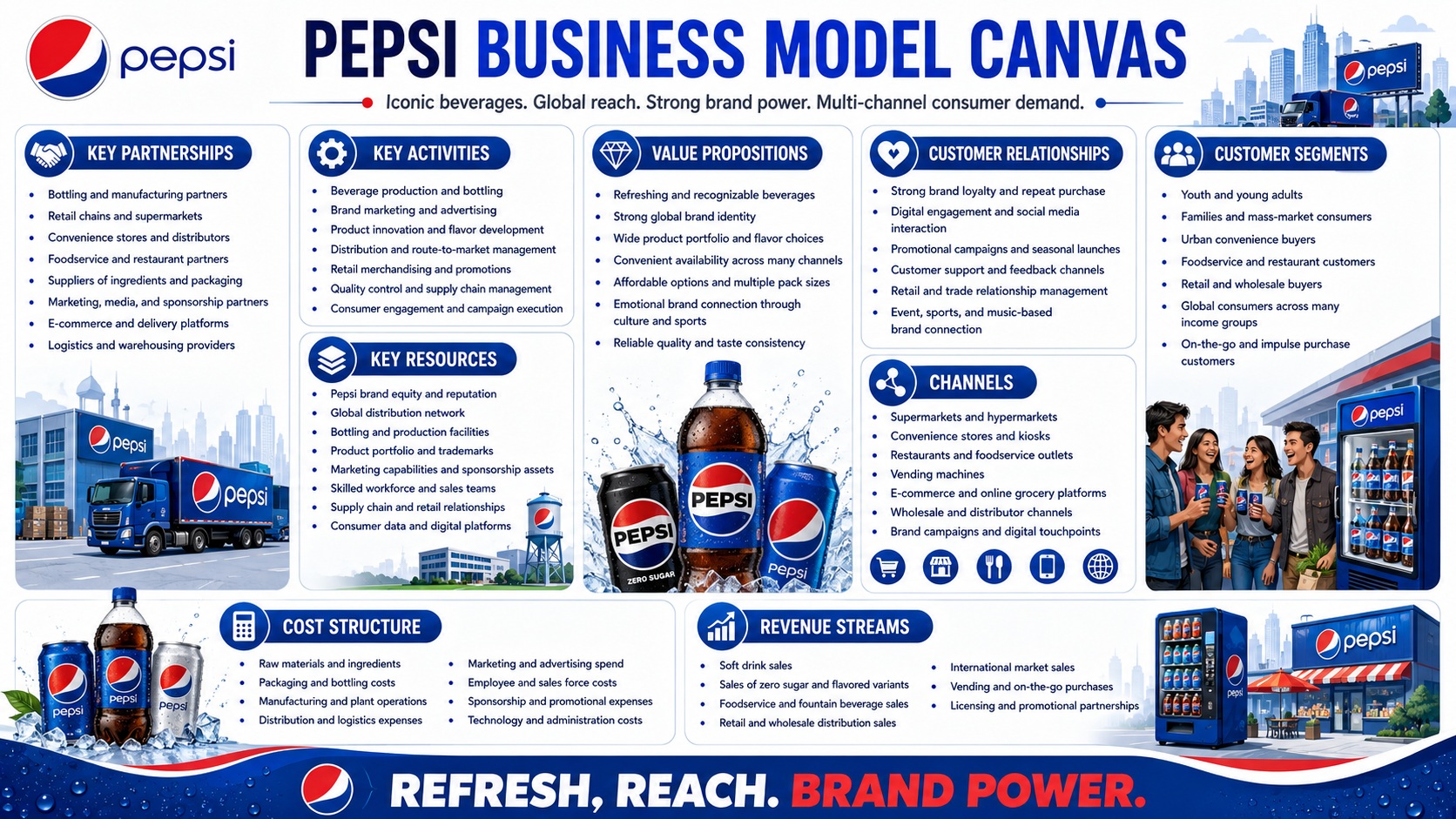
The diagram below gives a visual summary of how the main blocks of PepsiCo’s business model connect in one view. It helps readers move from the written explanation into a simpler strategic snapshot before continuing to the detailed block-by-block analysis.
Pepsi business model canvas:
Customer segments explain who PepsiCo serves and why those buyers matter. PepsiCo targets a mass market, but its real strength comes from serving many demand pools at the same time. It reaches consumers across age groups, income levels, consumption occasions, and taste preferences, while also serving trade customers that need dependable high-volume brands.
That mix matters because PepsiCo is present in both immediate-consumption and at-home consumption settings. A teenager buying Mountain Dew at a convenience store, a family buying Lay’s and Pepsi for a gathering, and a foodservice operator stocking beverages for high footfall venues all sit inside the same business model.
The company therefore benefits from wide relevance rather than narrow audience dependence.
| Segment | Details | Why It Matters |
|---|---|---|
| Mass consumers | Broad base of everyday buyers purchasing soft drinks, snacks, and take-home packs across many outlets | Creates volume stability, supports scale economics, and keeps PepsiCo relevant in routine consumption |
| Youth and pop-culture buyers | Consumers drawn to energetic brands, flavour variety, music, sports, and trend-led beverage occasions | Helps PepsiCo maintain cultural visibility and refresh brand relevance in younger segments |
| Health-aware consumers | Buyers looking for zero sugar drinks, hydration, portion control, oats, and lighter food-and-drink choices | Allows PepsiCo to participate in wellness-driven demand instead of relying only on indulgence |
| Institutional and channel buyers | Retailers, foodservice operators, vending partners, wholesalers, and other route-to-market intermediaries | Strengthens distribution reach, shelf access, and recurring sales across multiple consumption settings |
PepsiCo wins because it serves both end consumers and commercial buyers. One part of the model generates pull through brand demand, while another secures push through retail and distribution relationships. That is why the Pepsi Business Model Canvas is strong here. It gives PepsiCo multiple customer layers, broader purchase occasions, and less dependence on one narrow demographic or one single drinking moment.
The value proposition explains why consumers and channel partners choose PepsiCo products repeatedly. PepsiCo offers more than taste. It delivers brand recognition, portfolio choice, convenience, and dependable availability across many categories.
That matters because fast-moving consumer goods are often bought quickly. Consumers usually do not spend much time analysing each purchase. Familiarity, visibility, trust, and format suitability often influence the decision more than technical product features.
PepsiCo strengthens its value by serving several demand occasions at once, from refreshment and indulgence to hydration, convenience, and family sharing.
| Value Proposition | Details | Why It Matters |
|---|---|---|
| Wide portfolio | Portfolio spans carbonated drinks, sports hydration, water, juice, oats, and convenient snacks for different tastes and needs | Enables PepsiCo to serve more occasions, reduce category dependence, and capture broader household demand |
| Strong brands | Established brands such as Pepsi, Gatorade, Lay’s, Doritos, and Quaker carry strong recognition and consumer trust | Reduces decision friction at the shelf and increases the probability of repeat purchase |
| Innovation and variation | Product updates include new flavours, zero sugar formats, pack-size changes, and occasion-based launches | Keeps the offer current as consumer preferences shift across health, taste, and affordability needs |
| Convenient access | Products are widely available through supermarkets, convenience stores, foodservice, vending, and digital channels | Makes purchase easy in both planned and impulse situations, supporting frequency and market share |
Customers do not choose PepsiCo only because one flagship product tastes good. They often choose familiarity, trusted quality, multiple options, and immediate availability in the place where they are shopping. The Pepsi Business Model Canvas becomes stronger because the company spreads value across categories, brands, pack sizes, and consumption moments. That gives PepsiCo a more resilient proposition than a business built around one narrower product type.
Channels explain how PepsiCo reaches customers and converts demand into repeat sales. In consumer packaged goods, distribution is not a support function. It is a strategic weapon. PepsiCo depends on broad and deep channel coverage so its brands are visible, stocked, and easy to buy across many settings.
The company uses modern trade, traditional trade, foodservice, wholesale, vending, and digital commerce to capture both planned and impulse purchases. That is important because consumer demand does not happen in one place. A shopper may buy snacks in a supermarket, a drink in a convenience outlet, and bundled products again in a foodservice venue.
This multi-channel system keeps the brand close to daily life.
| Channel | Details | Why It Matters |
|---|---|---|
| Modern retail | Supermarkets, hypermarkets, and organised retail chains with strong footfall and broad category assortment | Generates large-scale sales, supports promotions, and improves visibility across multiple product lines |
| Traditional retail | Convenience stores, neighbourhood shops, kiosks, and smaller high-frequency outlets | Captures immediate-consumption and impulse purchases in everyday local settings |
| Foodservice | Restaurants, entertainment venues, stadiums, and other away-from-home consumption channels | Expands brand presence beyond retail and creates additional consumption occasions |
| Digital and e-commerce | Online marketplaces, quick-commerce platforms, and other digitally enabled ordering channels | Improves convenience, supports targeted offers, and gives PepsiCo better access to demand signals and shopper data |
Distribution breadth gives PepsiCo more than physical reach. It also creates visibility, checkout presence, cooler space, promotional display opportunities, and routine consumer exposure. The Pepsi Business Model Canvas shows that strong channels do not only deliver units sold. They reinforce brand memory, protect market share, and make it harder for smaller rivals to compete consistently.
Customer relationships describe how PepsiCo keeps its brands relevant, visible, and repeatedly chosen. These relationships operate at two levels. One level is consumer-facing through campaigns, promotions, sponsorships, and digital engagement. The other is trade-facing through retailer support, merchandising, category management, and joint activation.
That dual structure matters because fast-moving brands are rarely sustained by advertising alone. A customer may like the brand, but the purchase still depends on price point, pack availability, display quality, and promotional timing.
PepsiCo therefore builds loyalty through both emotional connection and execution discipline.
| Relationship Type | Details | Why It Matters |
|---|---|---|
| Brand engagement | Advertising, celebrity and sports associations, cultural campaigns, and event-led brand activation | Builds emotional connection, increases recall, and shapes long-term consumer preference |
| Promotional loyalty | Bundles, contests, seasonal campaigns, limited editions, and price-led purchase incentives | Encourages repeat buying, trial of new products, and stronger basket conversion |
| Digital interaction | Social media presence, online campaigns, content engagement, and digital feedback loops | Keeps brands visible in daily digital life and helps PepsiCo stay aligned with changing sentiment |
| Trade relationships | Retail activation, merchandising support, category advice, and coordinated promotional programs | Improves shelf execution, strengthens partner loyalty, and converts brand demand into in-store sales |
Consumer loyalty in this category is rarely purely emotional or purely rational. PepsiCo must keep the brand desirable while making the product easy to notice and easy to buy. The Pepsi Business Model Canvas is strong in this block because customer relationships are reinforced not only through image-building, but also through everyday market execution that keeps trial and repeat purchase active.
Revenue streams explain how PepsiCo converts brand strength and distribution scale into income. Most revenue comes from product sales, but the economics behind those sales are more nuanced than simple volume. Category mix, packaging strategy, price ladders, promotions, and channel selection all shape revenue quality.
This matters because a beverage business and a snack business do not behave in exactly the same way. Beverage sales often improve visibility and cooler presence. Snack sales can support frequency, basket expansion, and retailer influence. Together, they produce a more balanced revenue base.
That is one of the biggest strategic differences in PepsiCo’s overall model.
| Revenue Stream | Details | Why It Matters |
|---|---|---|
| Beverage sales | Revenue from carbonated drinks, sports drinks, water, juice, and other refreshment-led beverage categories | Provides scale, brand visibility, and strong participation in high-frequency drinking occasions |
| Snack and food sales | Revenue from salty snacks, convenient foods, oats, and other packaged food products | Adds portfolio balance, increases household penetration, and improves cross-category resilience |
| Foodservice and away-from-home | Sales generated through restaurants, event venues, vending, and other immediate-consumption channels | Broadens consumption settings and reduces reliance on take-home retail purchases alone |
| Premium and innovation mix | Income supported by new launches, better-for-you lines, premium variants, and optimised pack architecture | Helps improve mix quality, supports margin expansion, and keeps growth from depending only on volume |
Not all revenue is equally strategic. Some streams create brand reach. Others improve margin mix or retailer leverage. The Pepsi Business Model Canvas is therefore built on complementary income sources rather than narrow product dependence. That balance helps PepsiCo remain more resilient when demand shifts across channels, formats, or consumer preferences.
Key resources describe the assets that make PepsiCo’s business model hard to copy. In this case, the most important resources are not only factories or trademarks on their own. The real strength comes from how brand assets, supply assets, commercial relationships, and organisational capability work together.
A smaller competitor may produce a similar beverage or snack, but that does not mean it can replicate PepsiCo’s distribution intensity, shopper recognition, or retailer influence. That gap is what turns resources into strategic barriers.
Scale, in PepsiCo’s case, is not only about size. It is about repeatable market power.
| Resource | Details | Why It Matters |
|---|---|---|
| Brand portfolio | Collection of category-leading and widely recognised brands across beverages, snacks, hydration, and convenient foods | Supports demand across many occasions and gives PepsiCo more ways to win shopper attention |
| Manufacturing and distribution network | Plants, bottling capability, warehouses, transport systems, and market-level logistics infrastructure | Enables scale, product availability, and dependable service across a wide geographic footprint |
| Retail relationships | Longstanding access to major retailers, wholesalers, and channel partners in multiple markets | Improves shelf placement, promotional support, and conversion from distribution into sell-through |
| People and know-how | Capability in R&D, marketing, procurement, sales execution, supply chain, and category management | Drives product innovation, brand building, and the operational discipline needed to sustain growth |
These resources create barriers that are difficult to replicate quickly. A challenger might copy a flavour or a package design, but building comparable shelf access, consumer memory, manufacturing consistency, and market execution is far harder. That is why the Pepsi Business Model Canvas remains anchored in accumulated commercial capability, not just in product formulas.
Key activities explain what PepsiCo must do exceptionally well for the model to keep working. This is not a company that can rely on branding alone. It must coordinate manufacturing, replenishment, pricing, trade execution, product development, and brand investment at the same time.
That makes execution especially important. A strong campaign may create demand, but sales can still be lost if supply is weak, assortment is wrong, or shelf presence is poor. In consumer goods, operational discipline is part of value creation, not just a back-end function.
PepsiCo therefore competes through consistency as much as through creativity.
| Activity | Details | Why It Matters |
|---|---|---|
| Manufacturing and supply execution | Producing goods efficiently, managing inventory, and moving products reliably through the supply chain | Prevents stock-outs, protects service levels, and supports cost discipline at scale |
| Brand building | Running campaigns, sponsorships, media investment, and cultural marketing across multiple brands | Maintains consumer pull, strengthens recall, and defends market share in competitive categories |
| Innovation and renovation | Launching new products, updating recipes, improving packs, and adjusting formats to fit demand shifts | Helps PepsiCo remain relevant as tastes, health priorities, and pricing expectations evolve |
| Trade execution | Managing merchandising, in-store displays, pricing programs, retail promotions, and channel activation | Converts brand awareness into actual sales by improving visibility, availability, and shopper conversion |
Operational excellence matters because even the best brand cannot sell if it is unavailable, wrongly priced, poorly displayed, or misaligned with the local market. The Pepsi Business Model Canvas works when supply, visibility, relevance, and promotion reinforce one another. That is why execution quality remains central to PepsiCo’s long-term advantage.
Key partnerships explain who helps PepsiCo operate effectively at global and local scale. Even though PepsiCo owns major brands and capabilities, the model still depends on a large ecosystem of external partners. Retailers, suppliers, foodservice operators, logistics providers, and marketing collaborators all shape performance.
These partnerships are important because consumer goods scale is collaborative. Product quality depends on reliable suppliers. Market access depends on retailer relationships. Visibility depends on merchandising and promotional cooperation. Cultural relevance often depends on external entertainment, sports, and campaign partnerships.
A strong portfolio still needs a strong ecosystem around it.
| Partner Type | Details | Why It Matters |
|---|---|---|
| Retail partners | Supermarkets, convenience chains, wholesalers, and other trade partners that carry PepsiCo products at scale | Ensure market access, strengthen shelf presence, and support recurring consumer visibility |
| Suppliers | Providers of ingredients, agricultural inputs, packaging materials, and production-related resources | Support quality consistency, supply continuity, and cost control across the portfolio |
| Foodservice partners | Restaurant groups, venue operators, entertainment sites, and other away-from-home operators | Expand consumption occasions and grow volume outside traditional take-home retail |
| Marketing and licensing partners | Sports properties, music platforms, entertainment collaborators, and co-branding relationships | Increase cultural relevance, improve campaign reach, and strengthen emotional brand connection |
Partnership quality affects both growth and operating stability. Strong supplier and trade relationships help PepsiCo protect availability, support launch timing, improve promotional execution, and maintain category visibility. The Pepsi Business Model Canvas shows that external coordination is not secondary. It is part of how PepsiCo turns brand strength into daily market performance.
Cost structure explains where PepsiCo spends heavily and why those costs are strategically necessary. This is a scale business, so cost pressure comes from many directions at once. Ingredients, packaging, freight, plant operations, labour, trade spending, and media investment all shape profitability.
The goal is not simply to cut cost. PepsiCo must spend enough to protect brand strength, service levels, and innovation while still maintaining margin discipline. That balancing act is especially important when input prices rise or promotional competition intensifies.
In other words, the challenge is productive spending rather than minimal spending.
| Cost Category | Details | Why It Matters |
|---|---|---|
| Raw materials and packaging | Spending on sugar, sweeteners, potatoes, grains, edible oils, cans, bottles, and other packaging inputs | Directly affects gross margin and exposes PepsiCo to commodity and packaging cost volatility |
| Manufacturing and logistics | Costs linked to plants, freight, storage, warehousing, routing, and last-mile delivery execution | Supports product availability and service reliability, but can pressure margins when costs rise |
| Marketing and promotion | Media spending, sponsorships, trade promotions, consumer discounts, and launch support investments | Drives demand, protects brand relevance, and sustains visibility in highly competitive categories |
| People, technology, and R&D | Investment in talent, systems, digital tools, analytics, and product development capability | Improves execution quality, future innovation, and the company’s ability to stay competitive over time |
Scale helps distribute many of these costs over large revenue bases, but it does not remove volatility. Commodity prices, freight rates, retailer demands, and marketing intensity can still pressure earnings. The Pepsi Business Model Canvas therefore shows a company that must manage both growth and productivity continuously to protect long-term profitability.
Before comparing PepsiCo with Coca-Cola, it is useful to look at how PepsiCo creates fit between what customers want and what the company delivers. That is the purpose of Value Proposition Canvas, or VPC. While Business Model Canvas explains the overall structure of the company, VPC focuses more closely on the link between customer needs and the company’s actual offer.
For PepsiCo, this framework is especially relevant because the business serves many consumption occasions rather than just one purchase moment. It must match refreshment, indulgence, convenience, affordability, and health-oriented demand across a wide portfolio of products.
In simple terms, VPC helps explain why the Pepsi Business Model Canvas works so well in practice. It shows how PepsiCo aligns consumer jobs, pains, and gains with products, brand strength, wide availability, and portfolio choice.
The customer profile looks at what PepsiCo’s target customers are trying to achieve, what frustrates them, and what outcomes they value most. Because PepsiCo serves a mass market, the profile below reflects broad consumer patterns across beverages and convenient foods.
| Customer Profile | Details |
|---|---|
| Customer Jobs | Find enjoyable drinks and snacks, buy trusted products quickly, choose items that fit taste, budget, and occasion, and access products conveniently across many outlets. |
| Customer Pains | Too many similar choices, rising prices, concern about sugar or unhealthy ingredients, inconsistent product availability, and low excitement from undifferentiated brands. |
| Customer Gains | Great taste, strong brand trust, wide product variety, easy availability, suitable pack sizes, affordable options, and products that match both indulgence and lifestyle needs. |
This profile shows that PepsiCo does not win only through flavour. It wins by reducing purchase friction, increasing availability, and giving customers enough choice to match different occasions and budgets.
The value map explains how PepsiCo responds to those customer jobs, pains, and gains. In this case, the company uses a portfolio strategy rather than a single-product strategy. It creates fit by offering multiple brands, pack formats, and price points across beverages and snacks.
That matters because customers rarely want the same thing every time. Some want indulgence, others want hydration, and many want a familiar option that is simply easy to buy. PepsiCo’s value map works because it addresses those variations without leaving the boundaries of its core brand and distribution system.
| Value Map | Details |
|---|---|
| Products and Services | Carbonated drinks, sports drinks, water, juice, oats, salty snacks, convenient foods, multiple flavours, varied pack sizes, and broad retail availability. |
| Pain Relievers | Trusted brands reduce uncertainty, broad distribution reduces search effort, pack options support affordability, and zero sugar or lighter options help answer health-related concerns. |
| Gain Creators | Strong taste appeal, portfolio variety, cultural relevance, convenience, value choices, and products that suit family use, social occasions, and individual consumption. |
This value map shows why PepsiCo’s business model is commercially powerful. The company does not depend on one hero product alone. It creates value by serving many needs at once through a broad but coordinated portfolio.
The table below shows how customer needs and PepsiCo’s value offer connect more directly. This format matches customer-side needs with company-side value creation in a clear and structured way.
| Customer Profile | Details | Matching Value Map | How PepsiCo Creates Fit |
|---|---|---|---|
| Customer Jobs | Customers want enjoyable drinks and snacks that are easy to find, easy to trust, and suitable for different budgets and occasions. | Products and Services | PepsiCo offers a broad portfolio of beverages and convenient foods across multiple brands, formats, and channels, making it easier for consumers to find a suitable option quickly. |
| Customer Pains | Customers face high price sensitivity, health concerns, too many similar choices, and inconsistent availability in some channels. | Pain Relievers | PepsiCo reduces those frictions through strong brand familiarity, wide distribution, smaller or varied pack sizes, and healthier or zero sugar options in selected categories. |
| Customer Gains | Customers value taste, convenience, trust, variety, and products that fit both indulgent and everyday needs. | Gain Creators | PepsiCo creates those gains through appealing flavours, broad product choice, cultural brand relevance, and reliable access across retail, foodservice, and digital channels. |
The fit is strong because PepsiCo’s portfolio does not solve only one problem. It helps customers make quick, low-friction choices across refreshment, snacking, value, and convenience. That is an important reason the Pepsi Business Model Canvas remains resilient in both mature and emerging markets.
The strongest fit happens in everyday, high-frequency consumption moments. PepsiCo performs well when consumers want familiar brands, easy access, and a product that fits the occasion without much decision effort. That includes buying a cold drink from a convenience store, choosing snacks for family sharing, selecting hydration products after sports, or picking take-home packs during supermarket shopping.
This is where PepsiCo’s portfolio logic matters most. A narrower company may win in one aisle. PepsiCo can create fit in several aisles and several demand moments at once. That broader relevance helps explain why the Pepsi Business Model Canvas remains competitive even under pricing pressure, health-related scrutiny, and changing consumer preferences.
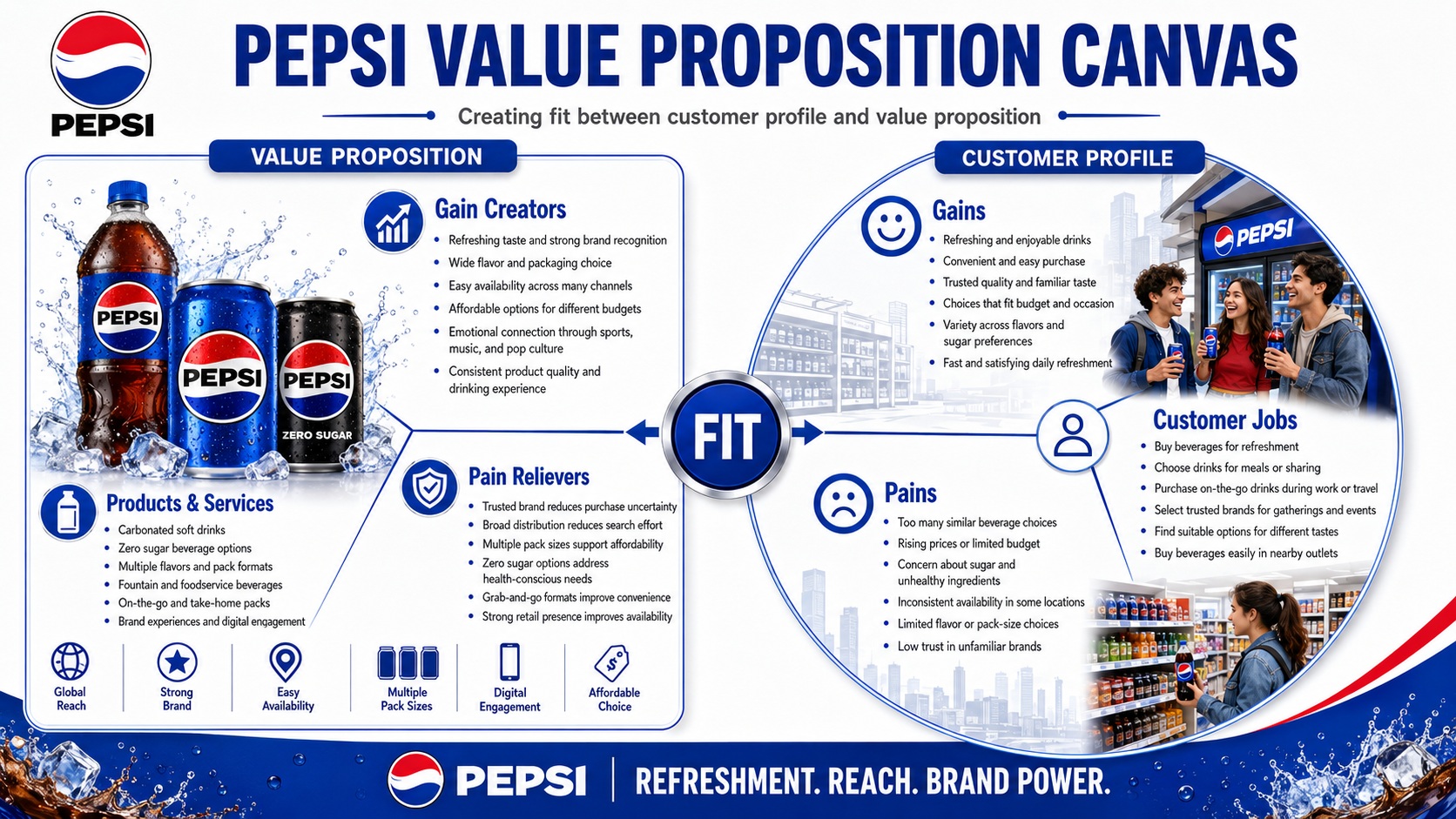
The following is VPC diagram of PepsiCo. It gives a visual view of how customer jobs, pains, and gains connect with PepsiCo’s products and services, pain relievers, and gain creators.
Pepsi value proposition canvas:
The Pepsi Business Model Canvas differs from Coca-Cola mainly in portfolio breadth, operating balance, and where structural advantage comes from. PepsiCo is built around both beverages and convenient foods. Coca-Cola remains far more beverage-centric and more concentrated around brand ownership, concentrate economics, and the wider bottling system.
That difference matters because the two companies create power in different ways. PepsiCo gains retailer influence from participating across more consumption categories and more shelves. Coca-Cola gains strength from beverage depth, iconic global drink brands, and system-wide scale in liquid refreshment.
The result is not that one model is universally better. The result is that each one is optimised differently.
| Dimension | PepsiCo | Coca-Cola |
|---|---|---|
| Portfolio logic | Beverages plus snacks and convenient foods, giving PepsiCo a wider role across household and impulse consumption | Primarily beverages, with a sharper strategic focus on liquid refreshment across many drink categories |
| Retail leverage | Multi-category shelf influence across beverages, snacks, and convenient foods in more than one aisle | Deep beverage dominance supported by cooler presence, fountain access, and strong bottling system execution |
| Revenue balance | More diversified by category, with snacks and foods helping offset pressure in beverages | More concentrated around drinks, with performance tied more directly to beverage volume, mix, and pricing |
| Brand tone | Youthful, energetic, and contemporary, often linked to pop culture, sports, and trend-led positioning | Classic, universal, and timeless, often built around heritage, emotional connection, and global familiarity |
| Model strength | Cross-category resilience, retailer relevance, and broader occasion coverage across food and drink | Focused beverage scale, powerful global drink brands, and efficient concentrate-and-bottling system economics |
PepsiCo’s broader basket can make it more resilient when one category slows, because strength in snacks or hydration can offset pressure elsewhere. Coca-Cola, by contrast, often benefits from tighter beverage focus and clearer system economics tied to concentrated brand leadership. This comparison is useful because it shows how the Pepsi Business Model Canvas is designed around diversification and cross-category leverage, while Coca-Cola’s model is designed around beverage concentration and depth.
The Pepsi Business Model Canvas highlights several reinforcing advantages that make PepsiCo more defensible than many consumer goods rivals. These strengths do not operate in isolation. They reinforce one another across branding, retail access, portfolio design, and execution quality.
Together, these strengths make PepsiCo harder to displace than a single-category competitor. They also explain why the company can remain relevant across more than one aisle, more than one consumer segment, and more than one price tier at the same time.
PepsiCo also faces important execution risks that reflect the scale and complexity of its business model. Because the company operates across many categories, channels, and geographies, these pressures can affect both revenue growth and operating efficiency at the same time.
None of these risks make the model weak. Instead, they show that PepsiCo must keep balancing scale, affordability, innovation, and productivity if it wants to protect margins while remaining competitive across both beverages and convenient foods.
PepsiCo should keep strengthening the portfolio logic that makes it different from Coca-Cola. More coordinated snack-and-drink bundles, joint promotions, and occasion-based merchandising can deepen cross-category advantage.
Management should also continue investing in zero sugar, hydration, portion control, and better-for-you innovations. Consumer pressure around health is not temporary, so adaptation needs to remain structural rather than cosmetic.
Another priority is value architecture. Smaller packs, sharper price ladders, and market-specific affordability options can defend volume without damaging long-term brand equity.
Finally, PepsiCo should push harder on data-led retail execution. Better demand sensing, assortment discipline, and store-level activation can improve sell-through while reducing wasteful promotional spending.
Overall, the Pepsi Business Model Canvas explains why PepsiCo remains one of the world’s most formidable consumer goods companies. Its strength comes from combining global brands, multi-category scale, wide distribution, and a commercial model that can serve many consumption occasions.
PepsiCo is not simply selling cola. It is managing a portfolio system that connects beverages, snacks, trade relationships, and brand culture into one integrated engine.
Future performance will depend on whether the company can keep balancing affordability, health-led innovation, retailer power, and operational productivity. If it does that well, PepsiCo can continue to compete effectively not only with Coca-Cola, but with a much wider set of food and beverage rivals.
This article is provided for educational and business analysis purposes only. Its content is based on publicly available information, general market observations, and strategic interpretation. It does not constitute financial advice, investment advice, legal advice, or an official statement from PepsiCo, Inc. Readers should conduct their own research before making any business, investment, or strategic decisions. All trademarks, logos, copyrights, brand names, and related materials mentioned or shown in this article belong to their respective owners.
Explore the FedEx Business Model Canvas, nine BMC blocks, Value Proposition Canvas, UPS and DHL… Read More
Explore the Quipper Business Model Canvas, nine BMC blocks, Value Proposition Canvas, Ruangguru and Pahamify… Read More
Explore the CARPUT Business Model Canvas, nine BMC blocks, Value Proposition Canvas, competitor comparison, competitive… Read More
Explore the Boost Business Model Canvas, nine BMC blocks, Value Proposition Canvas, competitor comparison, advantages,… Read More
Explore the Domino's Pizza Business Model Canvas, nine BMC blocks, Value Proposition Canvas, Pizza Hut… Read More
Explore the Mie Gacoan Business Model Canvas, including its customer segments, value propositions, revenue streams,… Read More