Quipper Business Model Canvas
Explore the Quipper Business Model Canvas, nine BMC blocks, Value Proposition Canvas, Ruangguru and Pahamify comparison, competitive advantages, risks, and strategic recommendations.
The BMC of Coca-Cola will discuss the business model of this renowned beverage manufacturer using the Business Model Canvas (BMC) framework. Explore the Coca-Cola Business Model Canvas in this updated 2026 analysis. Learn its customer segments, value proposition, revenue model, key partners, risks, and strategic advantages.
BMC Article No: BMC #044
Updated in 2026: This article has been refreshed with deeper block-by-block analysis, a fuller strategic interpretation, an expanded Value Proposition Canvas section, clearer discussion of portfolio diversification, stronger coverage of distribution economics, updated perspective on zero-sugar and total beverage positioning, and more practical recommendations before the conclusion.
The Coca-Cola Business Model Canvas helps explain how one of the world’s most recognised beverage companies creates, delivers, and captures value at enormous global scale.
Coca-Cola is not just selling a famous soft drink. It operates a global beverage system built on brand ownership, concentrate production, bottling partnerships, route-to-market strength, retail relationships, and marketing reinforcement across countless consumption moments. This system allows the company to stay relevant in supermarkets, restaurants, convenience stores, vending locations, entertainment venues, and household purchases at the same time.
That is what makes Coca-Cola strategically interesting. Many companies can create a beverage. Far fewer can build a system that turns brand recognition into repeat purchase across millions of outlets, many countries, and multiple product categories. The Coca-Cola Business Model Canvas is therefore useful because it shows that Coca-Cola’s success does not depend on product taste alone. It depends on how branding, distribution, pricing, availability, partnerships, and portfolio strategy work together.
Coca-Cola runs a brand-led beverage business model supported by a large bottling and distribution system. The company focuses heavily on brand building, concentrate economics, product strategy, portfolio management, and system coordination, while bottling partners handle much of the local manufacturing, packaging, merchandising, and physical distribution.
This structure gives Coca-Cola an important advantage. It allows the company to keep strong control over high-value parts of the business, such as brand equity, formulas, and strategic direction, without carrying every operating task directly in every market. In simple terms, Coca-Cola concentrates on what makes the system powerful, while partners help scale execution.
The model is also broader than one flagship cola product. Coca-Cola now competes as a total beverage company with products across sparkling drinks, water, juice, tea, coffee, sports drinks, and selected ready-to-drink categories. That matters because beverage demand is changing. Health concerns, price sensitivity, local preferences, and occasion-based consumption all influence what people buy. The Coca-Cola Business Model Canvas shows how the company uses a portfolio-and-system model to stay relevant across those shifts.
Business Model Canvas, or BMC, is a practical tool used to explain how a business creates value, delivers that value, and captures revenue. Instead of looking only at the product, it maps the wider logic behind the company.
BMC is especially useful for Coca-Cola because the business is often misunderstood as simply selling drinks. In reality, its long-term strength comes from a wider operating model that links emotional branding, retailer economics, bottling efficiency, packaging strategy, and market reach.
Instead of viewing Coca-Cola as only a beverage manufacturer, BMC shows the system that supports its market power.
| BMC Block | Main Question |
|---|---|
| Customer Segments | Who does the business serve? |
| Value Propositions | What value does the business offer? |
| Channels | How does the business reach customers? |
| Customer Relationships | How does the business build loyalty? |
| Revenue Streams | How does the business make money? |
| Key Resources | What assets does the business need? |
| Key Activities | What must the business do well? |
| Key Partnerships | Who helps the business operate? |
| Cost Structure | What are the major costs? |
The Coca-Cola Business Model Canvas helps explain how consumer demand, trade partnerships, product availability, and brand consistency come together in one coordinated system. It also shows why Coca-Cola stays strong when these elements reinforce one another instead of operating separately.
Coca-Cola has evolved from a flagship cola brand into a broad beverage company with products across sparkling soft drinks, water, juice, sports drinks, tea, coffee, and other ready-to-drink categories. That shift matters because global beverage demand is no longer driven by one taste segment alone. Consumers now buy across multiple consumption occasions, health preferences, price points, and lifestyle needs.
Its scale remains one of the company’s biggest strategic advantages. A beverage business becomes stronger when brand demand, bottling capacity, route density, retail placement, and local execution improve together. Coca-Cola benefits from this reinforcing effect because its products are available in both high-volume urban channels and small everyday neighbourhood outlets.
The Coca-Cola Business Model Canvas is therefore about more than selling drinks. It is about building a system where brand equity creates traffic, channel access creates purchase opportunities, and a broad portfolio creates resilience. That wider view helps explain why Coca-Cola remains one of the strongest consumer brands in the world.
Coca-Cola is strategically interesting because it balances global control with local flexibility. The company defines brand strategy, product architecture, concentrate systems, and major marketing direction at scale, but much of the physical execution is carried out through a network of bottling partners and local route-to-market structures.
That combination gives the business both focus and leverage. Coca-Cola can keep investing in the highest-value areas such as brand power, packaging innovation, and category expansion, while local bottlers adapt production and market delivery to real operating conditions on the ground. This is very different from a company that tries to control every layer centrally.
Another reason Coca-Cola matters from a strategy perspective is that beverages are often low-involvement purchases. Customers usually make quick choices based on familiarity, visibility, temperature, price, and convenience. This means brand salience alone is not enough. Products must also be available in the right place, in the right size, at the right moment.
That is why the Coca-Cola Business Model Canvas is so useful. It shows how the company turns brand preference into shelf presence, then turns shelf presence into repeat purchase across many consumption moments.
Coca-Cola’s business model is evolving in several important ways, and each shift affects how the company competes.
First, portfolio diversification matters more than before. Coca-Cola continues moving beyond legacy cola dependence by growing zero-sugar variants and strengthening its role as a total beverage company. This matters because consumer demand is becoming more fragmented across taste, wellness, function, and lifestyle preferences.
Second, revenue growth management is becoming more central. Pack size, affordability ladders, premium packaging, and channel-specific pricing now play a bigger role in how the company protects both volume and profitability. In a market where inflation, cost pressure, and consumer budgets all matter, pack-price strategy is no longer a side issue.
Third, execution quality remains critical. Availability, cooler placement, in-store visibility, and route discipline still influence beverage performance heavily because many purchases are made quickly and close to the point of need.
Fourth, digital engagement is becoming more relevant in a physical-product business. Marketing, promotions, and consumer relevance are increasingly shaped by digital media, data, and culturally responsive campaigns.
The Coca-Cola Business Model Canvas is stronger in 2026 because the company is not just defending an old soda model. It is actively adapting a global beverage system to new consumption patterns, regulation pressure, and portfolio needs.
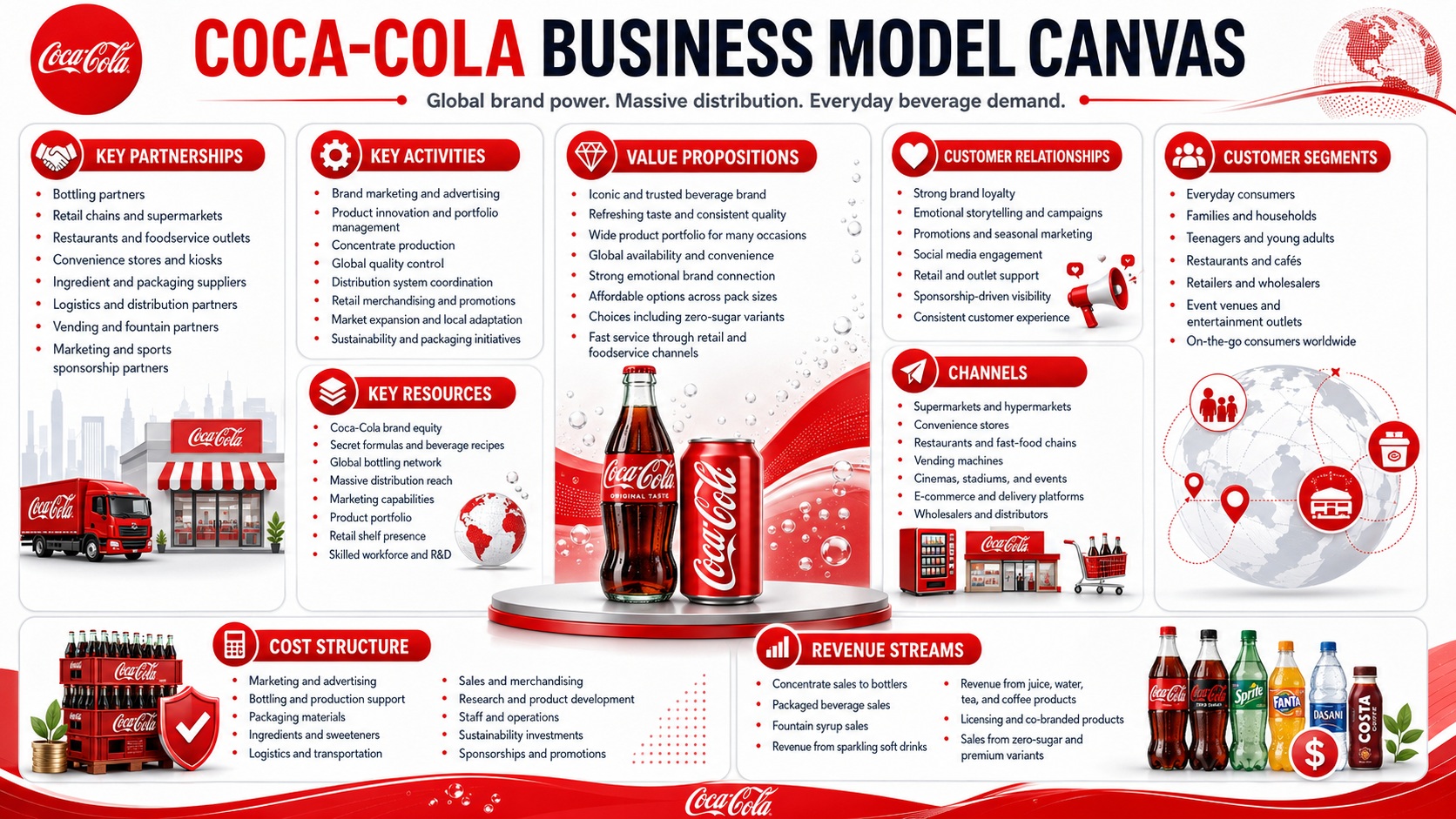
Before going into each block in detail, the summary below gives a quick view of how Coca-Cola’s business works. It offers a simple snapshot of the full model before moving into deeper analysis, making it easier to see how the blocks connect and reinforce one another.
| BMC Block | Coca-Cola Application |
|---|---|
| Customer Segments | Mass consumers, retailers, restaurants, convenience stores, distributors, and institutional buyers. |
| Value Propositions | Trusted brands, consistent taste, wide availability, broad beverage choice, and strong merchandising support. |
| Channels | Retail stores, supermarkets, foodservice, vending, e-commerce, and bottling distribution networks. |
| Customer Relationships | Brand loyalty, emotional marketing, trade support, promotions, and digital engagement. |
| Revenue Streams | Concentrate sales, finished product sales, licensing, and portfolio-driven beverage revenue. |
| Key Resources | Brands, formulas, bottling system, distribution reach, marketing capability, and retail presence. |
| Key Activities | Brand building, concentrate production, portfolio management, pricing, merchandising, and system coordination. |
| Key Partnerships | Bottlers, retailers, restaurants, suppliers, distributors, and marketing partners. |
| Cost Structure | Marketing, ingredients, packaging, operations, logistics, people, and system support. |
The diagram below gives a visual summary of how the main blocks of Coca-Cola’s business model connect in one view. It helps readers move from the written discussion into a practical visual format before continuing to the detailed block-by-block analysis.
Customer segments explain who Coca-Cola serves and why those groups matter. Coca-Cola serves a mass-market consumer base, but the real commercial structure is broader because it also depends heavily on trade customers and channel partners.
Consumers buy Coca-Cola products for refreshment, taste, habit, social moments, convenience, or brand preference. Some want affordability and everyday access. Others want specific product variants such as zero-sugar, juice-based drinks, or ready-to-drink coffee. Trade customers have different priorities. Retailers want fast-moving products with dependable demand and strong margins. Restaurants want beverage brands that support meal combinations and improve average ticket value. Distributors and bottlers want reliable volume, route density, and system clarity.
This customer mix gives Coca-Cola an important strategic advantage. It is not dependent on one narrow buyer group or one purchase occasion. Instead, the system serves at-home consumption, on-the-go demand, meal pairing, entertainment venues, workplace refreshment, and institutional environments.
| Customer Segment | What They Need | How Coca-Cola Serves Them |
|---|---|---|
| Everyday consumers | Refreshment, taste, affordability | Broad beverage portfolio and multiple pack sizes |
| Retailers | High turnover and strong brands | Merchandising support and reliable supply |
| Foodservice outlets | Recognised drinks and meal pairing | Fountain, packaged drinks, and channel support |
| Distributors and bottlers | Volume and operational clarity | System coordination and strong brand demand |
| Institutional buyers | Consistency and scale | Standardised supply and national reach |
The real strength of this block is breadth with repetition. Many customers buy often, even if each transaction is small. The Coca-Cola Business Model Canvas shows that consumer demand and trade demand reinforce one another, helping the company protect scale and frequency at the same time.
The value proposition explains why customers choose Coca-Cola over alternatives. For consumers, the promise includes familiar taste, refreshment, trust, broad choice, and easy access. For retailers and trade partners, the promise includes dependable demand, merchandising support, and the commercial strength of globally recognised brands.
This proposition is stronger than a simple product promise because it works on multiple levels. A consumer benefits from consistency and easy recognition. A retailer benefits from high product turnover and store traffic support. A restaurant benefits from established beverage pairing and customer acceptance. A bottler benefits from brand pull that makes local route execution more productive.
Coca-Cola’s value also comes from availability. In beverages, a good brand loses power when it is not present at the moment of purchase. Coca-Cola reduces that risk by combining brand familiarity with broad physical reach.
| Value Proposition | Customer Benefit | Business Impact |
|---|---|---|
| Trusted global brands | Confidence and familiarity | Supports repeat purchase |
| Consistent product quality | Reliable experience | Protects loyalty across markets |
| Wide beverage choice | More needs and occasions served | Expands category reach |
| Strong availability | Easy to find and buy | Increases purchase frequency |
| Trade and merchandising support | Better in-store performance | Strengthens channel relationships |
This block is one of the clearest strengths in the Coca-Cola Business Model Canvas because it shows how brand equity creates both consumer pull and channel leverage. That dual value makes the model harder to replicate.
Channels explain how Coca-Cola reaches customers and turns brand demand into actual sales. Unlike digital-native businesses, Coca-Cola depends heavily on physical route-to-market execution.
Its beverages move through supermarkets, hypermarkets, convenience stores, wholesalers, restaurants, cafés, vending machines, entertainment venues, hotels, workplace channels, and selected e-commerce platforms. Each channel serves a different purchase context. Household channels support stock-up purchases. Convenience outlets support impulse and immediate consumption. Foodservice channels support meal occasions. Vending supports speed and location convenience.
This mix matters because beverage purchases are often immediate and context-driven. A customer may prefer Coca-Cola, but purchase only happens if the product is visible, cold, priced appropriately, and easy to access in that specific moment.
| Channel | Examples | Strategic Role |
|---|---|---|
| Modern retail | Supermarkets and hypermarkets | High-volume household purchase |
| Traditional retail | Small shops and kiosks | Everyday convenience and reach |
| Foodservice | Restaurants, cafés, hotels | Meal pairing and brand visibility |
| Vending and on-the-go | Vending machines and events | Impulse consumption access |
| E-commerce | Grocery and delivery platforms | Expands convenience and basket integration |
This block matters because brand awareness alone does not create sales. Availability creates sales. The Coca-Cola Business Model Canvas highlights why distribution discipline remains one of the company’s most important long-term advantages.
Customer relationships describe how Coca-Cola keeps consumers emotionally engaged and commercially relevant over time. Unlike subscription platforms, Coca-Cola does not rely mainly on account-based retention. Instead, loyalty is built through habit, emotional association, cultural relevance, retail visibility, and repeated positive consumption experiences.
The company strengthens these relationships through major brand campaigns, sponsorships, seasonal promotions, in-store activation, and digital engagement. It also builds trade relationships by supporting product displays, coolers, menu integration, and promotional execution in retail and foodservice settings.
This is strategically important because beverages are usually easy to substitute. When emotional connection is weak, customers can switch quickly based on price or availability. Strong relationships reduce that risk by making Coca-Cola familiar, memorable, and easy to choose again.
| Relationship Driver | How It Works | Example |
|---|---|---|
| Emotional branding | Connects products with moments and feelings | Happiness, sharing, celebration themes |
| Promotions | Encourages trial and repeat purchase | Limited campaigns and seasonal offers |
| Retail activation | Improves visibility and selection | Point-of-sale materials and displays |
| Digital engagement | Keeps the brand visible online | Social content and interactive campaigns |
| Foodservice support | Strengthens outlet relationships | Menu presence and fountain programmes |
This block looks simple on the surface, but it is central to long-term volume. Strong customer relationships make Coca-Cola easier to choose repeatedly, even in crowded and price-sensitive markets.
Revenue streams explain how Coca-Cola captures value from its global beverage system. The company earns primarily through concentrate sales to bottling partners, finished product sales in selected operations, and portfolio-driven beverage revenue across multiple brands and formats.
This structure is strategically powerful because concentrate economics are usually more attractive than pure bottling economics. Bottling partners take on much of the manufacturing, packaging, and delivery burden, while Coca-Cola retains control over high-value system assets such as brands, formulas, and strategic direction.
Revenue quality also improves when the company has a broad portfolio. Different beverage categories, pack sizes, and channels can support growth under different consumer and economic conditions. A household grocery purchase behaves differently from a vending sale or a restaurant fountain sale.
| Revenue Stream | How It Works | Strategic Importance |
|---|---|---|
| Concentrate sales | Sold to bottling partners | Core high-value system revenue |
| Finished product sales | Direct sale in selected operations | Adds operational revenue |
| Brand licensing | Use of brands and system rights | Extends monetisation reach |
| Portfolio sales mix | Different brands and packs drive revenue | Reduces dependence on one category |
The Coca-Cola Business Model Canvas shows why this block is resilient. Revenue comes from a system architecture rather than from a single product line or one commercial format.
Key resources explain what Coca-Cola must possess to keep the business model running. Its most important assets are not limited to physical factories. They include brand equity, formulas, bottling relationships, distribution access, retailer presence, and global marketing capability.
A beverage company can imitate a flavour profile more easily than it can imitate a century of brand memory, consistent product recognition, and embedded retail access. That is why Coca-Cola’s intangible assets matter so much.
The company’s brand portfolio is one of the strongest resources in the whole system. Another critical resource is its bottling network, because local market execution depends on production capacity, route coverage, and outlet reach. Marketing capability also matters because Coca-Cola competes in categories where attention and emotional relevance strongly influence buying behaviour.
| Key Resource | Why It Matters | Example |
|---|---|---|
| Brand portfolio | Drives demand and recognition | Coca-Cola, Sprite, Fanta, Minute Maid |
| Formulas and IP | Protects product distinctiveness | Proprietary concentrate systems |
| Bottling system | Enables local production and delivery | Global network of bottling partners |
| Retail and channel access | Converts brand demand into purchase | Shelf space and fountain presence |
| Marketing capability | Sustains relevance and preference | Global campaigns and local activation |
Together, these resources form a reinforcing system. The Coca-Cola Business Model Canvas makes clear that competitive strength comes from how these assets operate together, not from any one resource in isolation.
Key activities describe what Coca-Cola must do exceptionally well to sustain performance. Brand building sits at the centre, but it is not enough on its own. The company must also manage concentrate production, portfolio planning, innovation, packaging strategy, pricing architecture, revenue growth management, and trade execution.
Execution quality matters because beverages are bought frequently and compared quickly. If pricing is weak, availability slips, or packaging becomes mismatched to customer budgets, sales can shift fast. That is why Coca-Cola’s activity set combines both demand generation and demand capture.
The company also has to coordinate its system constantly. Bottlers, retailers, foodservice partners, suppliers, and internal teams all need alignment on product mix, timing, promotional execution, and availability priorities.
| Key Activity | What It Involves | Why It Matters |
|---|---|---|
| Brand marketing | Campaigns, sponsorships, storytelling | Sustains preference and demand |
| Concentrate production | Formula preparation and quality control | Protects consistency |
| Portfolio management | Category and brand decisions | Matches changing consumer demand |
| Revenue growth management | Pack-price architecture and mix | Protects affordability and margin |
| Trade execution | Displays, cooler presence, promotions | Improves conversion in-store |
This block shows that Coca-Cola wins through disciplined repetition and system coordination, not through occasional bursts of innovation alone.
Key partnerships explain who helps Coca-Cola deliver value at scale. The most important partners are bottlers, retail customers, restaurants, ingredient suppliers, packaging providers, logistics partners, and selected marketing or media partners.
Among these, bottling partners are the most critical. They manufacture, package, distribute, and often help execute local market strategy in ways that make the entire system work. Retailers are equally important because shelf placement, cooler visibility, and in-store execution directly shape sales outcomes. Foodservice chains matter because beverages are often chosen alongside meals, where brand familiarity can strongly influence selection.
Without these partnerships, Coca-Cola would struggle to maintain the reach, speed, and local responsiveness that define its business model.
| Partner Type | Role | Strategic Value |
|---|---|---|
| Bottling partners | Manufacture, package, and distribute | Enable local scale and reach |
| Retailers | Sell products to end consumers | Provide visibility and access |
| Foodservice chains | Serve drinks in dining occasions | Build volume and brand pairing |
| Suppliers | Provide ingredients and packaging | Maintain continuity and quality |
| Logistics partners | Support transport and delivery flows | Improve route efficiency |
Partnership quality directly affects product availability, service levels, and market penetration. This is one of the clearest strengths within the Coca-Cola Business Model Canvas.
Cost structure explains where Coca-Cola spends money to maintain growth and system performance. Major costs include marketing, concentrate and ingredient inputs, packaging, people, commercial operations, logistics support, and broader system coordination.
Packaging is especially important because it affects affordability, product mix, shelf appeal, and transport economics. Marketing is equally central because beverage categories have low switching costs, meaning demand must be reinforced continuously. The company also needs to support people, planning, analytics, and commercial execution across a large international system.
A strong Coca-Cola model is not simply about minimising cost. It is about spending in ways that protect brand power, route reach, and portfolio relevance at the same time.
| Cost Category | What It Covers | Why It Matters |
|---|---|---|
| Marketing | Advertising, sponsorships, campaigns | Sustains brand demand |
| Ingredients and concentrate | Sweeteners, flavour inputs, processing | Supports product consistency |
| Packaging | Cans, bottles, labels, cartons | Drives cost and price architecture |
| People and operations | Commercial, strategy, and support teams | Keeps the system coordinated |
| Logistics and route support | Movement across markets and channels | Protects availability |
Cost efficiency matters, but cost quality matters more. The model becomes stronger when Coca-Cola spends in ways that improve brand pull, channel reach, and revenue mix together.
Value Proposition Canvas, or VPC, is a practical tool used to explain how a company’s offer matches what customers actually need. One side focuses on the customer profile, including jobs, pains, and gains. The other side focuses on the value map, including products and services, pain relievers, and gain creators.
Coca-Cola is a useful case because beverage choice looks simple on the surface but is highly competitive underneath. Customers want taste, convenience, trust, availability, the right pack at the right price, and products that fit different moments such as meals, travel, work, or social occasions.
The Coca-Cola Business Model Canvas becomes even clearer when paired with VPC because it shows how operational scale supports real customer preferences at the point of purchase.
The customer profile explains what Coca-Cola’s customers are trying to get done, what frustrates them, and what outcomes they want. In this case, most customers are trying to satisfy a refreshment need quickly, affordably, and reliably.
Some are buying for themselves on the go. Others are buying for family consumption at home. Some want a familiar cola taste. Others want zero-sugar, juice, water, or a drink that fits a specific meal or mood. This means the profile is simple in action but broad in demand logic.
| Customer Profile | Details |
|---|---|
| Customer Jobs | Buy a beverage for refreshment, meals, social moments, travel, or quick energy. |
| Pains | Limited availability, wrong pack size, weak taste expectations, price sensitivity, and too little choice. |
| Gains | Reliable taste, easy access, trusted brands, suitable pack options, and enjoyable consumption moments. |
This profile matters because beverage demand is frequent and habit-driven. Small frictions such as stockouts, poor visibility, or the wrong price-pack mix can shift customer choice quickly.
The value map explains how Coca-Cola responds to those customer jobs, pains, and gains. It does this through a broad brand portfolio, multiple pack sizes, dependable product quality, strong route-to-market coverage, and brand familiarity that reduces buying uncertainty.
The company does not rely on one product format alone. It uses different categories, pack architectures, price points, and channel strategies to stay relevant in different purchase contexts.
| Value Map Element | Details |
|---|---|
| Products & Services | Sparkling drinks, juice, water, tea, coffee, sports drinks, fountain offerings, and multiple packaging formats. |
| Pain Relievers | Consistent taste, wide distribution, price-pack variety, retailer presence, and familiar branding. |
| Gain Creators | Strong brand enjoyment, occasion fit, cold availability, meal pairing, and broad portfolio choice. |
The strength of this value map lies in repeatability. Coca-Cola makes the desired choice easier to recognise, easier to find, and easier to buy across many environments.
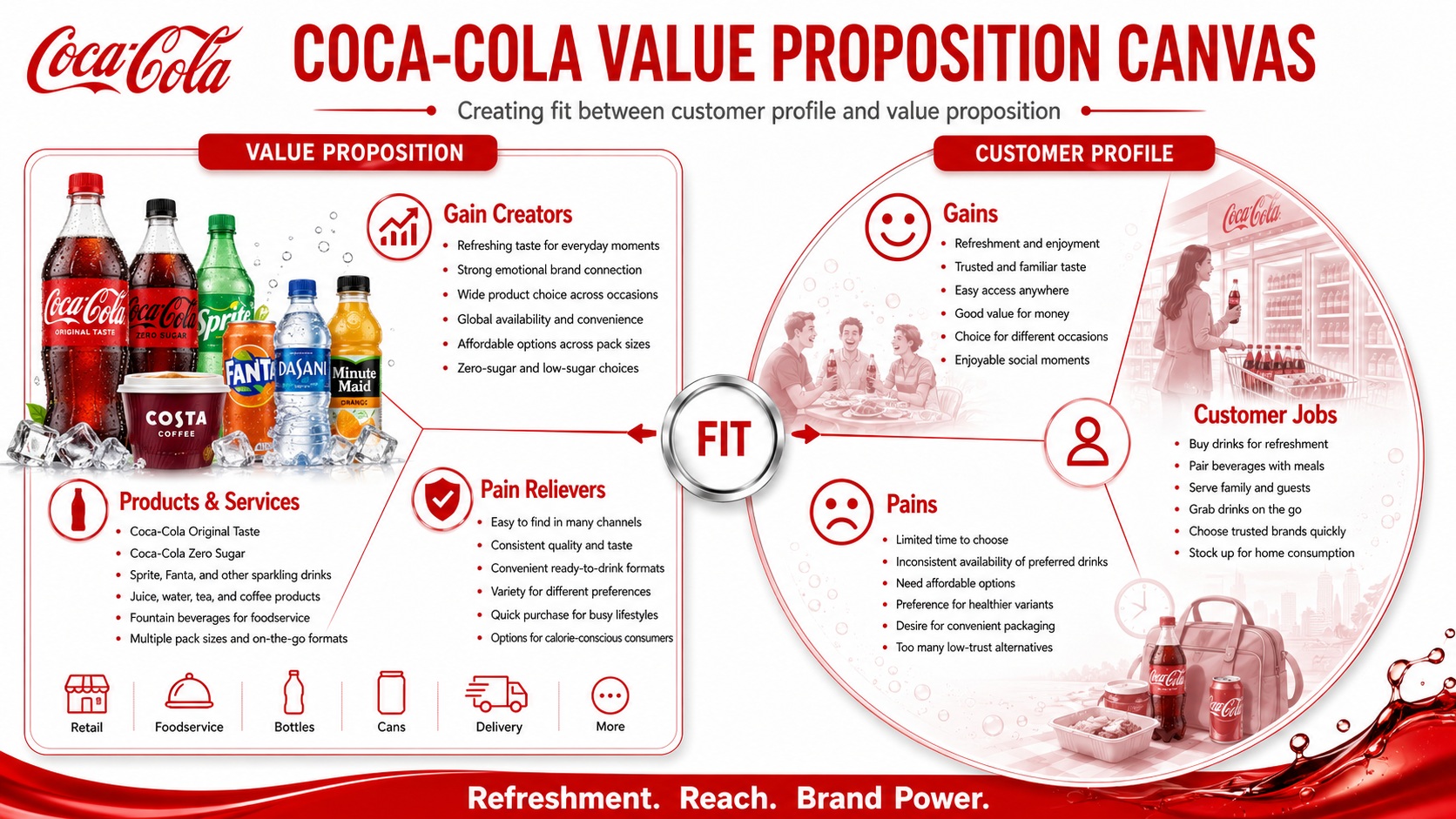
The fit happens when Coca-Cola matches everyday refreshment needs with trusted brands, easy access, dependable quality, and appropriate price-pack options.
That fit is stronger than it first appears because Coca-Cola does not serve only one occasion. It stays relevant across home consumption, meal occasions, travel, entertainment, and quick convenience purchases.
| Customer Profile | Details | Matching Value Map | How Coca-Cola Creates Fit |
|---|---|---|---|
| Customer Jobs | Buy drinks for refreshment and daily occasions | Broad beverage portfolio | Serves multiple needs across moments and channels |
| Pains | Price sensitivity, inconsistent options, low availability | Pack-price choices and wide distribution | Reduces friction and improves access |
| Gains | Trusted taste, convenience, and enjoyment | Strong brands and quality consistency | Encourages repeat purchase and loyalty |
This fit matters because beverage purchases are frequent, low-friction, and often made with little time for comparison. Coca-Cola wins when the choice feels both familiar and convenient.
The diagram below gives a visual summary of how Coca-Cola’s customer profile and value map connect in one structured view.
The Coca-Cola Business Model Canvas highlights several advantages that support long-term strength and help explain why the company remains one of the most resilient players in the global beverage industry. These strengths are not isolated. They work together across brand building, route-to-market execution, portfolio breadth, and system economics to sustain Coca-Cola’s market position over time:
These strengths reinforce one another. Brand pull improves shelf access. Shelf access improves repeat purchase. Repeat purchase strengthens trade value. That reinforcing cycle is one of the biggest reasons Coca-Cola remains so resilient.
Coca-Cola also faces several risks and challenges that can affect growth quality, operating consistency, and long-term resilience across its global beverage system. These issues do not affect every market in the same way, but together they shape how the company protects demand, margins, reputation, and future competitiveness:
These risks do not make the model weak. They show why portfolio adaptation, pricing discipline, sustainability credibility, and system execution remain essential to Coca-Cola’s future performance.
Coca-Cola should continue expanding the role of zero-sugar, lower-sugar, and adjacent beverage categories so growth becomes less tied to legacy soda perceptions.
Management should also keep strengthening revenue growth management. Better pack architecture, affordability ladders, premium packaging logic, and channel-specific pricing can protect both volume and margin under changing economic conditions.
Another priority is stronger cold availability and outlet execution in high-frequency channels, because physical convenience still drives a large share of beverage choice. Small improvements in visibility, cooler access, and stock consistency can create meaningful volume impact.
The company should also invest further in occasion-based portfolio strategy. Different brands should play clearer roles across meals, energy needs, hydration moments, family purchases, and on-the-go consumption.
Finally, Coca-Cola should deepen digital and data-led marketing so consumer relevance remains strong across younger segments and changing media habits. This matters not only for awareness, but also for brand renewal and future demand quality.
The Coca-Cola Business Model Canvas shows a business built on much more than beverage manufacturing. Coca-Cola wins because it combines brand power, system economics, route-to-market strength, channel execution, and repeat consumption moments into one coordinated commercial model.
That is why the company remains strategically strong. It does not need to rely only on product novelty to stay relevant. Instead, it grows by staying trusted, available, adaptable, and commercially useful across many channels and customer contexts.
Viewed this way, Coca-Cola is not simply a soft drink company. It is a global beverage system designed to turn brand equity into repeat purchase at extraordinary scale. That is the core logic behind the Coca-Cola Business Model Canvas.
This article is provided for educational and informational purposes only and is intended to support learning, discussion, and general understanding of the company’s business model. The content is based on information from public sources and also includes the personal opinions of the author. It is not an official statement from Coca-Cola, does not represent the company’s corporate views, and should not be interpreted as official brand communication. All trademarks, brand names, logos, images, copyrights, and related materials belong to their respective owners, and any references used in this article are solely for explanation, analysis, and educational purposes.
Explore the Quipper Business Model Canvas, nine BMC blocks, Value Proposition Canvas, Ruangguru and Pahamify… Read More
Explore the CARPUT Business Model Canvas, nine BMC blocks, Value Proposition Canvas, competitor comparison, competitive… Read More
Explore the Boost Business Model Canvas, nine BMC blocks, Value Proposition Canvas, competitor comparison, advantages,… Read More
Explore the Domino's Pizza Business Model Canvas, nine BMC blocks, Value Proposition Canvas, Pizza Hut… Read More
Explore the Mie Gacoan Business Model Canvas, including its customer segments, value propositions, revenue streams,… Read More
Restaurant Business Model Canvas: A Practical Guide to Designing, Evaluating, and Improving Restaurant Business Models… Read More