



Share This Article


Netflix Business Model Canvas: How Netflix Built a Global Streaming Entertainment Platform
BMC Article No: BMC #015
Updated for 2026: This article has been revised with the latest available information on Netflix’s revenue growth, advertising strategy, paid sharing monetization, live programming, games, and global streaming competition.
Introduction
Netflix is one of the world’s leading entertainment services, offering TV series, films, games, and live programming across many genres and languages. Members can watch anytime, pause, resume, and change plans when needed.
The Netflix Business Model Canvas is interesting because Netflix is no longer only a streaming subscription company. It has become a global entertainment platform built around original content, licensed content, personalization, advertising, live events, games, and international scale.
This model works because Netflix turns attention into recurring revenue. Viewers pay monthly for entertainment, while Netflix uses data, technology, and content investment to keep them watching.
In 2025, Netflix reported revenue of about USD45.18 billion, up 16% from 2024. Its operating margin also increased to 29.5%, showing stronger profitability as revenue grew faster than major cost categories.
This article breaks down how Netflix creates value, reaches viewers, earns revenue, manages costs, protects its competitive position, and faces future risks.
What Is Netflix’s Business Model?
Netflix’s business model is built around paid digital entertainment access. Customers subscribe to Netflix because they want convenient access to movies, series, documentaries, live content, and international shows without depending on traditional television schedules.
The company earns most of its revenue from monthly membership fees. It also earns revenue from advertising, consumer products, live experiences, and other sources, although membership fees remain the primary revenue base.
A key strength is scale. Netflix can spread content, technology, marketing, and platform costs across a large global audience. More viewers create more data, which improves recommendation quality and helps Netflix understand what content works across different markets.
The Netflix Business Model Canvas shows a company that combines entertainment, technology, customer data, global distribution, and recurring revenue into one integrated model.
What Is Business Model Canvas?
Business Model Canvas, or BMC, is a practical tool used to explain how a business works. It helps readers understand how a company creates value, delivers that value, and captures revenue from the market.
Instead of looking only at products, BMC looks at the full system behind a company. It connects customers, value propositions, channels, relationships, revenue, resources, activities, partners, and costs in one view.
The Netflix Business Model Canvas helps explain why Netflix is not only a content company. It is also a technology platform, a subscription business, an advertising channel, and a global entertainment brand.
| BMC Block | Main Question |
|---|---|
| Customer Segments | Who does the business serve? |
| Value Propositions | What value does the business offer? |
| Channels | How does the business reach customers? |
| Customer Relationships | How does the business build loyalty? |
| Revenue Streams | How does the business make money? |
| Key Resources | What assets does the business need? |
| Key Activities | What must the business do well? |
| Key Partnerships | Who helps the business operate? |
| Cost Structure | What are the major costs? |
Quick Overview of Netflix
Netflix was founded in 1997 by Reed Hastings and Marc Randolph. The company started as a DVD rental business by mail before moving into online streaming in 2007.
Over time, Netflix shifted from distributing other studios’ content to producing its own original films, series, documentaries, and specials. This move gave the company more control over content differentiation and global release strategy.
Its biggest strategic shift was the move from a pure subscription model to a broader monetization model. Netflix now combines paid plans, ad-supported plans, password-sharing monetization, live programming, games, and global content production.
Financially, the company has become much stronger. In 2025, Netflix revenue reached USD45.18 billion, while operating income reached about USD13.33 billion.
This matters because Netflix is now managing two priorities at once: grow revenue and improve profit discipline.
Why Netflix Is Strategically Interesting
Netflix is strategically interesting because it changed how people consume entertainment. Traditional television depends on fixed schedules, advertising slots, channels, and regional distribution windows. Netflix made entertainment on-demand, global, personalized, and subscription-based.
Its advantage comes from a loop. Better content attracts viewers. More viewers create more engagement data. Stronger data helps Netflix improve recommendations, marketing, localization, and content decisions.
Another important factor is global reach. Netflix can release one show across many countries, then localize subtitles, dubbing, artwork, and promotion. A Korean, Spanish, British, Indian, or American title can become popular far beyond its home market.
From a strategy perspective, the Netflix Business Model Canvas shows how recurring revenue, content ownership, recommendation technology, brand trust, and global scale reinforce one another.
Latest Developments: What Is Changing Around Netflix?
Netflix is changing in several important ways.
First, advertising is becoming a major growth area. Netflix said its 2025 ad revenue grew more than 2.5 times versus 2024 to more than USD1.5 billion. The company also forecast about USD3 billion in ad revenue for 2026.
Second, Netflix is investing beyond traditional streaming. Its official profile now describes the service as offering TV series, films, games, and live programming.
Third, competition is widening. Netflix identified competitors that include Alphabet, Amazon, Apple, Comcast, Disney, Meta, Roblox, TikTok, and local media companies.
These changes make the Netflix Business Model Canvas more important because Netflix must defend viewer attention across streaming, social media, gaming, live events, and digital advertising.
Netflix Business Model Canvas Summary
The summary below gives a quick view of how Netflix’s business model works. It shows who Netflix serves, what value it offers, how it reaches users, how revenue is generated, and what resources keep the model running.
| BMC Block | Netflix Application |
|---|---|
| Customer Segments | Entertainment viewers, families, global audiences, advertisers, content fans, and mobile users. |
| Value Propositions | On-demand entertainment, original content, personalization, convenience, global stories, and flexible plans. |
| Channels | Netflix app, website, smart TVs, mobile devices, telecom bundles, app stores, and partner devices. |
| Customer Relationships | Personal recommendations, profiles, watch history, notifications, plan flexibility, and customer support. |
| Revenue Streams | Subscriptions, ad-supported plans, extra member fees, advertising, consumer products, and live experiences. |
| Key Resources | Content library, brand, data, recommendation engine, technology platform, talent, and global rights. |
| Key Activities | Content production, licensing, streaming operations, personalization, marketing, pricing, and ad sales. |
| Key Partnerships | Studios, creators, production houses, cloud providers, device makers, telecoms, advertisers, and agencies. |
| Cost Structure | Content production, licensing, technology, marketing, personnel, payments, localization, and compliance. |
Netflix BMC Diagram:

1. Customer Segments
Customer segments describe who Netflix serves. Netflix reaches a broad global audience, but different viewers use the platform for different reasons.
Some customers want daily entertainment after work. Families need safe and varied content for adults and children. Movie fans look for high-quality films and exclusive releases. International viewers want local stories, subtitles, dubbing, and culturally relevant recommendations.
Advertisers are also becoming a more important customer group. With ad-supported plans, Netflix does not only serve viewers. It also serves brands that want access to engaged audiences in premium entertainment environments.
Netflix Customer Segments:
| Customer Segment | What They Need | How Netflix Serves Them |
|---|---|---|
| Individual viewers | Convenient entertainment anytime. | Offers series, films, documentaries, and personalized recommendations. |
| Families | Content for adults and children. | Provides profiles, Kids experience, parental controls, and varied genres. |
| Global audiences | Local and international stories. | Invests in regional content, subtitles, dubbing, and localized discovery. |
| Entertainment fans | Exclusive shows and films. | Produces originals, franchises, documentaries, anime, and special events. |
| Advertisers | Premium digital audience reach. | Offers ad-supported plans and first-party audience data. |
The Netflix Business Model Canvas shows that Netflix serves both consumers and advertisers. This dual audience gives Netflix more monetization options, but it also requires careful balance between viewing experience and advertising growth.
2. Value Propositions
The value proposition explains why customers choose Netflix. At the simplest level, Netflix offers convenient entertainment without the restrictions of traditional TV.
Subscribers get access to a wide library of series, films, documentaries, stand-up specials, animation, games, and live programming. The experience is available across devices, which makes Netflix easy to use at home, during travel, or on mobile.
Personalization is a major part of the value proposition. Netflix recommends shows based on viewing behavior, profile history, language, genre interest, and engagement patterns. This reduces search friction and helps users find something to watch faster.
Netflix Value Propositions:
| Value Proposition | Customer Benefit | Business Impact |
|---|---|---|
| On-demand access | Viewers watch anytime and anywhere. | Increases usage and subscription value. |
| Original content | Users get exclusive shows and films. | Differentiates Netflix from competitors. |
| Personalization | Viewers find relevant content faster. | Improves engagement and retention. |
| Global content | Audiences discover stories from many countries. | Expands international appeal. |
| Flexible plans | Customers can choose different price points. | Supports wider market coverage. |
Netflix’s value proposition is not only content volume. The stronger value comes from convenience, personalization, exclusive titles, local relevance, and habit formation.
3. Channels
Channels explain how Netflix reaches customers. Netflix has a highly digital channel model because most discovery, sign-up, viewing, billing, and support happen online.
The main channel is the Netflix app. Viewers access it through smart TVs, smartphones, tablets, laptops, gaming consoles, streaming devices, and web browsers. This wide device availability makes Netflix easy to adopt.
Partnerships also extend reach. Telecom operators, internet service providers, device manufacturers, app stores, and payment partners help Netflix reach more customers and reduce subscription friction.
Channels are central to the Netflix Business Model Canvas because distribution determines how easily viewers can start watching, continue watching, and return after leaving.
Netflix Channels:
| Channel | Examples | Strategic Role |
|---|---|---|
| Netflix app | Smart TVs, phones, tablets, and consoles. | Main viewing and engagement channel. |
| Website | Sign-up, account management, and browsing. | Supports direct customer access. |
| Device partners | Smart TVs and streaming devices. | Makes Netflix visible on home screens. |
| Telecom bundles | Mobile, broadband, and entertainment bundles. | Expands reach and lowers payment friction. |
| Digital marketing | Social media, trailers, email, and push notifications. | Drives awareness and title discovery. |
Strong channels help Netflix stay present in daily entertainment routines.
4. Customer Relationships
Customer relationships describe how Netflix keeps viewers engaged. The company does not rely on personal sales teams for most customers. Instead, it builds relationships through product experience, personalization, content release rhythm, and account habit.
Profiles make the relationship more personal. Different household members can receive different recommendations, watchlists, viewing histories, and content suggestions.
Notifications, trailers, previews, top-ten lists, and personalized artwork help bring users back. These tools are important because Netflix competes for attention every day.
Netflix Customer Relationships:
| Relationship Driver | How It Works | Example |
|---|---|---|
| Personalization | Recommendations match viewing behavior. | A viewer sees more crime dramas after watching similar titles. |
| Profiles | Each user gets a separate experience. | Family members maintain different watch histories. |
| Content habit | New releases encourage repeat visits. | Weekly or seasonal launches bring viewers back. |
| Flexible plans | Users can adjust or cancel plans. | Customers choose ad-supported or ad-free options. |
| Customer support | Help is available for account and billing issues. | Users resolve password, payment, or device problems. |
Netflix’s relationship model depends on repeated engagement. The more often viewers watch, the more valuable the service feels.
5. Revenue Streams
Revenue streams show how Netflix makes money. The core revenue source is monthly membership fees from paid streaming plans.
Netflix offers different plan types depending on country, pricing, video quality, household usage, advertising availability, and account-sharing rules. As of December 2025, Netflix said paid plan prices ranged from the U.S. dollar equivalent of USD1 to USD37 per month, depending on country and plan type.
Advertising is becoming more important. In Q1 2026, Netflix said its ads plan represented more than 60% of all Q1 sign-ups in ads countries.
Netflix Revenue Streams:
| Revenue Stream | How It Works | Strategic Role |
|---|---|---|
| Subscription fees | Users pay monthly for access. | Main revenue engine. |
| Ad-supported plans | Lower-priced plans include advertising. | Attracts price-sensitive users and advertisers. |
| Extra member fees | Account sharing is monetized. | Converts shared usage into revenue. |
| Advertising | Brands pay to reach Netflix audiences. | Adds monetization beyond subscriptions. |
| Consumer products and experiences | Merchandise and live experiences support titles. | Extends popular content beyond the screen. |
The Netflix Business Model Canvas makes clear that Netflix is evolving from one main revenue stream toward a broader entertainment monetization model.
6. Key Resources
Key resources are the assets Netflix needs to operate and compete. The most obvious resource is content, but the deeper advantage comes from the combination of content, technology, data, brand, talent, and global distribution rights.
The content library includes original shows, licensed titles, documentaries, animation, films, and regional productions. Popular titles help attract subscribers, while a deep catalogue helps retain them.
Technology is another core resource. Netflix needs reliable streaming infrastructure, recommendation systems, encoding tools, data analytics, payment systems, and product design capability.
Netflix Key Resources:
| Key Resource | Why It Matters | Business Impact |
|---|---|---|
| Content library | Gives viewers reasons to subscribe. | Supports acquisition and retention. |
| Original IP | Creates exclusive value. | Reduces reliance on external studios. |
| Recommendation engine | Helps users find content. | Improves engagement. |
| Global brand | Builds trust and recognition. | Lowers adoption barriers. |
| Viewer data | Shows what users watch and skip. | Improves content and product decisions. |
Netflix’s key resources work together. Content attracts attention, technology delivers the experience, and data improves relevance.
7. Key Activities
Key activities describe what Netflix must do well. The company must consistently acquire, produce, distribute, recommend, market, and monetize entertainment at global scale.
Content development is central. Netflix must identify stories that can attract strong audiences, whether through local productions, global originals, documentaries, comedy, animation, or live programming.
Platform management is equally important. Streaming must be fast, stable, easy to use, and available across many devices.
Netflix Key Activities:
| Key Activity | What It Includes | Strategic Role |
|---|---|---|
| Content production | Developing films, series, documentaries, and specials. | Builds differentiation. |
| Content licensing | Acquiring external titles and rights. | Maintains library depth. |
| Personalization | Ranking, recommendations, artwork, and discovery. | Increases viewing time. |
| Platform operations | Streaming, payments, apps, security, and reliability. | Protects user experience. |
| Marketing | Promoting titles and plans across markets. | Drives acquisition and engagement. |
Netflix must balance creative risk with financial discipline. Too little content weakens engagement, while too much inefficient spending can pressure margins.
8. Key Partnerships
Key partnerships help Netflix operate globally. No streaming platform can build every show, technology layer, device relationship, payment method, and advertising capability alone.
Production partners are essential. Netflix works with studios, producers, writers, directors, actors, post-production teams, and local creative communities to produce and acquire content.
Technology and distribution partners also matter. Smart TV makers, telecom providers, cloud infrastructure partners, payment platforms, app stores, and device manufacturers help Netflix reach users.
Netflix Key Partnerships:
| Partner Type | Examples | Strategic Role |
|---|---|---|
| Content creators | Studios, producers, directors, and writers. | Supply creative output. |
| Technology providers | Cloud, encoding, payments, and security partners. | Support platform reliability. |
| Device manufacturers | Smart TVs, consoles, and streaming devices. | Improve access and visibility. |
| Telecom operators | Broadband and mobile bundles. | Expand distribution. |
| Advertisers and agencies | Brands, media buyers, and ad-tech partners. | Grow advertising revenue. |
Partnerships allow Netflix to scale faster, but they also create dependency. Strong partner management is therefore critical.
9. Cost Structure
Cost structure explains where Netflix spends money. The largest cost areas are content, technology, marketing, personnel, payments, and operating infrastructure.
Content remains the most important cost category. Netflix spends on original production, licensed titles, talent, post-production, localization, and content amortization. In 2025, cost of revenues reached about USD23.28 billion, equal to 52% of revenue.
Technology and development also matter. Netflix spent about USD3.39 billion on technology and development in 2025, mainly linked to product, infrastructure, recommendations, and service improvements.
Netflix Cost Structure:
| Cost Area | What It Covers | Strategic Impact |
|---|---|---|
| Content production | Originals, talent, filming, editing, and post-production. | Drives differentiation. |
| Licensing | Rights to external films and shows. | Supports catalogue depth. |
| Technology | Streaming, apps, data, security, and recommendations. | Protects service quality. |
| Marketing | Title launches, digital ads, trailers, and promotions. | Drives demand. |
| Localization | Subtitles, dubbing, regional artwork, and compliance. | Supports global growth. |
Netflix’s cost structure is heavy, but scale helps the company spread these costs across a large revenue base.
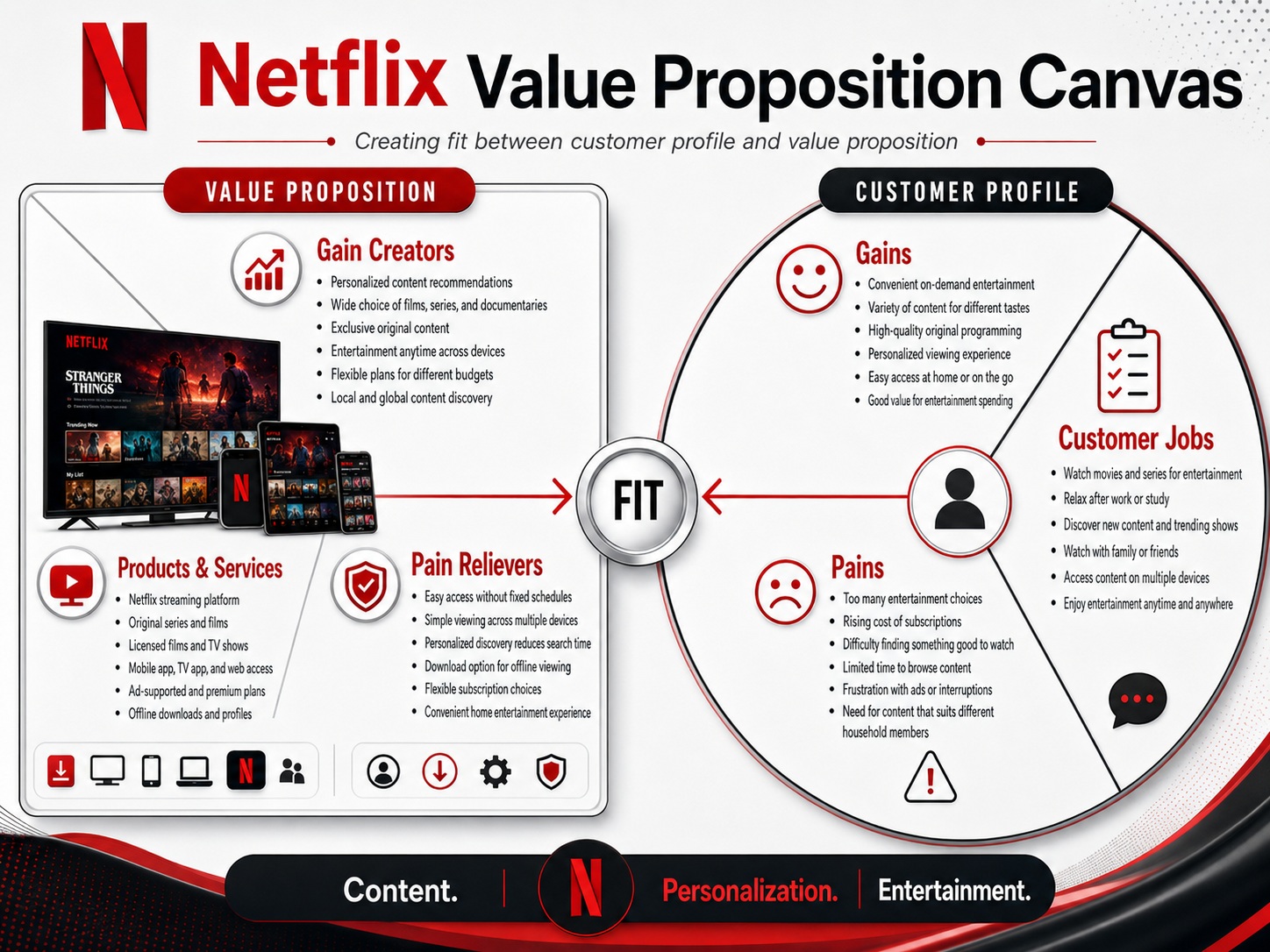
Value Proposition Canvas View
For Netflix, the Value Proposition Canvas helps explain how the platform fits customer needs. It connects what viewers want to achieve with Netflix’s products, pain relievers, and gain creators.
Customers do not only want more shows. They want entertainment that is easy to find, easy to watch, worth paying for, and relevant to their personal taste.
Netflix creates fit when viewers open the app and quickly find something suitable for their mood, language, device, time available, and household context.
Customer Profile
The customer profile explains what Netflix viewers are trying to achieve. Most customers want convenient entertainment for relaxation, family time, learning, conversation, and cultural discovery.
Viewers also want fewer frustrations. They dislike poor content discovery, limited choice, excessive ads, complicated access, weak recommendations, and expensive bundles.
Expected gains include quality content, global variety, emotional enjoyment, convenience, personalization, and flexible pricing.
| Customer Profile | Analysis |
|---|---|
| Customer Jobs | Watch entertainment, relax, follow popular shows, discover global content, and entertain family members. |
| Pains | Too much choice, poor recommendations, rising subscription costs, content removal, ads, and platform fragmentation. |
| Gains | Convenience, exclusive titles, personalization, flexible plans, local content, and shared cultural moments. |
Netflix Value Proposition
Netflix responds through a mix of content, technology, personalization, and plan flexibility. Products and services include streaming plans, ad-supported options, profiles, recommendations, downloads, subtitles, dubbing, games, and live programming.
Pain relievers include simple access, cross-device viewing, personalized discovery, parental controls, local language support, and different price points.
Gain creators include exclusive originals, global hits, binge-worthy series, documentaries, live events, and content that becomes part of social conversation.
| Value Proposition Element | Analysis |
|---|---|
| Products and Services | Films, series, documentaries, animation, games, live programming, profiles, and downloads. |
| Pain Relievers | Easy access, recommendations, subtitles, dubbing, parental controls, and flexible plans. |
| Gain Creators | Originals, global stories, premium entertainment, cultural relevance, and personalized viewing. |
Where the Fit Happens
The fit happens when Netflix reduces the effort needed to find and enjoy entertainment. A viewer may open Netflix after work, see a relevant recommendation, continue a saved episode, or discover a new series through the top-ten list.
Fit also happens at household level. Parents can use children’s profiles, adults can keep separate watch histories, and different users can watch on different devices.
The Netflix Business Model Canvas becomes stronger when viewed with this fit. Netflix wins when viewers feel that the service consistently gives them something worth watching.
VPC Table
| Customer Profile | Details | Matching Value Proposition | How Netflix Creates Fit |
|---|---|---|---|
| Customer Jobs | Viewers want entertainment, relaxation, discovery, and family viewing. | Products and Services | Netflix offers films, series, documentaries, games, live content, and profiles. |
| Pains | Users face too much choice, weak discovery, rising costs, and fragmented platforms. | Pain Relievers | Recommendations, flexible plans, subtitles, downloads, and simple access reduce friction. |
| Gains | Customers want quality, convenience, relevance, and cultural moments. | Gain Creators | Originals, global hits, personalization, and local content create stronger value. |
VPC Diagram:
Competitive Advantages
Netflix has several competitive advantages that support its long-term business model.
- Strong global brand: Netflix is widely recognized as a leading streaming entertainment platform.
- Scale advantage: Large global reach helps spread content and technology costs across many users.
- Original content capability: Netflix can create exclusive shows and films that competitors cannot offer.
- Personalization engine: Recommendation systems help improve discovery and engagement.
- Global content strategy: Local productions can travel across countries and become international hits.
- Advertising growth: Ad-supported plans create new monetization without relying only on subscriptions.
- Product convenience: Multi-device access makes Netflix easy to use in many viewing situations.
- Data advantage: Viewing behavior helps Netflix refine content, marketing, product design, and retention strategy.
These advantages reinforce one another. Scale funds content, content drives engagement, engagement creates data, and data improves the viewing experience.
Risks and Challenges
Netflix also faces several risks that may affect future growth.
- Content cost pressure: Original production and licensing require large investment before audience response is fully known.
- Subscription fatigue: Customers may cancel when they feel they are paying for too many platforms.
- Advertising execution risk: Too many ads could weaken the viewing experience and hurt retention.
- Strong competition: Netflix competes against streaming platforms, social media, gaming, YouTube, TikTok, and local media.
- Hit dependency: Major titles can drive engagement, but not every expensive production becomes successful.
- Price sensitivity: Higher plan prices may push some users to downgrade, share accounts, or cancel.
- Regulatory pressure: Global operations create risks around data, content rules, taxation, advertising, and consumer protection.
- Partner dependency: Device platforms, app stores, telecoms, and production partners can influence access and economics.
These risks do not mean Netflix is weak. They show that the streaming leader must keep balancing growth, price, content quality, user experience, and profitability.
Strategic Recommendations
Netflix should strengthen its core subscription business while growing advertising carefully. The ad-supported plan should remain attractive, but advertising load must not damage the premium entertainment experience.
Content investment should become more disciplined. Netflix should continue funding global originals, but decision-making should focus on engagement, retention, repeat viewing, franchise potential, and international portability.
The company should also expand live programming selectively. Sports, comedy, reality events, awards-style formats, and special broadcasts can create appointment viewing, but rights costs must remain controlled.
More attention should go to family, kids, and household value. When multiple household members use Netflix regularly, cancellation becomes less likely.
Advertising should use Netflix’s first-party data responsibly. Better targeting, measurement, and brand-safe formats can improve advertiser value without making viewers feel overexposed.
Netflix should continue improving product discovery. Better search, smarter recommendations, shorter decision time, and clearer content positioning can increase satisfaction.
The Netflix Business Model Canvas suggests one strategic priority: grow monetization without weakening the viewer trust that made Netflix valuable in the first place.
Conclusion
Netflix’s business model is powerful because it combines content, technology, personalization, global reach, and recurring revenue. The company does not only sell access to shows. It sells convenience, entertainment choice, discovery, and viewing habit.
The subscription model remains the foundation, but advertising is becoming a major growth engine. Live programming, games, consumer products, and experiences may also expand Netflix’s role beyond traditional streaming.
A major lesson from Netflix is that digital business models must keep evolving. What started as DVD rental became streaming. Next, what started as streaming became original content. What started as subscriptions is now moving toward subscription-plus-advertising monetization.
Future growth will depend on how well Netflix manages content spending, competition, advertising quality, pricing, regulation, and customer engagement. When those areas are handled well, Netflix can remain one of the most important entertainment platforms in the world.
Disclaimer
This article is for educational and business analysis purposes only. It is based on publicly available information, general market observation, and strategic interpretation. It is not financial advice, investment advice, legal advice, or an official statement from Netflix, Inc. Readers should conduct their own research before making business, investment, or strategic decisions.

