



Share This Article


MR DIY Business Model Canvas: How MR DIY Built a Value Retail Powerhouse
BMC Article No: BMC #026
This article has been revised in 2026 to reflect the latest publicly available information, business developments, and strategic analysis of MR DIY.
Introduction
MR DIY is one of Malaysia’s most recognisable value retail brands. It sells home improvement products, household goods, hardware, stationery, electrical items, toys, accessories, and daily essentials at affordable prices.
The MR DIY Business Model Canvas is interesting because the company does not compete through one product category. It competes through price, convenience, product variety, store density, supplier efficiency, and disciplined retail execution.
This model works because customers often need small, practical items quickly. A shopper may visit MR DIY for batteries, cleaning tools, kitchen items, phone accessories, paint brushes, storage boxes, or simple repair products. Instead of visiting many specialist shops, customers can find many low-ticket items under one roof.
In this article, we will break down how MR DIY creates value, reaches customers, earns revenue, manages costs, and protects its competitive position.
What Is MR DIY’s Business Model?
MR DIY’s business model is built around affordable retail, broad product variety, convenient locations, high store traffic, and efficient sourcing. The company offers many categories of daily-use products under the “Always Low Prices” promise.
Unlike premium retailers, MR DIY does not depend on luxury positioning or exclusive products. Its strength comes from being accessible to mass-market customers. The company serves households, students, workers, small business owners, DIY users, and budget-conscious shoppers.
A major strength is scale. MR DIY can buy in large volumes, manage a wide supplier base, distribute products across many stores, and serve frequent small-basket purchases. This gives the business a repeat-visit advantage.
The MR DIY Business Model Canvas shows a company that uses low prices to attract customers, store expansion to increase reach, product variety to raise basket size, and operational control to protect margins.
What Is Business Model Canvas?
Business Model Canvas, or BMC, is a practical tool used to explain how a company works. It helps readers understand how a business creates value, delivers that value to customers, and captures revenue from the market.
Instead of looking only at products, BMC looks at the full business system behind those products. It connects customers, value propositions, channels, relationships, revenue, resources, activities, partners, and costs in one simple view.
This makes BMC useful for analysing MR DIY because the company is not only selling hardware. It is building a mass-market retail engine based on accessibility, assortment, pricing, supplier management, logistics, and store productivity.
| BMC Block | Main Question |
|---|---|
| Customer Segments | Who does the business serve? |
| Value Propositions | What value does the business offer? |
| Channels | How does the business reach customers? |
| Customer Relationships | How does the business build loyalty? |
| Revenue Streams | How does the business make money? |
| Key Resources | What assets does the business need? |
| Key Activities | What must the business do well? |
| Key Partnerships | Who helps the business operate? |
| Cost Structure | What are the major costs? |
Quick Overview of MR DIY
MR DIY started as a single store in 2005 on Jalan Tuanku Abdul Rahman, Kuala Lumpur. The company has since grown into a major value retailer known for convenience, affordability, and wide product choice. Its official Malaysia site states that MR DIY has more than 1,400 stores throughout Malaysia, average store size of 10,000 square feet, and 17,000 product varieties.
The group operates several retail formats. MR DIY focuses on home improvement and household products. Next, MR DIY Express serves easy-access locations. MR DIY PLUS combines MR DIY, MR.DOLLAR, and MR.TOY products under one roof. MR.TOY focuses on affordable toys, while MR.DOLLAR offers trendy household and lifestyle products.
In FY2025, MR DIY reported revenue growth to RM4.95 billion, while its outlet count increased to 1,556 stores. Malaysia remained the dominant revenue contributor.
Why MR DIY Is Strategically Interesting
MR DIY is strategically interesting because it turns low-priced retail into a high-frequency, mass-market model. Many retailers sell affordable goods, but few can combine price, range, convenience, and scale as effectively.
The store experience is simple. Customers enter, browse many categories, compare prices quickly, and leave with practical items. This supports impulse purchases because many products are affordable and easy to justify.
Location strategy also matters. MR DIY stores are placed in malls, neighbourhood areas, hypermarkets, commercial zones, and community locations. This makes the brand visible and convenient for different customer groups.
The MR DIY Business Model Canvas is strategically interesting because it shows how a value retailer can grow by solving everyday problems. Customers may not plan a large purchase, but they return often because small household needs keep appearing.
Latest Developments: What Is Changing Around MR DIY?
MR DIY’s model continues to evolve in three important ways.
First, store expansion remains a key growth lever. Public reporting shows that the group increased its outlet count by 8.4% in FY2025 to 1,556 outlets, with plans to open about 155 new stores in FY2026.
Second, productivity is becoming more important. As store density increases, the next stage of growth depends not only on opening more outlets, but also improving sales per store, product mix, refurbishment, and inventory efficiency.
Third, customer value remains central. Inflation, cautious consumer spending, and price sensitivity can make affordable retail more relevant, but weak consumer sentiment can also reduce basket size.
These changes make the MR DIY Business Model Canvas important because the company must balance expansion, margin discipline, store productivity, and customer affordability.
MR DIY Business Model Canvas Summary
Before going into each block, the summary below gives a quick view of how MR DIY’s model works. It shows who the company serves, what value it offers, how revenue is generated, and what resources keep the system running.
| BMC Block | MR DIY Application |
|---|---|
| Customer Segments | Mass-market households, DIY users, budget shoppers, students, small businesses, and family buyers. |
| Value Propositions | Affordable prices, wide product range, convenient locations, practical products, and one-stop shopping. |
| Channels | Physical stores, mall outlets, neighbourhood outlets, e-commerce, marketplace platforms, and promotions. |
| Customer Relationships | Everyday convenience, price trust, promotions, accessible service, and repeat shopping habits. |
| Revenue Streams | Retail product sales, online sales, private-label goods, promotional sales, and category expansion. |
| Key Resources | Store network, supplier base, brand, distribution system, inventory data, staff, and retail formats. |
| Key Activities | Sourcing, merchandising, logistics, store operations, pricing, promotions, expansion, and inventory control. |
| Key Partnerships | Suppliers, landlords, mall operators, logistics partners, digital platforms, and marketing partners. |
| Cost Structure | Inventory, rental, staff, logistics, marketing, utilities, technology, store fit-out, and distribution costs. |
MR DIY Business Model Canvas Diagram:
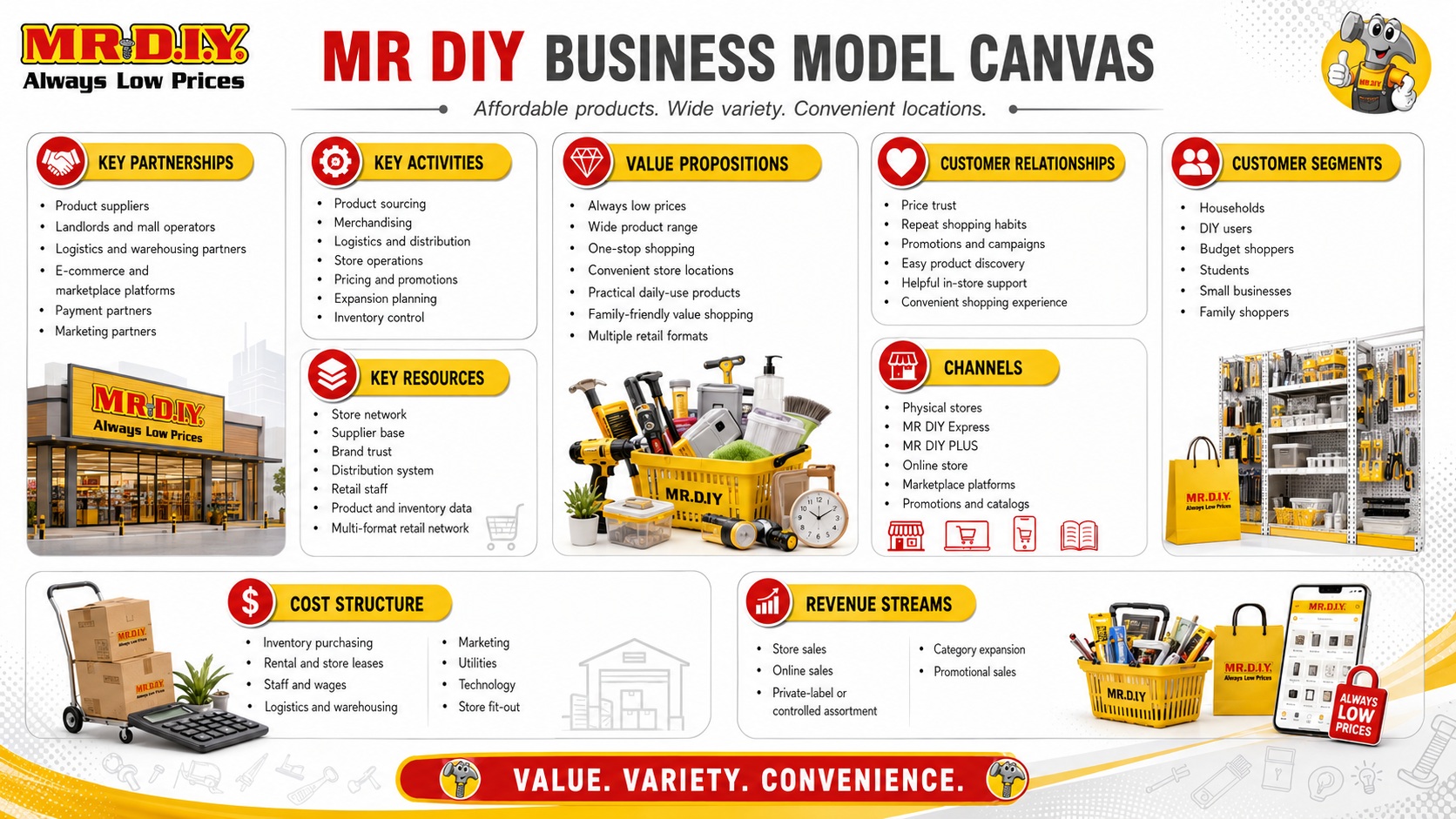
1. Customer Segments
Customer segments describe who the business serves. MR DIY serves a broad mass market, but its core customers are people who want practical products at affordable prices.
The company does not depend on one narrow customer group. A family may buy household items. A student may buy stationery and phone accessories. A small business owner may buy basic tools, storage items, or cleaning supplies. A DIY user may visit for repair products and hardware.
This broad customer base gives MR DIY resilience. When one product category slows, another category can still generate traffic. Daily-use items also encourage repeat visits because customers often need replacement products.
| Customer Segment | What They Need | How MR DIY Serves Them |
|---|---|---|
| Households | Affordable home, kitchen, cleaning, and storage products. | Offers many daily essentials under one roof. |
| DIY users | Simple tools, repair items, hardware, and accessories. | Provides practical products for home improvement tasks. |
| Budget shoppers | Low prices and acceptable quality. | Uses value pricing and broad assortment. |
| Students | Stationery, gadgets, small accessories, and personal items. | Offers low-ticket products in accessible locations. |
| Small businesses | Operational supplies at affordable prices. | Supports repeat purchases of basic business-use items. |
The MR DIY Business Model Canvas shows that customer breadth is a major strength. MR DIY can serve many everyday missions without depending on luxury demand. This gives the business a wider demand base, reduces dependence on any single shopper type, and helps keep store traffic relevant across different income groups and buying occasions.
2. Value Propositions
The value proposition explains why customers choose MR DIY. At the simplest level, the company offers affordable, practical, and easy-to-find products for daily needs.
Its strongest value proposition is convenience at low prices. Customers can buy many unrelated items in one trip. This saves time because they do not need to visit a hardware shop, stationery shop, phone accessory shop, and household store separately.
Product variety is also important. MR DIY offers thousands of items across categories, which increases browsing and impulse purchase potential. A customer who enters for one item may leave with several.
| Value Proposition | Customer Benefit | Business Impact |
|---|---|---|
| Always low prices | Customers feel they can buy without overspending. | Builds price trust and frequent visits. |
| Wide product range | Many practical needs can be met in one store. | Increases basket size and store traffic. |
| Convenient locations | Stores are easy to access in many communities. | Expands reach and improves brand visibility. |
| Practical products | Items solve daily home, work, and repair needs. | Keeps demand recurring and broad. |
| Multiple formats | Different store types serve different locations. | Improves market coverage and site flexibility. |
MR DIY’s value proposition is powerful because it is simple. The company wins when customers believe they can find useful products quickly, affordably, and conveniently. That clarity matters because customers do not need a long buying process. They need confidence that the store will solve everyday problems without wasting time or stretching the budget.
3. Channels
Channels explain how MR DIY reaches customers. Physical stores are the main channel because the business relies heavily on walk-in traffic, product browsing, and convenient access.
Store placement is critical. MR DIY uses malls, commercial areas, hypermarkets, neighbourhood locations, and easy-access sites to remain close to customers. This helps the company become part of routine shopping behaviour.
Digital channels also support the model. Online stores and marketplace platforms allow customers to browse products, compare prices, and buy without visiting a store. However, the physical network remains central because many items are low-ticket and purchased through immediate need.
| Channel | Examples | Strategic Role |
|---|---|---|
| Physical stores | Mall outlets, neighbourhood shops, hypermarket sites. | Drives visibility, access, and impulse purchases. |
| MR DIY Express | Smaller, easy-access stores. | Serves convenience-led locations. |
| MR DIY PLUS | Larger format with wider categories. | Increases basket potential and family shopping. |
| E-commerce | Official online channels and marketplaces. | Extends reach beyond store visits. |
| Promotions | In-store campaigns, catalogues, digital promotions. | Stimulates traffic and repeat purchases. |
Strong channels make MR DIY accessible. The store network acts as both sales engine and marketing platform. Each outlet does more than generate revenue. It also increases visibility, reinforces brand familiarity, and keeps MR DIY close to routine customer traffic in daily life.
4. Customer Relationships
Customer relationships describe how MR DIY keeps customers returning. The relationship is built less on personal service and more on price confidence, convenience, product availability, and habit.
Customers return because the store solves recurring needs. Household products run out. Tools break. Cleaning items need replacement. Phone cables, batteries, containers, and stationery are frequently needed.
Promotions also reinforce the relationship. Customers respond to visible deals, seasonal offers, and affordable product discovery. Store staff support the relationship by helping customers find products quickly.
| Relationship Driver | How It Works | Example |
|---|---|---|
| Price trust | Customers expect affordable products. | A shopper checks MR DIY before buying elsewhere. |
| Shopping habit | Frequent small needs create repeat visits. | Families return for household supplies. |
| Product discovery | Wide range encourages browsing. | Customers buy extra items beyond the original need. |
| Accessible support | Staff help customers locate items. | A customer asks where to find repair tools. |
| Promotions | Offers create urgency and store traffic. | Seasonal campaigns increase basket size. |
MR DIY’s customer relationship is practical. Loyalty comes from repeated usefulness, not complex membership design. In this model, trust is built through consistency. Customers return because the store repeatedly delivers affordable solutions for small but frequent needs.
5. Revenue Streams
Revenue streams show how the business makes money. MR DIY earns mainly from retail product sales across physical stores and online channels.
The model depends on high transaction volume. Many products are low-priced, so growth comes from store traffic, basket size, category expansion, and repeat purchases. This makes operational efficiency very important.
Category breadth improves revenue resilience. Hardware, household, stationery, toys, electrical accessories, automotive items, storage products, and seasonal goods can support different buying occasions.
| Revenue Stream | Description | Why It Matters |
|---|---|---|
| Store sales | Sales from physical outlets. | Main revenue base of the business. |
| Online sales | Sales through official and marketplace channels. | Adds convenience and digital reach. |
| Category expansion | New product types and seasonal products. | Creates more reasons to visit. |
| Private-label products | Own-brand or controlled assortment goods. | Can improve margin and differentiation. |
| Promotional sales | Campaign-led purchases and bundled offers. | Supports traffic and volume. |
The MR DIY Business Model Canvas shows a revenue model based on volume, access, and variety. Each store becomes a small local demand capture point. This means growth does not rely on one blockbuster product. It comes from repeated transactions, broad category demand, and the ability to convert everyday needs into steady retail sales.
6. Key Resources
Key resources are the assets required to deliver the business model. MR DIY’s most important resources are its store network, supplier base, brand, distribution system, retail formats, inventory data, and operating teams.
The store network is the most visible resource. More stores create more access points for customers. Strong coverage also increases brand familiarity because customers see the brand repeatedly in daily life.
Supplier relationships are equally important. Low prices depend on procurement discipline, volume buying, product selection, and cost control. Without reliable suppliers, the company would struggle to maintain variety and affordability.
| Key Resource | Role in the Business Model | Strategic Value |
|---|---|---|
| Store network | Provides customer access across locations. | Drives traffic, convenience, and visibility. |
| Supplier base | Supports assortment and competitive prices. | Protects product availability and margin. |
| Brand trust | Signals affordability and practical value. | Encourages repeat visits. |
| Distribution system | Moves products to stores efficiently. | Reduces stockouts and supports scale. |
| Retail staff | Operate stores and assist customers. | Maintains service and execution quality. |
| Product data | Guides assortment and stock decisions. | Improves merchandising accuracy. |
These resources make MR DIY difficult to copy at scale. Competitors may copy product categories, but matching store reach, sourcing, logistics, and execution is harder. The real advantage lies in how these resources work together. Scale alone is not enough unless it is supported by reliable replenishment, brand trust, and disciplined operating control.
7. Key Activities
Key activities are the tasks MR DIY must perform well every day. These include sourcing, buying, merchandising, logistics, pricing, store operations, marketing, and expansion planning.
Sourcing is central because the company must offer affordable products while protecting quality and margin. Good buying decisions determine whether customers see the store as useful and trustworthy.
Inventory management is another critical activity. Stores need enough stock to meet demand, but excess stock can reduce working capital efficiency. A value retailer must balance variety with discipline.
| Key Activity | What It Involves | Business Impact |
|---|---|---|
| Product sourcing | Finding suppliers and negotiating prices. | Supports low-price positioning. |
| Merchandising | Selecting categories, displays, and product mix. | Improves basket size and browsing. |
| Logistics | Moving goods from suppliers to stores. | Protects availability and cost efficiency. |
| Store operations | Managing staff, shelves, checkout, and service. | Keeps customer experience consistent. |
| Expansion planning | Selecting sites and opening new stores. | Grows market coverage. |
| Promotions | Running campaigns and seasonal offers. | Drives traffic and repeat visits. |
The MR DIY Business Model Canvas shows that retail execution is the hidden engine of the brand. Low prices only work when sourcing, logistics, and store operations are tightly managed. This is why operational discipline matters as much as pricing strategy. A value retailer can only sustain customer trust when shelves stay stocked, costs stay controlled, and store standards remain consistent.
8. Key Partnerships
Key partnerships help MR DIY operate and scale. The company depends on suppliers, landlords, mall operators, logistics providers, technology vendors, payment partners, and digital marketplace platforms.
Supplier partnerships are especially important. MR DIY needs a steady flow of affordable products across many categories. Good suppliers help the company maintain range, quality, and cost competitiveness.
Property partnerships also matter. Store location can determine sales performance. Landlords, malls, hypermarkets, and commercial property owners help MR DIY secure customer traffic and local visibility.
| Partner Type | Examples | Contribution |
|---|---|---|
| Product suppliers | Local and international suppliers. | Provide products at competitive cost. |
| Landlords | Malls, shoplots, retail parks, hypermarkets. | Provide strategic store locations. |
| Logistics partners | Transport, warehousing, delivery providers. | Support distribution efficiency. |
| E-commerce platforms | Online marketplaces and digital partners. | Expand digital sales reach. |
| Payment partners | Banks, card networks, e-wallet providers. | Improve checkout convenience. |
| Marketing partners | Media, agencies, digital platforms. | Support campaigns and promotions. |
These partnerships allow MR DIY to focus on retail strategy, category management, customer access, and scale execution. Good partnerships also improve speed and flexibility. When suppliers, landlords, and logistics partners perform well, MR DIY can expand more confidently and maintain a more reliable customer experience across locations.
9. Cost Structure
Cost structure explains the major expenses required to run the business. MR DIY’s largest cost areas include inventory purchases, rental, staff, logistics, utilities, marketing, technology, and store fit-out.
Inventory cost is central because the company sells many physical products. Procurement discipline has a direct impact on gross margin. A small improvement in buying cost can matter because the business operates at large scale.
Rental and staff costs also shape profitability. Stores need good locations and enough employees, but operating costs must remain controlled to support low prices.
| Cost Area | Examples | Business Impact |
|---|---|---|
| Inventory | Product purchasing and replenishment. | Largest driver of cost and margin. |
| Rental | Store leases and location costs. | Affects profitability per outlet. |
| Staff | Wages, training, store management. | Supports service and operations. |
| Logistics | Warehousing, transport, distribution. | Determines availability and efficiency. |
| Marketing | Promotions, campaigns, catalogues, digital ads. | Drives customer traffic. |
| Store fit-out | Shelving, signage, fixtures, renovation. | Supports store opening and refurbishment. |
| Technology | POS systems, inventory tools, e-commerce. | Improves control and productivity. |
The MR DIY Business Model Canvas shows that cost control is not only a finance issue. It is the foundation of the company’s price promise. Every major cost line influences the customer proposition. If costs are managed well, MR DIY can protect margins while keeping prices attractive and its value positioning credible.
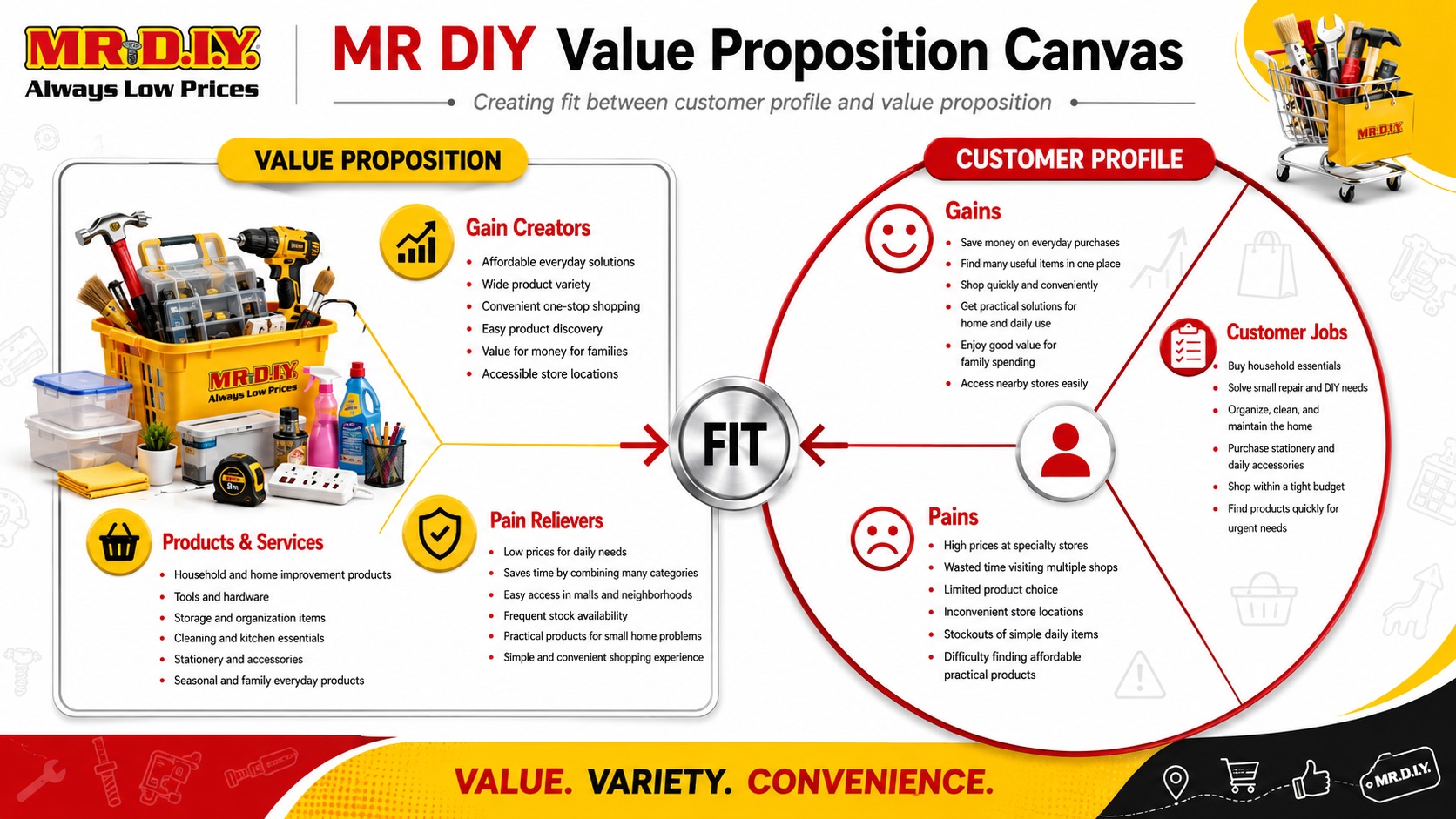
Value Proposition Canvas View
The Value Proposition Canvas helps explain how MR DIY’s offer fits customer needs. It connects what customers want to achieve with the products, services, pain relievers, and gain creators provided by the company.
For MR DIY, the fit is clear. Customers want affordable products, easy access, quick problem-solving, and practical choices. The company responds with low prices, many categories, convenient stores, and simple shopping.
This fit is powerful because many purchases are functional. Customers are not always looking for premium experience. They often want to fix, replace, clean, organise, decorate, or maintain something at home or work.
Customer Profile
The customer profile explains what MR DIY customers are trying to achieve, what problems they face, and what benefits they expect.
Many customers want to solve small daily problems without spending too much. They may need a screwdriver, extension plug, lunch box, mop, glue, cable, basket, or toy. Speed and affordability are important because these are often unplanned needs.
Customers also want convenience. They prefer stores that are nearby, easy to browse, and filled with practical options.
| Customer Profile Element | Analysis |
|---|---|
| Customer Jobs | Buy affordable items for home, repairs, school, office, cleaning, storage, and small projects. |
| Pains | High prices, limited product choice, inconvenient locations, poor stock availability, and wasted time. |
| Gains | Low prices, wide range, quick shopping, useful products, and confidence that basic needs can be met. |
Value Map
MR DIY’s value map responds directly to the customer profile. The company provides a broad range of products at affordable prices through accessible stores.
Its products and services reduce customer pain by making basic items easier to find. Instead of searching across many shops, customers can visit one MR DIY outlet and solve several needs at once.
The brand also creates gains by making affordability feel normal. Customers can browse freely, compare many small items, and buy without heavy financial pressure.
| Value Proposition Element | Analysis |
|---|---|
| Products and Services | Hardware, household items, stationery, electrical accessories, toys, storage, cleaning products, and daily essentials. |
| Pain Relievers | Low prices, many categories, convenient outlets, regular stock, and quick product discovery. |
| Gain Creators | One-stop shopping, practical range, family-friendly products, impulse buys, and value-for-money perception. |
Where the Fit Happens
The fit happens when customers need practical products quickly and MR DIY makes those products affordable and accessible.
For example, a customer may need cleaning tools, a phone cable, batteries, plastic containers, and basic repair items. MR DIY creates fit by allowing the customer to buy all of them in one trip at prices that feel manageable.
VPC Table
| Customer Profile | Details | Matching Value Proposition | How MR DIY Creates Fit |
|---|---|---|---|
| Customer Jobs | Customers want to clean, organise, repair, replace, store, and buy small daily essentials quickly and affordably. | Products and Services | Hardware, household goods, stationery, electrical accessories, toys, storage products, and daily essentials help customers solve these routine needs in one place. |
| Pains | Customers face high prices, limited product choice, inconvenient locations, stock gaps, and wasted time moving between different stores. | Pain Relievers | Low prices, wide category range, accessible outlets, regular stock, and quick product discovery reduce these frustrations. |
| Gains | Customers want convenience, affordability, useful product choices, faster shopping, and confidence that basic needs can be met in one visit. | Gain Creators | MR DIY creates gains through one-stop shopping, practical assortment, family-friendly products, impulse purchase opportunities, and strong value-for-money perception. |
This is why the model works well in a cost-conscious market. Customers do not need a premium retail journey for every purchase. They need convenience, range, and price confidence.
Competitive Advantages of MR DIY
MR DIY’s competitive advantage comes from execution at scale. The company is not strong because of one factor. It is strong because many parts of the model reinforce each other.
- Dense store network: More stores make the brand easy to access and difficult to ignore.
- Low-price perception: Customers associate the brand with affordability, which supports repeat visits.
- Wide product range: Many categories create more purchase occasions and higher basket potential.
- Supplier scale: Large buying volume improves procurement power and margin control.
- Format flexibility: MR DIY, Express, PLUS, MR.TOY, and MR.DOLLAR allow different site strategies.
- Everyday relevance: Products are practical, frequently needed, and easy to understand.
- Brand familiarity: Frequent store visibility builds trust across households and communities.
- Operational discipline: Sourcing, logistics, merchandising, and store execution support the price promise.
MR DIY Business Model Canvas analysis shows that the company’s advantage is a system advantage. Competitors can copy products, but they may struggle to copy scale, locations, sourcing, and customer habit.
Risks and Challenges
MR DIY’s business model is strong, but it is not risk-free. Growth depends on continued customer traffic, strong execution, and careful cost control.
- Consumer spending pressure: Weak household sentiment can reduce basket size, even when store traffic remains stable.
- Store saturation risk: More outlets can create overlap if site selection is not disciplined.
- Margin pressure: Currency movement, supplier costs, freight rates, and discounting can affect profitability.
- Inventory complexity: A wide product range increases the risk of stockouts, slow-moving items, and working capital pressure.
- Competition: Supermarkets, mini markets, online marketplaces, hardware shops, and discount retailers can compete on price.
- Rental and labour cost increases: Higher operating costs can weaken the low-price model.
- Quality perception risk: Very low prices must still meet acceptable customer expectations.
- Digital competition: Online sellers can offer aggressive pricing and wider product comparison.
These risks do not mean the model is weak. They show that value retail requires constant discipline across buying, pricing, inventory, store productivity, and customer trust.
Strategic Recommendations
MR DIY should continue growing, but expansion must remain disciplined. Store openings should focus on sustainable economics, local demand, catchment strength, and minimal overlap with existing outlets.
The company should also improve store productivity. Refurbishment, better layout, category zoning, clearer signage, and stronger product discovery can increase basket size without depending only on new outlets.
Private-label development should be strengthened carefully. Own-brand products can improve margins and differentiation, but quality control must remain strict to protect customer trust.
Digital channels deserve more attention. Online shopping, click-and-collect, product search, local stock visibility, and targeted promotions can support younger and convenience-driven customers.
Supplier diversification should remain a priority. A wide supplier base can reduce procurement risk, protect stock availability, and support stronger negotiation power.
MR DIY Business Model Canvas suggests one clear priority: keep the low-price promise while improving productivity, assortment quality, and customer convenience.
Conclusion
MR DIY’s business model is powerful because it combines affordability, product variety, convenient locations, and operational scale. The company does not only sell hardware or household items. It sells practical access to everyday solutions.
Its strength comes from being useful to many customer groups. Families, students, workers, small business owners, DIY users, and budget-conscious shoppers all have reasons to visit.
The business also benefits from frequent, low-ticket purchases. Customers may not plan a major shopping trip, but small daily needs bring them back.
Future growth will depend on disciplined expansion, stronger store productivity, better inventory control, supplier efficiency, and continued customer trust. If these areas are managed well, MR DIY can remain one of Malaysia’s strongest value retail models.
Disclaimer
This article is for educational and business analysis purposes only. It is based on publicly available information, general market observation, and strategic interpretation. It is not financial advice, investment advice, legal advice, or an official statement from MR DIY Group. Readers should conduct their own research before making business, investment, or strategic decisions.

