



Share This Article


Marugame Udon Business Model Canvas: How Japanese Freshness, Halal Localisation and Fast-Casual Dining Drive Growth in Indonesia
Article No: BMC #043
Updated in 2026: This article has been comprehensively rewritten to reflect Marugame Udon Indonesia’s evolving restaurant network, official mobile application, PoinMU loyalty programme, digital promotions, halal positioning and omnichannel customer experience.
The update also includes deeper analysis of all nine Business Model Canvas blocks, expanded strategic insights, a complete Value Proposition Canvas, comparisons with Yoshinoya and HokBen, five competitive advantages, five business risks and challenges, and actionable strategic recommendations.
Introduction
What makes a bowl of Japanese noodles successful in Indonesia, a country already famous for its diverse noodle dishes, rice meals and affordable street food?
The answer goes beyond taste.
Marugame Udon has built its Indonesian business around a combination of Japanese culinary authenticity, freshly prepared noodles, efficient restaurant operations, accessible dining locations and adaptation to local consumer preferences.
Its distinctive approach demonstrates how an international restaurant concept can preserve its original identity while becoming relevant to a different market.
Unlike traditional full-service Japanese restaurants, Marugame Udon emphasises speed, product visibility and a relatively straightforward ordering experience. Customers can choose udon dishes, add tempura and other side items, and enjoy a meal without the formality associated with premium Japanese dining.
Indonesia represents an important market for the brand. PT Sriboga Marugame Indonesia was established in 2012 and opened its first restaurant at Mall Taman Anggrek, Jakarta, on 14 February 2013. The company subsequently developed a wider restaurant presence and obtained halal certification in 2015.
The Murugame Udon Business Model Canvas provides a useful framework for understanding how these decisions translate into customer value, revenue generation, operational efficiency and competitive differentiation.
More importantly, it reveals why a successful restaurant chain must manage much more than its menu.
What Is Marugame Udon’s Business Model?
Marugame Udon operates a fast-casual restaurant business model specialising in Japanese udon noodles, tempura and complementary food and beverages.
The concept sits between conventional quick-service restaurants and full-service Japanese dining establishments.
Customers receive freshly prepared food in a relatively efficient service environment, while the restaurant maintains a distinctive Japanese culinary identity.
In Indonesia, the business operates through PT Sriboga Marugame Indonesia, drawing on the Japanese brand’s recipes and operational techniques while serving the requirements of the local market.
The Murugame Udon Business Model Canvas can be understood through three interconnected economic drivers.
First, a focused menu centred on udon and tempura allows the business to develop repeatable production processes and specialised kitchen capabilities.
Second, restaurant locations, takeaway options, delivery access and digital engagement create multiple opportunities for customers to purchase meals.
Third, complementary purchases such as tempura, beverages and other side dishes increase revenue per transaction beyond the main noodle dish.
This combination allows Marugame Udon to compete on more than price.
Its commercial proposition depends on customers perceiving sufficient value in food freshness, Japanese authenticity, convenience and the overall dining experience.
The business must therefore balance product quality with affordability, service speed and restaurant-level profitability.
Why Marugame Udon Is Strategically Interesting
Marugame Udon demonstrates how a relatively specialised food concept can become a scalable restaurant business.
Rather than attempting to offer every category of Japanese cuisine, the brand concentrates on a recognisable product platform: udon and tempura.
That specialisation offers several strategic benefits.
A focused menu can simplify ingredient planning, staff training, kitchen design and operational quality control. Customers also understand the restaurant’s core offering immediately, reducing the need for extensive product explanation.
Another important factor is localisation.
Japanese authenticity attracts customers seeking an international dining experience, but Indonesian market requirements influence how that experience must be delivered.
Halal assurance, convenient locations, familiar flavour options and accessible meal combinations all contribute to market acceptance.
The Murugame Udon Business Model Canvas also illustrates the importance of restaurant economics.
Unlike digital platforms, restaurants face substantial physical operating costs. Rent, labour, ingredients, utilities and equipment must be supported by sufficient transaction volume and contribution margin.
Consequently, successful expansion requires more than opening additional outlets.
Each restaurant must generate enough demand, maintain consistent food quality and manage its operating costs effectively.
This makes Marugame Udon an instructive example of how product differentiation, operational standardisation and local market adaptation work together.
Latest Developments: What Is Changing Around Marugame Udon?
Several developments are relevant to evaluating Marugame Udon Indonesia in 2026.
1. Digital Loyalty Is Becoming Part of the Business Model
Marugame Udon Indonesia’s official website promotes its mobile application, including PoinMU rewards and app-exclusive coupons.
This represents an important development from the earlier analysis, which identified the absence of a comprehensive loyalty programme as a potential growth opportunity.
Digital loyalty provides a mechanism for encouraging repeat visits, communicating promotions and developing more direct customer relationships.
2. Restaurant Accessibility Continues to Matter
The company’s official location directory lists restaurants across Jakarta and other Indonesian locations.
Its network includes shopping-mall locations as well as other urban commercial sites, illustrating the importance of convenient physical access.
3. Halal Assurance Remains a Strategic Differentiator
Sriboga identifies halal certification as an important milestone in the brand’s Indonesian development.
In a Muslim-majority market, halal assurance can reduce purchasing uncertainty and broaden customer acceptance beyond dedicated Japanese-food enthusiasts.
4. Promotions Support Repeat Purchase and Product Discovery
The official website continues to feature promotional campaigns, including an October 2026 campaign.
Such activities can stimulate visits, introduce menu combinations and create reasons for customers to return.
5. Restaurant Economics Are Increasingly Omnichannel
For fast-casual operators, dine-in, takeaway, delivery and digital engagement must work together.
Convenience can expand the addressable market, but delivery fees, packaging expenses and promotional discounts also affect profitability.
The strategic challenge is therefore to grow customer demand without sacrificing the economics of individual transactions.
Understanding the Business Model Canvas
The Business Model Canvas (BMC) is a strategic management framework that explains how an organisation creates, delivers and captures value.
Developed by Alexander Osterwalder and Yves Pigneur, the framework consists of nine interconnected building blocks.
For Marugame Udon, these blocks provide a structured view of how the restaurant concept translates into a functioning commercial operation.
| BMC Block | Key Question |
|---|---|
| Customer Segments | Who are the primary customers? |
| Value Propositions | Why do customers choose Marugame Udon? |
| Channels | How does the brand reach and serve customers? |
| Customer Relationships | How are repeat visits and loyalty encouraged? |
| Revenue Streams | How does the business generate income? |
| Key Resources | What assets and capabilities enable operations? |
| Key Activities | What must the company execute effectively? |
| Key Partners | Which external relationships support the business? |
| Cost Structure | What are the major operating expenses? |
The Murugame Udon Business Model Canvas is particularly useful because restaurant success depends on alignment across all nine blocks.
Fresh food requires appropriate ingredients, trained employees and reliable kitchen processes.
Convenient service requires suitable restaurant layouts and efficient ordering systems.
Affordable pricing requires sufficient transaction volume, effective procurement and disciplined cost management.
Understanding these relationships helps explain both the strengths and limitations of the business.
Marugame Udon Business Model Canvas at a Glance
The following table summarises the nine building blocks of Marugame Udon Indonesia.
| BMC Block | Marugame Udon Indonesia |
|---|---|
| Customer Segments | Urban professionals, students, families, Japanese-food enthusiasts and convenience-oriented diners |
| Value Propositions | Freshly prepared udon, Japanese authenticity, halal assurance, fast-casual convenience and menu customisation |
| Channels | Restaurants, takeaway, delivery channels, official website, mobile application and social media |
| Customer Relationships | In-store service, consistent dining experiences, PoinMU rewards, coupons, promotions and digital engagement |
| Revenue Streams | Udon dishes, tempura, side dishes, beverages, meal combinations and off-premise orders |
| Key Resources | Brand, recipes, operating know-how, trained employees, kitchens, locations, supplier relationships and digital systems |
| Key Activities | Food preparation, procurement, quality control, restaurant operations, training, marketing and customer service |
| Key Partners | Japanese brand ecosystem, Sriboga, ingredient suppliers, landlords, delivery providers and technology partners |
| Cost Structure | Food ingredients, labour, rent, utilities, equipment, logistics, marketing, technology and delivery-related costs |
The model combines the discipline of a specialised restaurant chain with the flexibility required to serve different dining occasions.
Its long-term performance depends on whether the brand can maintain a recognisable Japanese experience while controlling costs and adapting to Indonesian consumer behaviour.
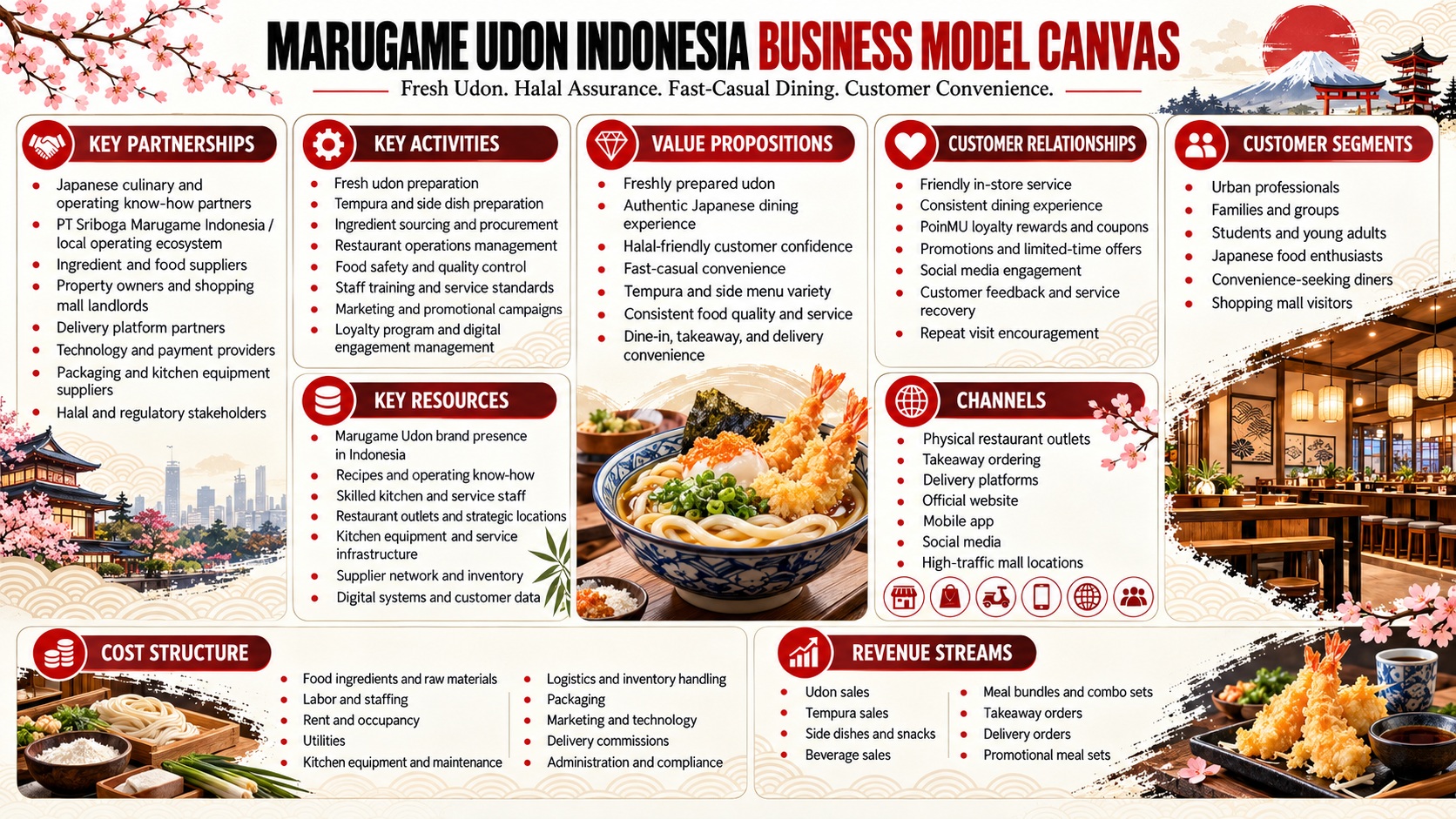
BMC Analysis of Marugame Udon
The detailed Murugame Udon Business Model Canvas examines how the company’s commercial proposition is supported by operational capabilities and customer relationships.
Each block contributes to the performance of the others.
A strong value proposition attracts customers, but appropriate locations determine accessibility. Efficient kitchens support service speed, while procurement and staffing decisions determine whether that service can be delivered profitably.
Digital loyalty may increase visit frequency, yet additional transactions only create sustainable value when restaurant capacity and contribution margins are managed effectively.
The following analysis evaluates each component individually before examining how the complete business model operates as one system.
1. Customer Segments
Marugame Udon serves customers who want Japanese food without the time commitment or expense commonly associated with premium Japanese restaurants.
Its audience extends beyond consumers who are already familiar with udon.
Urban workers may visit for a convenient lunch, while families may prefer the brand for its predictable food quality and comfortable restaurant environment.
Marugame Udon Customer Segments
| Customer Segment | Customer Needs | Strategic Importance |
|---|---|---|
| Urban professionals | Convenient, satisfying meals during working hours | Supports weekday transactions |
| Families | Halal assurance, variety and comfortable dining | Encourages group purchases |
| Students and young adults | Accessible Japanese food and promotions | Builds future customer loyalty |
| Japanese-food enthusiasts | Authentic flavours and freshly prepared udon | Reinforces brand differentiation |
| Convenience-oriented consumers | Takeaway and delivery access | Extends demand beyond dine-in |
Customer Segment Analysis
The most attractive customer groups are not necessarily those making the largest individual purchases.
Office workers may spend less per visit than families but return more frequently. Families may visit less often while generating higher transaction values through multiple dishes and beverages.
This distinction matters for marketing and outlet planning.
Restaurants near offices can emphasise speed and lunch convenience, while family-oriented mall locations can promote shared dining occasions and menu variety.
Marugame Udon should therefore evaluate customer lifetime value, visit frequency and transaction contribution rather than treating all customers as equally profitable.
A stronger understanding of these differences can improve promotion design, menu planning and restaurant-level performance.
2. Value Propositions
Marugame Udon’s central value proposition is delivering an authentic Japanese noodle experience through a convenient and approachable restaurant format.
Freshly prepared udon and tempura create product differentiation, while halal assurance and accessible dining environments help make the concept relevant to Indonesian consumers.
Marugame Udon Value Propositions
| Value Proposition | Customer Benefit | Why It Matters |
|---|---|---|
| Freshly prepared udon | Perceived freshness and product quality | Differentiates the core offering |
| Japanese culinary authenticity | Distinctive flavours and preparation | Strengthens brand identity |
| Halal assurance | Greater confidence for relevant consumers | Broadens market accessibility |
| Fast-casual service | Reduced dining time | Supports everyday meal occasions |
| Tempura and side dishes | Choice and meal personalisation | Increases perceived value and basket size |
| Consistent restaurant experience | Predictable quality and service | Encourages repeat purchases |
Value Proposition Analysis
The brand’s differentiation depends on combining product and experience.
Fresh noodles alone may not justify a higher price if service is slow or food quality varies between outlets. Similarly, convenient locations provide limited competitive advantage when the meal itself fails to meet expectations.
Halal positioning strengthens accessibility, but it should complement rather than replace the core Japanese culinary proposition.
The strongest value emerges when customers receive consistent freshness, satisfying flavour, convenient service and confidence in food preparation.
Marugame Udon must preserve this combination as its network expands.
Operational shortcuts that weaken freshness or consistency could undermine the very reasons customers choose the brand over cheaper alternatives.
3. Channels
Channels determine how customers discover, evaluate, purchase and receive Marugame Udon’s products.
Physical restaurants remain central because they provide both food distribution and the sensory experience of Japanese noodle preparation.
Digital channels extend accessibility and create additional customer engagement opportunities.
Marugame Udon Channels
| Channel | Role | Strategic Importance |
|---|---|---|
| Physical restaurants | Dine-in purchasing and brand experience | Core transaction and experience channel |
| Takeaway | Convenient off-premise consumption | Serves time-sensitive customers |
| Delivery platforms | Access to home and workplace customers | Expands geographical reach |
| Official website | Menu, location and promotional information | Supports customer discovery |
| Mobile application | Rewards, coupons and digital engagement | Encourages direct relationships |
| Social media | Product promotion and brand communication | Builds awareness and consideration |
Channel Analysis
Not every channel produces the same economic value.
Dine-in customers experience the brand directly and may purchase additional tempura or beverages. Delivery orders provide convenience but can involve platform commissions, packaging costs and reduced control over food presentation.
The official application offers an opportunity to strengthen direct engagement, although its commercial impact depends on customer adoption and active usage.
Marugame Udon should manage channels according to profitability and customer needs rather than transaction volume alone.
An effective omnichannel strategy allows customers to choose how they purchase while ensuring that each channel contributes positively to brand perception and operating performance.
4. Customer Relationships
Customer relationships influence whether Marugame Udon becomes an occasional dining choice or a regular meal destination.
The business builds relationships primarily through consistent food quality, convenient service, recognisable products and promotional engagement.
Its official loyalty application adds a more structured mechanism for encouraging repeat purchases.
Marugame Udon Customer Relationships
| Relationship Type | Details | Why It Matters |
|---|---|---|
| In-store experience | Efficient service and consistent preparation | Builds satisfaction and trust |
| Digital loyalty | PoinMU points and coupons | Encourages repeat engagement |
| Promotional campaigns | Limited-time offers and menu incentives | Stimulates purchase occasions |
| Social media engagement | Menu announcements and customer interaction | Maintains brand visibility |
| Customer support | Feedback and service issue resolution | Protects reputation |
Customer Relationship Analysis
Restaurant loyalty differs from loyalty to a digital platform.
Customers can easily switch between competing restaurants, particularly when several alternatives operate within the same shopping centre.
Marugame Udon must therefore earn repeat visits through a combination of food quality, convenience, price perception and positive experiences.
PoinMU creates opportunities to reward purchasing behaviour, but discounts should not become the primary reason customers return.
Excessive promotions can train consumers to delay purchases until discounts become available.
A more sustainable approach combines relevant rewards with menu discovery, personalised offers and consistent service.
The strongest customer relationship is created when the dining experience remains attractive even without promotional incentives.
5. Revenue Streams
Marugame Udon generates revenue primarily through food and beverage sales across its restaurant and off-premise channels.
The core udon offering attracts customers, while complementary products create opportunities to increase transaction value.
Marugame Udon Revenue Streams
| Revenue Stream | Details | Strategic Importance |
|---|---|---|
| Udon dishes | Core noodle products | Primary sales driver |
| Tempura | Individually selected side dishes | Increases basket value |
| Other side dishes | Complementary menu items | Broadens purchasing choices |
| Beverages | Drinks purchased with meals | Adds revenue per transaction |
| Meal combinations | Main dishes with complementary items | Supports bundled purchasing |
| Takeaway and delivery | Orders consumed outside restaurants | Extends customer occasions |
Revenue Stream Analysis
The most important distinction is between revenue growth and profitable revenue growth.
Selling more udon increases transactions, but the contribution from each order depends on ingredients, labour, packaging, discounts and channel-related expenses.
Tempura and beverages can improve transaction economics when customers add them to an existing purchase without substantially increasing service complexity.
Meal combinations may also increase perceived value, provided discounts do not eliminate the incremental contribution.
The Murugame Udon Business Model Canvas highlights the importance of average transaction value, purchase frequency and product-level profitability.
Management should evaluate which menu combinations generate attractive margins and which promotions merely shift demand from full-price purchases.
A sustainable revenue strategy should encourage customers to purchase more frequently and select complementary items while preserving the brand’s quality positioning.
6. Key Resources
Marugame Udon depends on physical, human and intangible resources that allow its Japanese restaurant concept to operate consistently.
The brand’s recipes and preparation techniques are important, but they must be supported by appropriate restaurant infrastructure and trained employees.
Marugame Udon Key Resources
| Key Resource | Details | Why It Matters |
|---|---|---|
| Brand identity | Established Japanese udon positioning | Supports recognition and trust |
| Recipes and know-how | Japanese preparation techniques | Preserves product differentiation |
| Restaurant network | Physical outlets and commercial locations | Provides customer accessibility |
| Kitchen equipment | Noodle preparation and cooking facilities | Enables operational consistency |
| Employees | Kitchen, service and management personnel | Delivers the customer experience |
| Supply chain | Ingredient availability and procurement capabilities | Supports quality and cost control |
| Digital infrastructure | Website, application and customer engagement systems | Enables loyalty and promotions |
Key Resource Analysis
Some resources become more valuable as the restaurant network expands.
Brand recognition can lower customer acquisition barriers in new locations, while established training processes can accelerate employee readiness.
Other resources create significant ongoing commitments.
Restaurant leases, specialised equipment and staffing requirements generate costs that must be supported by sufficient demand.
The most difficult capability to replicate may be the integration of Japanese preparation standards with efficient local execution.
Competitors can introduce noodle dishes, but consistently delivering the same experience across many outlets requires disciplined operational systems.
Marugame Udon should therefore invest in resources that strengthen repeatability, product consistency and restaurant-level productivity.
Expansion becomes sustainable when these capabilities develop alongside the physical network rather than being added only after operational problems emerge.
7. Key Activities
Marugame Udon’s key activities convert ingredients, labour and restaurant infrastructure into a consistent customer experience.
Fresh food preparation remains central, but the business must also coordinate procurement, service delivery, quality assurance and demand generation.
Marugame Udon Key Activities
| Key Activity | Details | Why It Matters |
|---|---|---|
| Udon preparation | Preparing and cooking noodles | Delivers the core product promise |
| Tempura production | Preparing complementary dishes | Supports variety and basket value |
| Procurement | Managing ingredients and supplies | Protects quality and availability |
| Restaurant operations | Ordering, service and daily management | Determines speed and consistency |
| Quality assurance | Food safety and preparation standards | Protects customer confidence |
| Employee training | Culinary and service capability development | Enables repeatable execution |
| Marketing and loyalty | Campaigns, rewards and promotions | Encourages demand and repeat visits |
Key Activity Analysis
The business must manage two competing operational priorities: freshness and efficiency.
Fresh preparation strengthens product differentiation but introduces requirements for skilled employees, equipment availability and production scheduling.
Preparing too much food creates waste. Producing too little during peak periods can increase waiting times and reduce customer satisfaction.
Effective demand forecasting is therefore commercially important.
Restaurant managers need to understand sales patterns by hour, day, menu category and location.
Standardised procedures can reduce inconsistency, while employee training helps maintain quality during busy periods.
The strongest operating model combines predictable processes with sufficient flexibility to respond to changing customer demand.
For Marugame Udon, operational excellence is not merely a cost-saving exercise. It is the mechanism through which the brand delivers its promise of freshness, convenience and consistency.
8. Key Partners
Marugame Udon operates within a network of commercial relationships supporting brand standards, ingredients, restaurant locations and customer access.
Its Indonesian operating structure is particularly important because the Japanese concept must be translated into a locally executable business.
Marugame Udon Key Partners
| Key Partner | Role | Strategic Importance |
|---|---|---|
| Japanese brand ecosystem | Recipes, brand identity and operating know-how | Preserves authenticity |
| Sriboga Group | Indonesian operating and business capabilities | Supports local market execution |
| Ingredient suppliers | Food ingredients and materials | Ensures product availability |
| Property owners | Mall and commercial restaurant locations | Provides customer access |
| Delivery platforms | Off-premise order distribution | Expands purchasing convenience |
| Technology providers | Payments, digital systems and applications | Supports operating efficiency |
Key Partner Analysis
Partnership quality directly affects the reliability of the customer proposition.
Ingredient suppliers influence freshness, consistency and food costs. Landlords determine location accessibility and rental economics, while delivery partners affect customer convenience and order profitability.
The relationship between the Japanese brand ecosystem and the Indonesian operator is especially significant.
Japanese culinary standards provide differentiation, while local operating capabilities support procurement, staffing, compliance and market adaptation.
The Murugame Udon Business Model Canvas demonstrates how international restaurant expansion depends on combining global brand knowledge with local execution.
However, reliance on external partners creates exposure to supply disruption, rental increases and changing commercial terms.
Marugame Udon should therefore prioritise supplier resilience, disciplined location agreements and transparent partner performance management.
Strong partnerships create competitive value when they improve consistency, efficiency and customer accessibility rather than simply reducing short-term operating costs.
9. Cost Structure
Marugame Udon operates a physical restaurant model with substantial fixed and variable costs.
Unlike digital businesses, additional restaurant capacity requires investment in premises, equipment, employees and operating infrastructure.
Profitability depends on managing these costs without weakening the food experience.
Marugame Udon Cost Structure
| Cost Category | Details | Why It Matters |
|---|---|---|
| Food ingredients | Flour, proteins, vegetables, broth ingredients and cooking materials | Determines food cost and quality |
| Labour | Kitchen employees, service teams and managers | Supports daily execution |
| Rent and occupancy | Restaurant leases and property-related expenses | Creates fixed-cost commitments |
| Utilities | Electricity, water and cooking energy | Supports kitchen operations |
| Equipment | Noodle machinery, cooking equipment and maintenance | Enables production |
| Logistics | Ingredient transportation and inventory distribution | Maintains supply availability |
| Marketing and technology | Campaigns, loyalty systems and digital operations | Supports acquisition and retention |
| Delivery-related costs | Packaging, commissions and order handling | Affects off-premise margins |
Cost Structure Analysis
Restaurant profitability is highly sensitive to sales volume and operational productivity.
Rent and core staffing costs continue even when customer traffic is weak. Consequently, outlets with insufficient transactions can struggle despite offering attractive products.
Ingredient costs create another challenge because maintaining quality may limit opportunities to substitute cheaper materials.
The business should focus on reducing avoidable waste, improving production forecasting and increasing sales per labour hour.
Menu engineering can identify products that combine customer popularity with attractive contribution margins.
The Murugame Udon Business Model Canvas reveals that expansion decisions should be based on unit economics rather than outlet numbers alone.
A smaller network of profitable restaurants may create more value than rapid expansion into weak locations.
Long-term cost discipline should therefore protect the brand’s freshness proposition while improving purchasing efficiency, labour scheduling and restaurant utilisation.
How the Nine BMC Blocks Work Together
The nine components of Marugame Udon’s business model form an integrated commercial system.
Customer segments create demand for convenient Japanese meals.
Value propositions convert that demand into a reason to choose Marugame Udon rather than competing restaurants.
Channels make the offering accessible through restaurants, takeaway and digital purchasing journeys.
Customer relationships encourage repeat visits through consistent experiences, promotions and loyalty incentives.
Revenue streams capture value through udon, tempura, beverages and complementary purchases.
Behind these customer-facing activities, key resources provide the brand, people, equipment and locations required to deliver the experience.
Key activities convert those resources into freshly prepared meals and reliable service.
Key partners support ingredients, operational knowledge, property access and distribution.
Finally, the cost structure determines whether the complete system creates sustainable financial returns.
The Murugame Udon Business Model Canvas demonstrates that a restaurant’s competitive position is not created by one successful product.
It emerges when product differentiation, operating capabilities, customer access and economic discipline reinforce one another.
For example, strong demand for udon can increase revenue, but insufficient kitchen capacity may produce longer queues and weaken customer satisfaction.
Likewise, aggressive discounts can increase transactions while reducing profitability.
Management must therefore evaluate the complete system rather than optimise individual blocks independently.
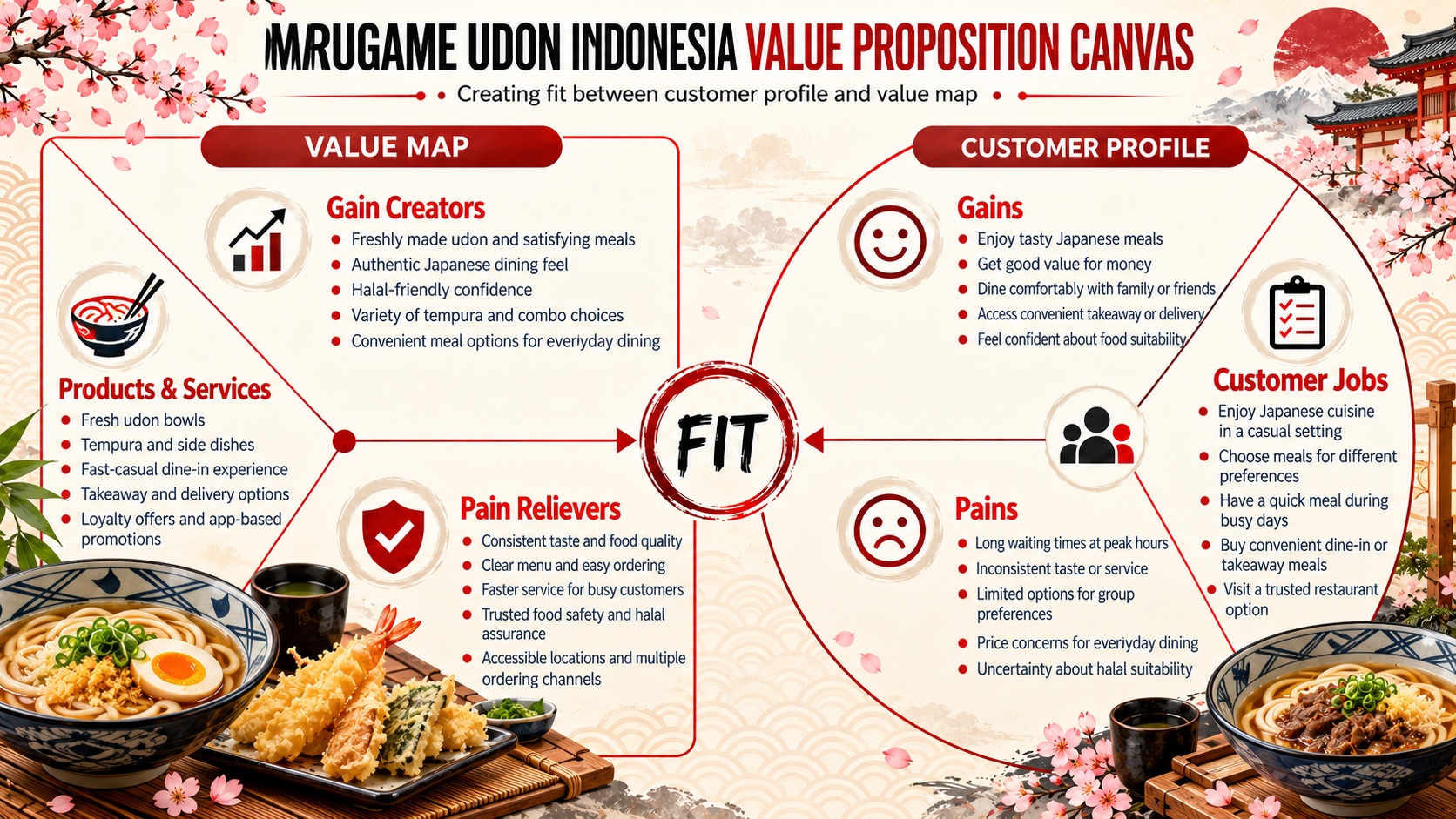
Value Proposition Canvas of Marugame Udon
The Value Proposition Canvas (VPC) provides a more detailed examination of how a company’s offering matches customer needs.
While the Business Model Canvas explains the complete business, the Value Proposition Canvas concentrates on the relationship between the Customer Profile and the Value Map.
For Marugame Udon, the central question is straightforward.
Why would an Indonesian consumer choose a Japanese udon restaurant instead of a local noodle shop, rice-based quick-service chain or another Japanese dining brand?
The Murugame Udon Business Model Canvas suggests that the answer lies in combining distinctive Japanese food with convenient service, product choice and local market accessibility.
Customer Profile
The Customer Profile identifies what customers are trying to accomplish, the difficulties they experience and the benefits they expect.
For Marugame Udon, the primary profile is an urban consumer seeking a convenient, satisfying Japanese meal.
Customer Profile of Marugame Udon
| Customer Profile | Details |
|---|---|
| Customer Jobs | Find a satisfying meal, enjoy Japanese cuisine, eat conveniently, dine with family or colleagues, and purchase food for takeaway |
| Customer Pains | Long waiting times, inconsistent food quality, limited menu choice, uncertainty about halal suitability, high prices and inconvenient locations |
| Customer Gains | Fresh food, authentic Japanese flavours, convenient service, menu variety, predictable quality and good perceived value |
Customer jobs include functional and emotional dimensions.
Functionally, consumers need a meal that fits their schedule and budget.
Emotionally, they may want to enjoy an international dining experience or share a pleasant occasion with family and friends.
A successful value proposition must address both dimensions.
Value Map
The Value Map explains how Marugame Udon’s products and services respond to those customer requirements.
Its offering is centred on udon and tempura, supported by restaurant operations, menu choices and customer engagement.
Value Map of Marugame Udon
| Value Map | Details |
|---|---|
| Products and Services | Freshly prepared udon, tempura, complementary dishes, beverages, dine-in, takeaway and digital loyalty features |
| Pain Relievers | Halal assurance, standardised preparation, convenient locations, efficient service and accessible menu choices |
| Gain Creators | Japanese culinary authenticity, visible preparation, meal customisation, satisfying flavours, product variety and rewards |
The value map shows why Marugame Udon should avoid competing exclusively on low prices.
Its differentiation comes from combining tangible product attributes with an identifiable dining experience.
Freshness supports food quality, while Japanese preparation techniques strengthen authenticity.
Convenient service makes the restaurant relevant to everyday meals rather than only special occasions.
The challenge is maintaining these benefits consistently as the business expands.
How Marugame Udon Creates Value Proposition Fit
Value proposition fit occurs when a company’s offering addresses important customer jobs, reduces significant pains and creates desirable gains.
For Marugame Udon, fit depends on delivering a distinctive Japanese meal without unnecessary inconvenience.
| Customer Profile | Customer Requirement | Matching Value Map | How Marugame Udon Creates Fit |
|---|---|---|---|
| Customer Jobs | Enjoy Japanese food conveniently | Udon, tempura and fast-casual service | Combines distinctive food with accessible dining |
| Customer Pains | Uncertainty about halal suitability | Halal assurance | Supports purchasing confidence |
| Customer Pains | Inconsistent meal quality | Standardised preparation | Creates predictable experiences |
| Customer Gains | Fresh, satisfying meals | Freshly prepared noodles | Reinforces product differentiation |
| Customer Gains | Greater choice | Tempura and side dishes | Allows meal personalisation |
| Customer Gains | Rewards for repeat visits | PoinMU and coupons | Adds incentives for returning |
Value fit is strongest when customers consistently receive the benefits they expect.
A convenient restaurant loses value when queues become excessive.
Similarly, attractive promotions cannot compensate for inconsistent food quality.
Marugame Udon should therefore measure customer satisfaction alongside operational indicators such as waiting time, repeat visits and product availability.
The Value Proposition Canvas ultimately shows that the brand must deliver freshness, authenticity, convenience and trust together.
Marugame Udon vs Yoshinoya vs HokBen: Business Model Comparison
Marugame Udon competes within Indonesia’s broader Japanese-inspired fast-casual restaurant market.
Two relevant competitors are Yoshinoya and HokBen.
Yoshinoya specialises in Japanese beef bowls and other rice-based meals, while HokBen offers a wider selection of Japanese-inspired bento meals, rice dishes and complementary products.
Both compete for customers seeking convenient, recognisable Japanese-style food.
The comparison focuses on the BMC blocks most relevant to competitive positioning rather than repeating all nine components.
Business Model Comparison
| Relevant BMC Block | Marugame Udon | Yoshinoya | HokBen |
|---|---|---|---|
| Customer Segments | Udon enthusiasts, urban diners and families | Beef-bowl consumers and convenience-oriented diners | Families, students and everyday meal consumers |
| Value Propositions | Fresh udon, tempura and Japanese noodle experience | Japanese beef bowls and convenient rice meals | Japanese-inspired meals, variety and familiar local positioning |
| Channels | Restaurants, takeaway, delivery and loyalty application | Restaurants, takeaway and delivery channels | Restaurants, takeaway, delivery and digital ordering |
| Revenue Streams | Udon, tempura, side dishes and beverages | Beef bowls, rice meals, sides and beverages | Bento meals, rice dishes, sides and beverages |
| Key Resources | Noodle preparation expertise, brand and restaurant network | Beef-bowl recipes, operating systems and brand | Established local brand, menu portfolio and operating network |
| Key Activities | Fresh noodle preparation, tempura production and service | Rice-bowl preparation and restaurant operations | Meal assembly, menu management and restaurant operations |
Strategic Comparison
The three companies compete within a similar dining category but emphasise different product propositions.
Marugame Udon’s differentiation comes from its specialised udon and tempura offering, supported by Japanese preparation techniques.
Yoshinoya focuses on convenient rice-based meals, particularly beef bowls, which can appeal to consumers seeking familiar and straightforward meal options.
HokBen offers a broader Japanese-inspired menu and benefits from its long-standing familiarity with Indonesian consumers.
The Murugame Udon Business Model Canvas suggests that the brand should protect its noodle-specialist identity rather than imitate competitors with increasingly broad menus.
Adding too many unrelated products could increase operational complexity and weaken the clarity of its positioning.
Instead, carefully selected innovations around udon, tempura, meal combinations and local flavour preferences may provide a stronger growth path.
Competitive Advantages
Marugame Udon possesses several advantages that help distinguish its restaurant concept from competing Japanese-inspired and local dining brands.
The Murugame Udon Business Model Canvas identifies five particularly important strengths.
-
Distinctive noodle specialisation: A clear focus on freshly prepared udon and tempura creates recognisable positioning and differentiates the brand from rice-based Japanese restaurant chains.
-
Japanese brand authenticity: Established recipes, culinary techniques and preparation standards support a credible Japanese dining proposition.
-
Halal market accessibility: Halal assurance helps the brand address an important consideration for Indonesian Muslim consumers while retaining its Japanese culinary identity.
-
Repeatable restaurant operating model: Specialised equipment, standardised processes and employee training provide a foundation for consistency across multiple outlets.
-
Growing digital customer engagement: The official application, PoinMU rewards and promotional channels create opportunities to strengthen repeat visits and customer relationships.
These advantages are most effective when they reinforce one another.
Japanese authenticity attracts interest, fresh preparation creates product differentiation, halal assurance broadens accessibility and consistent service encourages repeat visits.
Digital engagement can strengthen this cycle by keeping the brand relevant between purchases.
However, competitive advantages require continuous investment.
A specialised product becomes less distinctive if competitors replicate its quality, while operational inconsistency can weaken even a well-established brand.
Marugame Udon must therefore preserve its product identity while improving execution and customer engagement.
Risks and Challenges
Despite its established positioning, Marugame Udon faces commercial and operational risks associated with the Indonesian restaurant industry.
Five challenges are particularly relevant to the sustainability of its business model.
-
Intense restaurant competition: Japanese-inspired chains, local noodle restaurants and affordable quick-service brands compete for similar meal occasions, increasing pressure on pricing and differentiation.
-
Rising operating costs: Ingredient inflation, labour expenses, utilities and commercial property rents can reduce restaurant margins when price increases cannot be fully passed to customers.
-
Quality consistency during expansion: Maintaining noodle freshness, food safety, preparation standards and service quality becomes more complex as the restaurant network grows.
-
Delivery-channel profitability: Third-party commissions, packaging expenses and promotional discounts may reduce contribution margins even when off-premise sales increase.
-
Changing consumer preferences: Customers may shift towards lower-priced alternatives, healthier menu choices, different cuisines or newer restaurant concepts.
These risks can reinforce one another.
Higher costs may encourage price increases, but stronger competition can limit customers’ willingness to pay.
Meanwhile, efforts to reduce labour or ingredient expenses could weaken the freshness and service standards that differentiate the brand.
The strategic priority should be protecting restaurant-level profitability without compromising the core customer proposition.
Marugame Udon needs disciplined expansion, resilient procurement, effective menu management and continuous monitoring of customer behaviour.
Strategic Recommendations
Marugame Udon should build on its established strengths rather than pursue growth through restaurant expansion alone.
The Murugame Udon Business Model Canvas indicates that the most attractive opportunities lie in improving customer retention, strengthening unit economics, enhancing operational consistency and developing complementary revenue.
Future investment should prioritise initiatives that increase customer lifetime value while preserving the brand’s Japanese culinary identity.
1. Strengthen PoinMU as a Customer Retention Platform
Marugame Udon should develop its loyalty application beyond general promotional coupons.
The programme could encourage repeat purchases through visit-based rewards, personalised offers, birthday benefits and product discovery campaigns.
For example, customers who frequently purchase udon could receive incentives to try different tempura combinations.
Management should measure active members, repeat purchase frequency and incremental contribution margin rather than total app downloads alone.
2. Improve Restaurant-Level Unit Economics
Expansion decisions should be supported by a consistent financial performance framework.
Important indicators include sales per outlet, average transaction value, food cost percentage, labour productivity, occupancy cost ratio and operating contribution.
Restaurants with weak economics should receive targeted operational improvement plans before further expansion.
A disciplined approach can help ensure that network growth produces sustainable returns rather than simply increasing revenue.
3. Expand Menu Innovation Without Losing Specialisation
New products should complement the existing udon and tempura platform.
Potential innovations include seasonal broths, selected Indonesian-inspired flavours, vegetable-focused options and meal combinations designed for different purchasing occasions.
Every proposed menu item should be assessed against customer demand, ingredient availability, preparation complexity and contribution margin.
The objective is to create variety without turning a focused restaurant concept into an operationally complicated menu.
4. Optimise Dine-In, Takeaway and Delivery Economics
Marugame Udon should evaluate each purchasing channel independently.
Dine-in experiences can emphasise freshly prepared food and complementary purchases, while takeaway and delivery menus should prioritise products that maintain quality during transportation.
Delivery-specific packaging and carefully designed meal bundles may improve customer satisfaction.
Channel profitability analysis should account for commissions, discounts, packaging and operational handling costs.
5. Build a Data-Driven Restaurant Operating Model
The company should use transaction and operational information to improve restaurant performance.
Sales forecasting can support ingredient preparation, inventory replenishment and labour scheduling.
Customer purchasing patterns can also inform menu combinations and promotional campaigns.
For example, identifying peak demand for specific udon varieties could reduce stockouts and food waste.
Technology investment should be measured against tangible improvements in service speed, waste reduction, customer satisfaction and profitability.
6. Strengthen Supplier Resilience and Local Procurement
Reliable ingredients are essential to the freshness proposition.
Marugame Udon should evaluate opportunities for qualified local sourcing where product quality and Japanese preparation standards can be maintained.
Diversifying critical suppliers could reduce exposure to disruption, while stronger demand forecasting may improve procurement efficiency.
Supplier performance should be assessed against quality, consistency, availability, food safety and total cost rather than price alone.
7. Expand Selectively Into High-Potential Markets
Future restaurant development should follow customer demand and location economics.
High-traffic malls, office districts and established residential-commercial areas may offer different opportunities depending on customer purchasing patterns.
Before committing to new locations, management should evaluate catchment demographics, competitor density, expected transaction volume, rental commitments and operating capacity.
Smaller restaurant formats could also be tested where demand exists but conventional outlets are economically unattractive.
Expansion should remain a consequence of a proven operating model rather than the primary measure of success.
Conclusion
The Murugame Udon Business Model Canvas demonstrates how a specialised Japanese restaurant concept can establish a differentiated position within Indonesia’s competitive foodservice market.
Its business model combines freshly prepared udon, tempura, Japanese culinary authenticity, halal market accessibility and efficient restaurant operations.
These elements create a proposition that appeals to customers seeking a distinctive yet convenient dining experience.
However, product differentiation alone does not guarantee long-term profitability.
The business must continuously align its restaurant locations, employee capabilities, procurement systems, customer relationships and operating costs.
Digital initiatives such as PoinMU provide additional opportunities to strengthen retention and encourage repeat purchases, but their value depends on measurable commercial outcomes.
Competition from Yoshinoya, HokBen and local foodservice operators reinforces the importance of maintaining a clear brand identity.
Marugame Udon should avoid excessive menu diversification or expansion that compromises its specialised positioning.
Instead, its future growth should focus on operational excellence, selective menu innovation, customer loyalty, channel profitability and disciplined restaurant development.
The broader business lesson is that successful international expansion requires more than transferring a recognised product into a new market.
Companies must preserve what makes their offering distinctive while adapting the supporting business model to local consumer expectations and economic conditions.
For Marugame Udon, sustainable competitive advantage will depend on delivering Japanese freshness and convenience consistently, profitably and at scale.
Disclaimer
This article is intended solely for educational, informational and business analysis purposes.
The content is based on publicly available information, industry observations and independent strategic interpretation. It is not an official publication, statement, endorsement or representation of Marugame Udon, PT Sriboga Marugame Indonesia, Sriboga Group, Toridoll Holdings Corporation, Yoshinoya, HokBen or any other company mentioned.
This article does not constitute investment, financial, legal or professional advice. Readers should conduct independent research and consult qualified professionals before making business or investment decisions.
All company names, brand names, trademarks, logos, images and copyrighted materials belong to their respective owners. Any references are used solely for identification, commentary, comparison and educational purposes. No ownership, affiliation or endorsement is implied.
Business operations, products, prices, financial performance and market conditions may change. Certain strategic observations and recommendations represent analytical interpretations rather than verified company plans.
Meta Description
Explore the Murugame Udon Business Model Canvas, nine BMC blocks, Value Proposition Canvas, competitor comparison, risks and 2026 strategic insights.

